Starting to look at this exercise has fortuitously coincided with me reading Andrews (1999) (which I have to confess I have found a bit heavy going at times; it comes across in places as a bit too earnestly academic for my taste) so I have been thinking about some of the conventions in landscape paining, in particular, and already exploring the possibility that some of the thoughts that I expressed in Exercise 1.1 (https://markrobinsonocalandscape.photo.blog/2019/08/21/exercise-1-1-preconceptions/) already might be in need of some revision or development.
As a starting point I have simply chosen (as it turns out) thirteen different artists from the 18th and 19th centuries. The choice is not entirely random, although I have not selected these artists on the basis of any preconception of what elements and conventions I might find. Rather I have simply stuck to artists with whom I already have some degree of familiarity, whose works I have seen in the flesh as well as in reproduction, and who feature in some of the books that form part of my personal library (an admittedly partial and idiosyncratic selection, which are all referenced below). Most are British, three are American (members of the Hudson River school with whose works I developed some familiarity over the years on trips to the States and visits to, in particular, the MFA in Boston, and the Metropolitan in New York – the works that I have chosen for these artists are ones that I have seen in the flesh), and one German.
At this stage I have not given too much thought (though I do have a couple of ideas already) about photographic analogs as I want to see how this part of the exercise pans out first.
The choice of actual paintings is a little more random and mostly comes down to familiarity. I have deliberately avoided the French schools, as I am not sufficiently familiar apart from some of the Post-Impressionist, such as Monet, Dufy, Cezanne, whose work I do not really want to discuss anyway. Similarly I have avoided the Dutch/Flemish schools, mostly as their heyday really dates back to the previous century and so falls outside the stated scope of this exercise.
So here is my list of artists and chosen works, that I will then have a look at and comment upon individually:
Thomas Gainsborough, 1727-88: Mountain Landscape with Shepherd, 1783.
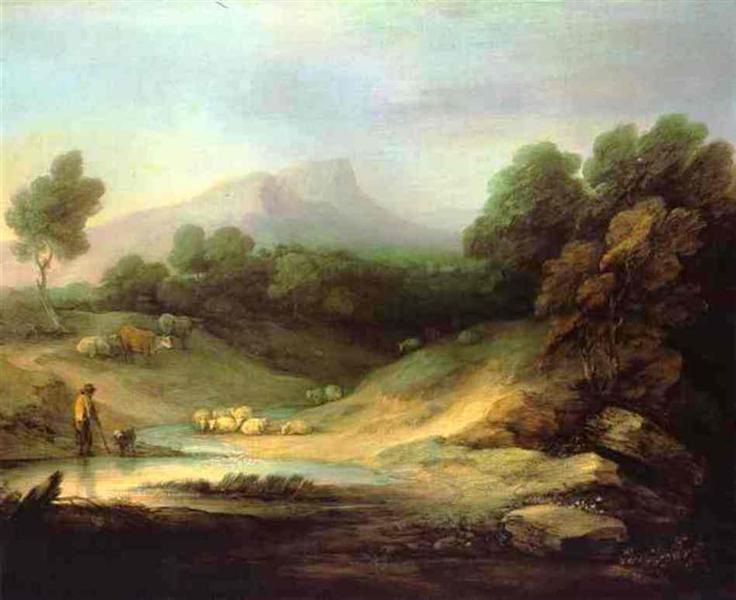
A common theme in English landscape painting of this period in particular (though Caspar David Friedrich did something similar in some of his more bucolic, less melodramatic paintings) was nature as a realm of agriculture. Not wild country but productive land. We have it here and again in the Samuel Palmer below. I guess that it is about ownership of the land but although the owner is not identified it is clearly not the pictured peasants. It also conforms to the predominant practice of the time of being a studio piece, not painted outdoors. It is also a concoction or confection not a representation of a real place (as is also the case with the Church below). Indeed I understand it was actually painted from a model that Gainsborough constructed out of odds and ends. Why he painted it I have no idea.
Francis Towne, 1740-1816: Rocks and Trees at Tivoli, 1781.
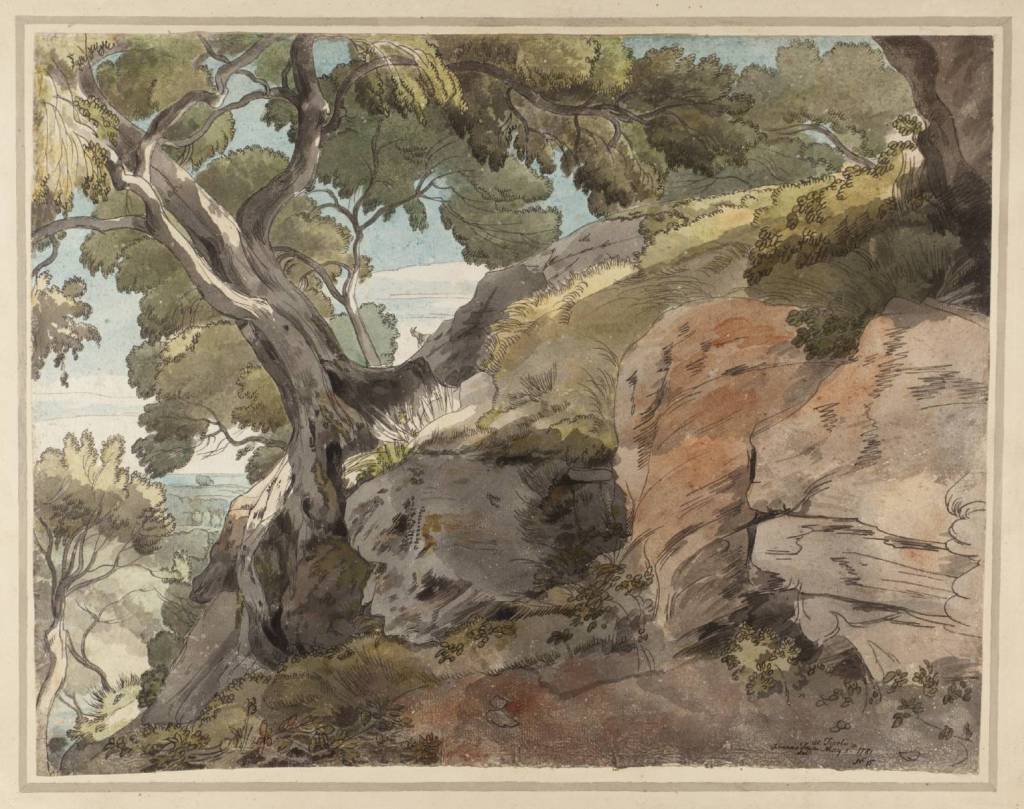
Painted in watercolour, in the open air, while on the Grand Tour, this was I suppose the equivalent of a modern holiday snapshot, a capturing of a picturesque scene, emphasising the wildness and ruggedness of nature even though within a broader managed and artificial environment.
John Robert Cozens, 1752-99: The Cloud, c. 1785.
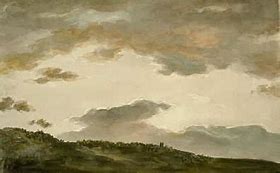
Another watercolour, again evidently painted outdoors, part of what strikes me as an important strand in landscape painting, the natural and realistic portrayal of nature and natural phenomena. Turner paid close attention to meteorology, although the ends results are more often than not rather stylised, as did Constable. Paradoxically the result is sometimes rather more abstract than purely representational.
Thomas Girtin, 1775-1802: Durham Cathedral and Bridge, 1799.
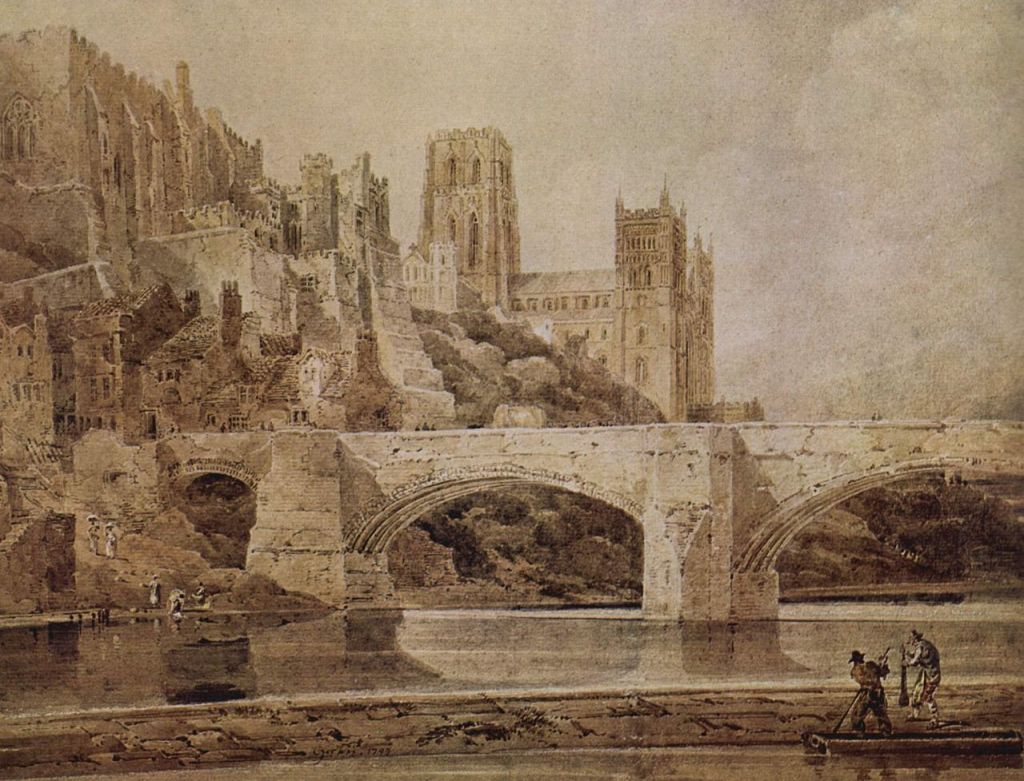
Another watercolour and one in a line of what I regard as more purely topographical records. Chosen partly because I know this view very well, but also because Girtin was born locally to where I live, just a little further west along the Tyne Valley at Haydon Bridge. Rather than being an imaginative work of art this is more of a documentary record of a particular place. It also happens to be a pretty spectacular site, and sight, so is, I suppose, still conforming to ideas of the picturesque. As with many pictures from this time there are again figures in the scene. Partly they give a sense of scale. Otherwise they seem to me to emphasise a sense of separateness from the world of the cathedral and the castle and the ordinary working people. For them this is not a picturesque, tourist, place but where they live and work. (This view has not changed much at all in the last two hundred years or more!)
JMW Turner, 1775-1851: Durham, 1834-5.
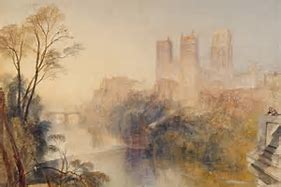
Same subject but different viewpoint, again part of Turner’s record of his travels throughout the North. What sets this apart though is the emphasis more on atmosphere and grandeur rather than a purely representational portrayal of the place. As with a lot of Turner what takes precedence here is the effect of light and atmospherics, producing something more intentionally “beautiful”, in the sort of way that Claude Lorrain lit his work.
John Constable, 1776-1837: The Hay-Wain, 1821.
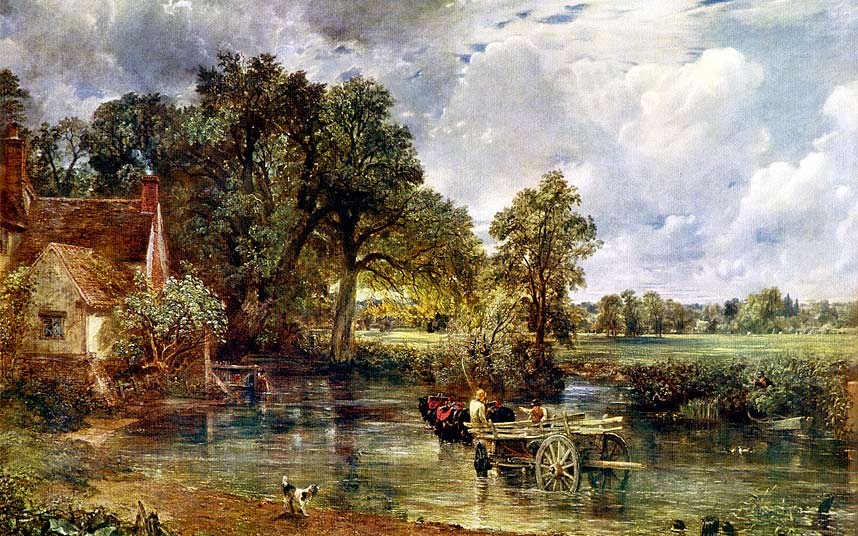
I guess there needs to be at least one well-known picture in this list, so this might as well be it. The significant elements for me in this are, again, observation of meteorology – I think Constable did it better in some of his cloud sketches but this nevertheless has the feel of a real sky, even though the picture was painted – constructed? – in the studio. At least though it is a view of a real place, albeit an idealised view. Once more also, there are people in the view emphasising that this is an environment that is lived in and worked; it is not raw nature but a managed, even manicured – just look at the parkland beyond the stream – landscape. But, yet again, and by no means for the last time, the lowly nature of the peasants emphasises their ties to the land without ownership of it. It is also a strangely apolitical (or perhaps not given Constable’s quite reclusive nature – “Though I am here in the midst of the world I am out of it-and am happy-and endeavour to keep myself unspoiled. I have a kingdom of my own both fertile & populous-my landscape and my children-“) and offers no hint of recognition of the dire state at the time of the English agricultural economy.
It is not really about conventions but one thing that has always puzzled me about this picture is why the wagon is moving along the stream rather than across it. Compositional impact rather than reality? Although “realistic”, in the sense of being a depiction of an actual place, this is by no means a reliable record of the actuality of rural life at the time.
John Sell Cotman, 1782-1842: Drop Gate , Duncombe Park, 1806.
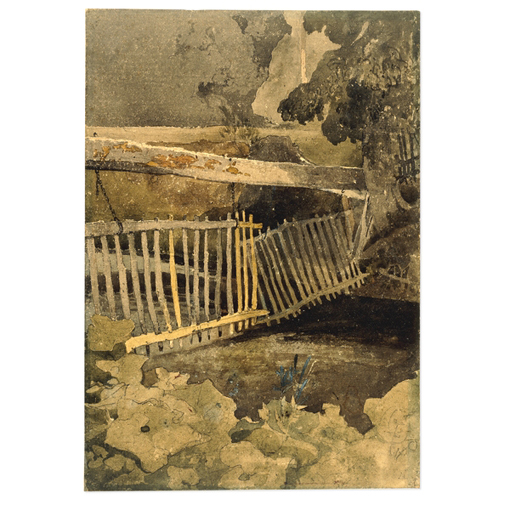
I have to confess to having chosen this picture not just because I love Cotman’s work – in the days when I struggled with watercolour myself, a much more difficult medium to use properly than any other in my view, Cotman was a continual inspiration, and indictment of my own efforts – but because of the political message that it carries and how it comes with my own thinking, and work, of late. Rather than helping form conventions, in some ways this piece subverts them. Note that it is in portrait rather than landscape orientation. This I find quite interesting. A landscape format would place more emphasis on the barrier. Adopting a portrait format gives more hints (nothing more because the rest of the picture is quite sketchy) of a sense of land that is accessible – the bottom/foreground – and what is not – the top/background. Does this, perhaps counter-intuitively, give greater emphasis to the sense of barrier and exclusion?
This is not about the land but about its ownership. You do not see the surrounding land, just the physical means by which your access to it is denied. This is “landscape with keep out sign”.
This is one image that I chose from the outset with a photographic analog in mind, which I will come back to in the next post, though I have for a practical reasons as much as anything, chosen a different format and concentration on the physicality of the barrier.
John Martin, 1789-1854: Manfred on the Jungfrau, 1837.
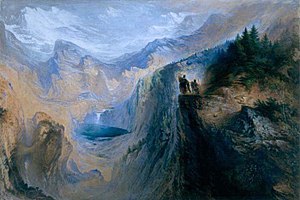
Another local, which is as good a reason as any for choosing Martin, though I have deliberately shied away from his more bonkers, apocalyptic, quasi-biblical extravaganzas (of which the Laing Art Gallery in Newcastle, as is fitting for a local lad, has a fine collection). This is at least a real place, though I doubt whether it is an accurate view of anywhere on the mountain and is rooted more deeply in Martin’s imagination and reading of Byron’s poem. Although not as extreme as most of the rest of his work this is, I suppose, an exercise in the Sublime, a landscape to shock and awe, that emphasises the smallness, the powerlessness and vulnerability, of humanity in the face of the enormity of the natural world.
Samuel Palmer, 1805-81: Moonlight, a landscape with sheep, 1831-3.
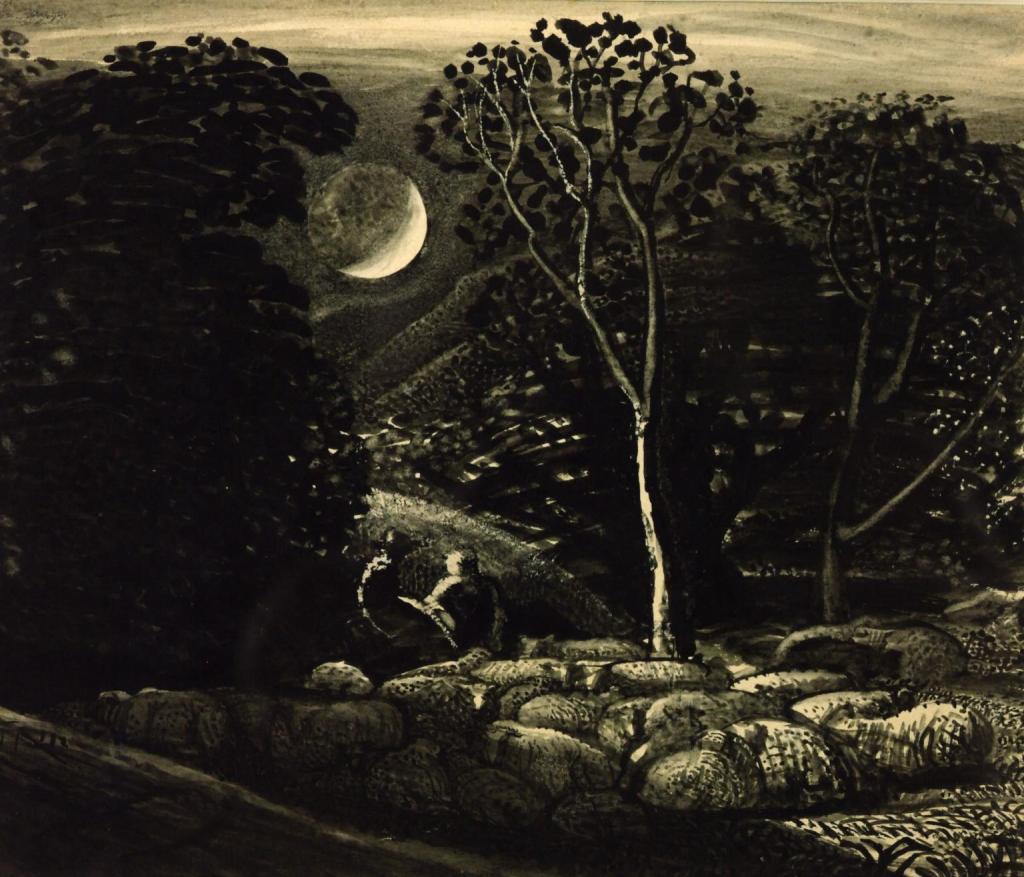
A contrasting moment of calm and serenity, ostensibly at least, but one that carries with it other implications. In a way this is not really a landscape at all. It is not about a particular place. Indeed there is not much to be seen apart from a few trees and hints of hills in the middle distance. Rather it strikes me as more of a “nocturne”, a study of a particular time, nighttime. As with the Gainsborough at the start of this list, and various others throughout, this is more about the relationship between the countryside and the people who lived and worked upon it without owning it. Here the shepherds do not even have a shelter for the night but are sitting out in the open watching their sheep. In some ways this is, for me, quite a shocking image. The “great outdoors” is the natural environment of animals, in this case the sheep. They exist in, on, and in harmony with, the land. Humans, as we have evolved, do not. We are no longer in our element unsheltered in nature. In a way, because this is not their natural environment, the shepherds depicted here are worse off, are lower in the “natural” order of things, than the sheep.
In terms of establishing conventions I think this is a bit of an outlier. What it does do, at least, is to show that a landscape does not necessarily have to be depicted in broad daylight. I guess this is something that Monet (whom I was not otherwise going to talk about!) did with some of his “series” paintings, such as the haystacks and Rouen cathedral.
Caspar David Friedrich, 1774-1840: The Oak Tree in the Snow, 1829.
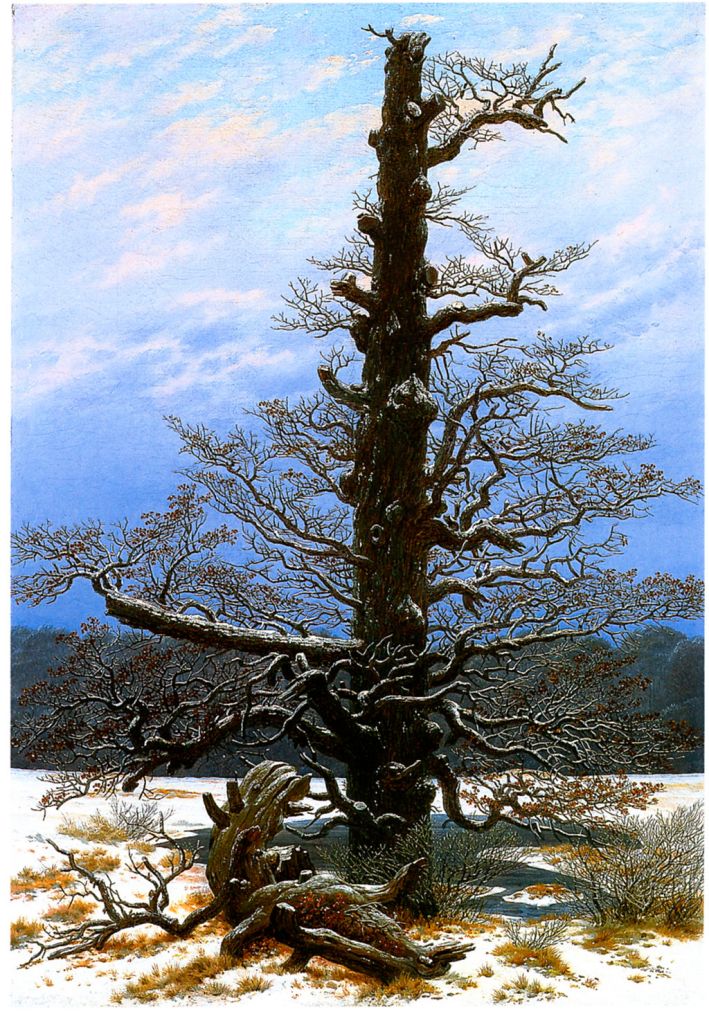
Another fairly bonkers painter (though not to the same extent as Martin) whom I guess we will look at a bit more in considering the Sublime. I have chosen this particular work because it shows how “landscape”, at least in artistic terms, can be reduced to, or more properly represented by, a single element within an environment. It is also another that I chose with a photographic analog in mind, of which more anon. Friedrich painted a number of pictures where a tree, or small group of them, are the central subject. This one though stands out as being one where the tree is the sole subject, where there is very little, if any, background. Where the tree, if it was a real tree rather than an ideal, romanticised idea of a tree, was is not important her, indeed is pretty irrelevant.
Thomas Cole, 1801-48: View from Mount Holyoke, Northampton, Massachusetts, after a Thunderstorm – The Oxbow, 1836.
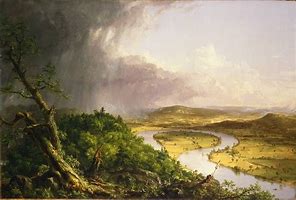
These next three paintings are interesting to me because although they are of the New World, and as a result one might expect a suitably new form of representation, they are in fact quite Old World in style and composition. The Cole, with its particular sense of light, reminds me of Claude Lorrain and carries well established ideas of the picturesque, the beautiful and the sublime. There is the common trope of man taming the wilderness and making it profitable: the gentle farm land of the valley has presumably been wrested from the wilderness that still covers the hills to the left. Now though, instead of shepherds tending their sheep, we have the artist himself, towards the bottom right, taming the view. This seems to me part of the white man’s programme of colonisation of the continent.
Frederic Edwin Church, 1826-1900: Heart of the Andes, 1859.
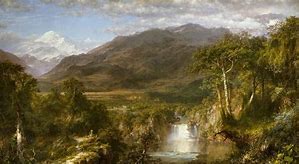
Church takes that colonisation a step further by extending it not just to the North American hinterland but to the southern continent as well. It is not very clear in this example but there is a cross and a couple of figures towards the bottom left, emphasising that this is a Christian colonisation . Again the scene itself is made up.
Albert Bierstadt, 1830-1902: The Rocky Mountains, Lander’s Peak, 1863.
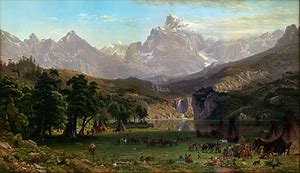
More colonisation her, this time back in the North. Although the depiction of the native Americans in the foreground is an acknowledgement that this is their land the colonisation is already well under way as the mountain in the distance already has a white man’s name. Rather chillingly Hughes (1997) (at page 195) quotes Bierstadt as saying that one day in the foreground of this scene “a city, populated by our descendants, may rise and in its art galleries this picture may eventually find its resting place”.
These three paintings also have in common that they were commercial, money making enterprises, painted on a grand scale and toured and exhibited by the artists, another way of making the landscape productive and profitable, without the necessity of sheep.
So far as I can tell, none of the pictures in my list above were the subject of commissions. I do not doubt though, particularly in the case of the Americans, that they all had a shrewd idea of what was likely to sell (except for the Cotman and Towne perhaps, and maybe the Palmer, as these seem to me much more personal works).
Next I will have a look at some photographs that were influenced by these painterly conventions.
Andrews, M, (1999). Landscape and Western Art. Oxford: Oxford University Press
Hooker, D, (ed), (1989). Art of the Western World. London: Boxtree
Hughes, R, (1997). American Visions. London: The Harvill Press
Lyles, A, & Hamlin, R, (1997). British Watercolours from the Oppé Collection. London: Tate Gallery Publishing
Paris, L, Fleming-Williams, I, & Shields, C, (1976). Constable Paintings, Watercolours & Drawings. London: Tate Gallery Publishing
Rajnai, M, et al., (1982). John Sell Cotman. London: Arts Council of Great Britain
Shanes, E, (1979). Turner’s Picturesque Views in England and Wales 1825-1838. London: Chatto & Windus
Wilton, A, & Lyles, A, (1993). The Great Age of British Watercolours 1750-1880. London: Royal Academy of Arts & Munich: Prestel Verlag
 Mark Robinson's OCA Landscape, Place & Environment Blog