I am going to start this brief survey of photographic analogs of conventional landscape paintings by turning it on its head and ask to what extent might the advent of photography actually have influenced painting?
I have in mind Henry Fox-Talbot in particular. His writings on “The Pencil of Nature” and his ideas about “photogenic drawing” suggest to me he was well aware of and influenced by a number of existing conventions of painting, and not just of landscapes. What though I feel is revolutionary about some of his work, specifically the haystack photos, is the introduction of the idea of a series capable of showing related scenes at varying times. This prefigures Monet’s series paintings decades later so it is interesting to speculate about whether Monet was aware of Fox-Talbot’s work from the 1840s and saw that he could apply the same principles to landscape painting.
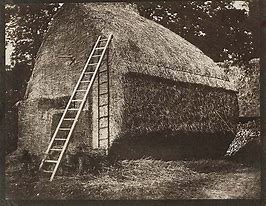
Leaving that aside for now, it strikes me that this could turn out to be quite an extensive exercise and that any number of examples of photographs informed by painting conventions could be cited. For now though I am going to focus on just a few examples, without, for example, trying to find an analog for each single painting in the first part of this exercise. It could though be something of a dynamic exercise and it might be worth adding and expanding as time goes on and more examples come to light. Once more the selection that I am going to put forward now is very partial and somewhat idiosyncratic, for which I make no apologies.
Also, as the brief is pretty wide, I am going to be cheeky and include a couple of my own images that might have some relevance, one taken a while ago and one that I have just made as part of the process of working on the exercise as a whole.
Gustave le Gray, The great wave, Sete, 1857
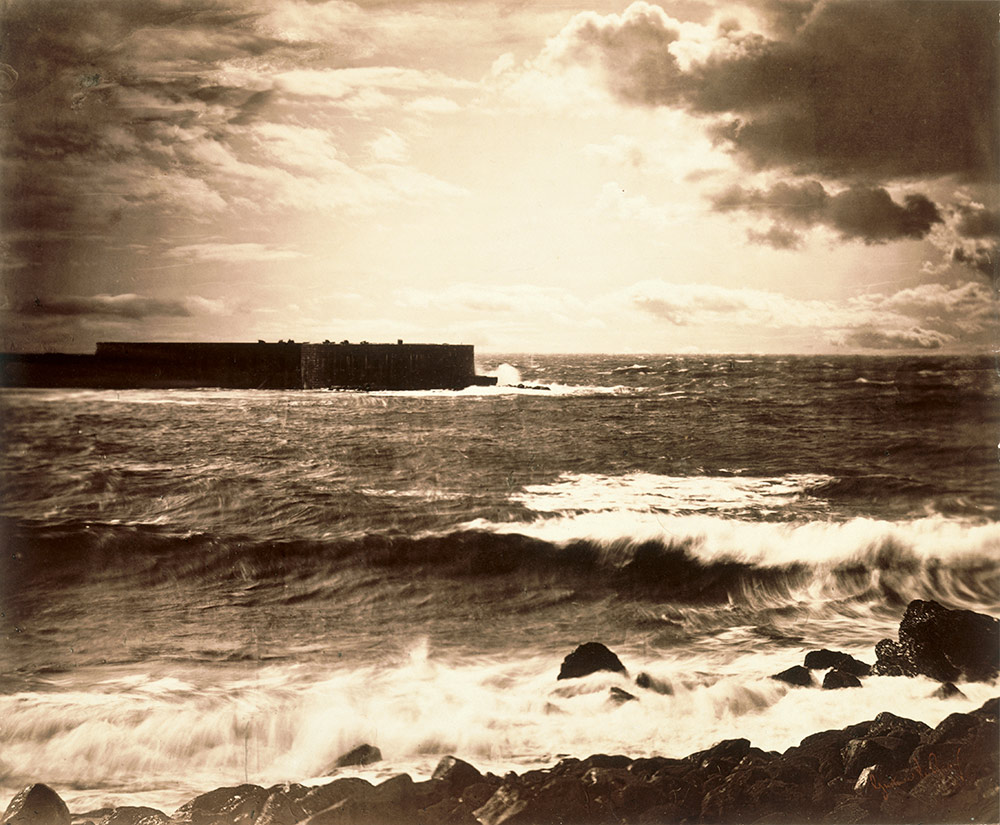
I did not know much about le Gray until I came across him in Warner Marien (2014) but I think he offers a useful starting point with this dramatic, indeed painterly, sea and skyscape. The light is very Claude Lorrain. It is also interesting that this image has been created in a way similar to a painting, in that it is made up of separate elements to creat on overall effect: he used separate negatives to print the sky and the sea.
Alfred Buckham, Aerial View of Edinburgh, c. 1920
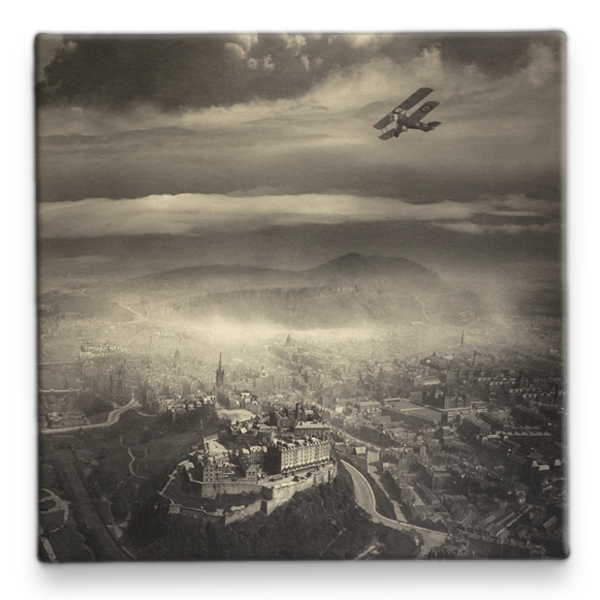
Another constructed image, taking a recognisable, actual place, and embellishing it to create something new. I first saw this at the Scottish National Portrait Gallery in Edinburgh, which has a fine photography collection, and was struck by the way multiple negatives have been used to create an idealised view of the city. I am not sure how many there were but it looks like two or more just for the sky, another for the added aeroplane (the same one crops up in some of his other pictures) and separate ones for the city and castle, and for Arthur’s Seat in the middle-ground.
Alfred Stieglitz, Equivalent, 1930
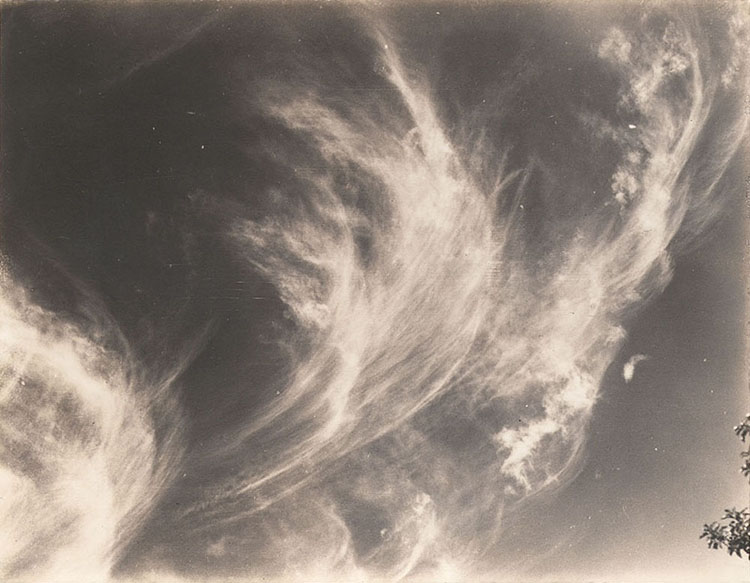
As with Constable’s cloud sketches and Cozen’s meteorological studies, Stieglitz is here simply observing natural phenomena but is similarly, in fact even more so, presumably deliberately, producing something much more abstract.
Anselm Adams, Rac Lake, Kings River Canyon, 1936
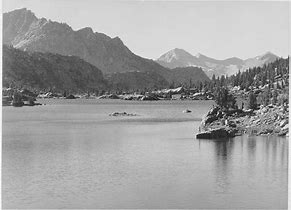
Given the nature of his work just about anything and everything that Adams produced must at one level or another have been influenced by the conventions of landscape painting. For present purposes I have chosen one of his National Park Service photos. )I could have chosen any number of other possible examples but this one seems to fit quite well with the points I want to make.) In common with, for example, Cole, Church, and Bierstadt, we have an impressive, expansive view, one that is given a sense of scale by the small figures on the spit off land towards the right side of the picture. Although it is not immediately obvious, and once again this is unfortunately not a very good example of the photo – it is probably better simply to look up any and all of the examples that I have chosen on Bing (which I tend to use) or Google Images – these tiny figures are emblematic of a new use, a new ownership, and new economic value of nature. Instead of being indigenous inhabitants living in idealised and innocent, almost prelapsarian harmony with the land, nor peasants labouring for a living, this is a new economy, that of tourism. Adams pictures for the NPS were of course, at one level, intended to publicise the natural landscapes preserved within the parks and promote tourism. There is though still a sense of a colonial enterprise at work: this landscape was once “owned”. at least inhabited by, indigenous peoples. Now it is “owned” by the US Government, under the benign stewardship of the NPS. (I do not want to mock or denigrate the work of the NPS, having benefited from their very existence and the work they do on visits to a few national parks, particularly in the US South West. Without them this is a danger many of these truly wonderful landscapes could have been exploited, desolated, and ruined. That though does not take away from the underlying colonialist enterprise of land management throughout the North American continent.)
Jeff Wall, A Sudden Gust of Wind (after Hokusai), 1993
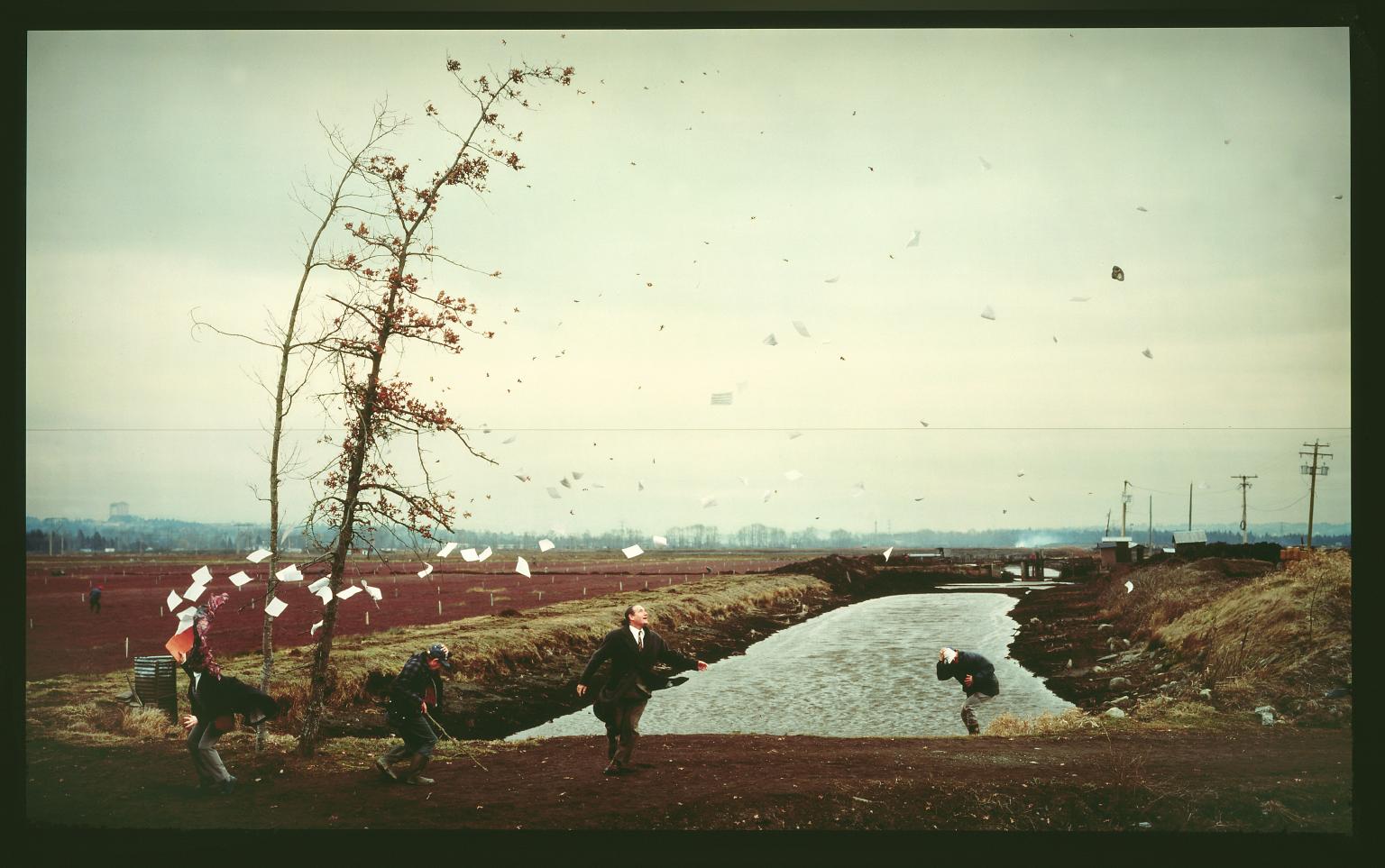
With this next one, the last for now, I realise I am pushing the envelope more than just a bit but nevertheless I think this is an interesting example of photography being influenced by the conventions of landscape painting and using them as an inspiration or jumping-off point.
I am perhaps using the breadth of the brief (which does not in all fairness restrict us to any particular artistic culture) in so far as Wall’s photo here is influenced not by any European or American artist but by the Japanese ukiyo-e painter and printmaker Katsushika Hokusai (1760-1849, so at least he falls within the time period specified by the brief!), best known for his picture of the great wave. This photo is based on one of his Thirty-six Views of Fuji-san, Travellers Caught in a Sudden Breeze at Ejiri. Although Japanese I do think the underlying image does share some things in common with Western landscape painting, not only as well as a sense of a particular place but also of a particular time, the passage of time, and recording of meteorological phenomena. Funnily enough though when I look at Wall’s picture I think more of Dutch paintings of the 17th century, such as that of Jacob van Ruisdael: there is the wide, flat landscape, the expansive sky which takes up two thirds of the composition, the sense of time and weather, and water – the channel here is reminiscent of the channels and dikes of Dutch fields, polder, reclaimed from the sea. What I suppose sets this piece apart from van Ruisdael, and links it more firmly to Hokusai, is the prominence within the landscape of the people. In contrast to the use of figures in Western landscape painting of the same time period there does not appear to be quite the same concern in Hokusai’s work of suggesting an economic, or at least amenity, value in the underlying environment being demonstrated by the presence and activities of the people.
And now two examples of my own work. The first, an image of a dead tree, was an early film experiment with my 4×5 large format camera (cropped down to focus on the main element and to emphasise the verticality of the subject, as did Friedrich):
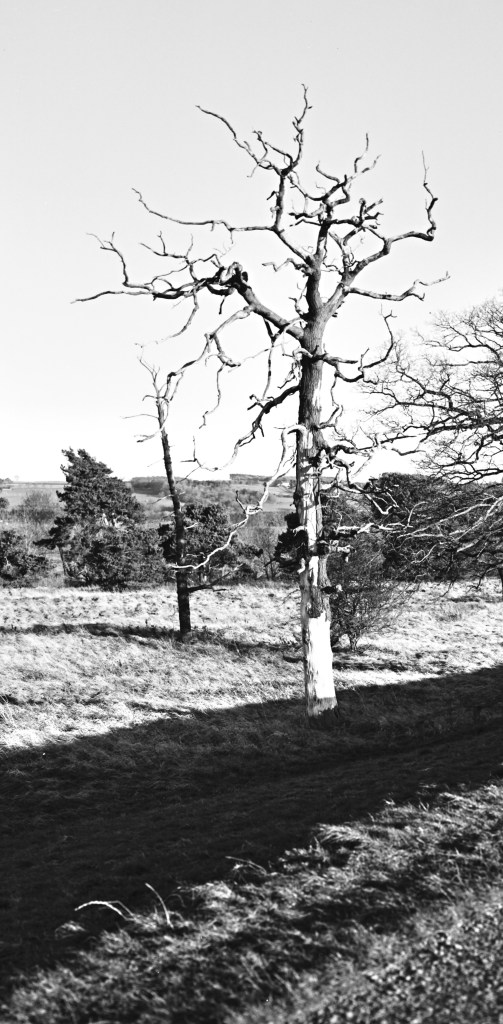
At least in retrospect there is an obvious analog with Caspar David Friedrich’s painting of a tree that I used as an example in the first part of this exercise. When I took this shot, in late December 2017, I did not consciously have Friedrich in mind. Nevertheless I do not doubt that he, and any number of other artists, were there at the back of my mind, beavering away in my unconscious, influencing my very conscious decision to seek out this particular dead tree as the subject for a photograph. I suppose it is inevitable that after a lifetime of looking at art (albeit not professionally, after all I was just a lawyer) my own artistic endeavours will have been, and continue to be, affected and influenced by the work of others.
The next one though was made deliberately and with this exercise in mind. I have written elsewhere (particularly in the context of the last assignment for I&P) about the work of Fay Godwin and how, back when I was working on EYV, I made an homage, a response, to one of her works. Of course this crops up again in Exercise 1.1 in this module. For the purposes of this exercise my starting point is the Cotman in the first part. The sort of drop gate that he depicted is still quite common round here, used as a barrier and in lieu of a fence over streams and rivers. The burn along which I walk almost every day with my dog has a few of these wherever it flows into, or out of, bits of privately owned land. As will already be apparent I am not keen on this sort of boundary and it irks me all the more here because the ‘owner’ of the land does not ‘own’ the burn itself. It is a quirk of English law that a landowner does not necessarily own a watercourse that flows through the property. All this might be owned is what are known as riparian rights, which allow certain uses of the water, such as the right to extract water, or to fish within it. It is, for example, not unheard of for an owner of land along the bank of a river not to own the right to fish in the river. (It gets complicated sometimes!) So the idea of a physical barrier over something that the landowner does not necessarily actually own is not something I am particularly comfortable with! With this in mind, here is my homage to Cotman:
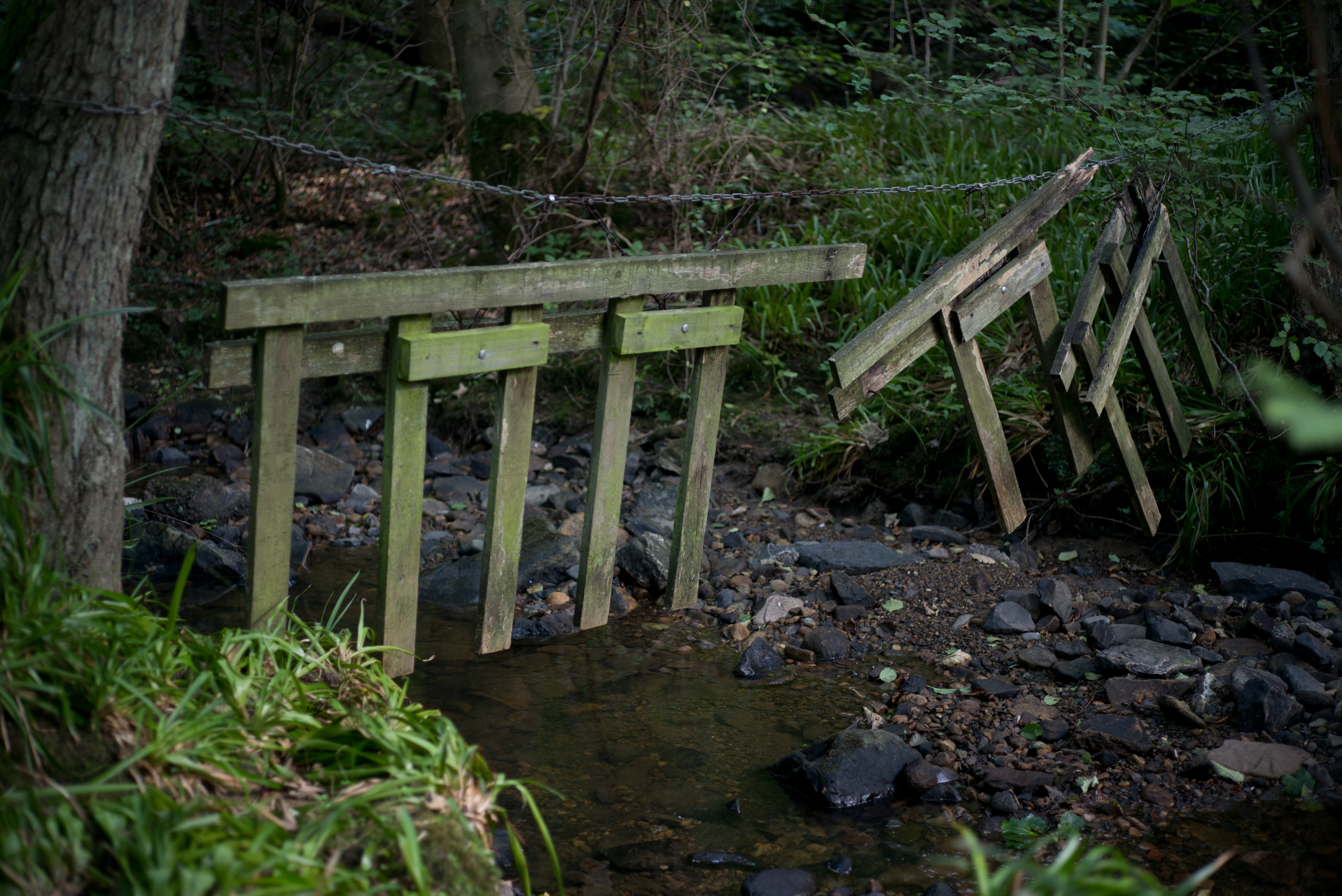
Quite fortuitously this drop gate echoes that in Cotman’s painting in that it is in two main parts, one of which is hanging at an angle. In contrast to the painting though I have adopted a landscape rather than portrait format. Partly this is a matter of pragmatism: it would have been physically difficult to get into a position that would have offered a similar view to Cotman’s and give a portrait view. In addition, in Cotman’s painting there is more open land in the background. Here is quite wooded at sits at the bottom of quite a steep slope in the background so there is no similar sense of openness denied. I therefore decided to focus more directly simply on the physicality of the barrier. That was in turn aided, quite by chance, by the light conditions – this bit of the burn is heavily shaded – which meant that in order to achieve a shutter speed of at least 1/60s, as I did not have a tripod with me at the time, I had to use a very shallow depth of field – f/1.7, which is close to the minimum achievable on this particular camera, a Leica M with a Summicron f/1.2 50mm lens.
Coming back to Caspar David Friedrich, one of his paintings that I considered including in the first part of this exercise was his “Monk by the Sea, 1808-10:

This has much in common with other paintings that concentrate on meteorology and natural phenomena, rather than a particular place, such as the earlier Cozens that I chose. Thinking of a modern analog someone who came to mind was the Japanese photographer Hiroshi Sugimoto and his seascape photos, of which this is just one example:
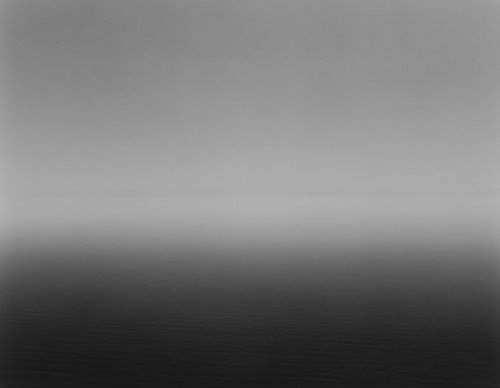
Ligurian Sea, Saviore, 1982
Whether Sugimoto was in fact influenced by earlier landscape painting I simply do not know. His website offers no clues, nor does his recently reissued book (2019) (on which I will do a separate short note). Nevertheless the parallel is there to be drawn, even if only speculatively. Apart from the obvious difference of the presence of an obvious shoreline and the figure of the Monk in the Friedrich, what they have in common is a view of sea and sky and a blurring of the horizon. Links might also be made with Turner. I suspect that Sugimoto was aware of the earlier conventions and influenced by them, even if only at an unconscious level, as with my “Friedrich” tree.
That, I think, will do for now, but as I have previously indicated it might well be worth revisiting this exercise as the course develops and add moe examples to it as I become more aware of the underlying conventions of landscape painting and their influence on photographers.
Dexter, J, (1994). Ansel Adams: The National Park Service Photographs. New York: Abbeville Press
Sugimoto, H, (2019). Seascapes. Bologna: Damiani Editore
Warner Marien, M, (2014) (4th ed.). Photography: A Cultural History. London: Laurence King Publishing
https://www.nationalgalleries.org/art-and-artists/artists/alfred-g-buckham
 Mark Robinson's OCA Landscape, Place & Environment Blog