When I first read the brief for this exercise I did not really know where to turn. As ever though something has, by chance, or coincidence, (or my trusty unconscious working overtime) cropped up that I think will serve. Fortunately it relates to photography and contemporary work at that. It also fits with certain aspects of Buddhism that I have been thinking about, if not directly meditating upon, recently.
From the reading that I have been doing of late on the Sublime the particular ideas that appeal to me most strongly are those relating to personal transcendence and the representation of the unrepresentable. On a second reading of Morley’s article (which incidentally I vaguely recollect seeing for the first time when it was published in the magazine Tate Etc back in 2010, at which time I was a Friend of the Tate and so received the physical magazine each quarter) two things caught my eye.
One was the following:
“But often contemporary perspectives on the sublime reject traditional conceptions of a self, or a soul or spirit, seen as moving upwards towards some ineffable and essential thing or power. Instead, the contemporary sublime is mostly about immanent transcendence: that is, it is about a transformative experience understood as occurring within the here and now.”
He then refers to the work of, in particular, Hiroshi Sugimoto, and a sense of void – “of being on a borderline or edge where we can no longer codify experience”. These ideas link to the Buddhist ideas of mindfulness and nothingness or emptiness, ‘sunyatta’, often represented in Zen as a calligraphic circle. A useful definition, or explanation, of the concept of emptiness can be taken from Baas & Jacob (2004) (at page 266):
EMPTINESS: The teaching unique to Buddhism, namely, that which we ordinarily perceive as inherently solid, permanent, lasting, and disconnected from and independent of everything else, is actually ’empty of inherent self-existence’, empty of anything separate and independent, fixed, permanent and self-maintaining. The Buddhist view is that phenomena are impermanent, interconnected, and in continuous flux. …
(This is a book I am going to come back to later as there is an interesting chapter in it on photography as Buddhist practice which, even stripped away of its specifically Buddhist context, has some interesting things to say about how to look and see as a photographer. More anon.)
I am quite pleased that Morley has included Sugimoto in this context as he is someone whose work I admire, and have been looking at more seriously again, and on whose Seascapes book I have already written a brief note (https://markrobinsonocalandscape.photo.blog/2019/09/14/hiroshi-sugimoto-seascapes-book/). So it is with him that I am going to stay for the purposes of this exercise.
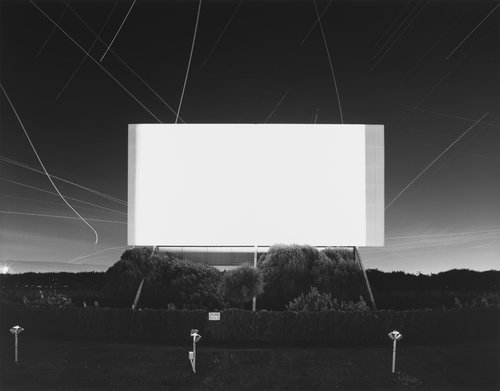
The example illustrated in Morley’s article is one of Sugimoto’s movie theatre pictures, in this case a drive-in, in which the exposure lasts as long as the film that was playing. What this inevitably produces a lit, but apparently blank, screen. That illuminated space is a sort of void, in the sense that nothing is visible within it, so that we can “no longer codify experience”, in this case in the sense that we cannot experience the film that is “depicted”. In a way this is also representing the unrepresentable: we have a still picture that captures and encapsulates a movie. A span of time has been reduced, in the form of the final photographic image, to a single instant. In Zen terms the photo is similar to the calligraphic zero. At a literal level the dark foreground and background sky, framing the “blank” lit screen, is a calligraphic ‘circle’ in its own right.
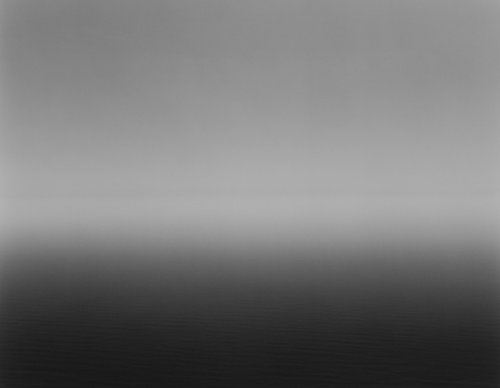
I feel the same argument can be made for the Seascape works that I have been looking at recently, and that I have previously in my own modest way sought to emulate.
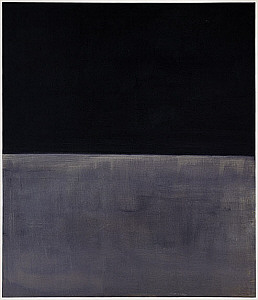
I had not realised until I read the introduction to Sugimoto (2019) by Munesuke Mita (at page 7) that the work of Mark Rothko, particularly the later monochrome compositions, specifically Untitled (Black on Gray), 1969/70 below, which share a similar form to Sugimoto’s photographs (although, as he argues, a different sense of vitality) might similarly sit within this conception of the Sublime in so far as he had “eliminated reality, meaning, form, and color (sic) from his work”.
What Sugimoto has done with his seascapes is take the viewer outside of both space – the only clue to the “reality” of the scene, in the sense of where the picture was taken, which is by no means discernible from the internal context of the images themselves, is offered by the caption – and time, as he did with the movie theatres. As Munesuke Mita puts it (at page 9): “It is a fertile tranquility of eternally recurring time.”
That in itself might stand as a not at all bad further possible definition of the Sublime.
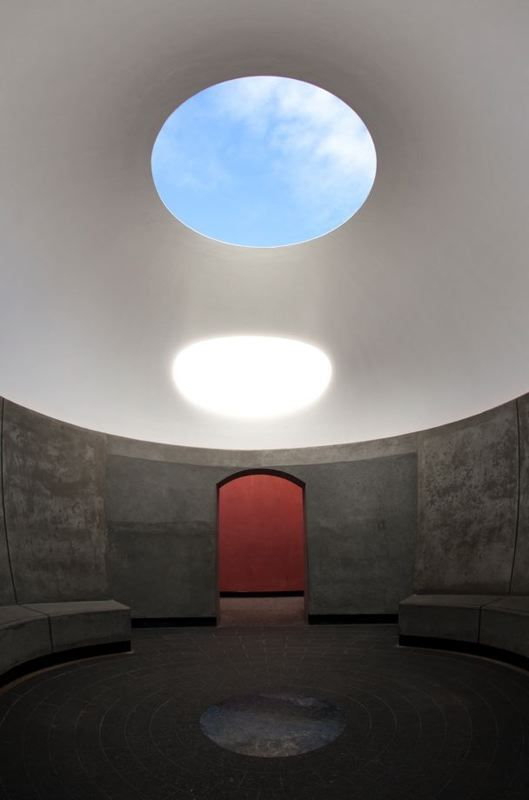
As an aside, it is interesting that Morley also mentions James Turrell in the same breath as Sugimoto. One of his Skyspace pieces is at Kielder (Cat Cairn), not too far from where I live. This is a circular space and so has at least superficial similarities with an enso and is doing something similar to Sugimoto in taking the viewer outside time and space.
I am going to think more about his work as a possible source or influence for Assignment 1, and also another possible approach to Exercise 1.5 (on which I am still having ideas!).
Baas, J, & Jacob, M.J. (eds) (2004). Buddha Mind in Contemporary Art. Berkeley: University of California Press
Sugimoto, H, (2019). Seascapes. Bologna: Damiani Editore
https://www.tate.org.uk/tate-etc/issue-20-autumn-2010/staring-contemporary-abyss
 Mark Robinson's OCA Landscape, Place & Environment Blog