My first reaction on reading the brief for this exercise was where on earth am I going to find what they are looking for? A moment’s further thought though led me to ask the question, in fact there is so much of this stuff out there how am I going to narrow it down to just a few images?
This exercise is such an oddly abrupt change of pace and direction, though not necessarily a bad thing at this stage, an opportunity introduce a different concept of landscape photography and break up what might otherwise start to become an habitual line of thought about how to approach the topic. It is though one that I feel deserves a much wider and deeper exploration than just this exercise. Let us see if ti comes up again later in the module.
To try to narrow things down a bit and make it more manageable for present purposes I have decided to rely solely on the resources within my own library. This means I can concentrate on work that I already know reasonably well and which, by virtue of the very fact it is in my library, has some resonance and importance for me. It also helps to show up some important differences in the approaches of the artists involved that is not questioned by the exercise but is I feel worth referring to.
Starting with that difference, what I note is that where we are looking at work that is explicitly socially concerned within a specific place or area, socially-concerned landscape, (another case of ‘landscape’ being much more than just a pretty view) the social comment side of things tends to be quite one sided, focused mostly on just one social class or milieu, rather than directed to highlighting social contrasts. A few examples:
Oscar Marzaroli in Glasgow. Tish Murtha in Newcastle. Jim Mortram in Dereham. Paul Trevor in Liverpool. Matthew Genitempo in the Ozarks. Alec Soth on the Mississippi. Ute & Werner Mahler in the German Kleinstadt. Marketa Luskacova in Whitley Bay. Ragnar Axelsson’s work in Iceland, Greenland, and the Faroes.
For the illustration of social contrasts I find the most fertile ground is provided a number of mostly American (I do have one Japanese example) “street photographers”, that is photography grounded in a particular place, not always a city. Here I am thinking of works by the likes of Robert Frank, William Klein, Joel Meyerowitz, and Daido Moriyama. (I could have chosen any number of other examples, as indeed I could with the list in the paragraph above, but these will do for now.)
The work in New York City in particular of Frank, Klein, and Meyerowitz, and to a lesser extent Walker Evans, whom I will otherwise leave out of the frame for now, should provide more than enough material to illustrate the differing social views and make up of the city, and indeed probably of some of the same streets and particular vantage points. All of them show affluence, poverty, “just-getting-by”, order, disorder, mixed and diverse social, not to mention ethnic, groups.
Meyerowitz’s street work in Paris shows similar contrasts there, something that is writ large across the page of any of his books that you might light upon made by Daido Moriyama in Tokyo.
There is so much material available here that it is difficult to do it justice. What I think though does help is to concentrate an a few examples, more than the two required by the brief, of the work of this particular constellation of artists that contain social contrasts within single or closely related images.
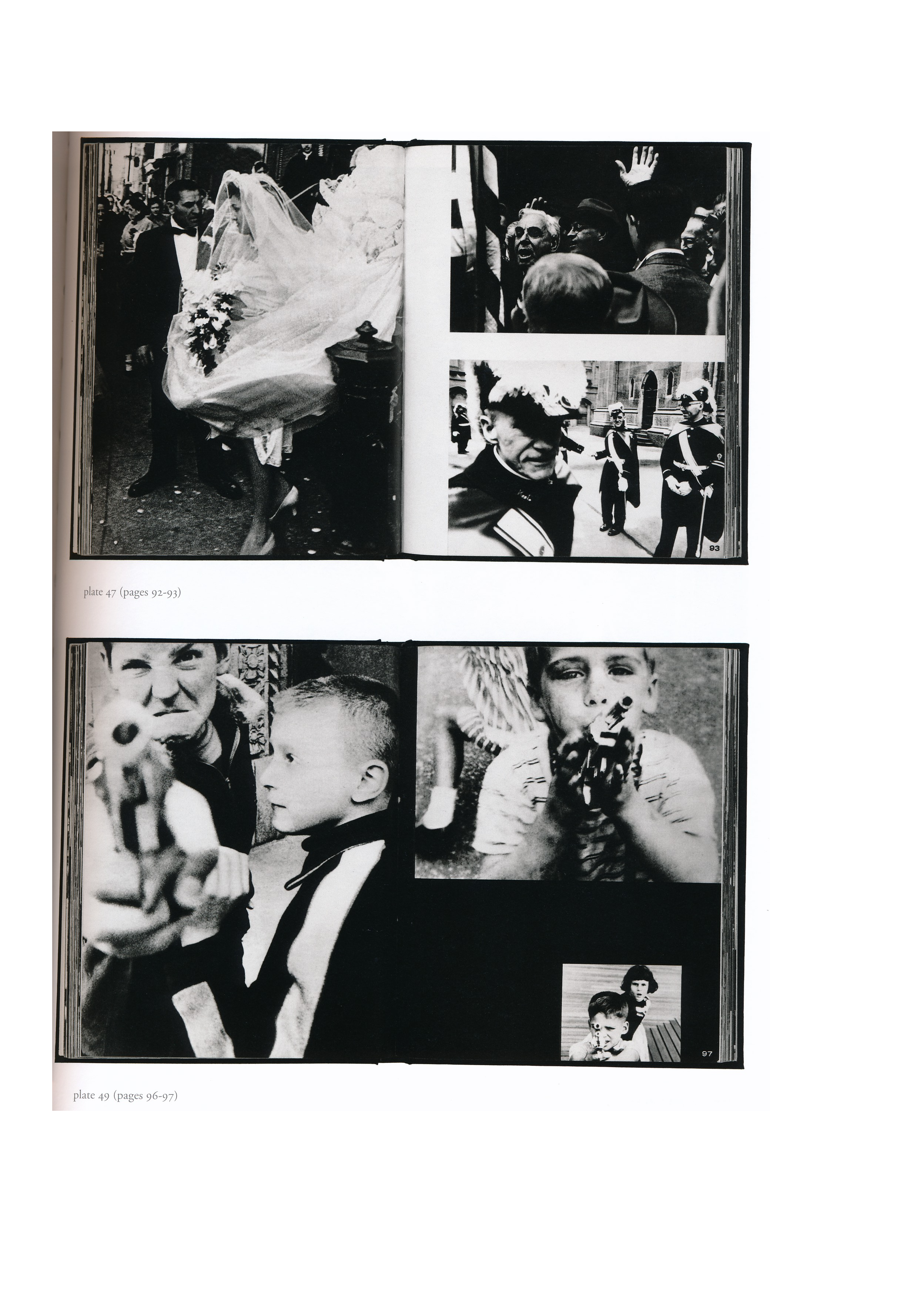
Another point that is worth making now is that on looking back over my choices I note that they all focus on people more than they do on particular places (with the possible exception of the last one). However, a sense of a particular place was clearly important to each of the artists. In the cases of Frank and Klein each picture is captioned by reference to a particular place. The subjects of Frank’s pictures in a way go to define, or at least contribute to, the “landscapes”, the environments within which they lived, not only physically but also socially. Klein’s work in this particular collection are all set in New York so as well as being pictures of various, socially diverse people, they are also still photos of the wider physical and social environment of the city itself.
Meyerowitz’s work, set in Paris, shows something of the character and nature of the city by portraying the varieties and mix of people living within it, who in turn give character to what one might regard as a typical Parisian street scene. Throughout his work Moriyama is showing us Tokyo, as a very specific, sui generis, place, or collection of heterogenous places, and again the people are integral to this process
As I hope I have made it clear elsewhere I do not view the concept of landscape in purely topographical or geographical terms but also in much wider documentary and social terms. I therefore make no apology for my choices.
My starting point is one of Robert Frank’s images from The Americans (2016), Elevator – Miami Beach:
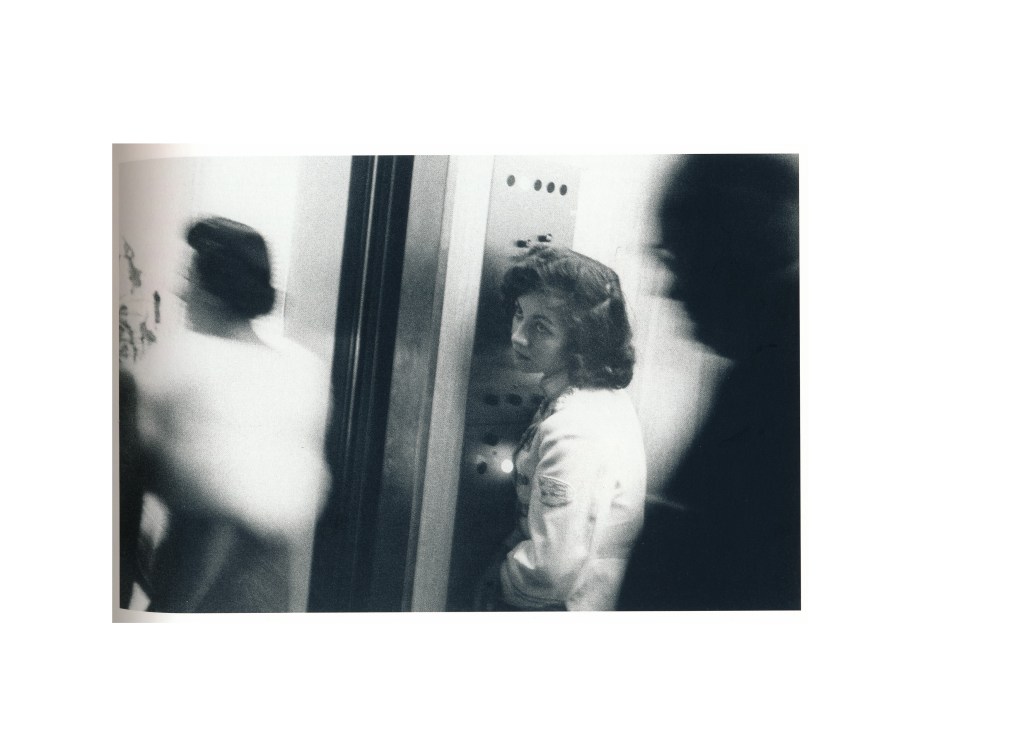
The lowly elevator attendant at the service of affluent society – check out the fur stole!
Another from the same book would be Charleston, South Carolina (I am going to come back to the issue of race later):
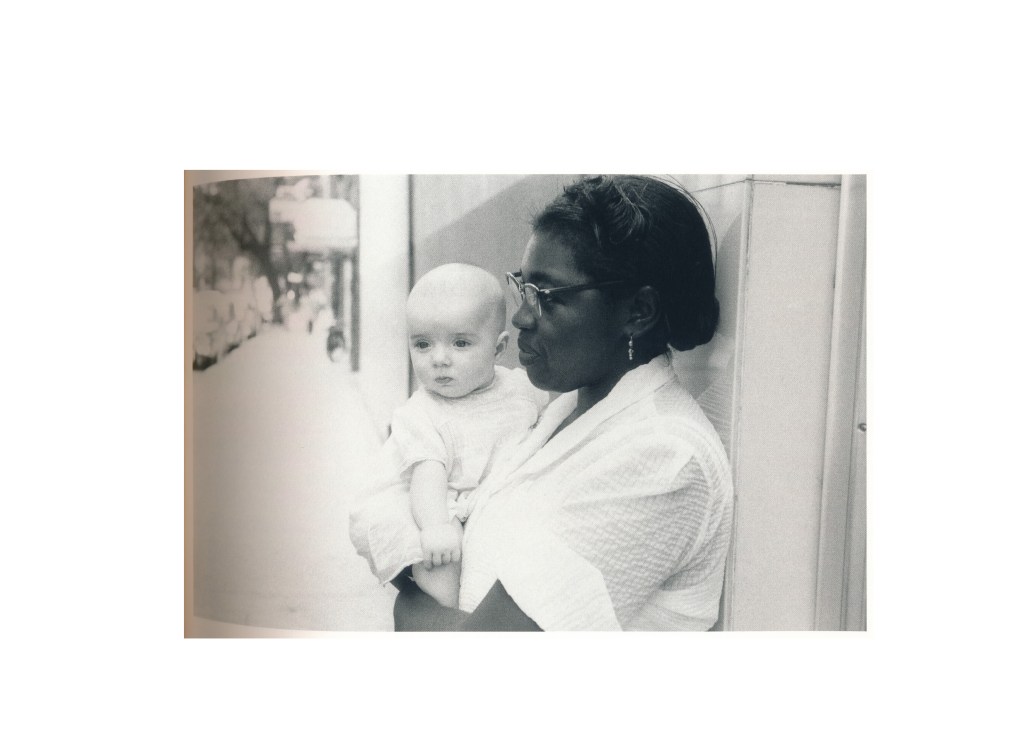
This image shows little of the physicality of the location but says a huge amount about it socially. This is the segregated south so the only real contact between races is through the relationship of master and servant, in some ways a continuation of the owner/slave relationship but on less extreme terms. The woman is clearly a maid or nanny, a servant of some sort, in the service of a white family, and presumably it is only the nature of that relationship and arrangement that allows her to be in that part of town with some degree of autonomy, if not authority.
Two double page spreads from Klein (2016):
From Meyerowitz (2018), Paris, France, 1967:
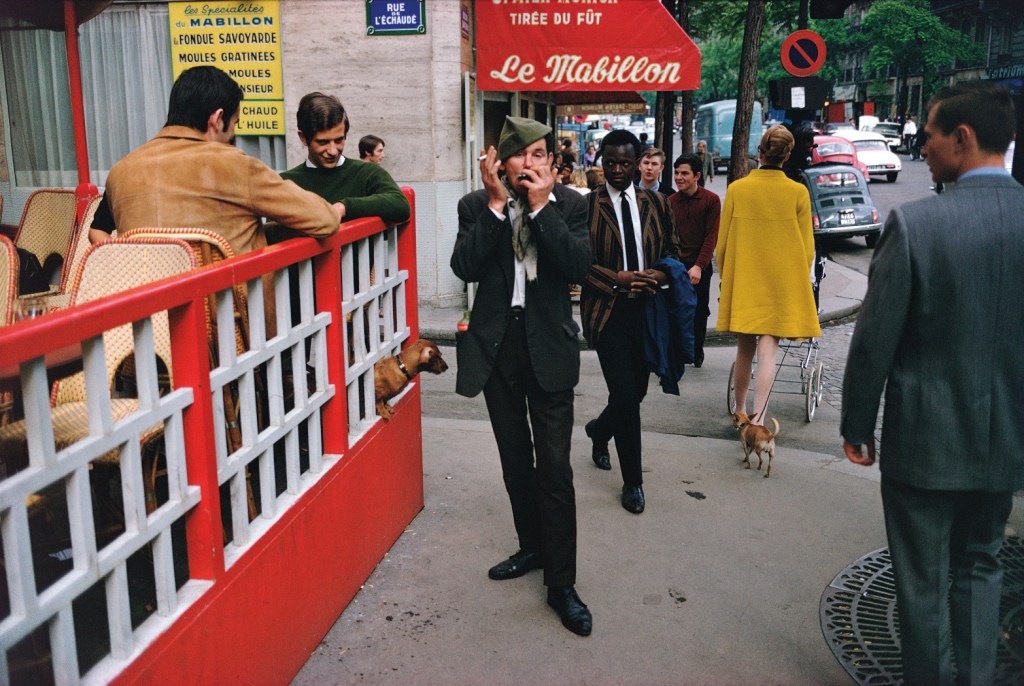
The affluent Parisians, the well-dressed man presumably of African descent evidently at ease within the ‘boulevardier’ environment though perhaps a little wary of what I assume is the fun being made by the men on the cafe terrace of the more louche character playing the harmonica – presumably a drunk judging from the bottle in his jacket pocket. A certain irony, possibly even a hint of hypocrisy if that is not pushing the point too far, here with those in the cafe, presumably having a drink, finding amusement in someone who seems to have had a drink.
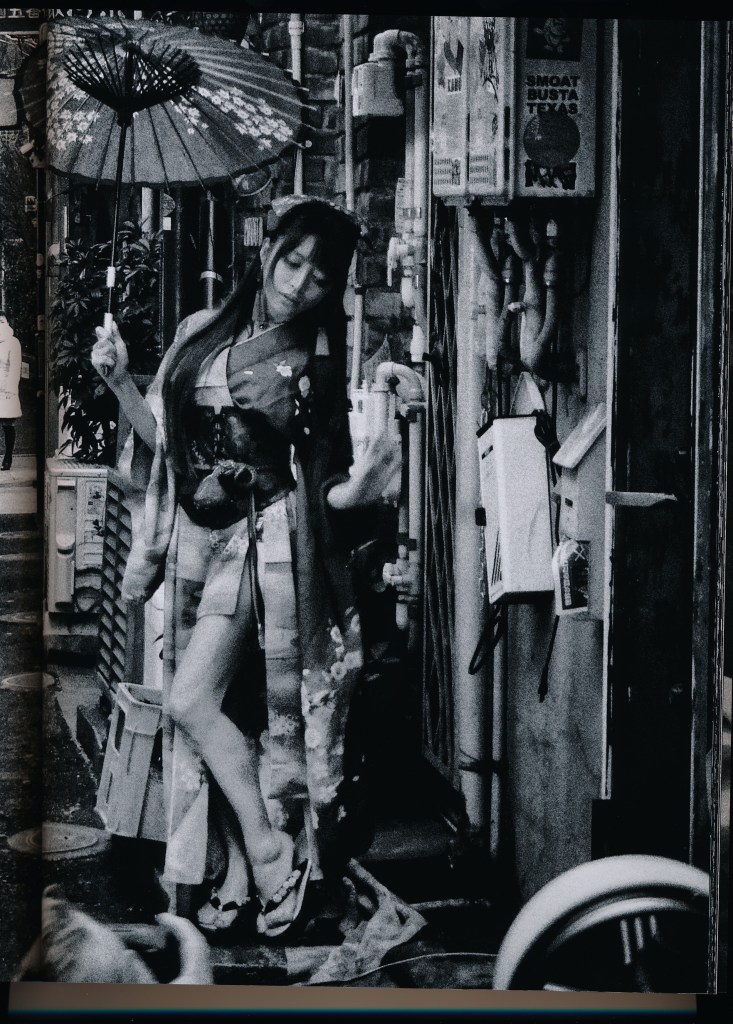
For Daido Moriyama there are any number of examples that I could have chosen. What I wanted to do was compare two double page spreads from Record No. 29 that show on the one hand a couple dressed in traditional kimonos on a busy Tokyo street (presumably in Shinjuku) and on the other hand what I take to be a homeless man, asleep on a sheet of cardboard. Unfortunately I cannot find examples of them on-line and as double pages they do not fit on my scanner. Instead I have therefore settled on this image from Record No.37. It is only half of a similar two page spread but this half catches one of the things I find in Moriyama’s work, the contrast , and indeed collision, between traditional and Western cultures in contemporary Japanese society, the elegance of traditional culture and the grittiness of much of modern Tokyo, and the contradictions between what might be perceived as an inherent quality of coyness and propriety in Japanese society and, as here, an open and obvious eroticisation of those traditional values:
My last example is a picture by William Eggleston, included in the catalogue of the fairly recent National Portrait Gallery exhibition (2016):
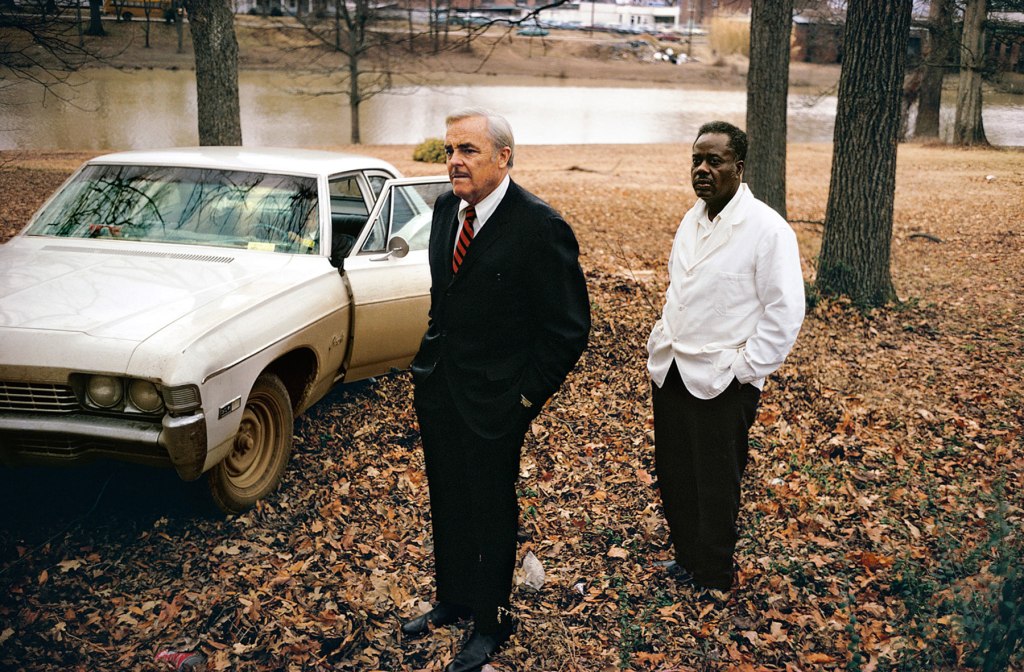
Much as I admire much of Eggleston’s work, some of it, not least this example, disturbs me. As with my Meyerowitz choice there is more of a sense of a landscape, in literal terms, here again specifically identified in the caption. Because of the social elements of the image though this location could stand in as a generic one for many places throughout the southern states. Indeed, if it was not for the caption it would be difficult to identify just where the place depicted is, so that it could be pretty much anywhere.
It is though the social contrasts that are most striking. What I cannot quite tell is whether Eggleston was being ironic in his composition and highlighting the social tensions at play in the south, or whether is was actually being non-judgmental, more accepting, given his background as an offspring of a wealthy plantation owning family, who presumably made their money from slavery. (This is one of the issues or difficulties that I have with warming to Eggleston as an individual.) What I find most striking is the composition and posing of the figures, the assistant matching the posture of the boss, but at a respectful distance behind him, itself signally social hierarchies. The racial element is, it seems to me, highlighted by the way the figures are made negatives of each other: the boss, a white man in a black suit, the assistant, a black man in a white jacket. This again emphasises the sense of difference, literally of social contrast: black is not white, and white is not black.
Frank, R (2016). The Americans. Göttingen: Steidl
Klein, W, (2016). Life is Good & Good for You in New York. New York:Errata Editions
Meyerowitz, J, (2018). Where I find myself. London: Lawrence King Publishing.
Moriyama, D, (2017). Daido Moriyama: Record. London: Thames & Hudson
Moriyama, D, (2018). Record No. 37. Tokyo: Akia Nagasawa Publishing
Prodger, P, (ed) (2016). William Eggleston Portraits. London:National Portrait Gallery
 Mark Robinson's OCA Landscape, Place & Environment Blog