Almost inevitably, having posted on this assignment yesterday something else has come up today that is worthy of comment.
In the Guardian this morning there was a piece on the latest Deutsche Börse photography prize and what caught my eye was the Anton Kuster Blue Skies Project. This is a series of ‘Polaroid’ photographs taken of the skies above the known, ‘official’, 1078 Nazi concentration camps. This has obviously not been an influence on me at all in the choice of subject for my assignment submission as I did not know about it until today. I am nevertheless very much struck by it and clearly this is an example of the Sublime, in the sense of provoking awe and even terror. A lot more serious than my little project!
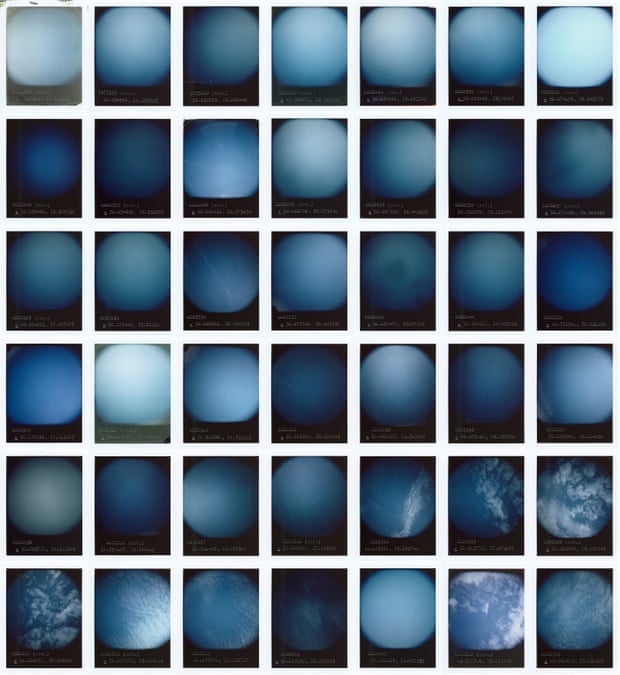
One thing that is worthy of note, and which I have not covered in any of the previous posts on my own work, is the vignetting. I do not know how Kusters has achieved this with his work. I did think about doing something like this, most likely by adding a mask in post-production, but ultimately rejected the idea because I felt it would make the resulting images much too derivative of Turrell’s work, in which the sky is seen within a frame created by an aperture in the roof of the structure. A sense of framing is also important in, for example, Hiroshi Sugimoto’s movie theatre work. For good or ill though I decided I did not want an artificial frame within the confines of the image itself. I preferred to let the limits of the photographic images themselves serve that purpose. In a way this again links back to some of the Buddhist ideas that have informed my project. The final images are a bit like thoughts drifting across one’s consciousness while meditating. They are insubstantial and fleeting, to be neither welcomed nor rejected or resisted, but merely to be noticed as they pass and let go on their way. Introducing some sense of frame would, I fear, give these “thoughts” too great a sense of solidity that would not fit within the particular conception of the Sublime that I have chosen to explore.
And how do I react to this work? That is a bit difficult as I have not seen it in the flesh. My first thoughts though are that it must be overwhelming simply because of the scale of the project, the number of individual images involved, small as they appear to be individually. Nothing can ever really convey or encompass the sheer scale and horror of the camps (even my own visit to Auschwitz a few years ago did not really convey a sense of the full scale of the evil at work though the experience of being there was itself shocking, deeply disturbing, and chilled me in a way that nothing has ever done before, and haunts me still) but the number of pictures does perhaps at least give some sense of it. If nothing else the affectless, almost abstract nature of the photos, lacking any inner context other than that provided by the stamped captions, gives some idea of the way that for the Nazis the death camps became paradoxically mundane, even banal, the killing merely a mechanical, bureaucratic process: which I find quite difficult to say and which serves only to emphasise how utterly horrific this enterprise was.
I do not honestly think this is the sort of project I could ever undertake and to that extent it does not lead me to think that there is anything I would necessarily do fundamentally differently if I was to address my own project again.
 Mark Robinson's OCA Landscape, Place & Environment Blog