Rather than just read Joel Snyder’s essay “Territorial Photography” in isolation using the example on the student website, I have gone back to Mitchell (2002) itself, particularly the introduction and Mitchell’s own opening essay “Imperial Landscape”, as I think this helps to put Snyder’s thoughts into context. That context is one that I have already looked at in the earlier modules of this course, not least in the final assignment for I&P, as one of the things that interests me about the idea of landscape, whether as a noun or, as Mitchell seeks to reclaim it, as a verb, is its social and political implications: ownership and exclusion in particular. As Mitchell puts it (at page 2):
“What we have done and are doing to our environment, what the environment does to us, how we naturalise what we do to each other, and how these “doings” are enacted in the media of representation we call ‘landscape’ are the real subjects of Landscape and Power.”
This resonates strongly with the views that I expressed on what landscape is in the first exercise on preconceptions. Ownership and exclusion are also elements of that thinking and these are perhaps, for me at least, the two most important points that I get from Snyder’s essay.
Snyder’s first main point, as I read it, might at first glance appear to be on a slightly different tack, discussing the way that landscape photography in the middle of the nineteenth century moved away from a pictorialist, artistic, approach towards on that was much more scientific and manufactured, thus establishing a sense of the truth and reliability of the photograph as a record. Linked with this he discusses the processes by which a mass audience and market for photographs was developed, quite different from the means by which “art” was distributed and seen by the wider public. It nevertheless strikes me that this is an important precursor to the two there main issues that Snyder discusses with his consideration of the work of Carleton Watkins and Timothy O’Sullivan respectively. As Mitchell writes at the start of his essay, the first of his “Theses on Landscape”: Landscape is not a genre of art but a medium.
The first main point that I take from Snyder, with his discussion of Watkins, is that landscape photography, at least in the US at that time, was effectively an imperial exercise. It was a way of saying that the great American landscape was that it was already “owned” by the (implicitly) white, western population of the continent. It was a relatively benign, though often imposing – awe inspiring, sublime – landscape that “belonged” to the modern Americans, that was already familiar and known. As with earlier landscape painting, such as the work of Bierstadt and Moran, both of whom I have looked at earlier, many of the places they painted had already been named by the new, non-indigenous, Americans.
What is more, as a concomitant of the ownership, Watkins depicted the landscape as something that should be exploited for its commercial and economic value. Not only did he take ‘picturesque’ images but, for example, he took pictures of railroads that blended into the landscape, and other industrial developments as if they belonged naturally in the environment. Ownership.
In the case of O’Sullivan, as Snyder presents his work, we also get a sense of ownership but this time of a more exclusionary nature. Watkins was employed by the mining companies, by the railroads, to promote their interests. O’Sullivan on the other hand was employed not to carry out precise, surveying and recording photographs (a task left to specialist surveyors and draftsmen) but simply to take pictures that could be used on an interim basis by his employers, the scientific (as opposed to the military who had hitherto carried out such exploratory work) explorers of previously unexamined territory.
This is the point at which the earlier discussion of a market for landscape photographs comes back into play. Watkins was producing work that was intended for wider dissemination, as part of the promotion of the ideas that the landscape was “your land” (at least that of the industrialists, mining, and railroad companies, something with which of course Woody Guthry disagreed with vehemently in his song “This land is your land”) that it was right and proper should be exploited. O’Sullivan’s work on the other hand was intended only for a much narrower audience, the scientific community that employed him, who were effectively saying that at least the knowledge to be derived from and about the landscape, if not the land itself, and the rights and means of its publication or distribution, was theirs alone. Exclusion.
Another point that Snyder draws out is that much of O’Sullivan’s work is the antithesis of that made by Watkins as its hows not a familiar, inviting, landscape, but one that is unknown and hostile. This is a sort of “keep out” sign, again part of the scientific attempt to retain ownership of knowledge. More exclusion.
Not touched upon by Snyder, at least not explicitly, but something that caught my eye was another element of this approach. In part it is perhaps explicable by the fact that there had been little previous non-indigenous exploration of some of these places, but it seems to me that fewer places have names applied to them that refer to modern Americans. For example, see Snyder’s quotation of O’Sullivan about Shoshone Falls (at pages 198 – 199), comparing it unfavourably with Yosemite. Many of the well known sites in Yosemite were then not named after indigenous peoples but American luminaries (such as Washington) and explorers, or Spanish imperialists. “Yosemite is a grace.” The falls on the other hand are named for indigenous people and are reached across “a waste”, are a “chaotic brink”, “a frightful glimpse of the unknown Inferno”. Yet more exclusion, and naked imperialism.
For the two further examples of photographs that the exercise calls for I have turned to Sandweiss (2002) as her book covers the photographing of the American West in more detail. From this I have chosen one work from each of Watkins and O’Sullivan as again their work was being used in different ways, consistent with the distinctions identified by Mitchell.
Staring with Watkins, here is a determinedly pictures view of the Yosemite Falls, a vista artfully framed by a stand of trees.
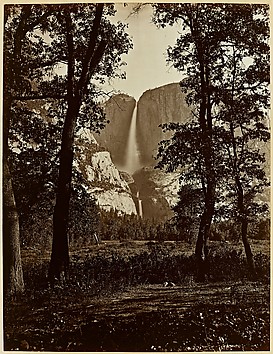
This picture falls clearly into the category of works that were demonstrating the ownership of the landscape by modern Americans and the propriety of using and exploiting it. This photo was included in a book published by Josiah Dwight Whitney following an eight-year survey of California and as Sandweiss puts it (page 276) it “exemplified the twinned spirits of scientific inquiry and unabashed boosterism”. The book was explicitly authorised and supported by the state legislature to act as a guidebook for travellers, a sort of illustrated Baedecker. Put to this use, whatever Watkins’s original intentions in making this photograph might have been, in the context of Whitney’s guide book, published in 1868, it becomes an invitation not only to visit the National Park (which had been created, or at least given protected status just a few years earlier in 1864) but to stand in the same spot and admire this particularly picturesque view of the falls. The visitor can “own” the view, and by extension the Yosemite park area, by standing on the same spot or simply by owning the book (of which only something in the order of 250 where produced with original photographic prints which effectively made that “ownership” more select and exclusive.)
For a further example of O’Sullivan’s work I have chosen not a straightforward landscape picture but more of a portrait, a group portrait, of Native Americans in their environment.
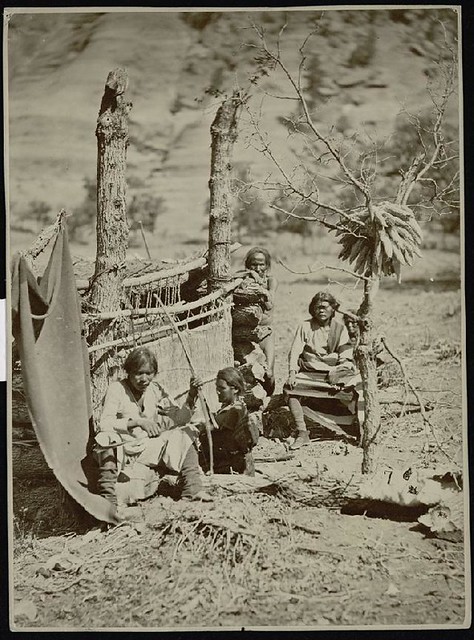
This was taken while O’Sullivan accompanied an Army run expedition, headed by Lieutenant George Wheeler that explored the area west of the hundredth parallel. This work is again exclusionary in that it was intended for the US Geological Survey and not for a wider, popular, audience, at least initially. It does though also have an ownership function in a similar way to Watkins’s work. What I find particularly interesting about it though is the uses to which it was put, how it was recontextualised by the texts that accompanied it in the survey reports and how its meaning was changed by those texts.
The composition of the image itself is fairly simple but still laden with significance. The central feature is a loom. It is still possible to see people working with looms like this today making the famed Navajo blankets and models of this sort of thing are offered for sale to visitors wherever you go in Navajo reservation towns. (I have travelled round the Four Corners area and saw, and was pressed to buy, any number of these things, temptations that I have to say I resisted.) The native Americans are in this way depicted as crafts-people. It also shows cobs of corn being dried, showing they are a rooted (forgive the pun), agricultural society. The figure to the front left though holds a bow and arrow, a nod to their martial past (the Navajo had been “pacified”, for which read defeated militarily, divested of their ancestral lands and confined to reservations, since the end of the 1860s).
When the album in which this image was included was first published in 1874 the accompanying text, as quoted by Sandweiss (page 191) described the Navajo as “an intelligent and fierce people by nature…[who have made]…good progress towards civilization”, all of which can be clearly read in the picture. It also supported the idea of modern American ownership of the West (Manifest Destiny) by reassuring settlers that this area was safe, while conflict continued on the Norther Plains and far Southwest. This ownership function was developed still further when the report was reissued, and presumably made more widely available in 1889, with the Navajo now portrayed as “quaint figures, dependent on government rations, whose glorious past had long since disappeared. And words that had once depicted them as industrious farmers now portrayed them as exotic anachronisms”. (Page 193.)
Paradoxically I cannot escape the feeling that in a way the sellers of the model looms on the reservations are perpetuating that same imperialist view of themselves.
Mitchell, W.J.T, (ed) (2002). Landscape and Power. Chicago: The University of Chicago Press
Sandweiss, M, (2002). Print the Legend: Photography and the American West. New Haven: Yale University Press
 Mark Robinson's OCA Landscape, Place & Environment Blog