A bit of a ramble, not so much a defined journey from A to B, with some observations along the way…
The idea of a landscape as a number of linked (though not necessarily physically or geographically) locations or places has been with me for a long time and indeed formed the very first assignment I did for this course, EYV’s Square Mile – a series of images showing a walk I do, with variations, almost every day with my dog.
(As an aside, here he is fast asleep on the sofa-bed in my study as I write this, tired out from a walk on that very route.
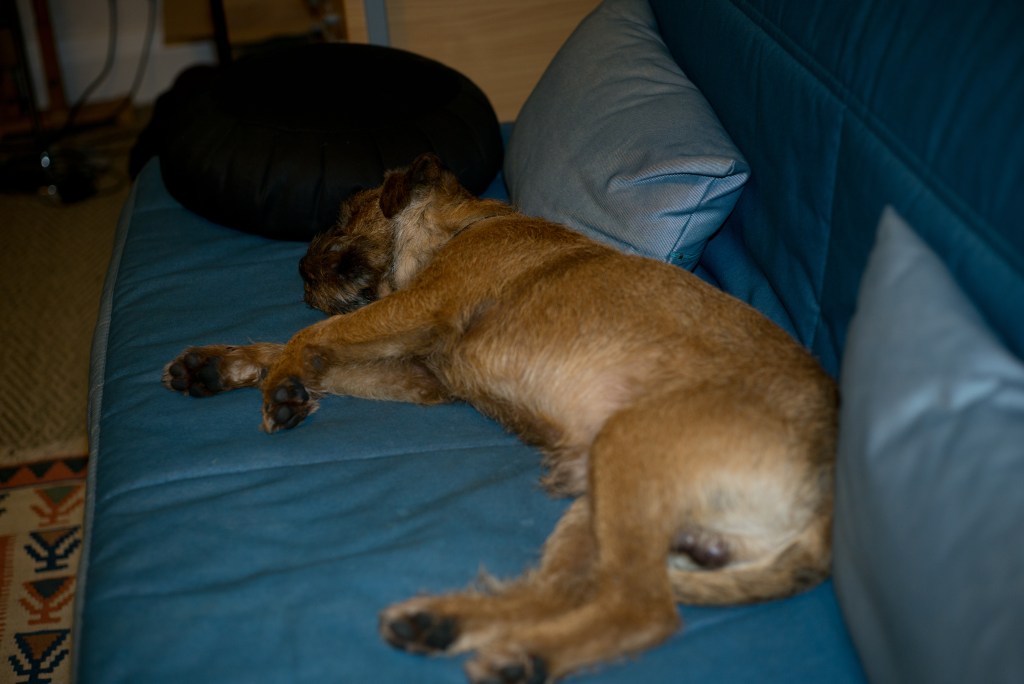
Admittedly a bit of an indulgence but not entirely inappropriate given the title of Soth’s book, though for us it would be more a case of “Sleeping by the Stocksfield Burn”. It does not have quite the same sense of scale and grandeur, does it? Anyway, I just felt like including it! It is about time the wee man makes an appearance. There is though nevertheless a serious point embedded in the use of this picture about how we interact with and are affected by landscape, the environment in which we I’ve and through which we move. In this case the landscape has simply tired out my dog!)
Alec Soth’s book is also one of my favourites. Oddly though I have not looked at it critically for a while, despite having referred to it a number of times while working on I&P (I think at the time I was probably more engaged by the more recent work of Matthew Genitempo). So it has been quite refreshing to come back to Soth and look at his work more closely again in the light of the article refered to in the course material.
So far as the book itself is concerned, one of the first things that strikes me, again, is the sharpness, the detail, the depth of field, that he achieves. This is no doubt a result of the use of a large format film camera (I understand he uses a 8×10), something that I have experienced myself with my 4×5. I am not quite sure why but it seems to me that this sort of effect is not so easily achieved with a digital camera, but it is one of the reasons why I keep coming back to film; 35mm, medium 120, and 4×5 large format. The other thing that I get this time round (no doubt the next time I go through it again it will be something different) is the sequencing of the images. Although the book is ostensibly record of a journey (or series of journeys) along the river it is not entirely sequential. There are diversions and on occasions it doubles-back on itself: just like the river itself. This question of sequencing, which I feel is what sets apart the best photo-books, is something that Soth addresses in the interview.
Turning to the interview in the link below (doesn’t the interviewer talk too much and ask over-elaborate questions!) there are a few points that I would like to reflect upon, not necessarily all related specifically to landscape photography. Almost random but all nevertheless personally important to me.
“The lesson I learned is that great pictures are all about luck, and anyone can take a great picture. But very, very few people can put together a great collection of pictures … the art, for me, is in the collection and interplay of images.”
This resonates very strongly with me. I am not, as will be apparent from other blog posts, a fan of the ‘salon’ approach to photography, the individual image, no matter how arresting or striking. Much more interesting for me is the sequence that builds and carries meaning and significance, that contains or creates some sort of narrative of its own. That does not though necessarily mean that there needs to be a clear narrative thread, that the sequence of images needs to have been created specifically with that in mind. I think here in particular of the work of Rinko Kawauchi whose genius, it seems to me, rests in her ability to bring together otherwise unrelated images, sometimes made over not inconsiderable periods of time, and find resonances, connections, coincidences, and combined meanings and significances within them when they are brought together.
Speaking of his project to record a version of the river: “… but I was shaping my own river. This is what photographers usually do, right? They create their own vision. I’d love to see how other photographers would approach the river. I’m quite certain that each approach would be entirely unique.”
Something else that speaks clearly to me and one of the reasons I get so annoyed, or more to the point, simply bored by the repeated, hackneyed images of the same things, the same places – whatever is fashionable or trending on Instagram or Flickr – the same view, from the same viewpoint, that says nothing about the photographer and what this place actually means to them (not much in most cases, I suspect). I would rather take a picture that is not that good so long as it actually means something to me, and possibly to some other hapless soul who happens to come across it and find something in it of interest.
Referring to Joel Sternfeld, whose work I am afraid I am by no means familiar with enough, yet: “He showed me that this life of serious looking was possible.” That is surely what photography is really about; not taking pictures alone but observing the world, attentively, critically, mindfully, and then choosing to record some element of that. Although not by any means a fan of the idea of the Decisive Moment I am very much in agreement with HCB’s view that this business is, at root, all about looking.
“… I really didn’t need all of the theory, critiques and assignments. I did’t begin to find my eyes until I was away from all of that. … I’m much more comfortable with the idea of apprenticeship than I am with the classroom.”
This is something of an existential question that I continue to ask myself as I work through this course. What really is the purpose or value of this degree? Why, indeed, am I doing it? What ultimately do I hope to get out of it? Is it actually going to make me a better or more thoughtful photographer (not necessarily the same things)? Not all of these, and any number of other, questions can necessarily be answered at any given time or consistently over time. I am not going to try to address any of them now. They are nevertheless always there, constant companions, always worth at least being aware of. Always worth bearing in mind, but not in themselves reasons, in so far as any of the answers might be negative, when not otherwise simply equivocal, not to continue with what at root I regard as a journey, an exploration of myself and the world around me.
“I don’t want to have to photograph water towers or Weimaraners year after year.” (Whoever put this interview together clearly cannot spell the dog breed’s name properly, and presumably has no idea what it actually means! I have used the proper spelling, curmudgeonly old pedant that I am.) I think this is a bit unfair on the Bechers whose typological work, though not something that I would want to do all the time myself, is serious and important. I do though agree about the dogs. I find Wegman’s work twee, pointless, self-indulgent, and utterly meaningless, not to say demeaning so far as the poor dogs are concerned.
Finally, “Words can easily ruin pictures.” I have banged on any number of times about my mistrust of combining pictures and words because of precisely this point. Not so much that words can “spoil” a picture, mar in it some aesthetic way, but that they can if used improperly subvert, manipulate and distort what the picture is really about. I would very much rather let an image speak for itself, even if that means that the message that the picture transmits is unclear, ambiguous, or open to different interpretations. Unravelling an image is something I would rather leave to the viewer than seek to trammel it with a written commentary.
Soth, A, (2017). Sleeping by the Mississippi. London: MACK
http://www.seesawmagazine.com/soth_pages/soth_interview.html
 Mark Robinson's OCA Landscape, Place & Environment Blog