As the next exercise directly addresses the issue of appropriation and the use of internet utilities such as Google Street View, I will leave my responses to the work of the like of Rafman and Henna until then. For now I will just make some observations – nothing too profound! – on the work of Liz Nicol and Ian Brown.
I have to confess I am not entirely sure why Liz Nicol’s work is featured at this point in the curse material. Whilst I understand how the Rubber Band Project came about I struggle to see it as a map of the walks in question and cannot but help feel that the mapping element is a little overstated. I do not expect it to be a literal map but looking at the work in isolation I do not get any sense of a progression, of a journey. Perhaps I am just missing something.
I do not have a problem with the use of cyanotypes as such but by their very nature, particularly when dealing with anything other than flat objects (I think the process was particularly well suited to Anna Atkins’s botanical work) they can be a bit difficult to decipher. As a result I sometimes find them to be a bit unengaging. It has to be said though that it is a fun medium and one that can be used very flexibly. I helped with a cyanotype workshop, run by the local rural arts charity that I volunteer for, at a small rural first school and the kids had lots of fun. I have also worked with another artist in residence at VARC, Lucy May Schofield, who has made some interesting pieces – including a mattress! – using the process. Nevertheless, of the various non-camera media I think I find photograms, such as the work of Man Ray and Laszlo Moholy-Nagy, more interesting.
Ian Brown’s work I have found more immediately engaging and thought-provoking. It has in particular got me to think differently about the work that I am continuing to do for Assignment 6. The idea of layering multiple images made over time of the same scene is intriguing and is perhaps another way of recording and representing a series of transitions. Just out of interest I have made an experiment in Photoshop with just half a dozen of the pictures I have taken so far, layering them one over another, and playing around with the opacity of each layer so that all are at least partially visible, to see how this might work in practice:
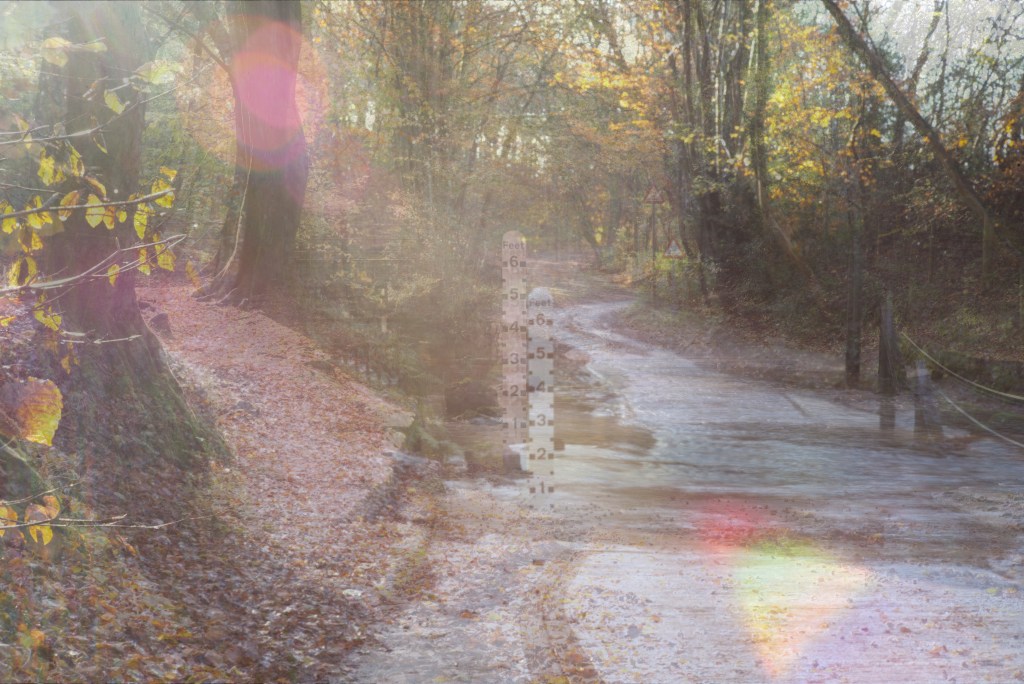
It is still very early days but already it is possible to start to see how the image is already starting to become blurred and indistinct, with the varying light and weather conditions and the small differences in the position of the camera from shot to shot over the weeks. Over time I can see how this view would become increasingly impressionistic. When I have some time I think some more extensive experiments would be in order.
http://www.beardsmoregallery.com/exhibitions/walking-the-land/
 Mark Robinson's OCA Landscape, Place & Environment Blog