As will be evident from some of my other work, particularly for C&N, I am a bit wary about combining photographs and text for fear that the latter can restrict the meaning of the image, or subvert and distort it. The idea of using text to make a piece of art is though a different matter.
I have had a look at the websites for Ed Ruscha, Barbara Kruger and Mark Titchner as recommended by the brief for this exercise but do not actually find any inspiration here. Whilst I admire Ruscha’s gas station paintings, for example, I find his text works do nothing for me: I struggle to see the point of an apparently random statement superimposed over a painting of a mountain. Kruger’s work is interesting but still does not affect me. Titchner’s work comes across to me as little more than empty sloganeering. Maybe I am being a little unfair to them all, but this is simply art that I do not like and from which I find I extract very little meaning.
Much more interesting and influential I find the text works made by Richard Long (on whom I am writing a separate post), Hamish Fulton, and some of the work of Autumn Richardson and Richard Skelton, to which I will return below.
For the purposes of this exercise I have started by making two lists rather than one as I have in mind different means of presentation for each. These are the product not just of one journey but a few over the last week or so. All stem from my daily dog-walking routine.
In the first I have made a list of all of the types of trees and shrubs that I can see (and can identify!) around here. Not all are necessarily native but at least they are all wild. I have deliberately excluded various of ‘plantation’ trees, ones that would not otherwise occur naturally in this area, such as the Pines and Spruces. Here is the list:
Apple, Ash, Beech, Birch, Blackthorn, Bramble, Broom, Buckthorn, Cherry, Chestnut, Dog Rose, Gorse, Hawthorn, Hazel, Holly, Hornbeam, Ivy, Larch, Oak, Rowan, Yew.
The second is of birds that I have seen on these same walks. There are a lot more varieties of birds about that I see on a regular basis at this time of year but I am excluding them because I have not seen any recently, such as Dipper, Goldfinch, Heron, Kingfisher, Red Kite, Mallard, (and obviously not including birds that are not here during the winter):
Blackbird, Bullfinch, Buzzard, Chaffinch, Crow, Dunnock, Jackdaw, Jay, Kestrel, Magpie, Nuthatch, Tawney Owl, Pheasant, Wood Pigeon, Redwing, Robin, Rook, Sparrowhawk, Starling, Mistel Thrush, Song Thrush, Blue Tit, Coal Tit, Great Tit, Grey Wagtail, Wren.
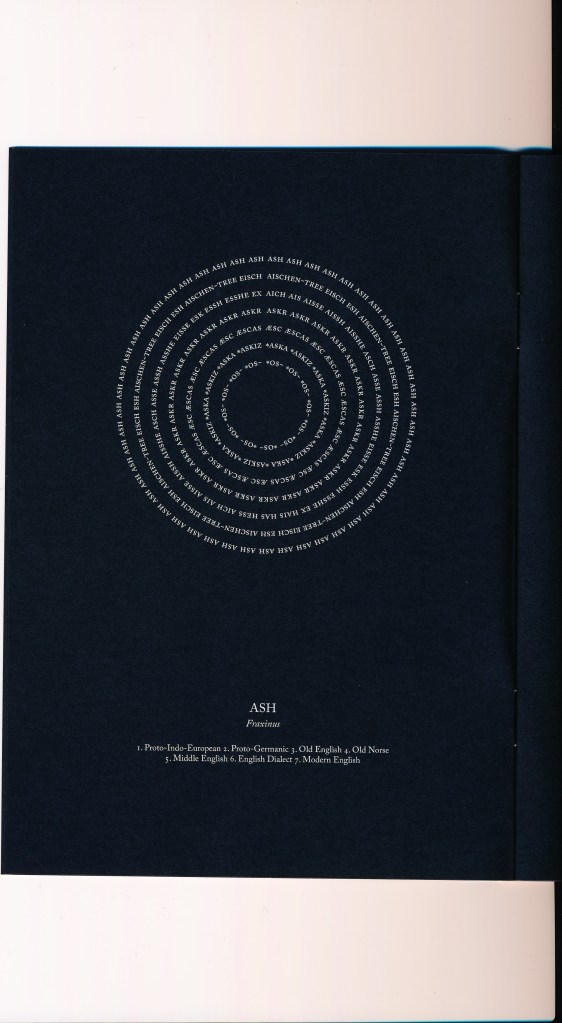
For the first list I take inspiration from Richardson and Skelton who have produced some text based works relating to trees, particularly those collected in Relics (2013). For each of a selection of trees they have created circular works made up of rings formed by various names for each tree, modern, ancient, dialect, and so on. The effect is of a cross section through the rings of thee tree. There is a form of dendrochronological effect in the finished work in so far as there is a temporal progression from the oldest form of the word in the centre to the modern on the outer ring. For example, Ash:
Taking this example as a starting point I have created my own version using a selection of the trees recorded on my walks, with Yew and Rowan alone on the inner two rings and pairs of trees, arranged nothing more than alphabetically, on the others:
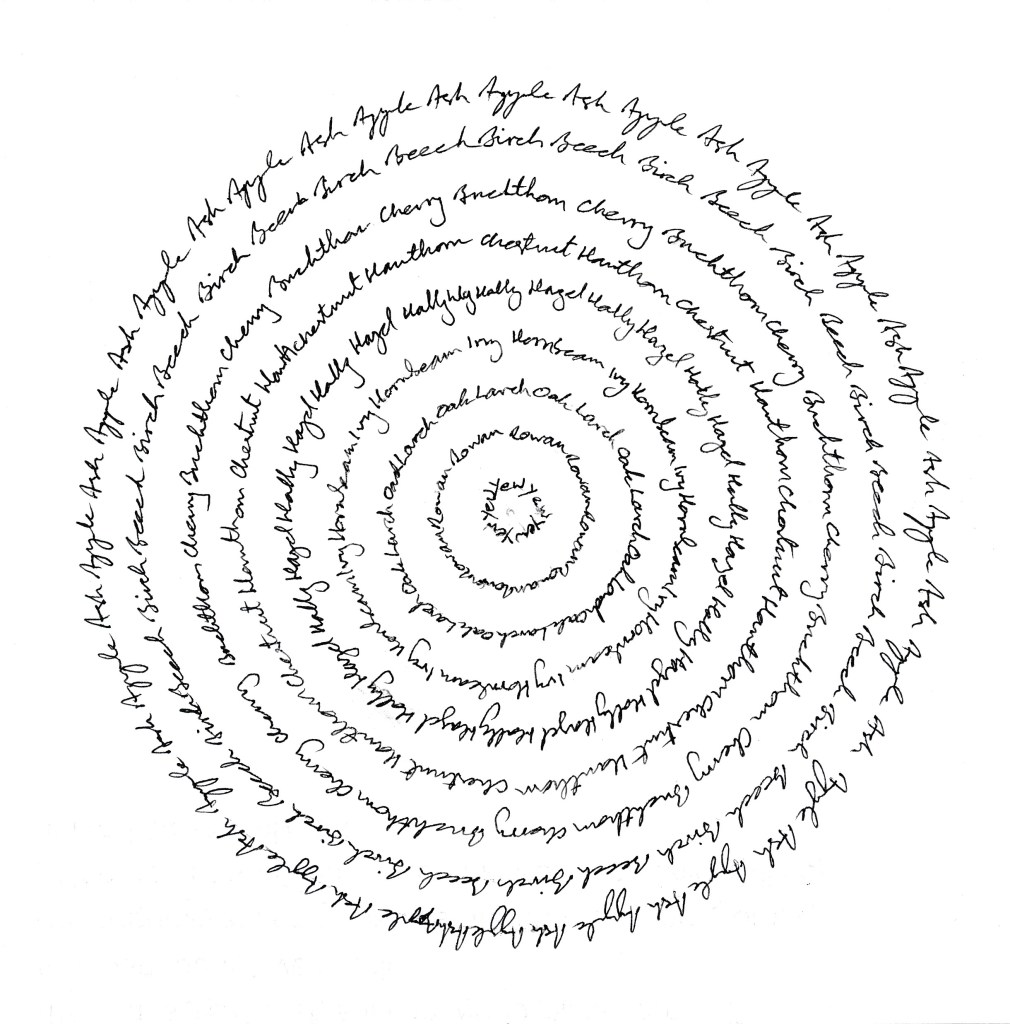
This is a bit rough-and-ready, nothing more than an initial sketch. I do not have any programs on my computer which would enable me to make anything like this so I have simply roughed it out by hand on a sheet of paper. Although in need of further work and refinement it nevertheless serves for present purposes and gives an indication of what might be achieved. As a first attempt I do not think it has come out too badly!
For the bird list I have two ideas. For the first I unfortunately cannot remember where the idea comes from (I thought it was either Richard Long or Hamish Fulton but cannot find any examples of their work that fit the bill). I know though that I have seem similar work before. The idea is to take a map, at fairly large scale, of the immediate area where I live and walk my dog, and put a ring on it, with a half mile radius circle centred upon my house, made up of the names of the birds on the list. (I have not yet had a chance to try a mock up to see how it might work in practice.)
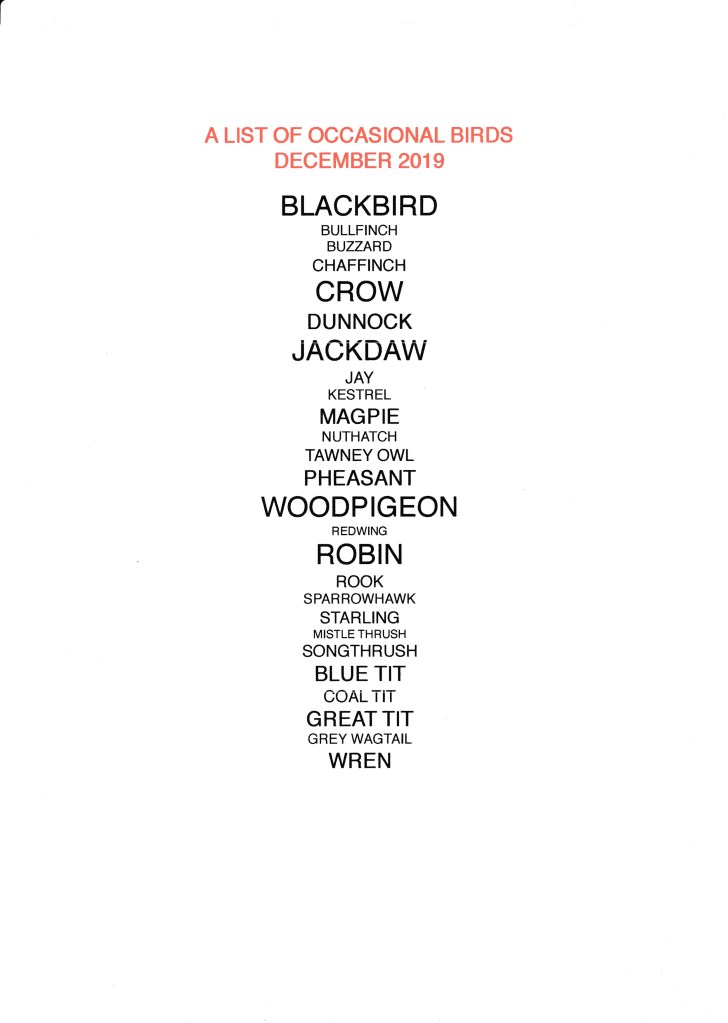
The other is based on Richard Long’s text works: a simple list of the birds but the size of the text varying depending on the frequency of sitings, from abundant as the largest to rare as the smallest. The text sizes are not strictly to scale but simply give an indication of the relative numbers of each species, and of course do not reflect their relative physical sizes. Again this could be refined and worked on further but here is what the first attempt looks like:
Richardson, A, & Skelton, R, (2013). Relics. Newcastleton: Corbel Stone Press
 Mark Robinson's OCA Landscape, Place & Environment Blog
One thought on “Exercise 2.5: Text in art”