I had not thought about it before but I suppose there is indeed a distinction between the works of the likes of Robert Smithson (which I have not seen in the flesh) and that of Richard Long, Hamish Fulton, and others. The polar differences are defined by the permanence or ephemerality of the work: Spiral Jetty still exists, although from time to time either swallowed up by the lake water, or left high and dry as the water recedes: much of Long’s work, such as A Line Made by Walking and his mud paintings (which I last saw about twelve years ago in Edinburgh) now exist only as photographs.
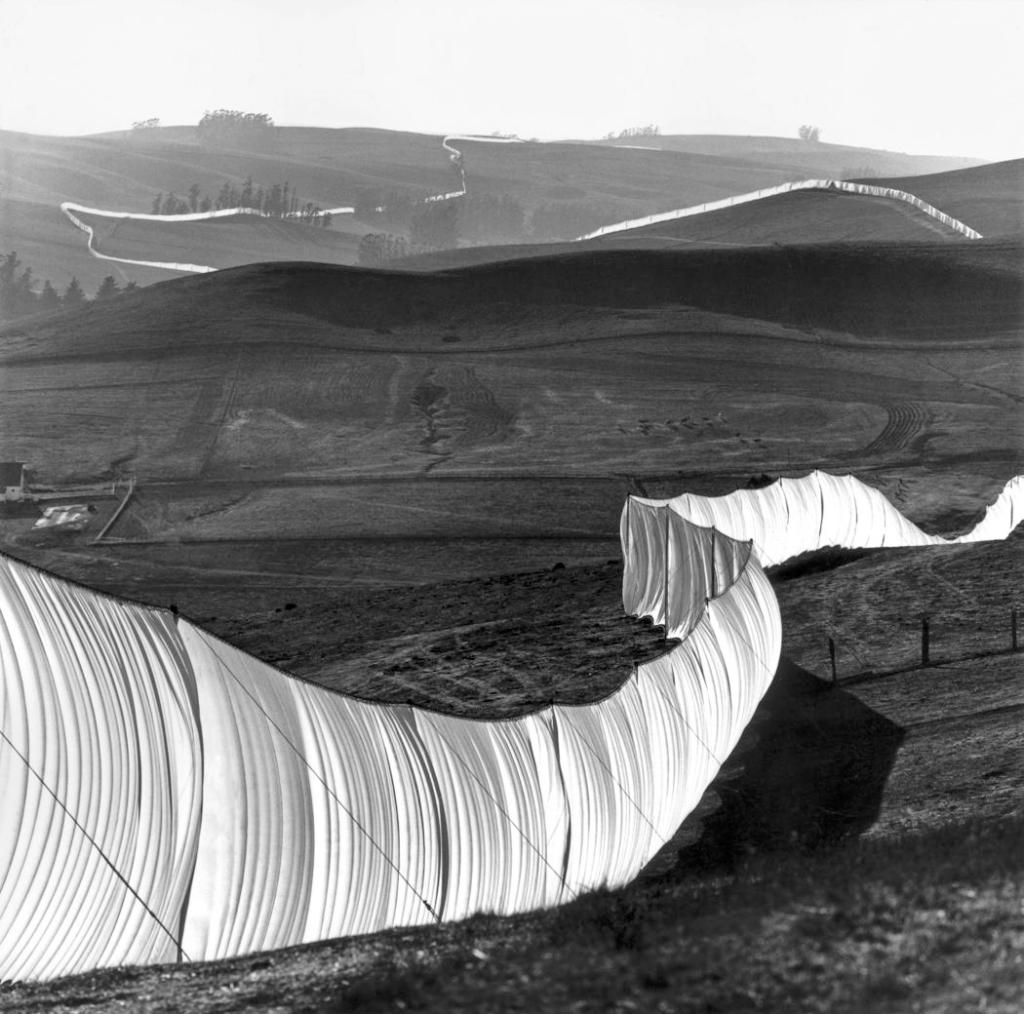
Christo and Jean-Claude are also mentioned in the part of the course material but I would place their work somewhere in between. Certainly it is “capitalist” art, to use Long’s phrase, in so far as these projects are expensive to implement. However their lasting impact on the ground is limited, they sit on more than in or as part of the landscape, and are ephemeral in their installed form – Running Fence, for example, took four years or so to plan and install but was then in place only for a brief time in 1976.
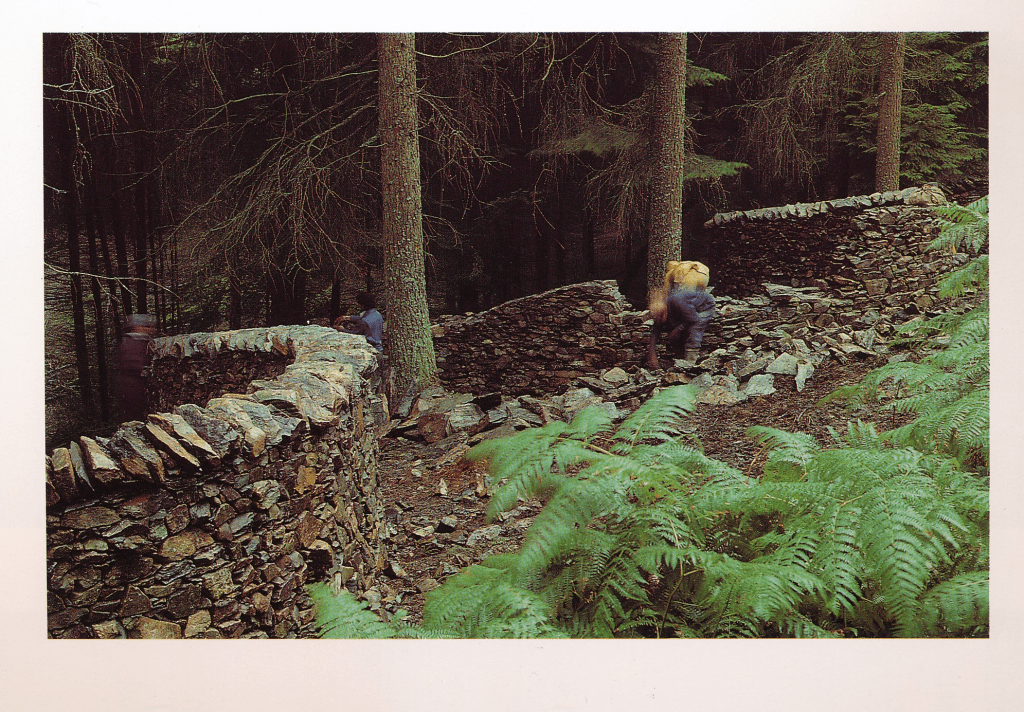
Another artist who comes to mind, much more environmentally minded and drive than Christo, is Andy Goldsworthy. Some of his works remain, such as “Wall that went for a walk” in Grizedale, but many, such as the ice or leaf sculptures, were naturally short-lived and remain now only as photographs.
What I think sets Long’s work apart is the mixture of approaches: physical artefacts both long-lived (gallery installations, painted sculptures) and temporary, some accessible, many not; photography; text; and the conceptual, the otherwise unrecordable activity simply of walking. (One other artist who occasionally mixes the physical with the conceptual that comes to mind here is David Nash. In particular I think of his Wooden Boulder which was both a physical artefact, a large carved wooden boulder, and the conceptual in the form of its journey down stream from Ffestiniog to the sea and its ultimate disappearance.)
It is this conceptual element, the idea that simple activity can itself be art is one of the aspects of Long’s work that I find particularly interesting and it is this part of his approach that has heavily influenced my efforts in the text in art exercise. (https://markrobinsonocalandscape.photo.blog/2019/12/27/exercise-2-5-text-in-art/). It is though also an influence on my thinking for Assignment 2 and the idea that it is the act of performing the journey, rather than for example simply recording the landscape through which it passes, that is important. I am similarly attracted by his use of chance in his work. As he says in the Guardian interview: “I guess I’m an opportunist, really. I go out into the world with an open mind, and I rely to a degree on intuition and chance.” Thesis one of the thoughts that has driven my first experiments with the camera simply pointed through the train window and images taken automatically with the interval timer.
Goldsworthy, A, (1994). Stone. London: Viking
Long, R, (2007). Walking and Marking. Edinburgh: National Galleries of Scotland
Nash, D, (2007). David Nash. London: Thames & Hudson
https://www.theguardian.com/artanddesign/2009/may/10/art-richard-long
 Mark Robinson's OCA Landscape, Place & Environment Blog