Coming back to psychogeography, the last post was written from a mostly literary perspective. Now I want to put down some thoughts from a speficially photographic point of view, taking as a starting point the three photographers mentioned in the course material.
The first is Brassaï. Initially I thought, yes, a psychogeographic photographer. On second thoughts though I am much more skeptical that he was. Certainly he photographed Paris, geographically certainly, and arguably psychologically in so far as he spent a lot of time in pursuit of the demimonde and Parisian nightlife. To that extent he chose the home of modern psychogeography as we know it, and he does have some of the appearance of the flaneur. I do wonder though whether that is really right.
I have difficulty with the idea of him as flâneur to start with not least because his use of a large format camera and magnesium flash does not strike me as being compatible with, let alone practical for, the aimless stroller. What is more he clearly had a certain milieu in mind and went in pursuit of it. It is not as if he stumbled upon his subject matter just by strolling around. On that basis alone I would suggest that Henri Cartier-Bresson fits the bill better, though even then I am not convinced, as I will explain when I come below to the subject of street photography.
The decisive point for me though is that many of Brassaï’s photos were actually staged, carefully posed and arranged, with people standing in for the ‘types’ he was looking for. I had not realised this until I read Stuart Jeffries’s article in the Guardian cited below but it now seems almost obvious when looking again at his pictures. Here is the particular example that Jeffries singles out in his piece (unfortunately not a very good copy but easily findable through Google or Bing Images):
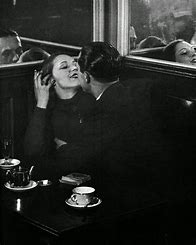
The posing of the figures and the composition, pivoting round the multiple reflections, now seems obviously contrived.
Before moving on I suppose it is worth considering, albeit only very briefly, another photographer of the cityscape of Paris, Eugene Atget, who admittedly is not mentioned. Again I do not think he fits the bill: no flâneury, more of a typological than psychological recording and cataloguing of parts of Paris. The only example of his work that I feel come close are the more surreal, random (?) shots of reflections in shop windows.
What of Robert Adams (whose writing I probably know better than I do his photographs) and his Summer Nights Walking? This I feel is more encouraging.
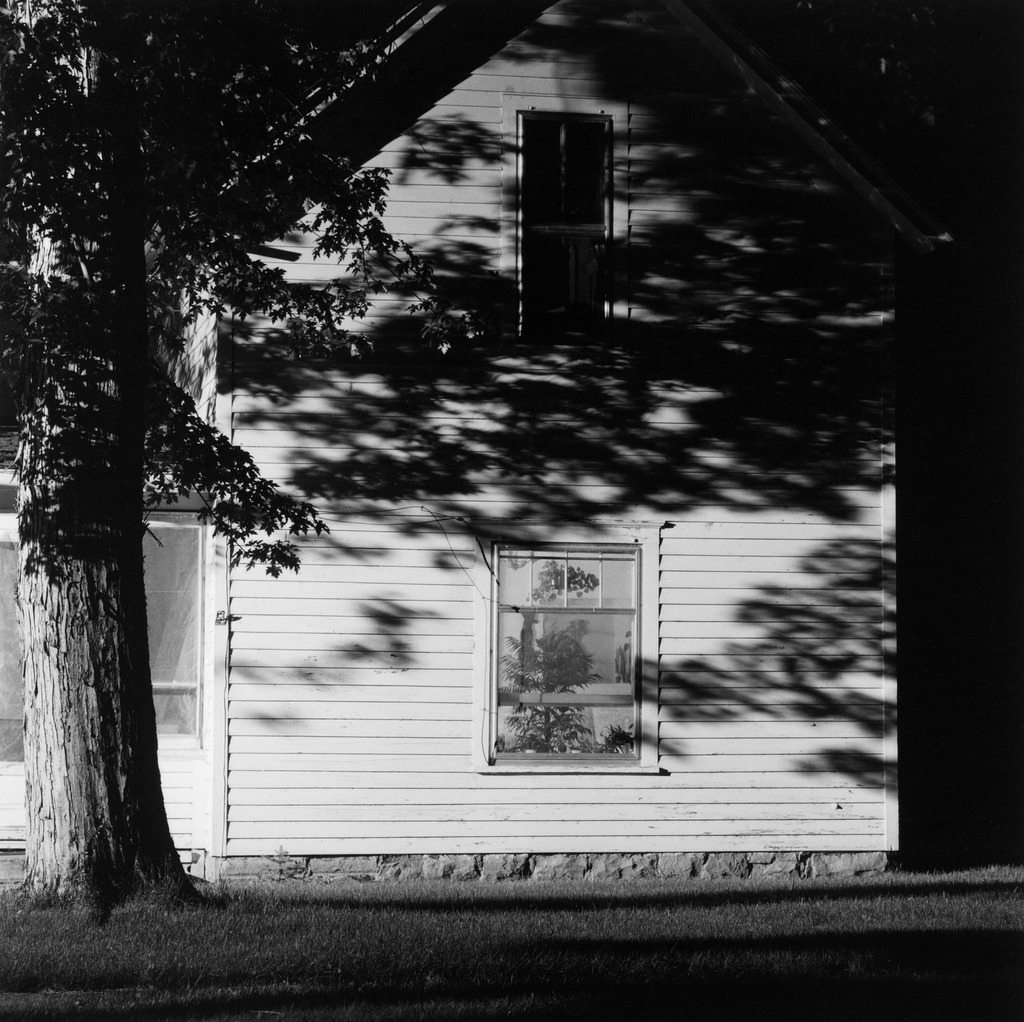
Although these are ostensibly just a collection of topological views taken on nocturnal walks around his home time I do feel they have much more psychological depth. They say so much more about the way of life in this town, which could probably stand as an exemplar of much of suburban America. They say much about the suburban domestic attitude towards night-time. Whereas in Brassaï’s Paris people came out at night to play, here they retreat behind closed doors and drawn curtains. There is almost a sense of menace in these pictures as if the camera, and we the viewers of the photos, are prowlers, looking for an opportunity to get up to no good.
At a superficial level, principally because of their nocturnal nature and the use of lighting, they call to mind some of Gregory Crewdson’s work but none of these seem to me to have the same sense of artificiality and contrivance. Crewdson’s work is often deeply psychological but rarely, to the limited extent that I am familiar with his work, in a specific, rather than generalised, way geographically rooted.
Mark Power’s work is new to me but comes across as the most psychogeographical work that I have looked at so far. There are clear echoes of the subjects written about by Farley & Symmons Roberts (2012) and the sort of places considered by Ian Sinclair. What I get first and foremost is a sense that these are not necessarily psychologically easy place to live. There is a strange almost post-apocalyptic absence of people and some of the places look more like the aftermath of a war-zone.
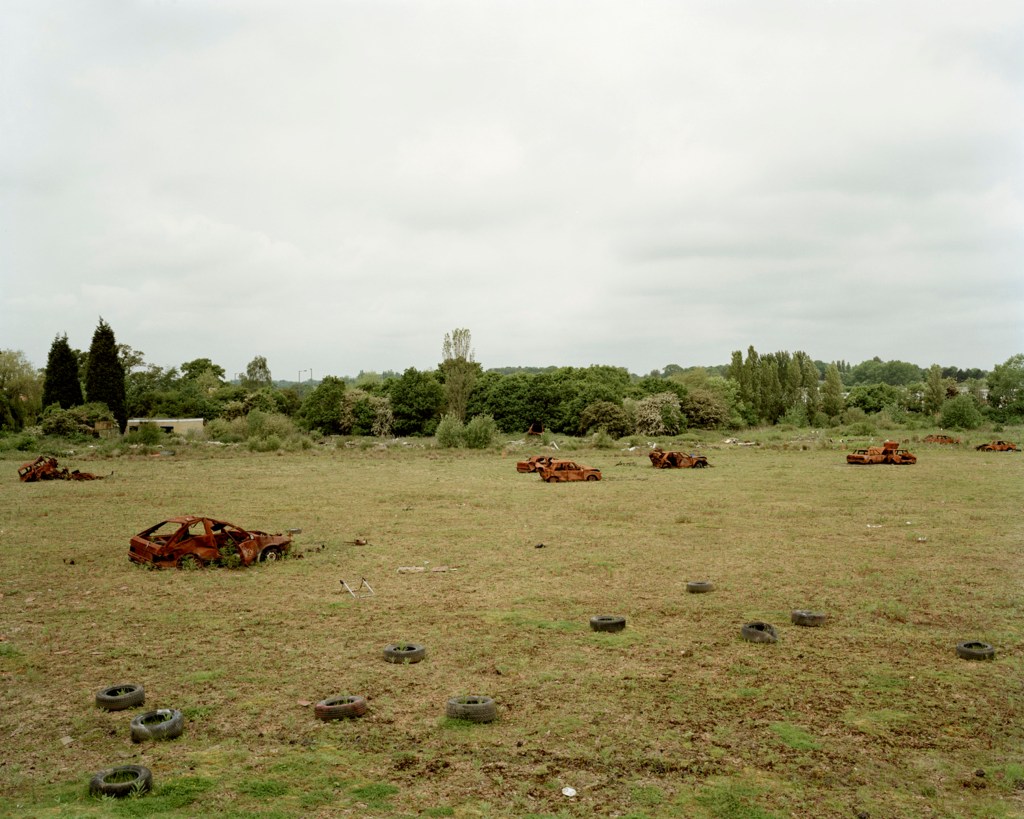
Rarely has an otherwise ordinary suburbia, or perhaps more appropriately exurbia, looked quite as menacing and unsettling.
This has set me thinking in more general terms about psychogeography in photographic terms. For example, where does the broad church of street photography stand in relation to the concept? My immediate reaction is that mostly it does not. So much street photography seems to be more concerned with human activity, and particularly the catching of people unawares, than addressing how they relate to the environment within which they are captured on camera. Coming back to HCB, he seems to be more concerned with capturing that elusive moment (I am not a devotee of the idea of the decisive moment, as I have written more than once elsewhere!), the sudden confluence of events and elements that makes an interesting picture, rather than how that is affected, caused, or influenced by the environment, notwithstanding that some of his work is set in quite specific geographical locations, such as India and China.
Casting my eyes over the bookshelves in my study two artists leap out at me as fitting more closely the idea of psychogeography. One is Guido Guidi. I am not sure about his work in Sardinia and around his home town of Cesena but I do think there is an element of the concept in his work in the Veneto (2019) in so far as he is not just picturing marginal and marginalised areas but how those places, policies of development and land use practices, have affected life there.
The other, more specifically, is Daido Moriyama, with his repeated, obsessive strolling around the Shinjuku area of Tokyo – a Japanese flâneur – compact camera in hand observing anything and everything going on, recording the environment, warts and all, the people, and the way the place affects their lives. There will no doubt be others who also fit the bill but Moriyama is for me the one who stands out most clearly as being the nearest photographic equivalent to one of Debord’s situationists.
Guidi, G, (2019). In Veneto, 1984-89. London: MACK
Moriyama, D, (2017). Daido Moriyama: Record. London: Thames & Hudson
Moriyama, D, (2016). Daido Tokyo. Paris: FondationCartier pour l’art contemporain
https://www.markpower.co.uk/projects/26-DIFFERENT-ENDINGS
https://www.theguardian.com/culture/2001/feb/06/artsfeatures
 Mark Robinson's OCA Landscape, Place & Environment Blog