A few reflections on this part of the course, prompted perhaps more by the two exercises that follow this section of the course material and by some of the reading I did in connection with the Picturesque. Nothing very profound, and indeed slightly random, but nevertheless pertinent to the way my thinking about landscape photography is developing.
Just by way of a preface, it is unfortunate that the video interview with Martin Parr that appeared in the Guardian and that is cited in the course material is no longer available. Though I am not much of a fan of Parr’s work, it would nevertheless have been interesting to hear his take on collecting in general, and postcards in particular. I never did see the Parrworld exhibition when it showed at the Baltic in Gateshead (more than ten years ago now!) and I have not looked at any of his Boring Postcards books so feel that, for all my generally critical stance, I have perhaps missed out on something here.
With that out of the way, I thought I would start with Susan Sontag (1979) and the closing comments in her essay “In Plato’s Cave” (page 24). Whilst I still bridle at the hyperbolic absolutism of her judgment I do find myself broadly in agreement. No, not “everyone is now addicted” to “an aesthetic consumerism”. Perhaps I and people I know are ‘unusual’ in this regard but I do not know anyone who really falls into this catch-all. For many years I did not take a camera with me when travelling. I had got tired of seeing the world through the viewfinder of a cheap camera (starting with a Kodak Instamatic as a child and working up to an Olympus OM-10 as a young adult) and taking pictures that did not really do reality any justice (a bit like the postcards in my last post). What I was missing was the experience of really looking at what was before me. That led me to replace the camera with a sketchbook, which made me look much harder and, although sometimes quite frustrating, was much more rewarding.
One of the things that brought home to me the banality of a lot of tourist photography, and here I am with Sontag wholeheartedly, was a [particular experience I still recall from nearly thirty years ago. On a road-trip through Europe with friends back in the 1980s we visited the BMW museum in Munich (a couple of those friends were real petrol-heads). At the same time we visited a group of Japanese tourists were also there. (I am most definitely not singling out the Japanese here. They could have been any nationality. They were just more noticeable as at that time I had not encountered many people from East Asia. What was most striking was that a number of them took pictures in front of almost every car on display. The pictures though were not of the cars but of the rest of their little group standing in front of, and in all likelihood almost completely obscuring the exhibits. Although again I do feel that Sontag somewhat overstates her case, I nevertheless do think this was an interesting example one of her comments:
“Ultimately, having an experience becomes identical with taking a photograph of it, and participating in a public event comes more and more to be the equivalent of looking at in photographed form.”
For these tourists the experience was not of looking at some old cars but of having their photographs taken while standing in front of them.
I guess this phenomenon continues today in up-dated form, but essentially the same thing, with the ubiquity of the smart phone and the compulsion (which, at the risk of indulging some Sontag-like hyperbole, seems almost pathological) to take the wretched “selfie” in front of whatever the tourist is ostensibly there to look at and experience.
I think I have since got over my former aversion to travelling with a camera (not that I do much travelling now) but am certainly a lot more considered about when I press the shutter as a tourist (as opposed to someone pursuing a particular photographic project). And yes, I do still sketch a little as well, though not as much as I used to.
Gilpin’s ‘pioneering’ work (1789) as a guide for tourists came back to mind when I read a little of Wells (2011) (around page 90) prompted by the course material. The tourist photographer is effectively being shepherded into particular places for the specific purpose of taking photographs. The tour bus stops at the local “beauty-spots”. Ordinance Survey maps still include a symbol identifying places from which to view picturesque scenes. I was reminded of a photo by Magnum photographer Raymond Depardon:
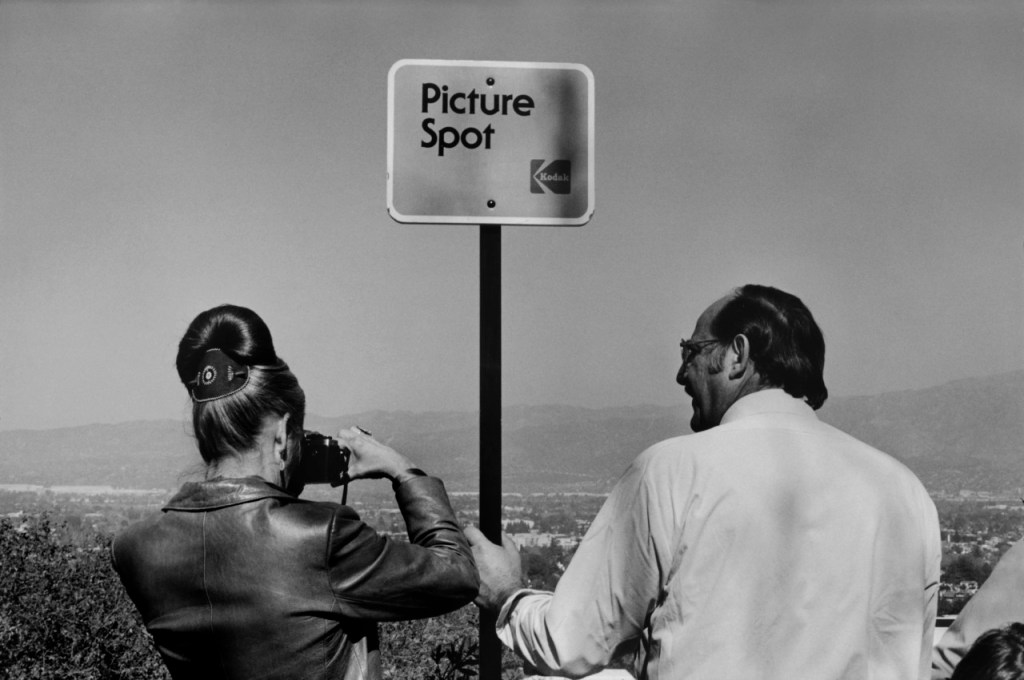
Perhaps not surprisingly the photographic industry, in this case film and consumer camera manufacturers Kodak (as I have said above my first camera was a Kodak), got on the bandwagon and erected their own signs. Says it all really about the consumerist commodification attacked by Sontag.
Going back to Wells and to Snyder in Mitchell (2002) and their narratives of the development of commercially available photographic images and a consumer market for them, struck a chord when I embarked on the postcards exercise. As I indicated then, I rarely if ever receive postcards now and if I do they tend to be of works of art rather than places. Given the proliferation of smartphones and cheap digital camera I had therefore expected that it would not necessarily be easy to find any decent contemporary postcards that would serve for the exercise. In that respect I was not surprised that I only found one shop in Hexham selling any (though that has to be caveated by the fact that there were a number of possible outlets that I did not get round to visiting). What did surprise me though was to be told by the ladies working in the shop in question that they actually sell a lot of cards. Not just a few but, in their words, “lots”! Apparently there is still a market for these things and my little corner of the world does attract quite a lot of visitors (Not too many: Northumberland is known as “The Hidden Kingdom” and we would like it to stay that way; but enough to support the local tourist economy.) Indeed, the first question I was asked was whether I was there on holiday! These factors then led me to speculate whether the relative health of this particular market for postcards might actually be a demographic issue. Again not at all a scientific analysis, but my guess is that a majority of the visitors we get, particularly in the local towns, as opposed to the wilder reaches of the county (Hadrian’s Wall, bits of the Pennine Way, the Cheviots) tend to be more ‘mature’ (which does not necessarily mean old!) Are they, I wonder, of a generation that is less likely to spend all their time pointing their phones at the sights and not into selfies?
Whatever the explanation might be, it would appear that there is still, possibly against the odds, a market and a life for the picture postcard.
Gilpin, W, (1789). Observations on the River Wye, and Several Parts of South Wales. London: Blamire (Gale ECCO facsimile reprint)
Mitchell, W.J.T, (ed) (2002). Landscape and Power. Chicago: The University of Chicago Press
Sontag, S, (1979). On Photography. London: Penguin
Wells. L, (2011) Land Matters: Landscape Photography, Culture and Identity. London: IB Tauris
 Mark Robinson's OCA Landscape, Place & Environment Blog