Before moving on to the next exercise, 3.4, I thought it might be useful (for me at least) if I was to record some responses to the work discussed in this part of the course material. I do not intend to pick any of it apart in detail but just to record some thoughts, not least because I have already spent some time looking at some of this work, particularly Mitch Epstein and Dana Lixenberg.
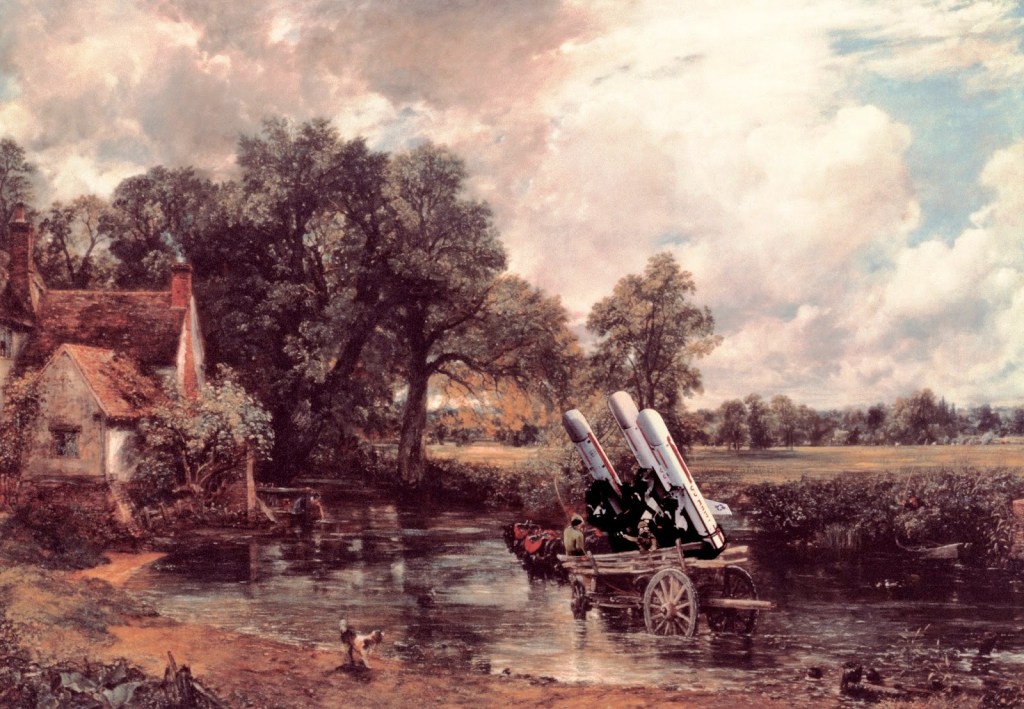
Starting with Constable and Kennard, I have a slightly different response to the Cruise missiles than Wells (2011) suggests because I take as my starting point the social, agricultural, background described by Andrews (1999). What Constable painted was an imagined, constructed, “remembered” ideal of a mixture of rural past and present that never really existed. I see Kennard’s work as being less a comment on the threat of the physical destruction of an “ideal” England, rather than Britain, (what about the other hapless countries that form part of this benighted Union that might also have been bombed to bits?) than the threat to an “idea” of England, an England that is more fiction than fact.
What I also get is that the threat is not necessarily from the former Soviet Union but from a so-called ally. By the 1980s the “threat” from the East was arguably more illusory than real and the bigger danger was presented by the paranoid bellicosity of the Americans. The Eastern Bloc was already under considerable strain and that decade of course saw its ultimate failure. What made the possibility of military action more possible (if not necessarily actually very likely) was the aggressive posture of the Americans in particular in positioning Cruise missiles in this country and 108 Pershing II missiles in West Germany. We now know that it was the Warsaw Pact countries that were afraid that they were about to be attacked by NATO rather than the other way round! I do though of course fully accept that this view has benefited from the hindsight offered by the last thirty years or so.
What I get from the picture in this context now is a comment on not just the perceived threat of physical annihilation by nuclear war, which was a very real fear at the time, but the threat to a wider sense of “English” (I deliberately use the word instead of British) identity and independence, an imagined sense of Englishness being subsumed by an increasingly American dominated Western culture, (not to mention power-politics). The point is, I suppose, that I see the threat coming from a completely different angle!
Which I suppose leads nicely on to Mitch Epstein. As I have mentioned elsewhere, I first became aware of his work back in 2009 in an article in Granta. Subsequently, my I&P tutor suggested him as a further research source right at the end of that course. I have subsequently bought a copy of his book (2011) and I thought I had already written specifically about it but it appears that I have not. I must come back to him properly in due course. For now though I just want to comment on his work in the context of my thoughts on Constable’s painting.
Going back through the book, and rereading the afterword it struck me there is a parallel between how I see Kennard’s work and how Epstein sees the US: as he puts it (last page), “while America teeters between collapse and transformation. The siting of Cruise missiles here was in some ways an act of paranoia and a surrender of national sovereignty to an “ally” and its huge military-industrial complex (how ironic that it was Eisenhower, general and latter day politician, who coined the phrase). What Epstein’s work shows is not just environmental peril, and perhaps perceived or imagined military threats, but a pervading sense of hubris. The country has driven itself to the brink with the idea of Manifest Destiny, which drove so much of the expansion into the west, with its concomitant, quasi-religious “right” to exploit the earth’s resources. But I feel it goes further than that. It is not just those environmental and other threats that are at work but internal, home-grown, fears and paranoia: look at the old lady with the security cameras and her gun, the repeated interventions and harassment of Epstein by corporate security and their neighbourhood proxies, the forces of local “law” (for which read, the most powerful corporate rather than constitutional) enforcement. Both sets of work, in this context, seem to me to be as much, if not more, about the destruction of landscape, a sense of belonging, a sense of nationhood, being driven from within society, the nation, itself and not just being the result of malign external forces.
Lastly for now I will just touch on Edward Burtynsky. I am not familiar with his work to any great extent and am going to need to get to know it, and him, better. Unfortunately the link in the course material to the interview about China is no longer available on the LenCulture site and I have not otherwise been able to find anything on Soundcloud that might replicate it. I am therefore going to need to do some more digging to get a proper handle on his work. For now though it is illuminating to look at the quotation on the home page of his own website: “[we] come from nature.…There is an importance to [having] a certain reverence for what nature is because we are connected to it… If we destroy nature, we destroy ourselves.” Here again we have, though this time on a global scale, danger and destruction coming from within, and not some real, or more likely imaged, enemy without.
Otherwise I would just comment from a purely aesthetic point of view that, although his images have considerable impact, not least because of their scale, they do not greatly appeal to me. I have a similar problem with, for example, and without wishing to be unfair by singling him out now, Andreas Gursky. The problem I have is that it al seems that bit too remote, too disengaged. In this sense I feel that Epstein’s work is, although some of it quite panoramic, much more closely engaged physically with his subjects. He was certainly more closely engaged so far as the harassment he encountered is concerned.
I am going to come back to Dana Lixenberg separately in a later post. I feel her environmental work is worth a separate look in its own right and I want to familiarise myself more with The Last Days of Shishmaref before commenting on it. (The link in the course material no longer works. Indeed it appears she no longer maintains a personal website and relies instead on that of the Grimm Gallery, which unfortunately does not have much to say about that particular project. I have therefore been tracking down a copy of the book itself and do not have it yet!)
Epstein, M, (2011). American Power. Göttingen: Steidl
Freeman, J, (ed), (2009). Granta Issue 107. London: Granta Publications
Wells. L, (2011) Land Matters: Landscape Photography, Culture and Identity. London: IB Tauris
 Mark Robinson's OCA Landscape, Place & Environment Blog