I am going to start with two images that I heartily disapprove of. Both are from BP adverts and are, in my view, little more than ‘greenwashing’
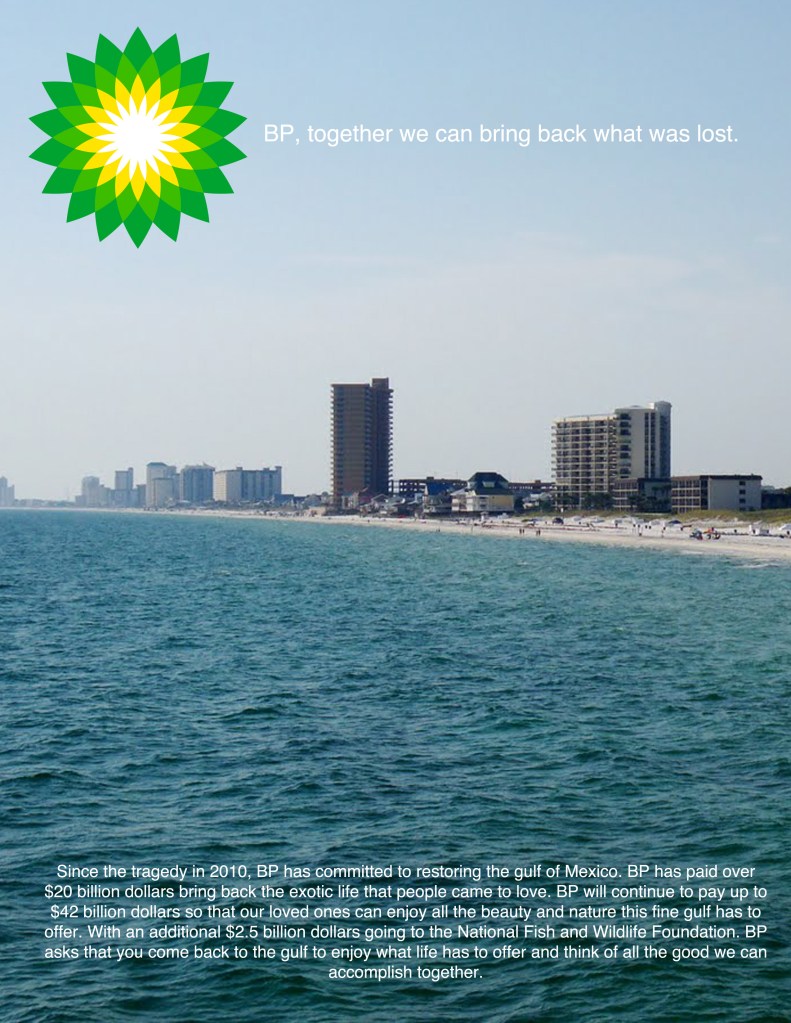
This is the first, a post-Gulf of Mexico disaster ad. The image itself strikes me as strangely bland showing some blue sea, a strip of beach, and a smattering of what I assume are holiday apartments and hotels. That part of the image is overpowered by the big BP ‘sun’ logo, which is the most visually dominant part of the whole confection. That logo itself is offensive enough in its own right, a mix of sun and sun-flower – naturally available power in the form of the sun and a widely recognised ecological movement symbol in the form of the flower. Yet BP is inseparable from finite and polluting fossil fuels.
The text is all the more offensive. On the one hand the message is everything will be ok because we, BP, are pouring so much money back in. That in itself will not, can never, fully ameliorate or reinstate what has been lost. And anyway, where is the money coming from? The continued exploitation of fossil fuels that are at the heart of the problem to start with, and us the public who still to a considerable extent need to rely on their products. Also, note how they use the word “tragedy” rather than the “disaster” it really was. This is a sly way of saying, “it was not really our fault”.
The other is come back to the Gulf so that we can do good together. Again the burden is to an extent being pushed onto us. There are not that many people visible in the photograph. Presumably what BP wants is for us to see more, and that this would indicate a recovery in the environment. This is of course rubbish. Although an increase in tourism would benefit the local economy it is not the answer. More visitors mean more development – imagine a more densely developed skyline – and significantly more pollution.
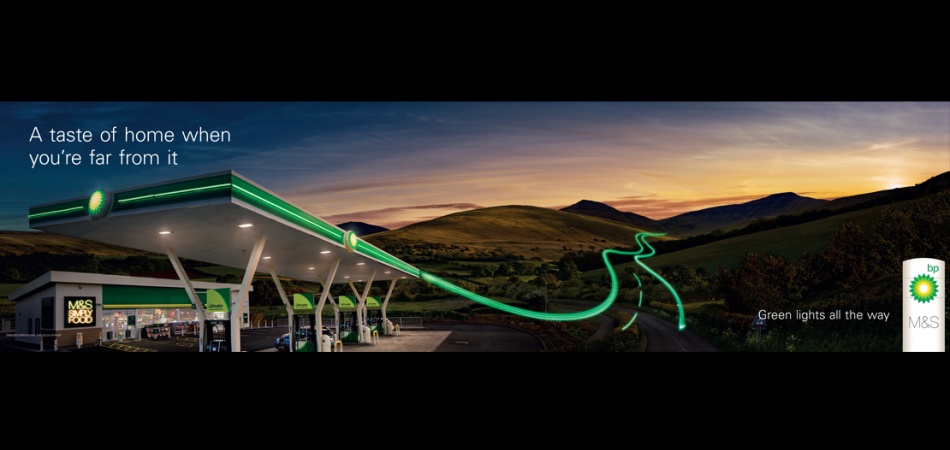
The second is also a product of the hapless BP. A clever ploy, teaming up with national treasure (though somewhat ailing) M&S, with the message that although you are away from home you can nevertheless eat as if you were at home (lots of people depend on M&S for their food shopping), while you fill up with BP fuel to get you home to the real thing. (As an aside, have you noticed how on motorways in particular and other major routes BP are more often than not the most expensive petrol stations with prices significantly higher than they would be elsewhere? “Were are being nice to you by joining ups with M&S but we are still going to rip you off!”)
“Green lights all the way”? AS if you are not going to suffer any hold-ups if you use BP feel? More greenwashing! And note how, and I think this is seriously misjudged, the ‘green lights’, presumably intended to eco cars’ lights, actually in this case run across country rather than sticking to the road. “Not only are we ripping you off but we are also riding rough-shod over the environment.”
My third example is one that I have referred to and written about before but is one that I keep coming back to and still has resonance for me, Fay Godwin’s The Duke of Westminster’s Estate, Forrest of Bowland, 1989:
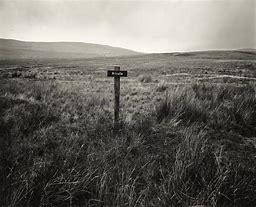
This is all about how land ownership is concentrated in the hands of a relatively small number of people and that it is used in an exclusionary way. Unfortunately the text is not clear in they particular specimens but the sign simply says “Private”. The message is clear and very simple, “this is my land, keep off it”, and her portrayal of it is far from approving.. Godwin did a lot of work based on this theme as a form of protest and resistance. I had not realised until I looked at the videos about Godwin while working on the Picturesque exercise that she had been president of the Ramblers Association and so was doing more than just taking photographs to illustrate and publicise the problem but also taking direct action, putting boots on the ground. My admiration for her and her work has only grown!
 Mark Robinson's OCA Landscape, Place & Environment Blog