I am going to start this section by looking just at the work of John Davies and to think about the observation made by Liz Wells (2011, at pp 170-1) quoted in the course material. In particular what I want to think about is whether or not I agree with Wells’s assessment. Does he teeter on the brink of the Picturesque at the expense of his political message?
Looking back at my earlier reflections on the Picturesque (https://markrobinsonocalandscape.photo.blog/2020/01/16/exercise-3-1-reflecting-on-the-picturesque/) I have to say that I am not at all sure that Davies applies picturesque modes as Wells puts it. I still to a large extent associate notions of picturesque with a sense of an ideal, more imagined than real and attempts to portray a landscape as complying with those notions. I really do not get this from Davies at all. As with Fay Godwin, I do think that some of his work might be described as Romantic, but again with a no-nonsense, hard, realistic and political edge and intent. Certainly there is a sense of pictorialism, in particular with what Wells describes as his Turneresque skies. I am though not convinced that the application of a pictorial aesthetic necessarily makes the images picturesque. Another artist who comes to mind who has produced some particularly dramatic skies in his landscapes, manipulating his negatives and prints in the darkroom, is Don McCullin. (I have to say I sometimes think he went a bit too far.) What I do not think you could seriously say of his work is that it is picturesque, and I am very much of that view when it comes to Davies. If anything, as with Turner’s dramatic skies, I think the effect owes more to a sense of the Sublime than anything else.
Looking in particular at his most recent book (2019) I do not feel that the political impact and importance of his images is at all diluted. On the contrary, they demonstrate graphically how the industrial heritage of this country, upon which much of its wealth was based, has been lost, indeed systematically and wilfully destroyed (think of Thatcher and the miners) and replace with something more insubstantial and ephemeral. I do not have the feeling he is looking back with a sense of nostalgia. Let us face it, much of the industrial landscape was grim, at best unattractive, and the lives of those dependent on the old “dirty” industries were hard. HIs juxtapositions of before and after photos do though raise questions about some of the changes, whether they really have, in the long term, always been for the better, whether the economic realities of today better, easier, today – something I very much doubt for significant portions of the population.
I can see that his distinctively pictorial style (I have no problem with that) can mean that his political message is not necessarily trumpeted loud and clear. That though is not to my mind a bad thing. I am happy that he has to an extent left it to the viewer to form her or his own view and judgments. I do not though share the view that this exposes him to the risk of veering into the Picturesque.
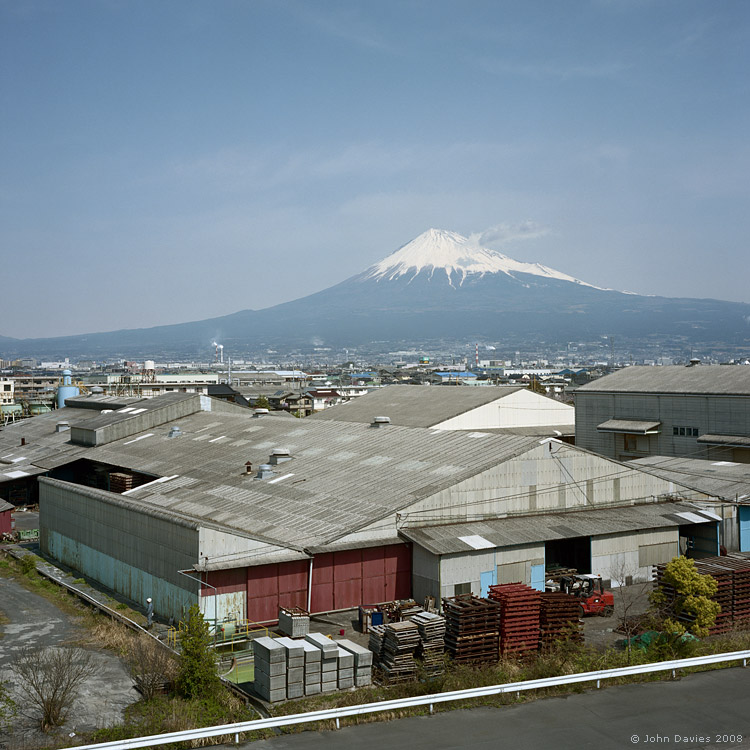
My views on his work are very much reinforced by something that I recently came upon quite by chance, a sequence of images that he made in Japan in 2008. (These appear on his website but I found them as part of the book (2008) cited below.) Despite his usual modus operandi, using black and white film, these are mostly in colour, which gives them a very different and particular effect. They are a sequence of images of the heavily urbanised and industrialised area of Fuji City, in the shadow of the iconic volcano Fuji-san. They do not follow the same before and after format but nevertheless there are similar things going on in them, particularly with his use of pictorial conventions. With these pictures he is saying something about the place of “order” in Japanese culture and society. The industrial landscapes he illustrates are therefore very “neat”, indeed ordered, even tidy. I do not think though that they could really be described as picturesque. Ordered but not particularly attractive. (This remains for me one of the puzzles of Japanese culture: a sense of beauty and natural order is so important but huge swathes of the country have been built upon and developed and nature has been organised, channelled, hemmed in.)
The pictorial convention comes in the form of the appearance in the background of the mountain in the background. There was a tradition amongst Japanese printmakers, and I think particularly of Hokusai and his Thirty-six views of Mount Fuji (Fugaku Sanjūrokkei), of depicting a scene with Fuji-san in the distance. Pictorial but not picturesque, as this example demonstrates:
Davies, J, (2019). Retraced 81/19. London: GOST
Kikuta, M, & Kodera, N, (2008). European Eyes on Japan – Japan Today vol. 10. Tokyo: EU-Japan Fest Japan Committee
Wells. L, (2011) Land Matters: Landscape Photography, Culture and Identity. London: IB Tauris
https://www.michaelhoppengallery.com/artists/123-john-davies/overview/#/artworks/11117
 Mark Robinson's OCA Landscape, Place & Environment Blog