I have to confess I am not really interested in advertising, indeed am deeply sceptical of it and pay it very little attention. I cannot therefore say that I enjoyed looking at much of the images suggested by the course material. (Not helped by the fact the Tim Simmons link appears to be bad and I could not find anything about the billboards on his website. The ads-ngo reference was also a bit of a mystery as I could not find any examples of parody ads: has the site moved on and changed since the course material was written, I wonder?)
What I did find interesting is Richard Prince’s work (which I have come across before) and revisiting Roland Barthes. In the case of the latter there is for me an interesting example of the unreliability of memory, relating to his Mythologies book (1972). I have a very clear mental image of owning a copy of this book. I remember the colour of the spine and the lettering on it; I can picture it sitting on a shelf next to his Image Music Text and The Pleasure of the Text; I remember reading it nearly thirty years ago. But where is it? I cannot find it anywhere in my library and it does not appear in my catalogue of the library. Did I actually own a copy? Did I but has it gone West somewhere along the line? Or have I just imagined it? Whether real or imagined I now have a pdf copy on my computer!
Having now (re)read Myth Today section (pp 109 ff) I was wondering what to say about this aspect of semiology, which he also writes about in the later book (1977, Change the Object Itself: Mythology Today, pp 165 ff), the concept having moved on in the intervening years, and how to express it. It then occurred to me that Prince’s work with the Marlboro adverts is actually quite a good example of what Barthes was talking about, and it fact made it easier for me to understand Barthes’s argument, which although very lucidly written, is still a bit dense to take in fully with just one reading. The course material itself even uses the word “myth” in discussing his work.
As the course material succinctly puts it, myth “takes into account the viewer’s existing contextual knowledge that informs a reading of the image. This, it seems to me, is what is at work in Prince’s work. Having removed the explicit context from the original adverts, having taken out the text and brand logo, the viewer is left to read the images in the light of their own knowledge and experience. In Western, European, culture, that knowledge is possibly fairly universal and consistent. Anyone who has ever seen a cowboy movie will bring a similar set of experiences, beliefs, memories, ideas, to a reading of the image and so imbue it with that second level of meaning that goes beyond mere signification.
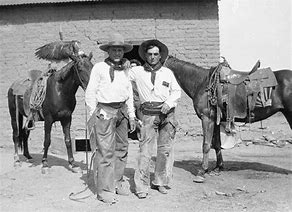
Barthes was of course writing about myth as a system of communication, a message. In its English dictionary definition though it has also taken on connotations of widely held but false belief or ideas. The myth of the cowboy, that the cigarette company and Prince were playing with, exploiting, fits nicely within that form of meaning, adding an extra layer of richness to a Barthesian use of the word. The idea of the cowboy that most of us carry with us is of course made up, largely by Hollywood and the movie industry. The very ‘look’ of the cowboy is made up, a relatively modern construct. If you look at contemporary photographs from the end of the 19thcentury, early 20th, such as the work of Erwin E Smith (easily findable on-line with a Google search) their ‘look’ is quite different, much more dated and ‘old-fashioned’.
With those thoughts in mind, what now occurs to me is that all these glossy car adverts that the course material talks about, are using “myth” in both these senses. But what appears to me to be particularly significant is that to an extent they are actually helping to form the viewers’ contextual knowledge, rather than relying on or exploiting what is already there, and it is this that perhaps I find particularly pernicious about advertising in general.
Barthes, R, (1977). Image Music Text. London: Fontana Press
Barthes, R, (1972). Mythologies. London: Jonathan Cape
 Mark Robinson's OCA Landscape, Place & Environment Blog