I thought for this exercise that I would have a look at an advert in a photography magazine and see where it goes. I have chosen an ad from the company MPB who specialise in the buying and selling of quality used equipment (I have had various bits of kit from them over the last few years, including a Leica – M type 240 – which is relevant to this particular advert) that appeared in the British Journal of Photography a couple of issues ago. As an aside, it is interesting how little advertising the BJP carries, which is something of which I approve! Another reason for choosing this ad is that it works with both text and image.
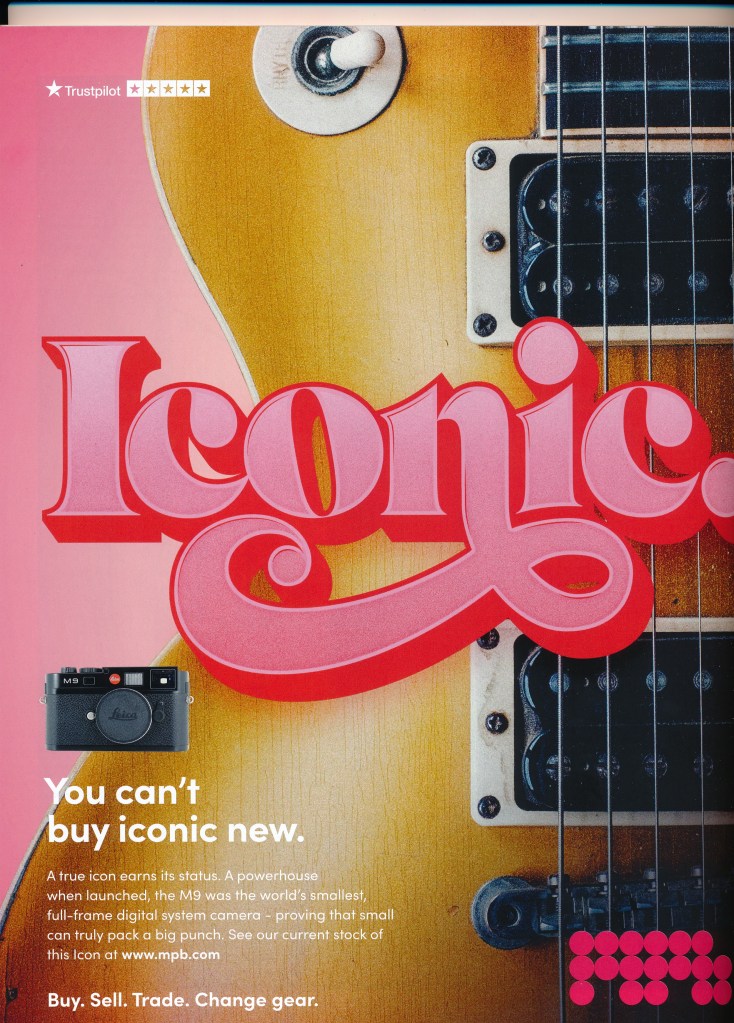
As I read this I see four primary Signifiers: the camera, the guitar, the two bits of text – “Iconic” and “You can’t buy iconic new”. From these I get a number of Signifieds: these are things that you cannot simply go out and buy, they are no longer made; they are design classics; they are likely to be expensive, and so all the more desirable; you are clearly a person of discernment and taste, not to mention means, for being interested in such items; you are an “artist”, or at least take artistic activity and endeavours seriously; you are possibly quite good at what you do – photography and/or music, but really any artistic practice – for you to consider such an item; although expensive these are quality products designed and built to last a life-time, and if anything improve with age – note the cracking of the varnish on the guitar, signs of wear and dirt, a patina of use and age that shouts “quality” – and so are actually good value, an investment; by buying and using such a camera or guitar you can be up there with your heroes, “standing on the shoulders of giants”.
Another point that is significant here from the point of view of Signifier and Signified is that the image of the camera is really quite small, taking up only a tiny portion of the page and dwarfed by the guitar, and the text emphasises the compactness of the camera. The message I get here is that with this camera you can be discrete, tasteful even, not having to flaunt your taste or means.
There are no doubt more SIgnifieds that could be read from this image but that is probably enough for now.
What I particularly like about this advert is the way it also works with and depends on Barthes’s idea of myth. To get a full meaning out of the image you need to take account of existing contextual knowledge. You need to know, for example, what the guitar is, a Gibson Les Paul – there is nothing explicit in the image to tell the viewer this – (I am not enough of a guitar geek to know which specific model this is, but that is not to say that I would not quite like to have one), and that this is a classic and desirable instrument. You also need to know the significance of the camera. It is interesting that “Leica” is not referred to by name in the ad, appearing only on the body of the camera in the classic red dot, and on the lens cover.
At a literal level there is of course a ‘myth’ that Leicas are in themselves superior cameras, with a rich historical background and pedigree. I have to confess that this myth is a very strong and attractive one. I know because to an extent this myth, and all the Signifieds identified above, led me for quite some time to aspire to owning a Leica. I now have two: the digital M; and an almost 60 year old M3 (35mm film). (And no, they were not very expensive, both bought second-hand and no more expensive than any of the current crop of good new digital cameras.) They are great to use and their optical qualities are first rate but I have to accept that they are not to everyone’s taste and there are plenty of other cameras that perform as well and do some things better (I still use my old Canon dslr for a lot of work). And no, they cannot in themselves make you a better photographer! They certainly do not make me a better photographer. I just like using them.
 Mark Robinson's OCA Landscape, Place & Environment Blog