While waiting for an opportunity to get out and start shooting this project (I have been rather frustrated by recent bad weather and too many other things to do when the weather has been reasonable) I have been doing a bit more research, in particular looking at the “New Topographics”, among others, which has led to some interesting conclusions and raised some further questions.
I have not looked much again at the Bechers notwithstanding they were part of the New Topographics show. This is not because I do not like their work, as I have written elsewhere more than once I do, but simply because their overtly and deliberately typological approach does not really help me with this project. They would have been relevant if I had intended to photograph different examples of the same type of building, as with Jethro Marshall’s village halls, but instead I am looking at a range of different buildings within the one village.
Putting aside my disagreement with Baltz’s views on the nature and function of landscape, and Adam’s notion of Form, I have looked again at both of their work but have found that neither really adds anything to my current thinking. I find that Baltz’s exaggeratedly deadpan aesthetic, though I quite like it in its own right, does not really fit with what I want to explore here. What I am interested in is the human intervention in the landscape to make otherwise non-descript spaces places with a particular significance. His approach is just that bit too blank for my purposes.
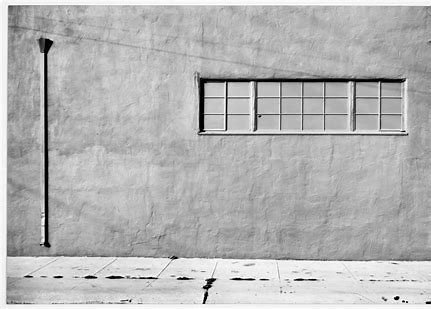
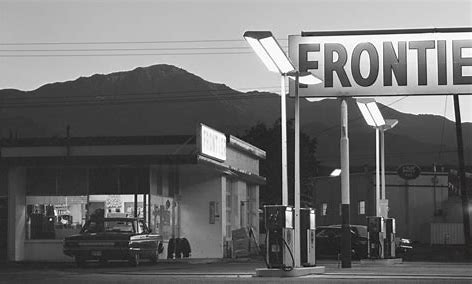
I have a similar issue with Adams’s work. Some is more closely related to what I am after, such as his gas station images, but I have already formed my own views in the light of the work of Ed Ruscha and Toshio Shibata, as I wrote in my first post on this project (https://markrobinsonocalandscape.photo.blog/2020/05/03/exercise-4-6-proposal-for-the-self-directed-project/).
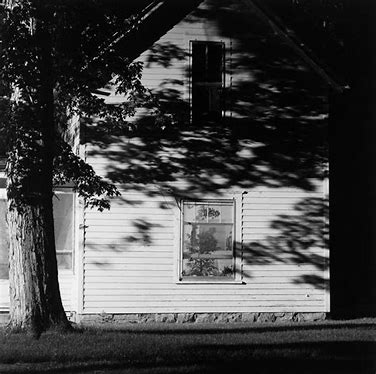
Otherwise, again much though I admire, for example, his night-time suburban images, they do not really take me any further forward.
Much of his rural landscape work, even where it shows signs of human intervention, is a bit too empty for what I am after, simply because the countryside that he worked in was itself so empty!
Taking the New Topographics as a starting point, I have also looked at some of the New Düsseldorf School, such as Struth, Ruff, and Gursky, but again do not feel that I gain anything useful from them. Gursky, for example, is certainly deadpan, but the monumentality of many of his images, both the subject matter and the physical photographs themselves, are a little off-putting and not really relevant to the much more domestic scale of my project.
This leads me to a couple of thoughts on research generally. In the case of this project the explicit, direct, conscious influences have been few, as I have already identified (Ruscha, Shibata, Ohashi, and now Marshall). I have to recognise though that there might well be other influences operating at an unconscious level, which quite possibly includes the New Topographics. I suspect it is inevitable that when you look at so much work, so many images, as we are doing on this course, it is hard for them not to have an effect at some level. The other thought is actually a question: how much does research help in reality? In so far as there is an unconscious influence, I do not doubt that it does. I do though wonder about the extent to which it has a conscious impact in the case of the project as I have conceived it. The point is that I have started with a particular idea, a development of much of the work that I have done for this module and in particular Assignment 2, and it is that idea that determines how I need to approach this work and what it should look like. Arguably therefore, even the conscious influences are not in themselves that significant. I think that research is important, even vital, even if only to set one’s own work into a wider context, but it is not necessarily a substitute for, and certainly not a bar, to coming up with original, personal ideas ab initio. I suppose the point is that it important to develop one’s own voice and not simply to follow what others have done in the past, or are doing now. Be aware of the traditions and wider context but find one’s own place with them.
The other thing that I found myself thinking about was the notion of “schools” in art generally. Can the artists featured in the New Topographics show truly be said to belong to a particular “school”, a conceptual style, of photography? Did the Bechers, Baltz, and Adams, for example, really have that much in common from an ideological or aesthetic point of view? Is it more a case of a curator creating a framework within which to collect and exhibit varied bodies of work? Certainly, it seems to me the Bechers have been doing something quite different, ploughing their own particular furrow. I do not see much of the same typological approach in the work of the others. Flicking through Wolf (2019) again it is striking how many of the artists interviewed do not seem to identify with any particular school, genre, or style, simply getting on with the work they need to do without having to carry the shackles and burdens of categorisation? Is it a case of curators, and critics, commentators and academics (let us not go near the theorists for now) trying to impose categories, structures, genres, on disparate bodies of work to meet their own practical or theoretical, ideological, needs and agendas? This is a much bigger topic than I want to get into in any depth at the moment but I am much inclined towards such a view. This is not to dismiss such an approach out of hand, but as I have indicated before I am inherently suspicious of, if not actively hostile to, efforts to pigeon-hole artist and their work, to fit them into categories not of their own making. I am wary of “isms”. Art, in all its forms, is too multifarious and varied to warrant or bear being straitjacketed in this sort of way.
All of which, in a somewhat roundabout way, brings me back to my starting point: what I am trying to do with this project is find my own way of expressing the ideas that interest me, without necessarily, consciously, being swayed or influenced by the work of others (except to the extent I have already acknowledged) or aligning my work to any particular school, genre, or style.
Wolf, S, (ed), (2019). PhotoWork: Forty Photographers on Process and Practice. New York: Aperture
 Mark Robinson's OCA Landscape, Place & Environment Blog