I had a long discussion with my tutor the other day about Assignment 5 (which, happily, he liked) and various other issues (I will deal with the feedback on this session anon) but for now one particular thing stands out for me. Something that I have not done with this latest project is juxtapose the two sets of images that I have produced side-by-side, for direct comparison. My tutor though has done just that and he has made an interesting observation as a result, how two views of the same scene, although taken from almost the same position, can be very different when taken on different cameras.
I have been aware throughout this project of the different characteristics of the different cameras that I have used and their different lenses: a digital Leica, full frame sensor, with a 50mm lens; a digital Canon, cropped sensor, with a 18 – 135mm zoom; and the 4×5 film camera with a 150mm lens (roughly equivalent to a 50mm lens on a 35mm camera. What I had not quite appreciated until my tutor pointed it out is how certain of the views I shot look significantly different from one camera to the other. This is particularly evident on the images of the train station. It does not really show up on most of the others as they are quite deadpan with a flat focal plane. The views of the station though have more depth and the eye is drawn into the picture, and into the distance, by the train tracks. Here are the pictures:
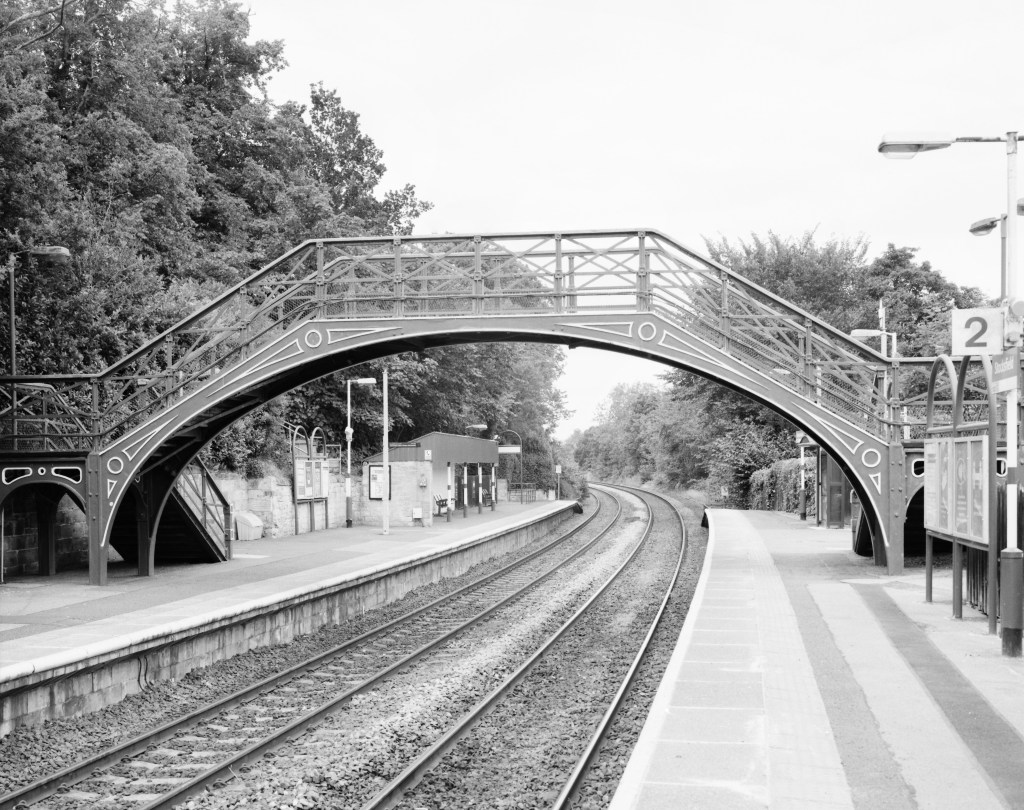
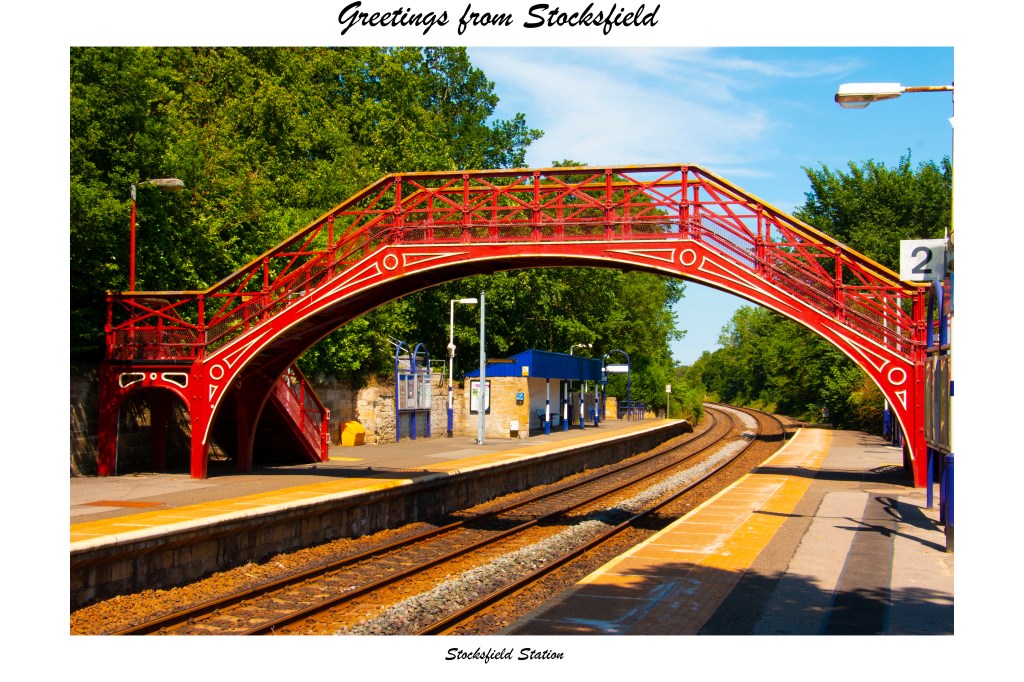
A couple of things strike me. One is how the bridge looks longer in the postcard, which was taken with the Leica and apart from the colour balance has not otherwise been adjusted in any way in Photoshop. The other is how much straighter the tracks appear in the large format camera version. Both were taken in almost exactly the same position. I had expected some differences as a result of the very different aperture settings and the resulting differences in depth of field: the Leica set itself to f/6.8; the film camera lens was set at f/22. It is often apparent in the work of Ansel Adams how the depth of field can have the effect of flattening out the image and a sense of depth starts to disappear as both near and far objects are in clear focus, which sometimes can seem almost hallucinatory. (All the more so when he went all the way to f/64. My 150mm large format lens stops down that far but I have not really had the courage to push it to that limit yet as it requires such long exposure times.) There is an element of that at work here but what I had not expected was how it might affect the apparent geometry of elements in the composition. Interesting, and something that I need to be aware of in future, and think about, before choosing which camera to use for a given project.
That consideration is I think the most important thing that comes out of this comparison. It is said (still, and all too often, and I profoundly disagree) that the camera does not lie. What this exercise demonstrates for me is that even if cameras do not lie, they do not necessarily tell “the” truth. Obvious really bit nevertheless still worth reflecting upon is that they are just means of seeing and recoding an image of a view, mechanical and technological analogues of human eyes. Different cameras, with different lenses and technical specifications and characteristics are going to capture images in different ways, just as the image that I perceive with my eyes and brain is going to be different from what someone else perceives when looking at the same object. There is no “truth” or “reality” in what we see, rather a physiological and neurological version of objective “reality”. As my Buddhist principles would have it though, reality is itself an illusion. So once again I am drawn back to idea that photography is fundamentally unreliable as an objective medium.
 Mark Robinson's OCA Landscape, Place & Environment Blog