Central to my thesis about the meaning and significance of landscape photography is the idea of the impact, or at least influence, on the environment of humankind. I have though now come across a collection of photographs, presented as “postcards”, that deal with a physical landscape that has not been affected directly (let us for now leave aside man-made climate change) for millennia.
Elena Cremona’s “Postcards from the past” is a set (still a book?) of twenty photographs, all of them postcard size (a ratio of 2:3) taken in Joshua Tree National Park, in the Mojave desert in California, during the break-up (break-down – is it not odd how we use two directly opposed directions to describe the same thing?) of a relationship. I cannot speak to that personal cataclysm but I do respond to these images on not only a photographic but also on a personal level, not least because I have been to that part of the world, more than once (driving, hiking, camping), and have been captivated by this primeval landscape. Apparently, at least superficially (human impact has of course been profound but not always immediately visible), this is an ancient, pristine landscape untouched by homo sapiens where you might not be surprised if a living dinosaur suddenly came into view around the next pile of rocks – think “Jurassic Park” without the vegetation. When U2 released their eponymous album (which I am afraid I did not like much) I thought, somewhat naively, that there was just one tree. There are in fact hundreds of thousands of them – possibly millions – (not strictly speaking trees at all, members of the Yucca family) though now direly threatened by climate change.
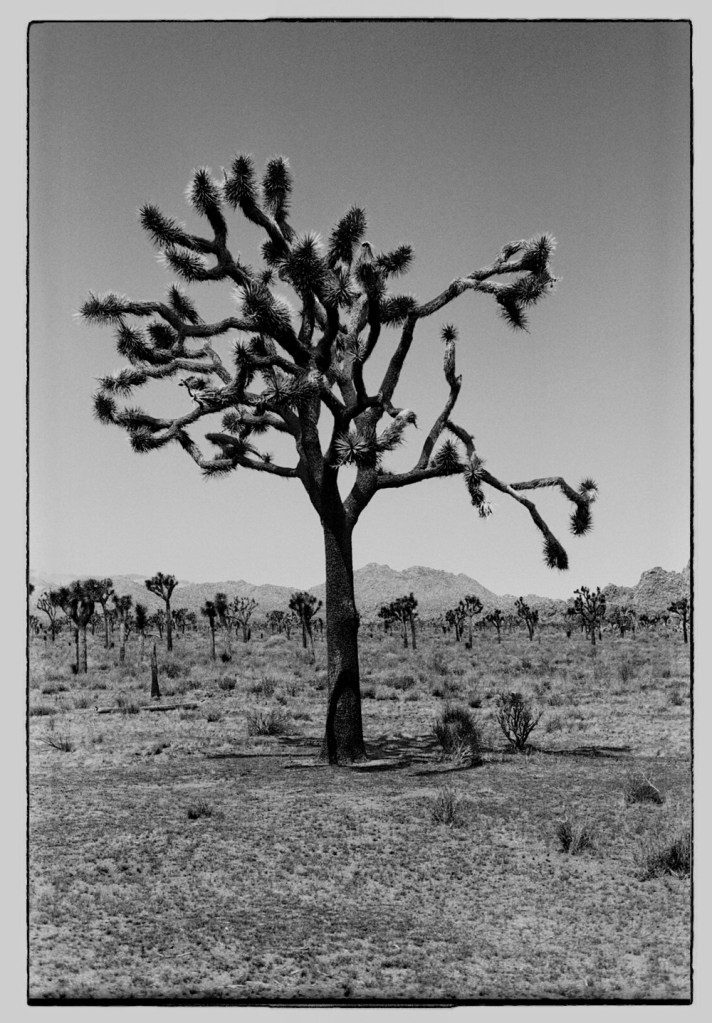
From a photographic point of view, there are a couple of things that strike me about these images. One is that they are clearly analogue, shot on film, though I find it hard to identify what format, which gives them an almost physical, tactile quality. Unlike Ansel Adams’s work, they are quite grainy, with relatively shallow depths of field, which I find particularly appealing given the, literally, “grainy” – dry, dusty, gritty – nature of the landscape (the grit gets everywhere). Whereas with Adams’s work when looking at his pictures you can feel like a disembodied observer with these photos I have the feeling of being there in the landscape, just looking at it through a limited aperture (admittedly, possibly because I have been there and seen it in just this way). Although postcard size the images are a little subversive in so far as all but one use portrait rather than conventional “landscape” format. This I find interesting as it not only subverts received notions of what a “landscape” picture should look like but also relates directly to the environment that is depicted. Joshua Tree National Park is high desert, a vast plain at least 1300 feet above sea level. The horizon is broad and flat. There is little to puncture the visual plane other than rock outcroppings. Apart from the trees themselves. They introduce a verticality, like exclamation marks, that serve to emphasise the way the flatness of the landscape actually accentuates the vastness of the sky above, making the experience of being there more of a vertical one than horizontal. It is hard to describe but the feeling that I have had there, every time I have been, is not only of the breadth of the horizon but how much space is above, as if standing on the bottom of a deep sea and looking up towards the sky.
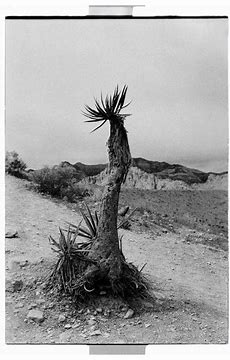
The postcard medium also strikes me as itself entirely appropriate as a means of depicting this specific landscape. There are people that live here (there is a town called Joshua Tree in which I have stayed, and stayed awake much of the night, woken by the comings and goings of a local family of coyotes!) but to visit is to feel a strong sense of being a visitor, an outsider, so that any view that one brings back is little more than a “postcard”.
In their physical postcard form they induce a degree of nostalgia. “Wish you were here!” It is very unlikely that I will ever revisit, but in some ways I would dearly like to do so. Although the memories that these photos encapsulate for the maker, for Elena Cremona, will be quite specific, and not necessarily pleasant, for me they embody very different and personal memories of my own. Although they are not my own photographs they nevertheless speak to me at a very personal level.
Cremona, E, (2019). Postcards from the past. London: Guest Editions
 Mark Robinson's OCA Landscape, Place & Environment Blog