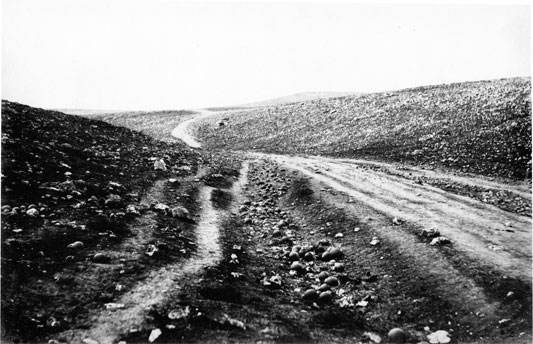
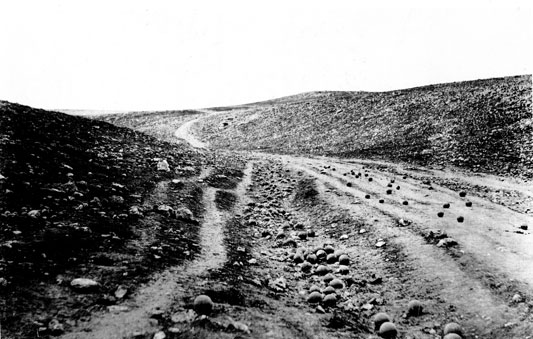
As I wait for my tutor to come back to me on Assignment 6, I am metaphorically twiddling my photographic thumbs. In doing so I came across an article on a website that is new to me, run by Jason Kottke, on which he posted an interesting piece about one of Roger Fenton’s best known photographs from the Crimean war, of the Valley of the Shadow of Death. This is something that I looked at in particular during C&N while considering the idea of Late Photography. What I did not consider then, but that Kottke’s piece addresses now, is the question of which of the two versions of the scene was made first, and whether either was “staged”. What is interesting about these images – as purely landscape photographs they do not show very much at all – is what they say about “truth” in photography, the inherent unreliability of the photograph itself, but how they are sometimes nevertheless interpreted by critics and writers, or indeed simple viewers, without there necessarily being any evidence to support the conclusions reached about them. These are all issues that I keep coming back to and have looked at in one way or another in every module of this degree so far. They are issues that do not simply go away, indeed in my opinion should never be allowed to go away, and remain fundamental to how we should approach, view, and interpret any photograph, whether made by someone else or our own, after the event and as we make it.
A point I have made repeatedly is that photographs are in and of themselves not reliable, that they do not illustrate a “truth”, in the absence of context and corroborative evidence. As Kottke shows in his article, and as explored in more depth by Errol Morris, the subject of this piece, in his NY Times articles from 2007, conclusions have been drawn about these two photographs that are simply not reliably backed up by objective evidence. (Although I have an account with the NY Times I have unfortunately so far only been able to read two of Morris’s three articles; I simply cannot get the third to load. That does not for now really affect the points I want to make and the short video embedded in Kottke’s piece tells the tale anyway. Because of the difficulties with the NY Times site, and as you might not have an account with them, without which it is difficult to read anything at all, I have not included below links to the original articles.)
There are two questions: one is which image was made first: the other is whether either was staged, the cannonballs having been moved to create a more dramatic image. Of these I think the first is less important although it is an interesting detective story in its own right and does contain a significant issue about the importance of correctly interpreting the intrinsic evidence contained within the photograph itself. It turns out, after a close but slightly erratic forensic investigation of the photographs themselves and the actual location where they were taken, that it is likely that the so called “on” photo, the one with cannonballs on the road, was taken second, as suggested by the movement of a number of small rocks down-hill compared with the “off” photo. What this does not tell us is whether this second image was staged in any way. This is where the issue of context and corroborative evidence becomes important. At least since Ulrich Keller published his book on the photography of the Crimean War (which I have not read), it has been assumed, at least asserted, that the “on” picture came second (possibly correctly although without a proper assessment of the evidence). Keller though went on to maintain that it had been staged by Fenton and that cannonballs were deliberately moved to create a new composition. These were views repeated, without any evident critical consideration by Sontag in her later book (which I still think is better than the earlier, more famous – notorious? – one though still marred by this sort of dogmatism) and have since then become received wisdom. And this is where my complaint lies, that the assertion, the assumptions made about Fenton’s intentions and actions are not supported by any objective evidence. They are mere assertions, indeed little more than fabrications. Unless of course Keller and Sontag were, for example, historical mind-readers. As Morris demonstrates, there is no objective evidence one way or another to cast any light on what Fenton might have intended or what he might have done or directed.
For what it is worth (which in reality is not much) my best guess, and it is only a guess, is that as Morris suggests this second image was not staged but was taken by Fenton after soldiers had moved some of the shot onto the road in the process of recovering some to be reused against the Russians who fired them originally. Would it not make more sense for Fenton to have simply realised once this exercise was underway that by chance the view of the road with the cannonballs on it was more dramatic than that without. If this was the effect he was after would it not have made more sense for him and his assistant, or under his supervision the soldiers who were evidently nearby, to move the shot from the outset before the first photograph was taken? We can probably never know for sure but this at least strikes me as being plausible.
A couple more things lead me to this admittedly speculative conclusion. One is to question how likely it was that there were soldiers about at the time with nothing better to do than move stuff around for Fenton so that he could make pictures while they were, it is worth remembering, under fire from the Russian positions? Another stems from my own limited experience of large format film photography. Fenton and his assistant took an hour and a half to make two photographs. I assume (but have not checked) that they were using a wet plate technology. This is not something that I have used myself but understand it is tricky and time consuming. Even using modern sheet film I know from my own experience that it can easily take half an hour or so to take just one exposure of a subject (and I seem to recall from her exhibition at the Side Gallery that this this was also the experience of Alys Thomlinson while shooting her Ex Voto project). So would Fenton have had the time even to direct his assistant or some soldiers to start moving things around? I do not know but my gut tells me that it does not sound convincing in the circumstances.
The main point, the most important point, is that there is no objective evidence to support the assertion that the scene was staged. This does not necessarily mean that the scene was not staged, just that we have no reliable evidence that it was.
The photographs simply show what was in front of Fenton when he took them. They do not in themselves tell us anything about how, where, or when, they were made. Anything else is little more than speculation and over-interpretation.
Sontag, S, (2004). Regarding the Pain of Others. London: Penguin
 Mark Robinson's OCA Landscape, Place & Environment Blog