Author: mark516450

Assignment 2 – Tutor Feedback

I had a very useful discussion with my tutor the other day in response to my submission for Assignment 2, which I am very pleased to report he liked! For ease, below is what he wrote in his formal report, that also covers a number of other issues:

Overall Comments

We discussed issues relating to the course in general; a perceived (in)balance between theory and practice (something I will raise at the next tutor meeting) and assessment procedure. One particularly interesting observation/revelation you talked about was an increasing sense of politicization relating to matters of Landscape; such a contrast to the classical and modern approaches to work in the genre.

This is a detailed and highly informed submission, clearly documented in the Learning Log from initial ideas to the final set, with an alternative version and two potential modes of presentation – slideshow and concertina artefact printed on both sides.

Feedback on assignment 

The submission is a strong conceptual work based on deep research and knowledge of extant work and practitioners.

Clear evidence of research into practice and an independent take on the brief which explored not only the idea of the ‘journey’, but also an alternative aesthetic, one antithetical to the conventional (picturesque) idea of landscape.  

There is always a danger of allowing a concept to determine the final work rather than having a high level of control over the choice of subject matter, and this can be a problem when engaging the viewer.  However, this set works well with the aims fully realized in a set of ‘randomly’ generated images documenting a train journey, with no post-production work or correction.  The set captures a real sense of the tedium of a repeated journey from the passenger‘s perspective as well as a sense of the physical limitations and possible perceptions of the landscape – snatches of rural and urban life flattened by the parallax depth of field, motion blur and muted seasonal colour and contrast.  This produces some genuinely intriguing images, a fleeting sense of the world around us and the limited grasp and understanding we can have; also, the form of the landscape, often blurred and smeared across the frame and textures, in the river, for example, an accidental byproduct of the process. 

We discussed the possibilities of exhibiting this type of work, with a slideshow as one option, or a printed concertina artefact similar to the work of Zoe Childerley’s work ‘Debatable Lands’.

Finally, what impresses is the amount of work – research and practice – that went into this project and importantly a sense of continuity of approach from Assignment 1.

Coursework

Demonstration of technical and Visual Skills, Demonstration of Creativity 

Detailed response to projects and exercises throughout.

Research

Context, reflective thinking, critical thinking, analysis  

The research and reflection carried out for this assignment, (mostly) independent and  exploratory, is highly focused and aligns itself to a contemporary contextual framework: from the Land Art of Christo, Long and Nash to recent exemplars by Kazuma Obara and Craig Mod (Kumano Kodo). You draw upon a range of sources and demonstrate a real knowledge and literacy of the medium in this genre.  Importantly, the continuing nature of the research over time running in parallel with the development of the assignment allows you to maintain a critical awareness of your own practice.  The final research note is about Ravilious’ ‘Train Landscape from 1940, with a quote that (I agree) clearly reflects your own aims:

‘We imagine ourselves, by an odd transference, as seated in a stationary interior with the world rushing past outside …”

Learning Log

We didn’t touch on the LL, but I can see that you’ve updated the pages with an article about the recent offerings at the Side Gallery and the ‘One Billion Journeys’ showcasing Wang Fuchun’s work  – interesting parallel to the Provoke group, and of course how this feeds into the development of your A2. 

Three detailed posts uploaded under your Notes tab on Postcards, (the usefulness of) Theory into Practice.  ‘When I am out taking pictures there is no room in my bag for books on theory!’ ,  a lot of practitioners would agree

The piece on filters (for analogue) was particularly interesting, I did a lot of work on ‘day for night’ cinematography in the 70s. Using the conversion tools in PS can produce a range of results and totally different moods in monochrome; I find them most effective with a considerable degree of control.

Suggested reading/viewing 

Tsunami Sidewalk by Chris Steele Perkins

 HYPERLINK “https://vimeo.com/42778555” https://vimeo.com/42778555

Pointers for the next assignment / assessment

We discussed the development of A3 and you are exploring ideas around Memorial benches and the landscape views they offer.  I can see a continuity of theme from A1 and 2 here in the sometimes random or mundane views these benches offer: who determines where they are sited, the doner, charity or local authority (?) 

We also discussed developments for Assignment 6 and the regular captures you have made for the ‘Ford’ project – all going well.”

All very gratifying and encouraging. At last I am beginning to think I am getting somewhere with this!

In the light of this feedback I do not really think that my submission for this Assignment necessarily requires any reworking. Nevertheless, having talked it through with my tutor, and having in particular reconsidered the alternative set that I produced, I do think there is a benefit in adding a couple of images from that other sequence to the primary set. In particular, there is something to be gained by adding the shot of the passing train, the tenth image in that series. Passing other trains, particularly on the bridge, is a common feature of this journey. Visually I also think it adds something in so far as there is the glimpse of the train, the Metro bridge (the blue one) just visible in the background through the windows of the other train, and a reflection of my train.

In addition, as I intend to follow up with the book idea (on which more anon) there are two images that might be used on its cover, that is the first and last of that other sequence. The first effectively gives a title to the set as a whole, and therefore to the book, and would be useful on the front cover. The last one gives a sense of the completion of the journey and so might usefully appear, perhaps just as a quite small print, on the back cover. The next step is to gets some prints made and start mocking up the book!

I will do a separate post next with the full, revised sequence.

Similarly I will write something more once I have had a chance to look at the Chris Steele Perkins video. (There is of course a local connection in so far as he spent a lot of time here in the North East and I wrote about his The Last Ships exhibition on my I&P blog: https://markrobinsonocablog3ip.wordpress.com/2018/09/26/the-last-ships-exhibition/)
Exercise 3.5: Local History

This is not an exercise that has helped me with settling on a subject for Assignment 3 as I had already decided what I want to explore in that project, and have indeed already started shooting (I got another couple of shots today while out working on this week’s images for Assignment 6). It is though something that is relevant to some of my thinking about post-industrial landscapes and how, over time, such places can revert to something approaching a natural state, and how the knowledge of the industrial past can be lost.

What I am particularly interested in here is the local history of lead mining and smelting. Most of the lead mined in the North East was worked in the North Pennines, in particular in Upper Weardale at places such as Kilhope and Rookhope. Kilhope is of course the home of the national lead mining museum. Unfortunately though, as I have discovered while carrying out my research, it does not appear to be home to an archive resource. There are though a few places in the Tyne Valleywhere lead was mined on a much smaller scale and it is one such site, less than a mile from my house, that I am interested in.

Local lore has it, and I have been aware since moving here more than fourteen years ago, that lead has been mined on the ridge just south of here, probably since Roman times, and carried down the hill to the river, just north of here, whence it was then carried on barges downstream to Newcastle (Pons Aelius). What I have wanted to do with my research is put some flesh on the bare bones.

I must say from the outset that it is clear that this task will require a lot more time than the suggested half day. I have also run into some frustration as although I have been able to identify a number of resources, in particular scholarly articles on the industry in this area, I have not yet been able to gain access to them. We are blessed here with a very fine old scholarly institution in Newcastle, The Northern Institute of Mining and Mechanical Engineers, incorporated in 1876 and housed in an impressive Victorian building in the centre of town (coincidentally next door to the Literary and Philosophical Society of which I have been a member for more than thirty years and visit on a monthly basis). The archives that they hold are extensive and nearly all of the documents that I know exist relating to my local lead mine are housed there. Unfortunately the building is undergoing extensive renovation work which means it will be closed until the autumn this year, and their library is now in storage, and as a result difficult to access. I might be able to get the librarian to retrieve some of the documents that I would like to consult but it is likely to be a time-consuming process.

Subject to that major handicap, I have at least been able to confirm the existence of a mine and smelting site. It is possible that to a large extent the documents still to be consulted will do little more than add further confirmation without necessarily providing much more detailed information. It would seem this was quite a small undertaking and its origins and early life, particularly if it goes back as far as the Romans, will not have been well documented, if at all.

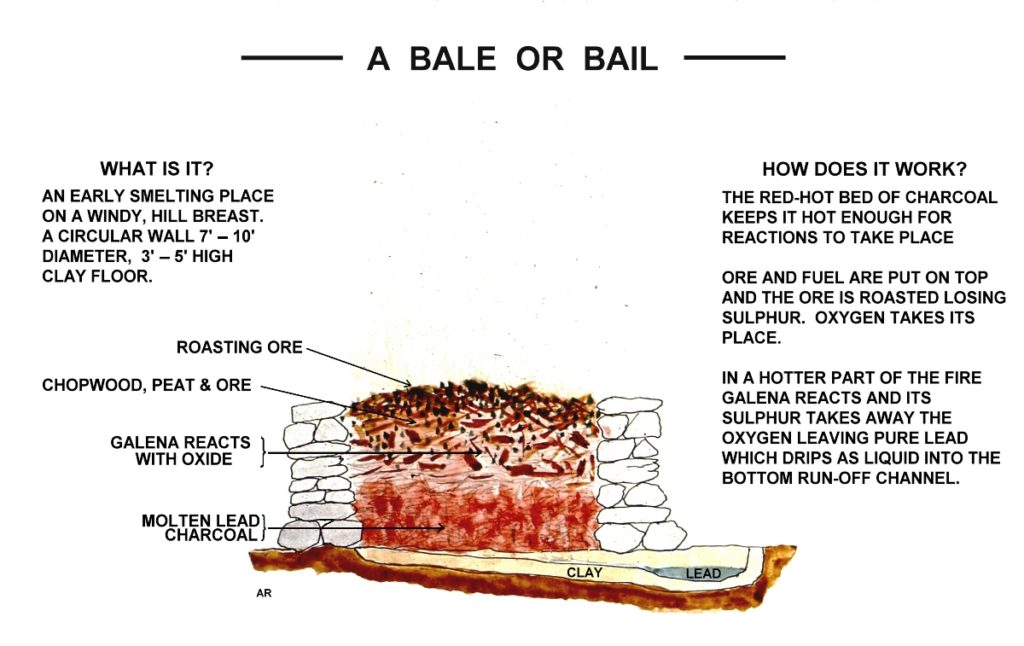
Apart from the local lore (I once met a man who was dowsing, with metal rods, in search of sites related to transport of lead down to the river!) there are clues in local place names. Two in particular are directly relevant. Part of the ridge is known as Bale Hill. At least since Medieval times, a Bale, or Bail, was a smelting site. Here is a diagram of one from the Northern Mining Research Society (to whom I will return below):

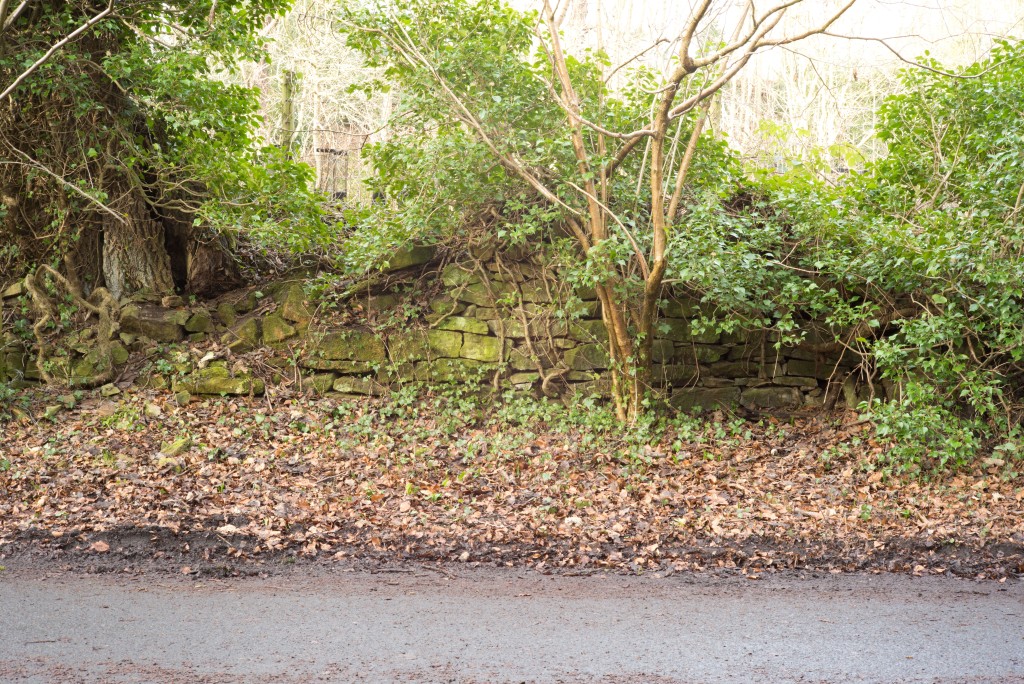
These were used to separate the metallic lead from the ore and were often placed on the upper slopes of hills in order to take advantage of winds and natural air-flow to raise the temperature of the ore. This explains something that had otherwise long puzzled me, why there is more than one Bale Hill within just a few miles of here. There is another one at Healey, a village a couple of miles to the west of here, part of the same ridge, that appears to have been a more important site and one that has been better documented. My Bale Hill is where our local golf course is and no traces remain of the site’s history.

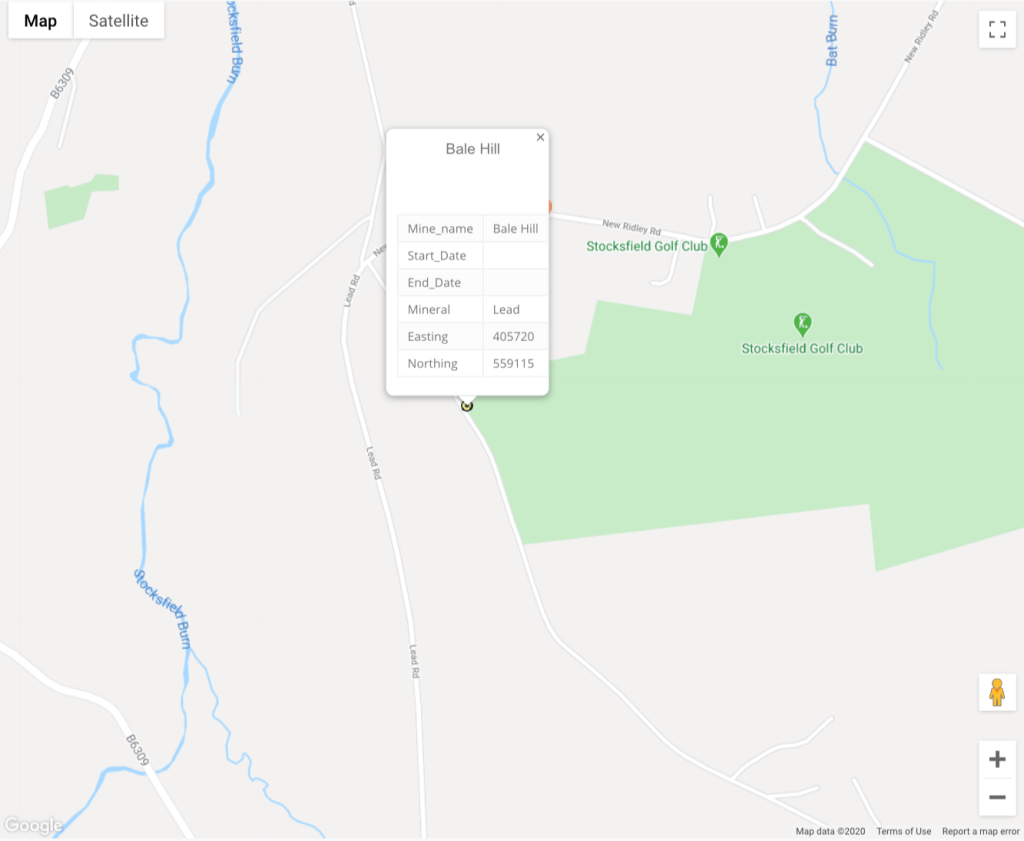
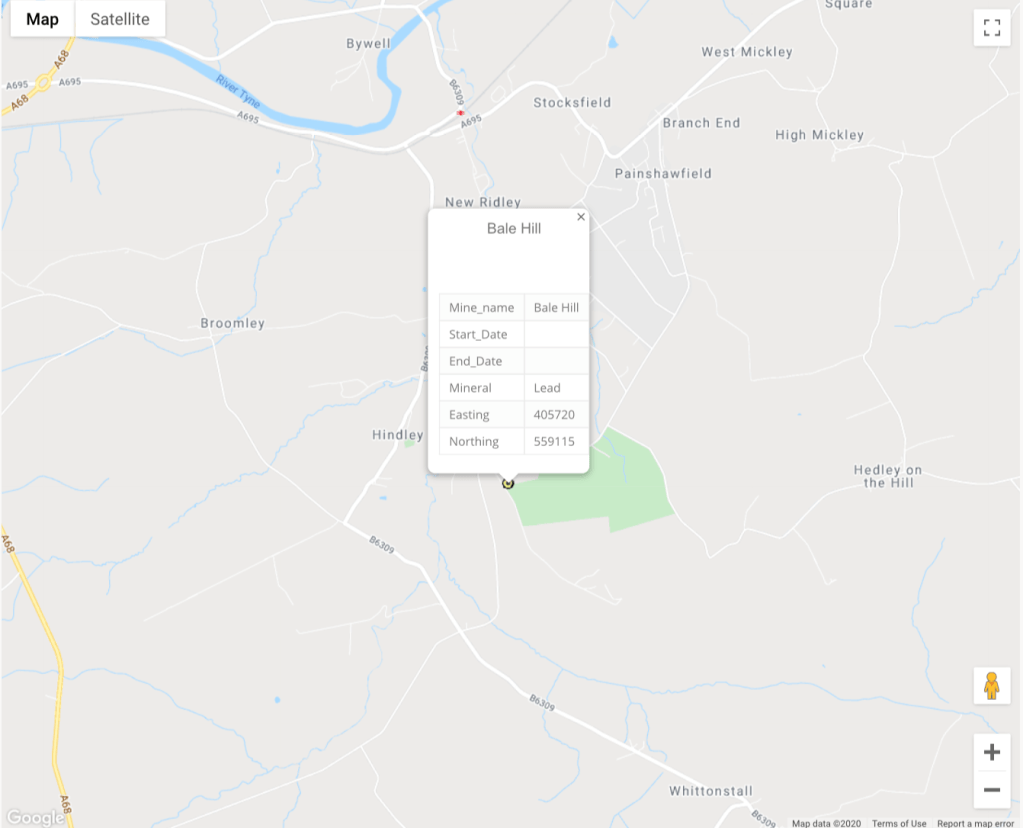
This map is from the NMRS and shows the location of the mine in relation to the river. Her is another in a bit more detail:

This shows the second geographical hint: the road that runs past the site, and runs down the hill towards the river, is still known as “Lead Road”. In fact, taking a closer look at it an the latest OS map, it can be seen that the road still has this name for much of its length and that it runs along the ridge to the west and links to nearly all the other known lead mining sites in this part of the Tyne valley.

Another snippet of information comes from the environmental search that was carried out when I bought my current house. Unfortunately I do not still have a copy of it (there will though be one in my lawyers’ file relating to the purchase) but I recall it indicated the presence of historical lead working quite close to the house, just below the escarpment on which we are located, in the valley of the Stocksfield Burn that flows north into the Tyne, and next to the lane that links the Lead Road to the river at Bywell. Again there are no physical traces left and it is not clear what exactly might have been done at the site. Local lore though suggests that it might have been a small (one man and his mule!) temporary smelting site.

Although I have not been able to consult any of the NMRS publications at the Mining Institute, I have at least been able to identify a couple of documents that might be relevant. One in particular is issue number 50 of their publication British Mining (at pages 95 to 97) that deals with lead mining, smelting, and iron ore smelting at a number of local sites, including my Bale Hill site. This reference suggests that latterly at least this site might have been used more for iron smelting.

I have also consulted my local library but unfortunately they do not have much on this topic. They do have a copy of another NMRS publication, British Mining 65, Allendale, Tynedale and Derwent Lead Mines by RA Fairbairn but when I checked last Thursday it was not available. However, from the sample pages available on the website (link below) it does not appear that there is much, if anything, in it that relates to my chosen site. At most I expect that these sources will do little more than confirm the existence of the site. The other thing that is apparent from this, and a number of other, otherwise unrelated NMRS publications that I have been able to sample, is that they probably concentrate mostly on the 19th and 20th centuries. What I am more interested in is the much earlier history of the site and I fear that this is not going to be easily available, if at all.

This is not going to form Assignment 3. Nevertheless I have given some thought to how it might be photographed. It is a bit difficult as there are no physical remains and so little information is available to cast any clear light on the activities over time at the site and along the Lead Road down to the river. What might work though would be a series of images simply of the countryside and the route down into the valley as it appears and exists now, if only to show how this post-industrial landscape has not exactly reverted to a previous natural state but has changed with other non-industrial usage.

https://mininginstitute.org.uk

https://www.nmrs.org.uk

http://www.nmrs.org.uk/wp-content/uploads/2016/09/bm65lookinside.pdf

Exercise 3.4: A persuasive image – 2

Rather than immediately produce a set of images for this exercise, what I am going to do for now is simply outline and describe some ideas, suggesting what they might contain and depict. Predictably, given the ideological views I expressed in the last post on the first part of this exercise, I am going to have another go at the fossil fuel industry, about which I am feeling all the more strongly as time goes on.

What I have in mind is a satire on an imagined brochure for an ecological theme park, another bit of greenwashing by a “green” non-renewable energy company. Not subtle, I am afraid, and very much aimed at highlighting the mythical company’s hypocrisy. In each case, for now, I am just going to identify the theme of a given part of the park and suggest a paradoxical photograph to accompany it:

The Arboretum – clear-felled tropical rain forest and fire ravaged woodland, as in Australia of late.

The Aquarium – a lake choked with algae and dead fish.

The Aviary – at best, glass cases filled with stuffed birds, otherwise oil-slicked seabirds, birds killed by pesticides and other chemicals in arable farm fields.

The Moorland – heather burning, grouse shooting, poisoned birds of prey.

The Wild Uplands – mountains of rubbish, piles of junked cars.

The Eco-Farm – batteries of chickens, penned pigs, piles of dead cows being burned for foot and mouth, BSE, Bovine TB, and any other avoidable animal diseases you can imagine.

Wild Nature – culled badgers, foxes and mountain hares hunted to death.

The Cafeteria – Mc Donalds.

Everywhere – “Keep Out” signs!

I could go on with more examples but frankly it would just get too depressing. More than just a but polemical I accept but this reflects some of how I feel at the moment. Certainly, as the brief for the exercise requires, I have taken an ideological standpoint.

Exercise 3.4: A persuasive image – 1

I am going to start with two images that I heartily disapprove of. Both are from BP adverts and are, in my view, little more than ‘greenwashing’

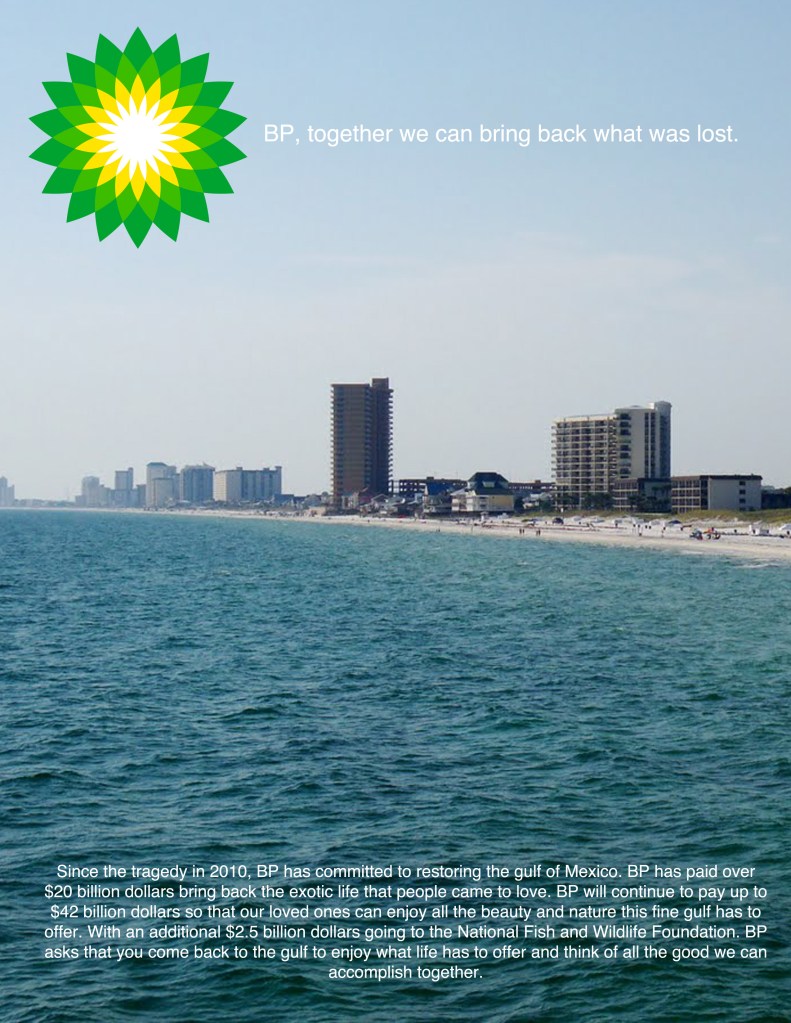
This is the first, a post-Gulf of Mexico disaster ad. The image itself strikes me as strangely bland showing some blue sea, a strip of beach, and a smattering of what I assume are holiday apartments and hotels. That part of the image is overpowered by the big BP ‘sun’ logo, which is the most visually dominant part of the whole confection. That logo itself is offensive enough in its own right, a mix of sun and sun-flower – naturally available power in the form of the sun and a widely recognised ecological movement symbol in the form of the flower. Yet BP is inseparable from finite and polluting fossil fuels.

The text is all the more offensive. On the one hand the message is everything will be ok because we, BP, are pouring so much money back in. That in itself will not, can never, fully ameliorate or reinstate what has been lost. And anyway, where is the money coming from? The continued exploitation of fossil fuels that are at the heart of the problem to start with, and us the public who still to a considerable extent need to rely on their products. Also, note how they use the word “tragedy” rather than the “disaster” it really was. This is a sly way of saying, “it was not really our fault”.

The other is come back to the Gulf so that we can do good together. Again the burden is to an extent being pushed onto us. There are not that many people visible in the photograph. Presumably what BP wants is for us to see more, and that this would indicate a recovery in the environment. This is of course rubbish. Although an increase in tourism would benefit the local economy it is not the answer. More visitors mean more development – imagine a more densely developed skyline – and significantly more pollution.

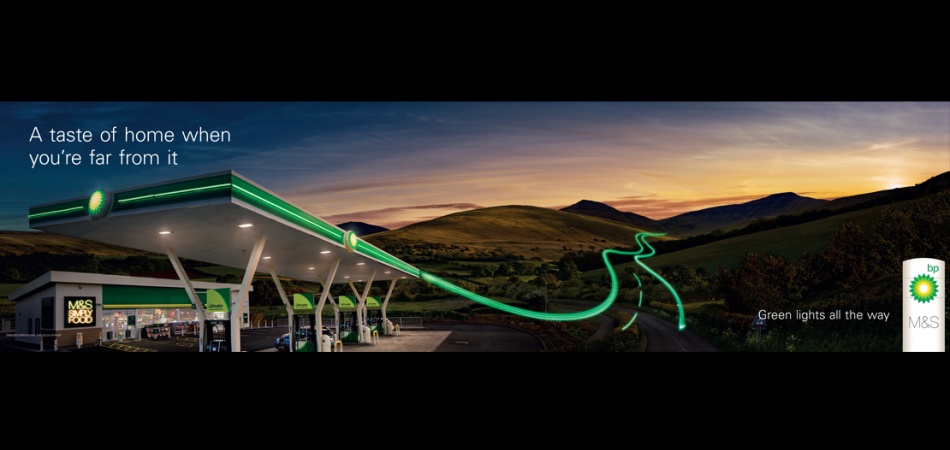
The second is also a product of the hapless BP. A clever ploy, teaming up with national treasure (though somewhat ailing) M&S, with the message that although you are away from home you can nevertheless eat as if you were at home (lots of people depend on M&S for their food shopping), while you fill up with BP fuel to get you home to the real thing. (As an aside, have you noticed how on motorways in particular and other major routes BP are more often than not the most expensive petrol stations with prices significantly higher than they would be elsewhere? “Were are being nice to you by joining ups with M&S but we are still going to rip you off!”)

“Green lights all the way”? AS if you are not going to suffer any hold-ups if you use BP feel? More greenwashing! And note how, and I think this is seriously misjudged, the ‘green lights’, presumably intended to eco cars’ lights, actually in this case run across country rather than sticking to the road. “Not only are we ripping you off but we are also riding rough-shod over the environment.”

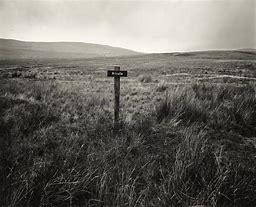
My third example is one that I have referred to and written about before but is one that I keep coming back to and still has resonance for me, Fay Godwin’s The Duke of Westminster’s Estate, Forrest of Bowland, 1989:

This is all about how land ownership is concentrated in the hands of a relatively small number of people and that it is used in an exclusionary way. Unfortunately the text is not clear in they particular specimens but the sign simply says “Private”. The message is clear and very simple, “this is my land, keep off it”, and her portrayal of it is far from approving.. Godwin did a lot of work based on this theme as a form of protest and resistance. I had not realised until I looked at the videos about Godwin while working on the Picturesque exercise that she had been president of the Ramblers Association and so was doing more than just taking photographs to illustrate and publicise the problem but also taking direct action, putting boots on the ground. My admiration for her and her work has only grown!

Assignment 6: An update

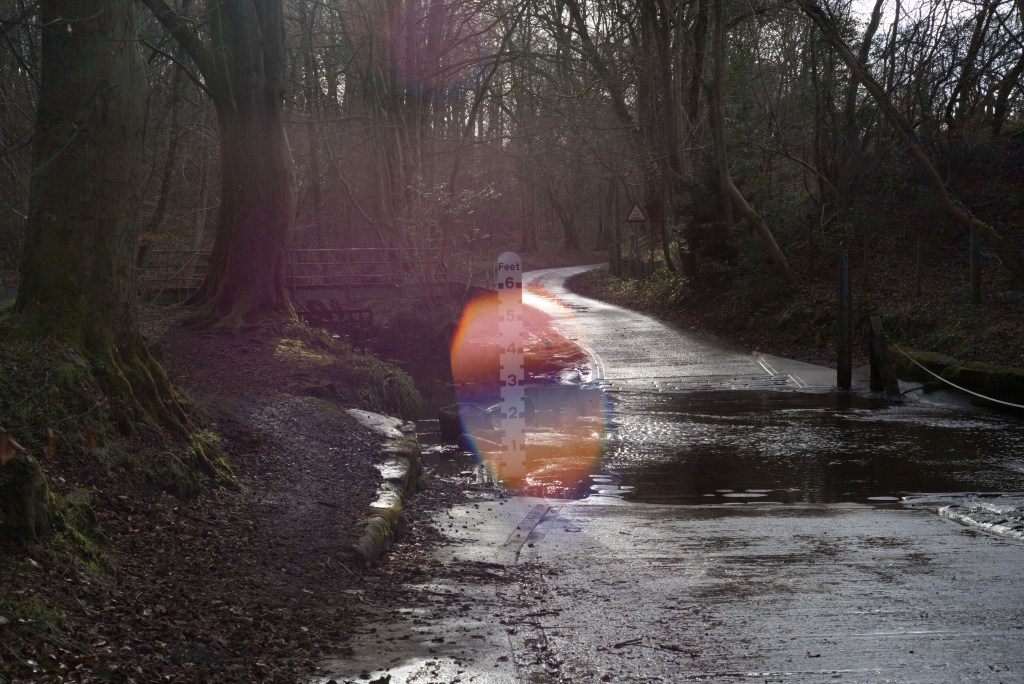
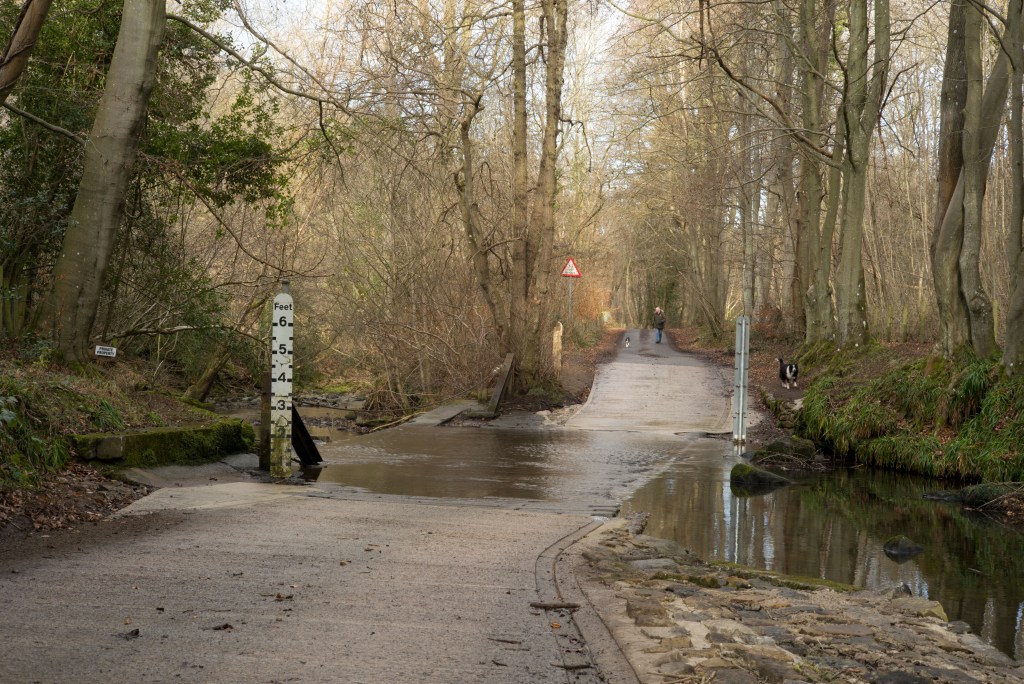
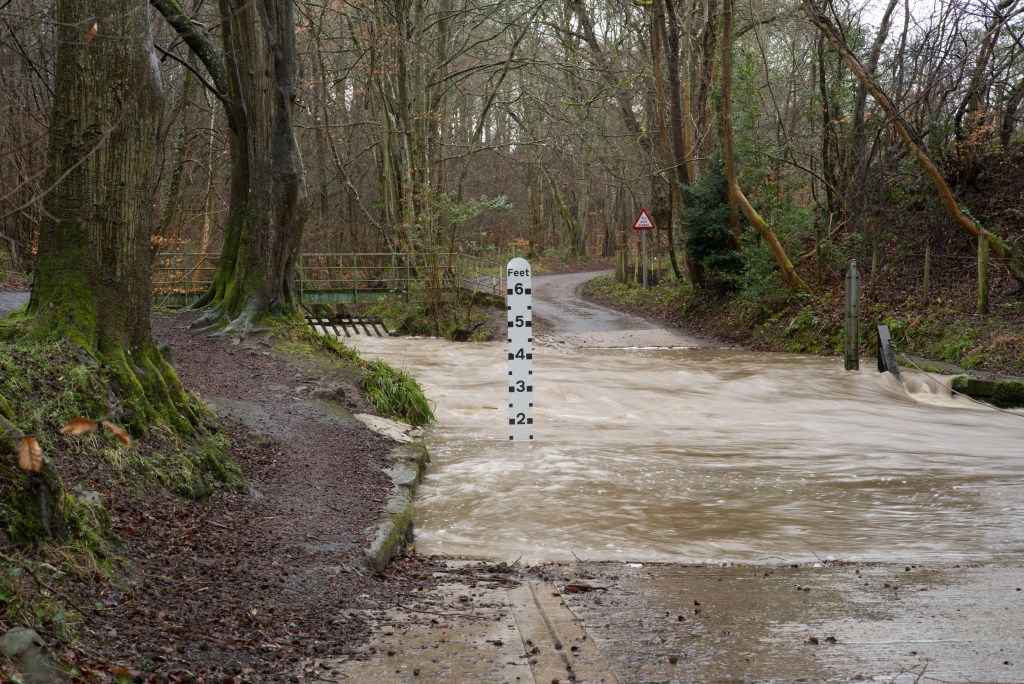
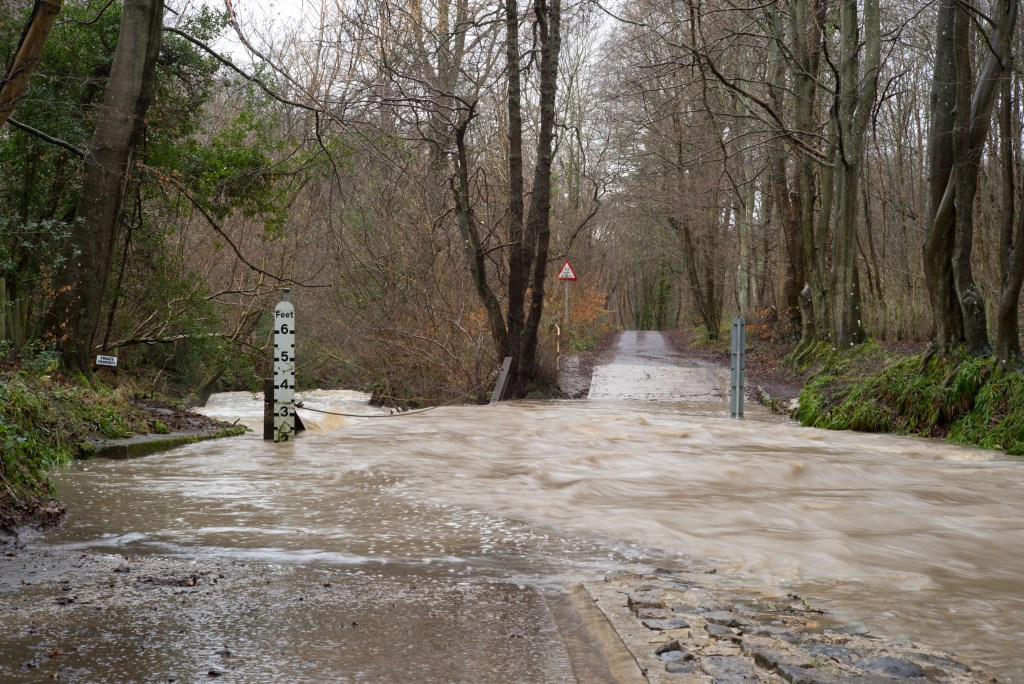
Though I continue to take shots for this project every week I have not posted an update for a while. I have decided to do so this weekend to reflect the way this scene can change significantly at very short notice.

Yesterday was calm and sunny so I decided to make some pictures before Storm Ciara struck, in case the weather became too bad to get out. Paradoxically, despite the almost hysterical warnings about this storm, today has not been so bad at all; wet and windy certainly but I have seen far worse!

Note there are only a couple of inches of water in the ford. Compared with today, less than 24 hours later, almost two feet deep on the upstream side:

Landscape as a call to action

Before moving on to the next exercise, 3.4, I thought it might be useful (for me at least) if I was to record some responses to the work discussed in this part of the course material. I do not intend to pick any of it apart in detail but just to record some thoughts, not least because I have already spent some time looking at some of this work, particularly Mitch Epstein and Dana Lixenberg.

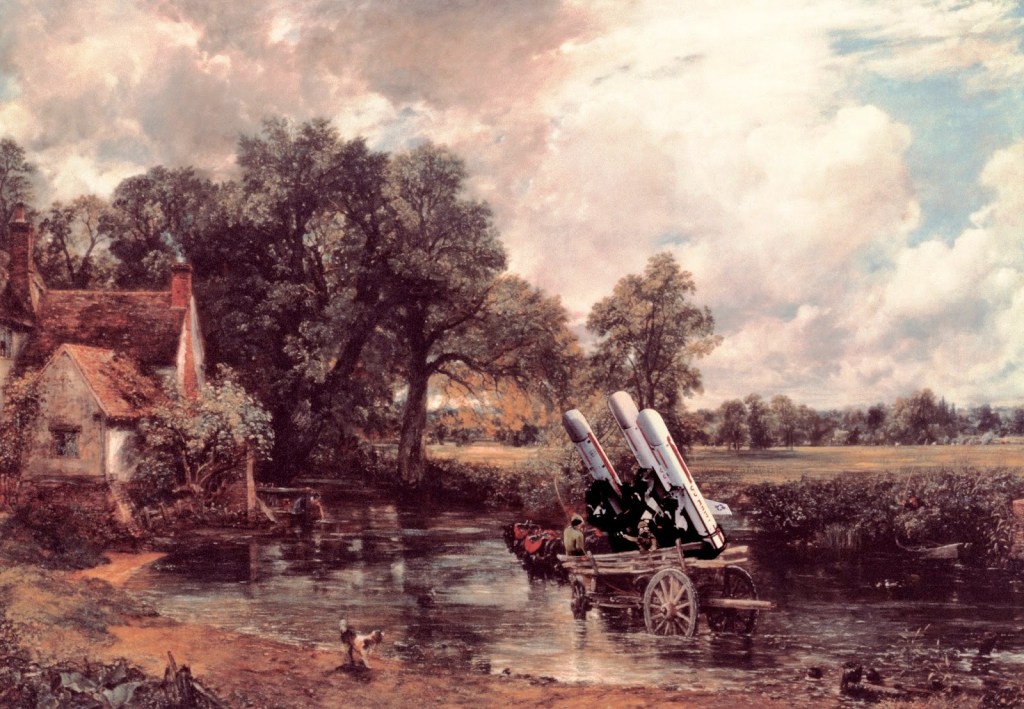
Starting with Constable and Kennard, I have a slightly different response to the Cruise missiles than Wells (2011) suggests because I take as my starting point the social, agricultural, background described by Andrews (1999). What Constable painted was an imagined, constructed, “remembered” ideal of a mixture of rural past and present that never really existed. I see Kennard’s work as being less a comment on the threat of the physical destruction of an “ideal” England, rather than Britain, (what about the other hapless countries that form part of this benighted Union that might also have been bombed to bits?) than the threat to an “idea” of England, an England that is more fiction than fact.

What I also get is that the threat is not necessarily from the former Soviet Union but from a so-called ally. By the 1980s the “threat” from the East was arguably more illusory than real and the bigger danger was presented by the paranoid bellicosity of the Americans. The Eastern Bloc was already under considerable strain and that decade of course saw its ultimate failure. What made the possibility of military action more possible (if not necessarily actually very likely) was the aggressive posture of the Americans in particular in positioning Cruise missiles in this country and 108 Pershing II missiles in West Germany. We now know that it was the Warsaw Pact countries that were afraid that they were about to be attacked by NATO rather than the other way round! I do though of course fully accept that this view has benefited from the hindsight offered by the last thirty years or so.

What I get from the picture in this context now is a comment on not just the perceived threat of physical annihilation by nuclear war, which was a very real fear at the time, but the threat to a wider sense of “English” (I deliberately use the word instead of British) identity and independence, an imagined sense of Englishness being subsumed by an increasingly American dominated Western culture, (not to mention power-politics). The point is, I suppose, that I see the threat coming from a completely different angle!

Which I suppose leads nicely on to Mitch Epstein. As I have mentioned elsewhere, I first became aware of his work back in 2009 in an article in Granta. Subsequently, my I&P tutor suggested him as a further research source right at the end of that course. I have subsequently bought a copy of his book (2011) and I thought I had already written specifically about it but it appears that I have not. I must come back to him properly in due course. For now though I just want to comment on his work in the context of my thoughts on Constable’s painting.

Going back through the book, and rereading the afterword it struck me there is a parallel between how I see Kennard’s work and how Epstein sees the US: as he puts it (last page), “while America teeters between collapse and transformation. The siting of Cruise missiles here was in some ways an act of paranoia and a surrender of national sovereignty to an “ally” and its huge military-industrial complex (how ironic that it was Eisenhower, general and latter day politician, who coined the phrase). What Epstein’s work shows is not just environmental peril, and perhaps perceived or imagined military threats, but a pervading sense of hubris. The country has driven itself to the brink with the idea of Manifest Destiny, which drove so much of the expansion into the west, with its concomitant, quasi-religious “right” to exploit the earth’s resources. But I feel it goes further than that. It is not just those environmental and other threats that are at work but internal, home-grown, fears and paranoia: look at the old lady with the security cameras and her gun, the repeated interventions and harassment of Epstein by corporate security and their neighbourhood proxies, the forces of local “law” (for which read, the most powerful corporate rather than constitutional) enforcement. Both sets of work, in this context, seem to me to be as much, if not more, about the destruction of landscape, a sense of belonging, a sense of nationhood, being driven from within society, the nation, itself and not just being the result of malign external forces.

Lastly for now I will just touch on Edward Burtynsky. I am not familiar with his work to any great extent and am going to need to get to know it, and him, better. Unfortunately the link in the course material to the interview about China is no longer available on the LenCulture site and I have not otherwise been able to find anything on Soundcloud that might replicate it. I am therefore going to need to do some more digging to get a proper handle on his work. For now though it is illuminating to look at the quotation on the home page of his own website: “[we] come from nature.…There is an importance to [having] a certain reverence for what nature is because we are connected to it… If we destroy nature, we destroy ourselves.” Here again we have, though this time on a global scale, danger and destruction coming from within, and not some real, or more likely imaged, enemy without.

Otherwise I would just comment from a purely aesthetic point of view that, although his images have considerable impact, not least because of their scale, they do not greatly appeal to me. I have a similar problem with, for example, and without wishing to be unfair by singling him out now, Andreas Gursky. The problem I have is that it al seems that bit too remote, too disengaged. In this sense I feel that Epstein’s work is, although some of it quite panoramic, much more closely engaged physically with his subjects. He was certainly more closely engaged so far as the harassment he encountered is concerned.

I am going to come back to Dana Lixenberg separately in a later post. I feel her environmental work is worth a separate look in its own right and I want to familiarise myself more with The Last Days of Shishmaref before commenting on it. (The link in the course material no longer works. Indeed it appears she no longer maintains a personal website and relies instead on that of the Grimm Gallery, which unfortunately does not have much to say about that particular project. I have therefore been tracking down a copy of the book itself and do not have it yet!)

Epstein, M, (2011).  American Power.  Göttingen: Steidl

Freeman, J, (ed), (2009).  Granta Issue 107.  London:  Granta Publications

Wells. L, (2011)  Land Matters:  Landscape Photography, Culture and Identity.  London:  IB Tauris

https://www.edwardburtynsky.com

Assignment 3: First Thoughts

Although I have only just submitted Assignment 2 and am still working through the course material for Part 3, I find that I am already thinking about possible approaches to this next assignment. I have not done any active research yet but already some ideas are staring to form and today I managed to take some initial test shots to see what the outcome might look like.

At this stage, rather than focusing on one specific landscape I am exploring different iterations of the same sort of physical environment, particularly memorials. I am not so much interested in, for example, large scale, municipal monuments but something much more low key, and even private. One idea that I have had relates to impromptu, temporary roadside monuments which often seem to spring up at the sites of accidents: bundles of flowers tied to lampposts, soft toys, photographs. I have not explored this yet as at the moment I cannot think of enough such sites locally that would offer enough scope for a project.

For now what I am exploring is memorial benches. I do not know why it should be the case but there seems to have been an explosion of them in recent years. In my own village, for example, I can immediately think of at least four private commemorations and one formal one, at the village war memorial. There will be plenty more in the other villages and towns along the valley.

What particularly intrigues me about these memorials is the way they lend a sense, real or imagined, of significance to a particular location that it might not otherwise have. Everywhere is just “space”. It only becomes a “place” when there is some form of human intervention. That might be a physical intervention, as here with the act of setting up a bench, or by simply giving somewhere or a physical feature a name. Turning a space into a place is an act of appropriation, colonisation. The sites that I have looked at so far are not significant in themselves. Setting up a memorial though establishes a sense of significance at least for the person remembered (invariably now dead). Because a place had some significance for someone else in a way makes it significant for the subsequent visitors and viewers, even if only in that it was significant to someone else.

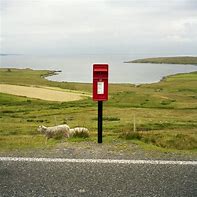
Although I have not done any conscious research yet, there are a couple of artists that I can think of immediately whose work has, inter alia, explored this notion of making a space a place by way of human intervention in and on it. One is Martin Parr’s Scottish post-boxes work: I am not familiar with it and have not yet explored it any further but I am at least aware of it and from what little I have seen, even if it was not necessarily the point for Parr when making the work, I think it is an interesting illustration of my point.

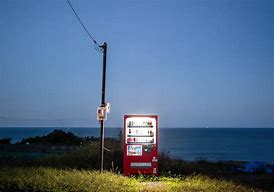
The other, who does appear in my own library, is Eiji Ohashi and his pictures of vending machines in Japan. Some of those that he photographed are in the middle of nowhere. Their very presence though, and I also think the act of photographing them, turns that nowhere into a somewhere.

That said, in some of the cases that I can think of, the chosen sites for the memorials give no indication of having been significant to those remembered. In at least one case that I have looked at today the site seems to have been chosen simply because it is a convenient public space. The result is that even though that space is not inherently significant it nevertheless becomes significant simply as a result of the siting of the memorial.

Two other points also occurred to me as I started to think about this. One is that, in my experience, despite being benches, self-evidently designed and built for the purpose of being sat upon, people rarely do in fact sit on them. For example, one is in a common field just a few metres from where I live that is frequented daily by local dog owners. Occasionally, particularly during the summer months, one might see someone sitting on the bench while their dog plays, but it is not an everyday occurrence.

The other relates to the siting of the benches. Whilst those I have looked at so far are in attractive locales, the views from them are not particularly picturesque. Although they offer welcome respite and rest on a walk they do not necessarily offer views that you would want to experience for their own sake.

Bearing these points in mind, what I have explored so far is the idea of producing a series of diptychs, showing the bench and its immediate surroundings, together with a view from it. For that view I have chosen one straight ahead, at right angles to the line of the bench in order to avoid giving a partial or distorted impression by choosing one over another.

Not for the first time, and almost certainly not for the last, I find myself at the moment indulging in a typological approach influenced by the Bechers!

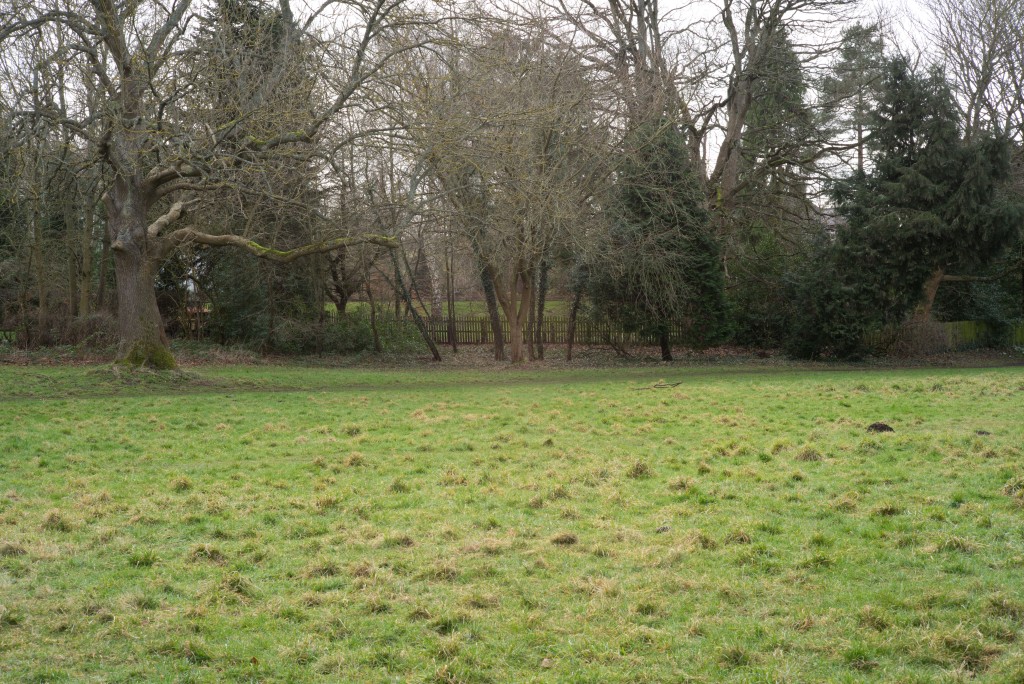
By way of a further experiment, in addition to using a digital camera I am also using a medium format film camera, in black and white only for now (this is, I guess, a nod in the direction of the influence of Fay Godwin that is almost certainly lurking at the back of my mind when I think of a project like this) but obviously I need to finish the first roll before I can develop it, scan, and post the resulting images. Here is what I have got so far just from the digital camera:

Ohashi, E, (2017).  Being There.  Tokyo:  Case Publishing

Ohashi, E, (2017).  Roadside Lights.  Tokyo:  Zen Foto Gallery

Late Photography

The subject of late photography is one that loomed fairly large in C&N and as such is something that I spent some time looking at then. I have gone back to that earlier work and again looked at Paul Seawright and Sarah Pickering, and read John Stathatos’s article. I find that having done so I do not really have much, if anything, to add for the time being. I think the important points are the ones to be made in response to Exercise 3.3. I do not propose therefore to write anything fresh here but simply refer back to a couple of my C&N posts, on which my views have not changed significantly in the interim.

Otherwise, I would mention that the link to the Library of Congress website appears to be bad and as no indication is given of what the content the subject of that link was supposed to be it is not really possible to find whatever the intended material is from within the website itself.

https://markrobinsonocablog2cn.wordpress.com/2018/01/18/project-4-public-order/

https://markrobinsonocablog2cn.wordpress.com/2018/01/18/project-4-the-gallery-wall-documentary-as-art/

https://markrobinsonocablog2cn.wordpress.com/2018/01/05/safety-in-numbness/

https://www.stathatos.net/sites/default/files/texts/61.hiding-open-paul-seawrights-afghanistan.stathatos.net.23047438.pdf

https://www.stathatos.net/texts/writings-photography-and-art/hiding-open-paul-seawrights-afghanistan

Exercise 3.3: Late Photography – Safety in Numbness & Joel Meyerowitz

I have of course already looked at Campany’s essay “Safety in Numbness” while working on C&N. (https://markrobinsonocablog2cn.wordpress.com/2018/01/05/safety-in-numbness/). The focus then though was on the issue of compassion fatigue that Sontag had addressed in her earlier book (1979) but on which she later changed her mind in her last book (2004). This time round we are coming to the article from a different angle. This time the relevant point is more about the role of “late photography”.

Rereading the essay this time round there are two particular points that come across strongly to me, which are of course related: that in a world of instant news feeds and live video broadcasts, the photograph, particularly in the mode of late-photography, offers a slower, more considered view of and approach to events; at the same time the late-photograph has increasingly become an aesthetic object rather than simply (was it ever a case of “simply?) a piece of photojournalism.

Today images of unfolding or recent events are more likely to be in the form of video, often taken at the very time on bystanders’ smart phones. As such they have an immediacy, though not necessarily reliability or objectivity. If we see a still image of an event it is just as likely to be a screen grab from a video sequence. Thinking back on the other hand to, for example, the Vietnam war (I am of an age to remember the nightly news bulletins) the images that were taken in the thick of the action were taken not on film or TV cameras, which were too bulky, but on 35mm film cameras: just look at the work of the likes of Don McCullin and Tim Page, to name but two. Now the photographer goes in with a camera after the event, to record what Campany calls the traces of traces, the aftermath, the consequences of action that has gone before. (Ivor Prickett’s work in Syria and Iraq immediately jumps to mind here having seen it at the Side Gallery and having written about it recently. There are a few images where something has just happened – a bomb blast or an airstrike – but mostly they are separated and divorced from the immediate action.)

Late photography offers an opportunity away from the sound/image-bite and increasingly short news cycles for a more considered, sober, assessment of events. It offers an opportunity to memorialise events. One consequence though is the aestheticisation, or at least the risk of turning reportage into art, of the work. This is not work for immediate consumption and is more likely to be seen, not by way of news outlets, but on the walls of galleries, as is the case with Prickett’s work, and Meyerowitz’s World Trade Centre photos. That is not necessarily a bad thing but is something that I think needs to be borne in mind when viewing and interpreting such work.

The pictures that Joel Meyerowitz took at the site of the twin towers is in some ways a perfect example.

As a first step, rather than looking at them again on-line, I have deliberately chosen to look at them only in hard copy, going back to the second chapter of his recent book (2018). These are pictures that deserve to be looked at more slowly, lingered over, and appreciated in a physical, tactile form, rather than as pixels on a bright screen. The scenes that he captured were intensely physical and to get something of that back I think it is worth slowing down and appreciating the physical feel of printed images in a hefty book.

How they differ from what we saw at the time on television is obvious. We saw repeated (indeed too often distastefully so) images of planes flying into the buildings and exploding, the spreading fires, people falling to their deaths, the steady collapse of the buildings. What we did not see, and for obvious reasons could not, is what was happening on the ground. Meyerowitz obviously cannot show this either but what he does show is the aftermath, what was left after, literally, the dust settled. What he shows is what, by the time he was able to photograph there, was no longer a prime concern of the news outlets.

And its value? In part it is I think precisely that, this filling in of the less “newsworthy” details. In some ways I see it as a truer, at the very least less sensationalist and therefore more reliable, portrayal of what happened here. Rather than sensationalist it is much more considered. As such I feel it serves as a more fitting memorial to events, the people who died (though they are of course strikingly absent from much of this work, other than in an more indirect way, as in photos such as “Five more found, New York City, 2001” – (2018) at pages 34 and 35.) It also serves as a tribute to those who worked to clean up the site afterwards, an unpleasant, dirty, traumatic, and dangerous process in its own right, who might otherwise be overlooked.

Meyerowitz, J, (2018).  Where I find myself.  London:  Lawrence King

Sontag, S, (1979).  On Photography.  London:  Penguin

Sontag, S, (2004).  Regarding the Pain of Others.  London:  Penguin

http://davidcampany.com/safety-in-numbness/

Assignment 2: Presentation

Whilst I will probably only finalise the set for this assignment once I have had feedback from my tutor I have nevertheless in the meantime been giving some thought to how that set might be presented when the time comes for assessment.

For the last assignment of I&P I toyed with the idea of making a form of concertina book. Eventually I rejected the idea as it did not really present the message that I wanted to get across, and my then tutor was a little cautious from a technical point of view, such a thing not necessarily being easy to pull off. Ironically I understand that the assessors were quite keen on the idea! For the present project though I think it would be ideal.

I do have a precedent in mind in the form of Zoe Childerley’s book (2016) which she made at a time that I was helping out at VARC. From her experience I know that it was technically quite a difficult book to produce (the first production run had all of the photos in reverse order!) but the final version works really well, with the sequence of images on one side and a map of the route that Zoe walked on the reverse.

Something like that should work well here, though instead of a hand-drawn map I would propose to make up a strip from an up-to-date OS map. Subject to looking into the practicalities, I doubt whether it would be feasible, practically and financially, to have a book made up professionally. I know that there various companies out there that will make bespoke photo-books but I am not sure about something in quite this physical form. It should though be possible to make a reasonable hand-made example that will at least adequately illustrate the principle.

Childerley, Z, (2016) The Debatable Lands.  High Green: VARC

http://www.zoechilderley.co.uk/the-debatable-lands-book/4593164515