Author: mark516450

William Blake – Book

What, you might ask, has William Blake got to do with landscape photography? That is a question I might have asked myself if it had not been for the catalogue that accompanies the recent, comprehensive, exhibition of the work of Blake at Tate Britain in London this past winter.

I did not actually get to see the exhibition itself and in a way I am glad. A lot of his work is quite small in scale. In a busy gallery, and I understand this has been a very successful show (for which read “busy”!), it can be difficult to see the work clearly, and at leisure, and to be able to get close enough to it to appreciate the detail. So, on the recommendation of a friend who did visit the show, I simply bought the catalogue.

Whether anyone is interested in photography or not, if you have any interest in Blake I would heartily recommend this volume. The reproductions are first rate, the scholarly articles that accompany them are very easy to read, and, perhaps most importantly for me, the images in the book include works that I have never seen before. I have other books on Blake already but there is material here that is new.

But the relevance to landscape? This comes in the final essay in the book by the graphic novelist Alan Moore (whose work I am aware of but not at all familiar with) who writes about the influence on Blake’s work of the address to which he and his wife moved in 1790, 13 Hercules Buildings, in Lambeth (page 199).

It is worth quoting almost all of the first paragraph in full as it both poses and and answers the question:

“When we speak of the poetry of place, we generally refer to words and images that celebrate or else investigate some fixed location. And yet, given that all creative works have arisen from whatever influences surrounded their geographic point of composition, surely all art could be said to be the art of place, something that could only have emerged from that specific spot at that specific time? A city, a field, a house, a street: all of these have their own aura, their own atmosphere, a lyric condensation born of memory and history, of people and events, …”

This appeals to me very much and fits with my own broad, catholic and inclusive, view of what might amount to landscape art. I find it quite liberating to think of landscape in such terms. But also quite challenging to find ways that this sort of sensibility might be shown when making a photograph, which has got to be a good thing. It is not just a matter of pointing the lens at a view but of finding something within what is visible that is of some significance or deeper meaning.

Myrone, M, & Concannon, A, (2019). William Blake. London: Tate Publishing

Assignment 3 : Further research and thoughts on presentation

Whilst I am continuing to beaver away with shooting for this assignment – I have been very much hampered by the weather of late and it is amazing how much time it all takes, particularly as I am shooting both digitally and with medium format film (more as an experiment in its own right if anything and an opportunity to get to know the camera properly): last week it took more than two hours to cover just five, fairly close, locations – I am nevertheless still looking at possible influences, both on the subject matter and on the mode of presentation.

After this last shoot I remembered some work by former OCA student “Rob TM” that was featured briefly in C&N, in particular his series “A Forest”. This consists of views of woodland, all fairly anonymous and undistinguished in their own right, juxtaposed with studio shots of rubbish and detritus he found at each particular spot. I think there are parallels here between his work and what I am exploring, how a location can take on a particular identity or significance as a result of some human intervention. Here is an example of his work. (I have not been able to find any freely available images on-line so this is an edited screen shot from his website.)

I had also already been thinking about how my images might be displayed and from the outset have conceived of them as a series of diptychs, quite possibly unconsciously influenced this work. The aspect ratio of the digital camera that I have been using is much wider than this so the resulting image is shallow but wide. Nevertheless I think it works. Here is an example, produce by simply copying and pasting the two related pictures into a new, double width file in Photoshop:


When I get round to developing the medium format film the aspect ratio will be much more like that above as 120 film in my Hasselblad produces 2 1/4 inch square frames.

I stil have more pictures to take, but I have at least identified some more potential sites that should give me enough to make up a set.

http://www.robtm.co.uk

Post/industrial Landscapes 3 – Urban Exploration

I find that I do not have much, if anything, to say on this subject from a photographic point of view. The treatment of this subject in the course material is fairly perfunctory and even Alexander (2015) lends little more than two pages to it (page 124 & 125) with just two examples of photographs by Suzanna Davison, of whom I had not come across before.

I have at least though done some reading of my own on the subject. I was in a way surprised that none of the books on psychogeography that I have read recently touch upon the subject at all. Perhaps the elements of danger, trespass, and the fact that there seems to be a lot of activity that goes on underground, really take urban exploration out of the realm of the flâneur. Breaking into a derelict building or infiltrating a sewage system are not exactly strolls.

The most interesting book that I have read that touches on the topic is in fact the first one in which I ever came across the topic, Manaugh (2009), which I first read more than ten years ago. (To be a bit more accurate perhaps the first time I encountered the phenomenon was when I saw Luc Besson’s film Subway back in the late 1980s.) The whole of the second chapter is devoted to “urban covers” who explore the networks of tunnels beneath out cities. This does at least have some striking and impressive examples of subterranean photography.

Otherwise, and coincidentally, the only other book that I have read recently that touches on this is Robert McFarlane’s recent book (2019). Most of this is not about urban exploration, but there is one chapter , Invisible Cities, (page 127 ff.) in which he goes underground in Paris.

One particularly interesting point that MacFarlane makes is in the drawing of a comparison between the activities of these French urban covers and Walter Benjamin’s monumental, but never completed, work The Arcades Project, which perhaps give the lie to my point about psychogeography and flâneury above. This was a multifaceted and kaleidoscopic exploration of the topography, history, mythology, all that you might ever want to know, of Paris. In a way it would have been the ultimate testament of a flâneur, though something that required a great deal more effort than just strolling. The work of the Paris spelunkers is doing a similar sort of thing to the city’s multiple under storeys, and indeed, to coin a phrase, ‘under stories’.

I am quite claustrophobic and would not want to go anywhere like this; even just reading his account of crawling through unbelievably narrower spaces filled me with fear, particularly when MacFarlane admits to his own sense of dread. I therefore have no interest in this sort of urban exploration. Nor do I really have any interest in the activity even when safely above ground. Although I am sure it would be interesting I am concerned about the possible illegality, and threats to personal safety. As a kid I might have been more interested (I have already mentioned the air-raid shelters and bunkers at the factory near where I lived as a child) but not now at my age.

Alexander, J.A.P, (2015).  Perspectives on Place.  London:  Bloomsbury

Macfarlane, R, (2019).  Underland.  London:  Hamish Hamilton

Manaugh, G, (2009).  The BLDG/BLOG Book.  San Francisco:  Chronicle Books

Photobooks

An intersting article in the Guardian this morning about the solace of photobooks: https://www.theguardian.com/artanddesign/2020/feb/24/teju-cole-photobooks-fernweh. I am not familiar with Tegu Coles’s work but I am at least aware of his recent book, Fernweh, although I have not seen a copy.

What struck me first is how our tastes overlap. Masahisa Fukase’s Ravens and Robert Frank’s The Americans are there on my shelves. So is Rinko Kawauchi’s Illuminance. I have also of late found myself looking a lot at her Ametsuchi and The River Embraced Me.

It then got me thinking about what I have been looking at on a regular basis recently, apart from stuff directly relevant to the current part of this course (though some of these are). Here are some that I keep coming back to:

Matthew Genitempo – Jasper

Guido Guidi – 5 Architectures, and the most recent Lunario

Daido Moriyama – Record

Provoke

Kazuma Obara – Exposure

Hiroshi Sugimoto – Seascapes

Alys Tomlinson – Ex Voto

(All of these have been referenced elsewhere apart from the latest Guidi so for now that is the only one that I will cite here.)

Guidi, G, (2020). Lunario. London: MACK

Assignment 6: Snow!?

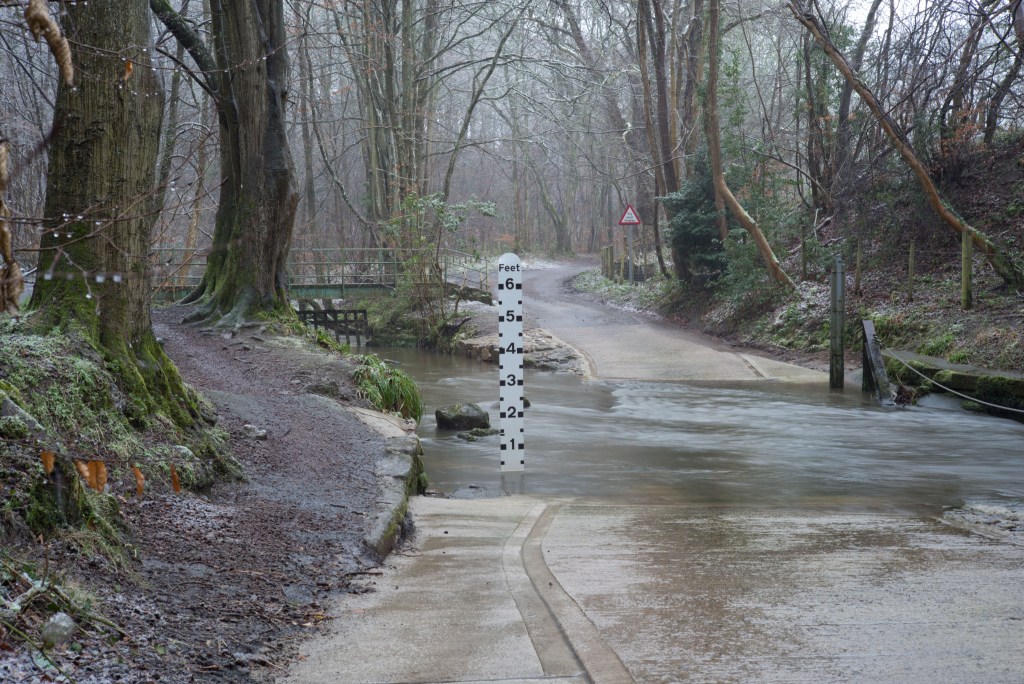
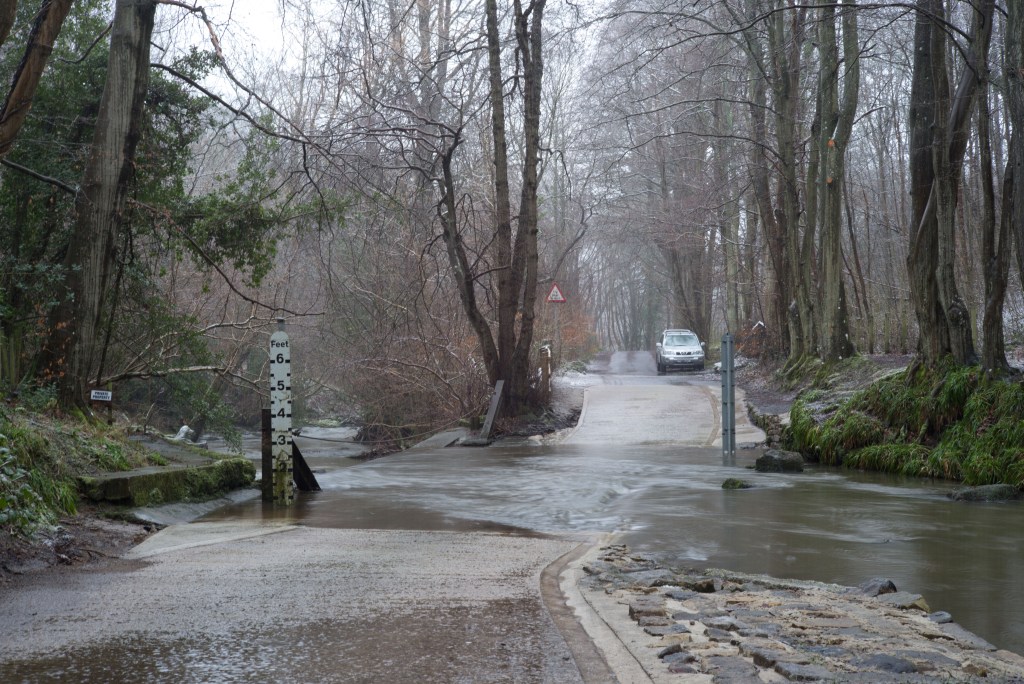
Another brief update as we have just had our first snow of the winter. We did in fact have some snow a week or so ago, but only down to about 100 metres above sea-level (my house is at about 70m and the fords at 50m). Today though it snowed right down into the floor of the valley. So, despite the horrid conditions – it was more wet than anything else – I went down to the fords again this morning to try to catch the changing conditions. There is not a great deal of snow to be seen, but at least there is something to indicate this is winter! Also the light was so poor the exposures were quite long (up to 1s) so that it is not possible to see individual flakes falling. There is though general blurriness that indicates the weather was not good!

24/02/2020
24/02/2020

Assignment 3: Further thoughts

Although I decided where I wanted to go with this assignment a while ago I have nevertheless continued to give it further thought as I work on it. Given the amount of Fay Godwin’s work I have been looking at in response to the course material of late I have given some consideration to another possible approach.

As I have written at various times, going right back to EYV, one of the strands in Godwin’s work that particularly appeals to me, increasingly at a political level, is those images that deal with people being excluded from a landscape: the ubiquitous notion of the “keep out” sign. This seems to me to be a particularly negative way of turning a space into a place. It does to though by exclusion: what was previously an open space, theoretically at least, open to and accessible by all, becomes a place, a specific place from which everyone other than the “owner” is now excluded.

Many of us do it, putting up fences and hedges around our homes, installing gates, intercoms and CCTV (as I have explored within my own village). Increasingly corporations are creating places around their buildings that appear to be public until you run into the security guards, note the cameras, discover the rules and regulations specifying what you can and cannot do (No Food, No Drinks, No Dogs, no rights!). Perhaps it is a natural human impulse.

I do think this offers fertile ground. I am though wary at the moment of getting into another rant (I do not know about any readers but it makes me tired) and so am going to stick with the more neutral, unpolitical approach that I have already started to work on.

So far as that project is concerned, having started out concentrating just on memorial benches, I have discovered that there are not in fact quite as many locally, despite the surprisingly dense cluster within a kilometre of my house, to provide enough material. I have however observed plenty of other, non-memorial, benches that share the same sort of apparently almost random citing that creates “non-views”, spaces becoming a sort of non-place, or at least one without any obvious significance. As they all have this particular factor in common I am going to spread my net a bit wider to include some of these other idiosyncratic spaces/places.

Post/industrial Landscapes 2

James Morris

Apart from noting a reference to him in Alexander (2015, at page 124) I did not really know much bout the work of James Morris before now. Indeed my first reaction was to confuse him with the writer of the same name who lives in north Wales!. Now that I have looked at some of his Welsh images I find a comparison with John Davies to be quite illuminating.

Leaving aside the obvious difference that Davies has worked primarily in monochrome where as Morris works predominantly (exclusively?) in colour, I am initially struck by the similarities in some of their work: subject matter (obviously), point of view, framing, format. The big difference is that Davies has done a lot of before-and-after shots whereas Morris concentrated on single images. His pictures though often manage to encapsulate elements of both before and after. Many of the landscapes he focuses upon have not really change after the demise of the industries that formed them. His work is therefore political but in a slightly different way: he highlights how the industrial landscapes of Wales, and presumably the communities that remain in them, have effectively been abandoned, or at least overlooked in the sense that there has been no post-industrial amelioration, restoration, or gentrification. In a way this makes his work more shocking to me than Davies’s.

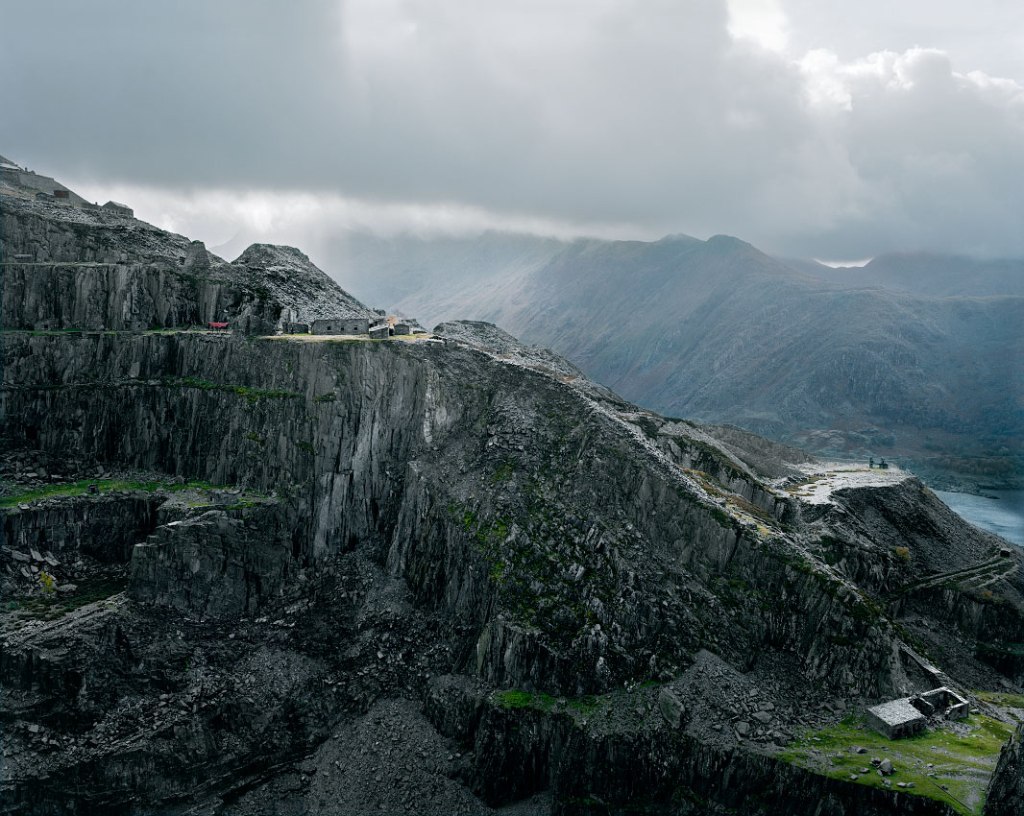
For example, an old slate quarry that remains just at it must have looked when work stopped for the last time:

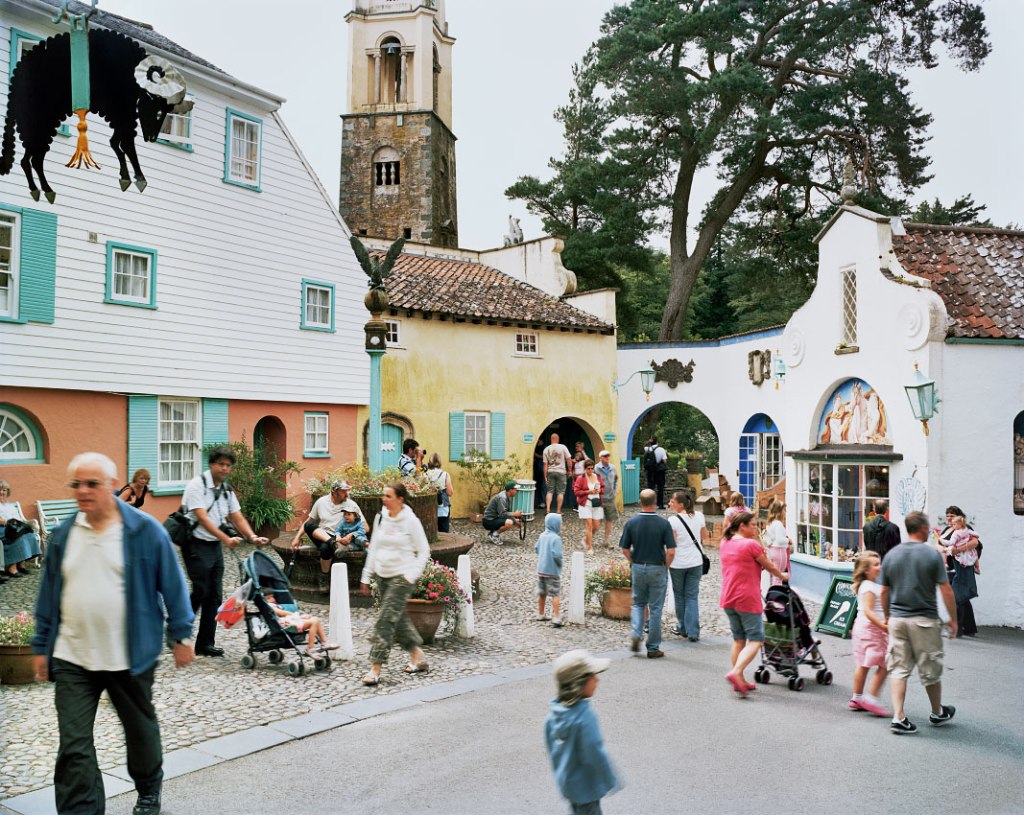
What they also share is a sense of the Sublime, as this example exemplifies. I do think though that Morris does sometimes come closer to the Picturesque, as in the case of this image from Port Meirion, famously the setting for The Prisoner, for those old enough to remember the television show:

However, the feeling that I get is that he is not just looking for a “pretty picture” and rather that there is again a political point being made. This time it is about a different form of exploitation, not for natural resources and industry, but this time cultural: when not industrial or post industrial, the Welsh landscape is presented as picturesque, something to the delight and amusement of people from outside. I suppose this is exemplified by his image of the car park in the Llanberis Pass at the foot of Snowdon, a magnet for hiking boot clad tourists. (I plead guilty here having trudged up to the summit as part of the Three Peaks Challenge almost sixteen years ago. Mea culpa.)

Patrick Shanahan

It would similarly have been interesting to draw comparisons with Shanahan’s Eden Project work. Unfortunately though the link in the course material no longer works, and I cannot otherwise find anything on the ffotogallery website. There is a website for a photographer of the same name but it has nothing within it about this particular project, so I cannot even be sure it relates to the same person. Similarly nothing seems to show up on, for example, Bing Images. I am afraid therefore that I am a bit in the dark here.

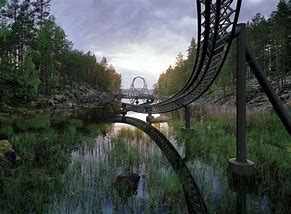
I wonder though, are there parallels here with the work of Ilkka Halso, mentioned in the previous section of the course material (and also considered by Alexander), whom I have not yet addressed? Halo’s images deal with the imminent extinction of natural habitats and a fictionalised, constructed, account of their preservation by effectively turning them into a theme park.

Roller-coaster, 2004

Can the Eden Project, which I confess I have not visited, be said to be doing something similar? Does this make it, to an extent, just another form of physical exploitation of the landscape, and cultural exploitation of the people who visit it? I do not want to be judgmental about it but there is something here that troubles me.

Coincidentally, Halso’s work has been used to illustrate a chapter on Landscape Futures, dealing both with their possible future fate and their value as commodities in a book that I will mention further in the next post on urban exploration: Manaugh (2009), chapter five (page 186, ff.). I first read this a decade ago but at the time Halso’s work did not really make an impact on me. Now I can see it in a different light.

Alexander, J.A.P, (2015).  Perspectives on Place.  London:  Bloomsbury

Manaugh, G, (2009).  The BLDG/BLOG Book.  San Francisco:  Chronicle Books

https://www.jamesmorris.info

Post/industrial Landscapes 1 – John Davies

I am going to start this section by looking just at the work of John Davies and to think about the observation made by Liz Wells (2011, at pp 170-1) quoted in the course material. In particular what I want to think about is whether or not I agree with Wells’s assessment. Does he teeter on the brink of the Picturesque at the expense of his political message?

Looking back at my earlier reflections on the Picturesque (https://markrobinsonocalandscape.photo.blog/2020/01/16/exercise-3-1-reflecting-on-the-picturesque/) I have to say that I am not at all sure that Davies applies picturesque modes as Wells puts it. I still to a large extent associate notions of picturesque with a sense of an ideal, more imagined than real and attempts to portray a landscape as complying with those notions. I really do not get this from Davies at all. As with Fay Godwin, I do think that some of his work might be described as Romantic, but again with a no-nonsense, hard, realistic and political edge and intent. Certainly there is a sense of pictorialism, in particular with what Wells describes as his Turneresque skies. I am though not convinced that the application of a pictorial aesthetic necessarily makes the images picturesque. Another artist who comes to mind who has produced some particularly dramatic skies in his landscapes, manipulating his negatives and prints in the darkroom, is Don McCullin. (I have to say I sometimes think he went a bit too far.) What I do not think you could seriously say of his work is that it is picturesque, and I am very much of that view when it comes to Davies. If anything, as with Turner’s dramatic skies, I think the effect owes more to a sense of the Sublime than anything else.

Looking in particular at his most recent book (2019) I do not feel that the political impact and importance of his images is at all diluted. On the contrary, they demonstrate graphically how the industrial heritage of this country, upon which much of its wealth was based, has been lost, indeed systematically and wilfully destroyed (think of Thatcher and the miners) and replace with something more insubstantial and ephemeral. I do not have the feeling he is looking back with a sense of nostalgia. Let us face it, much of the industrial landscape was grim, at best unattractive, and the lives of those dependent on the old “dirty” industries were hard. HIs juxtapositions of before and after photos do though raise questions about some of the changes, whether they really have, in the long term, always been for the better, whether the economic realities of today better, easier, today – something I very much doubt for significant portions of the population.

I can see that his distinctively pictorial style (I have no problem with that) can mean that his political message is not necessarily trumpeted loud and clear. That though is not to my mind a bad thing. I am happy that he has to an extent left it to the viewer to form her or his own view and judgments. I do not though share the view that this exposes him to the risk of veering into the Picturesque.

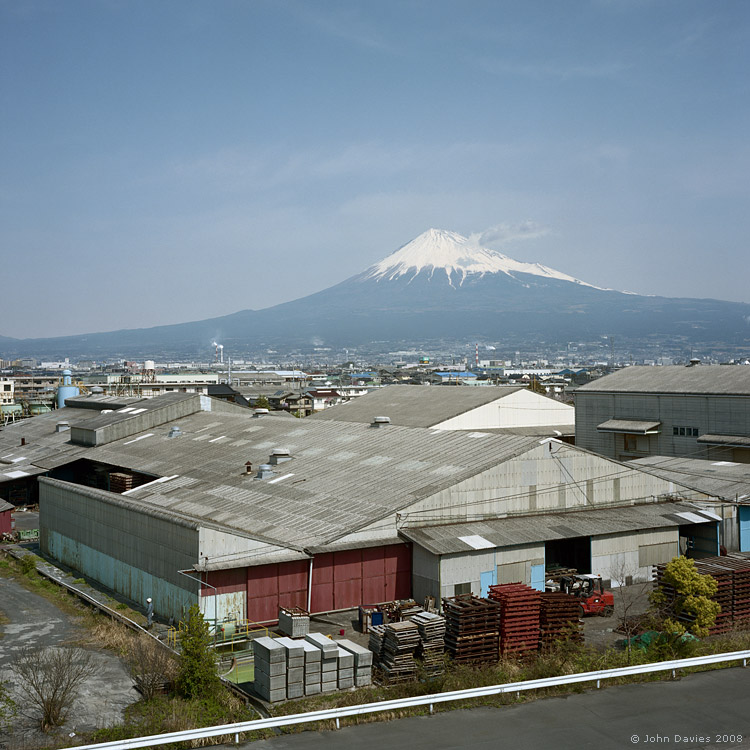
My views on his work are very much reinforced by something that I recently came upon quite by chance, a sequence of images that he made in Japan in 2008. (These appear on his website but I found them as part of the book (2008) cited below.) Despite his usual modus operandi, using black and white film, these are mostly in colour, which gives them a very different and particular effect. They are a sequence of images of the heavily urbanised and industrialised area of Fuji City, in the shadow of the iconic volcano Fuji-san. They do not follow the same before and after format but nevertheless there are similar things going on in them, particularly with his use of pictorial conventions. With these pictures he is saying something about the place of “order” in Japanese culture and society. The industrial landscapes he illustrates are therefore very “neat”, indeed ordered, even tidy. I do not think though that they could really be described as picturesque. Ordered but not particularly attractive. (This remains for me one of the puzzles of Japanese culture: a sense of beauty and natural order is so important but huge swathes of the country have been built upon and developed and nature has been organised, channelled, hemmed in.)

The pictorial convention comes in the form of the appearance in the background of the mountain in the background. There was a tradition amongst Japanese printmakers, and I think particularly of Hokusai and his Thirty-six views of Mount Fuji (Fugaku Sanjūrokkei), of depicting a scene with Fuji-san in the distance. Pictorial but not picturesque, as this example demonstrates:

Fuji City – 117, Shizuoka Prefecture, Japan, March 2008

Davies, J, (2019).  Retraced 81/19.  London:  GOST

Kikuta, M, & Kodera, N, (2008).  European Eyes on Japan – Japan Today vol. 10.  Tokyo:  EU-Japan Fest Japan Committee

Wells. L, (2011)  Land Matters:  Landscape Photography, Culture and Identity.  London:  IB Tauris

http://www.johndavies.uk.com

https://www.michaelhoppengallery.com/artists/123-john-davies/overview/#/artworks/11117

Landscape as a call to action 2 – Dana Lixenberg: The Last Days of Shishmaref – Book

It has taken almost two weeks but at last my copy of this book has arrived. One of the reasons it has taken so long is the lousy service of Amazon! I try to use Amazon as little as possible, normally only as a last resort if something that I want is not available, or available but not as a reasonable price, elsewhere. I will not for now go into details! Second attempt and I now have it.

What is happening in the Arctic, environmentally, socially, culturally, is something that has interested, and concerned, me for some timed over the years I have read quite a lot about the region: in particular writers such as Barry Lopez, Marie and Kari Herbert, Jean Malaurie, Hugh Brody, Gretel Ehrlich, and most recently Kathleen Jamie (and even Rockwell Kent! – who reads him these days?). Though I have not travelled within the Alaskan or Canadian Arctic, I have spent a little time in Western Greenland and, albeit fairly superficially, have witnessed there some signs of climate change (most notably the effect on glaciers) and some of the social impacts on the indigenous population.

Quite coincidentally I have just read Jamie’s latest book (2019) which has a couple of chapters about archeological excavations at Quinhagak on the Alaskan North Shore. She paints a prose picture of how the region is suffering from environmental degradation – global heating melting the permafrost upon which the people still depend – and how that also leads to social and cultural degradation and loss.

This is precisely what Lixenberg has portrayed pictorially for the inhabitants of Shishmaref in Alaska. Again warming is causing the permafrost to melt which is leading to the island on which the settlement is established to be steadily but inexorably destroyed by the sea. When Lixenberg made her book it was estimated the community would have to leave and relocate by this year, 2020. It seems they are still hanging on, but in part because the Federal Government has been totally ineffective in establishing a new site for them and enabling a move.

For now I do not really want to get into a political or environmental rant about what is happening here. Rather, I want to focus instead on what I see as the significance of this book from the point of view of “landscape” photography. I have repeatedly expressed the view that what interests me in landscape photography is not just the appearance of the physical environment but also the people within it, how they relate to it, how the landscape affects them , and in turn how it is affected by them. Thinking about this from the point of view of Assignment 3, that I am currently working on, it is the involvement of, and intervention by, people that makes a space a place. Without the people who live there Shishmaref would be a small island that is steadily being eroded. Because people live there, because they have imprinted upon it their history and culture, and have in return had their history and culture shaped and moulded in part by the island, it has become a place, a very particular place. It is a place of significance, to the people who live there, to the wider ecology, and to the environment as a whole threatened by climate change.

Lixenberg’s book appeals and speaks to me because it addresses all of those elements. There are purely topographical images, firmly rooted in the Sublime, not at all Picturesque. But there are also portraits, still lives, not the stuff of traditional landscape photography. Taken together, this multivalent approach builds up a much bigger, more ‘realistic’ picture, and that is precisely what appeals to me. It fits with so many of the other photobooks in my library, too numerous to list again, in which the relationship between the physical environment and the people within it are inextricably linked (physically, emotionally, politically, historically, culturally) and that together they make up “the landscape”. Indeed, I think that without such a multi-layered approach the war would not have the same impact at all and not get across its environmental message.

This has made me reflect on the photographic work I have done so far on this module and what I would like to achieve in the future. So far people have been literally absent from the work I did for Assignment 2 and it will be the same for Assignment 3. However, I am increasingly conscious of the fact that their presence is at least implied, and inescapable. Without human intervention and involvement the things and places I have photographed, and am still photographing, would not necessarily not exist, but would at least be devoid of any real significance. I do not know to what extent it might be possible in the future – I have not looked at Assignment 5 yet and there is not much scope in 6 – but this is something that I would like to explore further. Possibly there is something here for the critical review that makes up Assignment 4?

Jamie, K, (2019). Surfacing. London: Sort of Books

Lixenberg, D, (2008). The Last Days of Shishmaref. Edam/Rotterdam: Paradox/episode