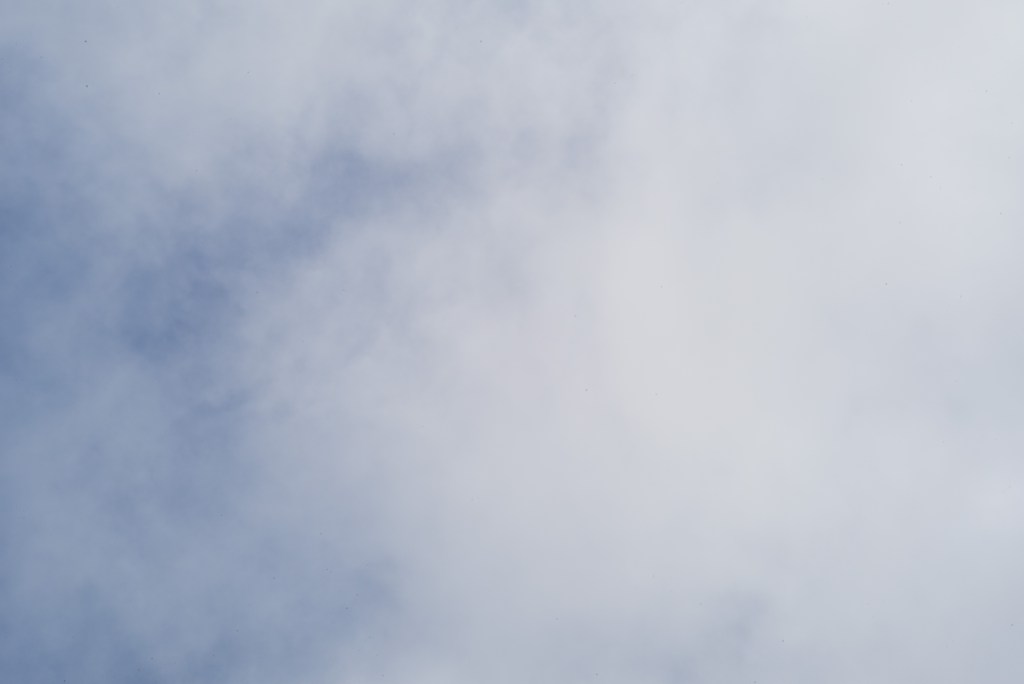
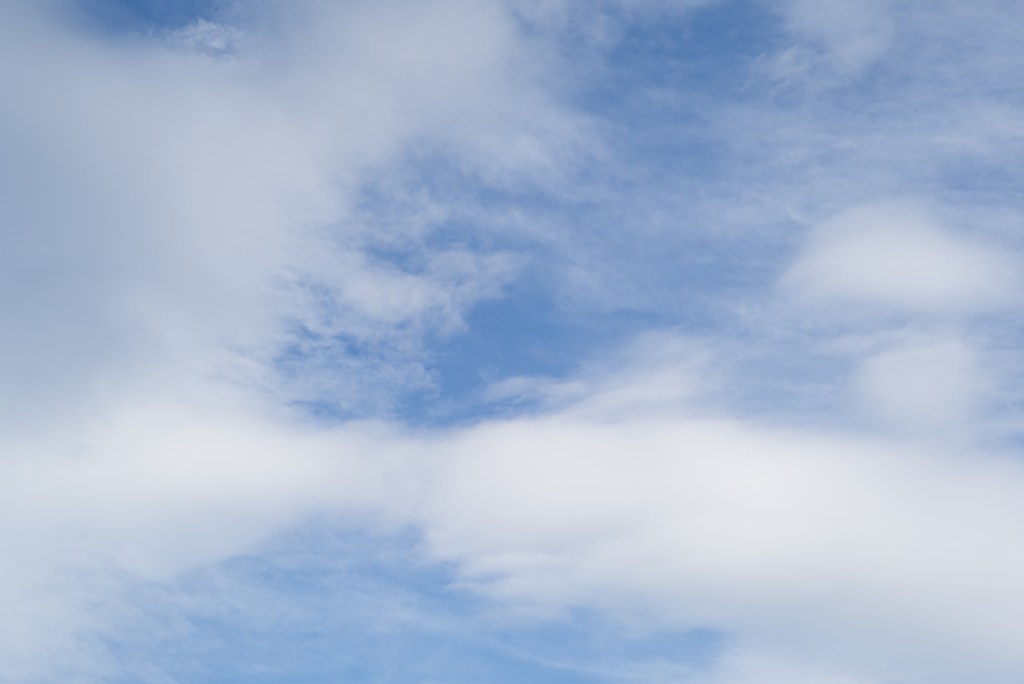
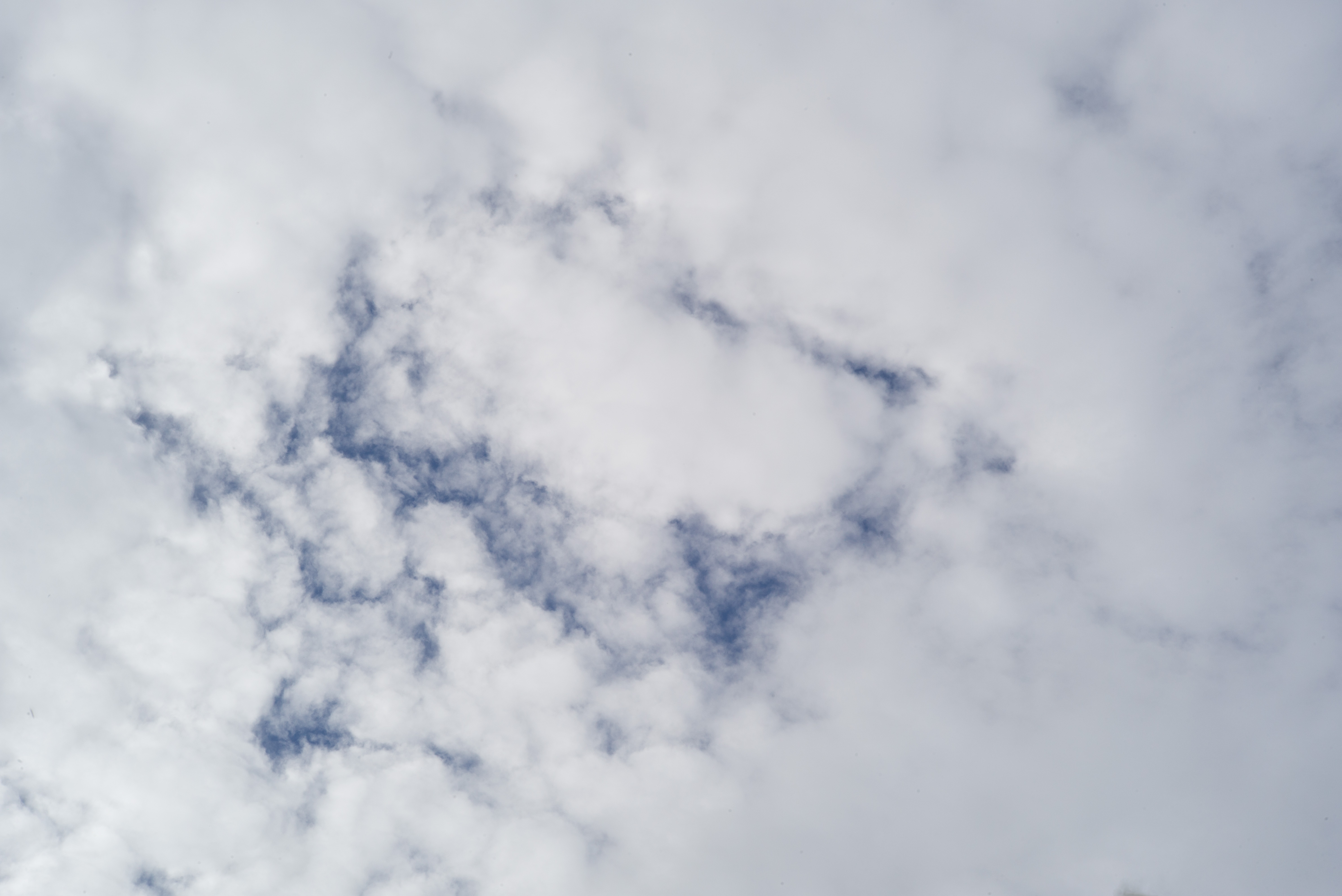
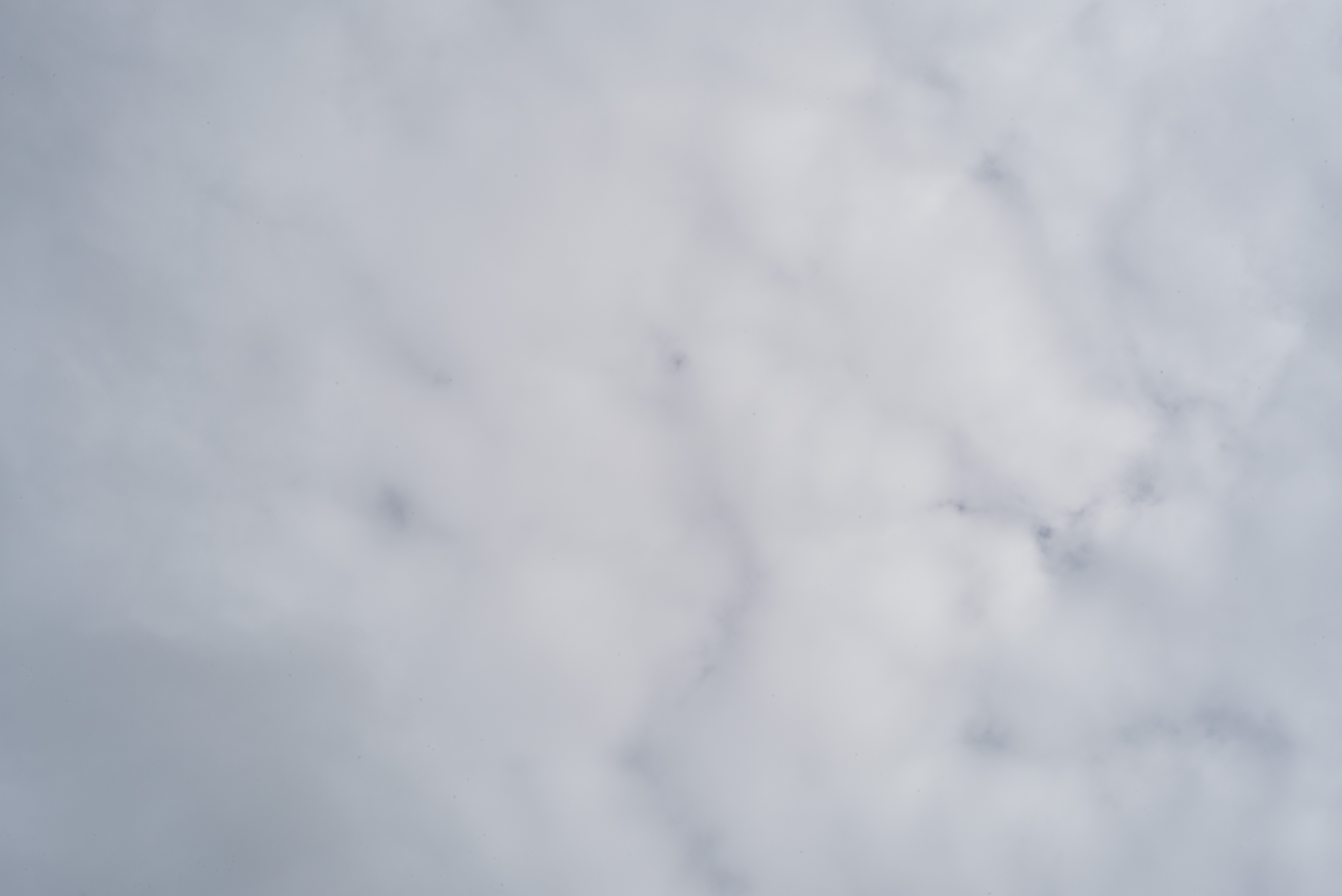
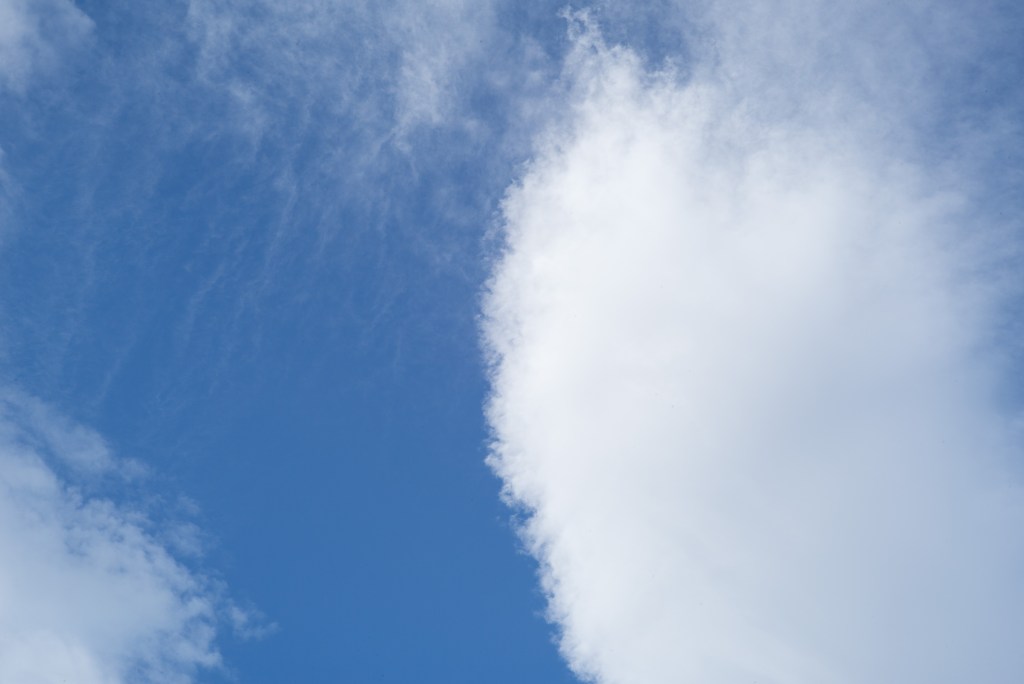
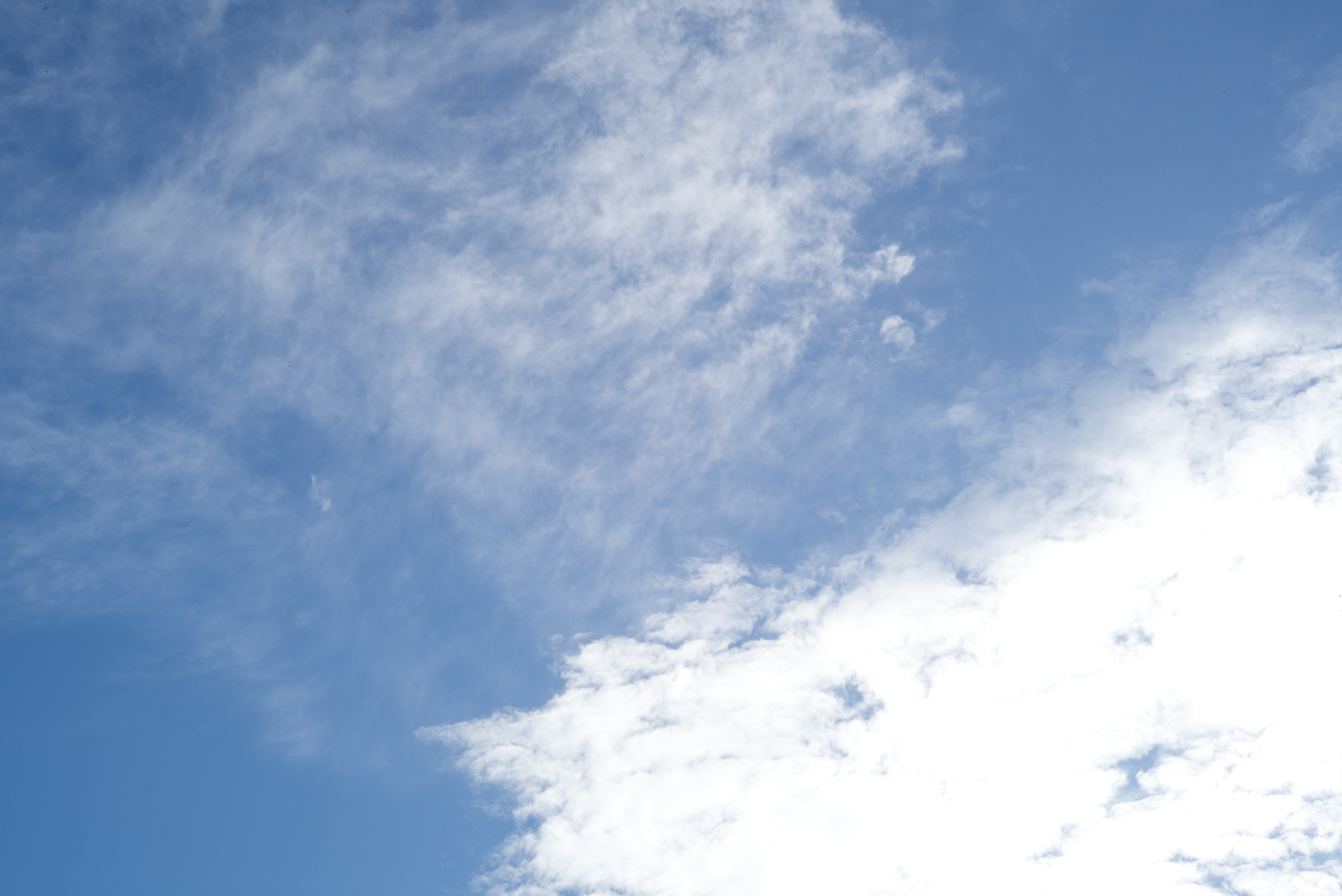
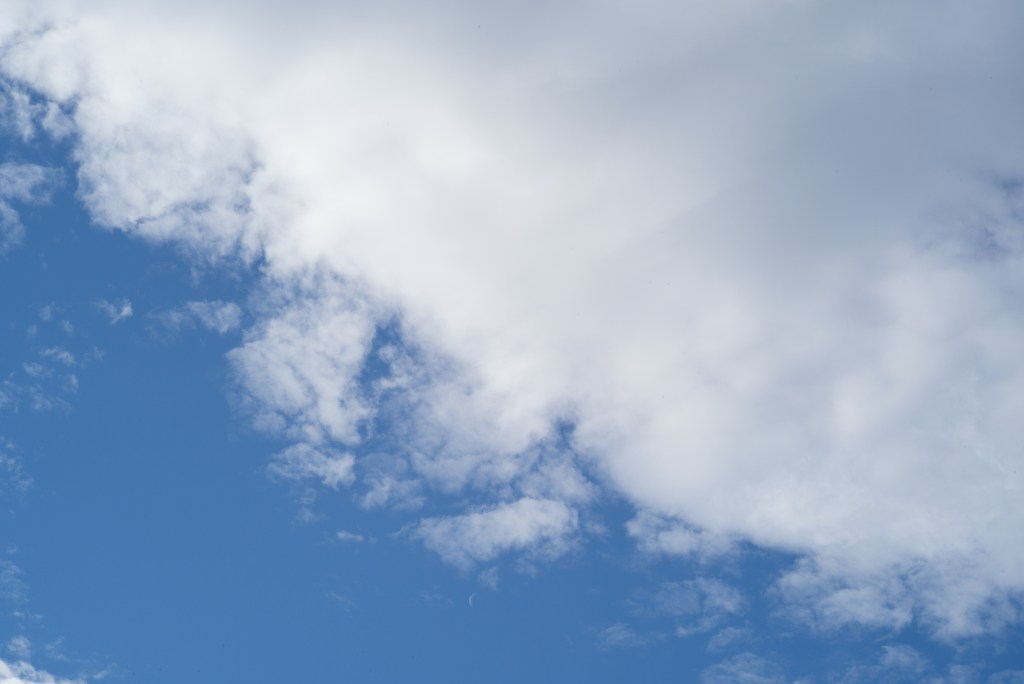
Category: Assignment 1

Exercise 5.5 : Create a slideshow

I am a little out of sequence again, but I have jumped ahead to this exercise as it fits with some work that I have been playing around with recently in connection with Assignment 1.  When I completed that assignment my primary mode of presentation was simply a sequence of still images.  I did though speculate about the possibility of transforming then into a slideshow, not realising at the time that this is something that we would be coming to later.  At the time I was not at all sure how I would be able to achieve this, but I have subsequently worked out how to do it, without special software.  I do now have the latest version of Lightroom, and I see that there is a slideshow function within it.  I have yet to master it so for the time being I have used the very simple function within iPhoto on my Mac, converting the resulting files into .m4v and .mov to enable them to play on any platform.

As I speculated when working on Assignment 1, in order for a slideshow of this sequence to work well, with a good transition from image to image, I have had to do a bit more editing of the final set I put together at the time.  I have had to flip a couple of the images to make sure that there is greater consistency in the direction in which the clouds eventually clear.  I have also added a couple of extra images, that did not form part of the original set, to make the dissolve smoother.  Ideally, I would have liked to add a couple more but unfortunately there are not enough suitable images amongst the experimental shots to make this possible.

Initially I was not sure about using an audio track, not least because there is not much choice within iPhoto.  I have though now had a look at the Free Music Archive website and found a track that is suitable – a manipulated field recording of temple bells and singing bowls, which are appropriate to the Buddhist ideas that underpin the work I made.  For the sake of comparison, I have uploaded to my new Vimeo account (apart from this exercise I am not sure how much I am going to use this!) two versions, one with, and one without, sound. My feeling at this stage though is that the version with sound works better.  Visually I am also quite pleased with this:  the sense of transition that I was looking for in this work is much stronger with the slideshow than a simple sequence of still images.

Apart from the work on the soundtrack, I had essentially finished the editing of the slideshow before I read any of this part of the course material.  To that extent I have not been influenced by any of the suggested examples, nor indeed much helped by them.  Most of the cited links appear to be bad so I could not access the recommended materials in any event.  Some I could not look at properly as I have a problem with running Flashplayer on my computer (why, is a mystery, as it is brand new and running the latest version of Mac OS, but Flashplayer will simply not load and run).  A couple of the photo-stories in Foto8 were interesting but not particularly helpful:  they are dealing with the use of slideshows in a documentary setting, without a particular narrative, whereas my work for Assignment 1 was predicated on specific start and end points, with a progression between them.  In any event I have my doubts about the suitability of slideshows for such documentary work.  I think it works with Chris Leslie’s piece where the still images stand in for video.  The soundtrack also gives it a sense of structure and progression.  For some of the work on Foto8 though it felt more like a mechanical means of moving from one image to the next, doing away with the need to press the “next” button that did not really add a sense of storytelling, at least in a linear sense.  I would much rather have moved through the images at my own pace, lingering, going back where necessary.

At the moment I do not envisage that any form of slideshow would be suitable for the work that I have in mind for Assignment 5.

http://foto8.com/new/online/photo-stories
http://freemusicarchive.org

Without soundtrack.
With soundtrack.

Assignment 1 – Further research

The two Dutch artists recommended by my tutor, Berdnaut Smide and Jan Dibbetts, are both new to me. In the context of the work that I have done for this first assignment I think the former is more interesting and relevant.

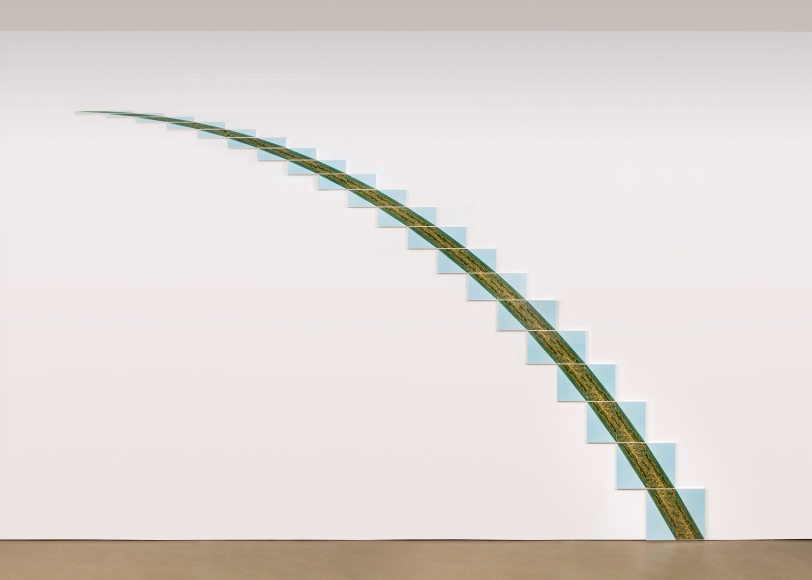
Dibbets’s geometrical collage approach is certainly striking and I can see some contexts in which I might want to experiment with this sort of form.

Comet Land 3º – 60º Sky Land Sky

For the present cloud/skyscape series though I struggle to see how it might be applied constructively.

Smide’s work, which at least in its static forms has some similarities with Judy Chicago’s smoke photos that I have written about briefly separately, but what I find more intriguing is his dynamic, video based work.

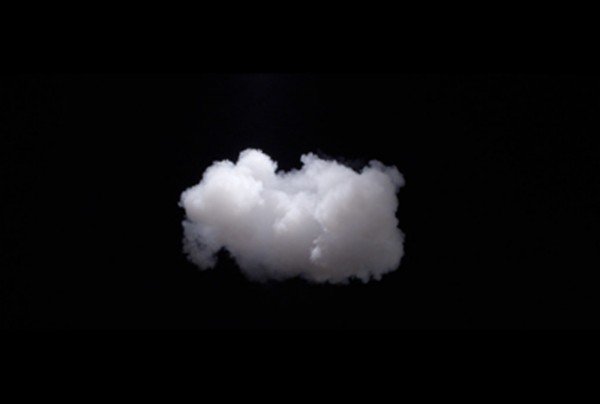
Nimbus Atlas

This was one of the influences for exploring the possibility of some sort of slideshow presentation, as discussed in my last post. I have no idea how he achieves this effect but clearly as it is video based it is potentially more successful as it avoids any sense of discontinuity which I fear is always going to be an inherent problem with any progression of still images.

I have kept what I hoped would be the best tip last, the interview with Hiroshi Sugimoto. I have to say though that I am a bit disappointed. I find this interview rather shallow, no doubt as a result of limited space and enforced brevity, and rather disjointed, so that it does not really do justice to any of the varied strands of his work. The references to spirituality in general and Buddhism in particular are unfortunately too superficial to add much that is useful to my understanding of Sugimoto’s work from this point of view.

What I did find interesting though is his observation on black and white photography, that it is the best medium to show “the tonality of darkness to light”, which is a view I share, and which perhaps goes to explain why so much of the work in my library of photobooks and the prints that I have collected are in black and white.

https://baltic.art/whats-on/judy-chicago

http://www.berndnaut.nl/

https://www.huffpost.com/entry/interview-with-hiroshi-su_b_8924692

https://www.peterfreemaninc.com/exhibitions/jan-dibbets2?view=slider#6

Assignment 1 – Tutor feedback

First feedback from a new tutor is always for me a bit of a nerve-wracking prospect. Whilst the first assignment is an opportunity for the tutor to get to know something of me and my work, this is also an important opportunity to get more of a feel for the tutor. Fortunately all has gone well this time and the feedback has been very positive and supportive. Needless to say I am pleased. For the sake of ease I have cut and pasted the main text below:

Overall Comments

This is an impressive submission, well-conceived and developed through rigorous and focused research evidenced in both the assignment notes and the exercises for Part 1.

All work uploaded to the online log.  

Feedback on assignment 

Aligning the idea of the ‘sublime’ with Buddhist ideas and principles such as Sunyata, a meditative state, works well as an approach for this assignment.  Your reference to Morley’s article about contemporary interpretations dealing with transformative and transcendent states really does bring a contemporary feel to the concept and a framework for the images you produced.  As does your note in Exercise (1.6),  ‘The Buddhist view is that phenomena are impermanent, interconnected, and in continuous flux. …’, 

The images as presented in the Blog don’t, perhaps, do justice to the concept and as you observe later, would better be displayed in an immersive situation (similar to Rothko’s works in the Tate or a dedicated space such as the chapel in Houston).

Alternatively, thinking about Turrell’s installation work – both the site specific and the gallery works – another option would be to use an audio-visual installation to produce a similar effect.  

But it’s the idea here that is important, and certainly gazing into space, the shifting patterns of cloud, light and colour, can certainly induce a meditative state.

You quote Mark Godfrey’s take on Richter to qualify your own ideas:  

 “these are not just paintings of skies – they are paintings that show Richter’s attraction to the ‘unknowable and unrepresentable’…” This fits exactly with the interpretation that I have sought to place upon the Sublime. 

Your set of images, from overcast to ranges of cloud textures, to an almost clear sky, do, in terms of a sequence, offer what might be moments from a single experience and viewpoint.  A range of colours – temporal and meteorological – would be interesting for their variation, but wouldn’t offer the same sense of continuity.  

In his seascapes, Sugimoto, I recall, was looking for vistas that had remained unchanged for millennia, the same our ancestors would have seen, producing a sense of continuity – certainly the sublime: his aesthetic serves to enhance this. Interesting what he says in the introduction to the series on his website, ‘Every time I view the sea, I feel a calming sense of security, as if visiting my ancestral home; I embark on a voyage of seeing.’

Your note:

‘How paradoxical though that Burke was of the view that art was not really capable of communicating a sense of the Sublime and that this was better done through poetry. ‘

Is this about imagination, where visualisation is a more personal first-hand experience through literature, rather than gazing at the work (interpretation) of an artist?  But then one role of an artist has always been to visualize and to provide a (communal) representation of the unknown. 

I thought the work of Gary Miller was very interesting; a man of many ideas with a truly prolific output, some of it reminiscent of Turrell.

I agree with your Postscript about the images from the Blue Skies Project (terrifying indeed). The lack of a frame for your images does reduce the context and emphasizes perhaps, that this is more of a representation of the idea, ‘a bit like thoughts drifting across one’s consciousness while meditating.’  An additional challenge might be to find a way of converting this into an alternative and immersive experience for the viewer.

Coursework

Demonstration of technical and Visual Skills, Demonstration of Creativity 

Excellent work here.  A detailed response to 1.9 ‘Social Contrasts’ with a range of examples and lucid commentary.  Strong practical application in 1.8 The Zone System.

Highly focused research and observations providing a framework for the assignment (Contemporary Abyss and Beauty and the Sublime) – a short literary review that I would be pleased to see from my Masters students at an institution elsewhere.

Research

Context, reflective thinking, critical thinking, analysis  

Mentioned elsewhere, the critical thinking around this assignment is of the highest quality, supported by a broad range of research from historians, theorists and practitioners.

Learning Log

Context, reflective thinking, critical thinking, analysis  

Strong concept, initial notes and images for Assignment 6. It will be interesting to see how your take on this idea progresses.  Would you consider any interaction from people/traffic/ animals – also weather conditions as well as the shifting seasons?”

The final comment about interaction from people and traffic is something that I have already addressed in my updated post on Exercise 1.5 (https://markrobinsonocalandscape.photo.blog/2019/11/26/exercise-1-5-visualising-assignment-six-transitions-update/).

The question of how best to present this work is something I have also been thinking about. Although as matters presently stand it is not practical or feasible for me to do so I still very much like the idea of an immerse space containing just big prints of the photos. I have though also played around a bit with the idea of some sort of slideshow. My present resources for creating one area fairly limited. There is a facility to do so with the Apple propriety Photos programme on my iMac. This is fairly basic and, again for present purposes, I do not have the possibility of making and running a proper slideshow in a public space. Nevertheless it has provided a vehicle with which to experiment and see how a dynamic presentation might look. What I have achieved is a slow resolve of each image into the next, starting from the fully occluded sky to the almost clear one. Even in this family basic form the result is still quite immersive, and meditative. There are though a couple of points that I get from it. One is that the sequence would probably need to be expanded with a few more “intermediate” images to make the progression a bit smoother. The other is that the direction of the resolve means that a couple of images would need to be reversed so that the clearer patches of sky are all on, and so emerge from, the right hand side. As it is, with some clearer patches on the left, a couple of the transitions are a bit abrupt. With a bit more work, and a more sophisticated program or app I am sure this could turn out quite well.

My tutor has helpfully suggested some further research and I will write about this separately.

Assignment one: Beauty and the Sublime – Postscript

Almost inevitably, having posted on this assignment yesterday something else has come up today that is worthy of comment.

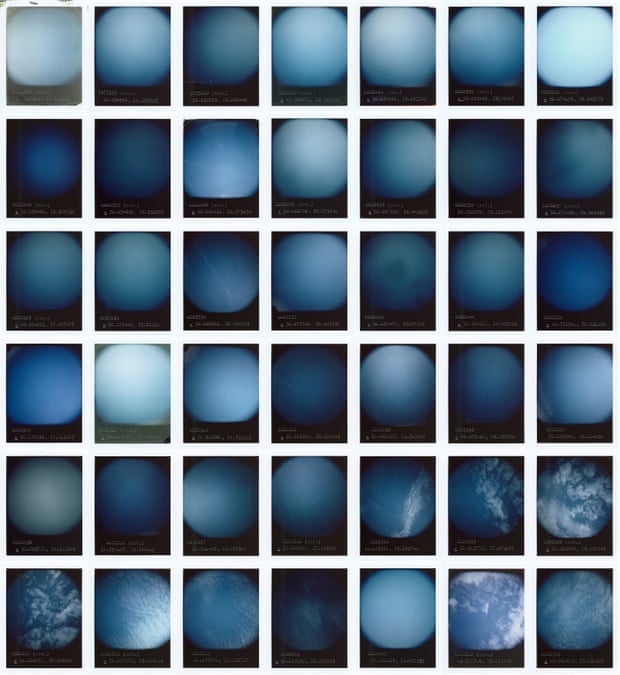
In the Guardian this morning there was a piece on the latest Deutsche Börse photography prize and what caught my eye was the Anton Kuster Blue Skies Project. This is a series of ‘Polaroid’ photographs taken of the skies above the known, ‘official’, 1078 Nazi concentration camps. This has obviously not been an influence on me at all in the choice of subject for my assignment submission as I did not know about it until today. I am nevertheless very much struck by it and clearly this is an example of the Sublime, in the sense of provoking awe and even terror. A lot more serious than my little project!

One thing that is worthy of note, and which I have not covered in any of the previous posts on my own work, is the vignetting. I do not know how Kusters has achieved this with his work. I did think about doing something like this, most likely by adding a mask in post-production, but ultimately rejected the idea because I felt it would make the resulting images much too derivative of Turrell’s work, in which the sky is seen within a frame created by an aperture in the roof of the structure. A sense of framing is also important in, for example, Hiroshi Sugimoto’s movie theatre work. For good or ill though I decided I did not want an artificial frame within the confines of the image itself. I preferred to let the limits of the photographic images themselves serve that purpose. In a way this again links back to some of the Buddhist ideas that have informed my project. The final images are a bit like thoughts drifting across one’s consciousness while meditating. They are insubstantial and fleeting, to be neither welcomed nor rejected or resisted, but merely to be noticed as they pass and let go on their way. Introducing some sense of frame would, I fear, give these “thoughts” too great a sense of solidity that would not fit within the particular conception of the Sublime that I have chosen to explore.

And how do I react to this work? That is a bit difficult as I have not seen it in the flesh. My first thoughts though are that it must be overwhelming simply because of the scale of the project, the number of individual images involved, small as they appear to be individually. Nothing can ever really convey or encompass the sheer scale and horror of the camps (even my own visit to Auschwitz a few years ago did not really convey a sense of the full scale of the evil at work though the experience of being there was itself shocking, deeply disturbing, and chilled me in a way that nothing has ever done before, and haunts me still) but the number of pictures does perhaps at least give some sense of it. If nothing else the affectless, almost abstract nature of the photos, lacking any inner context other than that provided by the stamped captions, gives some idea of the way that for the Nazis the death camps became paradoxically mundane, even banal, the killing merely a mechanical, bureaucratic process: which I find quite difficult to say and which serves only to emphasise how utterly horrific this enterprise was.

I do not honestly think this is the sort of project I could ever undertake and to that extent it does not lead me to think that there is anything I would necessarily do fundamentally differently if I was to address my own project again.

https://antonkusters.com/theblueskiesproject

https://www.theguardian.com/artanddesign/2019/nov/05/deutsche-borse-photography-prize-mohamed-bourouissa-anton-kusters-mark-neville-clare-strand

Assignment one: Beauty and the sublime

I have already discussed at some length the thinking behind my approach to this assignment in the preparation done as Exercise 1.7 (https://markrobinsonocalandscape.photo.blog/2019/10/15/exercise-1-7-assignment-preparation/). To recap briefly, I have taken the idea of the Sublime as my subject and have interpreted that notion as the representation of the unrepresentable, of nothingness in a specifically Buddhist sense, of the void. In this regard I have been most consciously influenced by the work of Hiroshi Sugimoto, particularly his movie theatre and seascape pictures, though I have stopped short of directly emulating any of that work by concentrating instead on clouds rather than the sea and sky or the passage of time. There are nevertheless, almost inevitably, elements of passing time and trying to capture something intangible, ineffable, transient, in choosing clouds as my raw material.

The choice of clouds was also influenced by the skyscape works of James Turrell, and, as it turns out on a more unconscious level, the cloud paintings of Gerhard Richter. Alfred Stieglitz, who blazed a trail by taking some of the earliest cloud photos, was explicitly not a direct influence although I was of course already aware of his Equivalents; if anything he has been something of a negative influence, as I suggest below.

One of the things that I had not fully considered while working on the preparation for this assignment, as recorded in Exercise 1.7, was how the final set would be chosen and how it would be sequenced. That is something that has been resolved only now that I have come to finalise the set and in a way the solution was obvious and embedded within the basic idea.

As the idea that I want the the images to portray is itself quite abstract I decided not to use any pictures that are too clearly and easily identifiable as photos of clouds. I have in this sense deliberately shied away from the pictorialist approach of Stieglitz. The final set are therefore some of the more purely abstract images that I made, though in a couple of cases this has been achieved more in post-production by judicious cropping rather than in the original composition of the shots. To a limited extent that desire for abstraction has also been influenced by the paintings of Mark Rothko.

So far as sequencing is concerned, to the extent that the final images have no apparent intrinsic meaning in themselves, any random order might have sufficed. However as there is an explicit Buddhist element of thinking behind my approach to the assignment a natural sequence presents itself. Not quite a series of reincarnations towards enlightenment but nevertheless a progression from doubt and obscurity, in the form of the blank, even, grey sky of the first image, through slowly breaking cloud cover, to clarity and enlightenment in the final clear blue sky. It is though significant that there remains some small vestige of cloud in that final image – doubt and lack of absolute clarity will always be with us and it is important to acknowledge that.

Although not really part of the brief for this assignment I have in addition given some thought to how, in an ideal world, this sequence might be displayed or exhibited to best effect. Thinking of the all encompassing and enveloping experience of viewing Rothko’s paintings where they fill a space dedicated to them alone, as for example in their special room at Tate Modern, I feel this set would work as big prints filling a room so that the viewer is immersed in them and left with no other points of reference. That would at least make them a bit more awe-inspiring, to come back to one of Burke’s definition of the Sublime, than the small images above.

Exercise 1.7: Assignment one preparation – 2

I am not entirely sure why the course material now requires me to record correspondence with my tutor about my chosen subject for Assignment One. It is not something that any of the other modules have asked for. Nevertheless, suitably redacted to concentrate on the principal subject, here is my email and my tutor’s reply:

“Whilst the idea of the Beautiful has not really engaged me I feel more drawn to the ideas of the Sublime and that is the path I want to go down.  If you have a look at my recent blog-post, particularly on 1.6 The contemporary Abyss and preparatory work in 1.7 you will get an idea of where my thinking is heading at the moment.  The ideas that appeal most to me are the Sublime as representing the unrepresentable, the void, and Buddhist notions of emptiness/nothingness.  The two particular artists who are influencing me most at the moment are Hiroshi Sugimoto and James Turrell.  What I have been concentrating on is a series of sky-scapes, cloud-scapes, with a view to producing images that are in a way devoid of any meaning or significance in and of themselves – other than at a most basic level, meteorological records – almost abstract, hinting at something ineffable and transcendent (without wishing to sound too much likes Pseuds’ Corner!).

If you have a moment please take a look and yours thoughts would be most welcome.  All going well I would hope to have this assignment finalised within the next few weeks, at which point I would propose simply to produce a further blog post covering the points required by the brief and a final set of images.  I will probably also include contact sheets to give some idea of the preparatory work and final selection process.”

Reply:

“The direction you’re taking A1 looks fine, with some solid points of research – Turrell, Sugimoto and Richter: they all have a solid conceptual framework for their work.  Also, very detailed exercises uploaded to your LL.”

Assignment one: Contact sheets

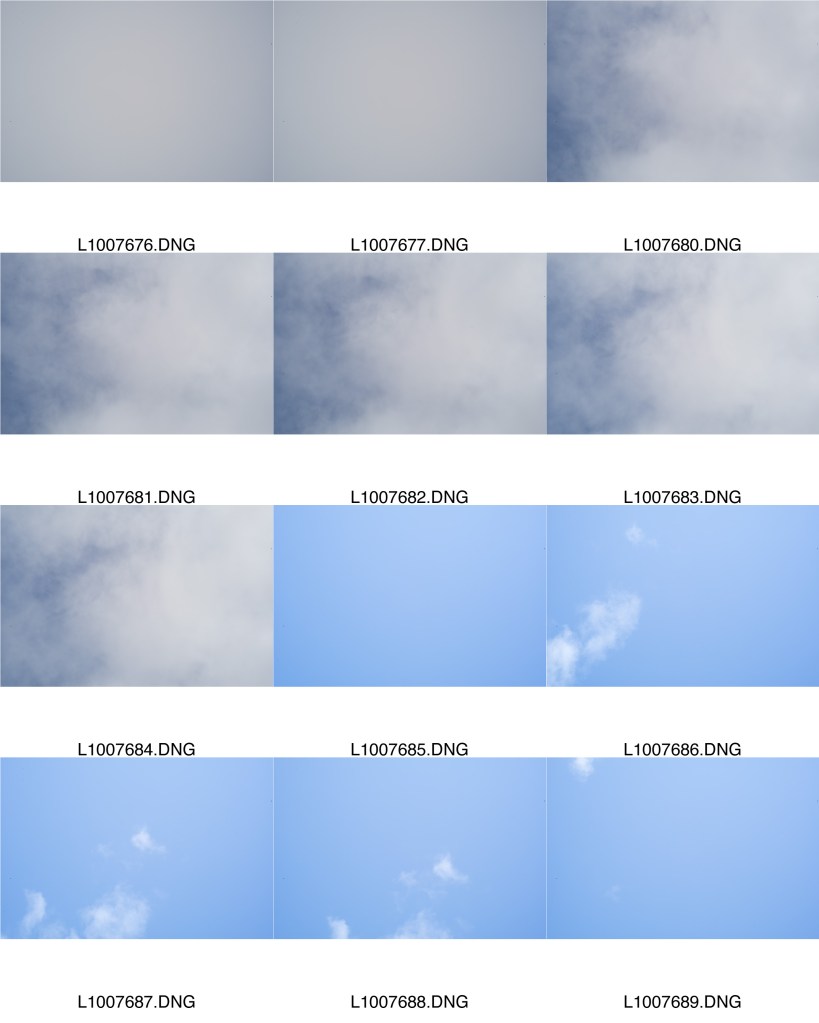
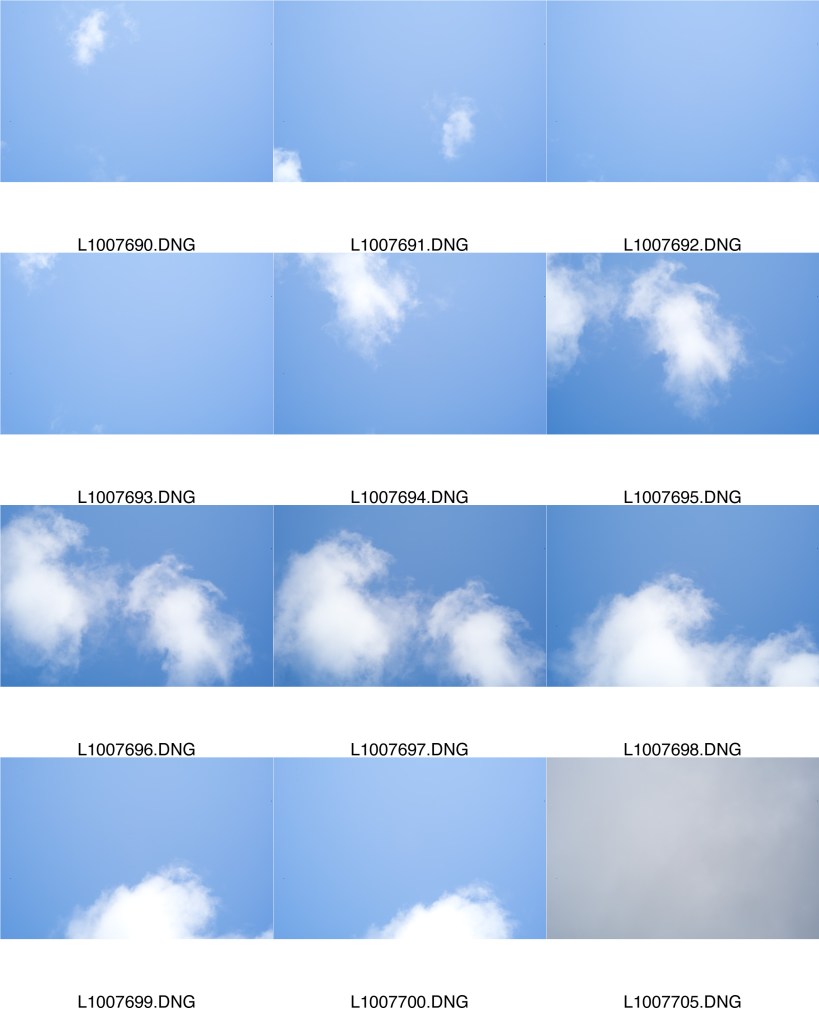
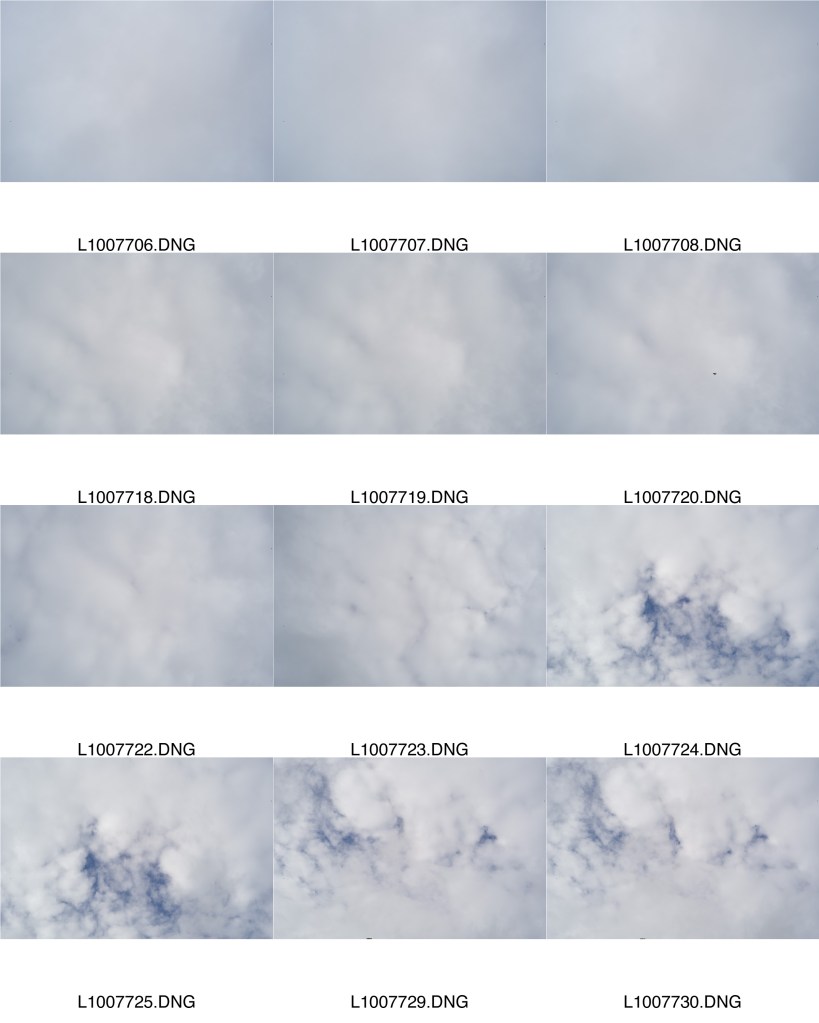
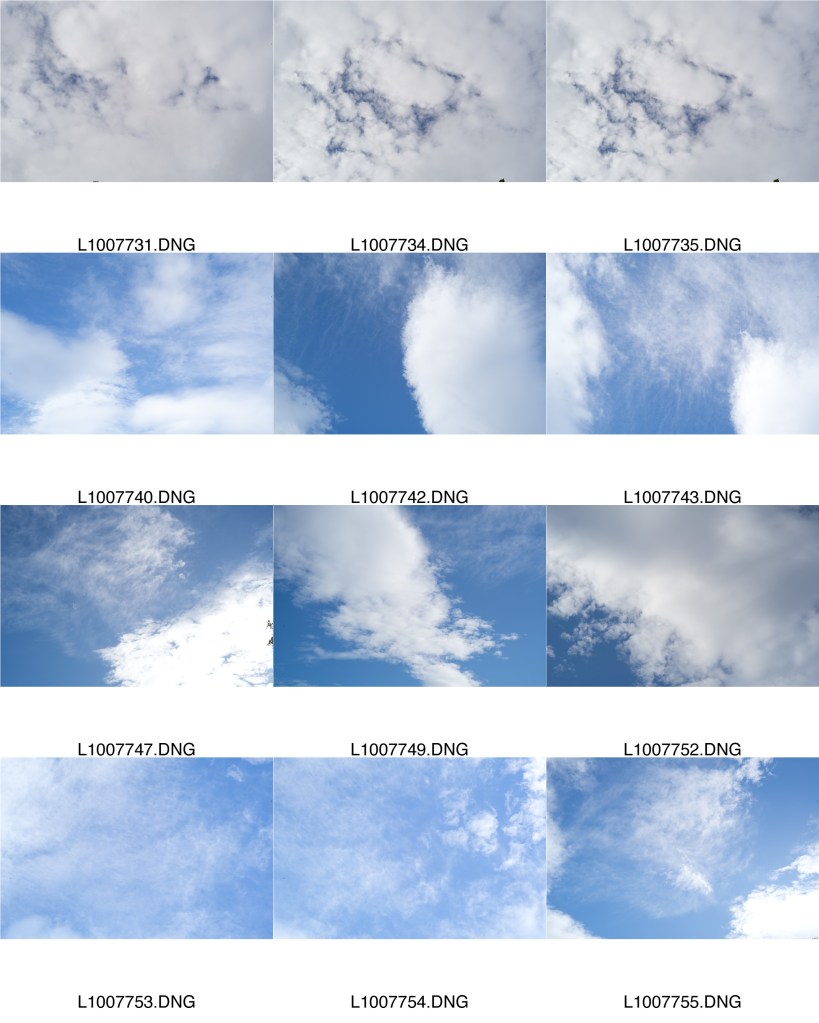
Although I have posted only a few, representative, sky shots in the evolving post for Exercise 1.7 I have actually now taken about 60 pictures and so it is time to start editing them and narrowing down to a final set for submission.

Reviewing the body of images that has developed there are a number that a are unusable because tree branches have got in the way. On one of the last days that I worked on this it was quite windy and it was only when I came to look at what I had taken that it became evident that the tops of a couple of trees in my garden – a pair of birches in particular which are quite tall – had whipped about in the wind and got into the frame. I have simply excluded these. Those that remain are the ones that can potentially be used, albeit a few might need some cropping and a bit of other tidying up – there is a passing bird in one that would need removing (if anything it is amazing that there is just the one!) – and some dust spots. Somewhat annoyingly there are some dust specks on the lens I used for this project that clearly need a bit of vigorous cleaning and once I have made the final choice I will have to do some spot healing in Photoshop.

Here are the remaining potentials. Next job is to edit and sequence them.

Exercise 1.7: Assignment one preparation

Looking ahead to Assignment One I am thinking about concentrating on the Sublime, rather than the Beautiful, as this should give me greater scope to explore the ideas of presenting the unpresentable and of nothingness/emptiness that I have written about recently.

What I would most dearly like to do, as I have lady suggested, is work on a seascapes project. However I have to admit that this would in many ways probably be far too derivative of Sugimoto, even if I was to go for somewhat more dramatic scenes, such as those made by Garry Fabian Miller. From a practical point of view I doubt the feasibility at the moment of making such work given the length of the round-trip to the nearest bit of coast.

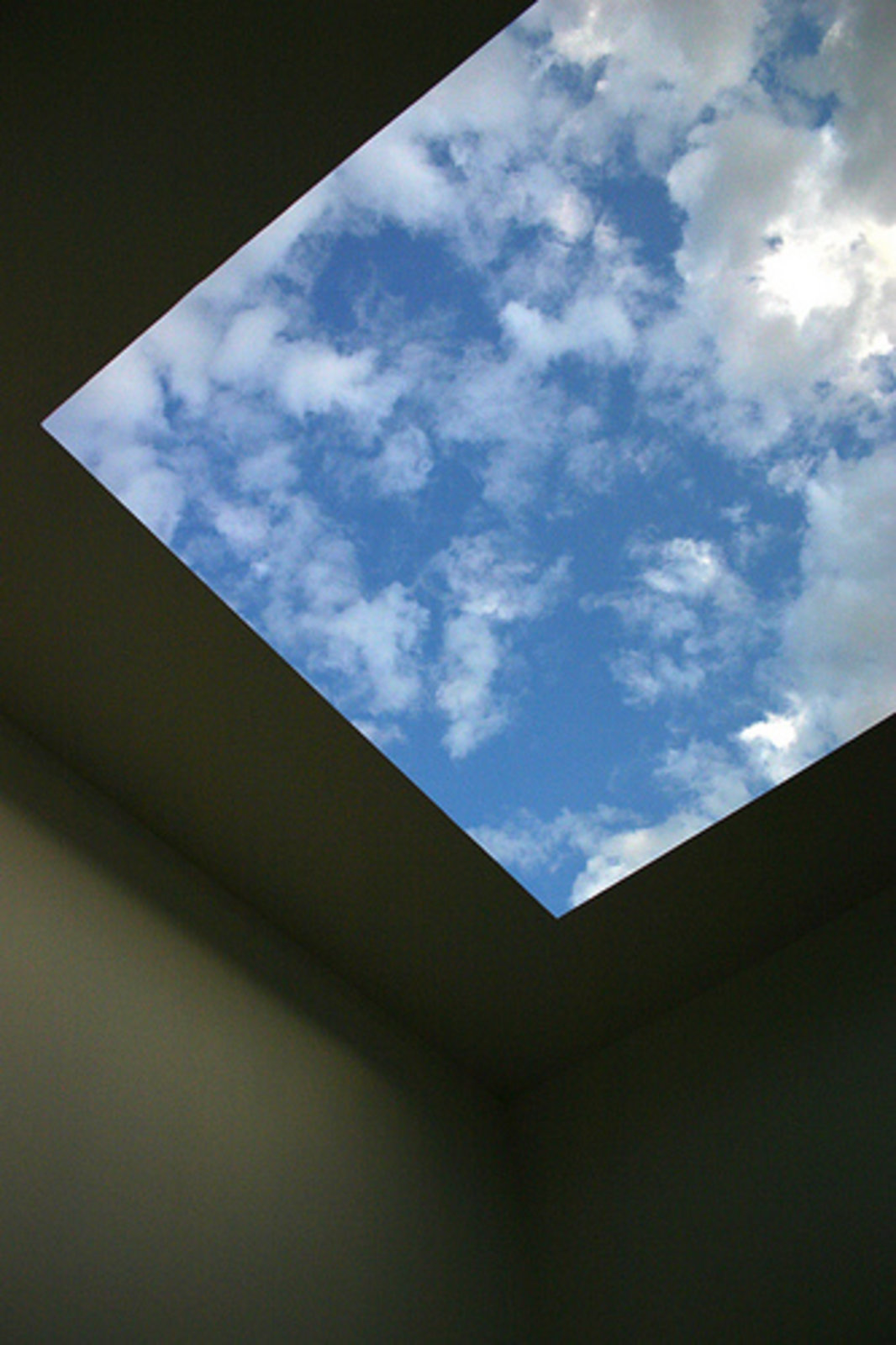
As an alternative I am currently thinking more along the lines of James Turrell’s Skyspaces. This will link back to the cloud paintings of the likes of Cozens, Turner, and Constable all of whom I mentioned in Exercise 1.3. It also still fits with the idea of the void in Sugimoto’s work, and the concepts of the sublime that have appealed to me from the outset.

Again it is not really practical at the moment for me to make repeated trips to the nearest Turrell to me at Kielder. It is not that far away but still at least an hour’s drive in each direction – it is easy to forget how big and relatively empty this county is! Really though I do not need to go there and can shoot sky scenes in the comfort of my own garden.

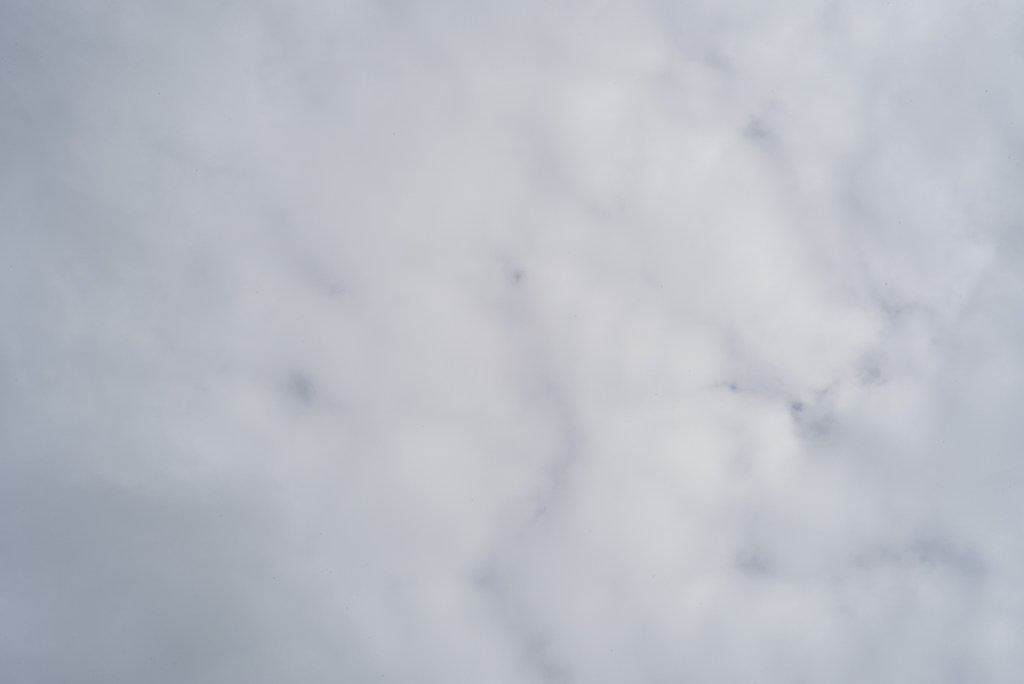
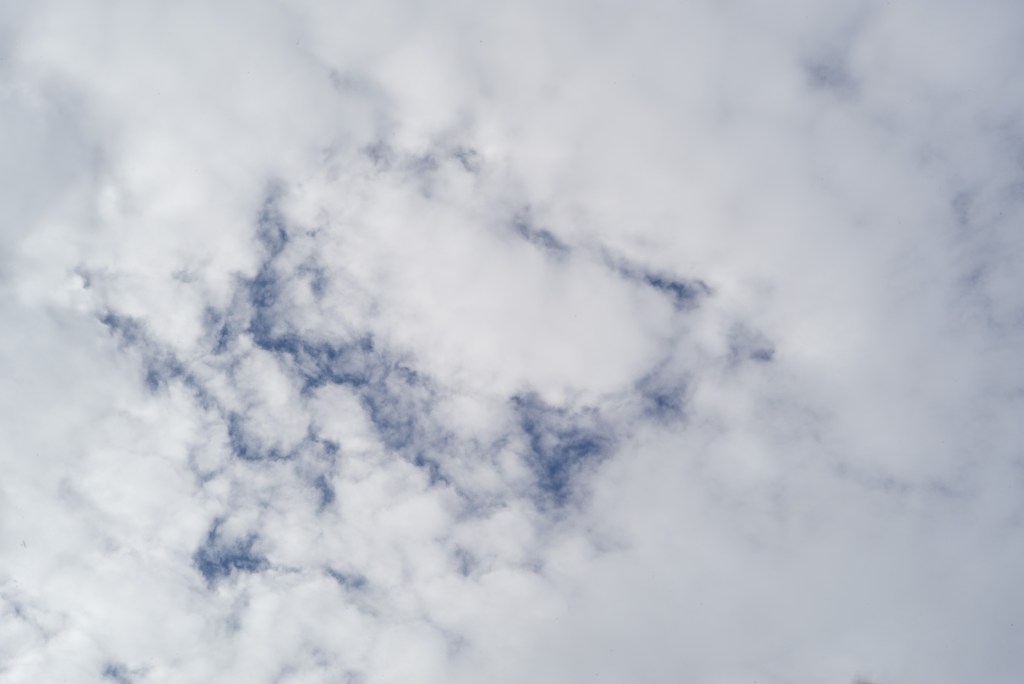
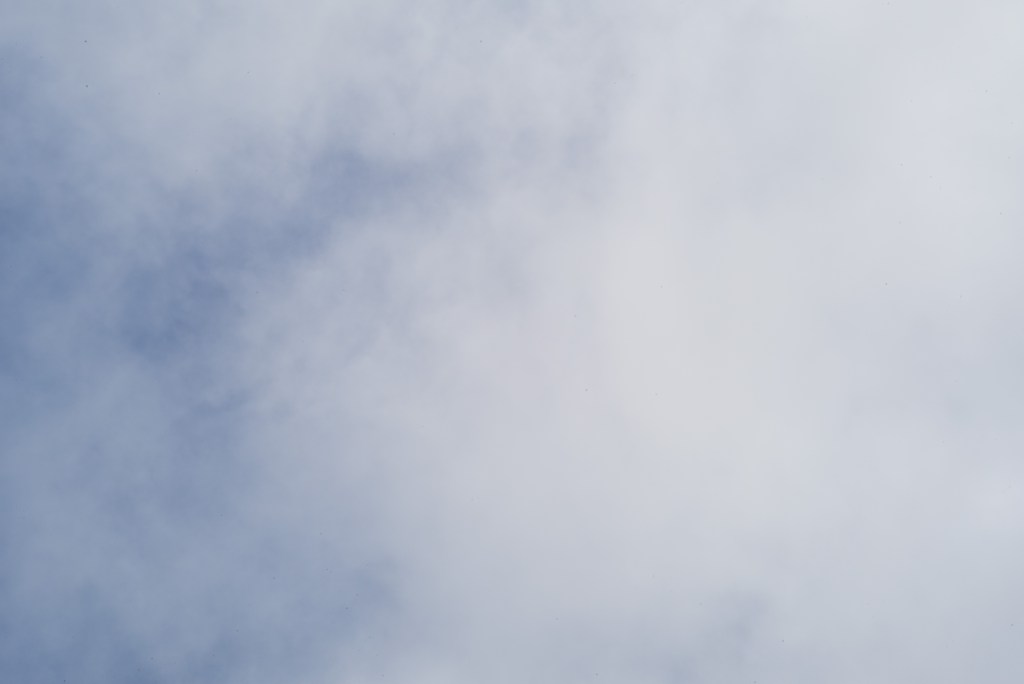
Here are the first couple of experiments, taken yesterday and today. Yesterday was very overcast so the picture actually reveals little – it is a void, empty, a picture of nothingness. Today was a bit more broken so the picture is more easily recognisable as clouds.

14/10/2019
15/10/2019

I will continue with this experiment over the next couple of weeks (weather permitting) and try a shot each day and see what we get. I will also, in the meantime, think about some other possible approaches.

16/10/2019
16/10/2019
20/10/2019
22/10/2019
22/10/2019

23/10/2019
23/10/2019
23/10/2019
23/10/2019
23/10/2019

These were all taken over the course of the same afternoon. It was quite breezy so the sky was constantly changing. Though not easy to see, the third in this day’s sequence managed to catch the moon, a very small crescent in the middle towards the booth of the picture, just below the cloud edge.

While working on this I have been giving further thought to other potential influences on what I am trying to achieve. One of course has to be Alfred Stieglitz and his “Equivalents”, photographs of clouds that are arguably the first abstract pictures ever made. I do not though feel any conscious influence. Yes of course I am doing something similar with my cloud pictures but only up to a point. Stieglitz was, I think, very much pursuing a pictorialist line of approach. His could pictures do not carry, so far as I can divine, any deeper meaning or significance. It is not clear to me that he “meant” anything in particular in making these pictures. In a way what he was doing was more closely aligned with what Cozens, Turner, and Constable were doing.

The other is Gerhard Richter who made a number of sea- and sky-scape paintings in the late 1960s and early 1970s. While working on my pictures I had this nagging feeling at the back of my mind that a contemporary artist had done this sort of work but it is only now, now that I am just about ready to submit this first assignment, that I have realised that it is Richter that I have had in mind and have gone back to look at this work. Although not an active, conscious influence this work has clearly had an effect, even if only at an unconscious level because clearly Richter was seeking to do with his cloud paintings what I am trying to do now. As Mark Godfrey points out (2011, at page 83): “these are not just paintings of skies – they are paintings that show Richter’s attraction to the ‘unknowable and unrepresentable’…” This fits exactly with the interpretation that I have sought to place upon the Sublime.

Wolken, 1970

Godfrey, M, & Serota, N, (2011). Gerhard Richter: Panorama.  London: Tate