This is not a book about landscape photography as such but I nevertheless mention it here because it relates to one of the issues that was thrown up by the work that I did for the critical review in Assignment 4: to what extent does an artist’s outsider status, specifically so far as a particular place is concerned, affect or inform their photographs of that place and offer a new perspective on it. This book, which is effectively the catalogue of a show at the Israel Museum in Jerusalem in 2013 looks as if it might go some way towards answering that question, or at least offering a further perspective on it.
I had not come across this show or book before but within the last week or so my wife listened to an on-line talk given by the author and tipped me off. Nor have I yet had time to delve into it beyond a quick first glance to see who is in it. The answer to that question is just about everyone who was a significant figure in photography, particularly during the first half of the last century. Too many to mention in full, but Robert Frank and William Klein, key figures in my essay, are there in some numbers.
After the work that I did, I am firmly of the view that inevitably one’s relationship to a particular place will have an effect on how one sees and portrays it. Where that relationship is as an “outsider” then the possibilities arise of disclosing new insights, as Frank and Klein did.
At the moment I do not really have to time to indulge in a further detailed investigation of this subject as I am presently more preoccupied with this particular course: getting Assignment 5 finished (it is very nearly there); finalising Assignment 6; and then getting ready for Assessment (which looks as if it is going to be quite a big job since the processes changed). I will though nevertheless be thinking more about this issue once I have the time, not least because it occurs to me that this might be something that will be touched on in my next module in so far as I am thinking of doing Self and Other.
Perez, N.N, (2013). Displaced visions. Jerusalem: The Israel Museum
At my tutor’s suggestion I have had a look at an old television programme called Return Journey (which dates back to 1981 but is available on YouTube). This focuses on three photographers: Humphrey Spender and the work he did in Bolton (“Worktown”) for Mass Observation, Derek Smith, and Jimmy Forsyth. The question with which I approached this programme was what, if anything, does it have to say about the thesis I proposed for the Assignment 4 essay. The short answer is, I think, not a lot, but nevertheless it raises some interesting points that are relevant.
Mass Observation, and Spender’s work for the scheme, was expressly anthropological in nature (the programme begins with a somewhat tongue in cheek description of the discovery of that exotic race the Northern Working Class was discovered and needed to be investigated and documented which unfortunately does not disguise what comes across as a sometimes fundamentally patronising streak in Mass Observation, worthy though the scheme certainly was) recording how people lived. It was not so concerned with where they lived, with portraying the environment they inhabited, except to the extent that environment influenced the way the people lived. It was not a visual description of Bolton, or any other generic northern working town, in the same way that Klein described New York.
Smith’s work does not take me much further forward. His story was more to do with his return to Newcastle after studying in London, his ceasing to work as a photographer, becoming involved instead with Amber Films and the Side Gallery (some interesting shots of the old interior of the gallery as I remember it in the mid-1980s).
Forsyth of course spent much of his life on Tyneside and all of his work was done there. It is his that is perhaps the most relevant to the question that I was exploring. Rather than include examples of his work here I am instead putting a link below to the Amber archive of his work, which includes some really nice examples of what he did. Does he fit my thesis? I have to say I do not think so. He was in many ways a classic street photographer, taking pictures of the people, places, things, that he saw around the Scotswood Road. I do not feel that he was making a photographic portrait of his adopted city through the medium and subject matter of its people in anything like the way Klein did. If anything, although not formally so, I feel he was again acting in more of an anthropological way, even if he would not necessarily have seen it that way. He simply set out to record the area and its people as the old fabric of this part of the city was gradually, but inexorably, destroyed. Not just the physical environment (hardly anything of the old Scotswood survives) but, more importantly, the communities that lived there who were dispersed or housed in new high-rise blocks (most of which have also since fallen prey to the wrecking ball). Yes of course his work does describe the city through its people to some extent but that does not appear to have been his intention. Perhaps therefore, albeit in a negative way, his work might be seen as support for the argument that I mooted that one of the key elements in determining the effect of such bodies of work is the intention of the photographer. Klein wanted to depict New York “in a new way” but that was not also Forsyth’s aim.
So what do I get from this programme, apart from the simple pleasure of seeing really good work in an interesting and well made documentary? Above all I suppose it is more questions. It certainly does not close the open question that I ended my speculation on. It certainly highlights for me the slippery and unreliable, and ultimately unhelpful, categories and genres into which we try to force so much photographic work. Here the boundaries are so blurred as to be almost meaningless. At the same time this work is anthropological, typological, social documentary, topographical, portraiture, etcetera, etcetera. It all depends on the purpose of the work, the intentions of the photographer, and how that work is used subsequently by editors, curators, critics. What this particularly brings back to mind is something that Paul Hill said in his lecture (on YouTube, again; link below):
“Landscape photography is not about the land. Like all photography genres it is about the medium – and the maker – not the subject matter …”
Although there is a danger of this being used as a Humpty-Dumptyish credo (“When I use a word it means just what I choose it to mean – neither more nor less.”) this is something with which I very much agree. To the extent there is any firm conclusion to be drawn from the issues that I considered in the essay, this perhaps is it.
Carroll, L, (ed. Gardner, M), (1966). The Annotated Alice. London: Penguin
Despite what I have just written with regard to my tutor’s feedback on the Assignment 4 essay, I already find myself looking at it again! What has brought it back into focus is leafing through a little book that I bought recently, effectively a catalogue of an exhibition put on by Street Level Photoworks in Glasgow of the work of Oscar Marzaroli.
I have known Marzaroli’s work for some time, but it did not really come to mind when working on the essay. At the time, because of the relative breadth of his subject matter, and the way his work is often presented simply as street photography influenced by the likes of HCB, it did not seem to fit my thesis. This recent exhibition (which I did not see) and the accompanying book though have changed my view. By focusing on work that he did in Glasgow it puts his work there in a different light. These are predominantly pictures of Glaswegians rather than Glasgow itself. Whilst his aesthetic was very different from that of William Klein, it nevertheless now strikes me that Marzaroli actually did something similar for Glasgow: by portraying the city’s people he was showing us something of the city itself, as it was in the 1960s in particular, a city that has long since ceased to exist, both socially and physically. To that extent it might be said that this element of his work fits the thesis I was exploring in that essay.
It also adds to my question about the role of, or the importance of being, an “outsider”. Like Klein in New York, he was a native of Glasgow, but did his work there after an absence of a number of years in Sweden and London.
Regardless, it is good to see this work again, which is warm and deeply sympathetic, and deserves to be better known in its own right. In turn this makes me realise that Tish Murtha was also doing something similar with her work on the west end of Newcastle (another returnee after time away from her home region, after studying with David Hurn in Newport). Why that did not occur at the time is beyond me! Perhaps I am going to find something similar when I revisit Jimmy Forsyth’s work.
Dickson, M, (2020). Oscar Marzaroli. Glasgow: Street Level Photoworks
Whilst the feedback from my tutor on Assignments 3 and 4 has been very positive, indeed throughout this course, I have nevertheless been thinking about whether there is still anything that I need to reflect upon and address.
So far as Assignment 3 is concerned I think there are two points, both of which I have already addressed to an extent elsewhere. The first relates to presentation of the work. At the time I produced the work I did not give this much thought. Since then I have of course gone on to use the final set for the print on demand exercise and have had actually had the book made up. For the purposes of presentation for assessment I do not now think there is anything more that I need to do with this work and I could simply put the book forward in the vent of physical submission. Whether OCA reverts to this of course remains to be seen.
The other point relates to the development of a personal voice, which was something my tutor and I discussed at some length. This is something that I wrote about specifically at the time (https://markrobinsonocalandscape.photo.blog/2020/04/29/further-musings-on-development-of-a-voice-body-of-work/). I have since continued to think about this issue but I am not sure I have got very much further forward with it. The issue is, I feel, that whilst I do seem to be finding a particular voice of my own, it is at the moment, inevitably, very much tied to the nature of the work required by this module. I have found an aspect of landscape photography that especially interests me and that has produced a recurring theme throughout that I have done so far. Whether I will want to continue in a similar vein once this module has been completed, whether it will feed through into what I do for the next module, or whether I will explore this further in my personal projects (not that I have much time for them at the moment!), I cannot yet tell. For now I have to recognise that I am still developing and there are plenty of other avenues yet to explore.
This actually strikes me as a good thing and that development and change are to be welcomed and embraced. And this leads me to my second general point from the feedback. In previous modules it has been a case of completing an assignment and moving on to the next. To an extent that is perhaps a result of the nature of the earlier modules and the way they have been constructed. The present LPE module comes across to me as more integrated, at least thematically linked and consistent. As a result, each step calls for a reassessment of what has gone before. This, as my tutor has observed, is what I have been doing by going back to look again at the work done for earlier assignments and reconsidering it in the light of more recent work and developments in my thinking and experience. It has felt important to me to consider how earlier work might be developed or readdressed, so that the assignments have become for me, to an extent, not fixed but dynamic pieces of work. This is why I have gone back to each of the first three assignments and done more work on them, in particular with a view to means and modes of presentation. This is probably also what is behind my decision for Assignment 5 to produce two distinct sets of images exploring different ideas about landscape photography.
So far as Assignment 4 is concerned, I do not think there is much more that I can add for now. I still very regard this as an introductory piece, a first look into my chosen subject that in some ways raises more questions than it answers. It would really benefit from expansion and development but I do not see that as a realistic prospect within the confines of the current course. I suspect though that in the future I am going to think more about those further questions as I can see that they might well be relevant to work that I do in the future. Whilst the essay in its current form does not necessarily, at least at face value, fit within the continuum of the work for the previous three assignments, and what I am doing for the next two, I do nevertheless see what the work on the essay has done is affect might broader thinking about landscape and the role of photography as a means of expressing my ideas of landscape.
On a few other points that have arisen out of the tutorial: I did look at Chris Steele Perkins Japanese work in connection with Assignment 2, but I will look at it again with a view to working out how best to present the work for Assignment 6. Shibata’s influence on what I am doing for Assignment 5 is something I have already addressed in writing about research for that project. Otherwise, I will follow up the Mass Observation and Jimmy Forsyth suggestions soon.
A little bit delayed but I have now had formal feedback from my tutor on Assignment 4 following our conversation a couple of weeks ago: all very positive and supportive.
“We had a long conversation about a range of topics including progress on the course, the thematic continuity in your work, including the written assignment, and the possible modes of presentation for Assignment 6.
The essay, although a subject difficult to condense into 2000 words, reflects a strength and depth of research that supports all of the coursework – theory and practice. I was impressed with the revision/reworking of earlier assignments – 2 and 3 looking at alternative forms of exhibition/dissemination; real evidence of dealing with a body of work in continual development.
Feedback on assignment
Discussing the essay for Assignment 4, your view is that it works as a starting point for a much larger piece. The limitations imposed by the brief mean that it is not really possible to explore the subject in depth at this stage. Perhaps it is something that could be picked up again later and developed. My own view is that it is little more than an introduction to a potentially much bigger exploration of the topic; there are lots more places that it might be possible to go with this line of thought. If anything, it leaves open and raises still more questions that might usefully be addressed and to be answered. As it stands though, it offers a starting point for a personal exploration of a subject that has not already been covered within the course or any of the other work I have done for it. As ever, a major practical question is whether or not I might have the time to devote to developing the subject further.
Coursework
Demonstration of technical and Visual Skills, Demonstration of Creativity
So far as other course work is concerned, we discussed my approach to the print on demand book mock-up exercise. You feel that this has worked well for the chosen subject matter and is possibly worth having printed in any event just for myself. I certainly feel quite happy with the concept that I have produced. I am already having a book made by Blurb of another, older, project, and once I have seen how that comes out, I will probably go ahead with this project as well.
I have in the meantime been working on a hand-made concertina book for the sequence of images that make up Assignment 2, in particular struggling with how to approach the map to go on the verso, discussing the practical and stylistic problems of trying to use an OS map. I showed you my current mock-up of a hand-drawn, rail network style map (which is currently having text added to it in Photoshop) and your reaction was that this looks good. In particular, that it does not contain too much information, which would otherwise be the case if it had been practical to use an OS map. I will press ahead with this concept and complete a maquette.
We also discussed my thoughts about slideshows for Assignment 1 and possibly for Assignment 6. You will have a look at the examples that I have produced so far, posted on my learning log, and we can discuss next time we speak.
Thorough and detailed research for A4, covering practitioners from three continents and a long time-frame.
Suggested ‘Return Journey, a film about Mass Observation and Jimmy Forsyth for further research, also a link to Amber’s site and exhibition of Jimmy Forsyth. Work – You are already acquainted with both.
Learning Log
There are a range of new items uploaded under the Books tab, including the online arts magazine Learned Pig, ‘Landscape as memory device – redux’ looking at the work of Onaka and Ogawa, interpretation through curating. Shibata’s ‘Gas Stations’, which could relate to your work for A5.
Suggested reading/viewing
You will come back with some suggestions for slideshows and movies that might be useful to consider when developing my own ideas.
(Still) looking for something a bit more engaging than time lapse sequences
An interesting pair of videos constructed from still images following the tsunami at Fukushima. The link wasn’t working at the time of search, but CSP’s site is worth exploring. http://www.chrissteeleperkins.com/multimedia/
Pointers for the next assignment / assessment
Having discussed my proposal for Assignment 5 we agreed that I should press ahead as planned. It is a logical development from the benches project for Assignment 3 and fits in well with the work that I have done until now on this course, and even going back as far as Square Mile for EYV. I certainly feel that over time my work has developed a distinctly local flavor and that my immediate locality is proving to be a major theme, and area of interest. We also discussed how my move from the city (now almost 15 years ago!) has influenced the way that I look at the village. This chimes with the hypothesis that I raised in the essay for Assignment 4 about the photographer as an outsider and how that colours the way a locality is seen.
You encouraged me to press ahead with both of the ideas that I have come up with so far: the postcards, and black and white, large format, images. This will fit well the workflow that I have already projected, starting with test shots with a digital camera to determine points of view and composition, which can then be developed into the postcards, before taking out the 4×5 camera. Using the latter I cannot afford to be making test shots and need to make each exposure count. Whilst the continuing Covod-19 lock-down continues, this is not really something that should get in the way of pressing on with this project. It is now more a practical question of when I am going to be able to devote the time to it.”
“The living language of our time is urban.” Sir Michael Tippett, Songs for Dov
Humans and landscape are inextricably linked. People have helped form the environment within which they live and have in turn been formed by it. This is nothing new, as Schama points out (1996, at page 7):
“Objectively, of course, the various ecosystems that sustain life on the planet proceed independently of human agency, just as they operated before the hectic ascendancy of Homo sapiens. But it is also true that it is difficult to think of a single such natural system that has not, for better or worse, been substantially modified by human culture. Nor is this simply the work of the industrial centuries. It has been happening since the days of ancient Mesopotamia. It is coeval with writing, with the entirety of our social existence. And it is this irreversibly modified world, from the polar caps to the equatorial forests, that is all the nature we have.”
With that background in mind, the question that I want to address here is whether the photographing of people in an urban environment, street photography, can itself be regarded as a form of landscape photography; whether the picturing of the human elements of a city can tell us anything about that urban environment without the direct depiction of the built environment itself. I also want to challenge the idea of genres and different disciplines within photography and argue for a greater sense of fluidity and overlap. As in many walks of life and human activity there is a tendency to categorise and draw distinctions. Photography seems particularly prone to this. There are photographers working in landscape, on the streets, in documentary and photojournalism, portraiture, and so on, and these are often presented as distinct disciplines. It is striking though that, for example, many of the photographers interviewed in Wolf (2019) resist such categorisation, reject the ideas of genre and style, and adopt a much more inclusive approach.
In this context what I have in mind is an idea of “street photography” as a form of visual psychogeography rather than a depiction of an identifiable physical, built environment. More than just the photographing of people within a particular environment, but also elements of the physical environment that would not necessarily of themselves be enough to identify with any certainty the particular location at which the photograph was taken, the signs and symbols of human presence and agency, that are encountered on the street.
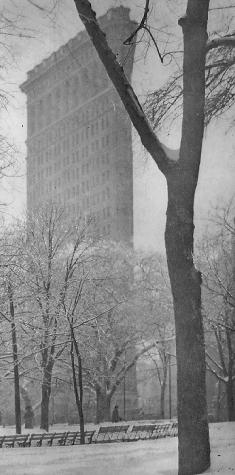
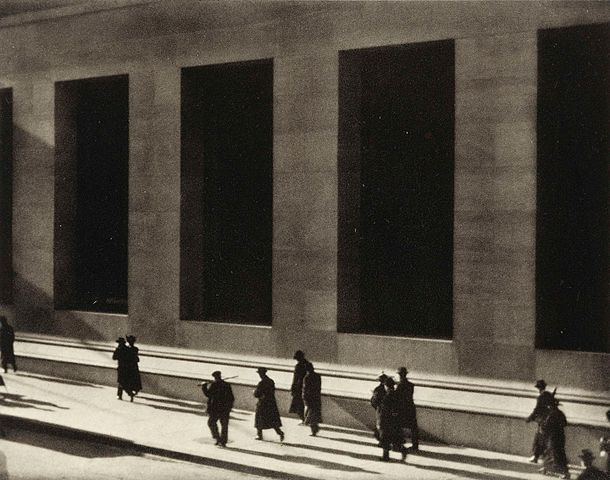
From earliest times people have been a feature of landscape painting. They have been used to give a sense of scale, to make a political point about ownership of the land, to tell a story about the land. As time has gone on people have become increasingly urbanised. Fewer people inhabit some bucolic ideal but live instead among structures of concrete, glass, and steel. In the early days of photography these urban environments themselves became the subject of “landscape” photography. The built environment was itself the subject and people were again often used in a similar way to the painterly conventions, for example in early work of Stieglitz and Strand.
Alfred Stieglitz. Flatiron Building. 1903Paul Strand. Wall Street. 1915
With the advent of more compact, portable cameras the focus shifted more to the people themselves rather than the places they lived. Humanity, with all its quirks and foibles, became the subject of the urban photograph rather than the city itself. The emphasis shifted from the topographical to the anthropological.
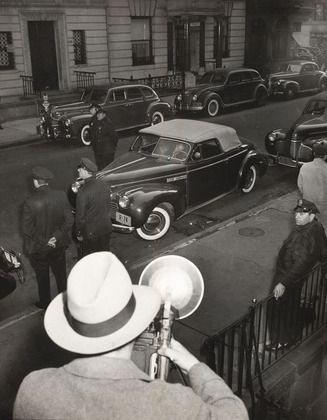
I certainly do not think that all approaches to street photography tell us much, if anything, about the urban environment. “Weegee” does not give us much sense of place as he created his “tabloid” dramas.
Arthur Fellig. Harry Maxwell Shot in Car. 1936
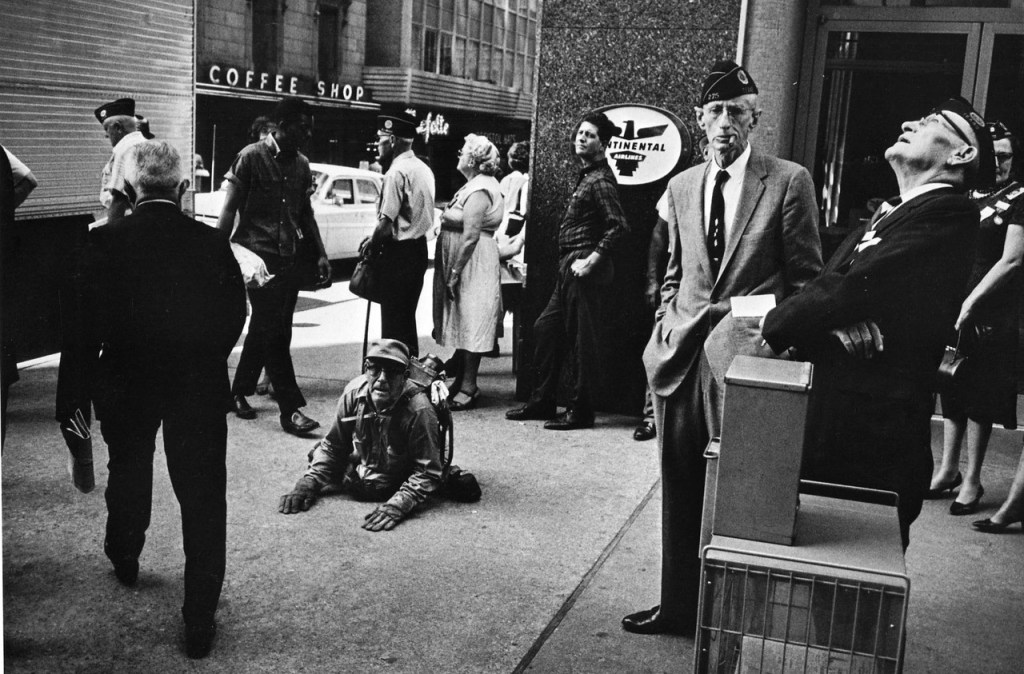
Nor do two of the greatest American street photographers, Lee Friedlander and Gary Winogrand.
Lee Friedlander. New York City. 1963 (?)Garry Winogrand. American Legion Convention, Dallas, Texas. 1964
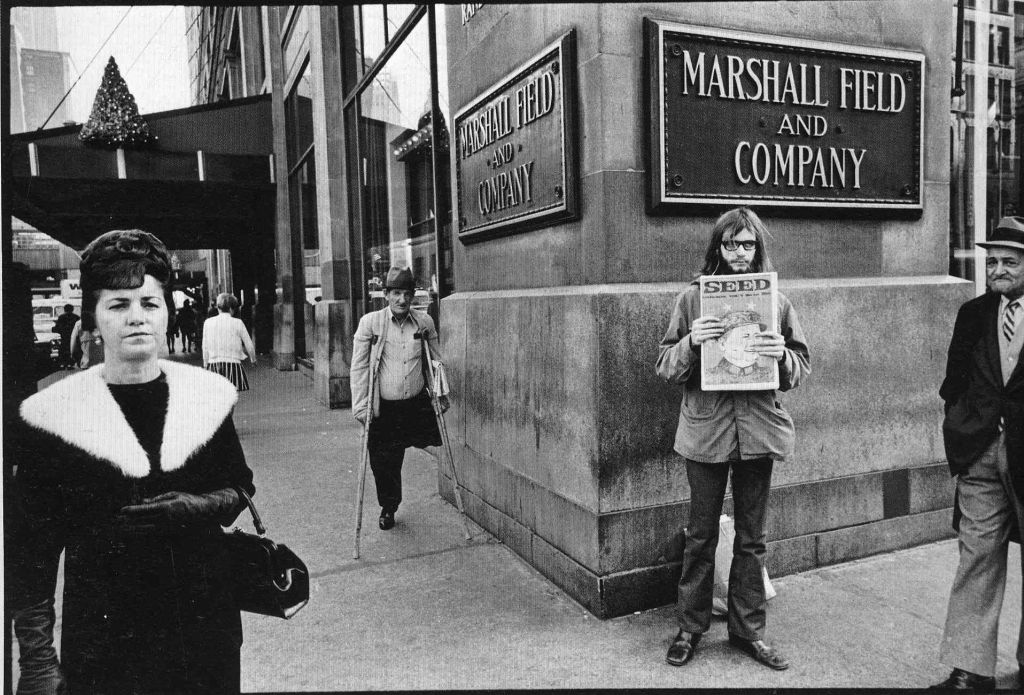
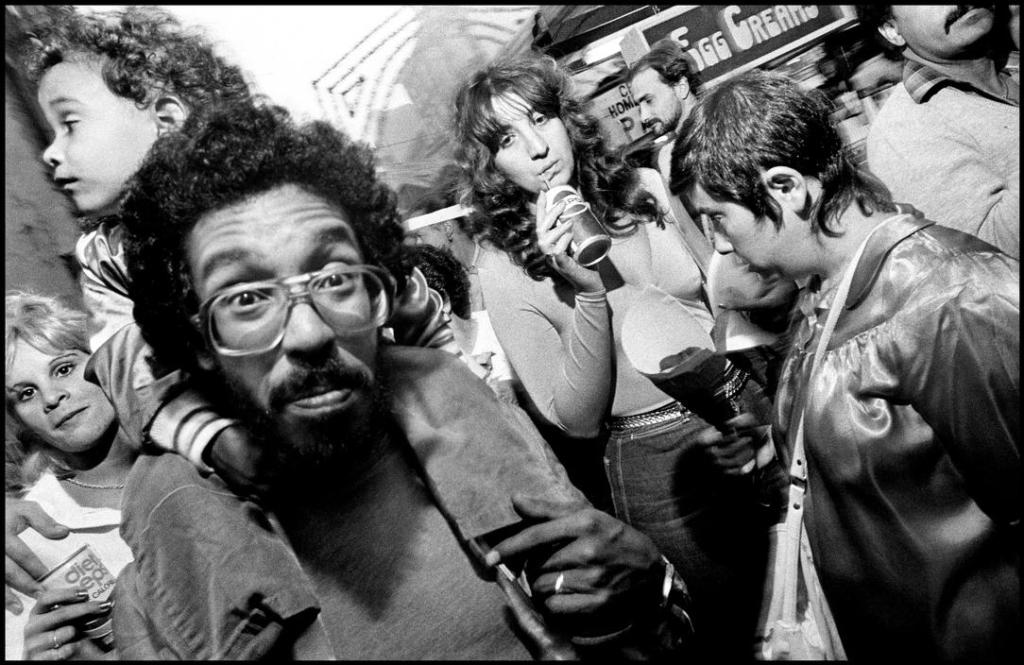
What they do give is a sense of urban, specifically American, society, but not necessarily of the place. Their work is more to do with the ‘social landscape’, as became the subject of a number of influential exhibitions in the 1960s (Warner Marien, 2014, p348 ff) and was subsequently taken further by the likes of Lisette Model and Diane Arbus. More recently there have been characters such as Bill Cunningham, more concerned with fashion and style than anything else, and Bruce Gilden with his (for my taste, rather aggressive and intrusive) flash-in-your-face approach to picturing ordinary people on the streets.
Bruce Gilden. New York City. (Date?)
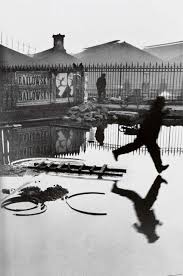
In the birthplace of photography as a medium, and urban photography as a particular approach, Paris, I again do not really find any artists who have caught the physical environment of the city through the photography of its inhabitants: Eugene Atget’s work is more purely topographical and people are largely absent; André Kertész was more interested in Surrealism; Brassai with the social landscape; Cartier-Bresson with the so-called decisive moment.
André Kertész. Meudon. 1928Brassaï. Paris by Night. 1933 Henri Cartier-Bresson. Behind Gare Saint-Lazare. 1932
It is perhaps surprising that this is arguable given that the street photographer might be regarded as the photographic equivalent of the flaneur and so immersed in the human/urban environment. It is though my impression that unlike the literary flâneur, particularly the more contemporary psychogeographers, the photographic flâneur does not generally create a photographic equivalent depiction of the city through images of its people alone. As Florian Ebner discusses in his article “Urban Characters, Imaginary Cities” in Eskilden (2008, p186 ff) and as Sontag argued (1979, pages 54 to 58) the photographic flâneur is more concerned with peering into the world outside his or her bourgeois milieu, a particularly socially-downward view (arguably a patronising one as a result) and the camera “makes everyone a tourist in other people’s reality, and eventually in one’s own” (page 57). Sontag’s views are not uncontroversial and accepted universally uncritically, despite the iconic status of her book (I personally have difficulty with many of her pronouncements on the medium). She did of course later revise her own views (2004). I do nevertheless feel there is a kernel of justification for what she says here and that it is a valid charge that can be laid at the door of some street photography; it simply does not always give us any real sense of the environment through which the photographer moves. One passage is particularly apt and worth quoting at some length, despite its hyperbole, (page 55):
“Gazing on other people’s reality with curiosity, with detachment, with professionalism, the ubiquitous photographer operates as if that activity transcends social class interests, as if its perspective is universal. In fact, photography first comes into its own as an extension of the eye of the middle-class flâneur, whose sensibility was so accurately charted by Baudelaire. The photographer is an armed version of the solitary walker reconnoitring, stalking, cruising the urban inferno, the voyeuristic stroller who discovers the city as a landscape of voluptuous extremes. Adept at the joys of watching, connoisseur of empathy, the flaneur finds the world “picturesque”. … The flâneur is not attracted to the city’s official realities but to its dark seamy corners, its neglected populations – an unofficial reality behind the façade of bourgeois life that the photographer “apprehends”, as a detective apprehends a criminal.”
The true irony, I suppose, is succinctly identified by Ebner (at page 192), that despite these indictments, “it is due to photography’s compulsion to collect in an apparently indifferent manner that it has provided the very bedrock of our visual memory of the city”.
Before moving on to my main point I must add a note here about the photographic examples that I am including below. In my view it is extremely difficult to identify one single example of the work of each of the artists I am about to discuss that adequately illustrates the argument. In each case it seems to me that it is the larger body of work, the whole book, or in Moriyama’s case his entire oeuvre, that is significant and that, I would argue, supports my position. Each image that follows is therefore little more than an isolated example of each photographers’ “bigger picture”.
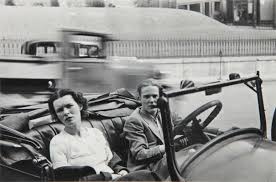
Despite the foregoing I do believe that there are some strands within the broad church of street photography that can be included within the wrapper of landscape photography. Walker Evans (always a good starting point) could perhaps be said to have sown some seeds with his American Photographs (2012), though I see this as work that overall is still more firmly rooted in the topographic.
Parked Car, Small Town Main Street. 1932
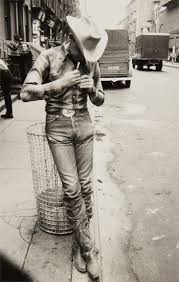
The real catalyst is perhaps Robert Frank’s “The Americans”, to my mind the first work to produce a psychogeographic picture of a nation as a whole (rather than a specific urban environment).
Rodeo – New York City. 1955/6
It strikes me that one significant element of Frank’s view, and depiction of then contemporary America, is that Frank was a “foreigner”, in so far as he was born in Switzerland, so was able, to an extent, to bring an outsider’s eye to the nation. To what extent this is a really a significant factor is a debate for elsewhere but perhaps it is more than coincidental that it is something that he shared to an extent with my next example, William Klein.
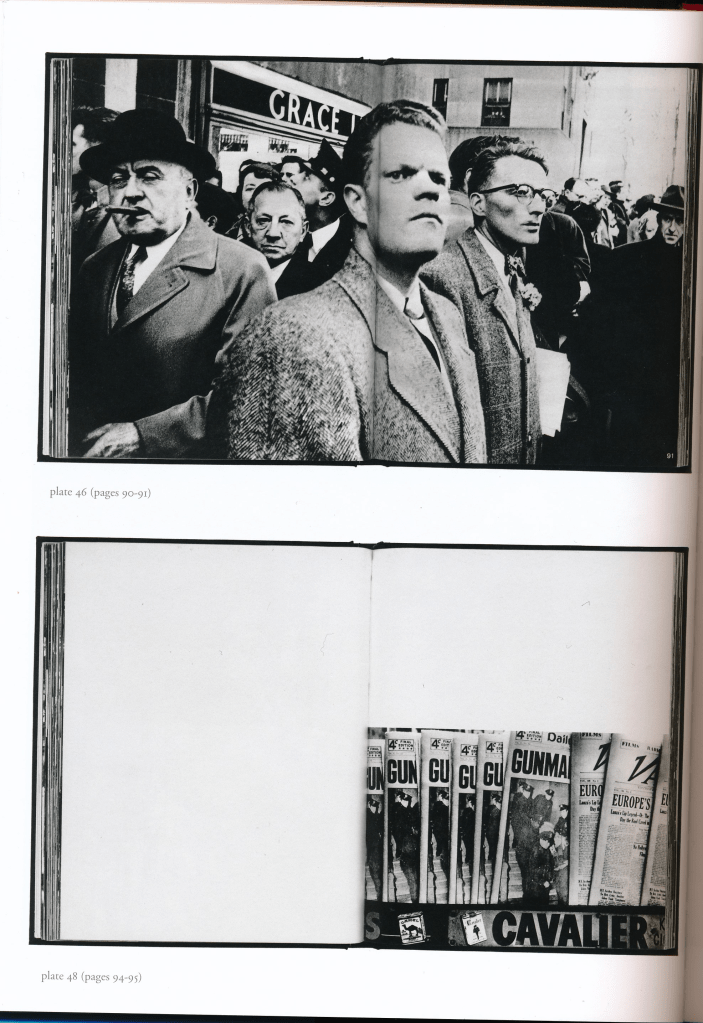
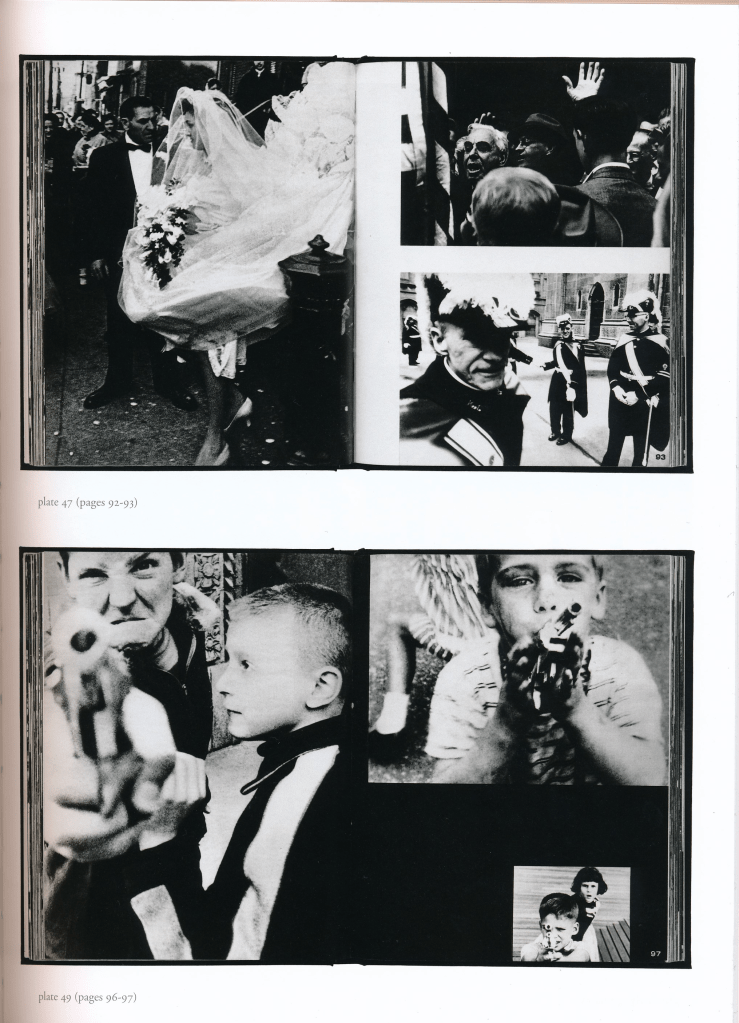
Klein’s book (2016) is one of the very few that I have come across that seem to me to show that street photography can approach the picturing of a physical landscape without depicting its topography in a literal, conventional “landscape photography” way. His approach is various, eclectic, sometimes apparently chaotic. The editing and arrangement of the images across the physical pages of the book are unconventional and often visually jarring. It sometimes reminds me of the “jump-cut” approach to editing used by French Nouvelle Vague film directors, particularly the sequence in Jean-Luc Goddard’s “A bout de souffle” in which Jean-Paul Belmondo and Jean Seberg drive around central Paris: the editing flits about from place to place in a non-linear manner but nevertheless conveys a sense of Paris itself. In Klein’s work we see people, snatches of places and locations, rarely, but not without exception, easily identifiable, signs, adverts, all sorts of symbols of an idea of the city. Occasionally it falls into Sontag’s flâneur trap, wallowing in the seedier sides of life, but nevertheless the cumulative effect is to give an impression of the city as a physical, geographical, place. In his article included in the 2016 ‘Books on Books’ edition of the book, Max Kozloff comments (unhelpfully, the pages of the commentary section of the book are not numbered):
“The experience of paging through New York comes to seem almost one of being on the run, of stumbling over obstacles, ending in visual fatigue. The big city often does that to its denizens, bombards them with feckless montage.”
And on Klein’s approach:
“Not people within an urbanscape, not architecture with signs of life, but the whole populated setting, far or close, draws his regard.”
Klein himself, as reported by Jeffrey Ladd in his accompanying article on the making of the book, had said from the outset that “he wanted to photograph New York in a “new way””. Not just the people, not just the physical nature and appearance of the city, but something much more. In a way the book becomes a pictorial analog of the physical experience of the city and being within its environment.
William Klein. Life is Good & Good for You in New York. 1956
As with Robert Frank, was it significant that Klein effectively photographed the city from the perspective of an outsider having spent the preceding years living in Paris? This recurring question, which is unanswerable here, actually leads me to another example, this time in Japan. (Another question that this investigation has thrown up is why so much street photography has focused on New York? It is no coincidence that all of the examples that I have cited so far have been photographers who have worked in New York City. The only other city that seems to have attracted a similar amount of attention is Tokyo. What is the attraction, what do they have in common given that they are physically such different cities?) The one particular photographer than comes to mind here is Daido Moriyama. His hometown is Osaka, in my own experience a very different city topographically and in terms of “atmosphere” from Tokyo.
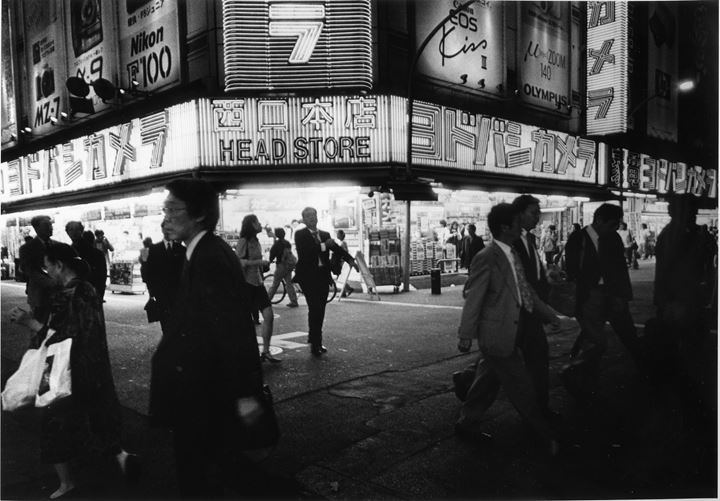
Whilst I am not personally well acquainted with Shinjuku (I spent more time in Shiba and more ‘genteel’ areas such as Asakusa and Ginza) I nevertheless find his obsessive photographs give a real sense of this rather shabby, seedy, somewhat disreputable area as a recognisable environment. He is not immune from the charge levelled at the voyeuristic flâneur of luxuriating in the more louche sides of city life – to quote from his 2016 book (again, the pages are unnumbered):
“… I still see Shinjuku as the great backwater, a formidable den of iniquity. The countless other neighbourhoods that make up the huge metropolis of Tokyo sped through the gradual changes of the fifty-plus years since the end of the war and, before our own eyes, have now been reduced to white, hygienic, sterile landscapes … but Shinjuku is still there in its primary colors, a living, writhing monster.”
“No matter in what city of what country I happen to find myself, the outside world I observe as I wander the streets presents me with the exciting or the erotic; my eyes roam freely over these sights and I release the shutter whenever I feel the urges of eternal desire or temptation.”
Daido Moriyama
Nevertheless, although Moriyama is not a perfect example, my impression is that there is plenty of work within his vast and sprawling oeuvre that can be taken as supporting an argument that certain aspects of and approaches to street photography are capable of conveying a sense of the built environment without simply and directly depicting its buildings.
So, what conclusions do I reach from this admittedly brief and somewhat superficial survey, how would I now answer my question? The conclusion that I reach is somewhat equivocal. Much street photography does not seem to me offer an affirmative answer to my question; from much I do not get any real sense of the street as a place. On the other hand, certain approaches to street photography can indeed amount to or encompass what might otherwise be seen conventionally as landscape photography and transcend, or transgress, ideas of genre and style. A related question, that is also perhaps beyond the practical scope of this essay, is why that should be the case? My tentative view at this stage is that a significant element might simply be the intention of the photographers; what are they looking for in their work on the city streets: is it sensationalism, squalor, serendipity, or a sense of the landscape as something that reflects the symbiotic relationship between the human and the physical environment?
I give the last word to Mario Carnicelli (another outsider, an Italian photographer who worked in America briefly between 1967 and 1973), quoted in Hotshoe (2019, pages 26-27), who sums up a possible positive answer to my question:
“The element of human beings – people – in the street. We are simply creating a theatrical fifth, a giant stage. The street represents a microcosm of the life, rhythms, feelings of common people. Street photography is a typically “local” universal because it is relatable to other places where people live, even in complete diversity of language, history and traditions. Photographs of faces, and gestures of inhabitants of a certain place, provide anthropological, and geographical, social and humanistic interest, as well as a catalogue of memories in rapidly changing times.”
Eskilden, U, (ed). (2008). Street & Studio. London: Tate Publishing
Evans, W, (2012). American Photographs. New York: The Museum of Modern Art
Frank, R, (2016). The Americans. Göttingen: Steidl
Klein, W, (2016). Life is Good & Good for You in New York. New York: Errata Editions
Moriyama, D, (2016). Daido Tokyo. Paris: FondationCartier pour l’art contemporain
Having given this quite a lot of thought, and having done some reading already, the subject that holds the most interest for me at the moment is the idea that landscape photography does not necessarily have to focus on the physical landscape or environment, natural or built, in order to convey something about it. Rather this can be done by concentrating on the people who inhabit the particular landscape. This comes from the idea that “a place and its people are inextricably linked”, as the course material puts it, and from thinking about the work of Lixenberg and Sobol. However, rather than looking again at their work, what I am thinking of is looking at the genre of street photography, and in particular a few artists who concentrated on photographing people in New York City, specifically.
Looking at some of this work again I am struck by how much some of it speaks of the nature of the city, built by, lived in, and used by people, and how the city in turn affects and shapes the lives of those people. I am not interested here in the street photography that simply seeks out “characters”, chance events or juxtapositions, nor indeed what has been described as the “social landscape” (though that would in itself be an interesting subject, albeit not one I am sure would fit entirely comfortable within this part of the course), but that which says something about the city as a place.
Exactly what the argument will be is still developing but it is beginning to take shape as the jottings accumulate in my notebook.
As indicated in a recent post, part of the reason for choosing such a subject is to step out of my comfort zone, literally out of my natural environment in so far as I do not live in a city, and have not lived in a big one for many years (not since a brief sojourn in London 36 years ago). Another reason is a desire to question and challenge the idea of distinct genres within photography. I also want to indulge in a bit of original thought, and it is interesting that in my research so far I have found nothing that is directly on the point, though enough that is more germane when given a wider view. I nevertheless hope that I can draw from this something that will be relevant to some of the work that I would like to attempt over time in my current more rural environment.
It is not often that I find the mere introduction to a section of the course material as significant or useful but on this occasion the opening paragraphs do just that. They chime with my thinking about Assignment 4 and coincidentally validate the approach I am planning. One sentence in particular strikes a chord: “A place and its people are inextricably linked.” This is exactly the point that I want to explore in the assignment and address the apparent paradox that photographs of people, rather than a physical location, can actually represent the landscape.
Although it does not fit with my current intentions, Dana Lixenberg’s book (2008), referred to in the same paragraph, and on which I have written previously (https://markrobinsonocalandscape.photo.blog/2020/02/19/landscape-as-a-call-to-action-2-dana-lixenberg-the-last-days-of-shishmaref-book/) is one that I have been looking at again and has informed some of my thinking in this regard. The further reference to Jacob Are Sobol’s book is similarly interesting in so far as it deals with similar subject matter. What I find particularly striking about his work though is the way it is much more personal, not least in the sense that he became a protagonist in his own story, an insider’s view. Lixenberg on the other hand, although clearly closely engaged with the community she was documenting, was nevertheless an outsider.
One thing that is particularly important to me, and my ideas about landscape, is that both these bodies of work illustrate that the relationship between people and landscape is two-way. This is particularly evident here in the case of these two groups of Inuit people (although they are thousands of miles apart, and speak different languages, their cultures are quite similar) although I guess the same might also be said of virtually everyone. Their landscapes are influenced and affected by the people themselves: they have built upon and changed the physical landscape in many ways, both in microcosm, in their immediate vicinity, but also in macrocosm in so fas as, even if only in a small way, their use of the trappings of modern life makes some contribution to global warming, which is in turn degrading their environment. But also their way of life and culture, the way they live on, in and on the land and its resources, is affected and shaped by the environment, as it has been for millennia.
Incidentally, the link to Sobol’s work cited in the course material appears no longer to exist and I found samples of his photographs on a newer site, to which there is a link below.
I would dearly love to have a physical copy of his book “Sabine”. It is set in a country that fascinates me, and which I have visited, albeit only briefly. It also has a visual aesthetic that I particularly like (though have so far not tried seriously to emulate) that I am more used to seeing in the work of Japanese photographers (such as, to name a few who appear in my library, the Provoke group, Daido Moriyama, Hajime Kimura, Masahisa Fukase – think Ravens in particular, Yasuhiro Ogawa, and Valentino Barachini – not Japanese I know, Italian, but has spent time and worked in Japan and has applied a similar aesthetic). I am not sure though that I can justify the cost: something in excess of €500!
Lixenberg, D, (2008). The Last Days of Shishmaref. Edam/Rotterdam: Paradox/episode
I have been contemplating possible subjects for this assignment for a while now and I think I have settled on a subject (on which I shall do a separate post). It might though be useful briefly to address some other ideas that I have considered but have decided not to proceed with for now – subject to second thoughts as I get down to work on the critical review in earnest!
Whatever final form the review takes, I am intending that it is going to deal with an element of the relationship, indeed the symbiosis between, people and landscape. As I have repeated throughout my work on this course this is the aspect of “landscape” that interests me most, both from a conceptual and a photographic point of view.
In Assignment 3 I have dealt both with landscape as an instrument of memory and how a place is created, the landscape given a particular sense of definition, by means of human intervention. These ideas have indeed been the primary threads running through all of Part 3 of the course material. The relationship between landscape and memory is something that interests me and is something that I would hope to be able to explore further in my own practice in due course.
With such a possible subject in mind I have been looking at some of the work in my own library (I find this is often as good a place as any to start) to see what ideas might come out. Given my growing interest in this aspect of photography it is perhaps no great surprise that I have an increasing number of books that fit the bill, though I have to recognise that my decisions to buy them have not been influenced by this interest at a conscious level.
There are two particular strands of work that I can immediately identify: one deals with the photographer’s personal memories; the other with the memories of other people. Some examples of the former:
Guido Guidi, In Sardegna
Hajime Kimura, Snowflakes (from Snowflakes Dog Man, which also to an extent explores the memories of another, his late father)
Daido Moriyama, Record and Daido Tokyo
Michael Schmidt, Berlin-Wedding
And of the latter:
Maja Daniels, Elf Dalia
David Favrod, Hikari
Rinko Kawauchi, The river embraced me
Kazuma Obara, Exposure
Donovan Wylie, The Maze
There are probably other books in my library for which the same case might also be made but these are the ones that jump out.
One of the more interesting books that I read for I&P was of course Hirsch (2012) which is all about the use of photography in the construction of memories, though admittedly in the context of family relationships rather than landscape or place. I see no reason in principle though why similar ideas and principles as she discusses should not apply equally to landscape photographs.
As I have said, this is a subject that interests me greatly. However, for the purposes of this assignment I feel I need to step out of my comfort zone a bit and address a different subject: one that still interests me but approaching it from an angle that, from the point of view of my own practice and seeking actively to pursue such a project, would be practically rather more challenging, as I will explain in my subsequent post on that other idea.
 Mark Robinson's OCA Landscape, Place & Environment Blog