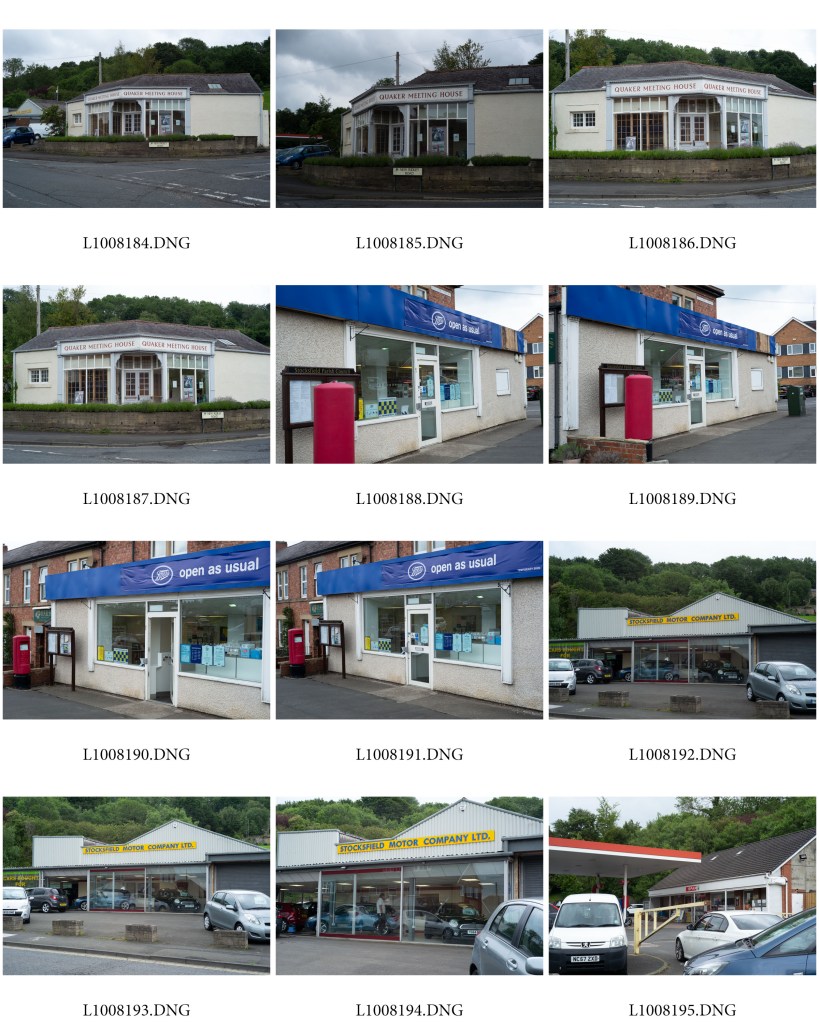
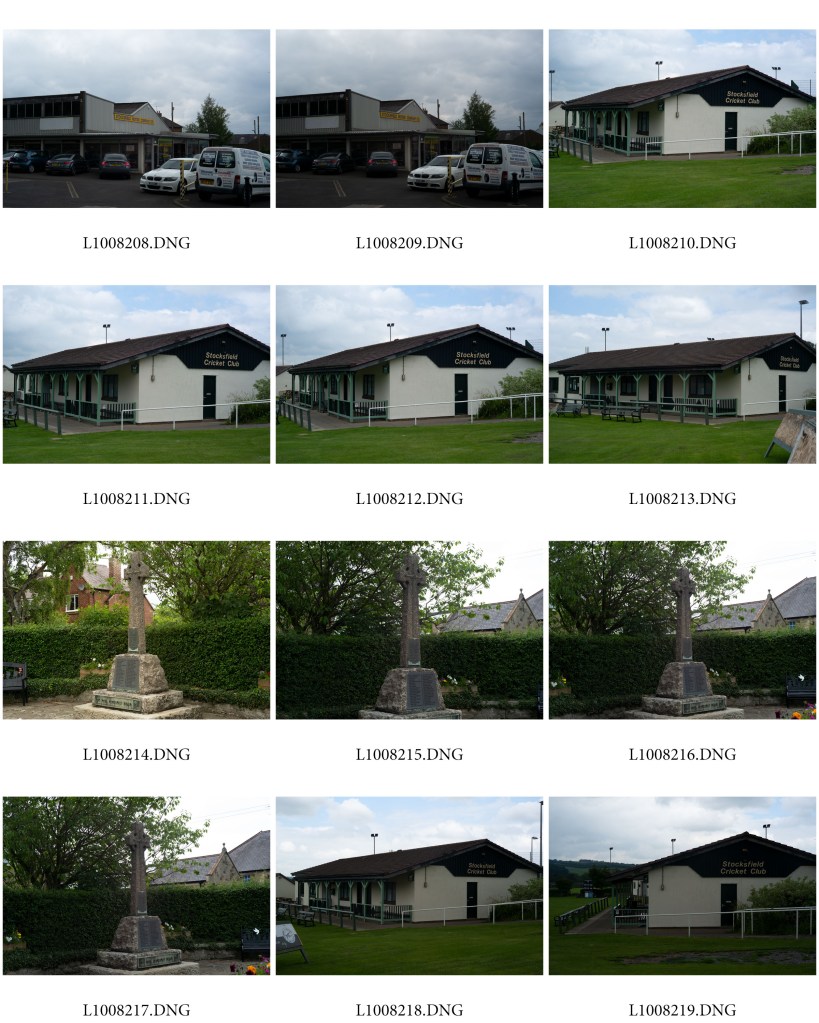
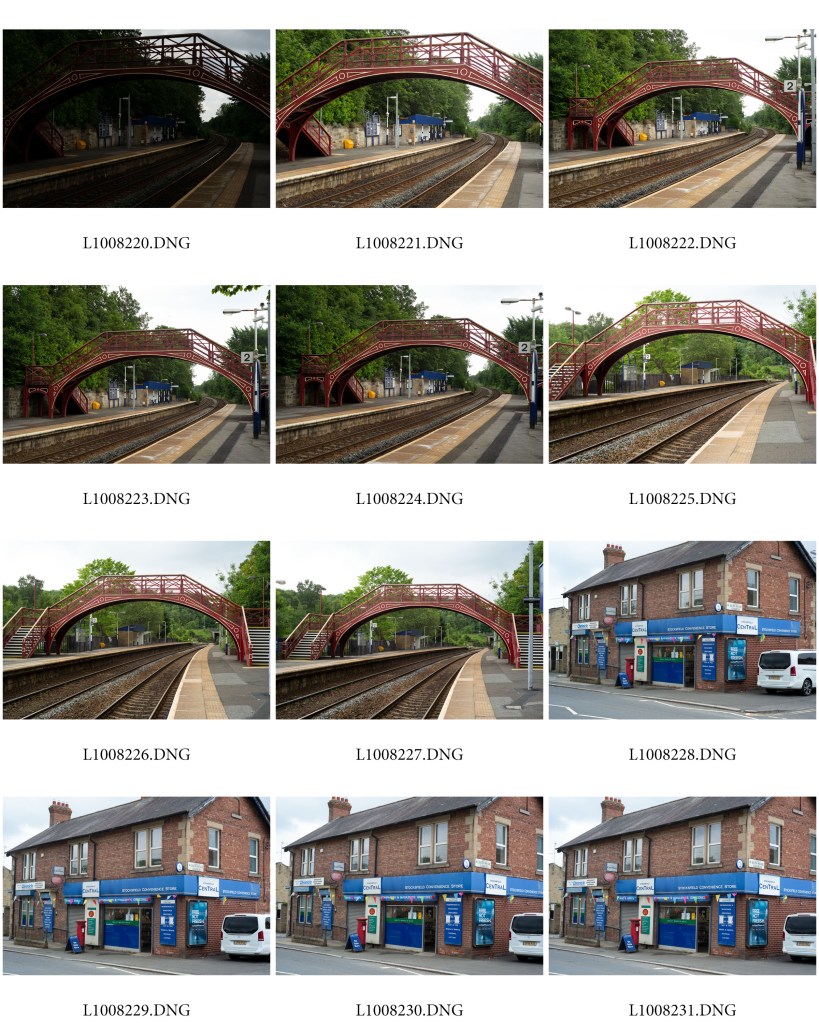
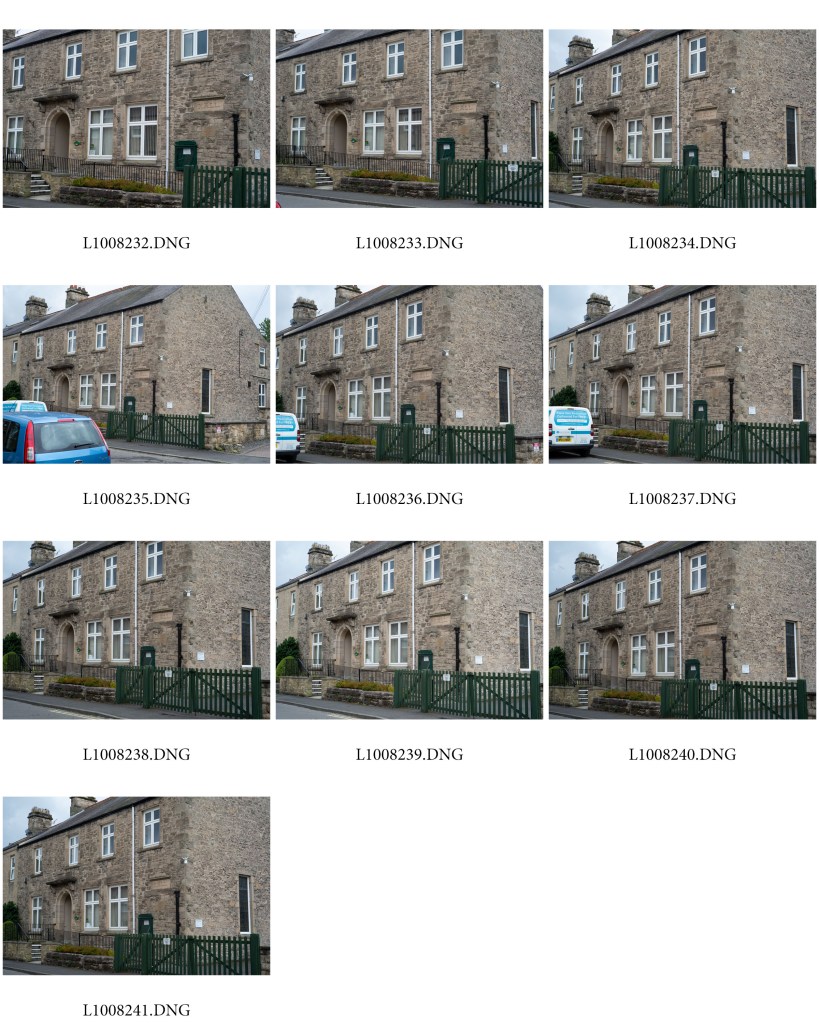
I have at last been able to get out for an hour or so to make a start on this assignment. At this stage what I am concerned about is testing out view-points and camera angles, rather than making “finished” images, and looking critically at the sites that I have in mind. This is perhaps just as well as the light was horrible: the sky was heavily overcast, the clouds leaden, and indeed it started to rain quite heavily not long after I came home. Nevertheless, it was a useful exercise and although I have yet to go through the pictures I took in detail I already have some ideas about what positions are going to work when I get to the shoot proper. It also became abundantly clear to me that one of my chosen sites, the village war memorial, does not really fit or work with the other sites and so I might well omit this. On the other hand, although they do not feature in the product of this first foray, there are a couple more sites, that did not feature in my initial thinking, that might well fit in quite well. I will have to do another test shoot of them before deciding.
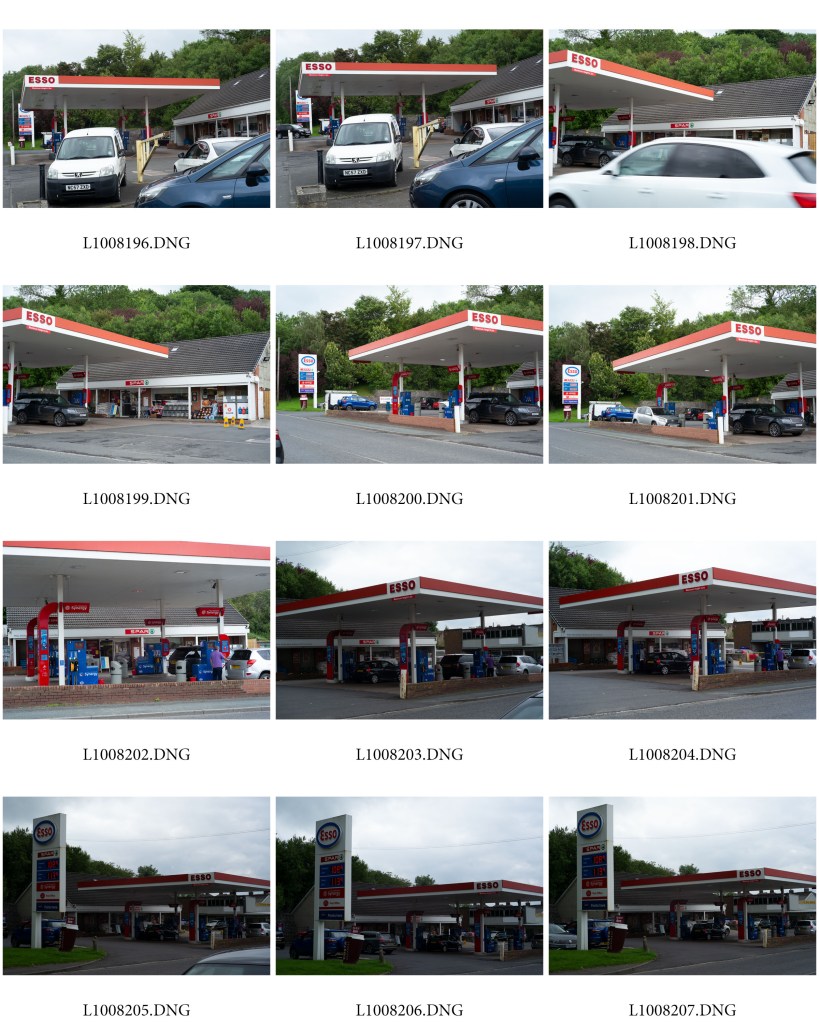
From a technical point of view, I quickly learned that the local petrol station and convenience store is going to be quite hard to capture. This is not just because of its size but also the effect the large forecourt canopy has on the light. This is certainly going to need some careful metering before I expose any film in the large format camera.
As a bit of an aside in this regard, I felt I was getting some slightly odd meter reading on the digital Leica I used for this first shoot. Despite the fact the light was so poor, I was surprised by some of the aperture settings that the camera recommended. Set at ISO 400 and 125s I was surprised that it kept wanting small apertures; I had expected it would need smaller f stops but it consistently pushed me towards the upper range on this camera’s lens, f/16. Unfortunately, I did not take a light meter with me to double-check but I did a quick test when I got home that suggested the readings were consistent. (This is not the first time that I have had what I feel to be aberrant readings on this camera but everything actually seems to work fine.) What this does serve to emphasise though is that I am going to have to be careful with meter readings for the film camera.
Another point is that the siting of the large format camera is going to be problematic in a couple of places because of the main road that runs through the village. Coincidentally, more with an eye on portrait photography, I have just bought a 210mm lens for the 4×5 camera which should help with capturing some of the views I want from slightly further way, that is across the road, than I would be able to achieve with my usual 150mm lens.
So far as attracting attention is concerned, in fact only one person approached me during this shoot: someone working at the local car dealer di ask what I was doing but then apologised for getting in my shots! I did take the precaution of putting my NUJ Student and OCA cards in a holder on a lanyard to make things look “official” and that perhaps helped. What sort of reaction I get when I set up a field camera on a heavy tripod, with a focusing cloth over my head, remains to be seen!
As yet unsorted and unedited, here are the contacts sheets from this first shoot (from which it is immediately clear that I need to rethink and look again at the angles for some of these sites):
While waiting for an opportunity to get out and start shooting this project (I have been rather frustrated by recent bad weather and too many other things to do when the weather has been reasonable) I have been doing a bit more research, in particular looking at the “New Topographics”, among others, which has led to some interesting conclusions and raised some further questions.
I have not looked much again at the Bechers notwithstanding they were part of the New Topographics show. This is not because I do not like their work, as I have written elsewhere more than once I do, but simply because their overtly and deliberately typological approach does not really help me with this project. They would have been relevant if I had intended to photograph different examples of the same type of building, as with Jethro Marshall’s village halls, but instead I am looking at a range of different buildings within the one village.
Putting aside my disagreement with Baltz’s views on the nature and function of landscape, and Adam’s notion of Form, I have looked again at both of their work but have found that neither really adds anything to my current thinking. I find that Baltz’s exaggeratedly deadpan aesthetic, though I quite like it in its own right, does not really fit with what I want to explore here. What I am interested in is the human intervention in the landscape to make otherwise non-descript spaces places with a particular significance. His approach is just that bit too blank for my purposes.
Otherwise, again much though I admire, for example, his night-time suburban images, they do not really take me any further forward.
Much of his rural landscape work, even where it shows signs of human intervention, is a bit too empty for what I am after, simply because the countryside that he worked in was itself so empty!
Taking the New Topographics as a starting point, I have also looked at some of the New Düsseldorf School, such as Struth, Ruff, and Gursky, but again do not feel that I gain anything useful from them. Gursky, for example, is certainly deadpan, but the monumentality of many of his images, both the subject matter and the physical photographs themselves, are a little off-putting and not really relevant to the much more domestic scale of my project.
This leads me to a couple of thoughts on research generally. In the case of this project the explicit, direct, conscious influences have been few, as I have already identified (Ruscha, Shibata, Ohashi, and now Marshall). I have to recognise though that there might well be other influences operating at an unconscious level, which quite possibly includes the New Topographics. I suspect it is inevitable that when you look at so much work, so many images, as we are doing on this course, it is hard for them not to have an effect at some level. The other thought is actually a question: how much does research help in reality? In so far as there is an unconscious influence, I do not doubt that it does. I do though wonder about the extent to which it has a conscious impact in the case of the project as I have conceived it. The point is that I have started with a particular idea, a development of much of the work that I have done for this module and in particular Assignment 2, and it is that idea that determines how I need to approach this work and what it should look like. Arguably therefore, even the conscious influences are not in themselves that significant. I think that research is important, even vital, even if only to set one’s own work into a wider context, but it is not necessarily a substitute for, and certainly not a bar, to coming up with original, personal ideas ab initio. I suppose the point is that it important to develop one’s own voice and not simply to follow what others have done in the past, or are doing now. Be aware of the traditions and wider context but find one’s own place with them.
The other thing that I found myself thinking about was the notion of “schools” in art generally. Can the artists featured in the New Topographics show truly be said to belong to a particular “school”, a conceptual style, of photography? Did the Bechers, Baltz, and Adams, for example, really have that much in common from an ideological or aesthetic point of view? Is it more a case of a curator creating a framework within which to collect and exhibit varied bodies of work? Certainly, it seems to me the Bechers have been doing something quite different, ploughing their own particular furrow. I do not see much of the same typological approach in the work of the others. Flicking through Wolf (2019) again it is striking how many of the artists interviewed do not seem to identify with any particular school, genre, or style, simply getting on with the work they need to do without having to carry the shackles and burdens of categorisation? Is it a case of curators, and critics, commentators and academics (let us not go near the theorists for now) trying to impose categories, structures, genres, on disparate bodies of work to meet their own practical or theoretical, ideological, needs and agendas? This is a much bigger topic than I want to get into in any depth at the moment but I am much inclined towards such a view. This is not to dismiss such an approach out of hand, but as I have indicated before I am inherently suspicious of, if not actively hostile to, efforts to pigeon-hole artist and their work, to fit them into categories not of their own making. I am wary of “isms”. Art, in all its forms, is too multifarious and varied to warrant or bear being straitjacketed in this sort of way.
All of which, in a somewhat roundabout way, brings me back to my starting point: what I am trying to do with this project is find my own way of expressing the ideas that interest me, without necessarily, consciously, being swayed or influenced by the work of others (except to the extent I have already acknowledged) or aligning my work to any particular school, genre, or style.
Wolf, S, (ed), (2019). PhotoWork: Forty Photographers on Process and Practice. New York: Aperture
My ideal venue for displaying a set of photographs from Assignment 5 would be the Side Gallery in Newcastle (dream on!). I very much doubt that there would be enough prints to properly fill the space in one of the two upper galleries but there is a small space on the ground floor that would work. It is though fairly small and so the prints themselves would similarly have to be kept on the small scale, probably no bigger than 8×10 inches. Exactly how they would be hung is difficult to estimate, or sketch, at the moment as I do not have any clear details of the scale of this space, which is little more than a large alcove with two and a bit usable walls. Depending on the final number of images though I would expect them to hang in a single row at eye level.
The next most suitable space locally would be the gallery at the Queen’s Hall in Hexham. Again, it is difficult to judge scale but I would expect that a dozen or so prints could easily be accommodated in the main ground floor space of a size up to A3, which is the biggest that I can currently print. Again, one row of images at eye level on the two main walls of the space, with perhaps a couple between the windows on the western elevation that overlook Beaumont Street.
As the subject matter is going to be locations in Stocksfield it would of course be nice to be able to display them here in the village. Unfortunately though, I cannot think of a suitable location. The village hall is not set up to act as a gallery. The Quaker Meeting House would be a nice venue but is too small and again not really suitable as a gallery space. The same goes for the cricket club. The local school (I am still not sure it is going to feature) might be a possibility but then there are issues with access. The local church hall is similarly not geared up to act as gallery.
This is a shame as having read John Walker’s essay (which I got from academia.edu rather than Scribd), it is clear that a local exhibition of local views would have an extra resonance for people local to the village. Such a display context would have greater meaning for people who live here in the village, and who might not otherwise necessarily see the pictures if they were hung in Hexham, albeit only about ten miles away. Equally, Hexham based viewers would not necessarily ascribe the same meaning and importance to such local images.
This is, I suppose, the central point to Walker’s piece, that where and how images are displayed inevitably has an impact on their meaning, just as, for example, does the juxtaposing of images, and the use of text either as caption or accompaniment. How and where images are displayed carries with them implications for the value, cultural or monetary, that might be ascribed to them. This is of course something that has been touched on before in the context of considering what amounts to a “photograph”: something that appears on a gallery wall is naturally going to be regarded as more “valuable” than something that is printed in a newspaper. McLuahan again and the medium as message.
The other main point I take away from his writing is the question of individualism in responses to images. I had not really thought about this before but it now seems to me to be obvious that there will not necessarily be as many different reactions to a picture as there are viewers. Yes, each individual might bring something particular to themselves to their engagement with and response to a photo but there will also be a great deal in common within groups of viewers. Certain experiences, values, understanding, beliefs, will be shared in common within any given group and that should mean that there will be a certain commonality in the way the images are read.
I have had some limited experience of this in the past when exhibiting some of my etchings and prints. In one group show that I participated in all the works were of the same dimensions and hung in the same way. There was a resulting sense of equality, no one’s work being favoured in any way over that of the others. In another group show (in a commercial gallery) there was a much more hierarchical approach, some prints being framed and hung, others simply mounted and put in browsing racks. The different contexts immediately drew different responses to the works from the buying public: the framed and hung pictures were much more likely to be bought than the others. Needless to say my work was only in the browsers and none of it sold! I did also have a small one-man show that coincided with the Tall Ships race calling at Newcastle some years ago. The pictures were of a nautical theme and the show took place on board one of the sailing ships that was taking part (a former colleague arranged things for me with the captain). Because of the context, the nautical theme, the display on board the ship, the prints actually sold quite well!
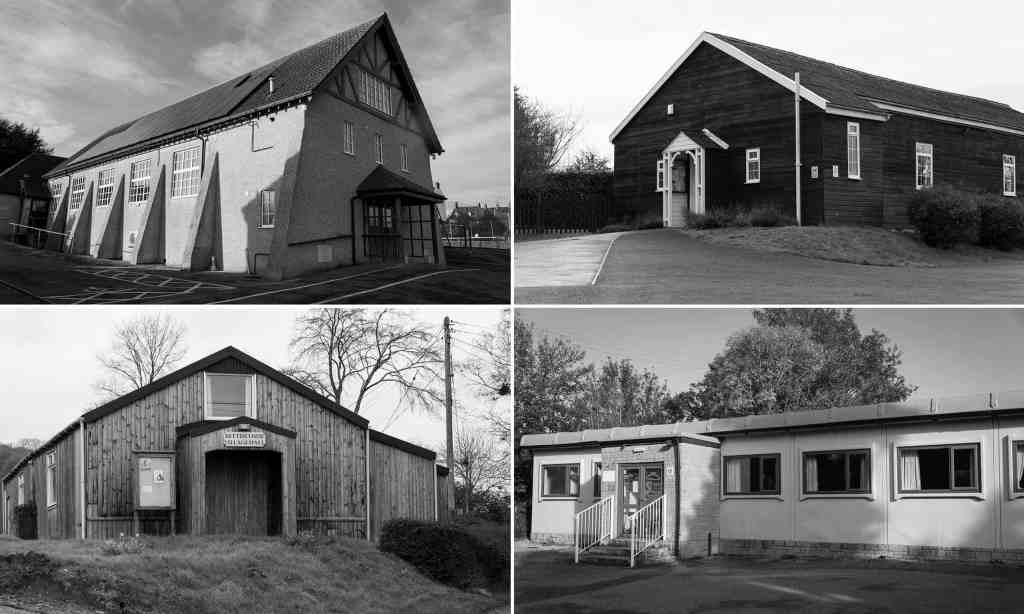
There was a piece in the Guardian that caught my eye this morning about a collection of photographs of village halls in the South-West. Black and white, landscape format photographs of simple, utilitarian, but nevertheless socially important and valuable places, they strike a chord with me in connection with my ideas for the self-directed project that forms Assignment 5. This sort of approach, picturing otherwise quite ordinary, mundane, architecturally neutral buildings and places is just what I plan to do within my own village, I am merely going to cast my net wider for a greater variety of buildings, though one at least is likely to be our own village hall.
I have included a link to the article below but because it is not very long I am also including the text here.
“This way for Bums and Tums! The discreet charm of the village hall
Bleak, bulky yet strangely beautiful, village halls are the beating heart of rural Britain, where great events happen for £8 an hour. We meet a photographer celebrating these harmonious hubs
‘Determinedly mundane’ … clockwise from top left, St Andrews Hall, Charmouth; Ashill; South Perrott; and Bettiscombe village halls in the West Country. Composite: Jethro Marshall
Arow of karate kids are performing mawashi geri kicks in unison to the cries of their teacher. Coincidentally, in the room next door, the Brownies are learning first aid. The next morning, a gaggle of pensioners arrive and are soon waltzing to wartime classics. Then, by the afternoon, a jumble sale is in full swing. One week later, dozens of people are queuing up to vote, hot on the heels of a neighbourhood forum discussing a contentious planning application.
These are just a few moments in the life of a humble village hall. More than any other building type, the village hall represents the ultimate multifunctional democratic space. It is a forum for raffles, cake sales, birthday parties, fitness classes, political meetings and more – a witness, as Jethro Marshall puts it, “to great human events – mostly for around £8 per hour”.
Absent of the life that sustains them, village halls have become haunting symbols of a time when we could congregate
Marshall, a Dorset-based art director and photographer, has surveyed a range of village halls across the West Country for his latest book, Halls & Oats, a celebration of what he calls “utilitarian bucolic construction”. In the midst of the pandemic, his carefully framed black and white images, devoid of human life, take on a new level of pathos. The children’s parties have stopped, the Bums and Tums classes are postponed, Knit and Natter has been put on hold. Absent of the life that sustains them, village halls have become empty shells of promise, haunting symbols of a time when we could congregate – but also hopeful reminders that we might one day do so again.
For all the colourful life they contain, these buildings tend to be fairly nondescript, if not downright bleak. As architect Sam Jacob writes in the introduction: “They are vernacular in a practical rather than sentimental way.” While town halls are draped in the heraldry of civic power, and churches are intent on impressing narrative and belief, the village hall is “determinedly mundane in its dogged lack of architectural expression”. Part barn, part chapel, part schoolhouse, they are, for want of a better word, sheds – but sheds full of civic ambition.
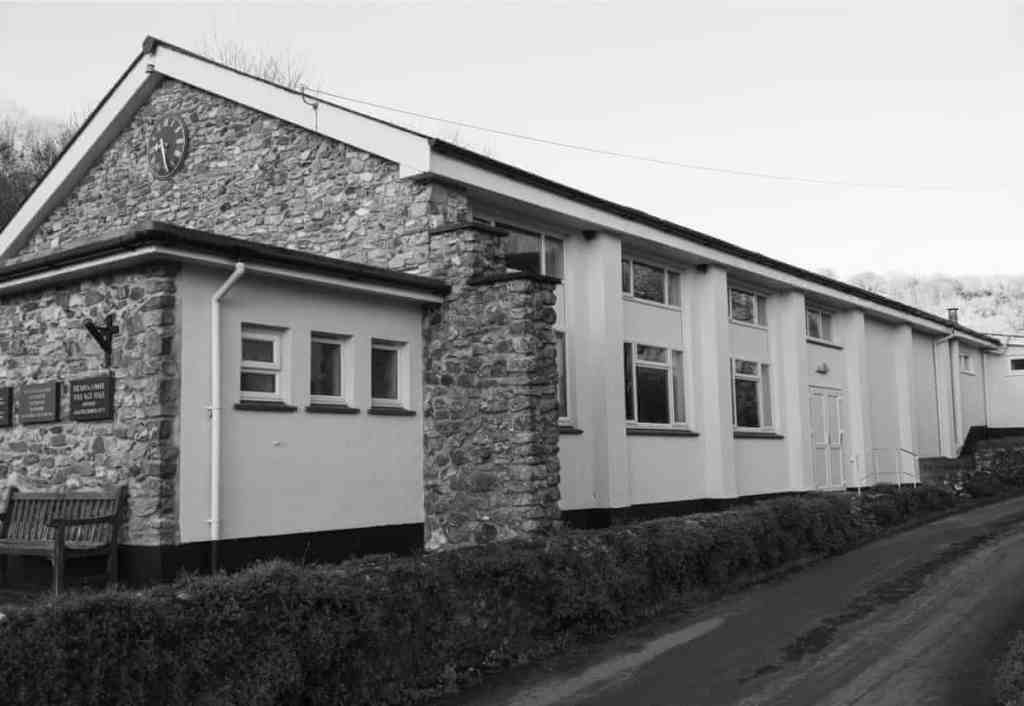
Weighty air … Branoc Hall, Branscombe. Photograph: Jethro Marshall
The Bettiscombe village hall, built in 1961, is a stained timber building with a simple pitched roof, elevated by the addition of a big porch and central square window. It has the look of an Amish barn or a pioneer church, the rituals of worship exchanged for bingo and Pudding and Pie nights. Branoc Hall in Branscome, built in 1976, is a grander affair, with two storeys of windows and exposed ragstone walls lending it a weighty air. A central clock on the gable end cements its status as a force for public good. St Andrews community hall, built in Charmouth in 1909, cranks the ambition up even further, with pebbledashed buttresses and a frontage clad with mock-Tudor timbers, giving the indoor lawn bowls sessions a whiff of Merrie Olde England.
With many taking on new life as hubs for aid networks in the pandemic, they remain radical spaces of social connection
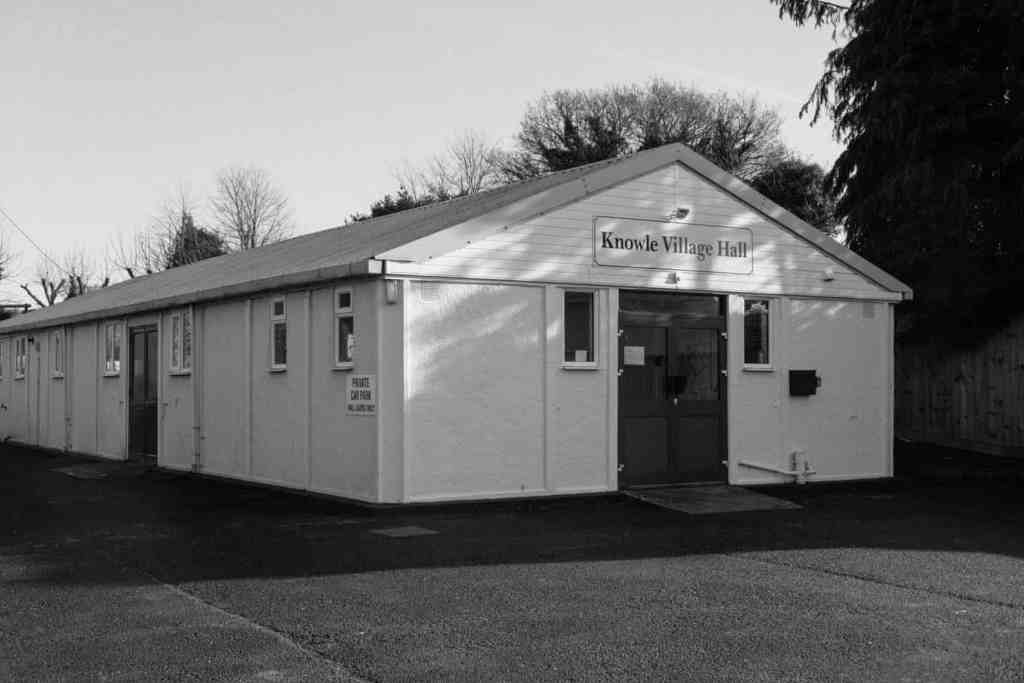
Others are more straightforward prefabs. Knowle village hallwas built in 1948 by the National Council of Social Services as a temporary measure and, like many temporary postwar structures, is still going strong 70 years on. In the Exmouth Journal’s report on its opening, a Mr Tilestone described how “the hall was not a building erected for any one section of the community. It was not for the men, the women, the small children, or the old people but it was for every single one of them – it belonged to the village as a whole.” As Jacob puts it, in their very existence, village halls are “a covenant – a promise even – of the possibility of community that must be fulfilled”. With many taking on a new life as hubs for aid networks in the pandemic, they continue to operate as radical spaces of social connection.
This is Marshall’s fifth book, under the imprint West Country Modern, following such titles as Farm Follows Function, Coastal Brutalism and This is Hardcore, the last a photographic essay of roads. The subjects seem wilfully mundane. They take the matter-of-fact aesthetic of the “new topographics”school of American photography – pioneered in the 1970s by Robert Adams, Lewis Baltz, Bernd and Hilla Becher – and apply it to the most humdrum of structures in the Devon and Dorset countryside.
‘Nondescript if not downright bleak’ … the prefab Knowle Village Hall. Photograph: Jethro Marshall
By doing so, Marshall forces us to look again, to see the beauty in barns and the majesty of flyovers. He says his intention is to “reframe our rural landscapes as inspiring, progressive environments” and sums up his position as “anti bucolic/pro rural”. The countryside is not a rose-tinted Eden, as hundreds of years of romantic propaganda would have us believe, but a place of work, industry and civic life. Activities may be on hold for now, but socially distanced coffee mornings and contactless karate will return soon enough.”
One interesting reflection that this piece sets off is the relationship between what I propose to do for this assignment and the “new topographics” school. I confess that much of the work of Louis Baltz has not moved me, and I do not agree with his ideas about what landscape is, and I do not agree with Adams’s notion of “Form” (as I have written elsewhere – https://markrobinsonocalandscape.photo.blog/2020/04/19/landscape-and-gender-exercise-4-4-of-mother-nature-and-marlboro-men/). I do though like the deadpan approach, particularly as practiced by the Bechers. So perhaps there is a connection, or an influence, at work behind my own intentions, though coming to a similar aesthetic from a rather different theoretical position. Perhaps it is also time to reassess my views of Baltz’s work, separated from his conceptual underpinnings.
Marshall, J, (2020). Halls & Oats. Lyme Regis: West Country Modern
My present intention is to develop some of the ideas explored in Assignment 3 about how spaces that are in themselves non-descript, not picturesque, are transformed into places of significance through human agency. In addition I want to explore how an additional layer of significance can be added to them by the simple act of photographing them. Specifically I have in mind various sites around the village, such as the petrol station, the cricket club, pharmacy, communal recycling bins, etc.
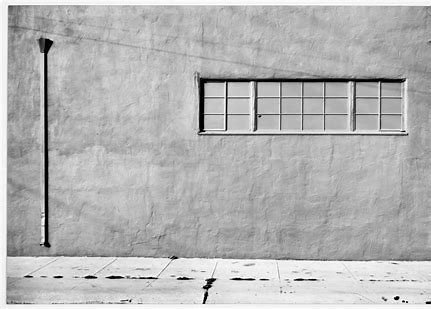
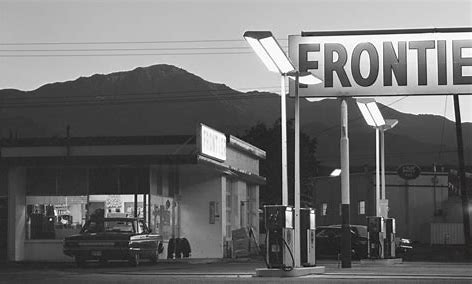
Background influences are very much the same as for Assignment 3, with perhaps particular emphasis on the work of Ed Ruscha and Toshio Shibata, Eiji Ohashi, and, in terms of presentation, Ingrid Pollard, as explained below.
The precise number of images is not yet clear. One consideration is that most of the sites I have in mind so far are along the main road that runs through the village. I need to assess each one first to ensure that I can photograph them safely without having to stand in the road! Subject to that, I currently have in mind eight to ten sites.
So far as presentation is concerned I have in mind two contrasting approaches that will both nevertheless make the same point. One, inspired by some of Ingrid Pollard’s work, is to produce a series of postcards, in similar style to those I bought for Exercise 3, using a digital camera and processing in Photoshop, with saturated colours and emblazoned with “Greetings from Stocksfield”; a somewhat ironic, tongue-in-cheek approach. The other is to take a more fine-art based approach, in the style of Anselm Adams and use black and white film (4×5) and a large format camera. Again, an ironic approach, raising the mundane to the level of art, possibly inviting a “gallery” exhibition to display them. Technically, this latter approach will involve some expense but as I already have film, paper for printing and darkroom equipment, that expense will be negligible. The “postcards” will need to be printed professionally (I cannot presently print in colour to a high enough standard) but as the prints will be fairly small I do not anticipate great expense.
One important practical consideration that needs to be borne in mind, and will have an effect on when this project might be carried out and how long it will take, is the effect of the current Covid-19 lock-down. So long as that remains in place there may well be physical constraints that hamper its execution. It will in any event have to approached sensitively to avoid too much unwelcome attention being drawn to it. With that in mind, I anticipate that the first stage will be to take a series of test shots to establish the best viewpoints and camera angles to keep setting-up time for the large format camera to a minimum. A further assessment of this will need to be made in due course.
 Mark Robinson's OCA Landscape, Place & Environment Blog