Category: Rework & Reflection 5

Assignment 5 – Different ways of seeing

I had a long discussion with my tutor the other day about Assignment 5 (which, happily, he liked) and various other issues (I will deal with the feedback on this session anon) but for now one particular thing stands out for me.  Something that I have not done with this latest project is juxtapose the two sets of images that I have produced side-by-side, for direct comparison.  My tutor though has done just that and he has made an interesting observation as a result, how two views of the same scene, although taken from almost the same position, can be very different when taken on different cameras.

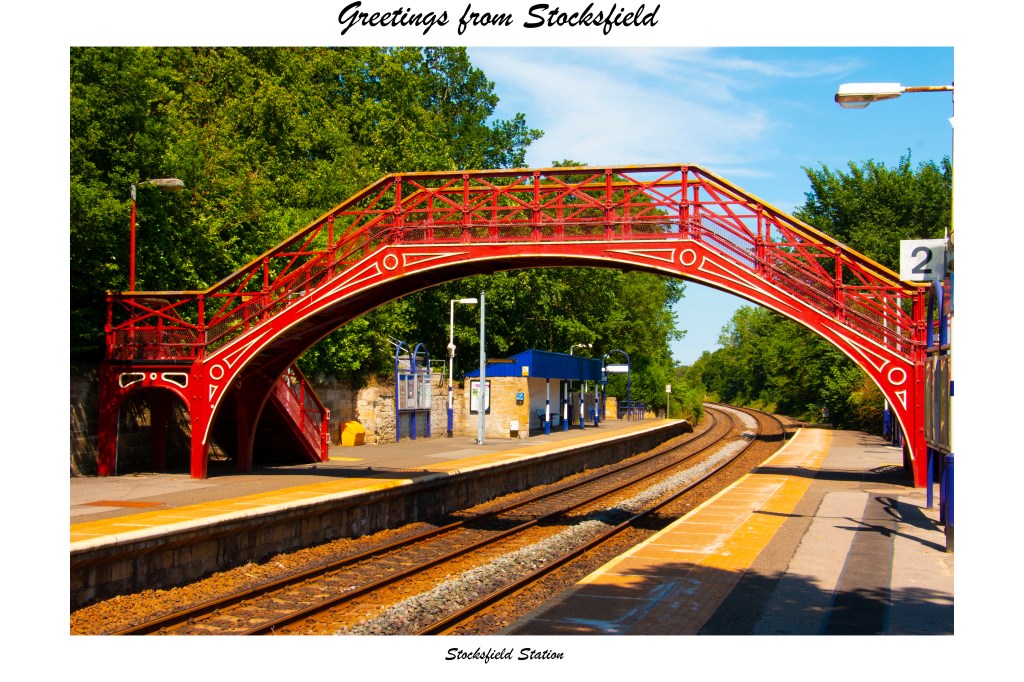
I have been aware throughout this project of the different characteristics of the different cameras that I have used and their different lenses:  a digital Leica, full frame sensor, with a 50mm lens; a digital Canon, cropped sensor, with a 18 – 135mm zoom; and the 4×5 film camera with a 150mm lens (roughly equivalent to a 50mm lens on a 35mm camera.  What I had not quite appreciated until my tutor pointed it out is how certain of the views I shot look significantly different from one camera to the other.  This is particularly evident on the images of the train station.  It does not really show up on most of the others as they are quite deadpan with a flat focal plane.  The views of the station though have more depth and the eye is drawn into the picture, and into the distance, by the train tracks.  Here are the pictures:
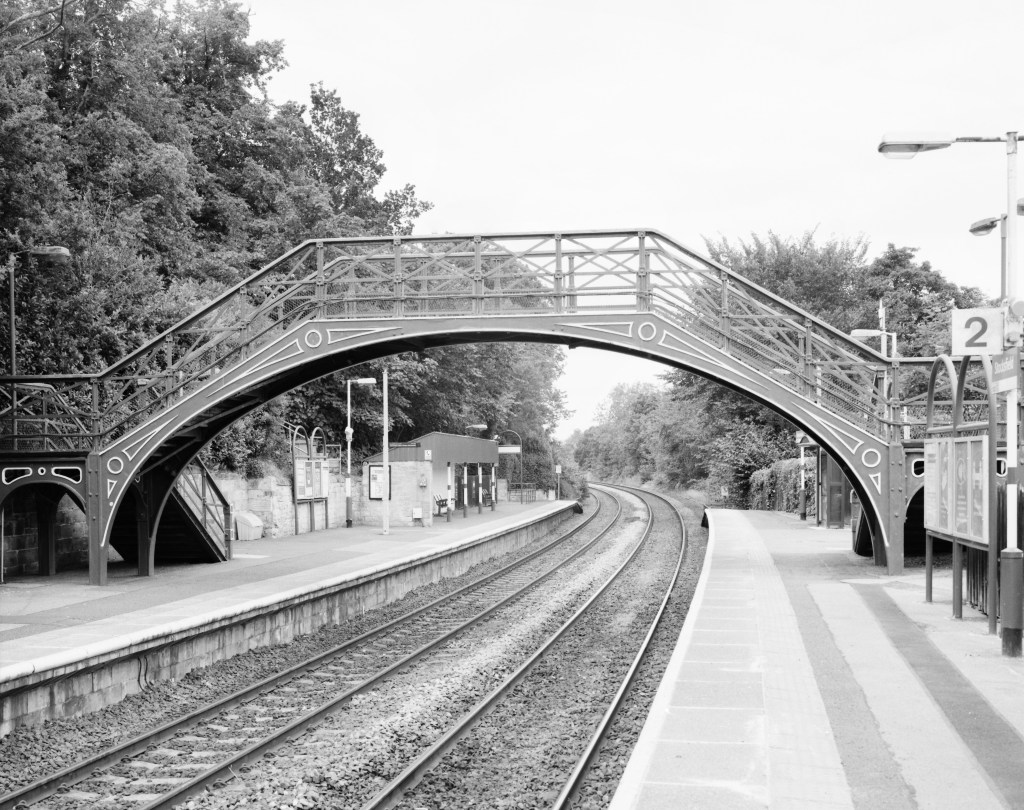
A couple of things strike me.  One is how the bridge looks longer in the postcard, which was taken with the Leica and apart from the colour balance has not otherwise been adjusted in any way in Photoshop.  The other is how much straighter the tracks appear in the large format camera version.  Both were taken in almost exactly the same position.  I had expected some differences as a result of the very different aperture settings and the resulting differences in depth of field:  the Leica set itself to f/6.8; the film camera lens was set at f/22.  It is often apparent in the work of Ansel Adams how the depth of field can have the effect of flattening out the image and a sense of depth starts to disappear as both near and far objects are in clear focus, which sometimes can seem almost hallucinatory.  (All the more so when he went all the way to f/64.  My 150mm large format lens stops down that far but I have not really had the courage to push it to that limit yet as it requires such long exposure times.)  There is an element of that at work here but what I had not expected was how it might affect the apparent geometry of elements in the composition.  Interesting, and something that I need to be aware of in future, and think about, before choosing which camera to use for a given project.

That consideration is I think the most important thing that comes out of this comparison.  It is said (still, and all too often, and I profoundly disagree) that the camera does not lie.  What this exercise demonstrates for me is that even if cameras do not lie, they do not necessarily tell “the” truth.  Obvious really bit nevertheless still worth reflecting upon is that they are just means of seeing and recoding an image of a view, mechanical and technological analogues of human eyes.  Different cameras, with different lenses and technical specifications and characteristics are going to capture images in different ways, just as the image that I perceive with my eyes and brain is going to be different from what someone else perceives when looking at the same object.  There is no “truth” or “reality” in what we see, rather a physiological and neurological version of objective “reality”.  As my Buddhist principles would have it though, reality is itself an illusion.  So once again I am drawn back to idea that photography is fundamentally unreliable as an objective medium.
Assignment 5 – Trials and tribulations of film – Postscript

I have at last worked out what the problem with the new lens that has dogged this project has been caused by.  Aghh!

Having checked (I thought) everything, I could only surmise that the problem lay with the new 210mm lens itself.  The good people who supplied the lens, though, have conducted a number of tests on it and confirmed that it is in perfect working order.  I have otherwise checked the camera and am happy with it.  I am also confident in my ability to take reliable light meter readings and expose the film properly:  why should my efforts work for my 150mm lens but not the 210mm?  What though is the one thing I did not check thoroughly?  The lens board!

This is the one other new piece of kit that I needed for the new lens but to which I did not pay much attention.  For anyone unfamiliar with large format cameras, lenses are attached to the front frame by a square plate, which is, by and large, of a standard size.  In the centre is a hole, through which the front and back elements of the lens and shutter, are screwed together.  The diameter of the holes in the centres of these plates are also standard sizes (known as Copal 0 to 3).  Each lens will conform to one of the sizes within this range, so a particular Copal lens board is needed for any given lens.  My Rodenstock 150mm is Copal 0, the smallest size.  The Schneider 210mm is Copal 1, the next size up.  I therefore needed a new board for this new lens. The board I bought for the 150mm lens is metal, and absolutely light-proof.  The new board is acrylic.  It looks opaque.  When I checked the interior of the camera for possible light leaks nothing showed.  The people who supplied, and have confirmed the quality of my 210mm lens, wondered whether the problem might be a light-bleed on a double-dark slide.  This struck me as inherently unlikely as I have not had a similar problem with anything shot on the smaller lens.  Nevertheless, I did start to wonder yesterday whether there might be an issue with the new lens board.  In particular, when I refitted it to the camera I noticed it was a little loose and rattled.  The design of the front frame is though such that this alone is not an issue and does not let any extraneous light in, as I confirmed with judicious application of torchlight.  Having nothing else left to do, almost out of idle curiosity, I turned the torch directly onto the lens board itself.  And there was the answer, the light was shining straight through.  Problem identified!

A phone call to the makers of my camera confirmed that they have only just become aware of the problem and a new board, with a suitably light-proof coating, is on its way to me, together with a fresh box of film to make up for all the frames wasted.  Which is what I regard as good service.

I am not going to reshoot this project again (yet again – I have just had to go out to one of my sites for the umpteenth time to photograph it again as I unfortunately discovered that the last frame I took there a few days ago has been affected by a bit of light-bleed; I suspect the double-dark slide got nudged very slightly out of position, probably when I putting the slide into the changing bag before transferring the film into my developing tank, just enough to over-expose one side of the negative and just enough to be noticeable, and render it unusable).  I am happy with what I have achieved with the old lens and cannot really afford yet more time on this assignment.  I do though now have the excuse, and impetus, to find something else to do, probably not connected with this course, to experiment and see just what this new lens can do.  I have high hopes!

And what is to be learned from this episode?  One thing is of course the reminder that shooting film is a very different prospect from shooting digitally.  Digital cameras do much, if not necessarily everything for you (compare my Canon DSLR and my Leica, which are a bit like chalk and cheese), and “light hygiene” is not really an issue.  With film on the other hand, you have to go right back to basics for just about everything and light hygiene is absolutely paramount.  Shooting film requires so much more care and attention, all the more so if you develop your own negatives and print from them.  For some time I have been of the view that far from being “Luddite”, using film is a useful way of learning, relearning, reinforcing, the basics of photography that are in danger of being lost in an otherwise monolithically digital world where the camera does so much of the legwork for you (though even the very best cameras will not make you a good photographer if you do not know how to use what is, after all, just another tool).  I would not necessarily advocate making it compulsory as part of the course to spend some time using film (as I believe some schools have in the past) but I certainly agree with the OCA recommendation that if at all possible students should get some experience of large and medium format cameras (I am conscious that I still need to  spend more time with my old Hasselblad).  Despite the recent frustrations, hopefully now resolved, I certainly feel that it has been a worthwhile experience getting to grips, even if still only at a fairly elementary level, with film photography and that this will inform future work with digital cameras.

Assignment 5 – Trials and tribulations of film – 2

The tribulations continue!  Having sorted out the issues with developing the film I have now discovered another problem which is causing me to rethink (again) my approach to this assignment – the new lens.

I have only had the lens that I have chosen for this job, the Schneider 210mm, for about a month and this is the only project that I have used it on so far.  Though the lens looks to be in very good condition, with nice clean, clear optics, it is simply not producing good pictures.  Image quality is poor, the picture is very grainy and foggy, completely unusable.  In contrast, my older Rodenstock 150mm lens, which I used for one picture on the shoot last week (exactly the same film and developed with those taken with the 210mm) has worked perfectly producing a photo with good grain and detail, nice contrast.

In light of this I am going to have to go back and reshoot (for the third time!) using just the 150mm.  This is inevitably going to mean rethinking camera angles and positions, and I might have to crop pout some extraneous background in Photoshop, but needs must.  Otherwise I would simply have to abandon this part of the project and do something else.  Already, as an exercise if nothing else, I have created a set of black and white images in 4×5 format from some of my original colour digital images, which if nothing else offer me something of a fall-back position, to offer an indication of what the more artistically driven and influenced set would look like.  I would though rather not have to use them as it feels a bit like cheating so I will persevere with the film.  At least I am used to and comfortable with the 150mm lens, and have confidence in it.  I just have to find yet more time to get a further shoot done, and put up with still more attention (some unwelcome) that a big camera on a tripod, and the spectacle of me covered by a heavy, dark focusing cloth (under which it can get amazingly hot!)  inevitably attracts.

Assignment 5 – Trials and tribulations of film

The first half of this assignment, the postcard set, having worked out quite well (the next step is to print them) I have been turning my attention to the other half, the black and white, large format film set.  After having been out on a first shoot yesterday I have been reminded of the joys, and frustrations, of shooting large format film and developing.

The big difference between shooting digitally and on film is of course that in the latter case you do not know what you have got, and whether the images are any good, until the film has been developed.  It was of course common for some photographers to use Polaroid film for a first shot to make sure everything is ok before committing to the sheet film.  Unfortunately, Polaroid film, when you can still find it, is quite expensive, as are the film backs/holders for large format cameras.  I did once look seriously at tracking down a Polaroid back that would fit my 4×5 but could not find anything reliable at a sensible price, let alone affordable film.  In the end I decided that even at the risk of wasted sheets (thank heaven I am only shooting black and white and not colour film, which is considerably more expensive) it would be cheaper in the long run to forget about Polaroids.  Over the last couple of years that I have been using this camera I have established a rigid routine for the various steps that are needed before any shot is actually taken, which takes a lot of the hazard and chance out of the process, but nevertheless I always have a slight sense of trepidation before releasing the shutter.

It also takes a lot longer to set up a shot, because of all the steps that need to be gone through.  No such thing as automatic mode, auto-focus, or in-camera light metering on this sort of camera!  Working with one of my digital cameras I have been able to capture the full set of ten images in not much more than an hour.  Yesterday it took an hour and a half to get just four shots!  (Admittedly some time was lost while I had to wait for people to get out of the way, but even so.)  Factoring the additional time for developing the negatives and making a set of test prints in the darkroom, it is going to take me considerably longer to complete this part of the assignment.

It should of course have been obvious from the outset but I had unaccountably forgotten that what I have seen and photographed through my digital cameras is not what I can see through the 4×5:  the format is obviously different, and so is the focal length of my available lens for this camera.  Fortunately, as I already knew what I was after from my first recce and shooting the postcard set, I was able to set up fairly quickly.  I had already worked out that the new 210mm lens would be better suited to most of the shots (with one particular possible exception) than my usual 150mm.  This choice was driven by bearing in mind that for many of the images I have to shoot across a road, so cannot get physically close the subject, and the distance would mean with the shorter lens that I would get too much extraneous background.

Then there is the developing, and this is where the real tribulations have come in!  I normally have no problem with developing.  All of my black and white work is done using Ilford film and I develop it all using Tetenal Paranol S (the old Agfa Rodinol), a combination that works really well for me:  just enough grain, good tonal range, and sharp contrasts.  Normally I use a fairly low concentration in the solution and develop slowly (Ilford FP4 125 ISO, which is what I am using, takes a good half hour).  It is though possible to speed up the process by increasing the concentration so, as I was a bit pushed for time yesterday, and keen to see the first results before getting out on another shoot (I already had in mind that they might have to act as little more than test shots anyway, not least because it was the first time I had used the new lens), I tried this alternative, which is recommended by Tetenal themselves.  Disaster!  Despite the more concentrated solution the shorter time has simply not allowed the film to develop properly.  To start with I was not sure what had gone wrong:  whether there had been a light leak in the camera, or the film backs, or a problem with the new lens (which would be particularly infuriating!).  It looked as if each sheet of film had been uniformly exposed, producing an apparently even, fog-like effect.  So, I double checked all the physical kit and took a few test shots at home, checking that any variables could be accounted for and identified.  I then developed them this morning, going back to my usual, slow process, and, hey presto, no problems.  A couple that I took using the 150mm lens for comparison purposes after the 210 are somewhat under-exposed but to keep variables to a minimum I did not readjust the shutter speeds or aperture setting and the light conditions did change slightly, but that is neither here nor there for present purposes.

The lesson is, clearly, to be patient, stick to the process that I am familiar with and that I know works.  It takes time to take each shot so take time to develop the negatives.  Looking at an enlarged scan of one of yesterday’s failures I can now see that the film did expose properly, there is an image to be seen, but the full tonal range had not yet emerged; the new recommended time was simply too short.

I am now going to have to go back and reshoot these first four sites.  The consolation, I guess, is that because of the time I had already spent out and about yesterday, a sudden change in the weather and the onset of rain, and a dog needing his lunchtime walk, I called it a day without shooting the full six that I had originally intended (without carrying a changing bag and developing tank, which will take six sheets at a time, I can only manage six shots as I have only three, double sided film backs for 4×5 – and let us face it I need to lug around more than enough kit as it is with this camera.)  The whole process though is also going to take a bit longer than planned as well because with yesterday’s failure and the test shots developed today, I have now run out of developer and fixer, and am low on film, so have had to order some more.  I should though be able to get out with the camera again later this week, weather permitting, lessons now duly learned.

Assignment 5 – Jigsaw Puzzle?

My wife copied one of my postcard pictures (the station) to a friend of hers who is a journalist – writer and film-maker – as she visited by train from the South West just before the lock-down started.  She commented that the picture would make a good jigsaw.  I had not thought of this before but that might actually fit the sort of aesthetic I have been looking for and is another interesting example of how images of places can carry extra significance, this time acquiring an element of diversion and entertainment.  I quite enjoy jigsaw puzzles from time to time so this might actually work.  I have already found on a quick internet search a couple of companies that will turn photographs into puzzles.  They are not at all expensive so I might just give one a go. I am quite amused by the prospect of including a jigsaw in a submission for formal assessment in due course:  it would not be practical, I fear, to have the full set made into puzzles and unfortunately the assessors would not have enough time to be able to sit down and complete the puzzle!  Nevertheless, I do not think it is too off-the-wall an idea.

I remember from when I was quite small that my grandparents had lots of things that had on them “postcard” views of places that they had been on holiday.   The possibilities for portrayal of any locality are legion: decorative crockery, tea-towels, place mats and coasters, and more besides.  

Assignment 5 – Sensitivities

Throughout the planning for this assignment I have had in mind the need to approach it carefully and avoid as much as possible attracting unwanted attention.  Today I got out for a further shoot (on which more anon) and had an example of just the sort of thing that I am wary of.

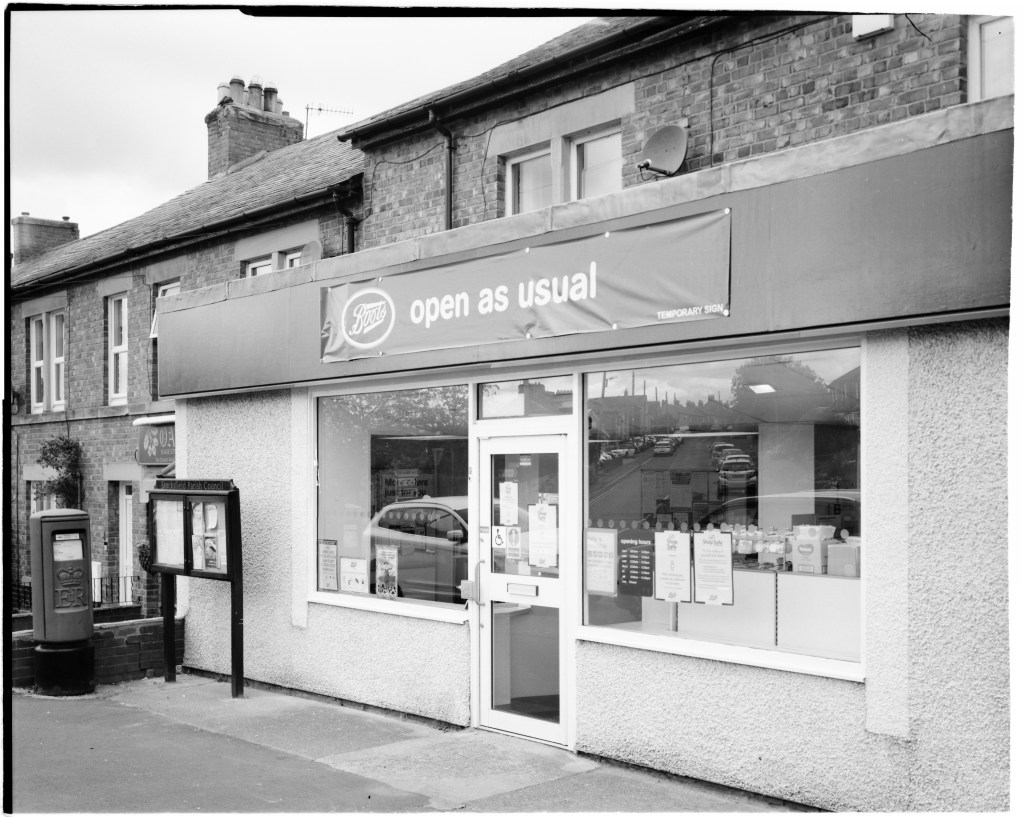
Having decided after the first foray to drop the war memorial and look at some alternative additional sites, I decided today to include the recently revamped “Village Store” (not to be confused with the local Spar).  Rather than my Leica, this time I used my old Canon with a zoom lens and mounted it on a tripod.  Although I was on the opposite side of the road, as soon as I set up the shopkeeper came straight out and ran across the road to ask why I was taking pictures of his shop.  He was not at all unpleasant or challenging but he was clearly anxious.  Once I explained what I was doing he was fine and said that he was worried that his landlord had decided to sell the shop and had not told him.  Not quite the sort of response that I was expecting.  He then went back to the shop looking relieved.

When I go back to shoot with the film camera, which will be even more conspicuous, I think it would be sensible to go into the shop first and tell him what I am doing, if only to keep him calm.

It never ceases to amaze me that most people today do not seem to bat an eyelid if you take pictures on a phone but react when you use a proper camera.  At one end of the spectrum I have attracted friendly curiosity, particularly when using my old film Leica, through nervousness, as today, suspicion, to outright hostility.  In the latter case I have learned simply to walk away and avoid any confrontation.  With luck, when I get out again with the 4×5 it will be curiosity rather than anything else that is generated.  I do not doubt that the sight of a large format camera on a tripod and my head underneath the focusing cloth is going to raise some eyebrows!