A bit of a digression (but not much), possibly interesting for some doing this particular module, but here is a recommendation of a website that revels in the name of The Learned Pig. As they put it, “The Learned Pig is an online arts magazine that brings together multiple perspectives on relationships between the human and the non-human.” Personally I find it a source of stimulating thinking about our relationships with environment.
Something I have just picked up from their latest email newsletter is a reference to what sounds like a fascinating book that is directly relevant to what we are doing here, not least to the long term project of Assignment 6: “Recollecting Landscapes”, a photographic survey and record of the changing landscapes in Flanders over the last century. Obviously this is not a project that we can possibly emulate in the short term but the idea is nevertheless intriguing and inspiring.
I shall see if I can get a better look at the book.
As I continue to take my weekly shots at the ford for this project I am becoming increasingly aware of, and attuned to, the subtle changes in the scene as time passes There are the occasional substantial changes, such as when the water level increases dramatically after prolonged rain, or as was the case this last weekend when the temperature plummeted, down to around minus 7º C first thing and not rising above freezing all day leaving everywhere iced up. Otherwise the major changes are only going to be visible over a much longer period.
This strikes me as being relevant to project in part 2, typologies and new topographies that I am just starting to explore and think about. As I am going to write elsewhere it is not the single image that is important but the greater mass and the juxtapositions that mass can create.
The true random thought here though for now is a musical analogy. I have been listening recently to a new set of recordings of piano music by Morton Feldman and what I see is a commonality of approach: Feldman’s work often evolves slowly, positively glacially (for example the second string quartet lasts for more than three hours and sometimes it is difficult to properly register the changes and development of the music from moment to moment – I have never yet managed to listen to the whole work in one sitting!) and it is only by taking a long view that it makes proper sense. That sort of process is at work here in this project and I expect that it will only be once it is complete that it will make proper sense.
Compared with previous modules I have got off to rather a slow start with this one, partly because its start overlapped with finishing off I&P and getting everything ready for assessment next month, partly because of some personal issues that have kept me away from working on this. I do though now feel that I am getting back into a groove, a routine, and getting more work done. What I really need to do though is get back out with an camera and make pictures again! This exercise gives me an opportunity to get going once more.
The idea of taking a series of images of the same scene over a prolonged period of time is something that I have thought about before and is something that I have already written about. Going right back to EYV and the Square Mile assignment this is an idea that I looked at then: (https://wordpress.com/post/markrobinsonocablog.wordpress.com/119). So it is good to come back to it again now. There is an obvious difference in time scale between anything that I can achieve over the next year or so and what Tom Phillips did over twenty years but nevertheless I feel this is still potentially fertile ground.
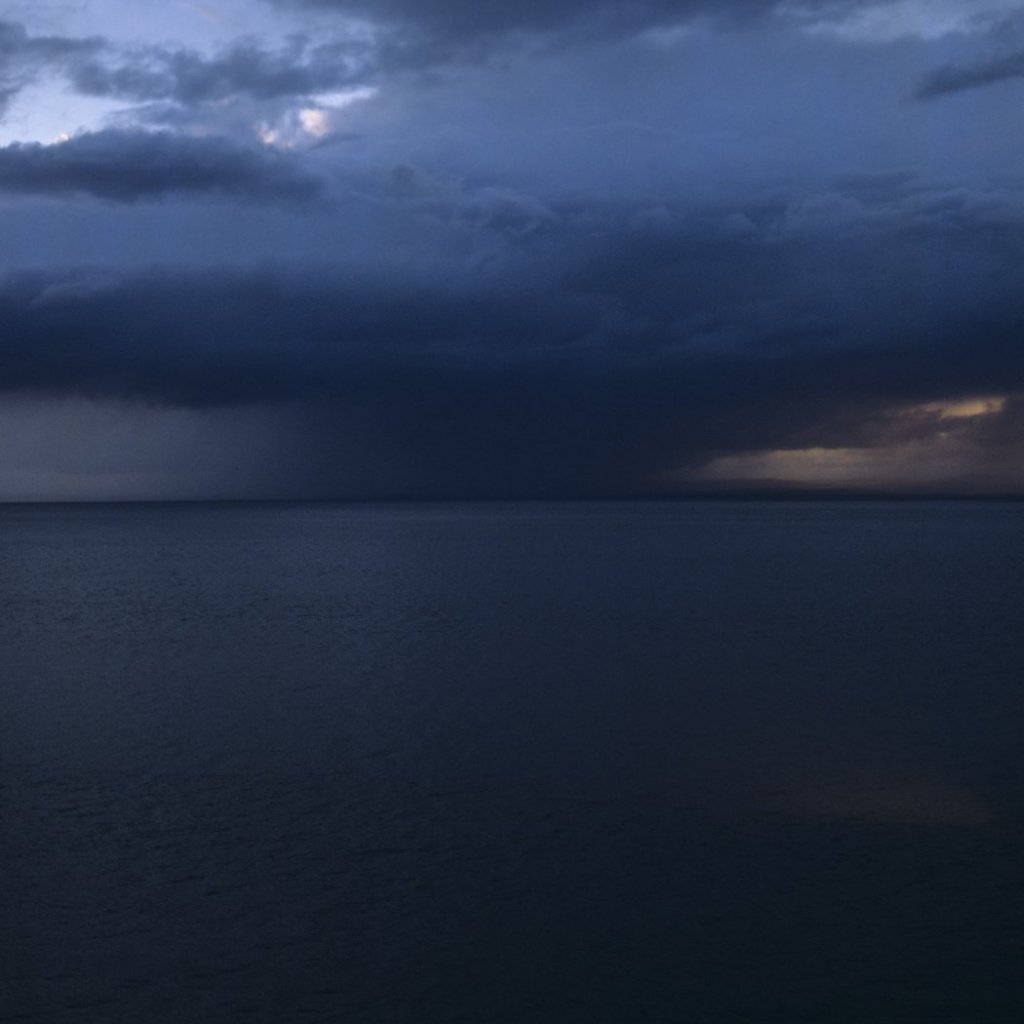
One project I would really like to pursue would be to take photos, possibly even on a daily basis at least at some times of the year, of a particular seascape, showing just sea, horizon and sky. This is partly inspired by the seascapes of Hiroshi Sugimoto (2019) that I have referred to before – though his work shows seascapes from around the world, rather than focusing on one single place. Coincidentally I have also just discovered some of the early, camera-based work of Garry Fabian Miller in the latest issue of the British Journal of Photography, particularly (at pages 52 and 53) from his Sections of England: The Sea Horizon series, of which this is an example (Number 18 Series 2 1976):
These works differ significantly from Sugimoto’s in that they are in colour whereas in his seascapes, so far as I can tell, Sugimoto worked exclusively in monochrome. They are also more overtly dramatic in so far as some feature a distinct horizon, and a focus on prevailing weather, reminiscent of the cloud sketches by Cozens and Constable, and Turner’s storm scenes. I do not know though whether he shot in a number of different locations or whether each image is of the same stretch of sea, although under differing conditions. For the purposes of a project such as this I think that Fabian Miller’s approach would be more productive.
Unfortunately however such a project is not really practical, even without bearing in mind the guidance in the brief for this exercise to concentrate on somewhere nearby. Although I am not that far from the coast, it is nevertheless the better part of a sixty mile round trip – at least – to the nearest possible location that I have in mind. It is simply not practical for me to be covering that sort of distance on a regular, let alone frequent basis. That is a shame because this is something that I would really like to try more seriously; maybe it will just have to become a personal project to be pursued over a much longer period.
My primary choice of practical subject is therefore a ford about ten minutes from home, and past which I have walked with my dog nearly every single day over the last three and a half years, where the scene is constantly changing, and which I have observed closely. I therefore already know what it is likely to look like at any given time of the year. There are obvious seasonal changes but it is also somewhere that can be subject to shorter term, sometimes quite dramatic, changes depending on weather and light conditions.
I have also been giving some thought to a plan B. I have not yet settled on a firm idea yet, and is suspect this will not crystallise until I have got down to proper work with plan A, but I have a couple of thoughts. One, proceeding from a comment in the exercise on preconceptions is that a landscape does not have to be a macro environment but can also be a micro one. With this in mind one possibility I have been thinking about is to photograph a spot (probably in one of the local woods) no more than, say, a metre across, to explore and reflect the changes that take place on a much smaller basis. Another is to focus on a location that is more man-made and is subject to more “managed” change. One possibility that I have in mind for this is a scrap-yard on a small industrial estate in Hexham, which is a site that I could realistically visit as much as weekly. Again this needs further thought but for now I think what I need to do is just get on and shoot at each location and see how they develop. I imagine there will still be time to change tack later if necessary, as long as I do not leave it too long.
Phillips, T (1992) Works and Texts. London: Royal Academy of Arts
 Mark Robinson's OCA Landscape, Place & Environment Blog