Category: Assignments

Assignment 3 – Final Set

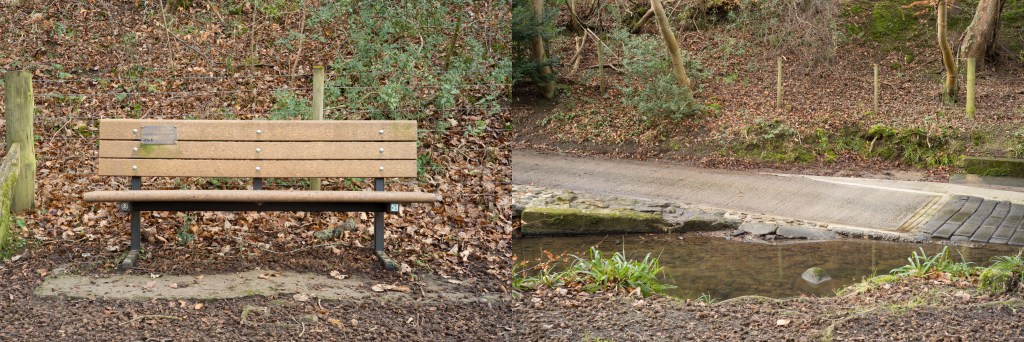
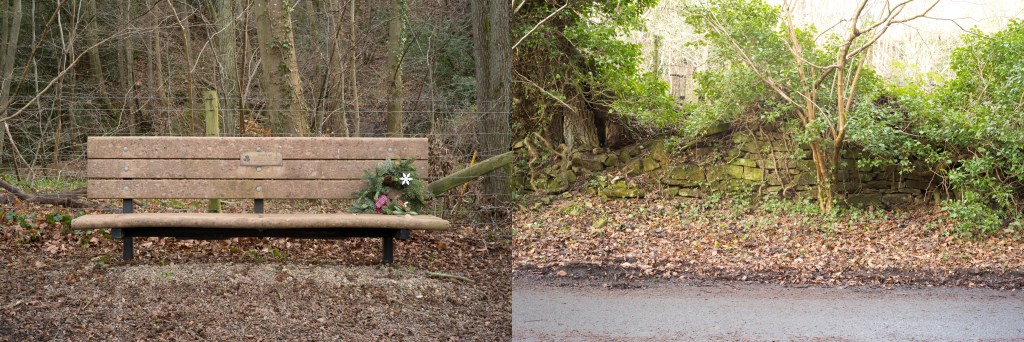
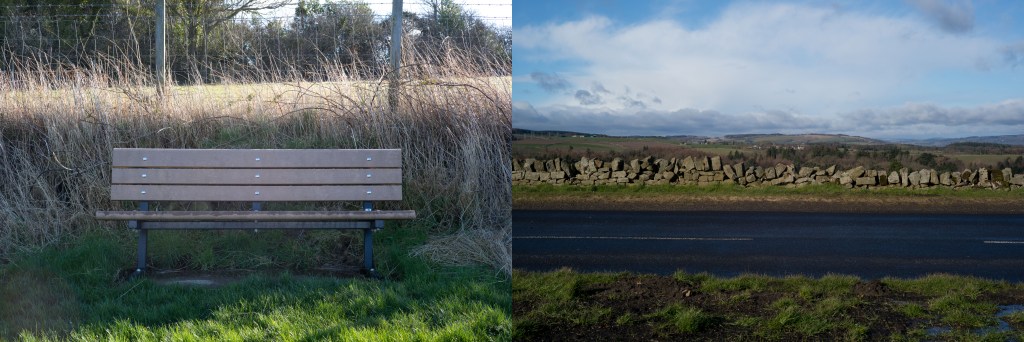
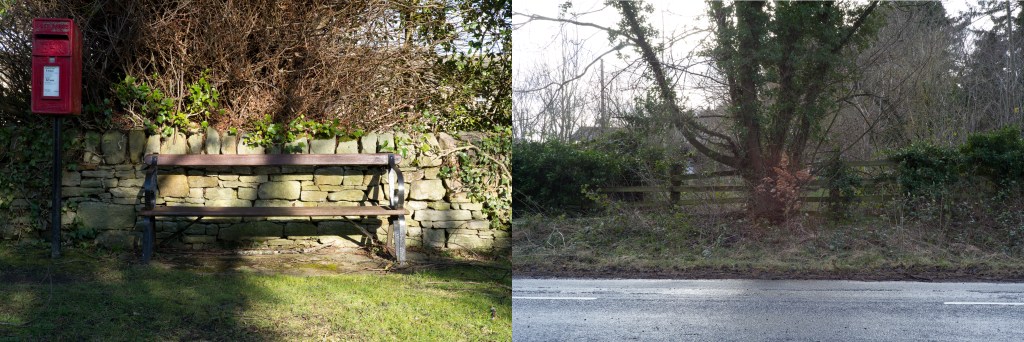
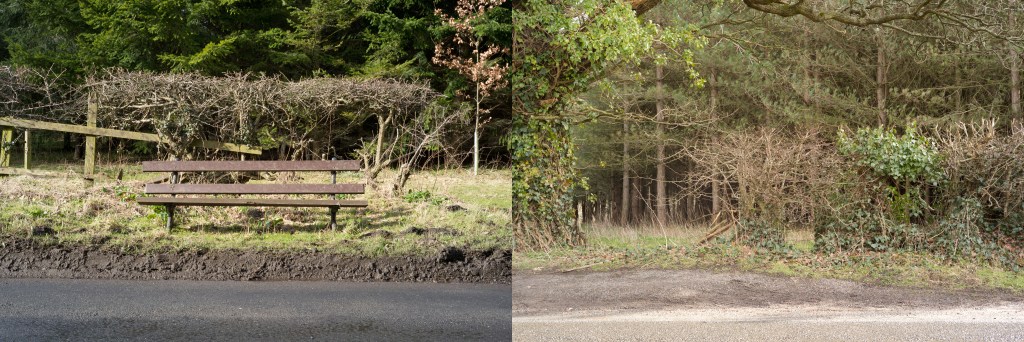
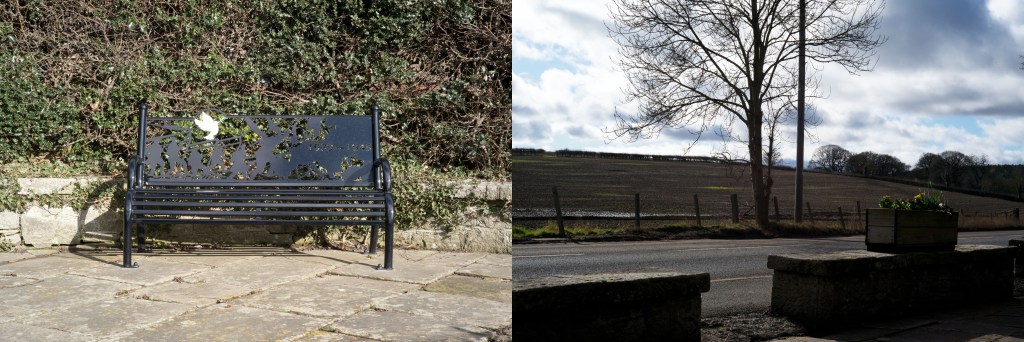
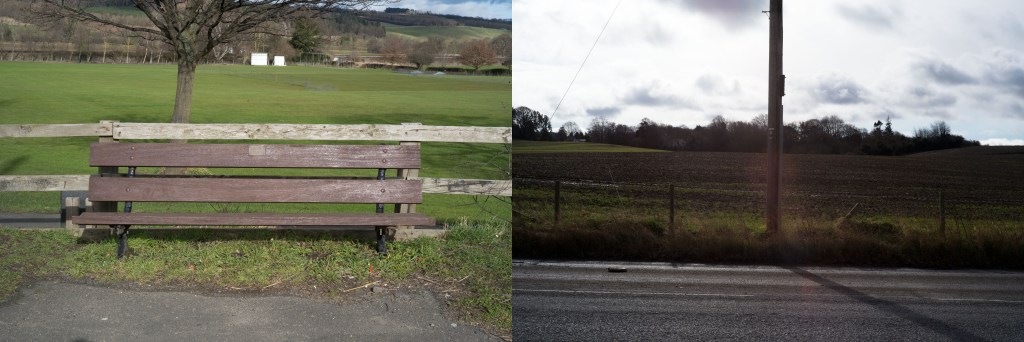
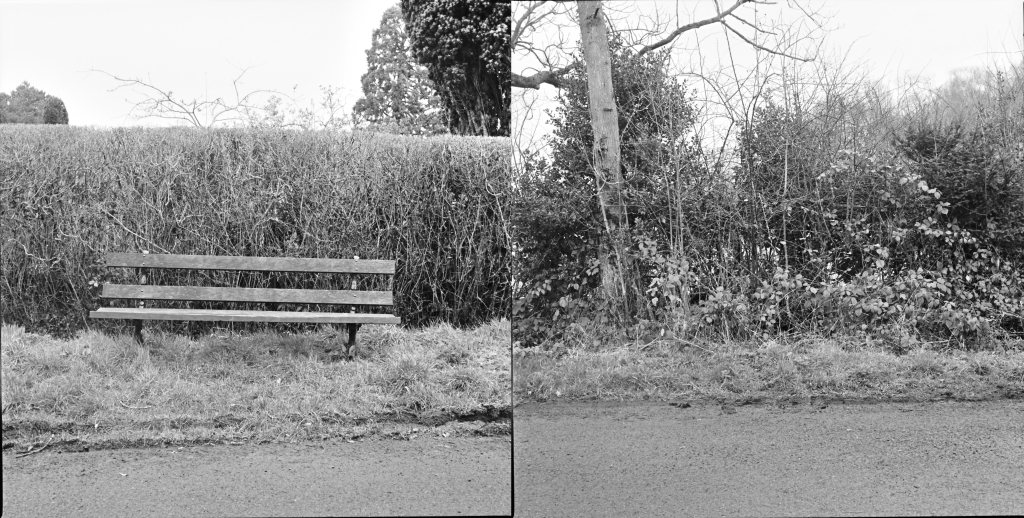
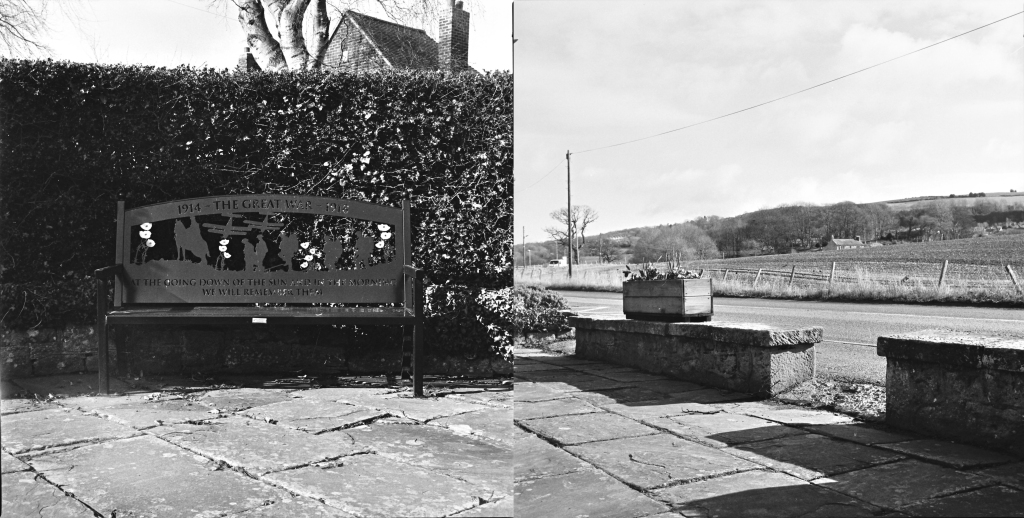
As outlined in earlier posts I have decided for this assignment to focus on the idea of spaces becoming specific places, with some sense of significance, as a result of human intervention.  To explore this idea I have concentrated on a series of public benches at various locations around the village where I live.  Some of these are specifically memorial benches, commemorating particular individuals, or historical events (for example, the First and Second World Wars, the Silver Jubilee of 1977).  Others are simply benches, presumably installed by the local Parish council, that do not have any obvious memorial function.

Some of the memorial benches carry public, easily understood memories.  For others the memories are more personal, known to only a select group of people, and not apparent to others.

All have in common, with one exception, that it is not clear what direct connection there is between the memory and the site, or why it might have been chosen.  The one exception (fourth in the sequence) states explicitly that the dedicatee had a fondness for that particular location.  

One other thing they have in common is that the sites do not even have anything that might be described as a picturesque view.  The “view” directly opposite is of little more than a hedge, or an otherwise featureless or characterless space.  Most are sited in locations that are otherwise attractive.  But that attractiveness is not apparent from the view directly in front of the bench.  Only one (the fifth) offers a more expansive view, looking across the valley opposite.  Even this is limited: the view is of the road, a stone wall, and then sky.  The valley vista is not actually visible from the bench. Tellingly, there is another bench on the far side of the road, just out of shot to the left, that does have an expansive view.  (Because of its location it was not practical to photograph it as well.)

As if to emphasise the lack of intrinsic significance of these locations, I only rarely see anyone sitting on a few of these benches.  Some I have never ever seen being used at all.

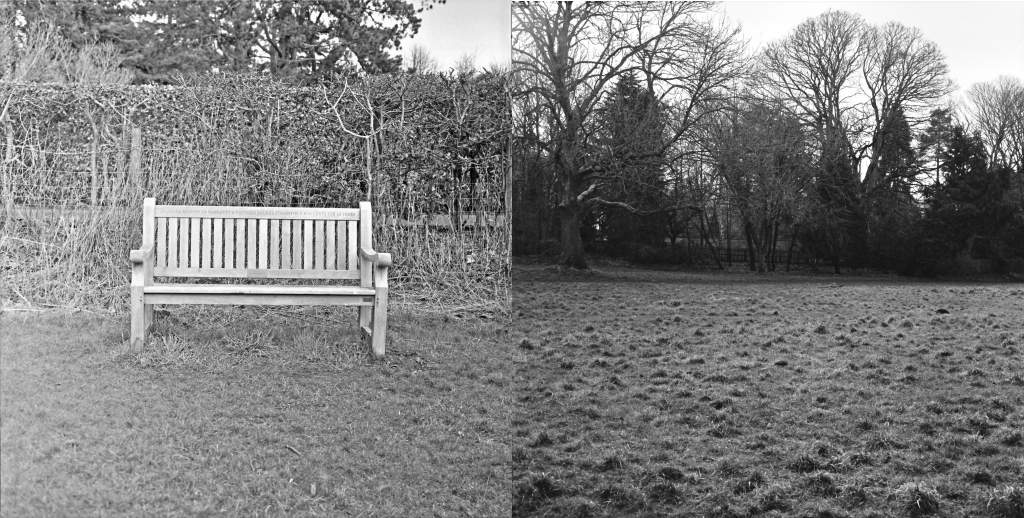
The images have been arranged into diptychs help root the benches in their locations.  The addition of coordinates reflects the fact anywhere can become a “place” by the simple act of specifying its geographical coordinates, turning it into somewhere that is locatable using, for example, GPS, or a map.  The sequence is simply determined by the position of each site on a clockwise loop from my house.

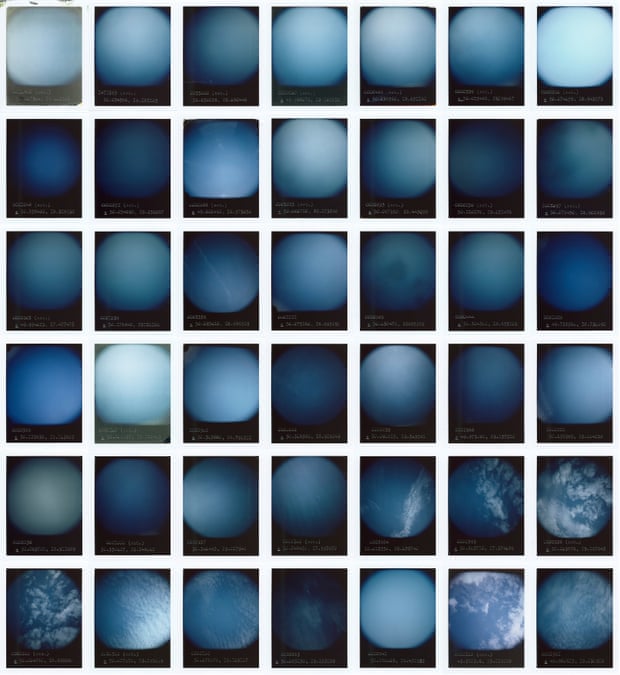
In terms of physical presentation, having settled on a typological approach, rather than a linear arrangement I feel that a block layout, in a manner similar to the some of the Bechers’s, and Anton Kuster’s Blue Skies project, would have greater visual impact.   For this to work properly though I feel that a considerably larger number of images would be needed than the assignment brief calls for.
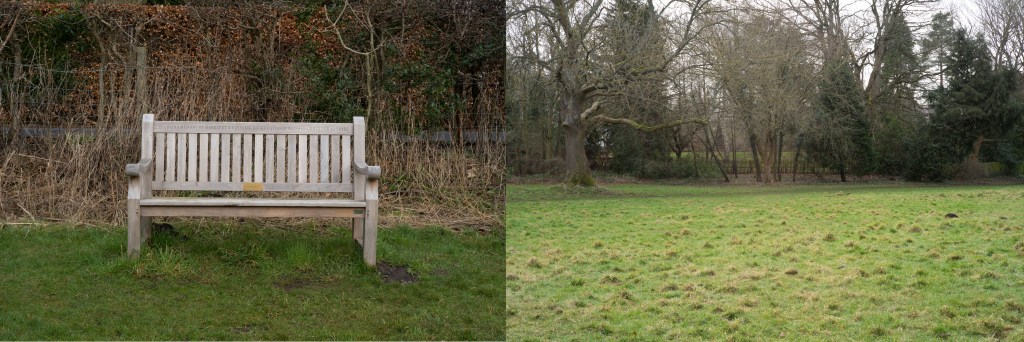
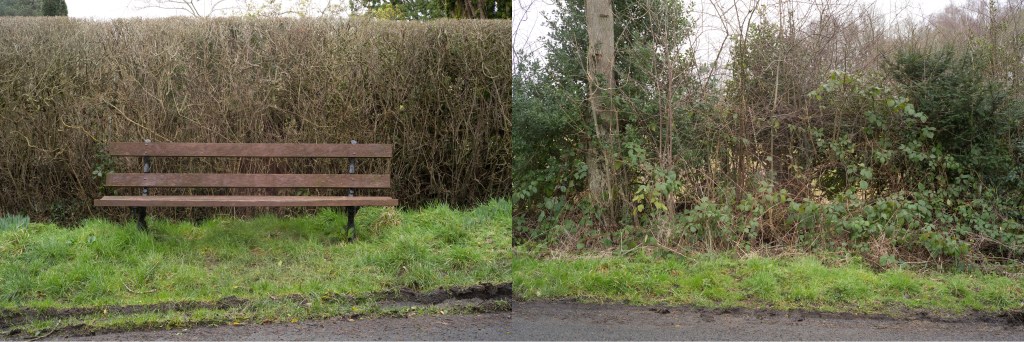
54.938641 -1.907353
54.936288 -1.909689
54.935301 -1.914846
54.934656 -1.916042
54.928091 -1.914941
54.919518 -1.916366
54.942782 -1.919470
54.948463 -1.911240
54.948747 -1.910016

Exercise 4.1: Critical review proposal

Having given this quite a lot of thought, and having done some reading already, the subject that holds the most interest for me at the moment is the idea that landscape photography does not necessarily have to focus on the physical landscape or environment, natural or built, in order to convey something about it.  Rather this can be done by concentrating on the people who inhabit the particular landscape.  This comes from the idea that “a place and its people are inextricably linked”, as the course material puts it, and from thinking about the work of Lixenberg and Sobol. However, rather than looking again at their work, what I am thinking of is looking at the genre of street photography, and in particular a few artists who concentrated on photographing people in New York City, specifically.  

Looking at some of this work again I am struck by how much some of it speaks of the nature of the city, built by, lived in, and used by people, and how the city in turn affects and shapes the lives of those people.  I am not interested here in the street photography that simply seeks out “characters”, chance events or juxtapositions, nor indeed what has been described as the “social landscape” (though that would in itself be an interesting subject, albeit not one I am sure would fit entirely comfortable within this part of the course), but that which says something about the city as a place.

Exactly what the argument will be is still developing but it is beginning to take shape as the jottings accumulate in my notebook.

As indicated in a recent post, part of the reason for choosing such a subject is to step out of my comfort zone, literally out of my natural environment in so far as I do not live in a city, and have not lived in a big one for many years (not since a brief sojourn in London 36 years ago).  Another reason is a desire to question and challenge the idea of distinct genres within photography. I also want to indulge in a bit of original thought, and it is interesting that in my research so far I have found nothing that is directly on the point, though enough that is more germane when given a wider view. I nevertheless hope that I can draw from this something that will be relevant to some of the work that I would like to attempt over time in my current more rural environment.

Part 4: Landscape and Identities

It is not often that I find the mere introduction to a section of the course material as significant or useful but on this occasion the opening paragraphs do just that. They chime with my thinking about Assignment 4 and coincidentally validate the approach I am planning. One sentence in particular strikes a chord: “A place and its people are inextricably linked.” This is exactly the point that I want to explore in the assignment and address the apparent paradox that photographs of people, rather than a physical location, can actually represent the landscape.

Although it does not fit with my current intentions, Dana Lixenberg’s book (2008), referred to in the same paragraph, and on which I have written previously (https://markrobinsonocalandscape.photo.blog/2020/02/19/landscape-as-a-call-to-action-2-dana-lixenberg-the-last-days-of-shishmaref-book/) is one that I have been looking at again and has informed some of my thinking in this regard. The further reference to Jacob Are Sobol’s book is similarly interesting in so far as it deals with similar subject matter. What I find particularly striking about his work though is the way it is much more personal, not least in the sense that he became a protagonist in his own story, an insider’s view. Lixenberg on the other hand, although clearly closely engaged with the community she was documenting, was nevertheless an outsider.

One thing that is particularly important to me, and my ideas about landscape, is that both these bodies of work illustrate that the relationship between people and landscape is two-way. This is particularly evident here in the case of these two groups of Inuit people (although they are thousands of miles apart, and speak different languages, their cultures are quite similar) although I guess the same might also be said of virtually everyone. Their landscapes are influenced and affected by the people themselves: they have built upon and changed the physical landscape in many ways, both in microcosm, in their immediate vicinity, but also in macrocosm in so fas as, even if only in a small way, their use of the trappings of modern life makes some contribution to global warming, which is in turn degrading their environment. But also their way of life and culture, the way they live on, in and on the land and its resources, is affected and shaped by the environment, as it has been for millennia.

Incidentally, the link to Sobol’s work cited in the course material appears no longer to exist and I found samples of his photographs on a newer site, to which there is a link below.

I would dearly love to have a physical copy of his book “Sabine”. It is set in a country that fascinates me, and which I have visited, albeit only briefly. It also has a visual aesthetic that I particularly like (though have so far not tried seriously to emulate) that I am more used to seeing in the work of Japanese photographers (such as, to name a few who appear in my library, the Provoke group, Daido Moriyama, Hajime Kimura, Masahisa Fukase – think Ravens in particular, Yasuhiro Ogawa, and Valentino Barachini – not Japanese I know, Italian, but has spent time and worked in Japan and has applied a similar aesthetic). I am not sure though that I can justify the cost: something in excess of €500!

Lixenberg, D, (2008).  The Last Days of Shishmaref.  Edam/Rotterdam:  Paradox/episode

https://www.jacobauesobol.com

Assignment 4: Possible subjects

I have been contemplating possible subjects for this assignment for a while now and I think I have settled on a subject (on which I shall do a separate post). It might though be useful briefly to address some other ideas that I have considered but have decided not to proceed with for now – subject to second thoughts as I get down to work on the critical review in earnest!

Whatever final form the review takes, I am intending that it is going to deal with an element of the relationship, indeed the symbiosis between, people and landscape.  As I have repeated throughout my work on this course this is the aspect of “landscape” that interests me most, both from a conceptual and a photographic point of view.

In Assignment 3 I have dealt both with landscape as an instrument of memory and how a place is created, the landscape given a particular sense of definition, by means of human intervention.  These ideas have indeed been the primary threads running through all of Part 3 of the course material.  The relationship between landscape and memory is something that interests me and is something that I would hope to be able to explore further in my own practice in due course.

With such a possible subject in mind I have been looking at some of the work in my own library (I find this is often as good a place as any to start) to see what ideas might come out. Given my growing interest in this aspect of photography it is perhaps no great surprise that I have an increasing number of books that fit the bill, though I have to recognise that my decisions to buy them have not been influenced by this interest at a conscious level.

There are two particular strands of work that I can immediately identify:  one deals with the photographer’s personal memories; the other with the memories of other people.  Some examples of the former:

Guido Guidi, In Sardegna

Hajime Kimura, Snowflakes (from Snowflakes Dog Man, which also to an extent explores the memories of another, his late father)

Daido Moriyama, Record and Daido Tokyo

Michael Schmidt, Berlin-Wedding

And of the latter:

Maja Daniels, Elf Dalia

David Favrod, Hikari

Rinko Kawauchi, The river embraced me

Kazuma Obara, Exposure

Donovan Wylie, The Maze

There are probably other books in my library for which the same case might also be made but these are the ones that jump out.

One of the more interesting books that I read for I&P was of course Hirsch (2012) which is all about the use of photography in the construction of memories, though admittedly in the context of family relationships rather than landscape or place. I see no reason in principle though why similar ideas and principles as she discusses should not apply equally to landscape photographs.

As I have said, this is a subject that interests me greatly. However, for the purposes of this assignment I feel I need to step out of my comfort zone a bit and address a different subject: one that still interests me but approaching it from an angle that, from the point of view of my own practice and seeking actively to pursue such a project, would be practically rather more challenging, as I will explain in my subsequent post on that other idea.

Daniels, M, (2019). Elf Dalia.  London:  MACK

Favrod, D, (2015). Hikari.  Berlin:  Kehrer Verlag Heidelberg

Guidi, G, (2019). In Sardegna: 1974, 2011. London:  MACK

Hirsch, M. (2012) Family Frames: Photography, Narrative and Postmemory.  Cambridge: Harvard University Press

Kawauchi, R, (2016). The river embraced me. Tokyo:  torch press

Kimura, H, (2019). Snowflakes Dog Man.  Italy:  ceiba editions

Moriyama, D, (2017).  Daido Moriyama: Record.  London:  Thames & Hudson

Moriyama, D, (2016).  Daido Tokyo.  Paris:  FondationCartier pour l’art contemporain

Obara, K, (2018). Exposure / Everlasting. Cordoba:  Editorial RM / RM Verlag

Schmidt, M, (2019). Berlin-Wedding.  London:  Koenig Books

Wylie, D, (2004). The Maze.  London:  Granta

Assignment 3: Black & White film

As a result of the increasing chaos surrounding the Covid-19 epidemic and, adding insult to injury, a problem with my computer’s connection to the internet (which with luck will be fixed in a couple of days), it seems to be taking forever to get this assignment completed. At last though I think I am nearly there!

I have now developed the films that I shot as an experiment while taking the digital shots for this task. By and large they have worked fairly well, though a couple have needed a bit of editing in Photoshop and if I was to use them for a final set there are a few that could ideally do with reshooting.

Nevertheless, if nothing else it has been a useful and interesting experiment, not to mention an opportunity to get to know my medium format film camera a bit better. I have only run a few rolls of film through it of late so I still have plenty to learn. Not least I need to develop more confidence and ability using a light-meter. Interestingly though I think I am already getter a better feel, on the basis of how pictures have come out so far, for what settings are likely to be right for varying light conditions without having to meter first. Practice, practice, practice! Indeed, I am toying with the idea of using film (probably 4×5 on my large format camera) for the final set for Assignment 5, which I have already started to think about and for which I already have some ideas.

In the meantime, here are the film shots for this assignment, with minimal editing, but organised into diptychs. These are for all eleven of the sites I shot, though as I have already indicated I will use fewer for the final set (I am in the process of making the final choice now), and they are not in any particular order.

Assignment 3: Contact Sheets

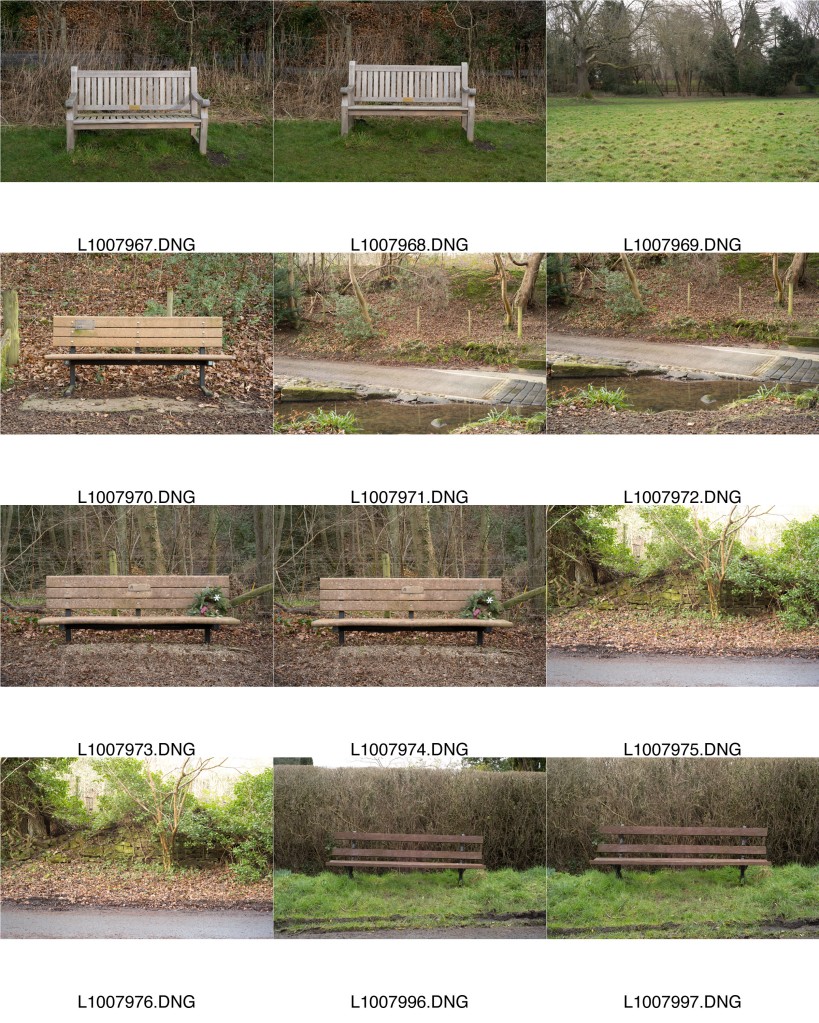
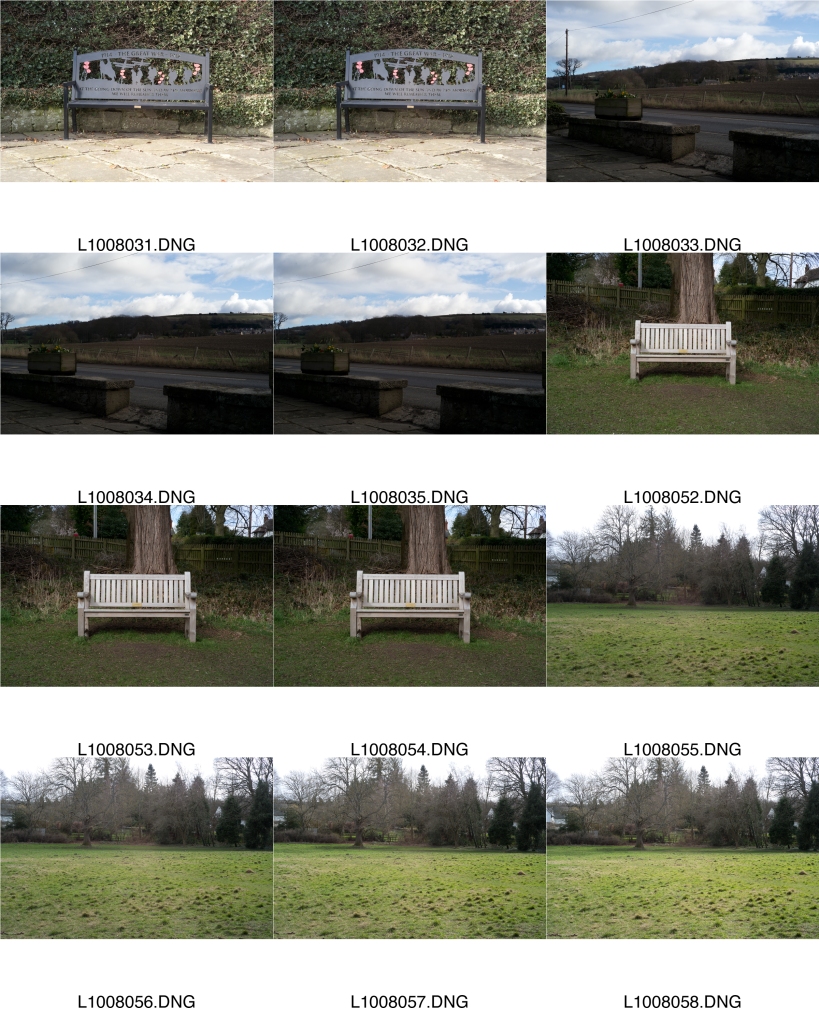
I think I have pretty much all I need for this assignment now, having photographed eleven sites, so I have now put together the contact sheets. Of these eleven I think I will actually only use nine or ten; the two war memorial benches are right next to each other and using both would be an unnecessary duplication. I am similarly not sure about using the last bench on the fourth contact sheet as this also to an extent duplicates the very first one. I will make a final decision once I work out a sequence for them, and note the coordinates for each site. Otherwise the images that I am going to use have all been selected and the diptychs produced in Photoshop.

Otherwise, I need to develop the rolls of film that I shot as well and see what they have captured.

Assignment 3: Another element

I think I have at last finished shooting for this assignment. A number of sites I had in mind I have since discounted as they have too much of a “view”. One of the common threads running through the bulk of the places I have chosen so far is that the view is pretty nondescript, not something that in its own right would justify the siting of a bench, memorial or otherwise. A handful of sites in Hexham that I had in mind all have too much of a view and so would not fit.

One last decision though that I have made is to include for each diptych its geographical coordinates: the spaces in question have become specific, definable, and locatable places. This decision has largely been influenced by Anton Kuster’s Blue Skies project that I looked at in connection with Assignment 1, and in which each photograph is annotated with the coordinates of the position from which it was taken.

I now just need to get on with editing and putting together a final set.

https://antonkusters.com/theblueskiesproject

https://www.theguardian.com/artanddesign/2019/nov/05/deutsche-borse-photography-prize-mohamed-bourouissa-anton-kusters-mark-neville-clare-strand

Assignment 2 – Further Research and Tutor Feedback

I have been so busy of late working on Part 3 generally and on Assignment 3 in particular that I have not until now got round to following up a link provided by my tutor in response to the work I did for Assignment 2. I have now remedied that oversight.

He pointed me in the direction of a short video clip, which is in fact a series of still photos, made by Chris Killip in the Japanese fishing town of Kesennuma shortly after the earthquake and tsunami struck in 2011, and some months later showing some of the clean up and start of recovery. Killip (for whom I have a lot of time, not least simply because of his connections with the North East) took photos every twenty paces along a particular street. This is an approach similar to the one I used, but of which I had not previously been aware, on my train journey, setting the camera to fire every ten seconds. In both our cases the resulting image is not the direct result of a conscious decision but of the operation of a pre-determined process, so the results are almost, but not quite, random.

The resulting work is very moving in its simplicity.

Coincidentally I have just started to read (or is it that I have just been prompted, reminded, to look at this video because I have just done so) Richard Lloyd Parry’s book (2017) about the tsunami. As is not uncommonly the case with my reading, this book has sat on my shelf for a couple of years before I have got round to reading it in earnest. Sometimes books just have to wait until the time is right for them, and more often than not I do not consciously know when that time is until I finally get my nose into it. Kesennuma, the town visited by Killip, is mentioned a few times. Even for Japanese people it is, or was, hardly known; it is not a part of Japan that I know at all – I really only know some of the the area between Tokyo and Kyoto, and the mountains above Nara overlooking the Inland Sea. It is poignant that it should become known now to a wider (but I guess still a fairly narrowly interested public) audience as a result of this tragedy. It also appears on one of the maps in Gretel Ehrlich’s book (2013) (which in contrast I read immediately it came out) but I do not recall that she visited, although she did spend some time nearby: she is more concerned with the people affected by the disaster than with specific locations (places such as Sendai and Fukushima apart – for obvious reasons).

Ehrlich, G, (2013). Facing the Wave: A Journey in the Wake of the Tsunami. New York: Pantheon

Lloyd Parry, R, (2017).  Ghosts of the Tsunami.  London:  Jonathan Cape

https://vimeo.com/42778555

Landscape as a memory device: Shimagatari – Book Further thoughts on Assignment 3

Whilst working on the sections of the course on Photography, memory and place (on which I still have to write something, and particularly Exercise 3.6, my primary focus has been on the idea of the photograph itself being a site of and aid to memory. What I have to some extent lost of is the idea that the landscape itself does the very same, and that this is what is captured in the photograph. This is implicit in the work I did for Exercise 3.5 on local history (https://markrobinsonocalandscape.photo.blog/2020/02/16/exercise-3-5-local-history/) and is also a growing idea in the context of Assignment 3, on which I am continuing to work.

This thought occurred, or perhaps re-occurred, while looking at Yasuhiro Ozawa’s book (2014) which has recently been reissued. What caught my eye in particular is part of his introduction:

“On Japan’s outlying islands (off the larger main islands of the archipelago) you find a kind of build-up of history, almost like a bank of snow. Emotions and recollections of the people and fragments of time accumulate layer upon layer to exude an air unique to the islands. Sometimes, as I walk the islands, that distinctive air becomes overwhelming and I hurry to board the return ferry. Yet once back on the mainland, I am gripped by a feeling that I’ve left something precious behind, and I find myself heading to the islands again.”

That sense of landscape as a place of, shaped by, and in turn, shaping history is something I get very strongly from Ogawa’s work in this book (even some of his older work that does not relate at all to Japan) and is in a way helping to refine, and define, my own understanding of what makes a given landscape important, rather than simply picturesque.

Ogawa, Y, (2014). Shimagatari. Tokyo: Sokyu-Sha

Assignment 3 : Further research and thoughts on presentation

Whilst I am continuing to beaver away with shooting for this assignment – I have been very much hampered by the weather of late and it is amazing how much time it all takes, particularly as I am shooting both digitally and with medium format film (more as an experiment in its own right if anything and an opportunity to get to know the camera properly): last week it took more than two hours to cover just five, fairly close, locations – I am nevertheless still looking at possible influences, both on the subject matter and on the mode of presentation.

After this last shoot I remembered some work by former OCA student “Rob TM” that was featured briefly in C&N, in particular his series “A Forest”. This consists of views of woodland, all fairly anonymous and undistinguished in their own right, juxtaposed with studio shots of rubbish and detritus he found at each particular spot. I think there are parallels here between his work and what I am exploring, how a location can take on a particular identity or significance as a result of some human intervention. Here is an example of his work. (I have not been able to find any freely available images on-line so this is an edited screen shot from his website.)

I had also already been thinking about how my images might be displayed and from the outset have conceived of them as a series of diptychs, quite possibly unconsciously influenced this work. The aspect ratio of the digital camera that I have been using is much wider than this so the resulting image is shallow but wide. Nevertheless I think it works. Here is an example, produce by simply copying and pasting the two related pictures into a new, double width file in Photoshop:


When I get round to developing the medium format film the aspect ratio will be much more like that above as 120 film in my Hasselblad produces 2 1/4 inch square frames.

I stil have more pictures to take, but I have at least identified some more potential sites that should give me enough to make up a set.

http://www.robtm.co.uk