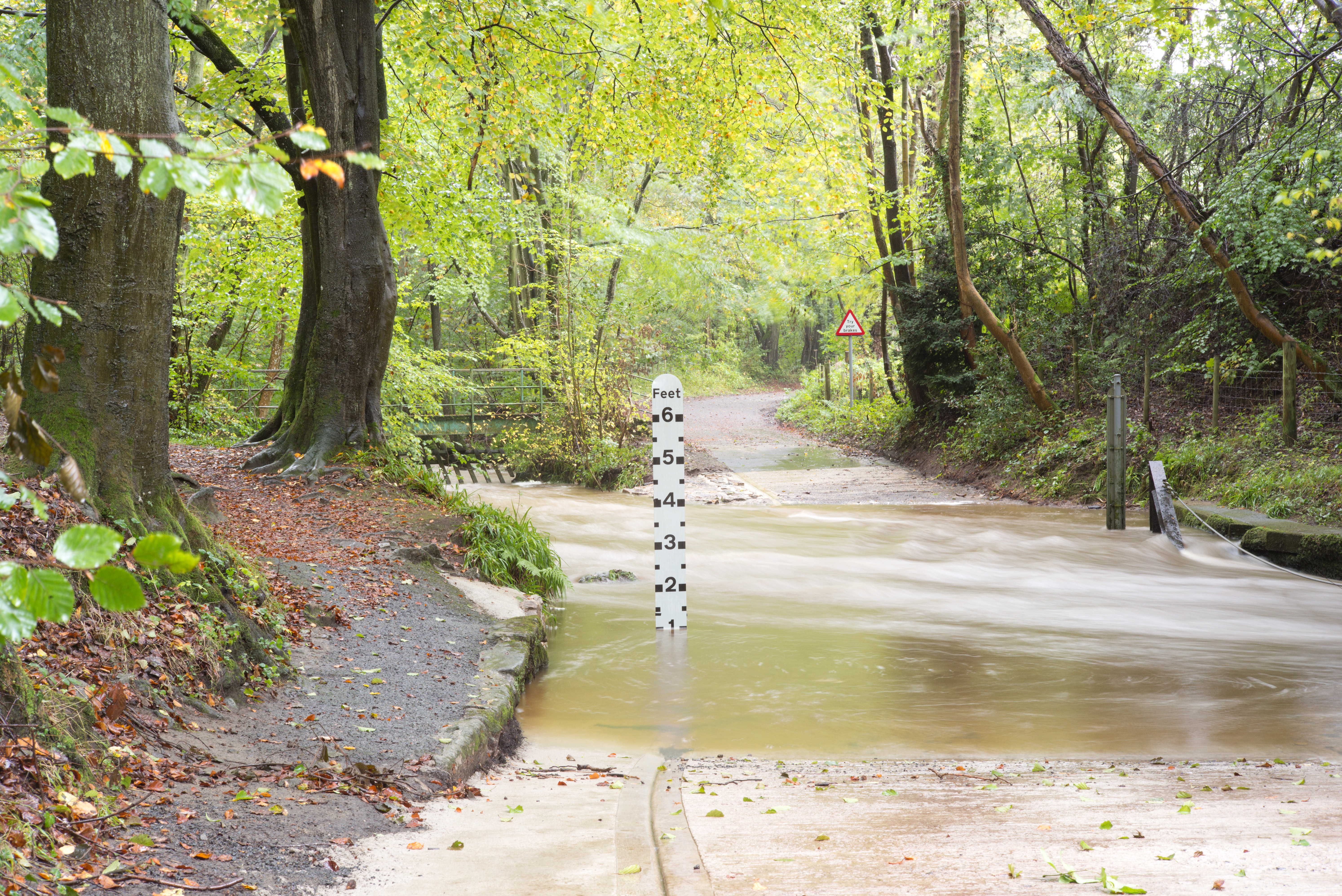
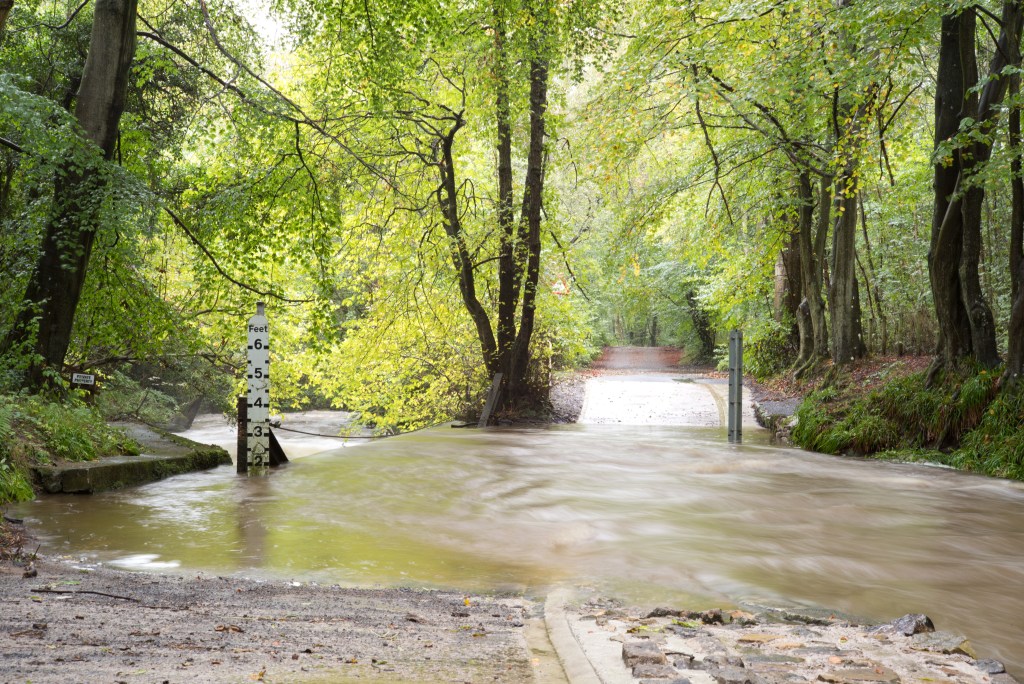
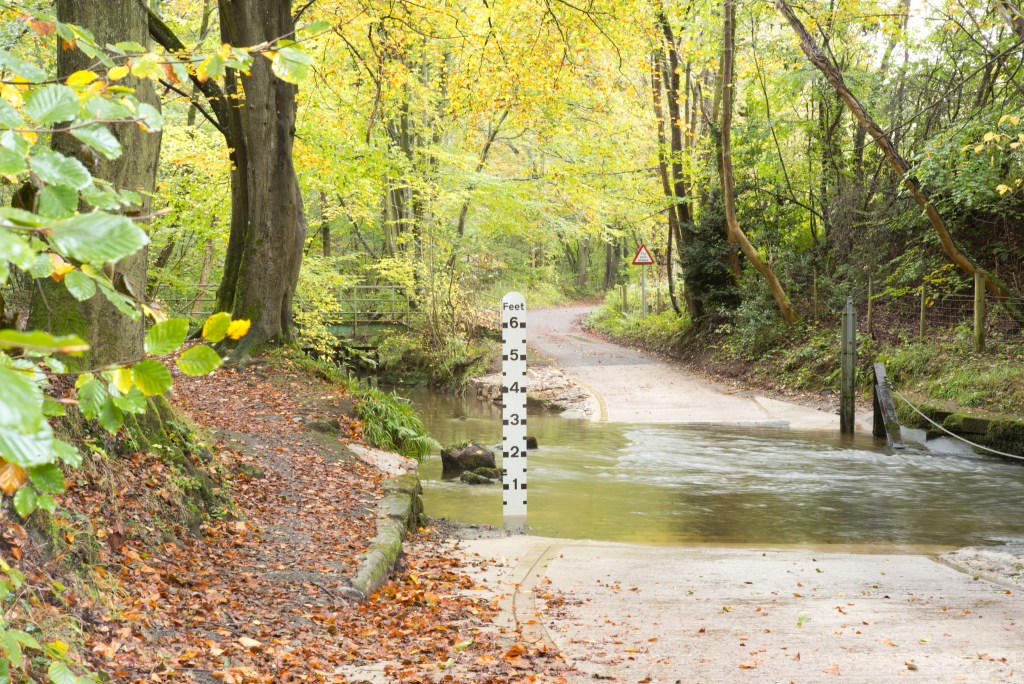
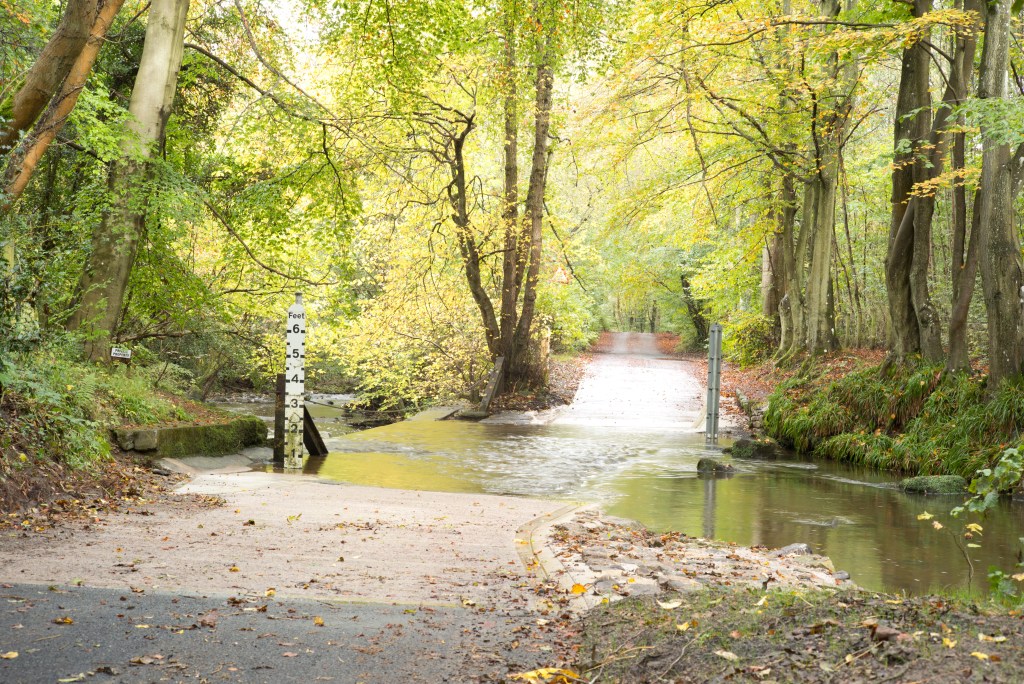
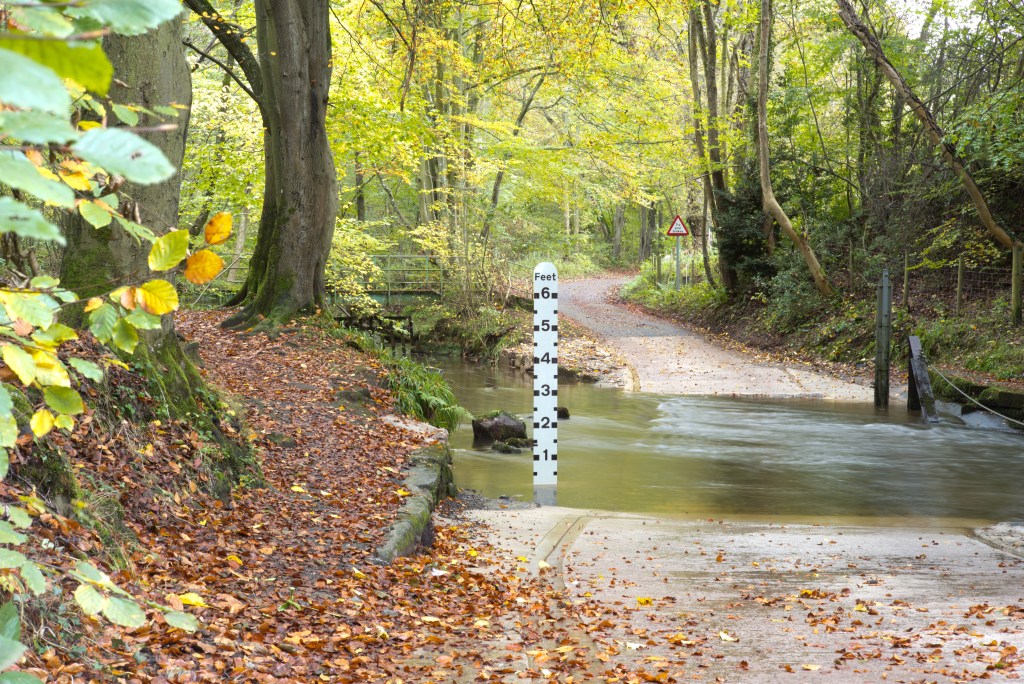
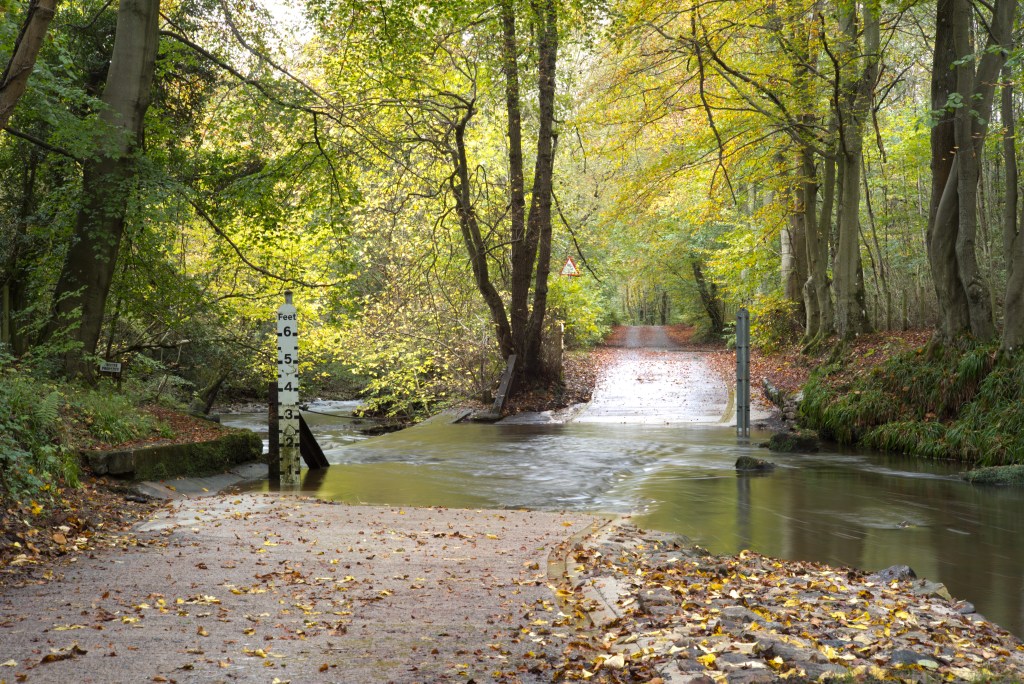
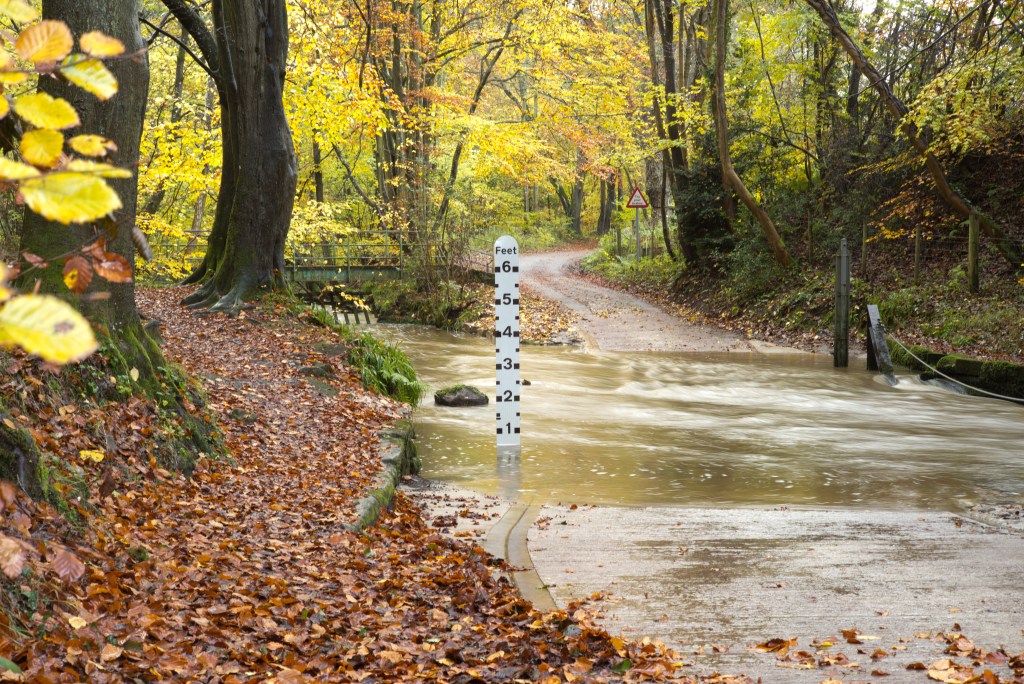
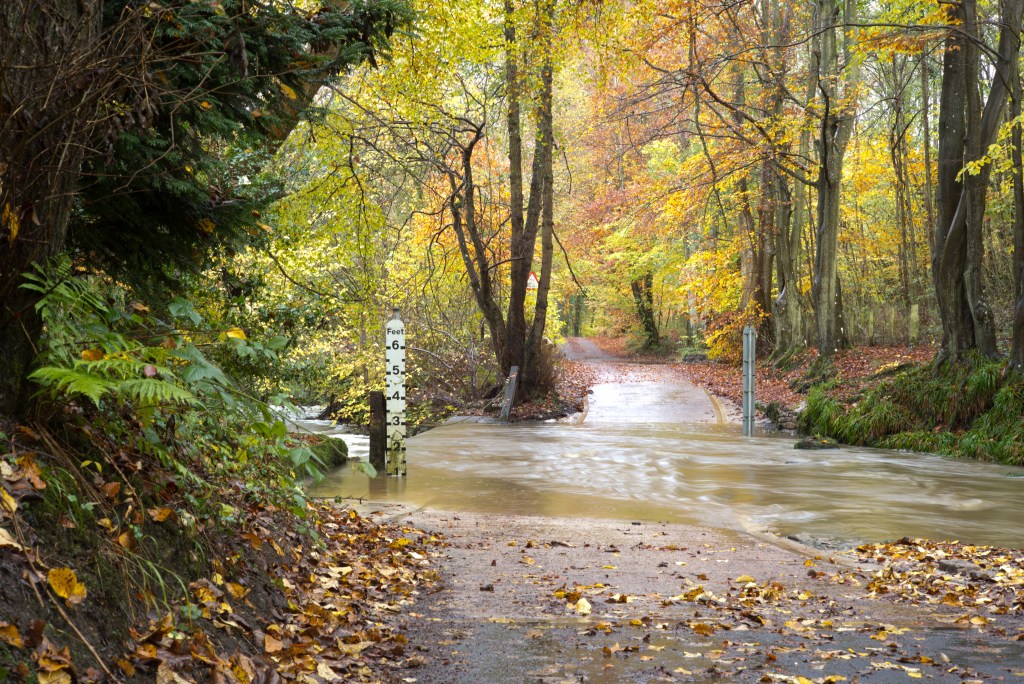
I have at last made a start shooting for this exercise. For now I have shot only the ford and will follow up with the fall back plans (on which I have had some more thought) later. I made a start now, despite the fact that the weather was quite bad today, to take advantage of the significant flow of water through the ford as a result of very heavy rain overnight. Despite the volume of rain over the last couple of weeks the water level had fallen back to just a couple of inches by yesterday. Today, on the upstream side, the water was almost two feet deep.
Having tried a few different angles I have settled on two, one looking upstream, one down. I will choose between them for the final set (assuming one of the backup plans does not take precedence) once a more substantial body of work has accumulated.
At the time these were taken it was raining (I had to shelter the camera under an umbrella as it is not weathertight!) so the light was quite poor. Exposures were as a result quite long (1.5s for the first, at f/16, ISO 400) which has made the water quite glassy and smooth. Obviously I used a tripod, which I set fairly low to keep some of the road in view in the foreground.
Fortunately, because of the depth of water I did not have to worry about cars coming through. One did approach from the downstream side but wisely turned around and went back!
Just how often I repeat these shots I have yet to decide but I expect it will probably be weekly. I can though be flexible and judge when it is worth revisiting on a daily basis as I walk the dog this way most days and so can see if there have been any noticeable changes before deciding when to come back with a camera.
14 October 2019
20/10/201920/10/2019
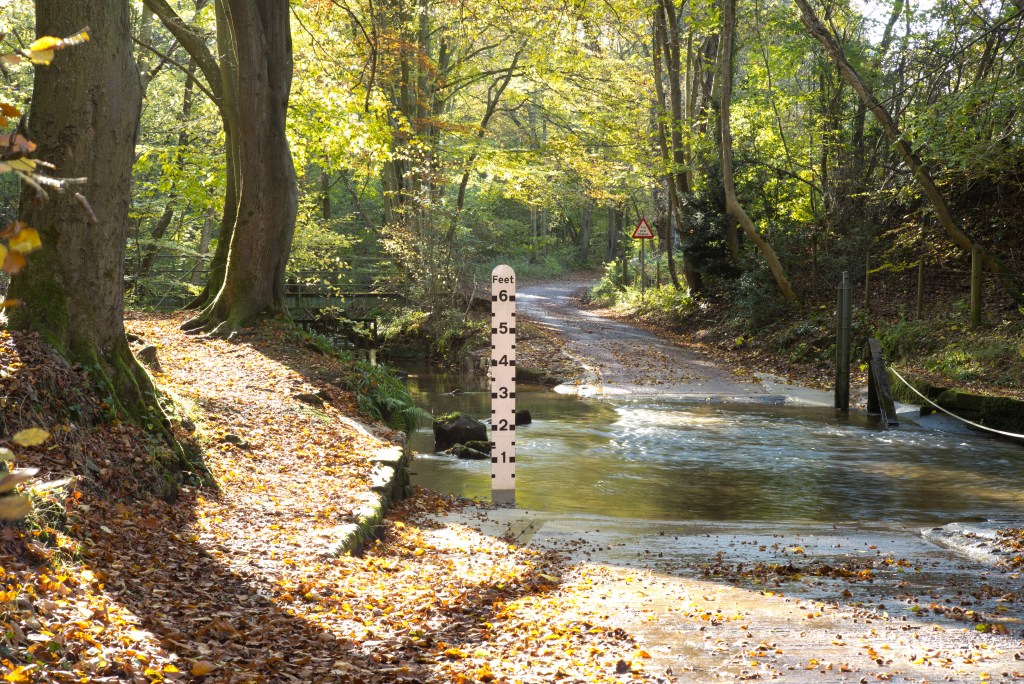
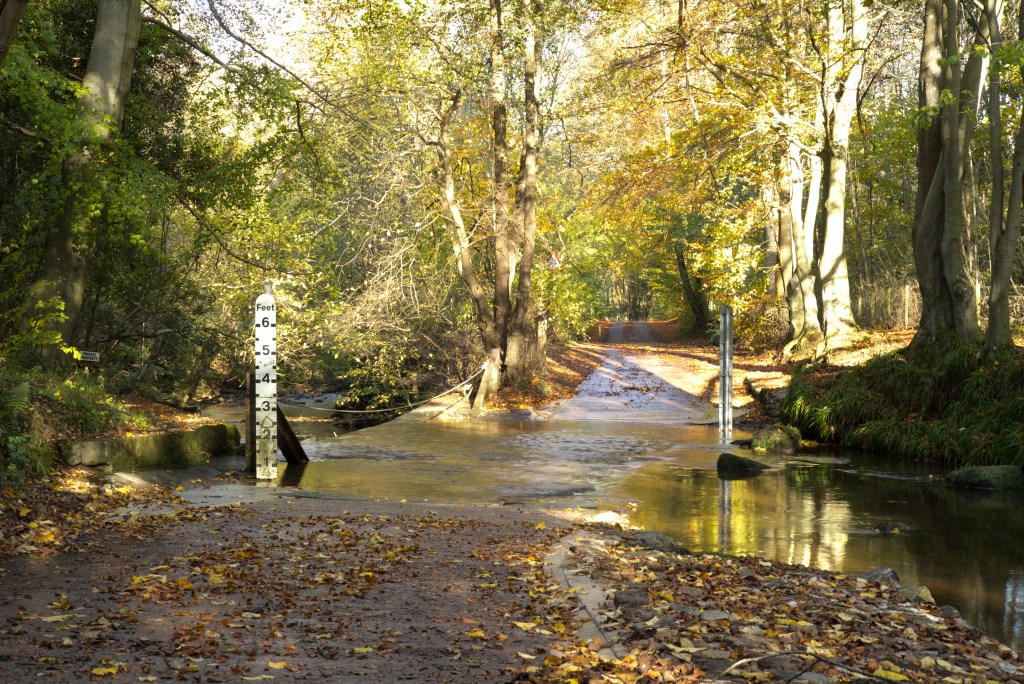
Interesting that these last two pairs of photos suggest that the default depth of water in the ford with regular but not too concentratedly heavy rain is about three inches, not something that I have noticed before.
27/10/201927/10/2019
The latest instalment. As with Plan B I think now is the time to stop the regular updating of this post and simply continue to gather shots that can be properly edited later. I will though add more if, for example, we have another flood or other dramatic changes to the scene over the coming months, which is quite likely given the amount of rain we are getting at the moment.
Compared with previous modules I have got off to rather a slow start with this one, partly because its start overlapped with finishing off I&P and getting everything ready for assessment next month, partly because of some personal issues that have kept me away from working on this. I do though now feel that I am getting back into a groove, a routine, and getting more work done. What I really need to do though is get back out with an camera and make pictures again! This exercise gives me an opportunity to get going once more.
The idea of taking a series of images of the same scene over a prolonged period of time is something that I have thought about before and is something that I have already written about. Going right back to EYV and the Square Mile assignment this is an idea that I looked at then: (https://wordpress.com/post/markrobinsonocablog.wordpress.com/119). So it is good to come back to it again now. There is an obvious difference in time scale between anything that I can achieve over the next year or so and what Tom Phillips did over twenty years but nevertheless I feel this is still potentially fertile ground.
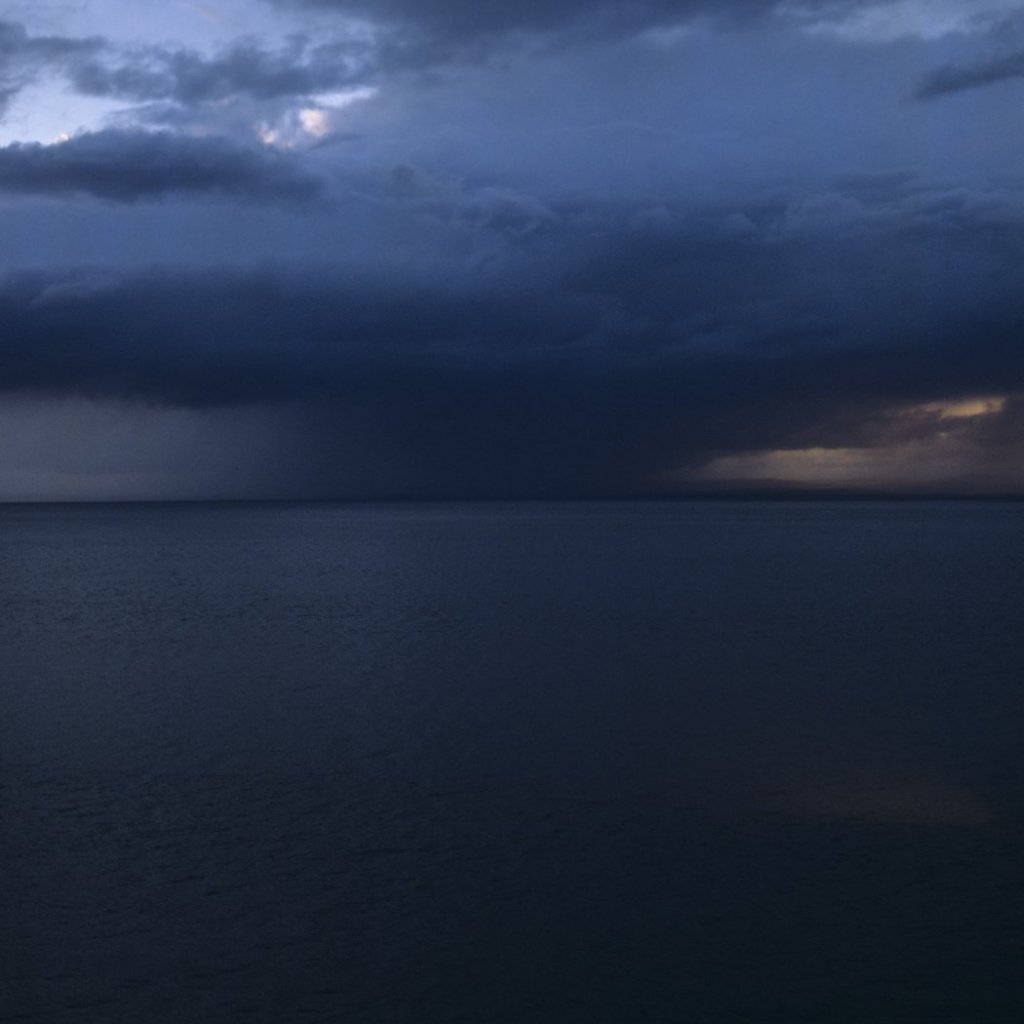
One project I would really like to pursue would be to take photos, possibly even on a daily basis at least at some times of the year, of a particular seascape, showing just sea, horizon and sky. This is partly inspired by the seascapes of Hiroshi Sugimoto (2019) that I have referred to before – though his work shows seascapes from around the world, rather than focusing on one single place. Coincidentally I have also just discovered some of the early, camera-based work of Garry Fabian Miller in the latest issue of the British Journal of Photography, particularly (at pages 52 and 53) from his Sections of England: The Sea Horizon series, of which this is an example (Number 18 Series 2 1976):
These works differ significantly from Sugimoto’s in that they are in colour whereas in his seascapes, so far as I can tell, Sugimoto worked exclusively in monochrome. They are also more overtly dramatic in so far as some feature a distinct horizon, and a focus on prevailing weather, reminiscent of the cloud sketches by Cozens and Constable, and Turner’s storm scenes. I do not know though whether he shot in a number of different locations or whether each image is of the same stretch of sea, although under differing conditions. For the purposes of a project such as this I think that Fabian Miller’s approach would be more productive.
Unfortunately however such a project is not really practical, even without bearing in mind the guidance in the brief for this exercise to concentrate on somewhere nearby. Although I am not that far from the coast, it is nevertheless the better part of a sixty mile round trip – at least – to the nearest possible location that I have in mind. It is simply not practical for me to be covering that sort of distance on a regular, let alone frequent basis. That is a shame because this is something that I would really like to try more seriously; maybe it will just have to become a personal project to be pursued over a much longer period.
My primary choice of practical subject is therefore a ford about ten minutes from home, and past which I have walked with my dog nearly every single day over the last three and a half years, where the scene is constantly changing, and which I have observed closely. I therefore already know what it is likely to look like at any given time of the year. There are obvious seasonal changes but it is also somewhere that can be subject to shorter term, sometimes quite dramatic, changes depending on weather and light conditions.
I have also been giving some thought to a plan B. I have not yet settled on a firm idea yet, and is suspect this will not crystallise until I have got down to proper work with plan A, but I have a couple of thoughts. One, proceeding from a comment in the exercise on preconceptions is that a landscape does not have to be a macro environment but can also be a micro one. With this in mind one possibility I have been thinking about is to photograph a spot (probably in one of the local woods) no more than, say, a metre across, to explore and reflect the changes that take place on a much smaller basis. Another is to focus on a location that is more man-made and is subject to more “managed” change. One possibility that I have in mind for this is a scrap-yard on a small industrial estate in Hexham, which is a site that I could realistically visit as much as weekly. Again this needs further thought but for now I think what I need to do is just get on and shoot at each location and see how they develop. I imagine there will still be time to change tack later if necessary, as long as I do not leave it too long.
Phillips, T (1992) Works and Texts. London: Royal Academy of Arts
 Mark Robinson's OCA Landscape, Place & Environment Blog