Category: Books

Assignment 5 – Research

There was a piece in the Guardian that caught my eye this morning about a collection of photographs of village halls in the South-West.   Black and white, landscape format photographs of simple, utilitarian, but nevertheless socially important and valuable places, they strike a chord with me in connection with my ideas for the self-directed project that forms Assignment 5.  This sort of approach, picturing otherwise quite ordinary, mundane, architecturally neutral buildings and places is just what I plan to do within my own village, I am merely going to cast my net wider for a greater variety of buildings, though one at least is likely to be our own village hall.

I have included a link to the article below but because it is not very long I am also including the text here.

“This way for Bums and Tums! The discreet charm of the village hall

Bleak, bulky yet strangely beautiful, village halls are the beating heart of rural Britain, where great events happen for £8 an hour. We meet a photographer celebrating these harmonious hubs
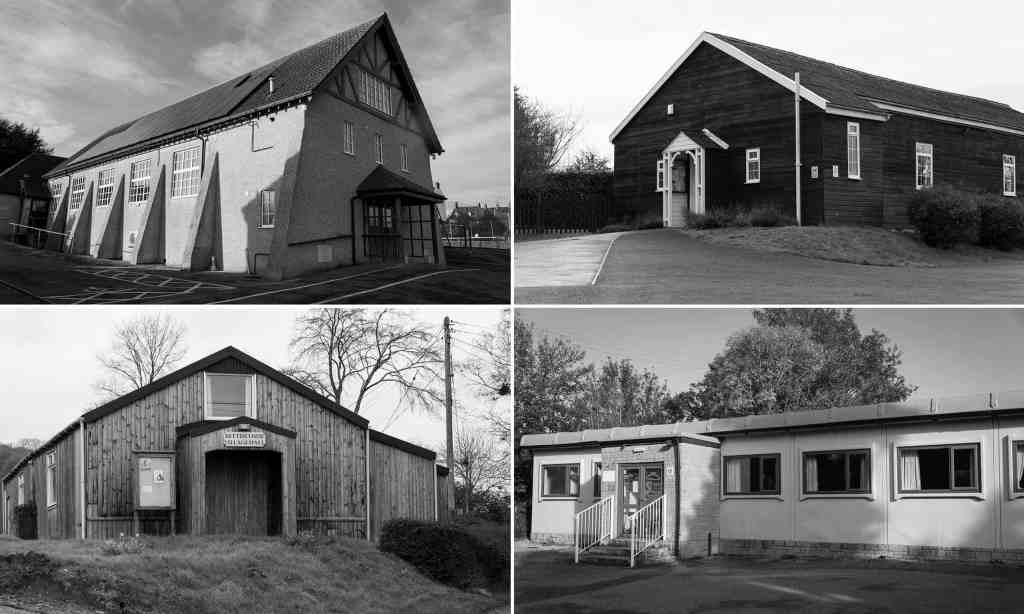
 ‘Determinedly mundane’ … clockwise from top left, St Andrews Hall, Charmouth; Ashill; South Perrott; and Bettiscombe village halls in the West Country. Composite: Jethro Marshall

Arow of karate kids are performing mawashi geri kicks in unison to the cries of their teacher. Coincidentally, in the room next door, the Brownies are learning first aid. The next morning, a gaggle of pensioners arrive and are soon waltzing to wartime classics. Then, by the afternoon, a jumble sale is in full swing. One week later, dozens of people are queuing up to vote, hot on the heels of a neighbourhood forum discussing a contentious planning application.

These are just a few moments in the life of a humble village hall. More than any other building type, the village hall represents the ultimate multifunctional democratic space. It is a forum for raffles, cake sales, birthday parties, fitness classes, political meetings and more – a witness, as Jethro Marshall puts it, “to great human events – mostly for around £8 per hour”.

Absent of the life that sustains them, village halls have become haunting symbols of a time when we could congregate

Marshall, a Dorset-based art director and photographer, has surveyed a range of village halls across the West Country for his latest book, Halls & Oats, a celebration of what he calls “utilitarian bucolic construction”. In the midst of the pandemic, his carefully framed black and white images, devoid of human life, take on a new level of pathos. The children’s parties have stopped, the Bums and Tums classes are postponed, Knit and Natter has been put on hold. Absent of the life that sustains them, village halls have become empty shells of promise, haunting symbols of a time when we could congregate – but also hopeful reminders that we might one day do so again.

For all the colourful life they contain, these buildings tend to be fairly nondescript, if not downright bleak. As architect Sam Jacob writes in the introduction: “They are vernacular in a practical rather than sentimental way.” While town halls are draped in the heraldry of civic power, and churches are intent on impressing narrative and belief, the village hall is “determinedly mundane in its dogged lack of architectural expression”. Part barn, part chapel, part schoolhouse, they are, for want of a better word, sheds – but sheds full of civic ambition.
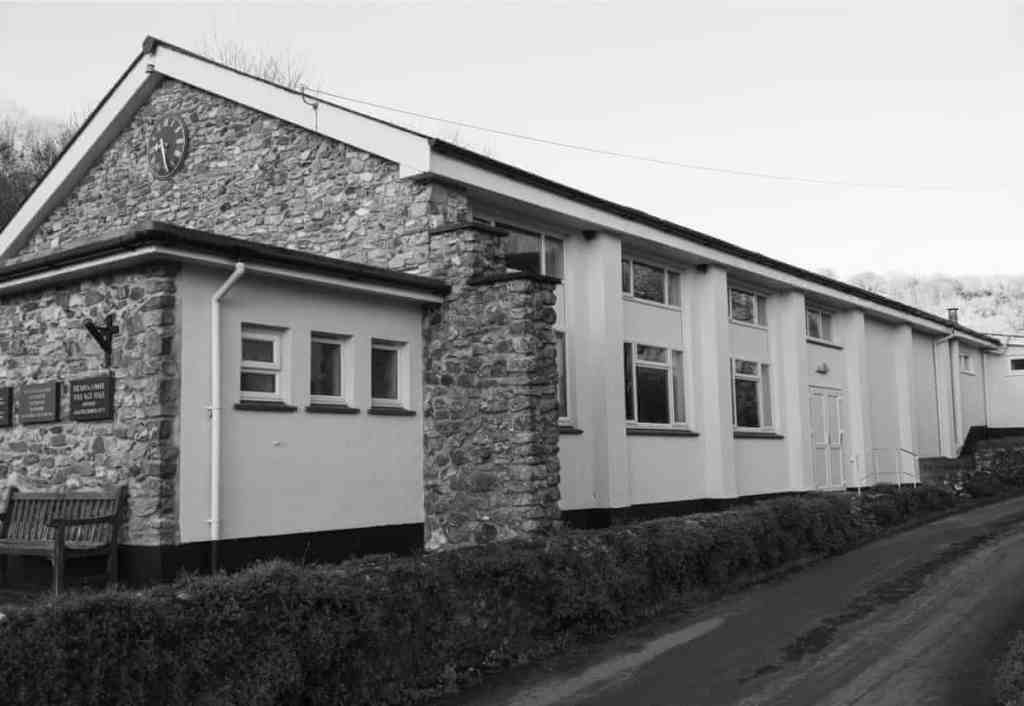
Weighty air … Branoc Hall, Branscombe. Photograph: Jethro Marshall

The Bettiscombe village hall, built in 1961, is a stained timber building with a simple pitched roof, elevated by the addition of a big porch and central square window. It has the look of an Amish barn or a pioneer church, the rituals of worship exchanged for bingo and Pudding and Pie nights. Branoc Hall in Branscome, built in 1976, is a grander affair, with two storeys of windows and exposed ragstone walls lending it a weighty air. A central clock on the gable end cements its status as a force for public good. St Andrews community hall, built in Charmouth in 1909, cranks the ambition up even further, with pebbledashed buttresses and a frontage clad with mock-Tudor timbers, giving the indoor lawn bowls sessions a whiff of Merrie Olde England.

With many taking on new life as hubs for aid networks in the pandemic, they remain radical spaces of social connection

Others are more straightforward prefabs. Knowle village hallwas built in 1948 by the National Council of Social Services as a temporary measure and, like many temporary postwar structures, is still going strong 70 years on. In the Exmouth Journal’s report on its opening, a Mr Tilestone described how “the hall was not a building erected for any one section of the community. It was not for the men, the women, the small children, or the old people but it was for every single one of them – it belonged to the village as a whole.” As Jacob puts it, in their very existence, village halls are “a covenant – a promise even – of the possibility of community that must be fulfilled”. With many taking on a new life as hubs for aid networks in the pandemic, they continue to operate as radical spaces of social connection.

This is Marshall’s fifth book, under the imprint West Country Modern, following such titles as Farm Follows FunctionCoastal Brutalism and This is Hardcore, the last a photographic essay of roads. The subjects seem wilfully mundane. They take the matter-of-fact aesthetic of the “new topographics”school of American photography – pioneered in the 1970s by Robert Adams, Lewis Baltz, Bernd and Hilla Becher – and apply it to the most humdrum of structures in the Devon and Dorset countryside.
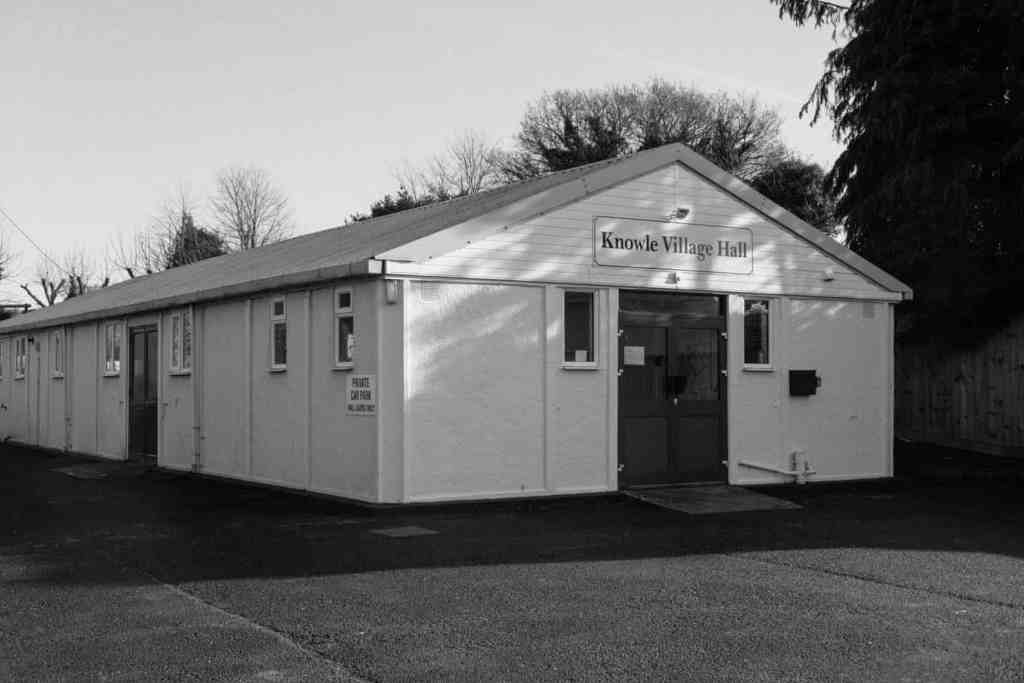
 ‘Nondescript if not downright bleak’ … the prefab Knowle Village Hall. Photograph: Jethro Marshall

By doing so, Marshall forces us to look again, to see the beauty in barns and the majesty of flyovers. He says his intention is to “reframe our rural landscapes as inspiring, progressive environments” and sums up his position as “anti bucolic/pro rural”. The countryside is not a rose-tinted Eden, as hundreds of years of romantic propaganda would have us believe, but a place of work, industry and civic life. Activities may be on hold for now, but socially distanced coffee mornings and contactless karate will return soon enough.”

One interesting reflection that this piece sets off is the relationship between what I propose to do for this assignment and the “new topographics” school.  I confess that much of the work of Louis Baltz has not moved me, and I do not agree with his ideas about what landscape is, and I do not agree with Adams’s notion of “Form” (as I have written elsewhere – https://markrobinsonocalandscape.photo.blog/2020/04/19/landscape-and-gender-exercise-4-4-of-mother-nature-and-marlboro-men/).  I do though like the deadpan approach, particularly as practiced by the Bechers.  So perhaps there is a connection, or an influence, at work behind my own intentions, though coming to a similar aesthetic from a rather different theoretical position.  Perhaps it is also time to reassess my views of Baltz’s work, separated from his conceptual underpinnings.

Marshall, J, (2020).  Halls & Oats.  Lyme Regis:  West Country Modern

https://www.theguardian.com/artanddesign/2020/may/31/village-halls-west-country-bums-and-tums
The Learned Pig & Recollecting Landscapes

A bit of a digression (but not much), possibly interesting for some doing this particular module, but here is a recommendation of a website that revels in the name of The Learned Pig. As they put it, “The Learned Pig is an online arts magazine that brings together multiple perspectives on relationships between the human and the non-human.” Personally I find it a source of stimulating thinking about our relationships with environment.

Something I have just picked up from their latest email newsletter is a reference to what sounds like a fascinating book that is directly relevant to what we are doing here, not least to the long term project of Assignment 6: “Recollecting Landscapes”, a photographic survey and record of the changing landscapes in Flanders over the last century. Obviously this is not a project that we can possibly emulate in the short term but the idea is nevertheless intriguing and inspiring.

I shall see if I can get a better look at the book.

https://www.orderromapublications.org/publications/recollecting-landscapes-rephotography-memory-and-transformation-1904-1980-2004-2014/198050

http://www.thelearnedpig.org

Landscape as memory device – redux

Continuing to indulge my interest in and fascination with Japanese photography I have just picked up a couple of books by Koji Onaka. I have been particularly struck by how similar thematic threads are running through the work of a number of artists whose work I have been looking at of late that are relevant to some of the issues addressed in this course.

These two books have something in common with Ogawa (2014) in so far as they are exploring parts of Japan, islands and smaller towns, away from the metropolitan centres, exploring a sense of memory of and in these places, memorialising them as they were, while they now change and are in danger of losing their original character. Onaka though takes the idea of the memory device a bit further.

Although put together quite recently both of these books are made up of photographs taken in the 1980s and 90s. They are, in a way, little memory capsules of Onaka’s time visiting and photographing these places. There are two points though that I find particularly interesting. In the earlier of the two books Onaka writes:

“I have plenty of negatives, which I’ve already forgotten, in which situation I shoot the films. So it was up to me to label them as old pictures, nonetheless, I somehow knew that it doesn’t matter when and where I took them and why I took those pictures.”

As photographs are generally unreliable so far as “truth” is concerned, so too are they unreliable as memory devices. The photographer’s memories, embedded in the images, are no longer accessible even to the person who made them.

The other point, which reinforces this last observation, comes from the more recent book. Onaka did not edit this set of images but left it to someone else. His editor has chosen and sequenced this set in such a way that they can be read as telling particular story, as Onaka puts it, of adolescent first love, a story that he says he could not have produced himself. The original memories have again become inaccessible and in their place has grown a new “memory” that is in fact entirely fictional. Nevertheless, there it now is, embedded in specific places at specific times. Or has the editor taken her own memories, from different places and times, and overlaid them on Onaka’s memories, obscuring their origins?

Ogawa, Y, (2014). Shimagatari. Tokyo: Sokyu-Sha

Onaka, K, (2019). Faraway Boat. Tokyo: Kaido Books

Onaka, K, (2013). twin boat. New York: Session Press

https://markrobinsonocalandscape.photo.blog/2020/03/08/landscape-as-a-memory-device-shimagatari-book-further-thoughts-on-assignment-3/

Keeper of the Hearth – Book

The latest photographic offering in the Guardian from the estimable Sean O’Hagan is about a new project, and related book, responding to Roland Barthes’s iconic book Camera Lucida.

At the heart of Camera Lucida, although it only makes an “appearance” about half way through the book, is a photograph of the author’s mother at the age of five. The irony is of course that the photograph itself does not actually appear at all; we only have Barthes’s description of it. (The book might, given that absence, perhaps have had an alternative title of Camera Vacua, the Empty Room, which opens up the pun – for which I can only apologise but nevertheless cannot resist – based on the modern, English, meaning of “camera” of the Empty Camera.)

What this recent project and its resulting book do is try to fill that gap, with various artists, writers, and others, presenting found or created images that in a way refer back to the photograph of Barthes’s mother and stand in for it. I have not seen a copy of the book, which is called Keeper of the Hearth after the French meaning of his mother’s name, Henriette, but will almost inevitably do so in due course, not least because it perhaps goes some way towards answering, or at least considering, one of the abiding questions about Camera Lucida: did the photograph actually exist?

I am aware that some critics, in particular have argued that it did not. I have not looked into any of those arguments, and have no firm view of my own one way or another, but it is certainly an interesting one, that I have thought about, and that does seem to me to have important implications for for issues about the “truth” and reliability of photographs. This is of course something that interested me throughout my time studying with OCA.

A number of possibilities occur to me. One is of course that the photograph did indeed exist. Why then does it not appear if it was such a pivotal image? Perhaps simply because it represented such a personal memory for Barthes that he did not want to share (all) of it? Was he making a point about the unreliability as a memory device? Was it a jeu d’esprit in the style of Lawrence Sterne in Tristram Shandy with his refusal to picture Widow Wadman, leading to the infamous blank page [147] and the exhortation to “Paint her to your own mind”? I cannot quite see Barthes being this frivolous but it is an idea that appeals to me.

Along this line of thought, and with parallels to this new project, in 2018 The Lawrence Sterne Trust (run from the actual Shandy Hall by the resourceful, entertaining, and hospitable, Patrick Wildgust) ran a project with 147 artists, writers, actors, assorted celebrities, to produce their own images or texts representing their own personal imaginings of the Widow. Great fun but also seriously thought provoking, as this new book will no doubt be.

Or, getting back to the point, did it not exist? Was it just a McGuffin, a useful mechanism for making his broader point?

In any event, even if it had appeared in the book would we have been able to trust it? In the absence of any corroborating context would we have been able to know whether it was genuine or not? But is that not largely the point, whether the photograph existed or not, and whether or not it was included in the book? This very much makes me think of various of the books by WG Sebald (whom O’Hagan mentions) that include photographs. There reliability, their veracity, is always open to question, which in turn adds to the lingering doubts about the precise status of some of his works: are they fact or fiction?

And that is of course a point that I keep coming back to, that photographs in and of themselves are not necessarily “the truth”.

https://www.laurencesternetrust.org.uk/shop-item.php?id=155

https://www.theguardian.com/artanddesign/2020/apr/15/photographic-mystery-roland-barthes-mother-odette-england-keeper-of-the-hearth

Toshio Shibata: Gas Stations – Book

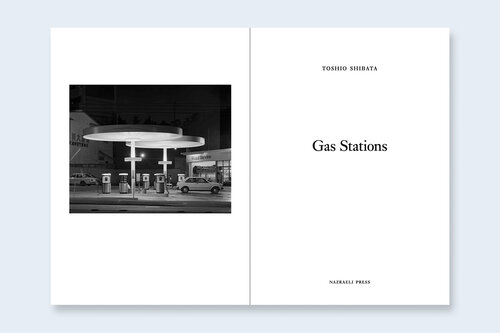
A short note on a little book that I have just acquired by the Japanese photographer Toshio Shibata. By “little” I mean little! Just 150mm by 210mm and containing only seven images, this is work that Shibata did in the 1980s and is, as the title suggests, a collection of black and white photos of Japanese gas stations. Taken at night (I am guessing, on a large format camera) they are starkly contrasted and have a sense of stillness and a gem-like quality that it seems to me you can really only get with film.

One of the things that attracted me to this work is the way, as with the likes of Eiji Ohashi and his vending machine pictures, such a mundane subject can be elevated to a higher aesthetic plane and how beauty can be found in a human intervention in the landscape that would not otherwise warrant a second glance (unless of course you need petrol for your car).

This sort of subject matter had of course already been explored in the 1960s by Ed Ruscha and his Twenty-Six Gas Stations and similar sites appear in the work of others (Stephen Shore’s Uncommon Places come to mind in particular). I think though that this more pared down, concise work has more impact. Certainly it appeals to me more strongly.

It is one of those odd coincidences that this book comes along just as I have been thinking about possible subjects for Assignment 5. One possibility that I had already been considering would be to photograph sites around my village, including our own petrol station (along with, for example, certain shops, the cricket club, local school, train station, and so on), with an absence of people, possibly also at night. If nothing else it would give me an excuse to try film again, on a large format camera. My only hesitation at the moment is that with the current virus lock-down being out and about without a particularly compelling reason might attract unwanted attention. Let us wait and see what happens over the coming weeks before any decisions are made.

Shibata, T, (2020). Gas Stations. Manchester: Nazraeli Press

Landscape as a memory device: Shimagatari – Book Further thoughts on Assignment 3

Whilst working on the sections of the course on Photography, memory and place (on which I still have to write something, and particularly Exercise 3.6, my primary focus has been on the idea of the photograph itself being a site of and aid to memory. What I have to some extent lost of is the idea that the landscape itself does the very same, and that this is what is captured in the photograph. This is implicit in the work I did for Exercise 3.5 on local history (https://markrobinsonocalandscape.photo.blog/2020/02/16/exercise-3-5-local-history/) and is also a growing idea in the context of Assignment 3, on which I am continuing to work.

This thought occurred, or perhaps re-occurred, while looking at Yasuhiro Ozawa’s book (2014) which has recently been reissued. What caught my eye in particular is part of his introduction:

“On Japan’s outlying islands (off the larger main islands of the archipelago) you find a kind of build-up of history, almost like a bank of snow. Emotions and recollections of the people and fragments of time accumulate layer upon layer to exude an air unique to the islands. Sometimes, as I walk the islands, that distinctive air becomes overwhelming and I hurry to board the return ferry. Yet once back on the mainland, I am gripped by a feeling that I’ve left something precious behind, and I find myself heading to the islands again.”

That sense of landscape as a place of, shaped by, and in turn, shaping history is something I get very strongly from Ogawa’s work in this book (even some of his older work that does not relate at all to Japan) and is in a way helping to refine, and define, my own understanding of what makes a given landscape important, rather than simply picturesque.

Ogawa, Y, (2014). Shimagatari. Tokyo: Sokyu-Sha

William Blake – Book

What, you might ask, has William Blake got to do with landscape photography? That is a question I might have asked myself if it had not been for the catalogue that accompanies the recent, comprehensive, exhibition of the work of Blake at Tate Britain in London this past winter.

I did not actually get to see the exhibition itself and in a way I am glad. A lot of his work is quite small in scale. In a busy gallery, and I understand this has been a very successful show (for which read “busy”!), it can be difficult to see the work clearly, and at leisure, and to be able to get close enough to it to appreciate the detail. So, on the recommendation of a friend who did visit the show, I simply bought the catalogue.

Whether anyone is interested in photography or not, if you have any interest in Blake I would heartily recommend this volume. The reproductions are first rate, the scholarly articles that accompany them are very easy to read, and, perhaps most importantly for me, the images in the book include works that I have never seen before. I have other books on Blake already but there is material here that is new.

But the relevance to landscape? This comes in the final essay in the book by the graphic novelist Alan Moore (whose work I am aware of but not at all familiar with) who writes about the influence on Blake’s work of the address to which he and his wife moved in 1790, 13 Hercules Buildings, in Lambeth (page 199).

It is worth quoting almost all of the first paragraph in full as it both poses and and answers the question:

“When we speak of the poetry of place, we generally refer to words and images that celebrate or else investigate some fixed location. And yet, given that all creative works have arisen from whatever influences surrounded their geographic point of composition, surely all art could be said to be the art of place, something that could only have emerged from that specific spot at that specific time? A city, a field, a house, a street: all of these have their own aura, their own atmosphere, a lyric condensation born of memory and history, of people and events, …”

This appeals to me very much and fits with my own broad, catholic and inclusive, view of what might amount to landscape art. I find it quite liberating to think of landscape in such terms. But also quite challenging to find ways that this sort of sensibility might be shown when making a photograph, which has got to be a good thing. It is not just a matter of pointing the lens at a view but of finding something within what is visible that is of some significance or deeper meaning.

Myrone, M, & Concannon, A, (2019). William Blake. London: Tate Publishing

Photobooks

An intersting article in the Guardian this morning about the solace of photobooks: https://www.theguardian.com/artanddesign/2020/feb/24/teju-cole-photobooks-fernweh. I am not familiar with Tegu Coles’s work but I am at least aware of his recent book, Fernweh, although I have not seen a copy.

What struck me first is how our tastes overlap. Masahisa Fukase’s Ravens and Robert Frank’s The Americans are there on my shelves. So is Rinko Kawauchi’s Illuminance. I have also of late found myself looking a lot at her Ametsuchi and The River Embraced Me.

It then got me thinking about what I have been looking at on a regular basis recently, apart from stuff directly relevant to the current part of this course (though some of these are). Here are some that I keep coming back to:

Matthew Genitempo – Jasper

Guido Guidi – 5 Architectures, and the most recent Lunario

Daido Moriyama – Record

Provoke

Kazuma Obara – Exposure

Hiroshi Sugimoto – Seascapes

Alys Tomlinson – Ex Voto

(All of these have been referenced elsewhere apart from the latest Guidi so for now that is the only one that I will cite here.)

Guidi, G, (2020). Lunario. London: MACK

Landscape as a call to action 2 – Dana Lixenberg: The Last Days of Shishmaref – Book

It has taken almost two weeks but at last my copy of this book has arrived. One of the reasons it has taken so long is the lousy service of Amazon! I try to use Amazon as little as possible, normally only as a last resort if something that I want is not available, or available but not as a reasonable price, elsewhere. I will not for now go into details! Second attempt and I now have it.

What is happening in the Arctic, environmentally, socially, culturally, is something that has interested, and concerned, me for some timed over the years I have read quite a lot about the region: in particular writers such as Barry Lopez, Marie and Kari Herbert, Jean Malaurie, Hugh Brody, Gretel Ehrlich, and most recently Kathleen Jamie (and even Rockwell Kent! – who reads him these days?). Though I have not travelled within the Alaskan or Canadian Arctic, I have spent a little time in Western Greenland and, albeit fairly superficially, have witnessed there some signs of climate change (most notably the effect on glaciers) and some of the social impacts on the indigenous population.

Quite coincidentally I have just read Jamie’s latest book (2019) which has a couple of chapters about archeological excavations at Quinhagak on the Alaskan North Shore. She paints a prose picture of how the region is suffering from environmental degradation – global heating melting the permafrost upon which the people still depend – and how that also leads to social and cultural degradation and loss.

This is precisely what Lixenberg has portrayed pictorially for the inhabitants of Shishmaref in Alaska. Again warming is causing the permafrost to melt which is leading to the island on which the settlement is established to be steadily but inexorably destroyed by the sea. When Lixenberg made her book it was estimated the community would have to leave and relocate by this year, 2020. It seems they are still hanging on, but in part because the Federal Government has been totally ineffective in establishing a new site for them and enabling a move.

For now I do not really want to get into a political or environmental rant about what is happening here. Rather, I want to focus instead on what I see as the significance of this book from the point of view of “landscape” photography. I have repeatedly expressed the view that what interests me in landscape photography is not just the appearance of the physical environment but also the people within it, how they relate to it, how the landscape affects them , and in turn how it is affected by them. Thinking about this from the point of view of Assignment 3, that I am currently working on, it is the involvement of, and intervention by, people that makes a space a place. Without the people who live there Shishmaref would be a small island that is steadily being eroded. Because people live there, because they have imprinted upon it their history and culture, and have in return had their history and culture shaped and moulded in part by the island, it has become a place, a very particular place. It is a place of significance, to the people who live there, to the wider ecology, and to the environment as a whole threatened by climate change.

Lixenberg’s book appeals and speaks to me because it addresses all of those elements. There are purely topographical images, firmly rooted in the Sublime, not at all Picturesque. But there are also portraits, still lives, not the stuff of traditional landscape photography. Taken together, this multivalent approach builds up a much bigger, more ‘realistic’ picture, and that is precisely what appeals to me. It fits with so many of the other photobooks in my library, too numerous to list again, in which the relationship between the physical environment and the people within it are inextricably linked (physically, emotionally, politically, historically, culturally) and that together they make up “the landscape”. Indeed, I think that without such a multi-layered approach the war would not have the same impact at all and not get across its environmental message.

This has made me reflect on the photographic work I have done so far on this module and what I would like to achieve in the future. So far people have been literally absent from the work I did for Assignment 2 and it will be the same for Assignment 3. However, I am increasingly conscious of the fact that their presence is at least implied, and inescapable. Without human intervention and involvement the things and places I have photographed, and am still photographing, would not necessarily not exist, but would at least be devoid of any real significance. I do not know to what extent it might be possible in the future – I have not looked at Assignment 5 yet and there is not much scope in 6 – but this is something that I would like to explore further. Possibly there is something here for the critical review that makes up Assignment 4?

Jamie, K, (2019). Surfacing. London: Sort of Books

Lixenberg, D, (2008). The Last Days of Shishmaref. Edam/Rotterdam: Paradox/episode

Unmapping the City: Perspectives of Flatness – Book

As I come to the end of part 2 and having now read all but one of the books in the reading list I find that there is one that has not been mentioned within the course material (unless I have missed something) and that I have not referred to myself. I thought therefore it would be worth a brief note, not least because having read it I am not entirely sure what I am supposed to get from it. Is this a bit of a pavé dans le mer tossed in to see how we react to it? If it is then at least I have read and thought about it.

I have commented more than once before on my struggles with theory and how much practical use it is to my photography. I also find that sometimes I have commented on a book not because I find it useful or interesting but quite the contrary. I find that both negative considerations apply here.

One problem that I have with this slim book is the opacity of much of the academic-theoretical language. I think if you are well versed in theory, and properly engaged by it, this sort of language carries with it a certain lucidity and precision. I am afraid though that it eludes me and sometimes (despite or because the precise use of language was my professional stock-in-trade as a lawyer for more than thirty years?) I find that even after as close a reading as I can manage I am still not always sure exactly what point is being made.

That apart, this is an interesting, and occasionally for me slightly surprising, account of the development of (what I shall admittedly and deliberately imprecisely simply term) modernism in visual art and the way art takes the real and the familiar three dimensional physical world and reduces it to a single, flat, plane. If nothing else this is a useful reminder that what is portrayed is not the real thing – the map is not the territory – and is not necessarily what we expect, remember, or think we know about what is depicted.

What though is the practical relevance of this to the photographic practitioner? It is of course always important and useful to know the story of the art and to have a sense of where within its range of practices one stands, and what other practitioners are conscious, and possibly unconscious, forebears and influences. However when I got to the brief section on psychogeography I found myself asking the question how this helps me as someone who takes photographs rather than theorises about photography? For an understanding of the concept and ideas behind psychogeography I think I got much more from Coverley (2018), not least simply because it is written in more accessible language, and because it is more wide-ranging and comprehensive. But even with that book the same question arises. At some level, probably unconscious, I am sure the concept is there in the background. At a conscious level though it is not something that directly influences how or what I photograph, except to the extent that I am undertaking an exercise that specifically explores it. When pursuing my own projects I do not go out thinking “I am going to approach this from a psychogeographic point of view”.

From a theoretical and art-historical point of view labels are useful, at least up to a point. I am though not at all sure how they necessarily help the person who takes photographs instead of writing about the practice.

One thing I would definitely say in favour of the book is that at least the editor takes photographs and has produced a couple of interesting sequences, juxtaposing adjacent images of different buildings in such a way that to set up some interesting surprises and challenges to one’s visual expectations. They quite cleverly subvert one’s perception of what is being seen. I think that some of the ideas discussed in the book, such as the references to abstraction and the use of collage, are relevant here but perhaps more in the process of editing and composition of the book rather than in the process of composing and taking each individual photograph.

Coverley, M, (2018).  Psychogeography.  Harpenden:  Oldcastle Books

Cramerotti, A, (2010).  Uncapping the City:  Perspectives of Flatness.  Bristol:  Intellect