Category: Coursework

Exercise 2.2 – Stalker

The “road movie” that I have chosen for this part of the exercise is Andrei Tarkovsky’s 1979 film Stalker. None of Tarkovsky’s films are what might be called ‘easy’ but that for me is one of the attractions of his work. Although the initial critical reception of this film was poor it has subsequently grown in stature and I have even come across it being cited as the Tarkovsky film for people who do not like Tarkovsky. I am not sure I entirely agree with that – I would suggest The Sacrifice instead – but certainly regard it as one of his best, most immediately engaging, films.

One of the things I find most intriguing about it is how it predated the Chernobyl disaster of 1986. The Zone, a sealed off area affected by some cataclysmic disaster, prefigures the exclusion zone around Chernobyl in an uncanny way. There is obviously no real connection but the parallels are remarkable.

That Chernobyl connection brings back to mind Kazuma Obara’s book (2018) that I have previously written about for I&P. I suspect that this is something that I am going to come back to when thinking about a subject for Assignment 2 as many of the images deal with the train journey between Chernobyl and Slavutych.

So, to the film itself. Looking at it again I am struck by the parallels that can be drawn with, in particular, The Divine Comedy and Pilgrim’s Progress. as in both of those books, the journey undertaken by the protagonists, in this case Stalker, the guide through the Zone (a Virgil to Dante), the Writer and the Professor, is a metaphorical one in which the latter two seek to reach The Room which will grant their desires. The Room is a bit like Paradise/the Celestial City but more ambiguous in that it does not necessarily bring about consequences that are positive. Indeed, as happened to another stalker, Porcupine, who does not appear but whose story is retold, the Room can be fatal for those who seek it for negative reasons. The Room is therefore capable of providing redemption, or perdition. (In this regard the coincidence of Chernobyl is almost overwhelming; the exclusion zone around the nuclear plant has proved to be a sanctuary for wildlife, a redemption; the radio-active contamination on the other hand is still killing people and leading to birth defects and illnesses more than 30 years after the event – perdition.)

The fact of and the nature of the journey are central to the film. Again following the established conventions, it is important that the journey is hazardous, that there are trials and obstacles to be overcome: there are guards at the perimeter of the Zone to be avoided, there are perils and hazards, not visible to or discernible by anyone other than the Stalker, along the way; the route is tortuous and circuitous, discovered by Stalker throwing ahead metal bolts tied with strips of cloth to find the safe way.

The process of the journey also importantly provides a literary/cinematic opportunity for the characters to explore their motives for coming to the Zone – the Stalker, apparently altruistically, to help people fulfil their desires (and presumably more mundanely to make a living for himself and his family), the Writer to recover his inspiration, the Professor to win a Nobel prize for scientific investigation of the Room – and reassess their validity. The process of the journey, by bringing the protagonists into such close proximity, and conflict, by challenging their motives and beliefs, brings out the true nature of the Professor’s intention, which is to destroy the Room with a nuclear bomb. (There is a supreme irony here that the zone around Chernobyl, which in so many ways resembles the Zone, was caused by a nuclear accident.) The journey is itself the redemptive process and force. The Stalker comes to doubt the value and purpose of what he does in so far it is no longer clear to him that the Room can provide true happiness; the Writer, who first realises the negative potential of the Room depending on an individual’s desires and intentions (in passing, quite a Karmic notion) loses some of his own arrogance and self-centredness; the Professor gives up his plan and dismantles his bomb.

I could go on, but am mindful of the suggested word limit for this exercise. I will therefore simply add a recommendation of Dyer (2013) which is a scene by scene description of, and commentary on the film. I have written elsewhere that I like Dyer’s writing on photography despite a tendency towards hyperbole and over interpretation. In this case though my view is that he spot on. His book is itself a sort of road movie in its own terms. As one reviewer quoted on the back cover (Sukhdev Sandhu of the Guardian) puts it, Dyer has the ability “… to make pilgrims of his readers and lead them on a journey in search of truths about love and about the nature of happiness…”. How apt!

Dyer, G, (2013).  Zona.  Edinburgh:  Canongate

Obara, K, (2018).  Exposure / Everlasting.  Cordoba:  Editorial RM / RM Verlag

Tarkovsky, A, (1979). Stalker.
Road Movies

Before getting on to Exercise 2.2, in particular the critique of a ‘road movie’, I thought it would be worthwhile first thinking about what amounts to a road movie, its roots in literature, and some common or key themes that I feel I have detected. I will then settle on just one film (I think I have already chosen the one) for further comment as part of the exercise proper later.

A car chase does not a road movie make! I rule out many films in which there might be a lot of action on the road (for example, Bullitt, in my view the greatest car chase ever, The French Connection, the second best, or any of the Mad Max movies, even the most recent, Thunder Road, which has some elements of what might otherwise amount to a road movie). Similarly I rule out movies where travel is merely incidental to the plot but not essential to it: for example two Agatha Christie thrillers, Murder on the Orient Express and Death on the Nile. In both cases there is a journey but the nature of those journeys are not essential to the underlying murder mystery, whodunnit, plots. They could just as easily have been static, set in a hotel or stately house.

Rather it seems to me the key factor is that the journey, whether physical or metaphorical, is integral to the plot and is part of its development and forward motion. The journey is not necessarily the whole point of the plot but is an inherent part of it. Here I think of the likes of, to make a fairly random selection, Thelma and Louise (which I have to say I have seen just the once and disliked intensely), Easy Rider, 2001: A Space Odyssey, Priscilla Queen of the Desert. Even Bergman’s The Seventh Seal I would count in here as the journey of the knight is of central importance: it is the journey of the crusaders back to Europe from the Holy Land that helps to spread the plague that carries off most of the characters at the end. Similarly The Blues Brothers. It is not just an extended car chase, though certainly up there with the greats, but the whole film is about a journey, both a physical one while the band is put back together and the concert receipts are run from the ballroom to Chicago, and a psychological/allegorical one as Jake and Elwood effectively grow up and take responsibility for their actions and for the benefit of others. (It has to be included in any event just because it is so funny!)

On a somewhat more serious note I would mention Almost Sunrise in which two US Army veterans return from service in Iraq with all sorts of traumatic psychological problems (PTSD) and seek relief by walking across America. This was a recent choice of the film club run by Tricycle Magazine, a Buddhist review, though not a specifically Buddhist film, and the link below is intended for subscribers to the magazine. It does at least show a brief trailer. The film is also available on DVD, and I guess might be accessible through some of the TV streaming services but I have not investigated. Even if not easily available I nevertheless mention it as it is a fine example of one of the key themes (which I have already touched on in passing in connection with The Blues Brothers and to which I shall return).

I see that The Road is mentioned in the course material. I have not seen the film but I have at least read the book. I confess it is not the sort of book that I would ordinarily read; someone lent it to my wife, it was lying around and I picked it up more or less idly. While I cannot say that I was wholly engaged, let alone convinced, by it I found it interesting enough and I guess I just gave it the benefit of the doubt on the basis it won a Pulitzer Prize. However, looking back I can see there is an important link back to much earlier literature that is worth noting and to which I will return below.

I pass over for now Kerouac’s On the Road, simply because I have never succeeded in wading my way through it.

Now turning to earlier literature there are a number of really important works that are built around and upon the idea of a journey and what that means for, and affects, the central characters. These are really the precursors of all modern road movies and set the abiding themes. Whilst I will look briefly at these chronologically I do not suggest that they represent a continuous or congruous tradition. They just happen to touch on the same issues and use similar forms.

Perhaps the very first example of a ‘road movie’ is the Babylonian Epic of Gilgamesh (second millennium BCE). It is really only the last three of the tablets that record the life and exploits of Gilgamesh in his wanderings and quest for immortality so it is really only this latter third or so of the whole epic that might be regarded as fitting the bill here. The key points though are there and in some ways established for subsequent works: the journey in search of a particular goal which either is, or is not, found. (I will come back to this point anon.)

Next Homer’s The Odyssey (eighth century BCE?), the story of the tortured and tortuous journey of Ulysses after the end of the Trojan war to his home in Ithaca. This is much more ‘modern’ in its form and much easier, and more accessible, for a modern reader, not to mention much longer, with a greater number of adventures and encounters on the way.

The Old Testament books of Exodus, Leviticus, Numbers, and Deuteronomy (sixth century BCE) telling of the journey of the Hebrews from captivity in Egypt to the Promised Land, led by Moses. (Does this mean that Cecil B. DeMille’s 1956 film The Ten Commandments, with Charlton Heston as an over the top Moses, counts as a road movie?)

Dante Alighieri, The Divine Comedy (1320). A metaphorical journey by Dante down through the circles of Hell, through Purgatory, and finally to Paradise where he not only witnesses the Almighty but is reunited with his beloved Beatrice.

Geoffrey Chaucer, The Canterbury Tales (late 14th century). A precursor of all the road movies and books that seek to present a picture of the contemporary country in which they are set. As On the Road is “the great American novel”, so the Tales are a portrait of 14th century England.

John Bunyan (1677-84). As with Dante, an allegorical journey to salvation in the Celestial City. (Oddly, although I have read it, probably more than just a couple of times since I was first introduced to Bunyan while at grammar school. I do not actually seem to have a copy of the book and so have not included it in the citations below.)

From these in many ways disparate sources there are a couple of particular themes that emerge. Each epic involves the main protagonist going through a series of encounters and tests which determine the outcome of the journey, resulting in either redemption or perdition. Gilgamesh fails in his search for immortality as a result a result of failing the test of not sleeping for a week. Ulysses reaches some form of redemption as he eventually makes it back home and regains his wife, Penelope, having largely remained true to his quest, despite his questionable dalliance with Circe. Moses does not cross over to the Promised Land because he failed a test set for him by God on the journey: he did not trust God’s word and struck the rock again in anger when water did not appear the first time. He was not redeemed. Dante on the other hand remains true and comes into the presence of the Divine. The Canterbury pilgrims reach the shrine of Thomas à Becket, despite all their ribaldry and naughtiness. Pilgrim is likewise redeemed by completing his journey despite the distractions, temptations and obstacles along the way.

These themes play out in the modern stories. Thelma and Louise plunge to their deaths at the end of a journey that becomes more and more criminal. The hippies in Easy Rider discover in their search for “America” that it is a place of ignorance, bigotry, isolationism, and hated, paying the ultimate price. The knight and lost of the other characters joint death’s dance at the end of the Seventh Seal, carried off by the plague. The travelling player, his wife and baby though are spared, arguably because of their simplicity and inherent goodness, so we have both perdition and redemption in one story. As I have already indicated Jake and Ellwood Blues both achieve a measure of redemption. In Priscilla Bernadette finds a man who loves and respects her, Mitzi is reconciled with his wife, at last bonds with his son, and finds contentment with Felicia.

The two Iraq veterans eventually find their peace of mind despite challenges and set-backs along the way.

In The Road the outcome strikes me as oddly Biblical, in a way echoing Moses: having guided his son across the country to safety he does not reach their goal, finally succumbing to some unidentified illness. This one stands apart to an extent though in that it is not immediately what his failure, that warrants perdition, actually amounts to. 2001 is also perhaps a little ambiguous. I tend though to favour the view, that I gather was Kubrick’s own, that although Dave Bowman dies, suggesting perdition, he is nevertheless reborn as the Star Child, elevated to a higher level of being, creating “a new heaven”, and so is redeemed.

So, next is my brief crit of my choice of road movie, and without giving away right now which film it is, I will say I have chosen one with a redemptive ending!

Alighieri, D, (Milano, P, ed) (1977). The Portable Dante. London: Penguin

Bates, E S, (ed), (1937). The Bible: Designed to be read as living literature, the old and the new testaments in the King James version. New York: Simon and Schuster

Chaucer, G, (Coghill, N, trans), (1979). The Canterbury Tales. London: Penguin

George, A, (trans.), (1999). The Epic of Gilgamesh. London: Allan Lane

Homer (Pope, A, trans) (1942). The Odyssey. New York: Heritage Press

McCarthy, C, (2007). The Road. London: Picador

http://tricycle.org/filmclub/almost-sunrise

Collins, M, (2016). Almost Sunrise

Exercise 2.2: Explore a Road – 1

The brief for this exercise says that it is not necessary to make any preparations but it is inevitable that I have at least been thinking about what I am going to do, and why. What I have decided to do follows on from a couple of ideas that I explored in I&P, thinking about the Georges Perec exercise, typologies (the Bechers), and Assignment 5.

With that background what I have firstly decided to do is focus only on a relatively short stretch of the road on which I live, about 200 metres out of a total length of roughly a kilometre, from the dead end at the top of the little cliff above the burn, to the first crossroad. Because this is where I live this is the stretch that I know best, not least because of the number of times I walk it with my dog. It also defines something of a distinctive enclave within the village as a whole comprising, as it does, three of the four oldest buildings in the village (350 plus years old, of which mine is one – there are few houses in most of the village that are much more than 120 years old), and includes a locally well known, and quite picturesque, but unusual, terrace of five former farm workers’ cottages.

Before I get down to actually taking pictures I first want to start with a little exercise in the style of Perec simply listing some of this small area’s characteristics, some of which have turned out to be a bit of a surprise:

Length of road: 200 metres.

Number of houses: 14 (of which one is unoccupied). Oldest, pre-1670. Newest, 2005.

Number of residents: 26 adults, 3 children.

12 retired people (comprising 2 former lawyers, 1 psychiatrist, 1 architect, 2 engineers, 1 cancer nurse, 5 unknown). 2 teachers. 1 lawyer. 2 care workers. 2 airline employees. 1 decorator. 1 dog walker/trainer. 1 full-time mother. 1 supermarket manager. 3 unknown.

10 dogs. 2 cats. 3 hives of bees.

25 cars/vans. 3 motorbikes.

(On) The Road (Again): Kander and Graham

There is so much material packed into this little corner of the course that there is almost too much to respond to adequately so, having concentrated for now just on Alec Soth, I will pay a little attention, just a few brief notes, to the works of Nadav Kander and Paul Graham that are also referred to. I find these two particularly interesting because of the very different ways they approach the photographing of a particular geographical line through both time and space.

Until now I have tended to think of Kander more as a portrait artist so it has been interesting to look at this more topographical work along the Yangtze River, not least just because of the sheer scale of the project.

This is in many ways quite a literal depiction of the river. It is there, or not far off, in most of the images. The series leaves you in no doubt that it is about following a specific route. Soth’s work on the other hand is I think rather more impressionistic and discursive (which is part of its charm for me). We see little of the river. It is not always evident that there is a river nearby in many of the shots. Were it not for the captions we would not know. More attention if focused on people, and places peripheral to the river itself, although no doubt in many ways shaped, informed, and affected by it. What they both do though is show the impact of human intervention on the landscapes defined by these river-sources. Soth does this, I might say, more benignly and less judgmentally than Kander who does not spare us the naked truth of the appalling environmental impact of people. If nothing else Kander has just put China even more firmly on my list of countries that I do NOT want to visit!

Graham’s work is similarly impressionistic in so far as the road itself does not appear directly a great deal. Again he is more concerned with the people encountered along it and places either side of it. The environmental issues are still there but they are not as ‘in your face’. What I find most striking though is what comes across to me as his sympathy for the people he encountered. He does not come across as judgmental and is much more respectful than, for example, I would expect someone like Martin Parr to be if he photographed a similar project. In a way it is quite a gentle work.

It is also interesting from the point of view of how the road has changed over the years. More of it has become multilane since the 1980s, much elevated to motorway status, and is of course very much busier. Not long after Graham made this work, just two years later, I used the A1 a lot once I had moved from London to the North East and I still remember how quiet (apart from a few notorious bottle-necks) certain stretches could be. Odd as it might sound – we are dealing here with a busy and far from attractive road that is really quite boring to drive along – this work evokes in me a strange sense of nostalgia.

Perhaps I will reflect a bit more on other work, or indeed the same stuff, as I start to work on the next exercise, once I have formed some idea of how I actually want to approach it.

https://www.nadavkander.com

ww.paulgrahamarchive.com

The Road

A bit of a ramble, not so much a defined journey from A to B, with some observations along the way…

The idea of a landscape as a number of linked (though not necessarily physically or geographically) locations or places has been with me for a long time and indeed formed the very first assignment I did for this course, EYV’s Square Mile – a series of images showing a walk I do, with variations, almost every day with my dog.

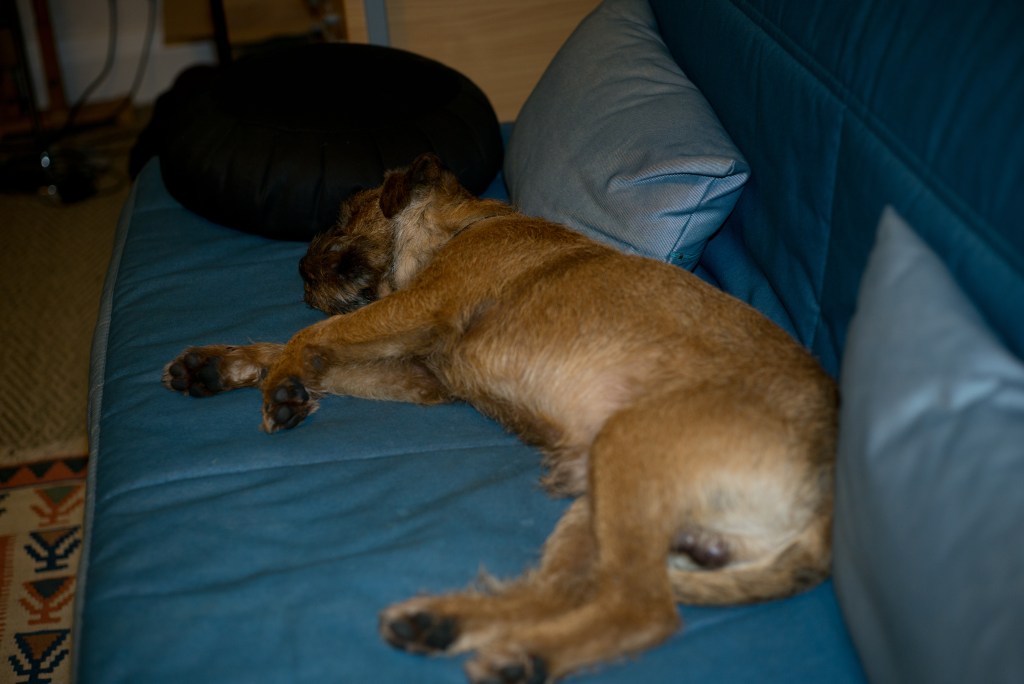
(As an aside, here he is fast asleep on the sofa-bed in my study as I write this, tired out from a walk on that very route.

Admittedly a bit of an indulgence but not entirely inappropriate given the title of Soth’s book, though for us it would be more a case of “Sleeping by the Stocksfield Burn”. It does not have quite the same sense of scale and grandeur, does it? Anyway, I just felt like including it! It is about time the wee man makes an appearance. There is though nevertheless a serious point embedded in the use of this picture about how we interact with and are affected by landscape, the environment in which we I’ve and through which we move. In this case the landscape has simply tired out my dog!)

Alec Soth’s book is also one of my favourites. Oddly though I have not looked at it critically for a while, despite having referred to it a number of times while working on I&P (I think at the time I was probably more engaged by the more recent work of Matthew Genitempo). So it has been quite refreshing to come back to Soth and look at his work more closely again in the light of the article refered to in the course material.

So far as the book itself is concerned, one of the first things that strikes me, again, is the sharpness, the detail, the depth of field, that he achieves. This is no doubt a result of the use of a large format film camera (I understand he uses a 8×10), something that I have experienced myself with my 4×5. I am not quite sure why but it seems to me that this sort of effect is not so easily achieved with a digital camera, but it is one of the reasons why I keep coming back to film; 35mm, medium 120, and 4×5 large format. The other thing that I get this time round (no doubt the next time I go through it again it will be something different) is the sequencing of the images. Although the book is ostensibly record of a journey (or series of journeys) along the river it is not entirely sequential. There are diversions and on occasions it doubles-back on itself: just like the river itself. This question of sequencing, which I feel is what sets apart the best photo-books, is something that Soth addresses in the interview.

Turning to the interview in the link below (doesn’t the interviewer talk too much and ask over-elaborate questions!) there are a few points that I would like to reflect upon, not necessarily all related specifically to landscape photography. Almost random but all nevertheless personally important to me.

“The lesson I learned is that great pictures are all about luck, and anyone can take a great picture. But very, very few people can put together a great collection of pictures … the art, for me, is in the collection and interplay of images.”

This resonates very strongly with me. I am not, as will be apparent from other blog posts, a fan of the ‘salon’ approach to photography, the individual image, no matter how arresting or striking. Much more interesting for me is the sequence that builds and carries meaning and significance, that contains or creates some sort of narrative of its own. That does not though necessarily mean that there needs to be a clear narrative thread, that the sequence of images needs to have been created specifically with that in mind. I think here in particular of the work of Rinko Kawauchi whose genius, it seems to me, rests in her ability to bring together otherwise unrelated images, sometimes made over not inconsiderable periods of time, and find resonances, connections, coincidences, and combined meanings and significances within them when they are brought together.

Speaking of his project to record a version of the river: “… but I was shaping my own river. This is what photographers usually do, right? They create their own vision. I’d love to see how other photographers would approach the river. I’m quite certain that each approach would be entirely unique.”

Something else that speaks clearly to me and one of the reasons I get so annoyed, or more to the point, simply bored by the repeated, hackneyed images of the same things, the same places – whatever is fashionable or trending on Instagram or Flickr – the same view, from the same viewpoint, that says nothing about the photographer and what this place actually means to them (not much in most cases, I suspect). I would rather take a picture that is not that good so long as it actually means something to me, and possibly to some other hapless soul who happens to come across it and find something in it of interest.

Referring to Joel Sternfeld, whose work I am afraid I am by no means familiar with enough, yet: “He showed me that this life of serious looking was possible.” That is surely what photography is really about; not taking pictures alone but observing the world, attentively, critically, mindfully, and then choosing to record some element of that. Although not by any means a fan of the idea of the Decisive Moment I am very much in agreement with HCB’s view that this business is, at root, all about looking.

“… I really didn’t need all of the theory, critiques and assignments. I did’t begin to find my eyes until I was away from all of that. … I’m much more comfortable with the idea of apprenticeship than I am with the classroom.”

This is something of an existential question that I continue to ask myself as I work through this course. What really is the purpose or value of this degree? Why, indeed, am I doing it? What ultimately do I hope to get out of it? Is it actually going to make me a better or more thoughtful photographer (not necessarily the same things)? Not all of these, and any number of other, questions can necessarily be answered at any given time or consistently over time. I am not going to try to address any of them now. They are nevertheless always there, constant companions, always worth at least being aware of. Always worth bearing in mind, but not in themselves reasons, in so far as any of the answers might be negative, when not otherwise simply equivocal, not to continue with what at root I regard as a journey, an exploration of myself and the world around me.

“I don’t want to have to photograph water towers or Weimaraners year after year.” (Whoever put this interview together clearly cannot spell the dog breed’s name properly, and presumably has no idea what it actually means! I have used the proper spelling, curmudgeonly old pedant that I am.) I think this is a bit unfair on the Bechers whose typological work, though not something that I would want to do all the time myself, is serious and important. I do though agree about the dogs. I find Wegman’s work twee, pointless, self-indulgent, and utterly meaningless, not to say demeaning so far as the poor dogs are concerned.

Finally, “Words can easily ruin pictures.” I have banged on any number of times about my mistrust of combining pictures and words because of precisely this point. Not so much that words can “spoil” a picture, mar in it some aesthetic way, but that they can if used improperly subvert, manipulate and distort what the picture is really about. I would very much rather let an image speak for itself, even if that means that the message that the picture transmits is unclear, ambiguous, or open to different interpretations. Unravelling an image is something I would rather leave to the viewer than seek to trammel it with a written commentary.

Soth, A, (2017).  Sleeping by the Mississippi.  London:  MACK

http://www.seesawmagazine.com/soth_pages/soth_interview.html

Exercise 2.1: Territorial Photography

Rather than just read Joel Snyder’s essay “Territorial Photography” in isolation using the example on the student website, I have gone back to Mitchell (2002) itself, particularly the introduction and Mitchell’s own opening essay “Imperial Landscape”, as I think this helps to put Snyder’s thoughts into context. That context is one that I have already looked at in the earlier modules of this course, not least in the final assignment for I&P, as one of the things that interests me about the idea of landscape, whether as a noun or, as Mitchell seeks to reclaim it, as a verb, is its social and political implications: ownership and exclusion in particular. As Mitchell puts it (at page 2):

“What we have done and are doing to our environment, what the environment does to us, how we naturalise what we do to each other, and how these “doings” are enacted in the media of representation we call ‘landscape’ are the real subjects of Landscape and Power.”

This resonates strongly with the views that I expressed on what landscape is in the first exercise on preconceptions. Ownership and exclusion are also elements of that thinking and these are perhaps, for me at least, the two most important points that I get from Snyder’s essay.

Snyder’s first main point, as I read it, might at first glance appear to be on a slightly different tack, discussing the way that landscape photography in the middle of the nineteenth century moved away from a pictorialist, artistic, approach towards on that was much more scientific and manufactured, thus establishing a sense of the truth and reliability of the photograph as a record. Linked with this he discusses the processes by which a mass audience and market for photographs was developed, quite different from the means by which “art” was distributed and seen by the wider public. It nevertheless strikes me that this is an important precursor to the two there main issues that Snyder discusses with his consideration of the work of Carleton Watkins and Timothy O’Sullivan respectively. As Mitchell writes at the start of his essay, the first of his “Theses on Landscape”: Landscape is not a genre of art but a medium.

The first main point that I take from Snyder, with his discussion of Watkins, is that landscape photography, at least in the US at that time, was effectively an imperial exercise. It was a way of saying that the great American landscape was that it was already “owned” by the (implicitly) white, western population of the continent. It was a relatively benign, though often imposing – awe inspiring, sublime – landscape that “belonged” to the modern Americans, that was already familiar and known. As with earlier landscape painting, such as the work of Bierstadt and Moran, both of whom I have looked at earlier, many of the places they painted had already been named by the new, non-indigenous, Americans.

What is more, as a concomitant of the ownership, Watkins depicted the landscape as something that should be exploited for its commercial and economic value. Not only did he take ‘picturesque’ images but, for example, he took pictures of railroads that blended into the landscape, and other industrial developments as if they belonged naturally in the environment. Ownership.

In the case of O’Sullivan, as Snyder presents his work, we also get a sense of ownership but this time of a more exclusionary nature. Watkins was employed by the mining companies, by the railroads, to promote their interests. O’Sullivan on the other hand was employed not to carry out precise, surveying and recording photographs (a task left to specialist surveyors and draftsmen) but simply to take pictures that could be used on an interim basis by his employers, the scientific (as opposed to the military who had hitherto carried out such exploratory work) explorers of previously unexamined territory.

This is the point at which the earlier discussion of a market for landscape photographs comes back into play. Watkins was producing work that was intended for wider dissemination, as part of the promotion of the ideas that the landscape was “your land” (at least that of the industrialists, mining, and railroad companies, something with which of course Woody Guthry disagreed with vehemently in his song “This land is your land”) that it was right and proper should be exploited. O’Sullivan’s work on the other hand was intended only for a much narrower audience, the scientific community that employed him, who were effectively saying that at least the knowledge to be derived from and about the landscape, if not the land itself, and the rights and means of its publication or distribution, was theirs alone. Exclusion.

Another point that Snyder draws out is that much of O’Sullivan’s work is the antithesis of that made by Watkins as its hows not a familiar, inviting, landscape, but one that is unknown and hostile. This is a sort of “keep out” sign, again part of the scientific attempt to retain ownership of knowledge. More exclusion.

Not touched upon by Snyder, at least not explicitly, but something that caught my eye was another element of this approach. In part it is perhaps explicable by the fact that there had been little previous non-indigenous exploration of some of these places, but it seems to me that fewer places have names applied to them that refer to modern Americans. For example, see Snyder’s quotation of O’Sullivan about Shoshone Falls (at pages 198 – 199), comparing it unfavourably with Yosemite. Many of the well known sites in Yosemite were then not named after indigenous peoples but American luminaries (such as Washington) and explorers, or Spanish imperialists. “Yosemite is a grace.” The falls on the other hand are named for indigenous people and are reached across “a waste”, are a “chaotic brink”, “a frightful glimpse of the unknown Inferno”. Yet more exclusion, and naked imperialism.

For the two further examples of photographs that the exercise calls for I have turned to Sandweiss (2002) as her book covers the photographing of the American West in more detail. From this I have chosen one work from each of Watkins and O’Sullivan as again their work was being used in different ways, consistent with the distinctions identified by Mitchell.

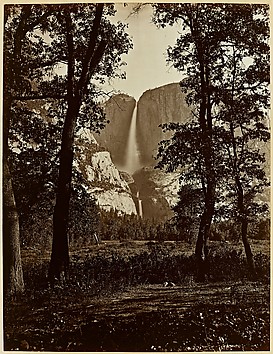
Staring with Watkins, here is a determinedly pictures view of the Yosemite Falls, a vista artfully framed by a stand of trees.

Carleton Watkins, The Yosemite Falls, 1866

This picture falls clearly into the category of works that were demonstrating the ownership of the landscape by modern Americans and the propriety of using and exploiting it. This photo was included in a book published by Josiah Dwight Whitney following an eight-year survey of California and as Sandweiss puts it (page 276) it “exemplified the twinned spirits of scientific inquiry and unabashed boosterism”. The book was explicitly authorised and supported by the state legislature to act as a guidebook for travellers, a sort of illustrated Baedecker. Put to this use, whatever Watkins’s original intentions in making this photograph might have been, in the context of Whitney’s guide book, published in 1868, it becomes an invitation not only to visit the National Park (which had been created, or at least given protected status just a few years earlier in 1864) but to stand in the same spot and admire this particularly picturesque view of the falls. The visitor can “own” the view, and by extension the Yosemite park area, by standing on the same spot or simply by owning the book (of which only something in the order of 250 where produced with original photographic prints which effectively made that “ownership” more select and exclusive.)

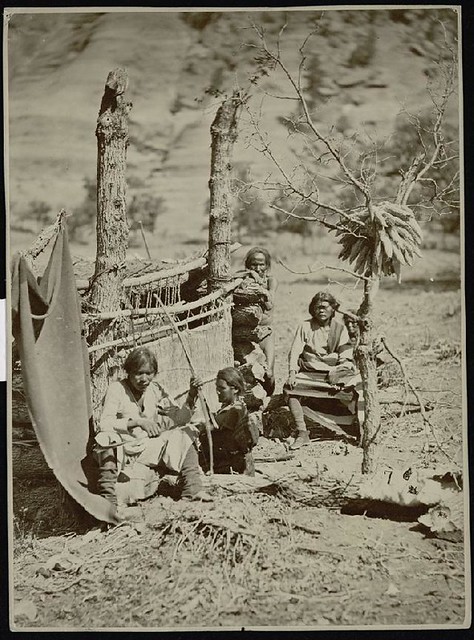
For a further example of O’Sullivan’s work I have chosen not a straightforward landscape picture but more of a portrait, a group portrait, of Native Americans in their environment.

Timothy O’Sullivan, Life Among the Navajoe Indians, 1873

This was taken while O’Sullivan accompanied an Army run expedition, headed by Lieutenant George Wheeler that explored the area west of the hundredth parallel. This work is again exclusionary in that it was intended for the US Geological Survey and not for a wider, popular, audience, at least initially. It does though also have an ownership function in a similar way to Watkins’s work. What I find particularly interesting about it though is the uses to which it was put, how it was recontextualised by the texts that accompanied it in the survey reports and how its meaning was changed by those texts.

The composition of the image itself is fairly simple but still laden with significance. The central feature is a loom. It is still possible to see people working with looms like this today making the famed Navajo blankets and models of this sort of thing are offered for sale to visitors wherever you go in Navajo reservation towns. (I have travelled round the Four Corners area and saw, and was pressed to buy, any number of these things, temptations that I have to say I resisted.) The native Americans are in this way depicted as crafts-people. It also shows cobs of corn being dried, showing they are a rooted (forgive the pun), agricultural society. The figure to the front left though holds a bow and arrow, a nod to their martial past (the Navajo had been “pacified”, for which read defeated militarily, divested of their ancestral lands and confined to reservations, since the end of the 1860s).

When the album in which this image was included was first published in 1874 the accompanying text, as quoted by Sandweiss (page 191) described the Navajo as “an intelligent and fierce people by nature…[who have made]…good progress towards civilization”, all of which can be clearly read in the picture. It also supported the idea of modern American ownership of the West (Manifest Destiny) by reassuring settlers that this area was safe, while conflict continued on the Norther Plains and far Southwest. This ownership function was developed still further when the report was reissued, and presumably made more widely available in 1889, with the Navajo now portrayed as “quaint figures, dependent on government rations, whose glorious past had long since disappeared. And words that had once depicted them as industrious farmers now portrayed them as exotic anachronisms”. (Page 193.)

Paradoxically I cannot escape the feeling that in a way the sellers of the model looms on the reservations are perpetuating that same imperialist view of themselves.

Mitchell, W.J.T, (ed) (2002).  Landscape and Power.  Chicago: The University of Chicago Press

Sandweiss, M, (2002).  Print the Legend: Photography and the American West.  New Haven:  Yale University Press

Exercise 1.7: Assignment one preparation – 2

I am not entirely sure why the course material now requires me to record correspondence with my tutor about my chosen subject for Assignment One. It is not something that any of the other modules have asked for. Nevertheless, suitably redacted to concentrate on the principal subject, here is my email and my tutor’s reply:

“Whilst the idea of the Beautiful has not really engaged me I feel more drawn to the ideas of the Sublime and that is the path I want to go down.  If you have a look at my recent blog-post, particularly on 1.6 The contemporary Abyss and preparatory work in 1.7 you will get an idea of where my thinking is heading at the moment.  The ideas that appeal most to me are the Sublime as representing the unrepresentable, the void, and Buddhist notions of emptiness/nothingness.  The two particular artists who are influencing me most at the moment are Hiroshi Sugimoto and James Turrell.  What I have been concentrating on is a series of sky-scapes, cloud-scapes, with a view to producing images that are in a way devoid of any meaning or significance in and of themselves – other than at a most basic level, meteorological records – almost abstract, hinting at something ineffable and transcendent (without wishing to sound too much likes Pseuds’ Corner!).

If you have a moment please take a look and yours thoughts would be most welcome.  All going well I would hope to have this assignment finalised within the next few weeks, at which point I would propose simply to produce a further blog post covering the points required by the brief and a final set of images.  I will probably also include contact sheets to give some idea of the preparatory work and final selection process.”

Reply:

“The direction you’re taking A1 looks fine, with some solid points of research – Turrell, Sugimoto and Richter: they all have a solid conceptual framework for their work.  Also, very detailed exercises uploaded to your LL.”

Exercise 1.9: Social Contrasts

My first reaction on reading the brief for this exercise was where on earth am I going to find what they are looking for? A moment’s further thought though led me to ask the question, in fact there is so much of this stuff out there how am I going to narrow it down to just a few images?

This exercise is such an oddly abrupt change of pace and direction, though not necessarily a bad thing at this stage, an opportunity introduce a different concept of landscape photography and break up what might otherwise start to become an habitual line of thought about how to approach the topic. It is though one that I feel deserves a much wider and deeper exploration than just this exercise. Let us see if ti comes up again later in the module.

To try to narrow things down a bit and make it more manageable for present purposes I have decided to rely solely on the resources within my own library. This means I can concentrate on work that I already know reasonably well and which, by virtue of the very fact it is in my library, has some resonance and importance for me. It also helps to show up some important differences in the approaches of the artists involved that is not questioned by the exercise but is I feel worth referring to.

Starting with that difference, what I note is that where we are looking at work that is explicitly socially concerned within a specific place or area, socially-concerned landscape, (another case of ‘landscape’ being much more than just a pretty view) the social comment side of things tends to be quite one sided, focused mostly on just one social class or milieu, rather than directed to highlighting social contrasts. A few examples:

Oscar Marzaroli in Glasgow. Tish Murtha in Newcastle. Jim Mortram in Dereham. Paul Trevor in Liverpool. Matthew Genitempo in the Ozarks. Alec Soth on the Mississippi. Ute & Werner Mahler in the German Kleinstadt. Marketa Luskacova in Whitley Bay. Ragnar Axelsson’s work in Iceland, Greenland, and the Faroes.

For the illustration of social contrasts I find the most fertile ground is provided a number of mostly American (I do have one Japanese example) “street photographers”, that is photography grounded in a particular place, not always a city. Here I am thinking of works by the likes of Robert Frank, William Klein, Joel Meyerowitz, and Daido Moriyama. (I could have chosen any number of other examples, as indeed I could with the list in the paragraph above, but these will do for now.)

The work in New York City in particular of Frank, Klein, and Meyerowitz, and to a lesser extent Walker Evans, whom I will otherwise leave out of the frame for now, should provide more than enough material to illustrate the differing social views and make up of the city, and indeed probably of some of the same streets and particular vantage points. All of them show affluence, poverty, “just-getting-by”, order, disorder, mixed and diverse social, not to mention ethnic, groups.

Meyerowitz’s street work in Paris shows similar contrasts there, something that is writ large across the page of any of his books that you might light upon made by Daido Moriyama in Tokyo.

There is so much material available here that it is difficult to do it justice. What I think though does help is to concentrate an a few examples, more than the two required by the brief, of the work of this particular constellation of artists that contain social contrasts within single or closely related images.

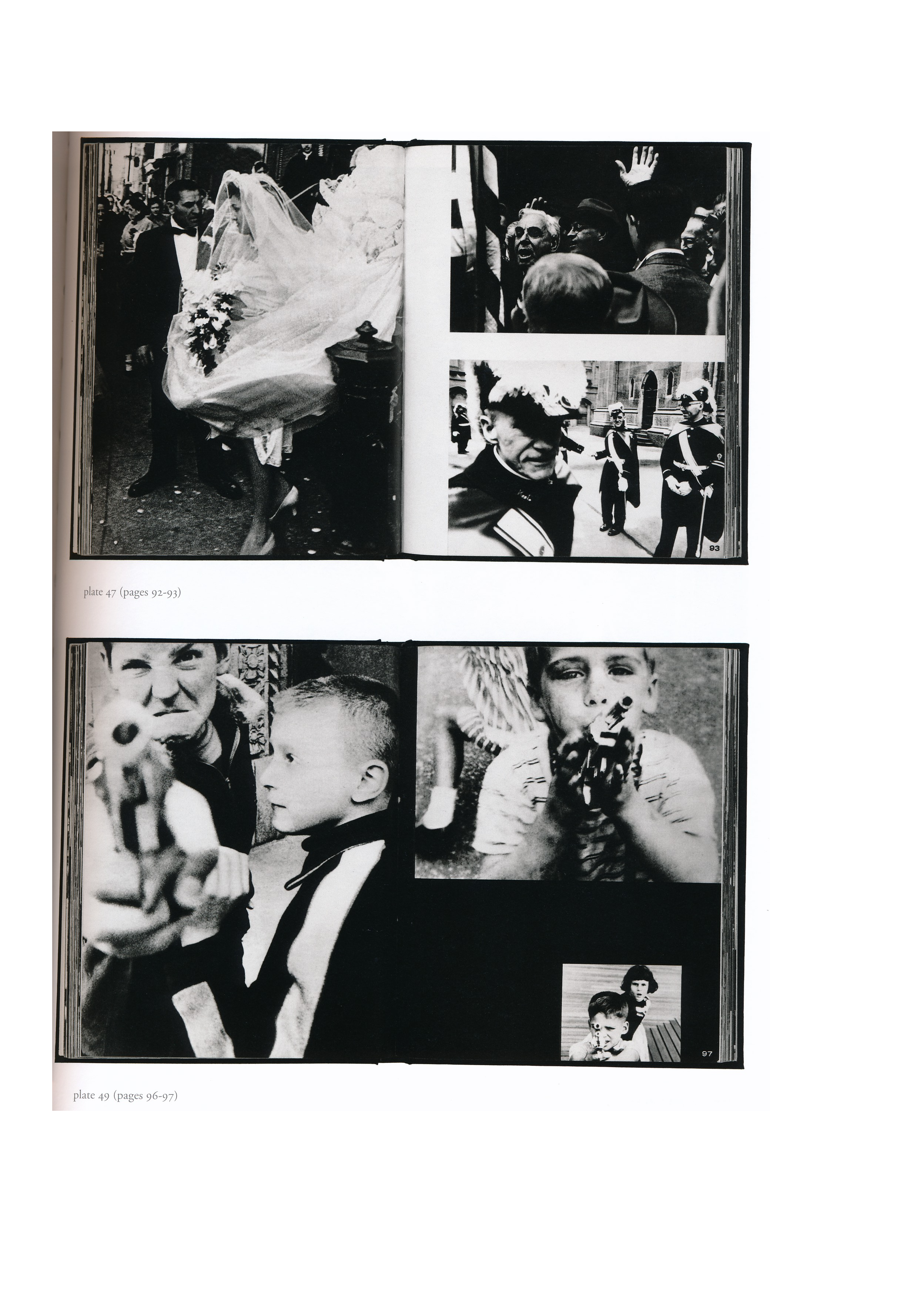
Another point that is worth making now is that on looking back over my choices I note that they all focus on people more than they do on particular places (with the possible exception of the last one). However, a sense of a particular place was clearly important to each of the artists. In the cases of Frank and Klein each picture is captioned by reference to a particular place. The subjects of Frank’s pictures in a way go to define, or at least contribute to, the “landscapes”, the environments within which they lived, not only physically but also socially. Klein’s work in this particular collection are all set in New York so as well as being pictures of various, socially diverse people, they are also still photos of the wider physical and social environment of the city itself.

Meyerowitz’s work, set in Paris, shows something of the character and nature of the city by portraying the varieties and mix of people living within it, who in turn give character to what one might regard as a typical Parisian street scene. Throughout his work Moriyama is showing us Tokyo, as a very specific, sui generis, place, or collection of heterogenous places, and again the people are integral to this process

As I hope I have made it clear elsewhere I do not view the concept of landscape in purely topographical or geographical terms but also in much wider documentary and social terms. I therefore make no apology for my choices.

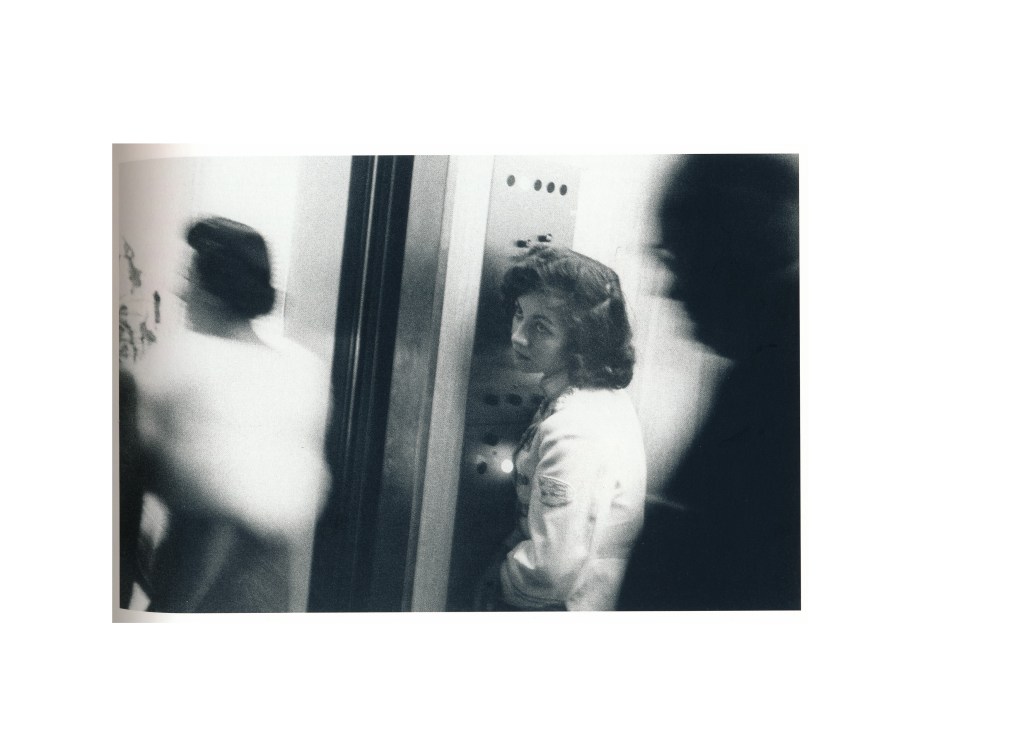
My starting point is one of Robert Frank’s images from The Americans (2016), Elevator – Miami Beach:

The lowly elevator attendant at the service of affluent society – check out the fur stole!

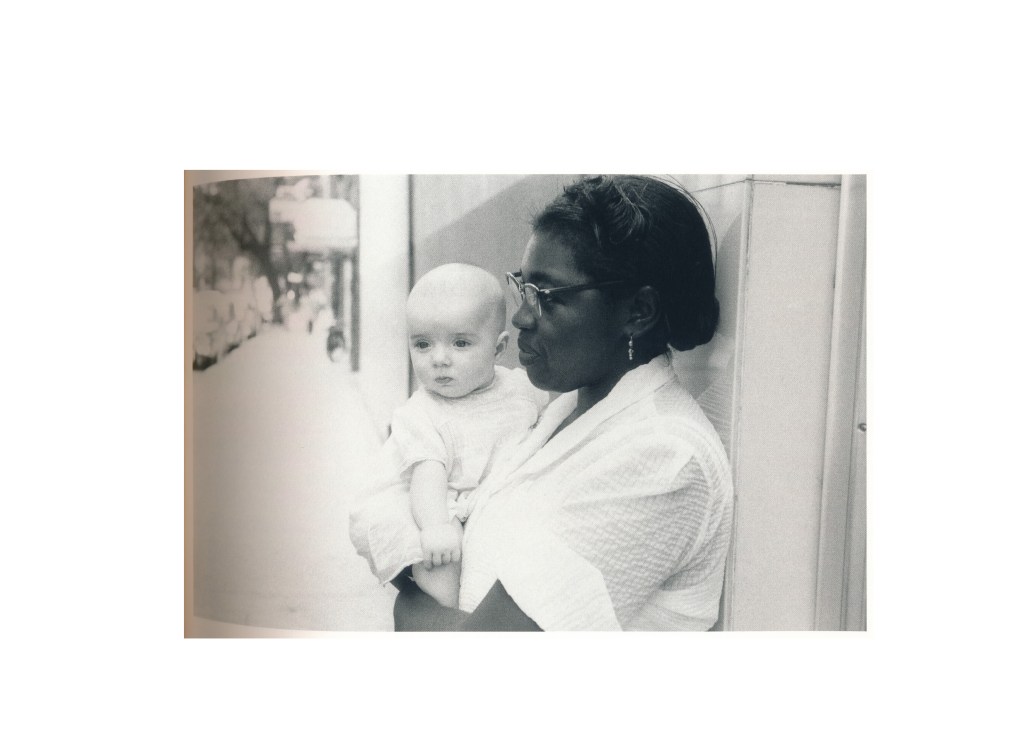
Another from the same book would be Charleston, South Carolina (I am going to come back to the issue of race later):

This image shows little of the physicality of the location but says a huge amount about it socially. This is the segregated south so the only real contact between races is through the relationship of master and servant, in some ways a continuation of the owner/slave relationship but on less extreme terms. The woman is clearly a maid or nanny, a servant of some sort, in the service of a white family, and presumably it is only the nature of that relationship and arrangement that allows her to be in that part of town with some degree of autonomy, if not authority.

Two double page spreads from Klein (2016):

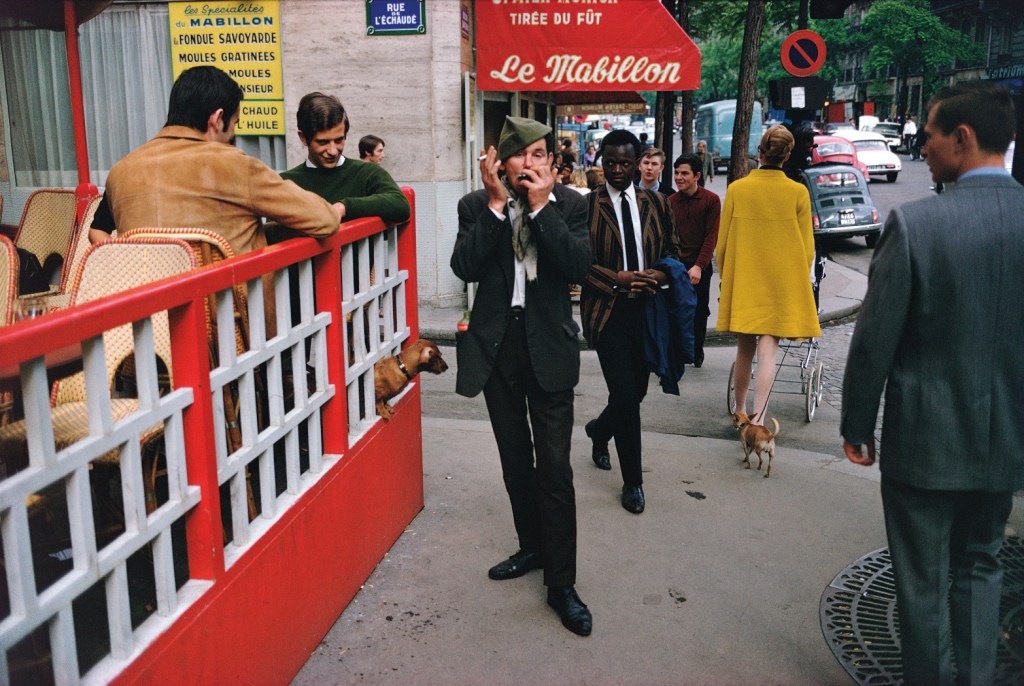
From Meyerowitz (2018), Paris, France, 1967:

The affluent Parisians, the well-dressed man presumably of African descent evidently at ease within the ‘boulevardier’ environment though perhaps a little wary of what I assume is the fun being made by the men on the cafe terrace of the more louche character playing the harmonica – presumably a drunk judging from the bottle in his jacket pocket. A certain irony, possibly even a hint of hypocrisy if that is not pushing the point too far, here with those in the cafe, presumably having a drink, finding amusement in someone who seems to have had a drink.

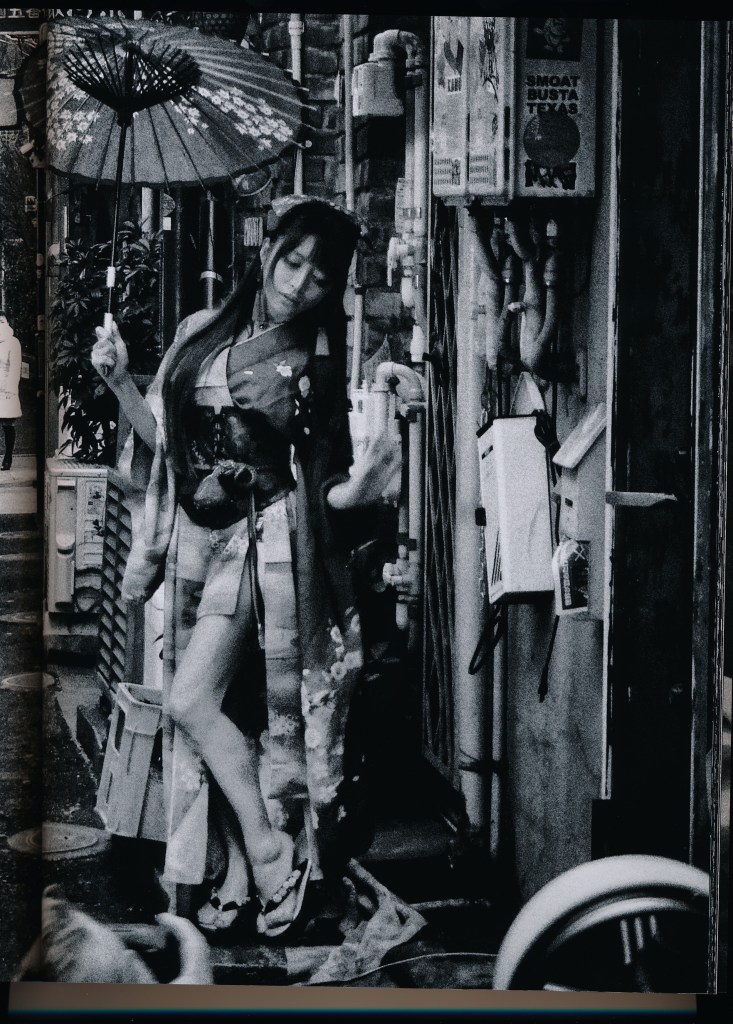
For Daido Moriyama there are any number of examples that I could have chosen. What I wanted to do was compare two double page spreads from Record No. 29 that show on the one hand a couple dressed in traditional kimonos on a busy Tokyo street (presumably in Shinjuku) and on the other hand what I take to be a homeless man, asleep on a sheet of cardboard. Unfortunately I cannot find examples of them on-line and as double pages they do not fit on my scanner. Instead I have therefore settled on this image from Record No.37. It is only half of a similar two page spread but this half catches one of the things I find in Moriyama’s work, the contrast , and indeed collision, between traditional and Western cultures in contemporary Japanese society, the elegance of traditional culture and the grittiness of much of modern Tokyo, and the contradictions between what might be perceived as an inherent quality of coyness and propriety in Japanese society and, as here, an open and obvious eroticisation of those traditional values:

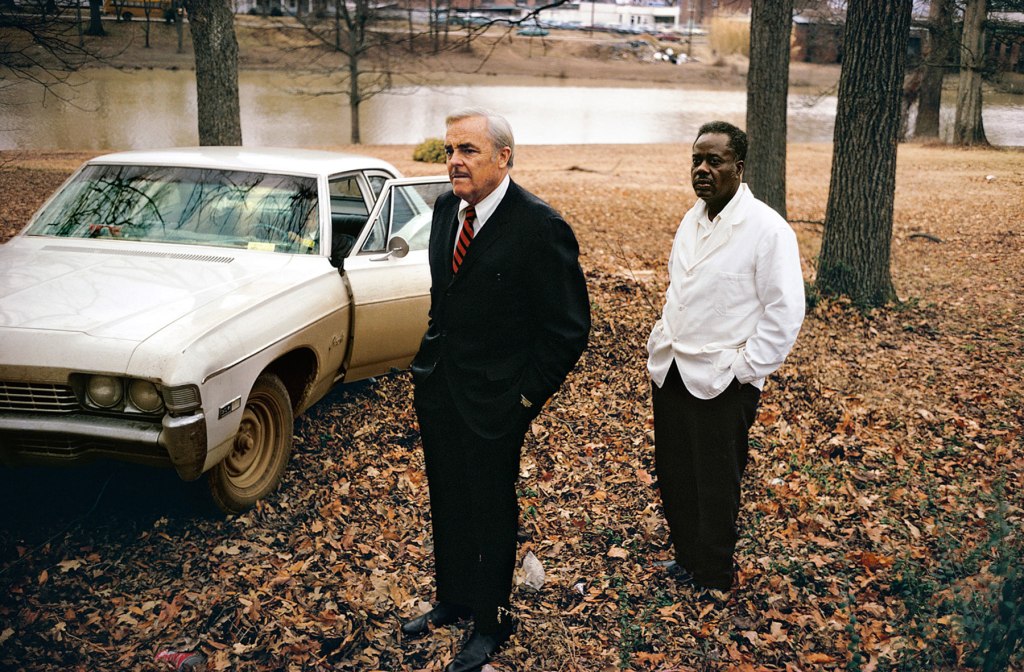
My last example is a picture by William Eggleston, included in the catalogue of the fairly recent National Portrait Gallery exhibition (2016):

Untitled , 1969-70 (the artist’s uncle, Adyn Schuyler Senior, with assistant and driver, Jasper Staples, in Cassidy Bayou, Sumner, Mississippi

Much as I admire much of Eggleston’s work, some of it, not least this example, disturbs me. As with my Meyerowitz choice there is more of a sense of a landscape, in literal terms, here again specifically identified in the caption. Because of the social elements of the image though this location could stand in as a generic one for many places throughout the southern states. Indeed, if it was not for the caption it would be difficult to identify just where the place depicted is, so that it could be pretty much anywhere.

It is though the social contrasts that are most striking. What I cannot quite tell is whether Eggleston was being ironic in his composition and highlighting the social tensions at play in the south, or whether is was actually being non-judgmental, more accepting, given his background as an offspring of a wealthy plantation owning family, who presumably made their money from slavery. (This is one of the issues or difficulties that I have with warming to Eggleston as an individual.) What I find most striking is the composition and posing of the figures, the assistant matching the posture of the boss, but at a respectful distance behind him, itself signally social hierarchies. The racial element is, it seems to me, highlighted by the way the figures are made negatives of each other: the boss, a white man in a black suit, the assistant, a black man in a white jacket. This again emphasises the sense of difference, literally of social contrast: black is not white, and white is not black.

Frank, R (2016).  The Americans.  Göttingen: Steidl

Klein, W, (2016).  Life is Good & Good for You in New York.  New York:Errata Editions

Meyerowitz, J, (2018). Where I find myself. London: Lawrence King Publishing.

Moriyama, D, (2017). Daido Moriyama: Record. London: Thames & Hudson

Moriyama, D, (2018). Record No. 37. Tokyo: Akia Nagasawa Publishing

Prodger, P, (ed) (2016). William Eggleston Portraits. London:National Portrait Gallery

Photography and the City

As is often the case with the present course material, any discussion of a given subject seems to set off a number of different connections, resonances, and issues that are ostensibly unconnected. The subject of the city here does precisely that for me.

I have not lived in a city for the last fifteen years or so and I find them increasingly to be alien and sometimes uncomfortable environments; I see that in the next section on psychogeography is going to look at the city as a means of making work and I anticipate that I am going to find that challenging. Living in the country I find myself increasingly distanced, not just physically but also mentally and emotionally from the city. I go into Newcastle only once a month or so. Very few other cities are now graced by my presence: Edinburgh once or twice a year at most (incidentally, for reasons that are still not entirely clear to me Edinburgh is the one city in which I feel more comfortable and at home despite never having lived there apart from occasional visits, in the past more frequent than now); Birmingham once every other year or so, though that is now likely to become much rarer; Glasgow and Belfast (which, like Edinburgh, I both enjoy) once in a while. London I have not visited for years (I did live there for a couple of years a long time ago and could not wait to get out!).

In photographic terms I do not find cities fertile places for making work. I have made some pictures in Newcastle for EYV and I&P but all too often, if I do not have a specific project or task in mind, taking a camera with me into the Toon is a waste of time (though it still does not stop me, just in case). I know that many people find the views along the Tyne of it bridges, for example, appealingly picturesque, but I am afraid this does nothing for me and they are not what I want to photograph. Part of the issue here might be, I suppose, that living and working in Newcastle over a period of thirty-odd years, this is what I saw very working day so it all became rather mundane and just part of the background.

Most of what I do make is local; if not within walking distance then no more than a short car ride away. In this regard it was interesting to note the comments in the material on Fox Talbot staying close to home for his better work. I certainly feel a lot more engaged and focused locally.

The other thing that caught my attention is the reference to Paul Seawright. I thought the name was familiar and of course he cropped up in C&N (https://markrobinsonocablog2cn.wordpress.com/2018/01/18/project-4-the-gallery-wall-documentary-as-art/). There are a couple of points that flow from this.

In that earlier post I wrote about the illusory distinction between documentary and art photography and argued that the one does not necessarily exclude the other. The same can be said here about, for example, landscape and documentary. His Invisible Cities work is both. I feel that any attempt to distinguish between the two in work such as this would be forced and unsustainable. That is very much how I feel and have argued right from the start of this course. As should be clear by now I find the more straightforward ‘picturesque’ approach to landscape photography uninteresting, unappealing, indeed quite sterile. For me the more interesting work is that which operates at other different levels as well. Invisible Cities certainly does that for me, as does, to take just one example that I have been looking at recently, the work of Mitch Epstein that I have already mentioned in connection with this module, and at the end of I&P.

I am also intrigued that apparently the title of this body of Seawright’s work is “appropriated” from the eponymous novel by Italo Calvino, a fabulous book that I am shocked to discover, on looking at my copy of it, I first read nearly thirty years ago! What is intriguing to me is the choice of this title. Although the novel is, at face value, a series of descriptions of cities visited by Marco Polo on his travels, it is of course a description of just one, real, city, Venice. The locations of Seawright’s pictures are not recorded in their captions. Is he, as Calvino, depicting the same city, while giving the impression that the work covers and derives from many? Is a single city being used to stand as a model for many? Or are a number of places being used to depict a sort of idea of a Pan-African city, not really an ideal but a sort of visual synecdoche? Is he, in line with his thinking behind his other work, simply leaving open an interpretative space for the viewer to occupy and inhabit? This sort of complexity, indeterminacy, gives an even richer, denser, more interesting flavour to what might otherwise be seen as rather deadpan work, which makes it all the more appealing to me.

Calvino, I, (1974). Invisible Cities. London: Picador

http://www.paulseawright.com

Exercise 1.8: Zone System in practice

As I mentioned in my previous post on the Zone System I was not at all sure quite how to approach this exercise with a digital camera and without a spot meter. I have though now worked out how to approach this and have come up with a trio of shots.

With its exposure compensation and bracketing functions it is of course quite a simple matter to get the camera itself too take a series of shots at different exposures, the equivalent of moving the mid-tone from one zone to another, and then processing them together to produce a final image that is properly balanced across the light range. The object of this exercise is though of course to have a go manually, at least as an exercise to demonstrate an understanding of the principle.

The trio of shots that I have produced are not the greatest, not least because I have not devoted as much time to them as I might otherwise – I have had other things that needed to be done today. They are at least nevertheless illustrative.

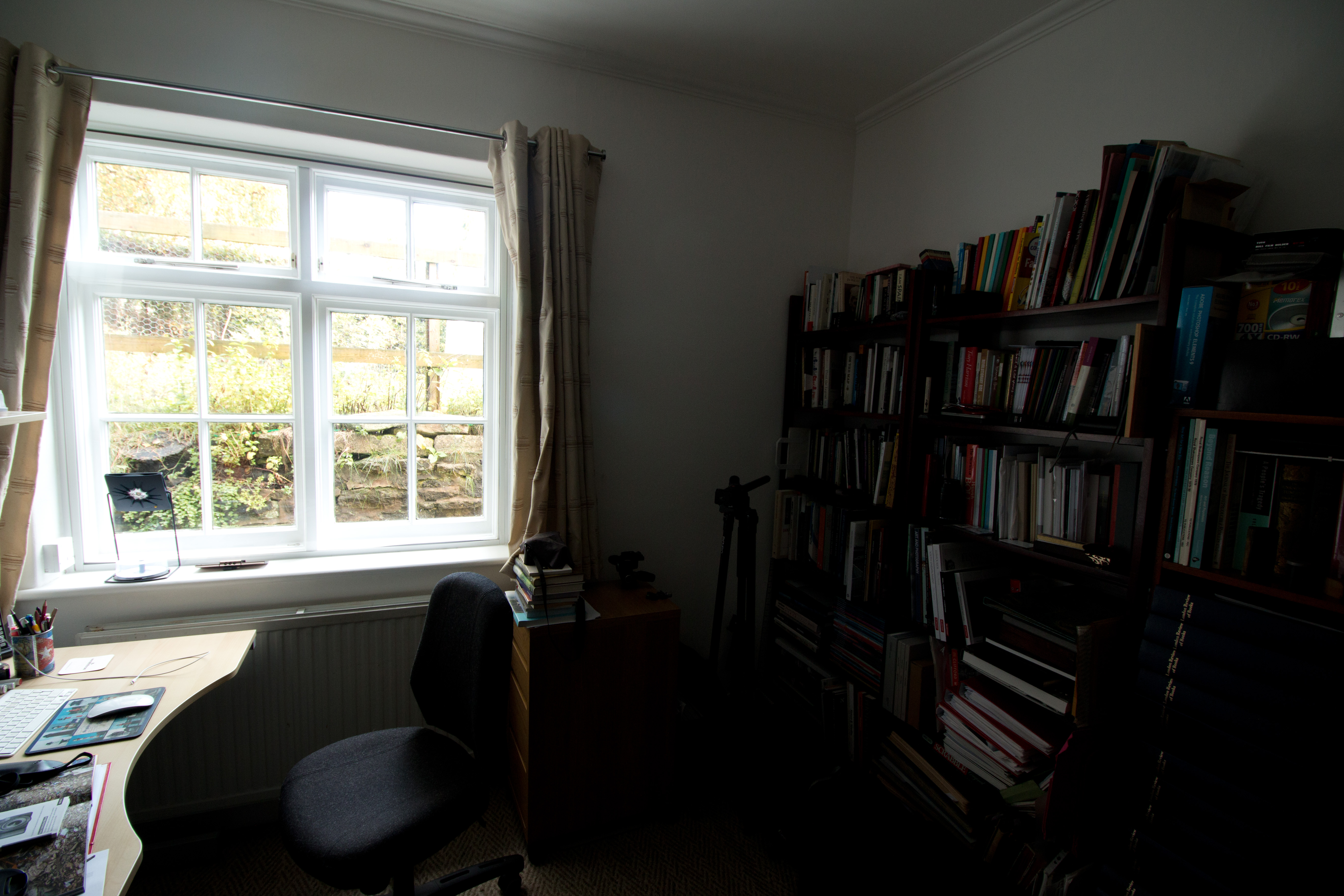
What I have chosen is a view across my study towards its window, and the dark corner next to it, to get the widely different light conditions. I used my old Canon rather than the newer Leica as I have not yet got my head round the light-metering options on the latter whereas I am reasonably familiar with those on the former. I set autofocus and metering to spot mode to at least approach what I might get if I had a separate spot meter.

As a first step I put a sheet of grey card in what felt like the middle of the light range in the study, catching a reasonable amount of light but not in direct sunlight (not that there has been much of that today!). Using a wide angle lens set at 10mm (this was the only way I could get in both the window and the darker corner) and putting the camera in Programme mode I metered the light on the card and got a reading of 1/15s at f/5.6 (at ISO 400). I used this as my baseline, Zone V. I then took my first shot, this time in Manual mode using these settings, effectively placing the wall between the window and the corner in that Zone:

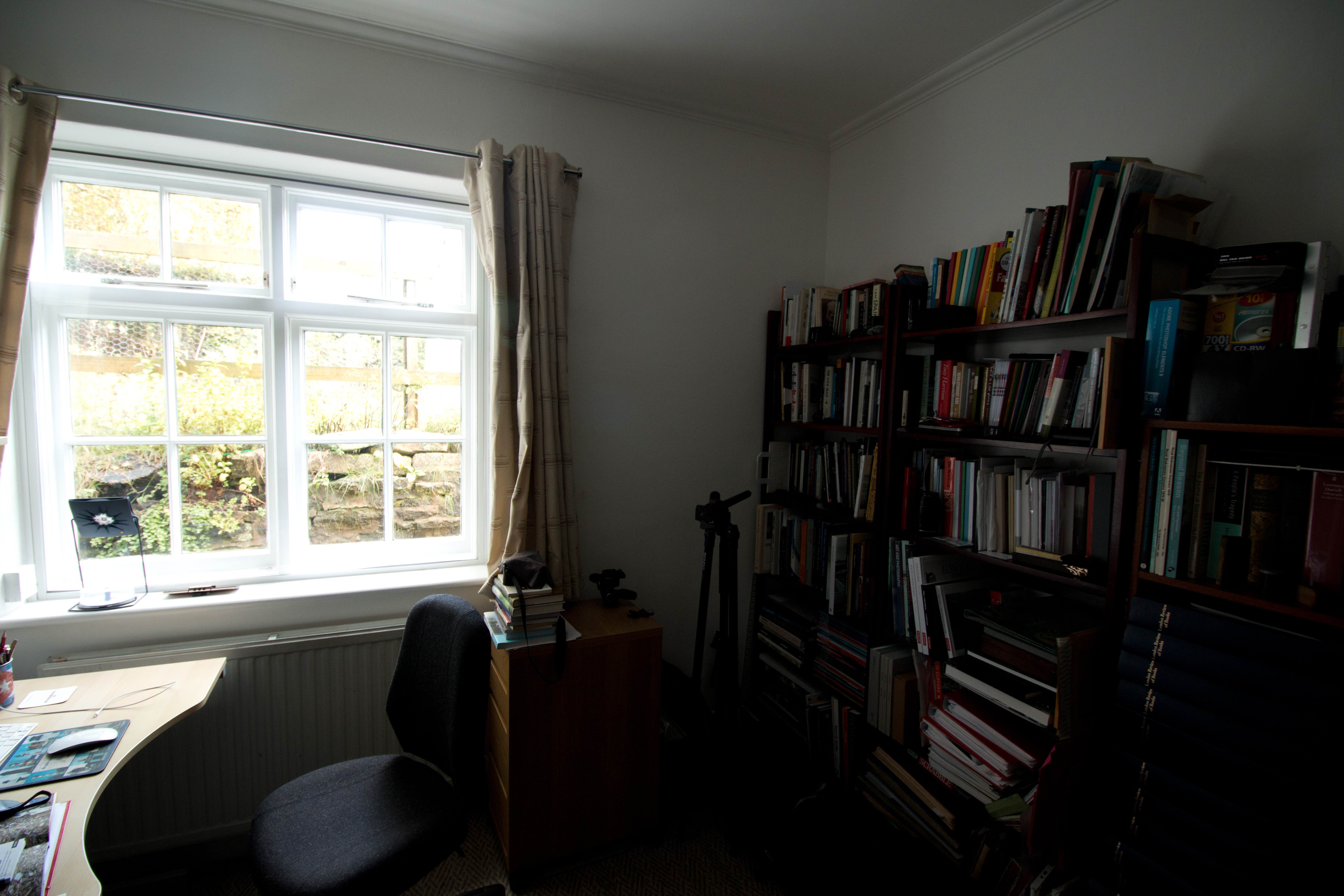
I then repeated at f/4.5, going up a stop (I wanted to go up two stops but this is the largest aperture available on this particular lens), effectively moving that area into Zone VI and consequently lightening the bookcases on the right, bringing out more detail. The downside is that it has also lightened the view through the window but at least it has not all burned out.

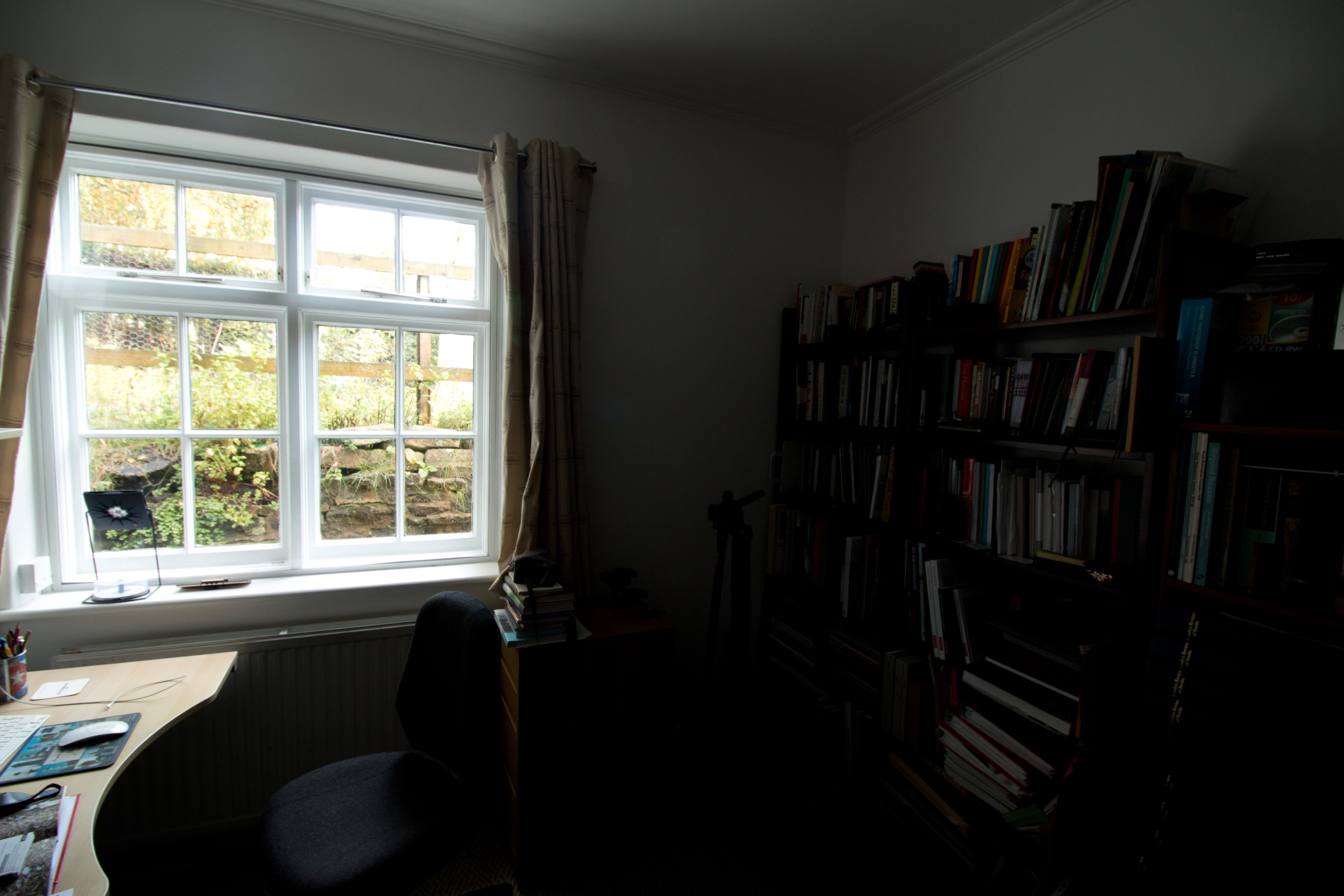
Going the other way I then stopped down two stops to f/7.6:

This moved the mid-tone to Zone III, making the right side considerably darker and difficult to see, but makes the window view more natural.

None are really ideal but shifting the mid-tone to Zone VI at least makes for a more balanced image in terms of the extremes of light and dark, and it striking how much of a difference it has made between the first two shots. I have to confess I was a bit sceptical at the outset about how this would work out in practice but I can now see that the system is in fact quite simple in practice and really can be useful even with a digital camera, not something that is confined just to negative printing.