Category: Coursework

The Zone System

This is an interesting topic to introduce at this point in the course and it is one that I suspect many of my fellow students will have little prior knowledge of, unless in the past they have worked predominantly in film. Today we are working mostly, and in many cases I imagine exclusively, with digital cameras. I am though aware that there are a number of us – Badger’s Luddites, ha! – who are at least dabbling in film, both as an artistic choice, and as a means of learning, or relearning, some of the technical basics that are still relevant but somewhat subsumed by and potentially lost in the digital world. I therefore find it intriguing to see how a technique – which I confess until now has seemed to me, wrongly, somewhat esoteric and overcomplicated – that was worked out to help with development and printing of analog film photos can still be relevant in a digital realm.

With this in mind it is perhaps telling that none of the few books that deal with technique in my own modest library have much if anything to say about this Zone system. Ingledew (2005), for example, (at page 245) has only a very brief glossary entry: “An aid for determining the correct exposure and developing times to achieve the maximum gradation of grey values in a negative print.”

Even an older book, Hedgecoe (1976), which is pre-digital, does not mention it at all whilst nevertheless going through the basics of negative printing.

Adams’s book (1983), of course, refers to the Zone system a lot, picture by picture, but does not go much further in explaining how it actually works in practice.

Paradoxically, one of the best explanations I have come across has been published just very recently on the website of the Intrepid Camera Company, who are the makers of my 4×5 film camera. There is a link to the article below, which is a useful step by step, guide to the use of the system in practice. I have to confess though that I have not tried following it yet, not least because I am still trying to sort out a darkroom so that I can try my own printing. (It is amazing how much extra kit is needed in order to do your own printing. In comparison film developing is really easy as the chemicals are simple and the only critical equipment are a light-safe changing bag and developing tank. To print there are all sorts of extra things needed, not to mention a dark room itself. Fortunately I have a wine cellar that can be made fully light proof without too much work and will function adequately at least on a temporary basis.)

From a practical point of view I will explore the system further by having a go at the next exercise, though at the moment I am not at all sure what the subjects are going to be, nor exactly how I am going to go about it, in the absence of any guidance on how the system works with a digital camera. I think for the purposes of this I am going to have to concentrate just on using a digital camera, which is probably the only way I can get fully accurate light-readings. I do have a light meter, which I use in particular with my film cameras, but it is an incident meter rather than a spot meter, so although it is a very good one it does have some limitations. (Spot meters seem to be really expensive and for what I currently need for my analog photography it is not an indulgence I really want.)

Adams, A, (1983).  Examples: The Making of 40 Photographs.  Boston:  Little, Brown & Co

Hedgecoe, J, (1976). The Book of Photography. London: Ebury Press

Ingledew, J, (2005). Photography. London: Lawrence King Publishing

https://intrepidcamera.co.uk/blog/learning-the-zone-system

Exercise 1.7: Assignment one preparation

Looking ahead to Assignment One I am thinking about concentrating on the Sublime, rather than the Beautiful, as this should give me greater scope to explore the ideas of presenting the unpresentable and of nothingness/emptiness that I have written about recently.

What I would most dearly like to do, as I have lady suggested, is work on a seascapes project. However I have to admit that this would in many ways probably be far too derivative of Sugimoto, even if I was to go for somewhat more dramatic scenes, such as those made by Garry Fabian Miller. From a practical point of view I doubt the feasibility at the moment of making such work given the length of the round-trip to the nearest bit of coast.

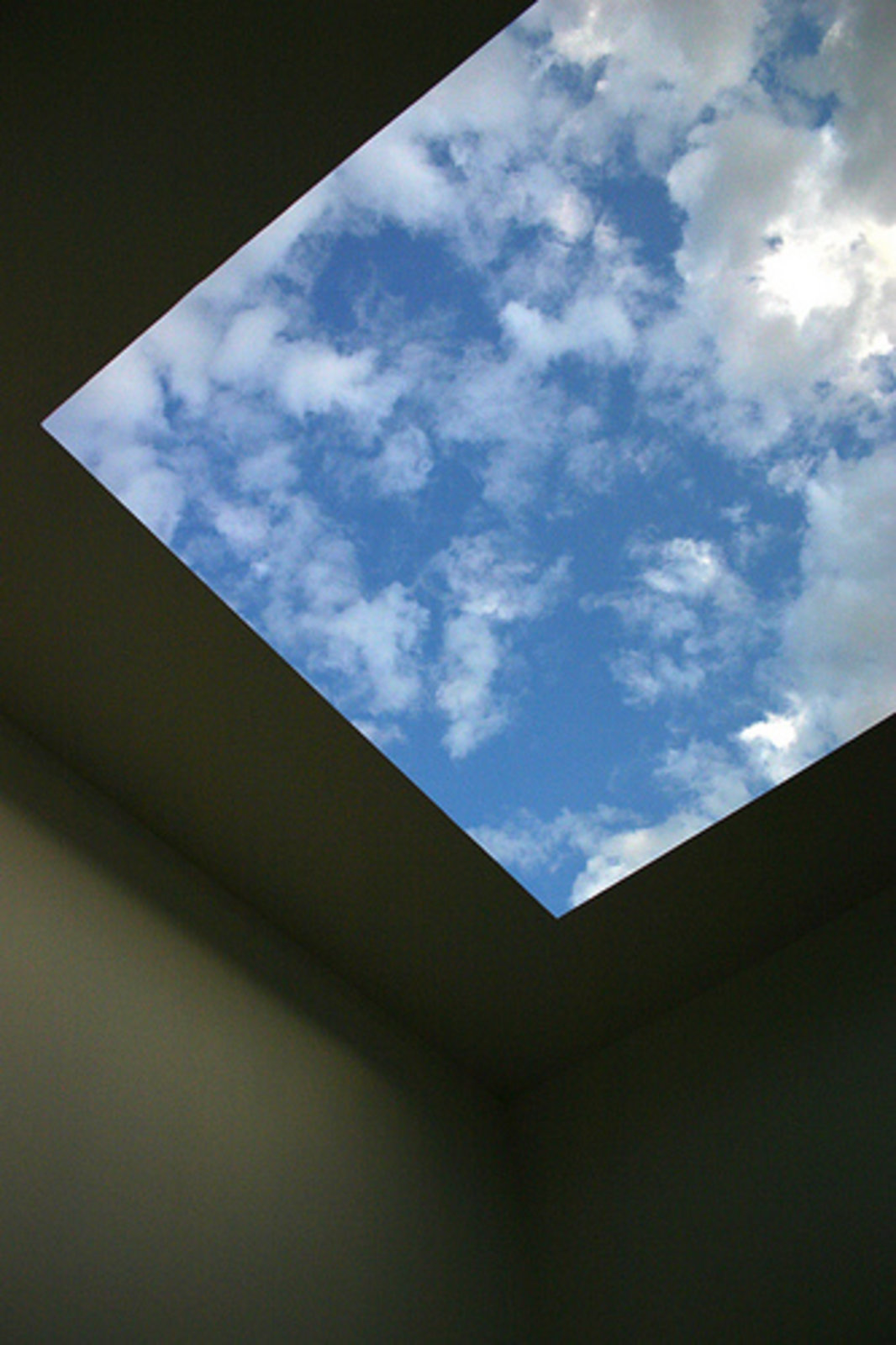
As an alternative I am currently thinking more along the lines of James Turrell’s Skyspaces. This will link back to the cloud paintings of the likes of Cozens, Turner, and Constable all of whom I mentioned in Exercise 1.3. It also still fits with the idea of the void in Sugimoto’s work, and the concepts of the sublime that have appealed to me from the outset.

Again it is not really practical at the moment for me to make repeated trips to the nearest Turrell to me at Kielder. It is not that far away but still at least an hour’s drive in each direction – it is easy to forget how big and relatively empty this county is! Really though I do not need to go there and can shoot sky scenes in the comfort of my own garden.

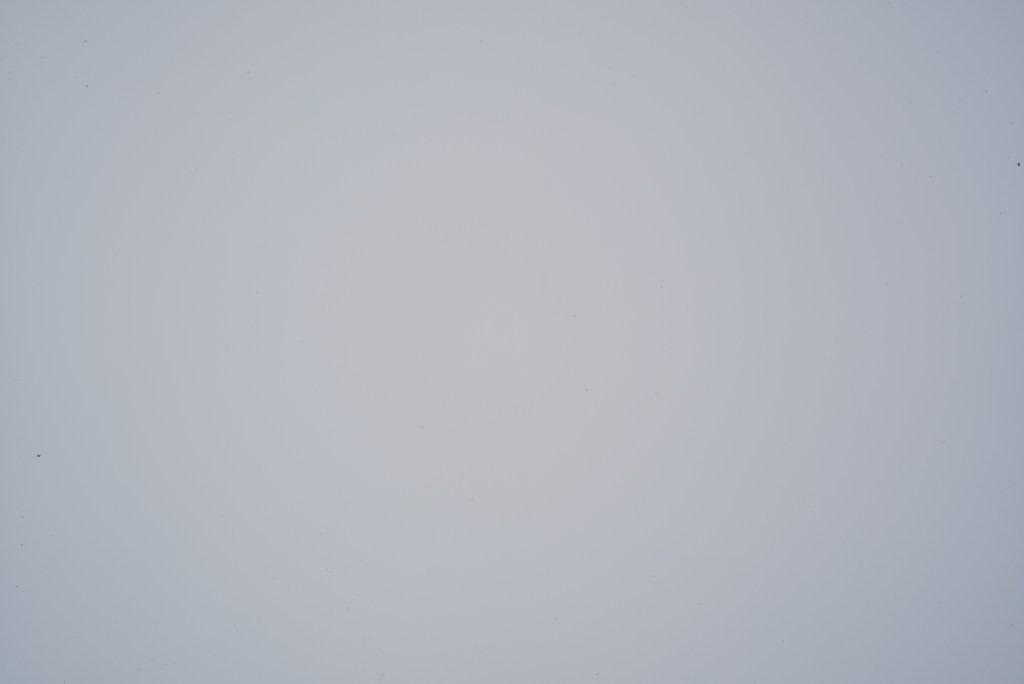
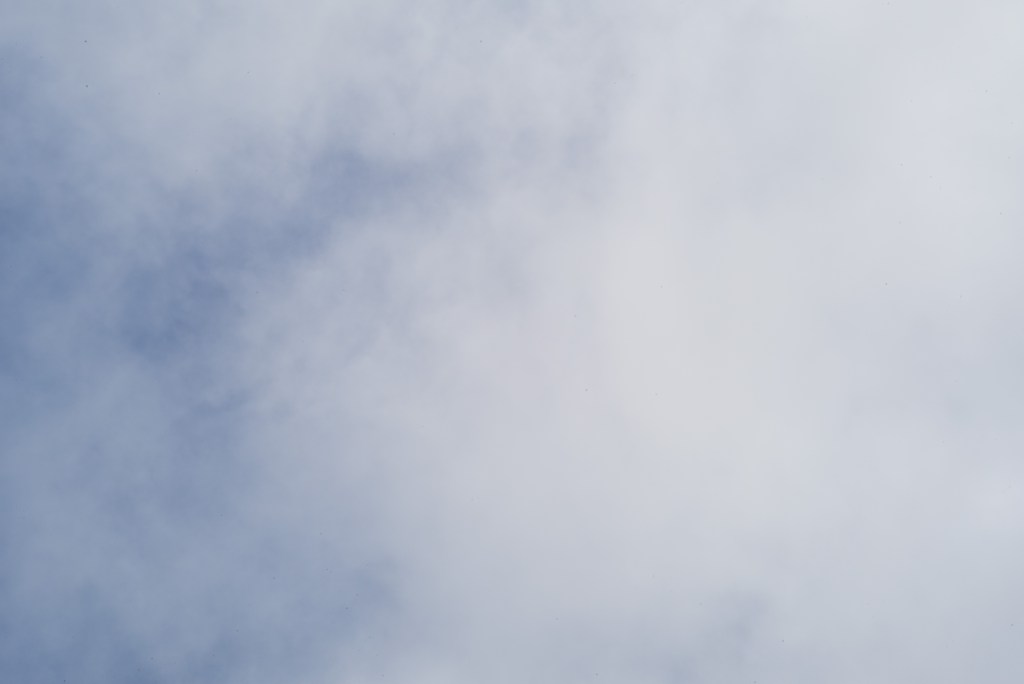
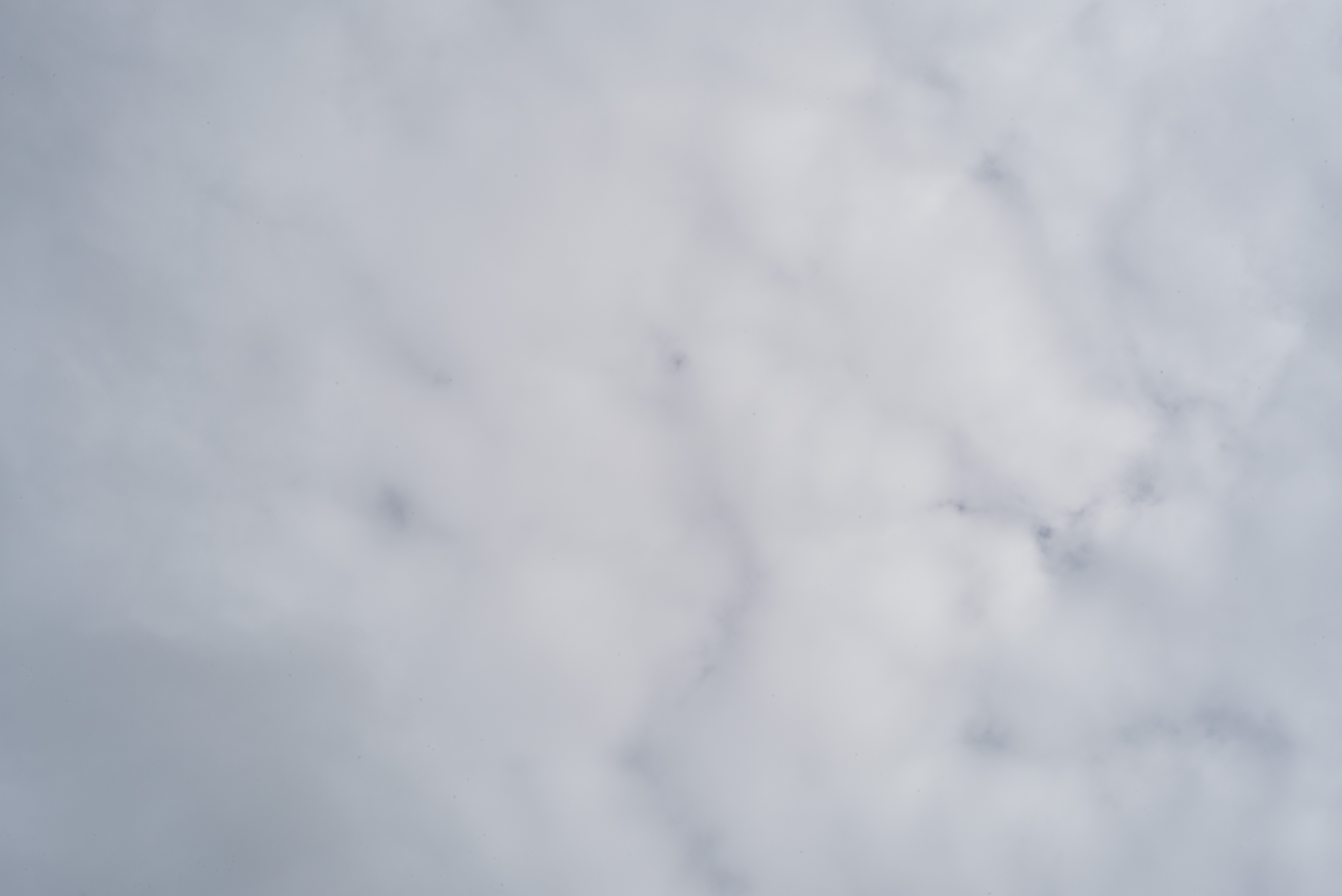
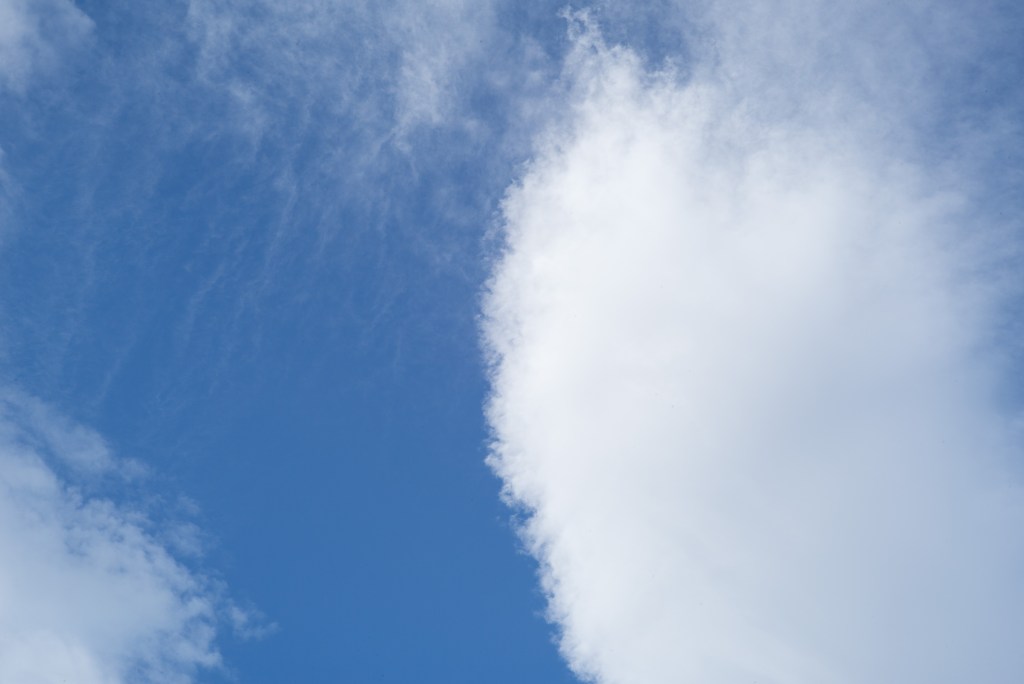
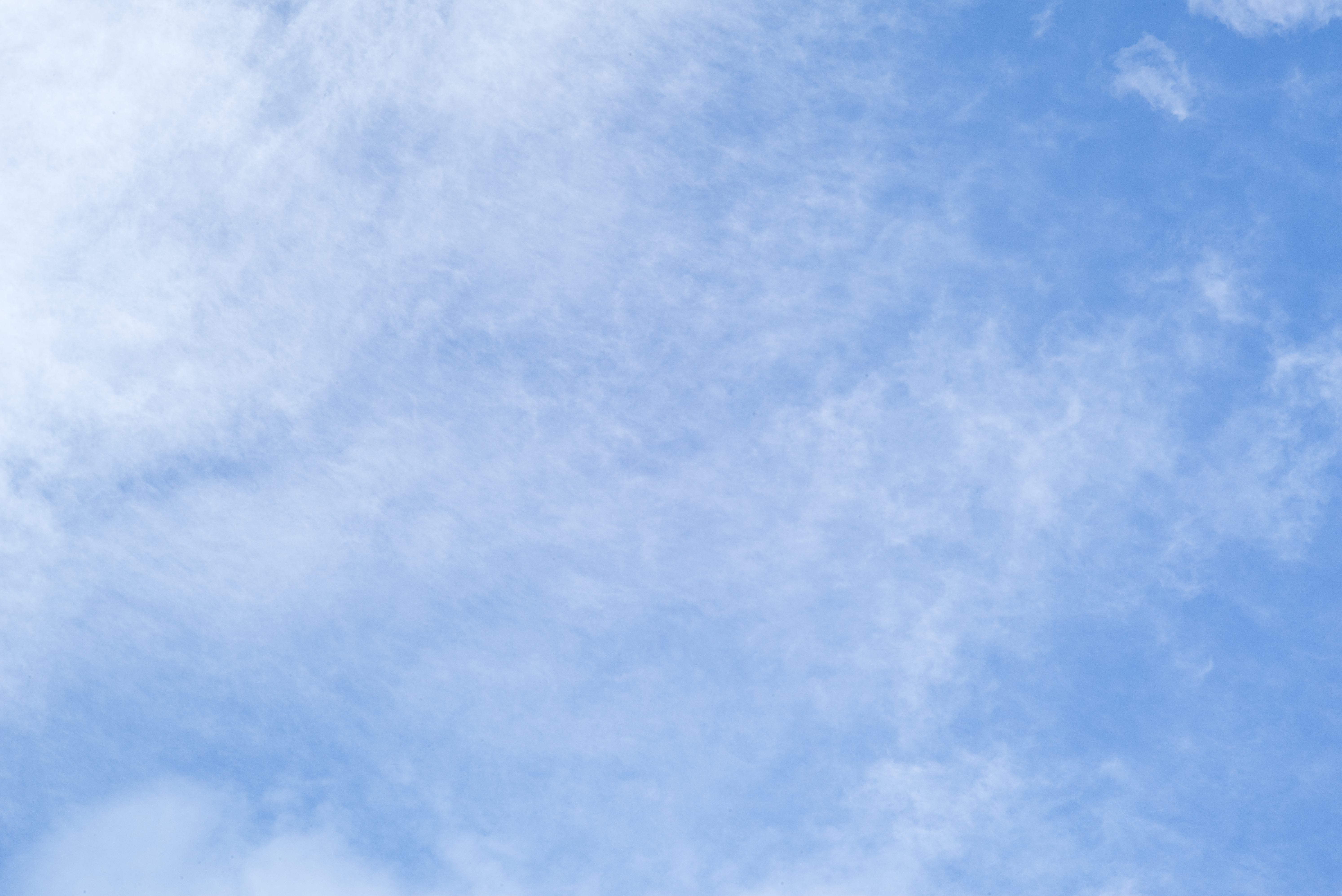
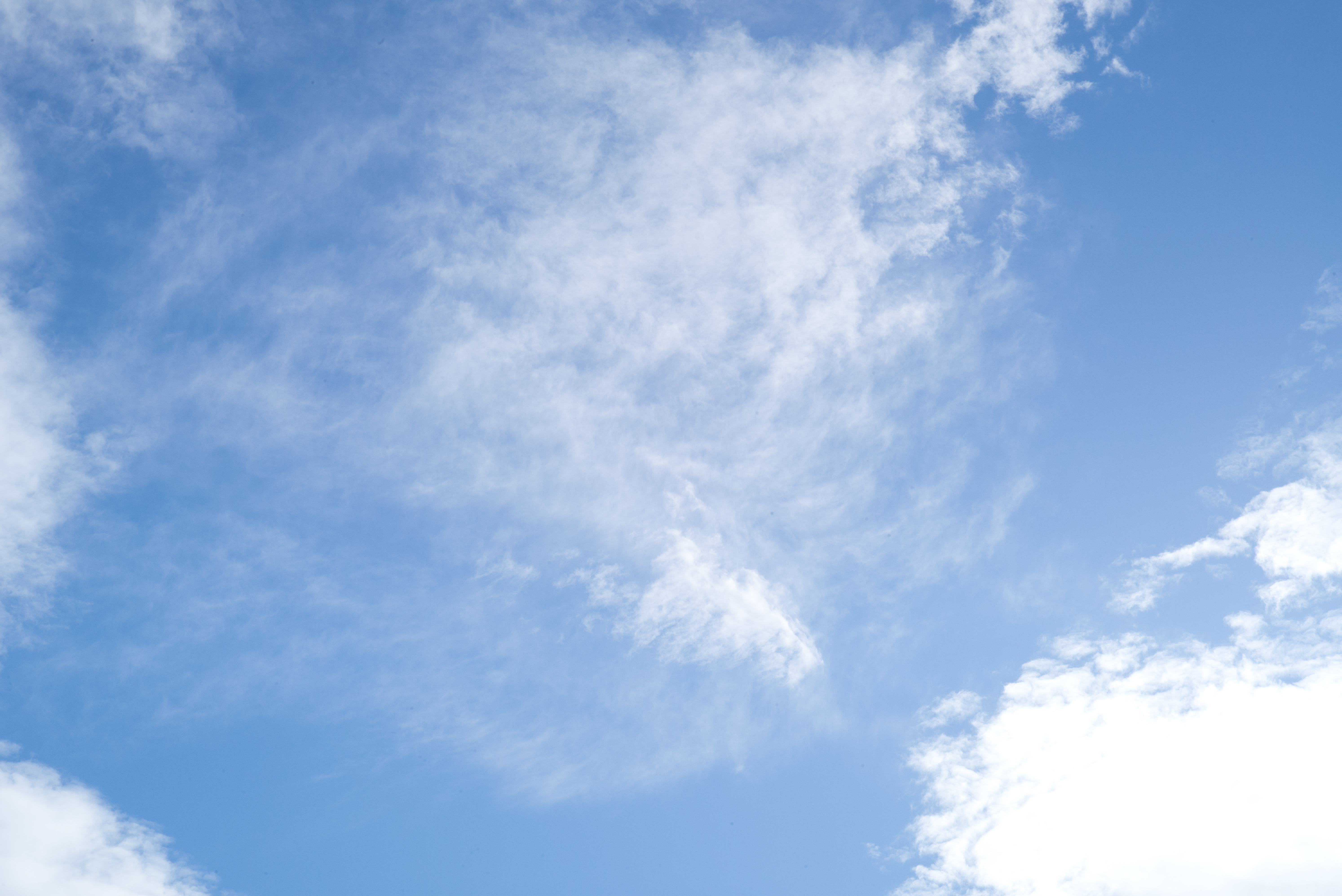
Here are the first couple of experiments, taken yesterday and today. Yesterday was very overcast so the picture actually reveals little – it is a void, empty, a picture of nothingness. Today was a bit more broken so the picture is more easily recognisable as clouds.

14/10/2019
15/10/2019

I will continue with this experiment over the next couple of weeks (weather permitting) and try a shot each day and see what we get. I will also, in the meantime, think about some other possible approaches.

16/10/2019
16/10/2019
20/10/2019
22/10/2019
22/10/2019

23/10/2019
23/10/2019
23/10/2019
23/10/2019
23/10/2019

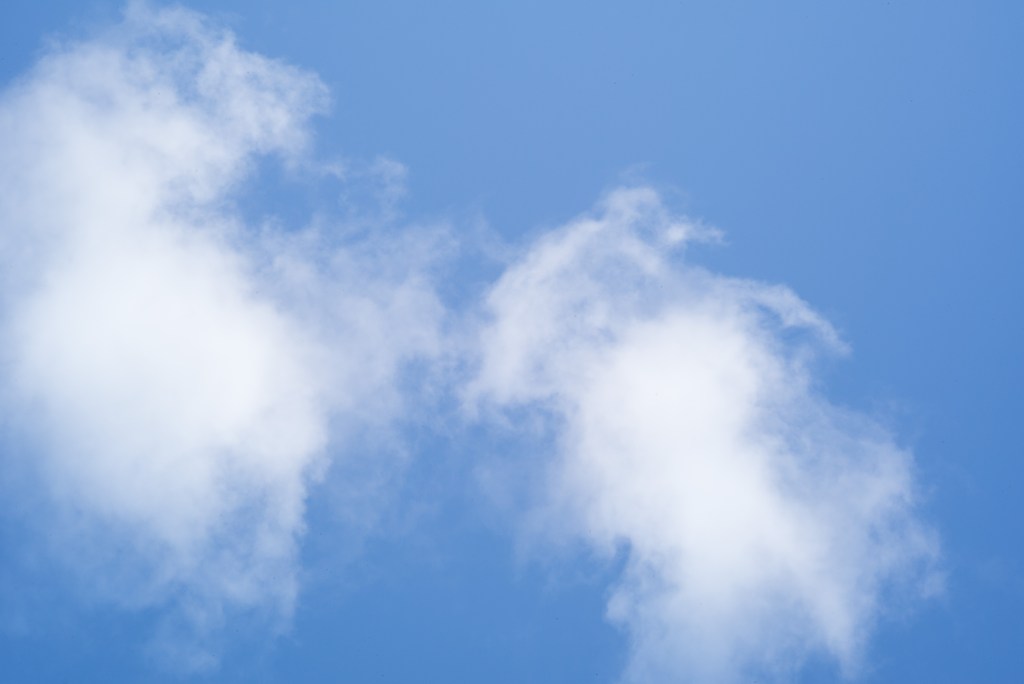
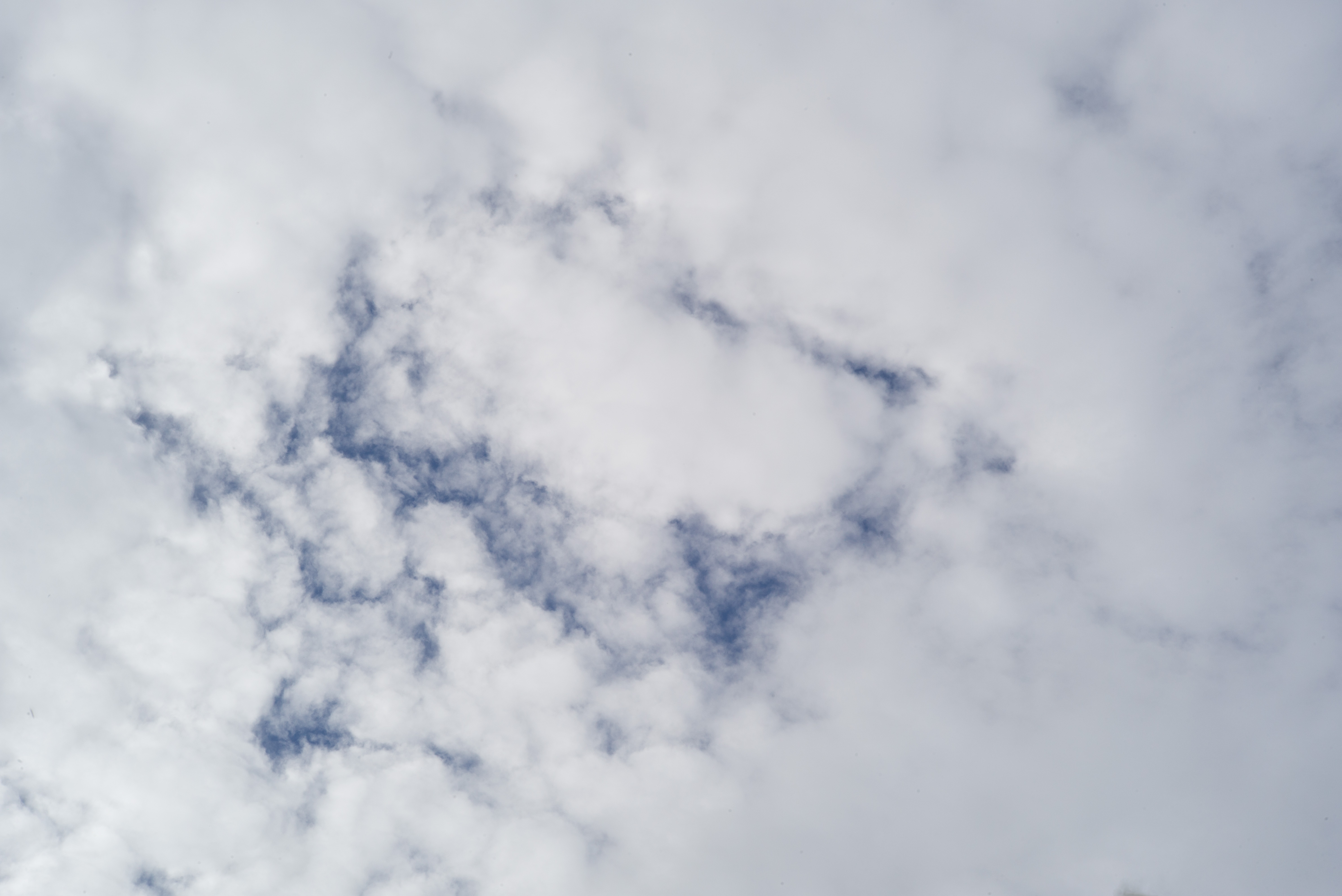
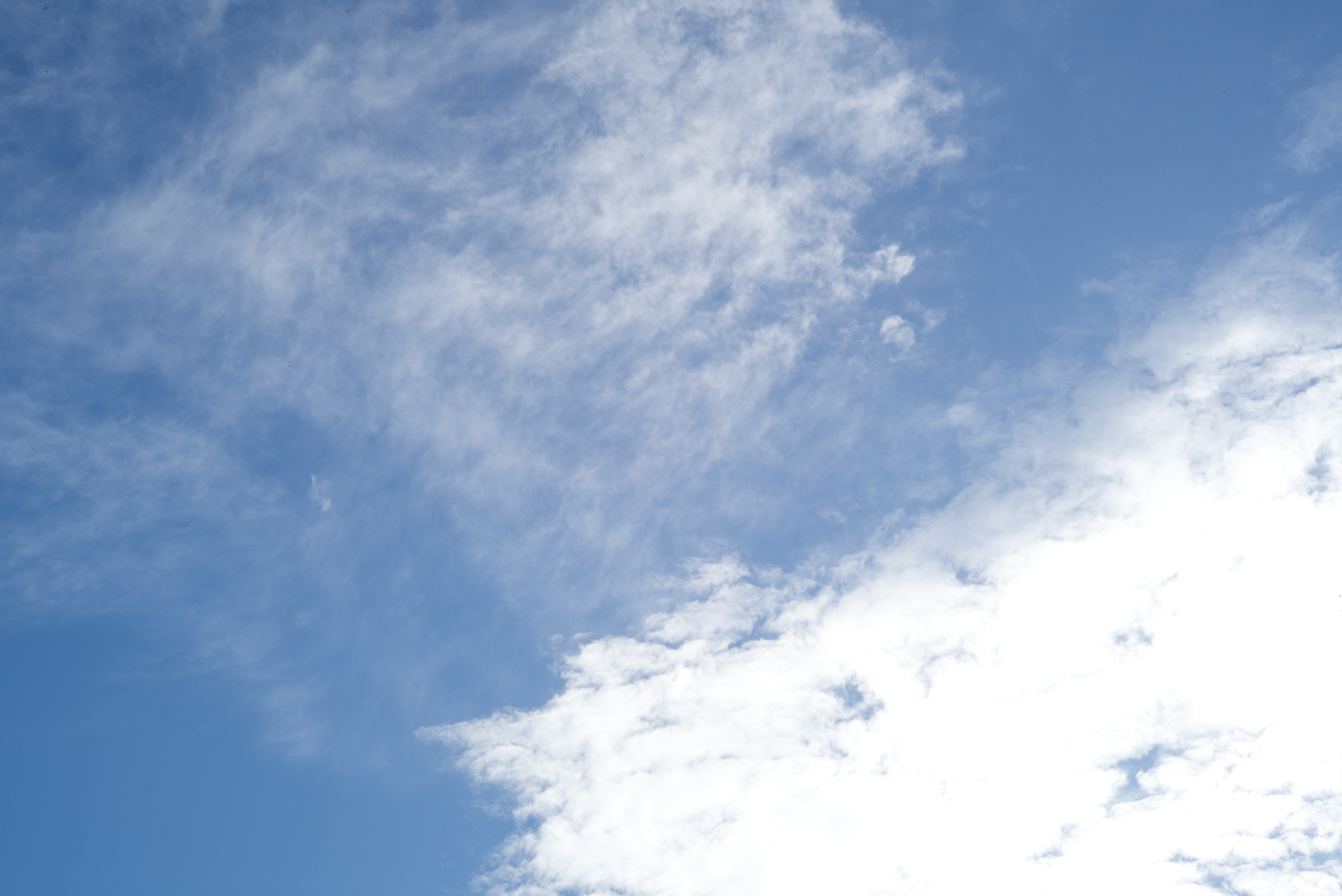
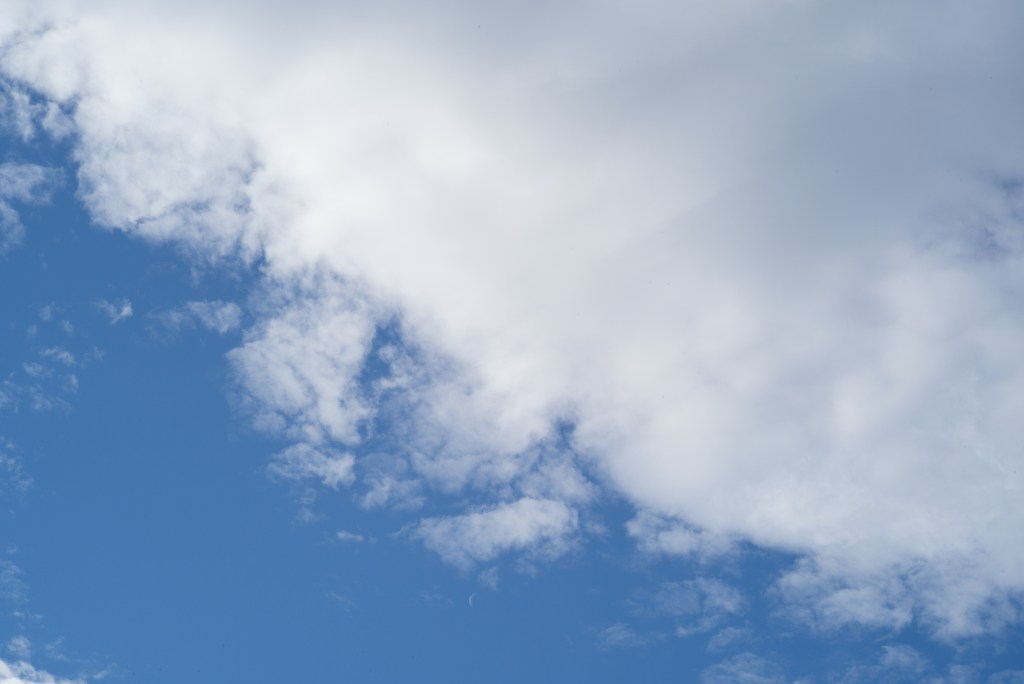
These were all taken over the course of the same afternoon. It was quite breezy so the sky was constantly changing. Though not easy to see, the third in this day’s sequence managed to catch the moon, a very small crescent in the middle towards the booth of the picture, just below the cloud edge.

While working on this I have been giving further thought to other potential influences on what I am trying to achieve. One of course has to be Alfred Stieglitz and his “Equivalents”, photographs of clouds that are arguably the first abstract pictures ever made. I do not though feel any conscious influence. Yes of course I am doing something similar with my cloud pictures but only up to a point. Stieglitz was, I think, very much pursuing a pictorialist line of approach. His could pictures do not carry, so far as I can divine, any deeper meaning or significance. It is not clear to me that he “meant” anything in particular in making these pictures. In a way what he was doing was more closely aligned with what Cozens, Turner, and Constable were doing.

The other is Gerhard Richter who made a number of sea- and sky-scape paintings in the late 1960s and early 1970s. While working on my pictures I had this nagging feeling at the back of my mind that a contemporary artist had done this sort of work but it is only now, now that I am just about ready to submit this first assignment, that I have realised that it is Richter that I have had in mind and have gone back to look at this work. Although not an active, conscious influence this work has clearly had an effect, even if only at an unconscious level because clearly Richter was seeking to do with his cloud paintings what I am trying to do now. As Mark Godfrey points out (2011, at page 83): “these are not just paintings of skies – they are paintings that show Richter’s attraction to the ‘unknowable and unrepresentable’…” This fits exactly with the interpretation that I have sought to place upon the Sublime.

Wolken, 1970

Godfrey, M, & Serota, N, (2011). Gerhard Richter: Panorama.  London: Tate

Exercise 1.5: Plan C

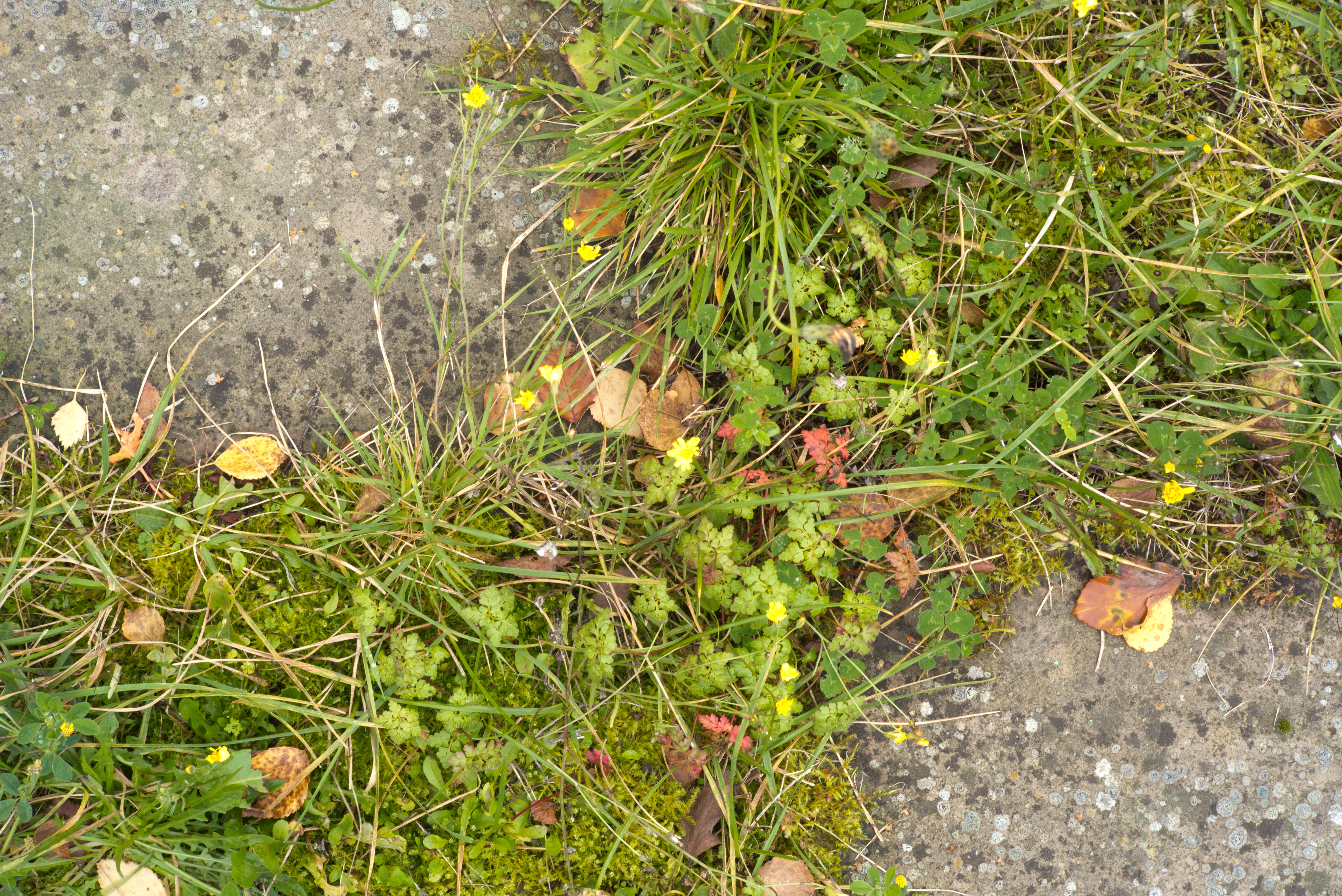
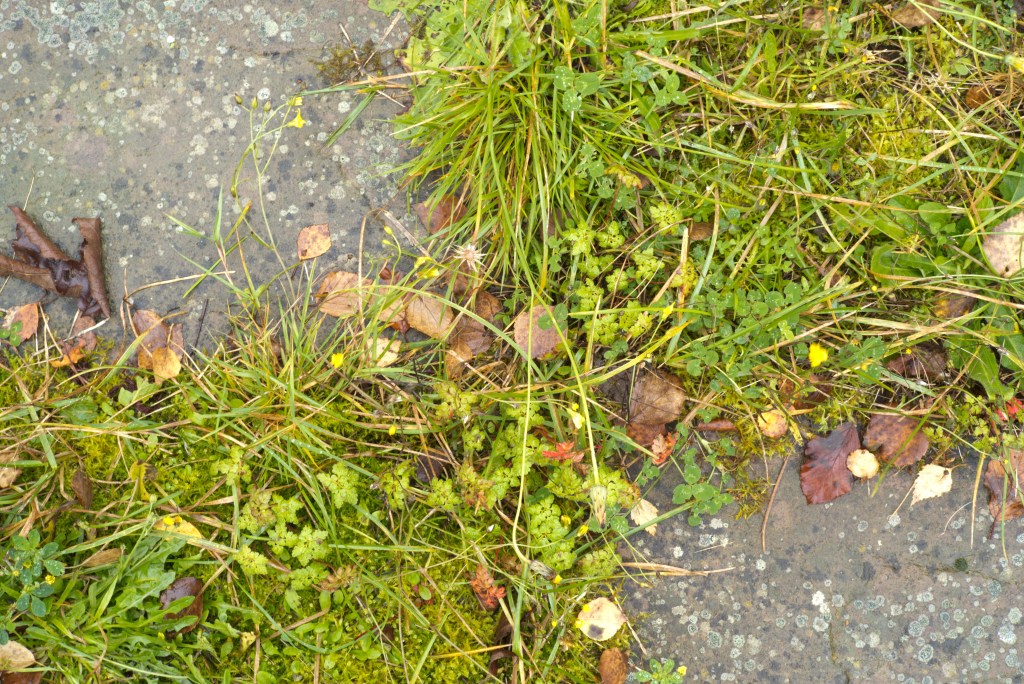
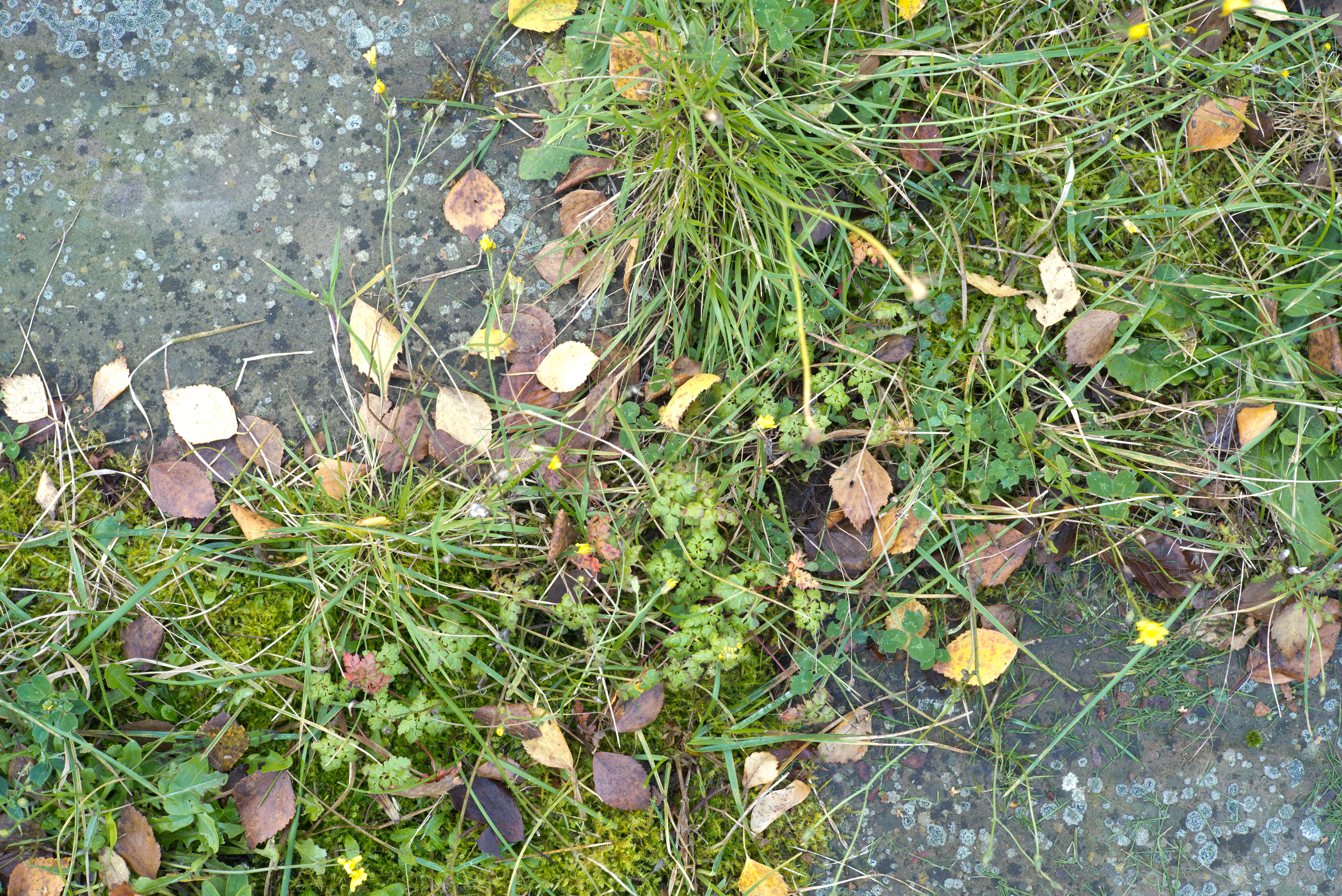
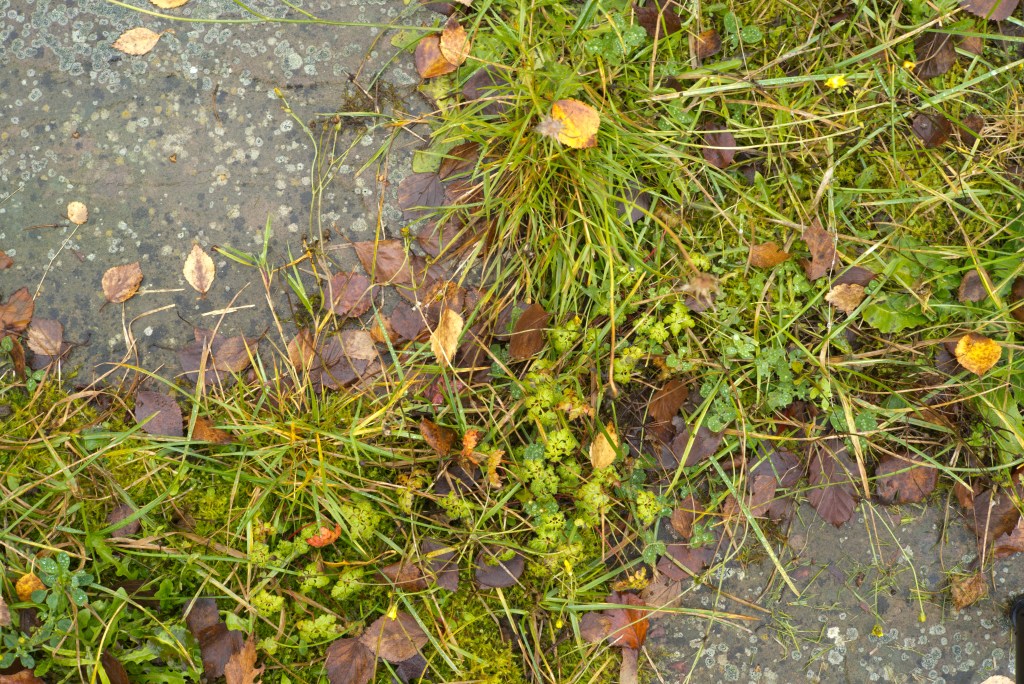
I have been struggling to come up with a microcosm view as another possibility for this exercise but have for now settled on a small area in my garden that I know will change over the coming year. Let us see how this progresses.

14 October 2019

20/10/2019
27/10/2019

Here is the latest instalment. I have to confess I am not quite sure where this is going and I very much doubt that this will turn out to be the final choice of subject. I am not helped by this particular shot being a bit clumsy in that one of the tripod legs makes an unwelcome appearance in the bottom right corner! I will persevere for a while longer though but only update this post if and when there is a change worthy of report.

03/11/2019

Exercise 1.6: The contemporary abyss

When I first read the brief for this exercise I did not really know where to turn. As ever though something has, by chance, or coincidence, (or my trusty unconscious working overtime) cropped up that I think will serve. Fortunately it relates to photography and contemporary work at that. It also fits with certain aspects of Buddhism that I have been thinking about, if not directly meditating upon, recently.

From the reading that I have been doing of late on the Sublime the particular ideas that appeal to me most strongly are those relating to personal transcendence and the representation of the unrepresentable. On a second reading of Morley’s article (which incidentally I vaguely recollect seeing for the first time when it was published in the magazine Tate Etc back in 2010, at which time I was a Friend of the Tate and so received the physical magazine each quarter) two things caught my eye.

One was the following:

“But often contemporary perspectives on the sublime reject traditional conceptions of a self, or a soul or spirit, seen as moving upwards towards some ineffable and essential thing or power. Instead, the contemporary sublime is mostly about immanent transcendence: that is, it is about a transformative experience understood as occurring within the here and now.”

He then refers to the work of, in particular, Hiroshi Sugimoto, and a sense of void – “of being on a borderline or edge where we can no longer codify experience”. These ideas link to the Buddhist ideas of mindfulness and nothingness or emptiness, ‘sunyatta’, often represented in Zen as a calligraphic circle. A useful definition, or explanation, of the concept of emptiness can be taken from Baas & Jacob (2004) (at page 266):

EMPTINESS: The teaching unique to Buddhism, namely, that which we ordinarily perceive as inherently solid, permanent, lasting, and disconnected from and independent of everything else, is actually ’empty of inherent self-existence’, empty of anything separate and independent, fixed, permanent and self-maintaining. The Buddhist view is that phenomena are impermanent, interconnected, and in continuous flux. …

(This is a book I am going to come back to later as there is an interesting chapter in it on photography as Buddhist practice which, even stripped away of its specifically Buddhist context, has some interesting things to say about how to look and see as a photographer. More anon.)

I am quite pleased that Morley has included Sugimoto in this context as he is someone whose work I admire, and have been looking at more seriously again, and on whose Seascapes book I have already written a brief note (https://markrobinsonocalandscape.photo.blog/2019/09/14/hiroshi-sugimoto-seascapes-book/). So it is with him that I am going to stay for the purposes of this exercise.

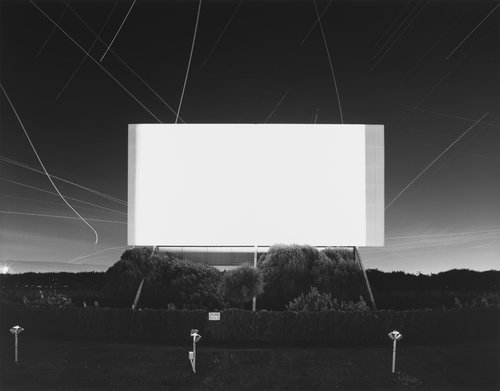
The example illustrated in Morley’s article is one of Sugimoto’s movie theatre pictures, in this case a drive-in, in which the exposure lasts as long as the film that was playing. What this inevitably produces a lit, but apparently blank, screen. That illuminated space is a sort of void, in the sense that nothing is visible within it, so that we can “no longer codify experience”, in this case in the sense that we cannot experience the film that is “depicted”. In a way this is also representing the unrepresentable: we have a still picture that captures and encapsulates a movie. A span of time has been reduced, in the form of the final photographic image, to a single instant. In Zen terms the photo is similar to the calligraphic zero. At a literal level the dark foreground and background sky, framing the “blank” lit screen, is a calligraphic ‘circle’ in its own right.

Union City Drive in, Union City 1993

I feel the same argument can be made for the Seascape works that I have been looking at recently, and that I have previously in my own modest way sought to emulate.

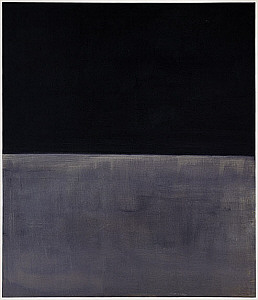
I had not realised until I read the introduction to Sugimoto (2019) by Munesuke Mita (at page 7) that the work of Mark Rothko, particularly the later monochrome compositions, specifically Untitled (Black on Gray), 1969/70 below, which share a similar form to Sugimoto’s photographs (although, as he argues, a different sense of vitality) might similarly sit within this conception of the Sublime in so far as he had “eliminated reality, meaning, form, and color (sic) from his work”.

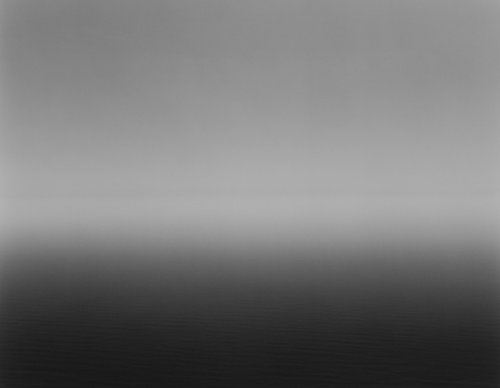
What Sugimoto has done with his seascapes is take the viewer outside of both space – the only clue to the “reality” of the scene, in the sense of where the picture was taken, which is by no means discernible from the internal context of the images themselves, is offered by the caption – and time, as he did with the movie theatres. As Munesuke Mita puts it (at page 9): “It is a fertile tranquility of eternally recurring time.”

That in itself might stand as a not at all bad further possible definition of the Sublime.

Ligurian Sea, Saviore, 1982

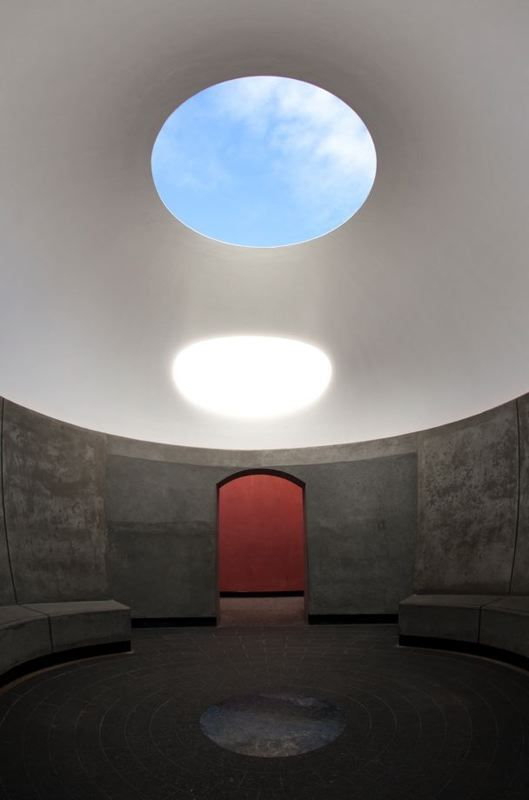
As an aside, it is interesting that Morley also mentions James Turrell in the same breath as Sugimoto. One of his Skyspace pieces is at Kielder (Cat Cairn), not too far from where I live. This is a circular space and so has at least superficial similarities with an enso and is doing something similar to Sugimoto in taking the viewer outside time and space.

I am going to think more about his work as a possible source or influence for Assignment 1, and also another possible approach to Exercise 1.5 (on which I am still having ideas!).

Baas, J, & Jacob, M.J. (eds) (2004).  Buddha Mind in Contemporary Art.  Berkeley:  University of California Press

Sugimoto, H, (2019).  Seascapes.  Bologna:  Damiani Editore

www.sugimotohiroshi.com

https://www.tate.org.uk/tate-etc/issue-20-autumn-2010/staring-contemporary-abyss

Exercise 1.5: Plan B

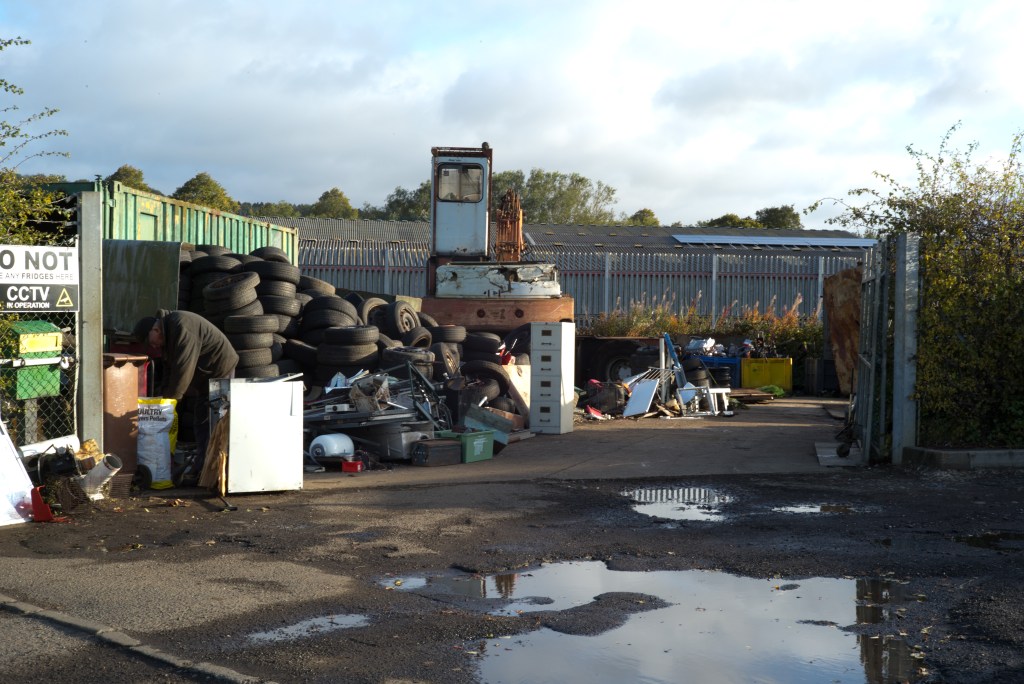
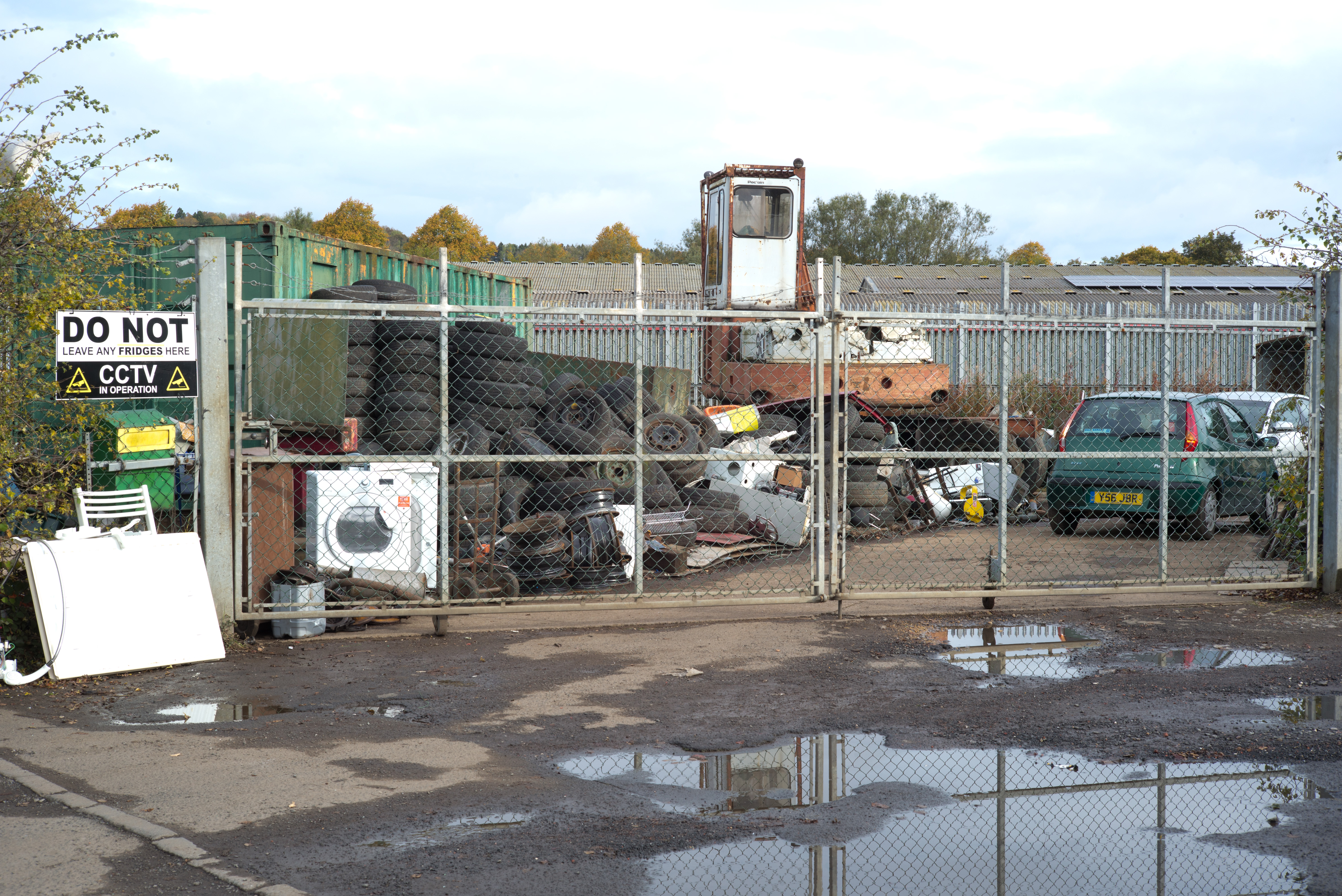
Here is a first go at a potential plan B, the local scrap yard. Normally I see this place on a Saturday morning when there is no-one about but as this was taken on a weekday the old fellow who evidently runs the place, rummaging there on the left was there. As a precaution, and matter of courtesy I asked if he minded if I took some pictures. Clearly from the somewhat bemused look on his face – I did not explain my intention as he did not show any inclination to engage in conversation – he must have wondered why on earth I wanted to do so, but nevertheless acquiesced.

I tried a couple of different angles but this was the only one that really worked and kept me close enough to the scene without having to stand in the middle of the road – there is enough traffic to present a hazard.

I suspect that further shots will be taken at weekends so the gate will be closed and no-one there. That might make the process a bit more comfortable. Anyway I will try it over the next few weeks and see how it starts to shape up.

I still have to settle on a possible “microcosm” site so will return to that later.

Continuing:

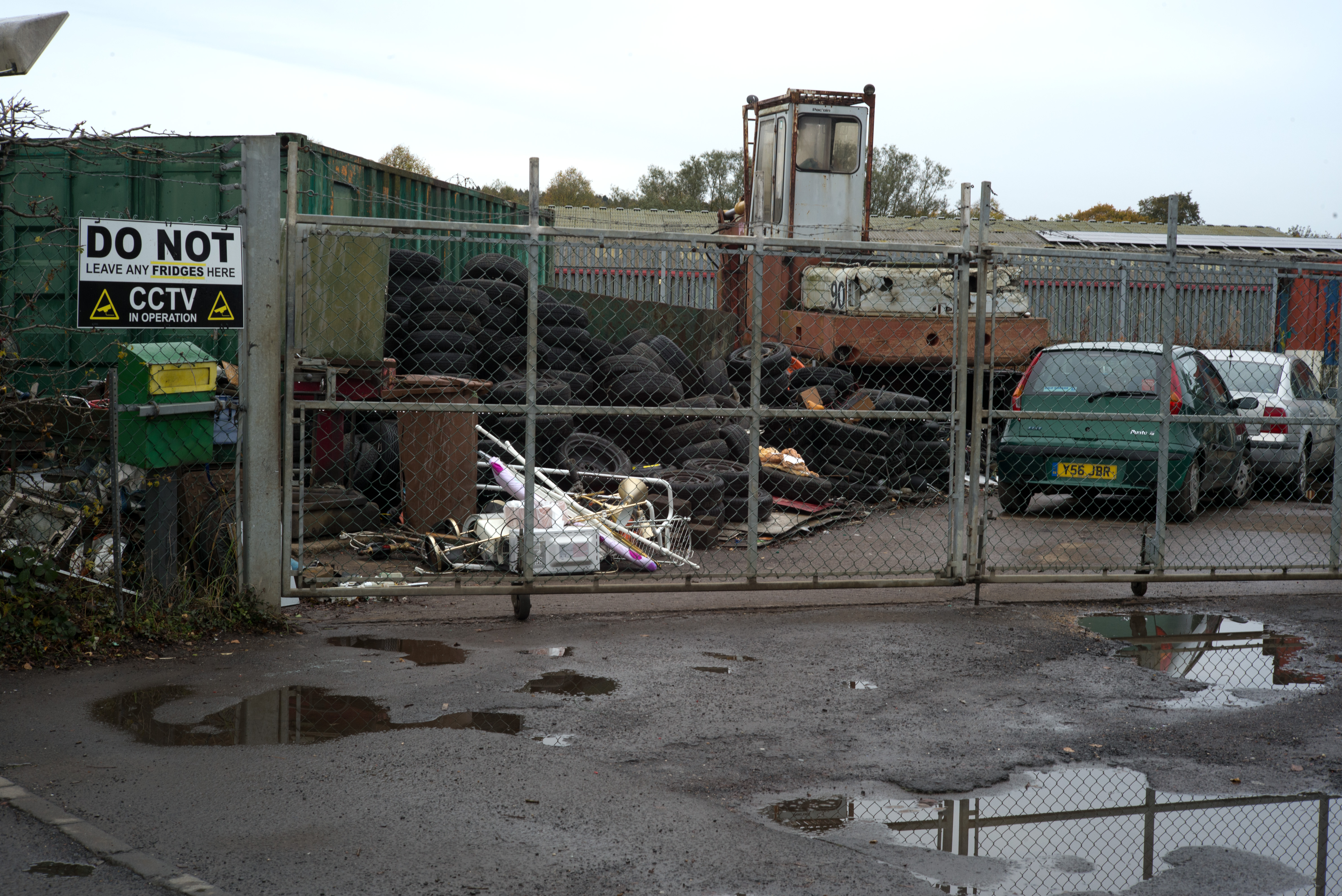
19/10/2019
26/10/2010

An overcast day after a couple of days of fairly heavy rain so the light was quite poor. To maintain a reasonable shutter speed of 1/60s and an aperture of f/11 to try to keep some depth of field, I found I needed to raise the ISO to 800. I am also finding hard to shoot from exactly the same vantage point each time because there are some cars that park on this little patch of ground opposite the gates and I keep having to shift position from week to week to work round them.

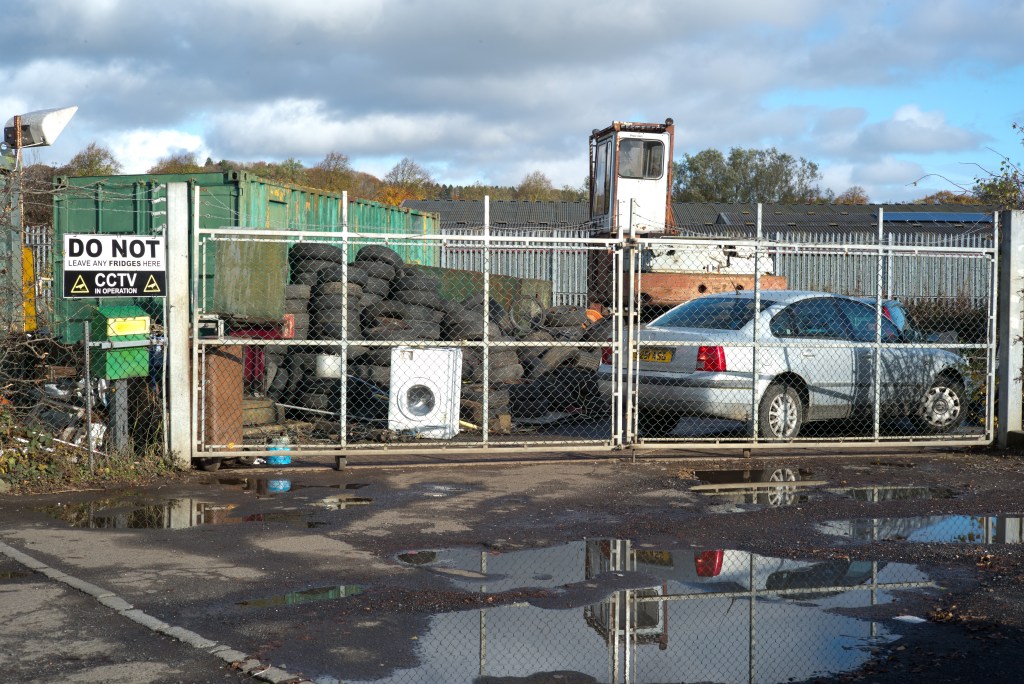
Last one for now. For the future I think what I will do is simply collect each weekly photo in a separate file and then sort and edit them once the time to finalise the assignment arrives, unless something noteworthy happens in the meantime. I feel it is a bit much at the moment to be updating this post every week. Rather I think I will do a sweep up post later, bringing the project up to date, even if only to confirm that this is not the subject that is going into the final submission.

02/11/2019

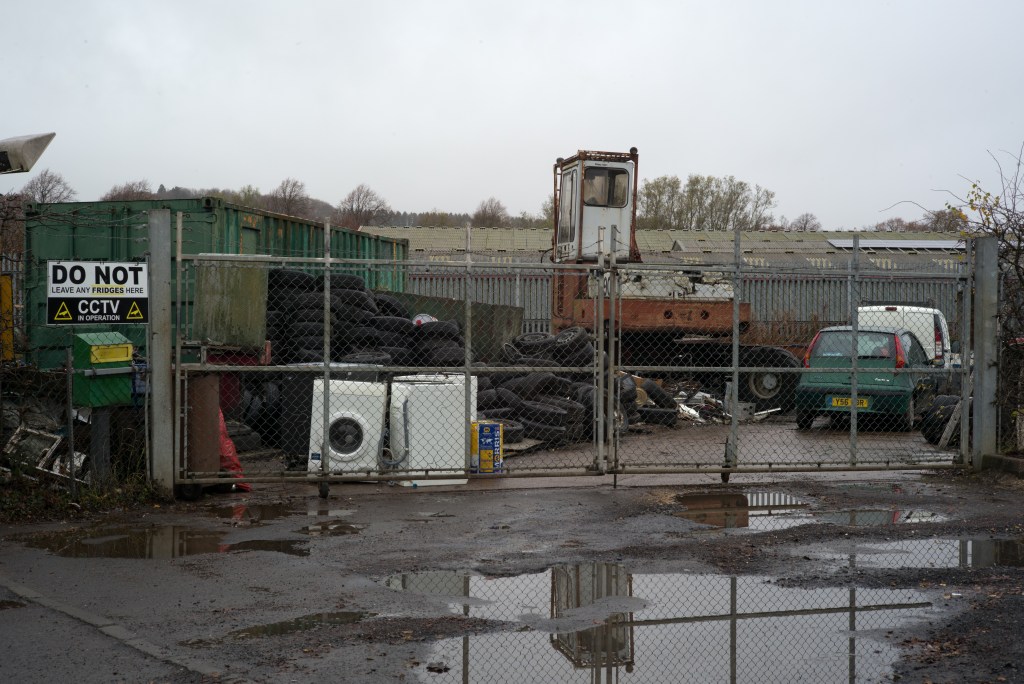
Since my last post on this I have at last decided that this is not a project that I am going to pursue further. Over the last few weeks I have continued to photograph the same scene and it is barely changing at all. Variations in the weather (not that it has changed much recently having been fairly monolithically overcast and wet) are I feel not enough to sustain interest.

16/11/2019

I think part of the problem is that I can really only shoot here on a Saturday but that is when no-one is working in the yard and nothing is happening. As a result all that there is to be seen from one week to the next is a puddle and a parked car! I cannot realistically expect that there is going to be sufficient seasonal variation to make much difference. I will therefore from now on be concentrating just on Plan A.

Beauty and the Sublime

Before getting into Exercise 1.6 (and at the moment I do not really know what work I am going to focus on – I will come back to that) I have first been looking at the concepts of Beauty and the Sublime. What follows is a very partial, no doubt characteristically personal, and admittedly not particularly profound, series of thoughts and observations on what I encountered so far, and ideas formed accordingly, on these concepts.

To be honest, apart from dipping into Beech (2009) (the introduction alone makes the book worth having), I have not read very much on the idea of Beauty. Rather I have concentrated more on the Sublime, which I think is the more interesting, if not necessarily the more controversial, of the two ideas. Frankly the academic discussion of Beauty does not really interest me. Aesthetics, as a subject, has never been a subject that holds my attention. Someone that I know has written a book on aesthetics, which I understand is well regarded, and teaches – or at least used to teach – at university, so I am well aware that this is a serious and, to some extent at least, an important area of study. Nevertheless, though I mean no disrespect, it simply does not do much for me personally as an intellectual subject. Though I had not quite thought of it in these terms before this is one reason why I find the work of Marcel Duchamp intriguing. Dadaism was rooted in rejecting aesthetics and the problems that it posed, not least the aestheticisation of capitalist society and culture.

If nothing else this highlights for me what I see as a flaw, or at least an overstatement, in Burke’s argument that beauty is a matter of taste and that taste is universal. As Beech argues in his beautifully concise introduction that is simply not true of all cultures at all times. To take just one example (not meant in at all a sexist way) consider the ideals of feminine beauty and how they have changed and varied over the centuries, as is clear from even a cursory reading of Berger (1927) in his discussions of the male gaze.

The other book I have read specifically on the subject of beauty in photography, is the aptly titled one by Robert Adams (1996). This beautifully concise and lucid collection of essays really only addresses the question of beauty in just one chapter, but it is one that gets straight to the heart of the matter. Without wishing to reduce his argument to an inaccurate and unrepresentative over-simplification, Beauty is Form. As Stieglitz is quoted at the end of the chapter (page 36): “Beauty is the universal seen.” An admirably pithy observation to offset so much of the academic blether that has been written on the subject. (I have a particular target in mind so far as the Sublime is concerned that I will come to anon.)

I did also go back to Alexander (2015) which I had read earlier in connection with I&P, looking again at the sections on Beauty and the Sublime in chapter two. Perhaps unsurprisingly, as Alexander apparently wrote this course, the book and course material pretty much cover the same ground so I did not really get much from this rereading. Still a good book though!

A paragraph that is particularly apt, emphasising the importance of understanding traditions and conventions, and which also speaks to some of my concerns about Ansel Adams, or at least about the way his work has been used and abused, and the salon-style approach to the striking single image, is this one (at page 27):

“One standard, then, for the evaluation of art is the degree to which it gives us a fresh intimation of For. For a picture to be beautiful it does not have to be shocking, but it must in some significant respect be unlike what has preceded it (this is why an artist cannot afford to be ignorant of the tradition within his medium). If the dead end of the romantic vision is incoherence, the failure of classicism, which is the outlook I am defending, is the cliché, the ten thousandth camera-club imitation of a picture by Ansel Adams.”

As a bit of an aside from the present consideration of Beauty and the Sublime, there are a couple of other comments Robert Adams makes in a later essay, Making Art New, (at pages 81 and 82) that caught my eye and are relevant to the issue of understanding traditions and conventions:

“Every serious artist borrows not only from those conventions but from the particular insights of individuals he admires. … It sometimes even seems as if the greatest artists borrow most.” (Picasso would of course have it that great artists “steal”!) “No serious artist would, in short, ever set out simply to repeat another.” Knowledge of the conventions is important butt must then be applied in a way to make out of them something new and personal.

The Sublime is on the other hand something about which I have been reading rather more, starting with Burke (1998), but giving Kant a miss (I have never got on well with Kant – perhaps I simply have not tried hard enough – and indeed do not have currently have any of his work in my library, unless of course there is something squirrelled away in an anthology, though I am at a loss to know which that might be). Again at the risk of being reductionist and over-simplifying, what I get from Burke is a sense that the Sublime is exalted and awe-inspiring (which also happens to be my dictionary definition), that it is about the attempt to represent the unrepresentable, to whit the Creator, although he was otherwise describing profound and moving experiences in what are purely secular terms.

How paradoxical though that Burke was of the view that art was not really capable of communicating a sense of the Sublime and that this was better done through poetry. From what little I know of Kant’s work, he too dismissed art from his consideration and concentrated on the importance of the aethestics of the experience of nature. (What little I have picked up of Kant’s thinking comes form the surprisingly engaging and interesting Melvin Bragg radio programme referred to in the course material which I thinks stands as a really useful primer on the subject, and more useful than some of the more “scholarly” stuff that has been written on the subject. (Unfortunately the BBC have just introduced their wretched Sounds app which means that the quoted link no longer works. After a bit of searching I have found the current one, cited below.) Paradoxical because just about everything else that there is readily available to read on the subject is from the perspective of the visual arts. Indeed, the subject of the Sublime seems to have all but disappeared from poetic discourse. OK, it might still be there and I have missed it: I read quite a lot of poetry still but fairly selectively, and none of the modern and contemporary poets I habitually turn to seem to dip their toes into this particular murky pond. If I want a poetic Sublime I find I have to go back, principally, to Milton!

What else have I been reading? Top of my list has been Morley (2010), whose introduction os again admirably concise and clear, giving a good overview of the subject. I have to say though that that overview, as goos as it is, leaves me with the inescapable feeling that much of what has been, and unaccountably is still being, written is more of the same angels dancing on pin-heads stuff and that the range of different types of Sublime has now become so wide and varied as to make any definition, indeed any conception, of the Sublime almost meaningless and otiose, except as an hermetic, academic discipline. Apart from the introduction I have so far only doomed in and out of the main body of the book but the overriding impression it gives is just that, that the subject has become so broad and varied it is in danger, if it has not done so already, of collapsing under its own weight. Nevertheless there a a few potentially useful things that I have already happened upon, and a few more that I can see I am going to want to think about more in connection with Exercise 1.6. (I have included Morley’s Tate essay in the references below as I have read it – and found it useful – in connection with this current rumination. I will withhold any direct comment on it though until I actually address that next exercise.)

One of the key texts included in the book so far as more contemporary conceptions of the Sublime is concerned is of course Barnett Newman’s The Sublime is Now of 1948 (page 25). In large part of course it is just a commentary on the development of the idea of the Sublime. I have to say though that apart from putting the idea back into contemporary critical discourse I am not sure it does much in itself to develop the idea. Rather what I get from the essay is a sense of a concern on Newman’s part to separate contemporary American artists from the history and conventions of European art, which he saw as having failed to achieve the Sublime and had got bogged down in debates about beauty and aesthetics. It is a call to American artists to be new. Whether that is something that was actually achieved is another matter for debate elsewhere.

In some ways even more useful is the essay by Julian Bell that I found when trawling through the mass of stuff on the Sublime on the Tate website e(Julian Bell, ‘Contemporary Art and the Sublime’, in Nigel Llewellyn and Christine Riding (eds.), The Art of the Sublime, Tate Research Publication, January 2013.) This has the advantage of not only not being bogged down with tortoured academic modes of discourse but also of approaching the subject from the point of view of a practical, practising artist. There are a couple of useful, or at least interesting, things I get from his article.

One thing is that it has got me to look a little more closely at Jean-Francois Lyotard (though I still have to read his contributions to Morley more closely). I have previously fought shy of reading him, given my inherent antipathy towards Theory and wariness of the philosophising of the French Left in the latter half of the last century. Nevertheless it seems to me that in some ways Lyotard hit the proverbial nail on the head. The Sublime is “presenting the unpresentable”, or as I put it earlier representing the unrepresentable. How this works in practical terms I need to think about more but this seems to me to encapsulate what the Sublime is about now, regardless of how it might have been presented in the past.

Another is his all too gentle swipe at Gilbert-Rolfe (1999), which I found strangely reassuring. Despite my antipathy towards much academic theorising, because his book is on the reading list I obtained a copy and had a go at reading it, not really knowing what to expect. I got through the introduction and most of the first chapter before completely losing patience with it. I spent 33 years practicing as a lawyer. Words and language were my primary tools and precision and, despite common misconceptions, economy of their use were of paramount importance. As a result I have no truck with such self-consciously and determinedly “clever” academese, with its mangled syntax, imprecise use of language, other than in an almost hermetic, private-language sort of way understandable only by fellow academics who speak the same language. I find it obscurantist, exclusionary, and often straightforwardly incomprehensible. All of the other work that I have read on this topic so far has been written in clear immediately intelligible language. Some of it has needed a bit more close analysis but nothing too onerous. This book though all too often simply comes across as the polar opposite. I very nearly ended up throwing it across the room in frustration. It is not so much that I cannot tease a meaning out of the word-salad but that it is frankly not worth the effort. So step forward Julian Bell who nicely, and subtly, puts this book in its place:

“By 2001, when Jeremy Gilbert-Rolfe published Beauty and the Contemporary Sublime, the institutionalisation of a concept that in Lyotard’s hands had been definitively anti-institutional was already a given. Gilbert-Rolfe contrarily proposed (as far as I can tell) that nowadays it was the category of ‘beauty’ (idiosyncratically defined) that was truly radical and liberators. A short sample of the book’s argumentation may suggest why it failed to resolve the issue to universal satisfaction:

The extreme mobility of the contemporary sublime erodes autonomy because it calls for movement through the heteronomous which is itself heteronomous, provisional singularity taking the place of the irreducible, movement being the indertiminacy of what is erased and represented within it.”

I rest my case and I doubt that I am going to spend much more time trying to wade through this book’s verbal soup.

I wil come back with more on this when I address the next exercise.

Adams, R, (1996).  Beauty in Photography.  New York:  Aperture

Alexander, J.A.P, (2015).  Perspectives on Place.  London:  Bloomsbury

Beech, D, (ed), (2009). Beauty.  London:  Whitechapel Gallery

Berger, J, (1972).  Ways of Seeing.  London:  Penguin

Burke, E, (1998).  A Philosophical Enquiry.  Oxford:  Oxford University Press

Gilbert-Rolfe, J, (1999).  Beauty and the Contemporary Sublime.  New York:  Allworth Press

Morley, S, (ed), (2010).  The Sublime.  London:  Whitechapel Gallery

https://www.bbc.co.uk/sounds/play/p004y23j

https://www.tate.org.uk/art/research-publications/the-sublime/julian-bell-contemporary-art-and-the-sublime-r1108499

https://www.tate.org.uk/tate-etc/issue-20-autumn-2010/staring-contemporary-abyss
Exercise 1.5: Visualising Assignment Six Transitions – 2

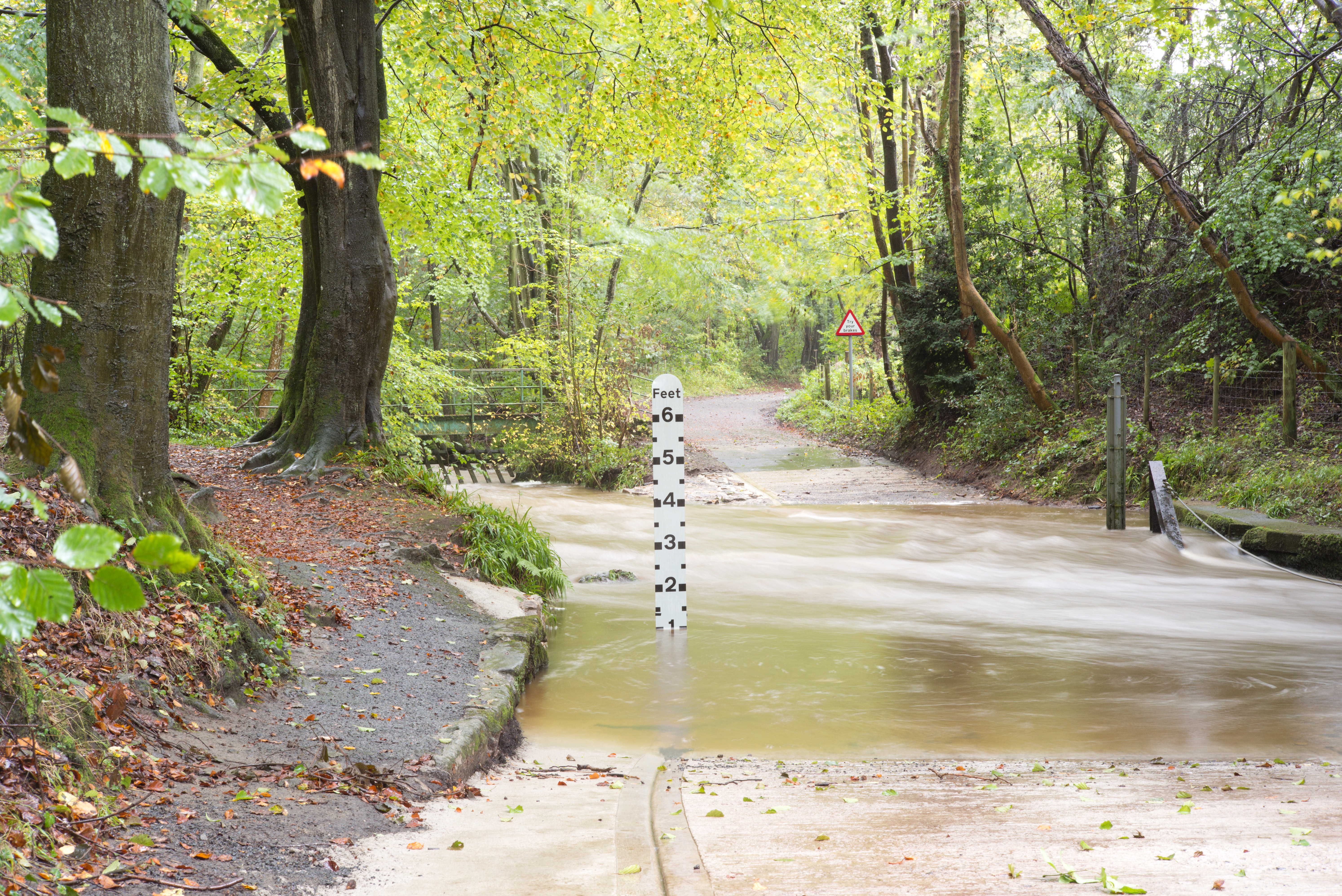
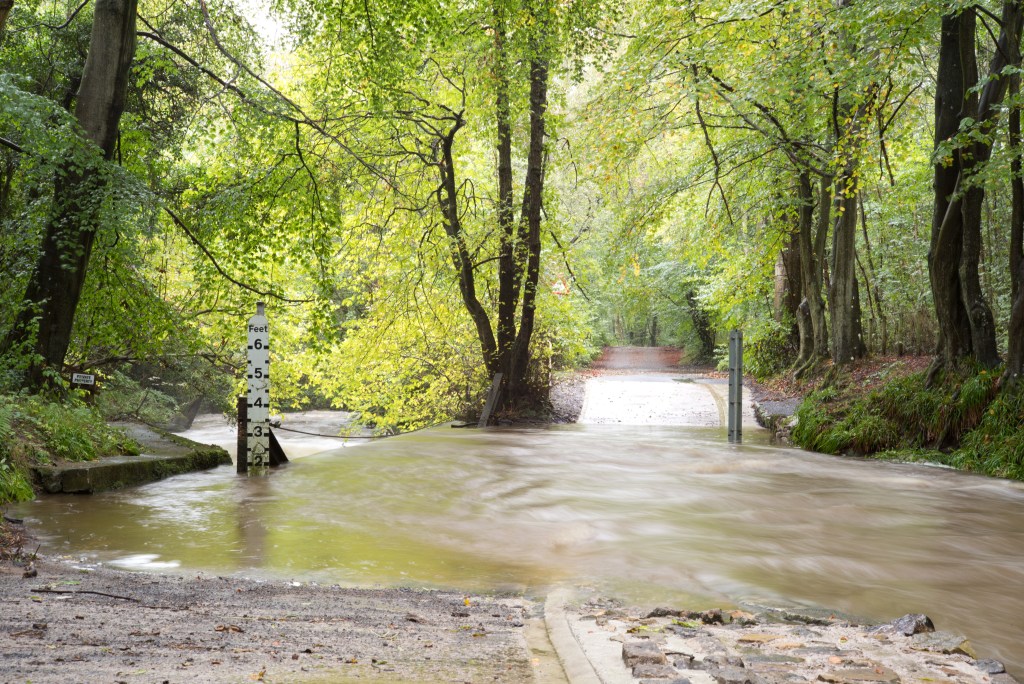
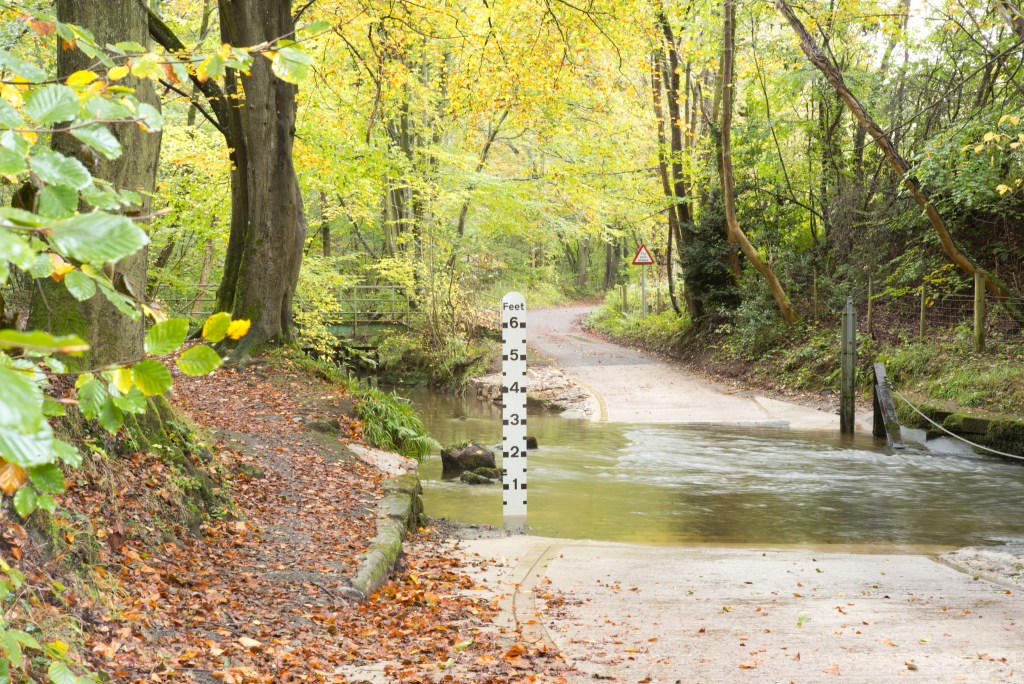
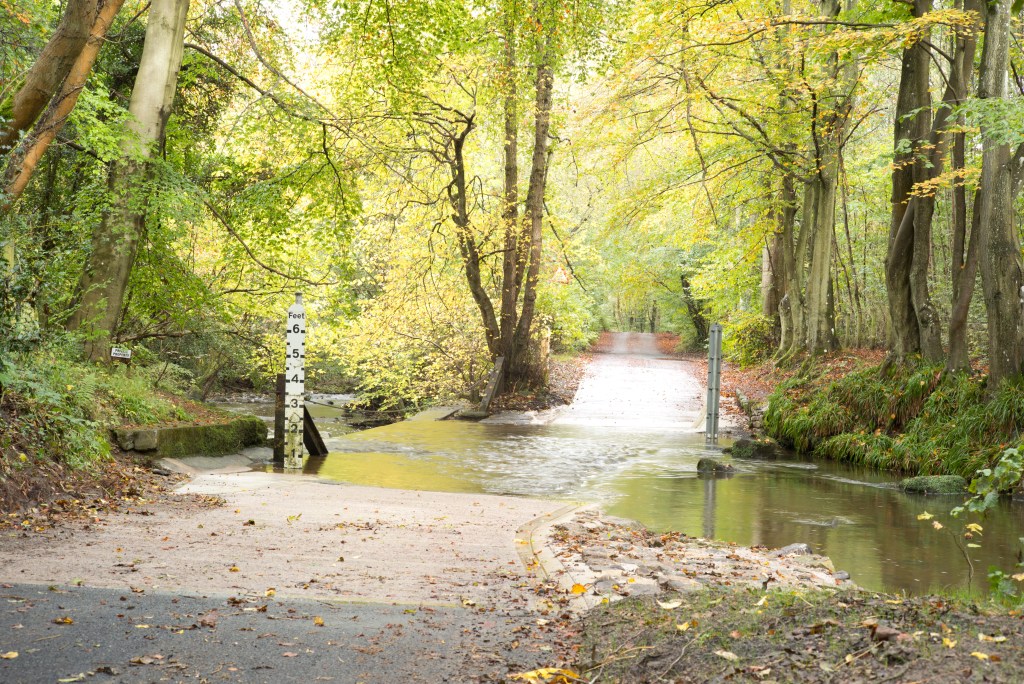
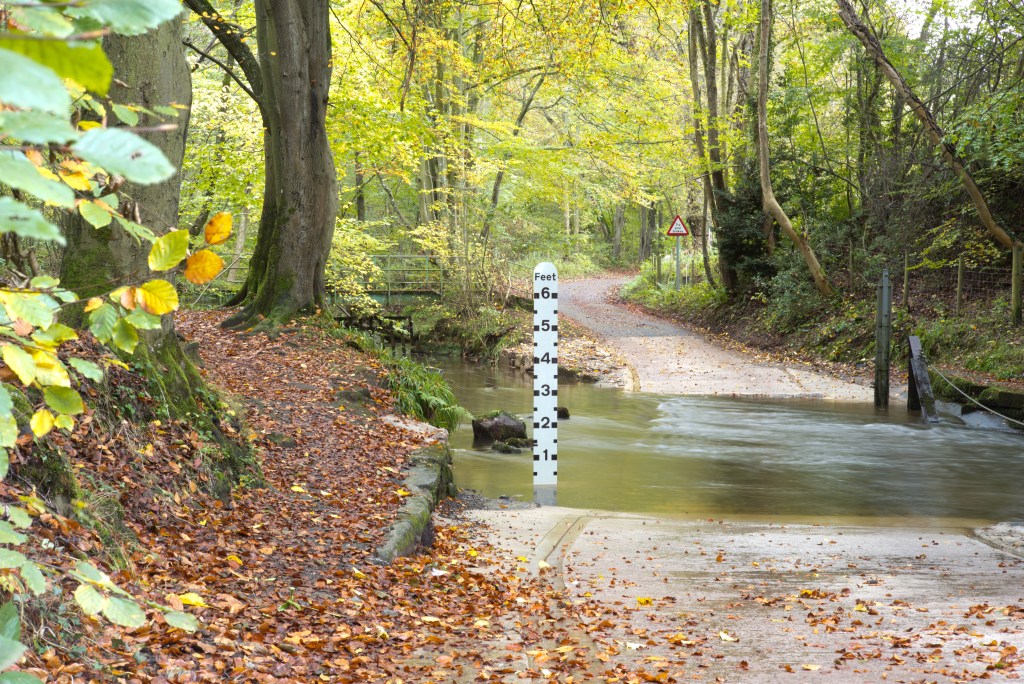
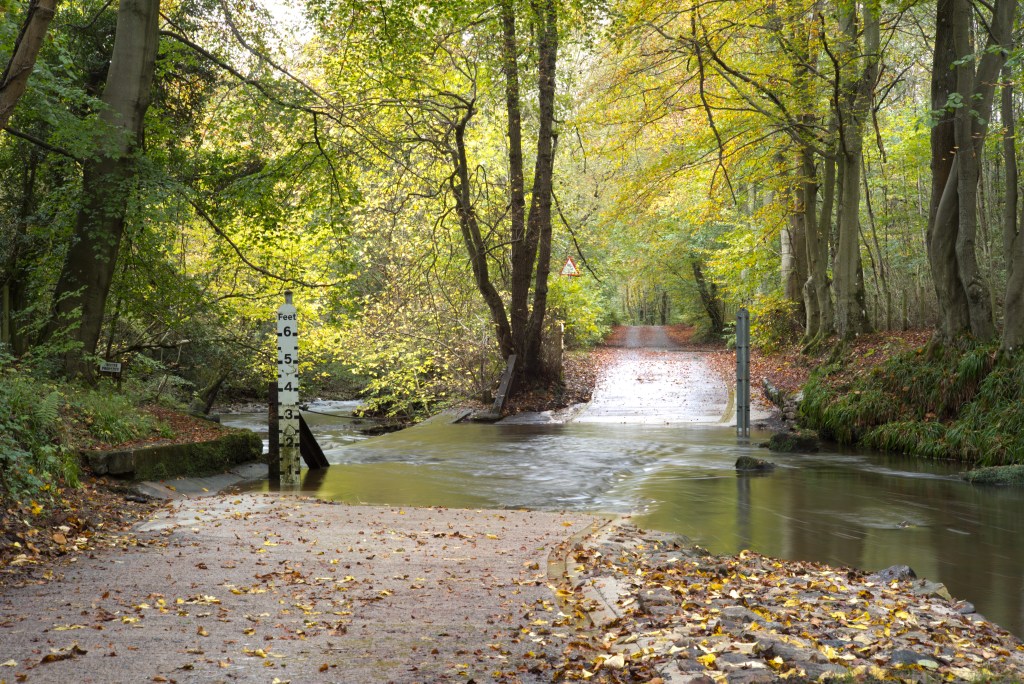
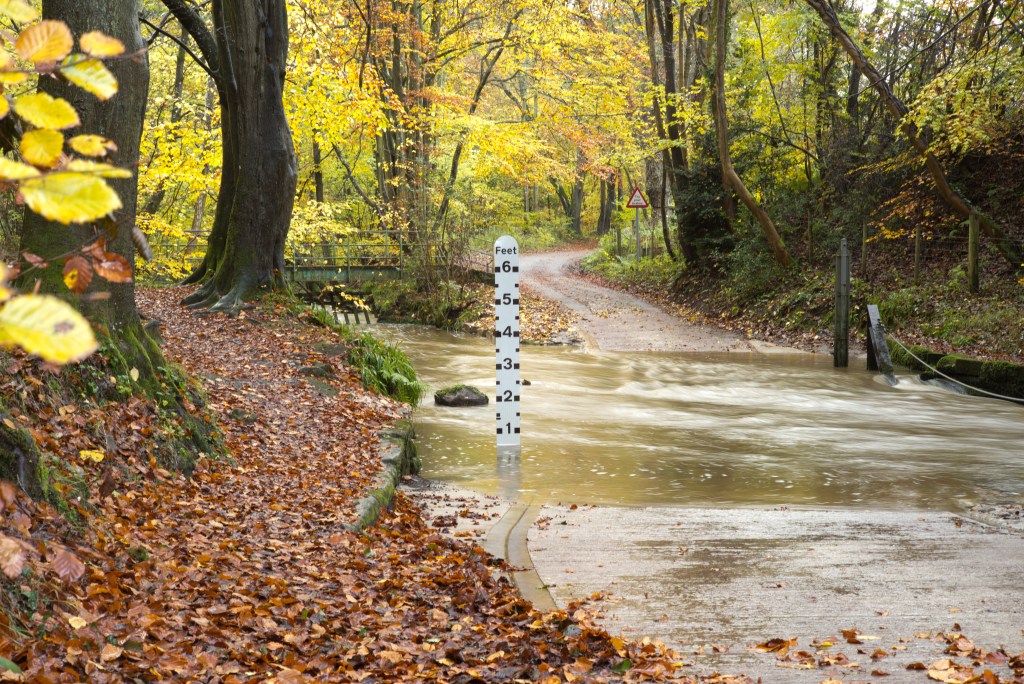
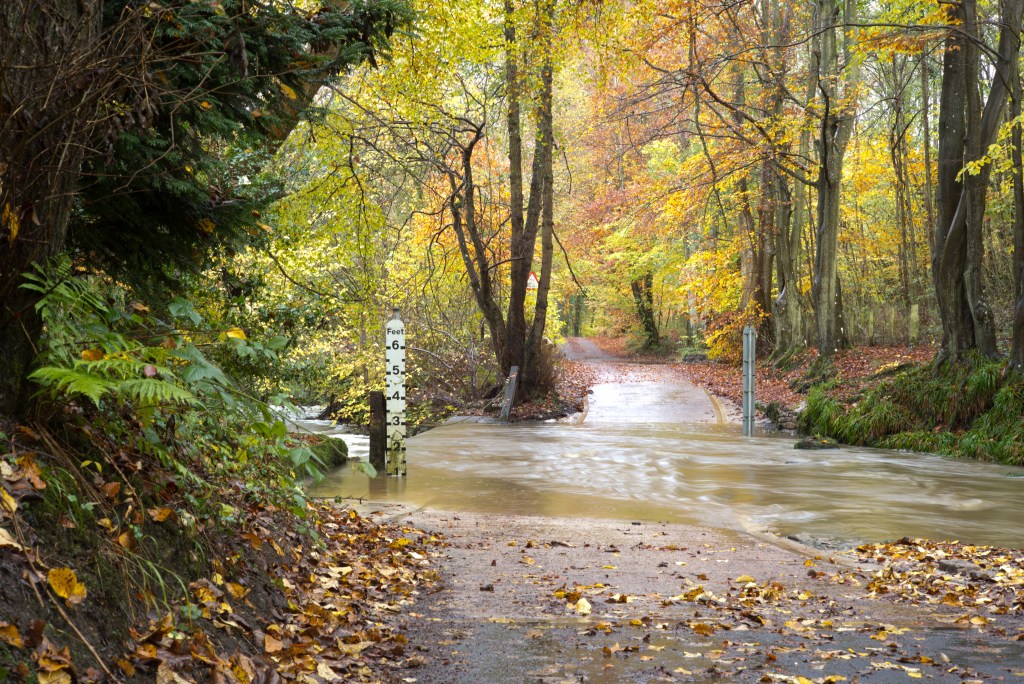
I have at last made a start shooting for this exercise. For now I have shot only the ford and will follow up with the fall back plans (on which I have had some more thought) later. I made a start now, despite the fact that the weather was quite bad today, to take advantage of the significant flow of water through the ford as a result of very heavy rain overnight. Despite the volume of rain over the last couple of weeks the water level had fallen back to just a couple of inches by yesterday. Today, on the upstream side, the water was almost two feet deep.

Having tried a few different angles I have settled on two, one looking upstream, one down. I will choose between them for the final set (assuming one of the backup plans does not take precedence) once a more substantial body of work has accumulated.

At the time these were taken it was raining (I had to shelter the camera under an umbrella as it is not weathertight!) so the light was quite poor. Exposures were as a result quite long (1.5s for the first, at f/16, ISO 400) which has made the water quite glassy and smooth. Obviously I used a tripod, which I set fairly low to keep some of the road in view in the foreground.

Fortunately, because of the depth of water I did not have to worry about cars coming through. One did approach from the downstream side but wisely turned around and went back!

Just how often I repeat these shots I have yet to decide but I expect it will probably be weekly. I can though be flexible and judge when it is worth revisiting on a daily basis as I walk the dog this way most days and so can see if there have been any noticeable changes before deciding when to come back with a camera.

14 October 2019

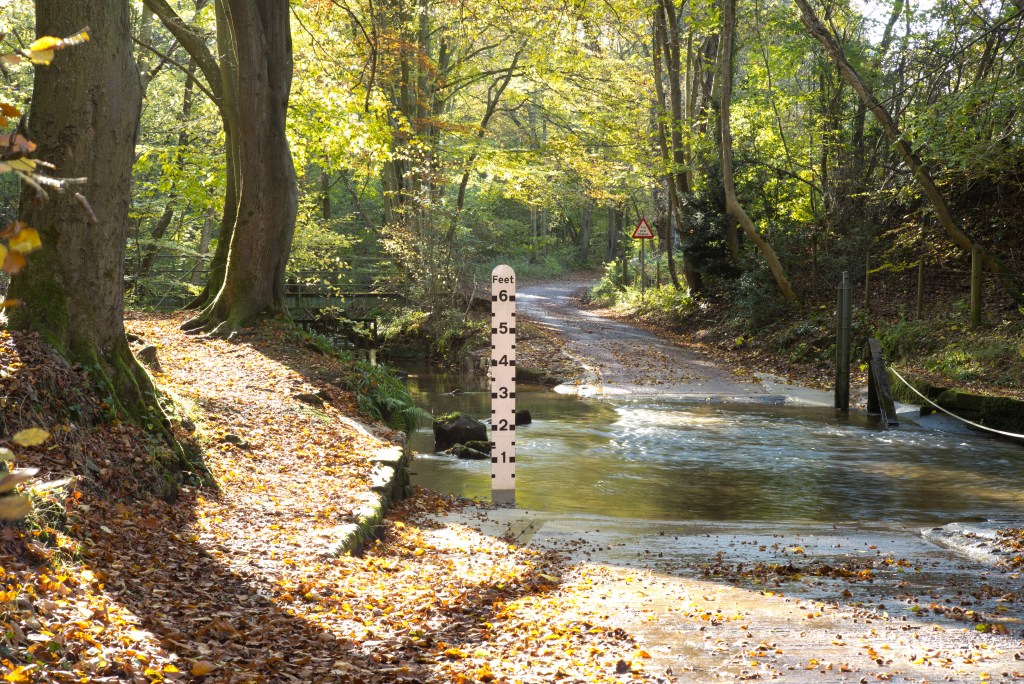
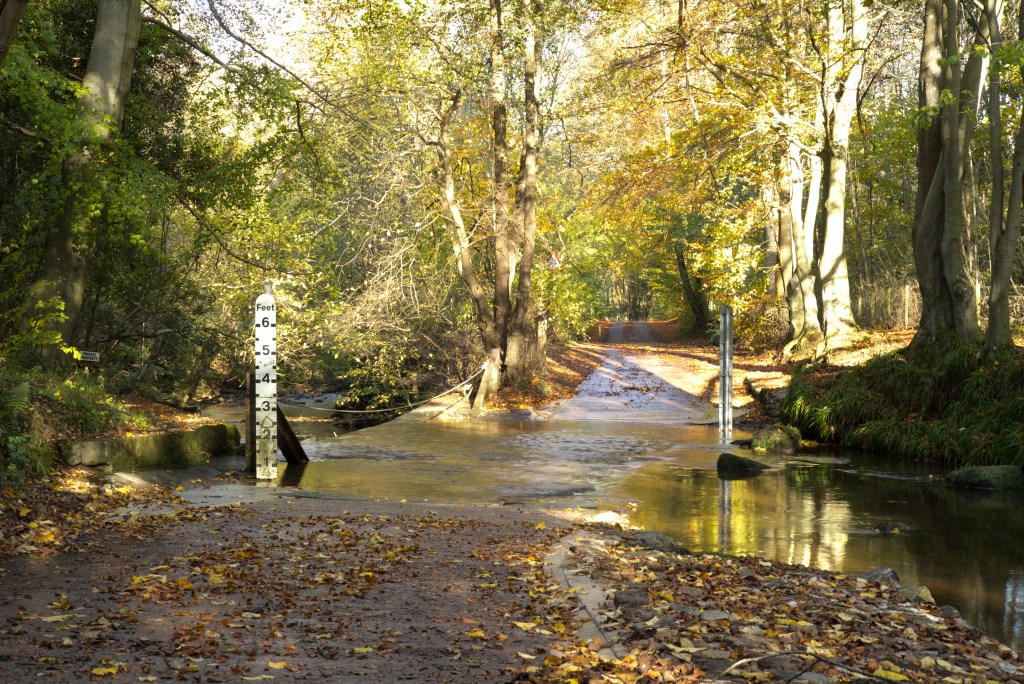
20/10/2019
20/10/2019

Interesting that these last two pairs of photos suggest that the default depth of water in the ford with regular but not too concentratedly heavy rain is about three inches, not something that I have noticed before.

27/10/2019
27/10/2019

The latest instalment. As with Plan B I think now is the time to stop the regular updating of this post and simply continue to gather shots that can be properly edited later. I will though add more if, for example, we have another flood or other dramatic changes to the scene over the coming months, which is quite likely given the amount of rain we are getting at the moment.

03/11/2019
03/11/2019

Exercise 1.5: Visualising Assignment Six: Transitions

Compared with previous modules I have got off to rather a slow start with this one, partly because its start overlapped with finishing off I&P and getting everything ready for assessment next month, partly because of some personal issues that have kept me away from working on this. I do though now feel that I am getting back into a groove, a routine, and getting more work done. What I really need to do though is get back out with an camera and make pictures again! This exercise gives me an opportunity to get going once more.

The idea of taking a series of images of the same scene over a prolonged period of time is something that I have thought about before and is something that I have already written about. Going right back to EYV and the Square Mile assignment this is an idea that I looked at then: (https://wordpress.com/post/markrobinsonocablog.wordpress.com/119). So it is good to come back to it again now. There is an obvious difference in time scale between anything that I can achieve over the next year or so and what Tom Phillips did over twenty years but nevertheless I feel this is still potentially fertile ground.
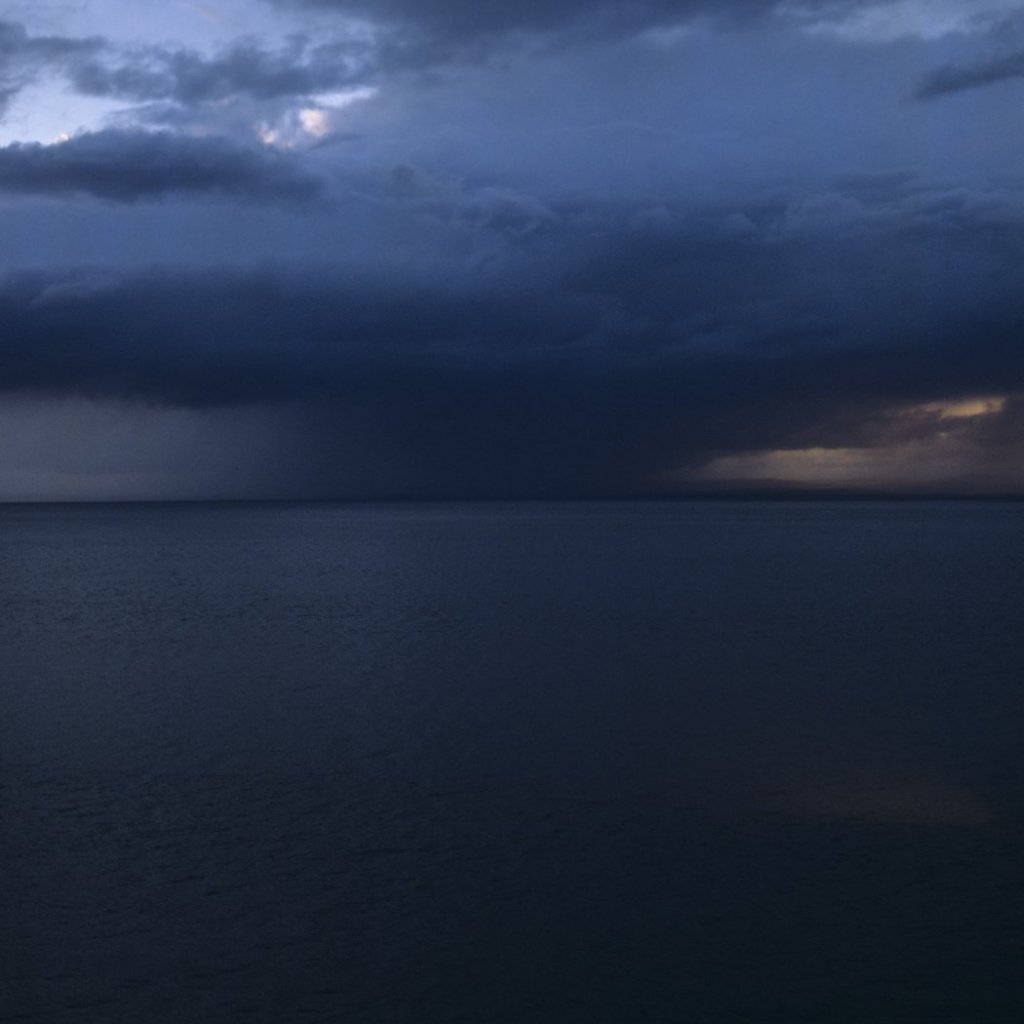
One project I would really like to pursue would be to take photos, possibly even on a daily basis at least at some times of the year, of a particular seascape, showing just sea, horizon and sky. This is partly inspired by the seascapes of Hiroshi Sugimoto (2019) that I have referred to before – though his work shows seascapes from around the world, rather than focusing on one single place. Coincidentally I have also just discovered some of the early, camera-based work of Garry Fabian Miller in the latest issue of the British Journal of Photography, particularly (at pages 52 and 53) from his Sections of England: The Sea Horizon series, of which this is an example (Number 18 Series 2 1976):

These works differ significantly from Sugimoto’s in that they are in colour whereas in his seascapes, so far as I can tell, Sugimoto worked exclusively in monochrome. They are also more overtly dramatic in so far as some feature a distinct horizon, and a focus on prevailing weather, reminiscent of the cloud sketches by Cozens and Constable, and Turner’s storm scenes. I do not know though whether he shot in a number of different locations or whether each image is of the same stretch of sea, although under differing conditions. For the purposes of a project such as this I think that Fabian Miller’s approach would be more productive.

Unfortunately however such a project is not really practical, even without bearing in mind the guidance in the brief for this exercise to concentrate on somewhere nearby. Although I am not that far from the coast, it is nevertheless the better part of a sixty mile round trip – at least – to the nearest possible location that I have in mind. It is simply not practical for me to be covering that sort of distance on a regular, let alone frequent basis. That is a shame because this is something that I would really like to try more seriously; maybe it will just have to become a personal project to be pursued over a much longer period.

My primary choice of practical subject is therefore a ford about ten minutes from home, and past which I have walked with my dog nearly every single day over the last three and a half years, where the scene is constantly changing, and which I have observed closely. I therefore already know what it is likely to look like at any given time of the year. There are obvious seasonal changes but it is also somewhere that can be subject to shorter term, sometimes quite dramatic, changes depending on weather and light conditions.

I have also been giving some thought to a plan B. I have not yet settled on a firm idea yet, and is suspect this will not crystallise until I have got down to proper work with plan A, but I have a couple of thoughts. One, proceeding from a comment in the exercise on preconceptions is that a landscape does not have to be a macro environment but can also be a micro one. With this in mind one possibility I have been thinking about is to photograph a spot (probably in one of the local woods) no more than, say, a metre across, to explore and reflect the changes that take place on a much smaller basis. Another is to focus on a location that is more man-made and is subject to more “managed” change. One possibility that I have in mind for this is a scrap-yard on a small industrial estate in Hexham, which is a site that I could realistically visit as much as weekly. Again this needs further thought but for now I think what I need to do is just get on and shoot at each location and see how they develop. I imagine there will still be time to change tack later if necessary, as long as I do not leave it too long.

Phillips, T (1992) Works and Texts.  London: Royal Academy of Arts

Sugimoto, H, (2019).  Seascapes.  Bologna:  Damiani Editore

Auerbach, J (2016). 20 Sites n Years: A film by Jake Auerbach

http://www.garryfabianmiller.com/work/view/sections_of_england__the_sea_horizon_3

British Journal of Photography, Issue 7889, November 2019

Smaller Apertures and Visualisation – Ansel Adams

I have been busy over the last couple of weeks with a number of other things, including getting I&P ready for assessment and prints despatched, so have not had a chance to do as much work as I would normally. Nevertheless I have at least been able to catch up with some reading, particularly on Beauty and the Sublime, which we will come to next in the course material. I have also been able to do some reading about Anselm adams, who is the focus of this particular part of the course.

When I started out on this module I identified one of the things that I would probably end up doing is re-evaluating my views on Adams and his approach to landscape photography. That I have now started to do by reading his book ‘Examples’ (1983). Subtitled “The making of 40 photographs” this is a sort of blow-by-blow account of the technical aspects of a selection of his photographs and how they were made and printed.

Of particular value to me is that this book has introduced me to a wider range of his work than I had otherwise been aware of. I am reasonably familiar with his work for the US National Park Service and have seen plenty of his other work, particularly in and around Yosemite. This book though has introduced me to some slightly more abstract work, and some striking portraits. This non-landscape work is something that I would like to see more of and will make some effort to track down. So far as the landscape work is concerned, although I still admire it and am impressed by it, it still does not really move or inspire me.

Whilst I can see the point of the position adopted by the f/64 group and their opposition to “pictorialism” and its use of photography as a sort of imitation of painting I cannot but help feel that much of the “straight” landscape work is still in essence pictorialist but with a sharper focus. The emphasis is on creating striking, impressive, beautiful, and I guess sublime, compositions – certainly very successfully – but as I have said I am left unmoved either an emotional or an intellectual level. I much prefer to look at work that carries some meaning beyond the surface appearance and with much of this sort of work I simply do not get it.

Far more interesting I find, for example, the work of Edward Weston whose landscapes tend much more towards the abstract, as illustrated by his “Dunes, Oceano” that appears in the course material. I will though keep an open mind, look at more of Adams’s work and see where it takes me.

So far as the book itself is concerned, it is interesting to follow Adams’s approach to his work and some of the little anecdotes are interesting and enlightening. However a litany of technical details repeated over forty photos eventually makes for a pretty dull read and ultimately there is a limit to how much I think I have learned so far from a technical point of view. As I have written elsewhere, particularly in the context of EYV, I am interested in, and am continuing to experiment with film, not least with my 4×5 large format camera, which I guess is not a million miles removed from some of the equipment that Adams used. I still feel that going back to basics is good discipline and it helps to reacquire some of the fundamental skills and knowledge that is perhaps otherwise at risk of getting lost with all-singing, all-dancing digital cameras. There are though limits. I do not get much from the discussion of lenses, not least because my lens (which is admittedly the only one that I currently have for this camera) although quite old is still a much more up to date piece of kit than the things Adams was using back in the 1930s and ’40s. The discussion of filters also does not help much as I do not presently have any (and indeed have no idea how I would use them with my current lens!). I do wonder what someone who has not worked with film, whose only experience is with digital equipment, would make of and get from much of this technical detail.

To be fair I think the problem stems from my own ignorance and lack of experience, rather than any underlying fault on the part of the book or adams’s writing and I guess I should use it as a spur to go out and learn more. In part I am at least going to do that once I start making prints directly from my negatives: I now have a light and timer unit that works with my camera, transforming it into an enlarger, and just need to sort out a darkroom. I suspect that once I start printing, much more of what he wrote, not least on the Zone system (on which I do not propose to say anything for now as I see that it is coming up in the course material as a topic in its own right, other than to say that it is at least now starting to make some sense to me) will have more of a practical impact and influence.

For the time being I think the most valuable thing I get from this work is the idea of visualisation. I guess it ought to be obvious but clearly it is not that it should not simply be a matter of looking through the viewfinder but of thinking from the outset about what the final image is intended to look like. I see this as particularly relevant when working with film and printing traditionally. I see no reason though why it should not also apply when working digitally and using the likes of Photoshop. I certainly feel in my own practice that I have become more thoughtful and considered about composition in camera before releasing the shutter and that as a result I am making stronger work. It also fits with my general preference not to indulge in any more post-production processing in Photoshop than I can realistically get away with. This is something for me to develop further (pardon the pun!) as I do more film based work in the darkroom.

Adams, A, (1983).  Examples: The Making of 40 Photographs.  Boston:  Little, Brown & Co

Exercise 1.4: What is a photographer?

I have long thought the question whether the photograph can be art a somewhat sterile one – shades of angels dancing on the heads of pins – and ultimately not particularly productive. It is something that has been written about at considerable length and a number of books on the subject (such as ‘Art and Photography’, ‘Art Photography Now’, ‘The Photograph as Contemporary Art’, to name just a few) grace the shelves in my study. So it is a little ironic to come across a single sentence now that in many ways I feel both encapsulates and resolves the debate, that was written as long ago as 1913.

Marius de Zayas was, I am afraid to admit, pretty much unknown to me before now, notwithstanding that I was aware of Stieglitz’s work with Gallery 291 and his championing of modern European art in New York at the beginning of the 20th Century. (I had to look him up on Wikipedia!) So being introduced to his essay “Photography and Artistic-Photography” from Stieglitz’s Camera Work in 1913 has been something of a revelation. (I have used the Journal1913 link as the other one cited in the course material comes up “Access Denied”.)

His opening sentence is the most succinct formulation on the subject I have ever come across:

“Photography is not Art, but photographs can be made to be Art.”

Photography is a process which, as de Zayas argued, seeks to find an objective view of Form. It is scientific and investigative, without preconceptions. Artistic-photography on the other hand is subjective, the artist-photographer bringing his or her preconceived ideas and notions to bear on Form: “… the [artist-photographer] uses the objectivity of Form to express a preconceived idea in order to convey an emotion.”

It is not quite as straightforward, or as simplistic, as one saying “it is art because I say it is”, but certainly in de Zayas’s view, as I read him, the intention of the person releasing the shutter is a significant element.

But – and there always seems to be a but – is his formulation wholly correct today in the light of the unprecedented number of images now being produced? For very many of the quotidian images that proliferate today I think the distinction does have validity. However, what about those images that are taken with some intention on the part of the person taking them beyond that of mere objective representation, but which fail to meet or effectively communicate those intentions? Do they cease to count as ‘art’ or are they just ‘bad art’.

And what about the works that are produced simply as a record? From the very acts of choosing what to shoot, where and when, is not the most apparently straightforwardly documentary work (in the widest possible sense) not also affected by the subjective views and intentions of the photographer and so capable of being art? I know that Don McCullin, for example, refuses to refer to himself as an artist, as anything other than “a photographer”, and that his work does not necessarily aspire to be “art”, but I cannot help but see much of it in that vein, as art, and good art at that.

Again I come back to the example of Bernd and Hilla Becher: does their ostensibly purely objective, typological approach not also amount to art?

What I am left thinking is that de Zayas’s formulation is largely correct but as ever when a dichotomy such as this is set up (and I do not like such superficially clear distinctions much at all!) it can at times turn out to be a false one, and at least to have slippery, mutable boundaries. If nothing else I guess it is for this last reason that I find the art/not-art debate so ultimately unhelpful and dissatisfying.

So what I am? Artist, photographer, neither, both? I think it varies from time depending on what I am doing and for what purpose. Mostly though I would, I think more accurately, just describe myself as a student of photography – or simply an old bloke who takes pictures.

http://www.journal1913.org/pdfs/1913_issue2.pdf

https://en.wikipedia.org/wiki/Marius_de_Zayas