When I first read the brief for this exercise I did not really know where to turn. As ever though something has, by chance, or coincidence, (or my trusty unconscious working overtime) cropped up that I think will serve. Fortunately it relates to photography and contemporary work at that. It also fits with certain aspects of Buddhism that I have been thinking about, if not directly meditating upon, recently.
From the reading that I have been doing of late on the Sublime the particular ideas that appeal to me most strongly are those relating to personal transcendence and the representation of the unrepresentable. On a second reading of Morley’s article (which incidentally I vaguely recollect seeing for the first time when it was published in the magazine Tate Etc back in 2010, at which time I was a Friend of the Tate and so received the physical magazine each quarter) two things caught my eye.
One was the following:
“But often contemporary perspectives on the sublime reject traditional conceptions of a self, or a soul or spirit, seen as moving upwards towards some ineffable and essential thing or power. Instead, the contemporary sublime is mostly about immanent transcendence: that is, it is about a transformative experience understood as occurring within the here and now.”
He then refers to the work of, in particular, Hiroshi Sugimoto, and a sense of void – “of being on a borderline or edge where we can no longer codify experience”. These ideas link to the Buddhist ideas of mindfulness and nothingness or emptiness, ‘sunyatta’, often represented in Zen as a calligraphic circle. A useful definition, or explanation, of the concept of emptiness can be taken from Baas & Jacob (2004) (at page 266):
EMPTINESS: The teaching unique to Buddhism, namely, that which we ordinarily perceive as inherently solid, permanent, lasting, and disconnected from and independent of everything else, is actually ’empty of inherent self-existence’, empty of anything separate and independent, fixed, permanent and self-maintaining. The Buddhist view is that phenomena are impermanent, interconnected, and in continuous flux. …
(This is a book I am going to come back to later as there is an interesting chapter in it on photography as Buddhist practice which, even stripped away of its specifically Buddhist context, has some interesting things to say about how to look and see as a photographer. More anon.)
I am quite pleased that Morley has included Sugimoto in this context as he is someone whose work I admire, and have been looking at more seriously again, and on whose Seascapes book I have already written a brief note (https://markrobinsonocalandscape.photo.blog/2019/09/14/hiroshi-sugimoto-seascapes-book/). So it is with him that I am going to stay for the purposes of this exercise.
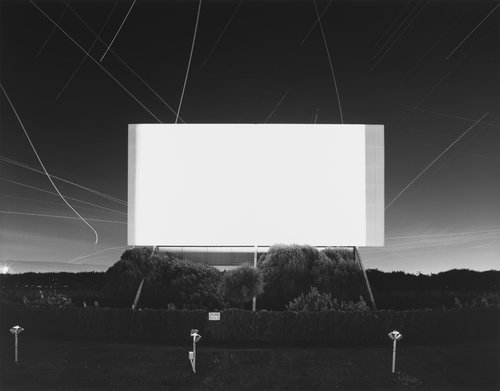
The example illustrated in Morley’s article is one of Sugimoto’s movie theatre pictures, in this case a drive-in, in which the exposure lasts as long as the film that was playing. What this inevitably produces a lit, but apparently blank, screen. That illuminated space is a sort of void, in the sense that nothing is visible within it, so that we can “no longer codify experience”, in this case in the sense that we cannot experience the film that is “depicted”. In a way this is also representing the unrepresentable: we have a still picture that captures and encapsulates a movie. A span of time has been reduced, in the form of the final photographic image, to a single instant. In Zen terms the photo is similar to the calligraphic zero. At a literal level the dark foreground and background sky, framing the “blank” lit screen, is a calligraphic ‘circle’ in its own right.
Union City Drive in, Union City 1993
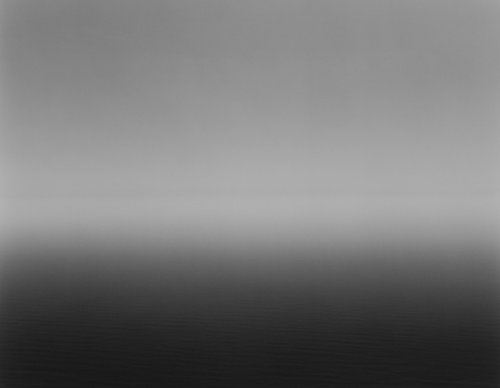
I feel the same argument can be made for the Seascape works that I have been looking at recently, and that I have previously in my own modest way sought to emulate.
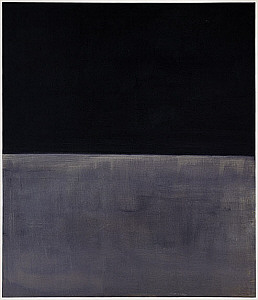
I had not realised until I read the introduction to Sugimoto (2019) by Munesuke Mita (at page 7) that the work of Mark Rothko, particularly the later monochrome compositions, specifically Untitled (Black on Gray), 1969/70 below, which share a similar form to Sugimoto’s photographs (although, as he argues, a different sense of vitality) might similarly sit within this conception of the Sublime in so far as he had “eliminated reality, meaning, form, and color (sic) from his work”.
What Sugimoto has done with his seascapes is take the viewer outside of both space – the only clue to the “reality” of the scene, in the sense of where the picture was taken, which is by no means discernible from the internal context of the images themselves, is offered by the caption – and time, as he did with the movie theatres. As Munesuke Mita puts it (at page 9): “It is a fertile tranquility of eternally recurring time.”
That in itself might stand as a not at all bad further possible definition of the Sublime.
Ligurian Sea, Saviore, 1982
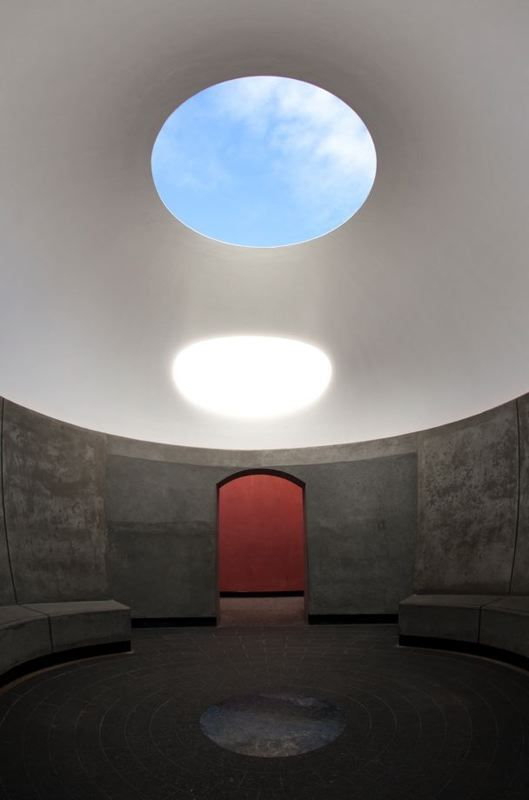
As an aside, it is interesting that Morley also mentions James Turrell in the same breath as Sugimoto. One of his Skyspace pieces is at Kielder (Cat Cairn), not too far from where I live. This is a circular space and so has at least superficial similarities with an enso and is doing something similar to Sugimoto in taking the viewer outside time and space.
I am going to think more about his work as a possible source or influence for Assignment 1, and also another possible approach to Exercise 1.5 (on which I am still having ideas!).
Baas, J, & Jacob, M.J. (eds) (2004). Buddha Mind in Contemporary Art. Berkeley: University of California Press
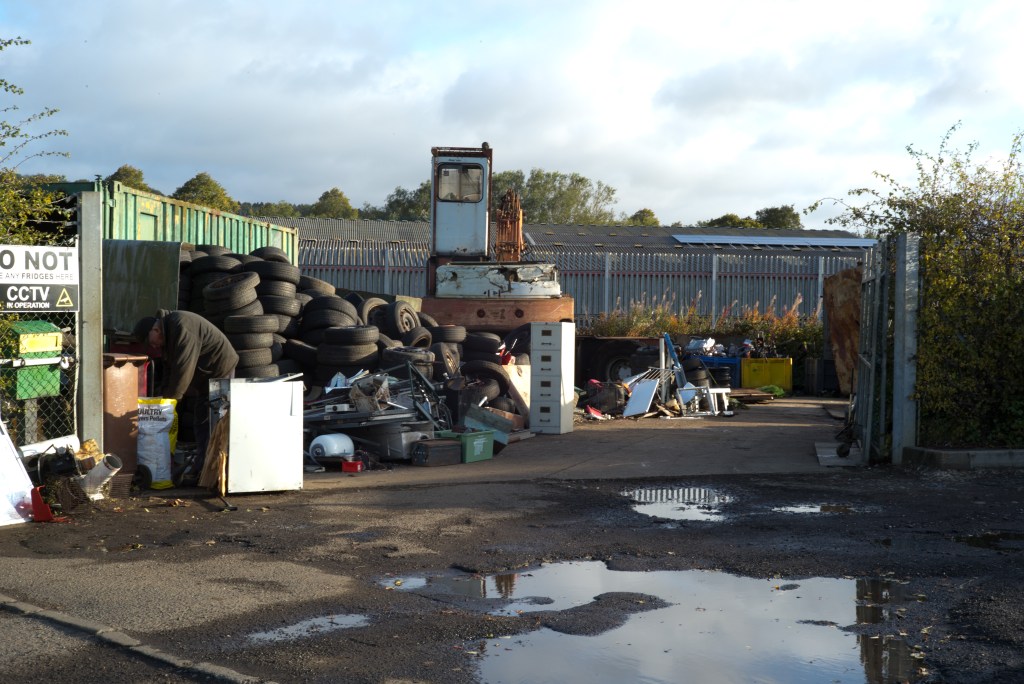
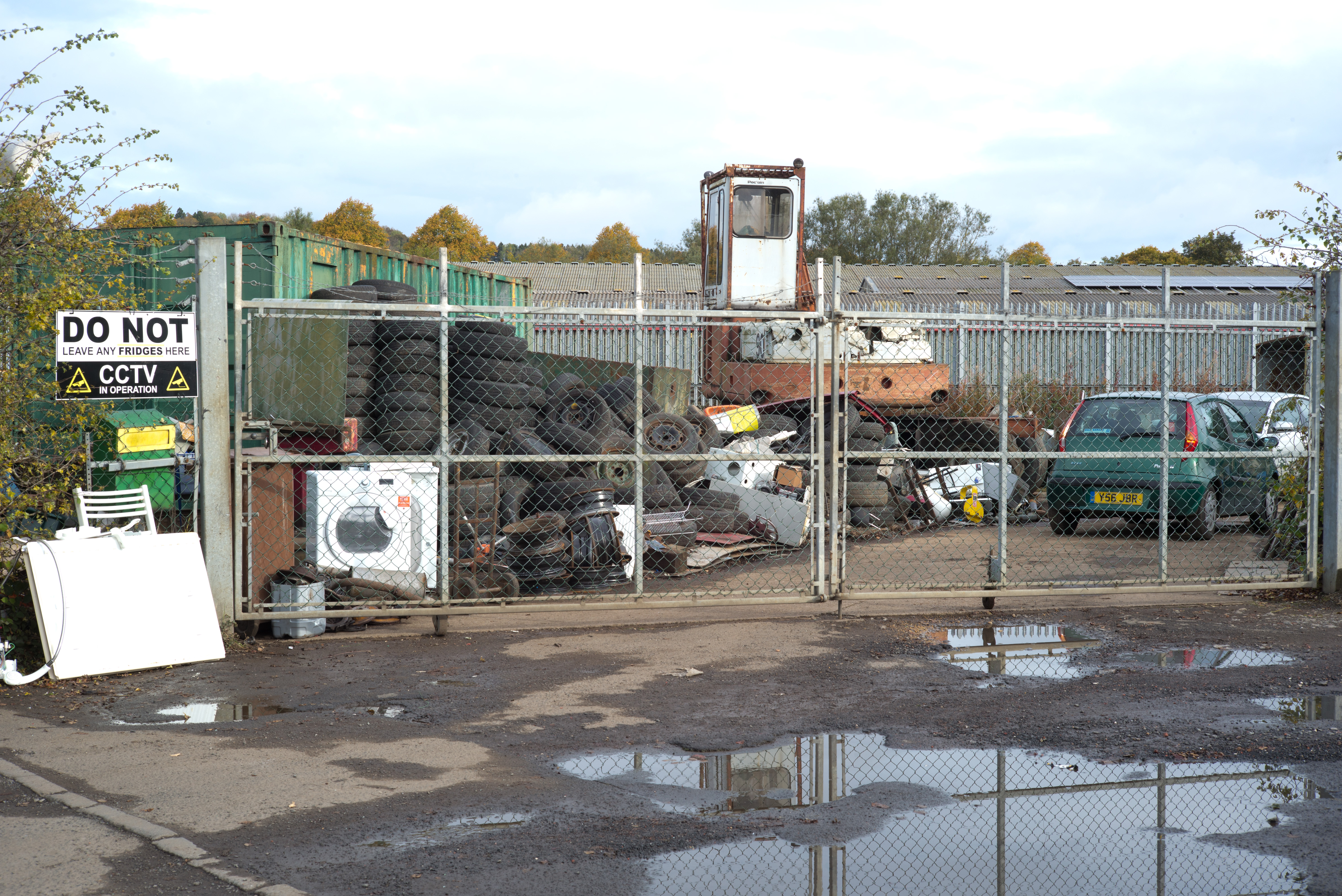
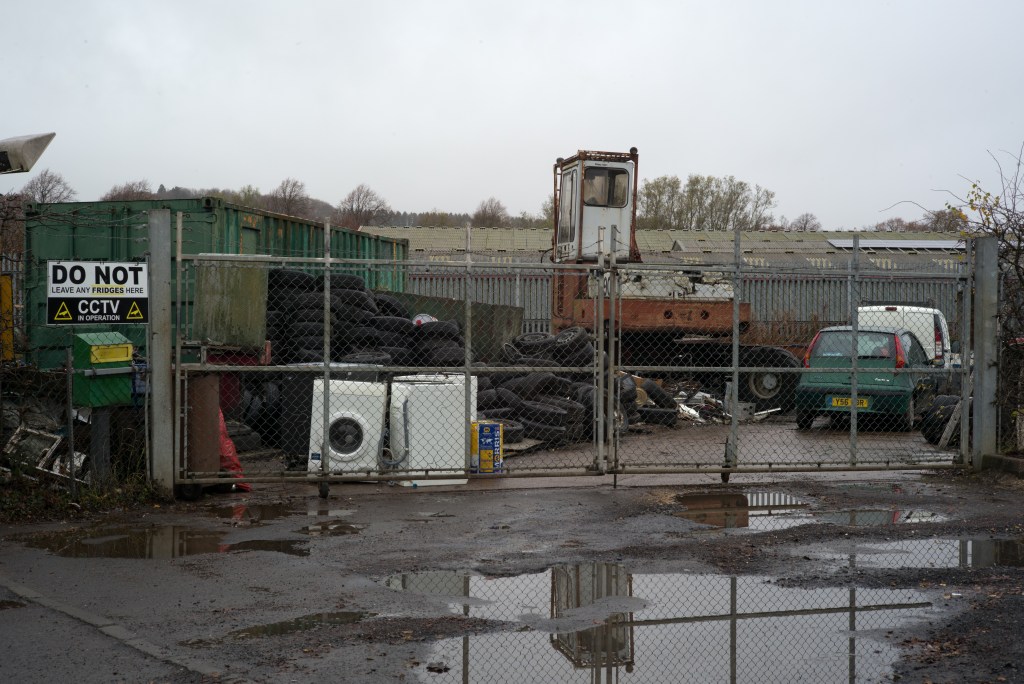
Here is a first go at a potential plan B, the local scrap yard. Normally I see this place on a Saturday morning when there is no-one about but as this was taken on a weekday the old fellow who evidently runs the place, rummaging there on the left was there. As a precaution, and matter of courtesy I asked if he minded if I took some pictures. Clearly from the somewhat bemused look on his face – I did not explain my intention as he did not show any inclination to engage in conversation – he must have wondered why on earth I wanted to do so, but nevertheless acquiesced.
I tried a couple of different angles but this was the only one that really worked and kept me close enough to the scene without having to stand in the middle of the road – there is enough traffic to present a hazard.
I suspect that further shots will be taken at weekends so the gate will be closed and no-one there. That might make the process a bit more comfortable. Anyway I will try it over the next few weeks and see how it starts to shape up.
I still have to settle on a possible “microcosm” site so will return to that later.
Continuing:
19/10/201926/10/2010
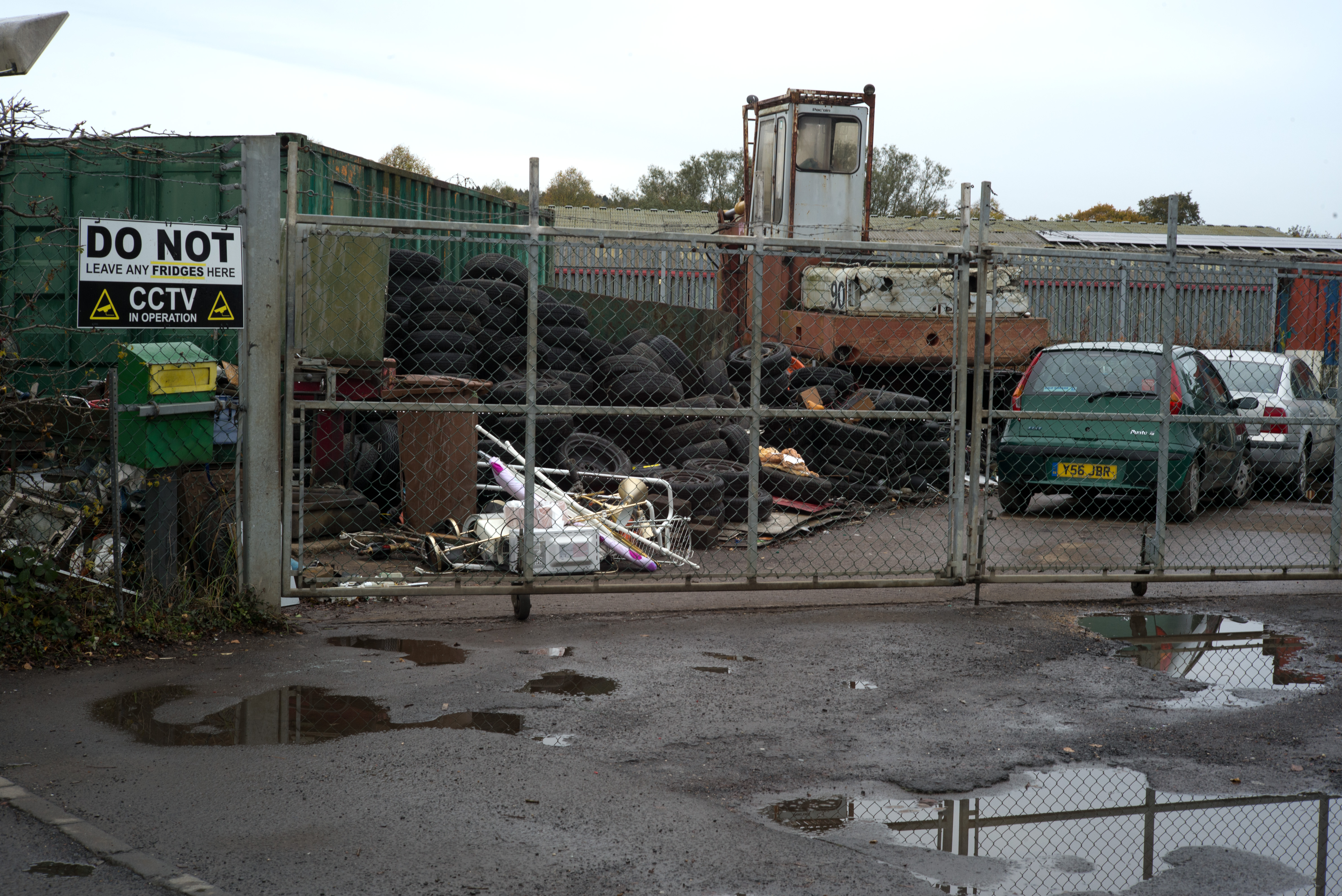
An overcast day after a couple of days of fairly heavy rain so the light was quite poor. To maintain a reasonable shutter speed of 1/60s and an aperture of f/11 to try to keep some depth of field, I found I needed to raise the ISO to 800. I am also finding hard to shoot from exactly the same vantage point each time because there are some cars that park on this little patch of ground opposite the gates and I keep having to shift position from week to week to work round them.
Last one for now. For the future I think what I will do is simply collect each weekly photo in a separate file and then sort and edit them once the time to finalise the assignment arrives, unless something noteworthy happens in the meantime. I feel it is a bit much at the moment to be updating this post every week. Rather I think I will do a sweep up post later, bringing the project up to date, even if only to confirm that this is not the subject that is going into the final submission.
02/11/2019
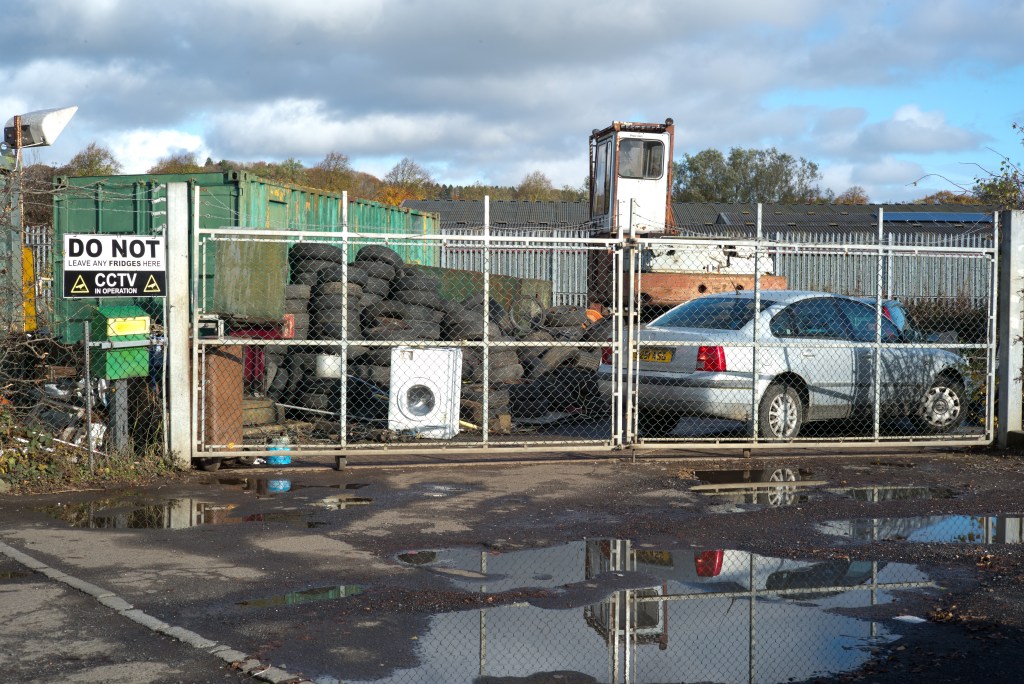
Since my last post on this I have at last decided that this is not a project that I am going to pursue further. Over the last few weeks I have continued to photograph the same scene and it is barely changing at all. Variations in the weather (not that it has changed much recently having been fairly monolithically overcast and wet) are I feel not enough to sustain interest.
16/11/2019
I think part of the problem is that I can really only shoot here on a Saturday but that is when no-one is working in the yard and nothing is happening. As a result all that there is to be seen from one week to the next is a puddle and a parked car! I cannot realistically expect that there is going to be sufficient seasonal variation to make much difference. I will therefore from now on be concentrating just on Plan A.
Before getting into Exercise 1.6 (and at the moment I do not really know what work I am going to focus on – I will come back to that) I have first been looking at the concepts of Beauty and the Sublime. What follows is a very partial, no doubt characteristically personal, and admittedly not particularly profound, series of thoughts and observations on what I encountered so far, and ideas formed accordingly, on these concepts.
To be honest, apart from dipping into Beech (2009) (the introduction alone makes the book worth having), I have not read very much on the idea of Beauty. Rather I have concentrated more on the Sublime, which I think is the more interesting, if not necessarily the more controversial, of the two ideas. Frankly the academic discussion of Beauty does not really interest me. Aesthetics, as a subject, has never been a subject that holds my attention. Someone that I know has written a book on aesthetics, which I understand is well regarded, and teaches – or at least used to teach – at university, so I am well aware that this is a serious and, to some extent at least, an important area of study. Nevertheless, though I mean no disrespect, it simply does not do much for me personally as an intellectual subject. Though I had not quite thought of it in these terms before this is one reason why I find the work of Marcel Duchamp intriguing. Dadaism was rooted in rejecting aesthetics and the problems that it posed, not least the aestheticisation of capitalist society and culture.
If nothing else this highlights for me what I see as a flaw, or at least an overstatement, in Burke’s argument that beauty is a matter of taste and that taste is universal. As Beech argues in his beautifully concise introduction that is simply not true of all cultures at all times. To take just one example (not meant in at all a sexist way) consider the ideals of feminine beauty and how they have changed and varied over the centuries, as is clear from even a cursory reading of Berger (1927) in his discussions of the male gaze.
The other book I have read specifically on the subject of beauty in photography, is the aptly titled one by Robert Adams (1996). This beautifully concise and lucid collection of essays really only addresses the question of beauty in just one chapter, but it is one that gets straight to the heart of the matter. Without wishing to reduce his argument to an inaccurate and unrepresentative over-simplification, Beauty is Form. As Stieglitz is quoted at the end of the chapter (page 36): “Beauty is the universal seen.” An admirably pithy observation to offset so much of the academic blether that has been written on the subject. (I have a particular target in mind so far as the Sublime is concerned that I will come to anon.)
I did also go back to Alexander (2015) which I had read earlier in connection with I&P, looking again at the sections on Beauty and the Sublime in chapter two. Perhaps unsurprisingly, as Alexander apparently wrote this course, the book and course material pretty much cover the same ground so I did not really get much from this rereading. Still a good book though!
A paragraph that is particularly apt, emphasising the importance of understanding traditions and conventions, and which also speaks to some of my concerns about Ansel Adams, or at least about the way his work has been used and abused, and the salon-style approach to the striking single image, is this one (at page 27):
“One standard, then, for the evaluation of art is the degree to which it gives us a fresh intimation of For. For a picture to be beautiful it does not have to be shocking, but it must in some significant respect be unlike what has preceded it (this is why an artist cannot afford to be ignorant of the tradition within his medium). If the dead end of the romantic vision is incoherence, the failure of classicism, which is the outlook I am defending, is the cliché, the ten thousandth camera-club imitation of a picture by Ansel Adams.”
As a bit of an aside from the present consideration of Beauty and the Sublime, there are a couple of other comments Robert Adams makes in a later essay, Making Art New, (at pages 81 and 82) that caught my eye and are relevant to the issue of understanding traditions and conventions:
“Every serious artist borrows not only from those conventions but from the particular insights of individuals he admires. … It sometimes even seems as if the greatest artists borrow most.” (Picasso would of course have it that great artists “steal”!) “No serious artist would, in short, ever set out simply to repeat another.” Knowledge of the conventions is important butt must then be applied in a way to make out of them something new and personal.
The Sublime is on the other hand something about which I have been reading rather more, starting with Burke (1998), but giving Kant a miss (I have never got on well with Kant – perhaps I simply have not tried hard enough – and indeed do not have currently have any of his work in my library, unless of course there is something squirrelled away in an anthology, though I am at a loss to know which that might be). Again at the risk of being reductionist and over-simplifying, what I get from Burke is a sense that the Sublime is exalted and awe-inspiring (which also happens to be my dictionary definition), that it is about the attempt to represent the unrepresentable, to whit the Creator, although he was otherwise describing profound and moving experiences in what are purely secular terms.
How paradoxical though that Burke was of the view that art was not really capable of communicating a sense of the Sublime and that this was better done through poetry. From what little I know of Kant’s work, he too dismissed art from his consideration and concentrated on the importance of the aethestics of the experience of nature. (What little I have picked up of Kant’s thinking comes form the surprisingly engaging and interesting Melvin Bragg radio programme referred to in the course material which I thinks stands as a really useful primer on the subject, and more useful than some of the more “scholarly” stuff that has been written on the subject. (Unfortunately the BBC have just introduced their wretched Sounds app which means that the quoted link no longer works. After a bit of searching I have found the current one, cited below.) Paradoxical because just about everything else that there is readily available to read on the subject is from the perspective of the visual arts. Indeed, the subject of the Sublime seems to have all but disappeared from poetic discourse. OK, it might still be there and I have missed it: I read quite a lot of poetry still but fairly selectively, and none of the modern and contemporary poets I habitually turn to seem to dip their toes into this particular murky pond. If I want a poetic Sublime I find I have to go back, principally, to Milton!
What else have I been reading? Top of my list has been Morley (2010), whose introduction os again admirably concise and clear, giving a good overview of the subject. I have to say though that that overview, as goos as it is, leaves me with the inescapable feeling that much of what has been, and unaccountably is still being, written is more of the same angels dancing on pin-heads stuff and that the range of different types of Sublime has now become so wide and varied as to make any definition, indeed any conception, of the Sublime almost meaningless and otiose, except as an hermetic, academic discipline. Apart from the introduction I have so far only doomed in and out of the main body of the book but the overriding impression it gives is just that, that the subject has become so broad and varied it is in danger, if it has not done so already, of collapsing under its own weight. Nevertheless there a a few potentially useful things that I have already happened upon, and a few more that I can see I am going to want to think about more in connection with Exercise 1.6. (I have included Morley’s Tate essay in the references below as I have read it – and found it useful – in connection with this current rumination. I will withhold any direct comment on it though until I actually address that next exercise.)
One of the key texts included in the book so far as more contemporary conceptions of the Sublime is concerned is of course Barnett Newman’s The Sublime is Now of 1948 (page 25). In large part of course it is just a commentary on the development of the idea of the Sublime. I have to say though that apart from putting the idea back into contemporary critical discourse I am not sure it does much in itself to develop the idea. Rather what I get from the essay is a sense of a concern on Newman’s part to separate contemporary American artists from the history and conventions of European art, which he saw as having failed to achieve the Sublime and had got bogged down in debates about beauty and aesthetics. It is a call to American artists to be new. Whether that is something that was actually achieved is another matter for debate elsewhere.
In some ways even more useful is the essay by Julian Bell that I found when trawling through the mass of stuff on the Sublime on the Tate website e(Julian Bell, ‘Contemporary Art and the Sublime’, in Nigel Llewellyn and Christine Riding (eds.), The Art of the Sublime, Tate Research Publication, January 2013.) This has the advantage of not only not being bogged down with tortoured academic modes of discourse but also of approaching the subject from the point of view of a practical, practising artist. There are a couple of useful, or at least interesting, things I get from his article.
One thing is that it has got me to look a little more closely at Jean-Francois Lyotard (though I still have to read his contributions to Morley more closely). I have previously fought shy of reading him, given my inherent antipathy towards Theory and wariness of the philosophising of the French Left in the latter half of the last century. Nevertheless it seems to me that in some ways Lyotard hit the proverbial nail on the head. The Sublime is “presenting the unpresentable”, or as I put it earlier representing the unrepresentable. How this works in practical terms I need to think about more but this seems to me to encapsulate what the Sublime is about now, regardless of how it might have been presented in the past.
Another is his all too gentle swipe at Gilbert-Rolfe (1999), which I found strangely reassuring. Despite my antipathy towards much academic theorising, because his book is on the reading list I obtained a copy and had a go at reading it, not really knowing what to expect. I got through the introduction and most of the first chapter before completely losing patience with it. I spent 33 years practicing as a lawyer. Words and language were my primary tools and precision and, despite common misconceptions, economy of their use were of paramount importance. As a result I have no truck with such self-consciously and determinedly “clever” academese, with its mangled syntax, imprecise use of language, other than in an almost hermetic, private-language sort of way understandable only by fellow academics who speak the same language. I find it obscurantist, exclusionary, and often straightforwardly incomprehensible. All of the other work that I have read on this topic so far has been written in clear immediately intelligible language. Some of it has needed a bit more close analysis but nothing too onerous. This book though all too often simply comes across as the polar opposite. I very nearly ended up throwing it across the room in frustration. It is not so much that I cannot tease a meaning out of the word-salad but that it is frankly not worth the effort. So step forward Julian Bell who nicely, and subtly, puts this book in its place:
“By 2001, when Jeremy Gilbert-Rolfe published Beauty and the Contemporary Sublime, the institutionalisation of a concept that in Lyotard’s hands had been definitively anti-institutional was already a given. Gilbert-Rolfe contrarily proposed (as far as I can tell) that nowadays it was the category of ‘beauty’ (idiosyncratically defined) that was truly radical and liberators. A short sample of the book’s argumentation may suggest why it failed to resolve the issue to universal satisfaction:
The extreme mobility of the contemporary sublime erodes autonomy because it calls for movement through the heteronomous which is itself heteronomous, provisional singularity taking the place of the irreducible, movement being the indertiminacy of what is erased and represented within it.”
I rest my case and I doubt that I am going to spend much more time trying to wade through this book’s verbal soup.
I wil come back with more on this when I address the next exercise.
Adams, R, (1996). Beauty in Photography. New York: Aperture
Alexander, J.A.P, (2015). Perspectives on Place. London: Bloomsbury
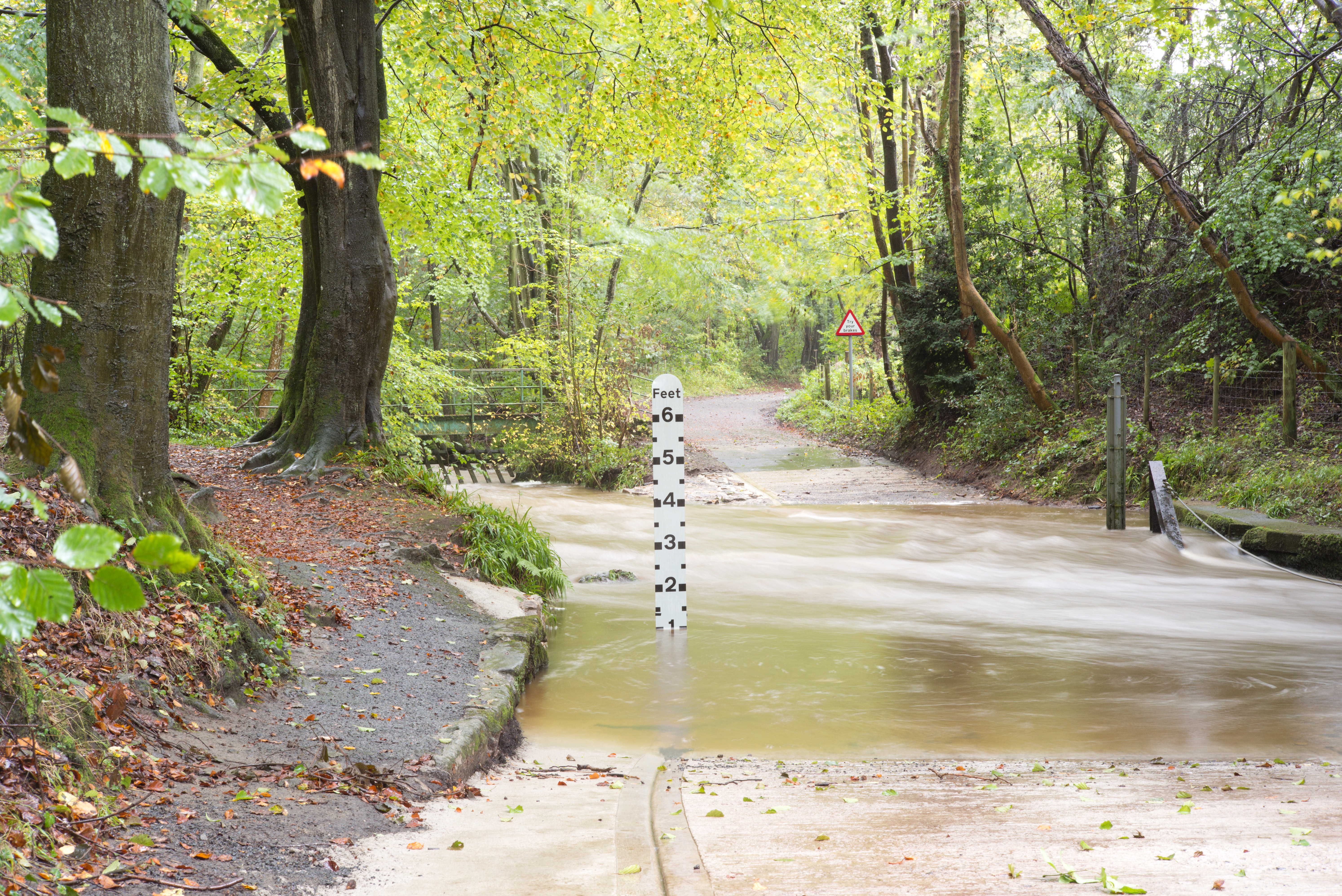
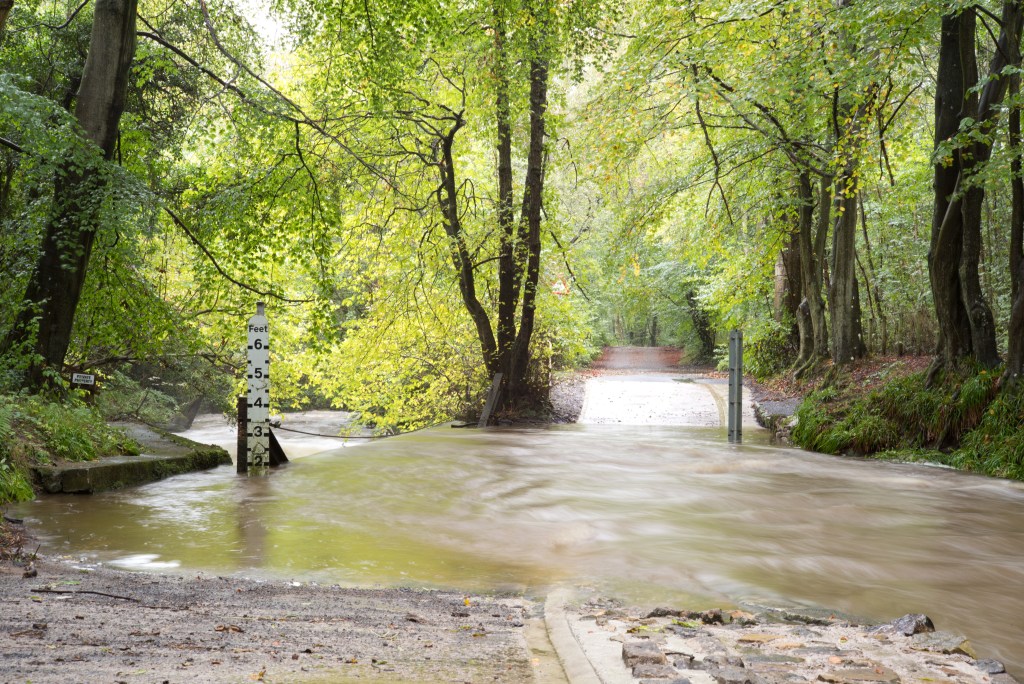
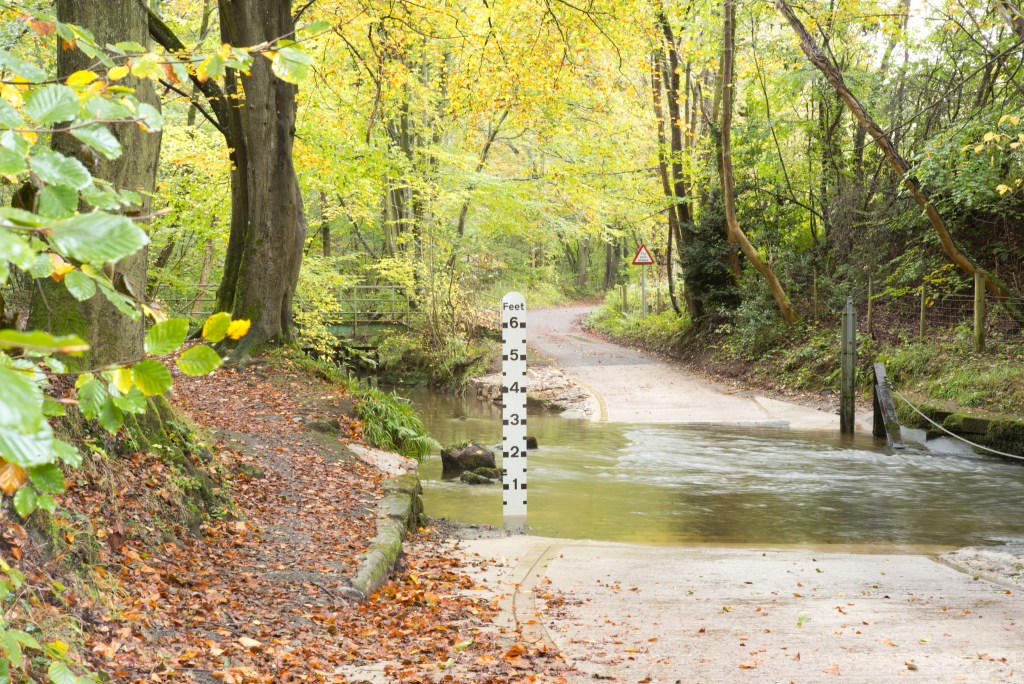
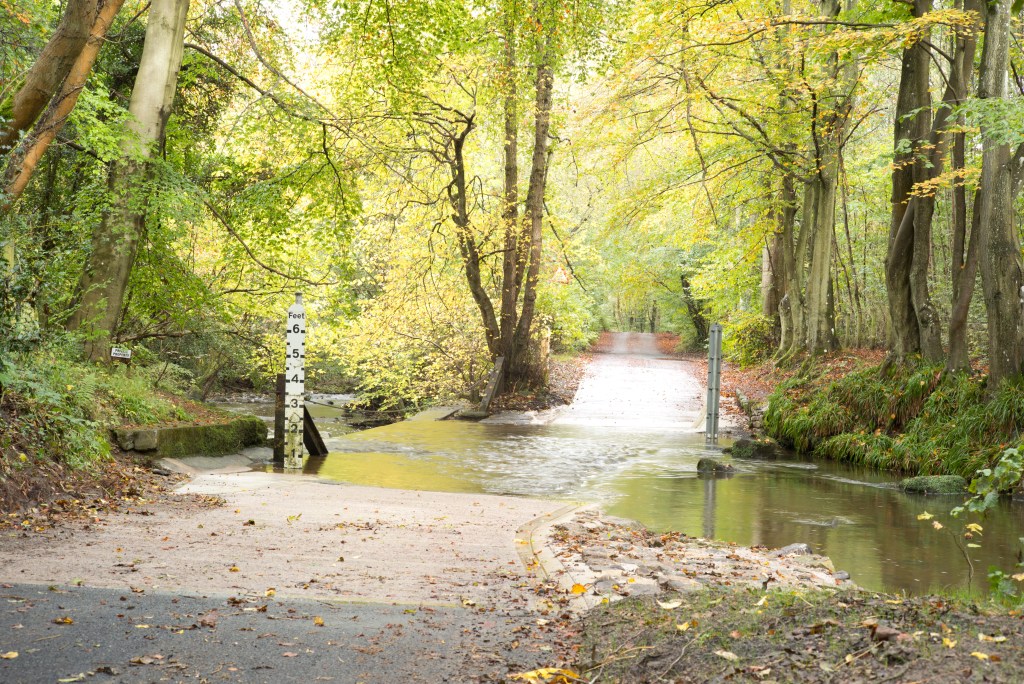
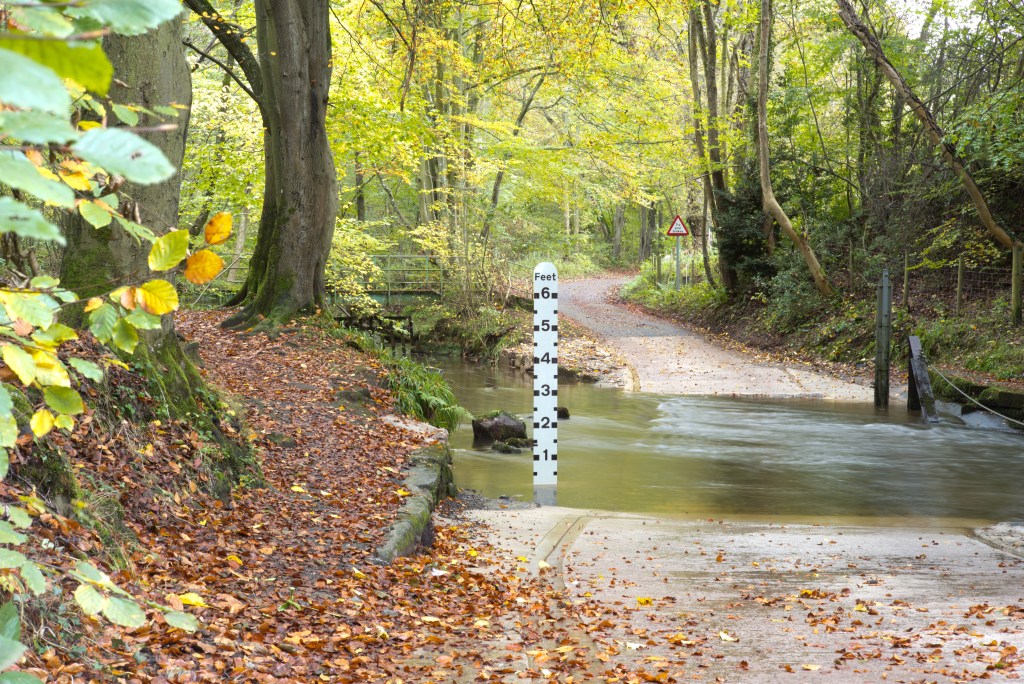
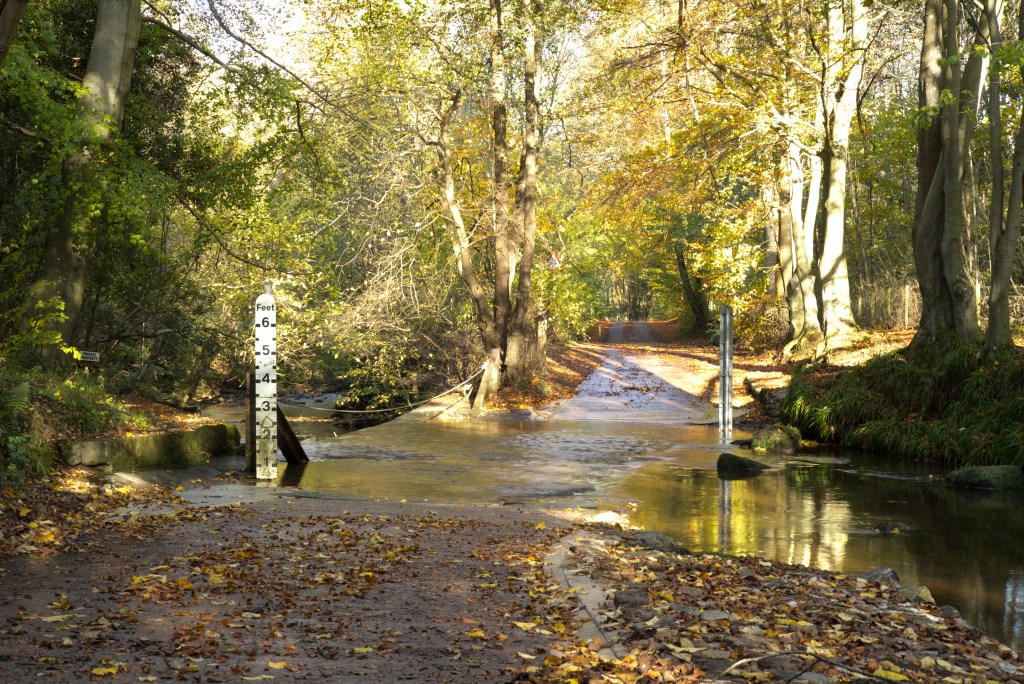
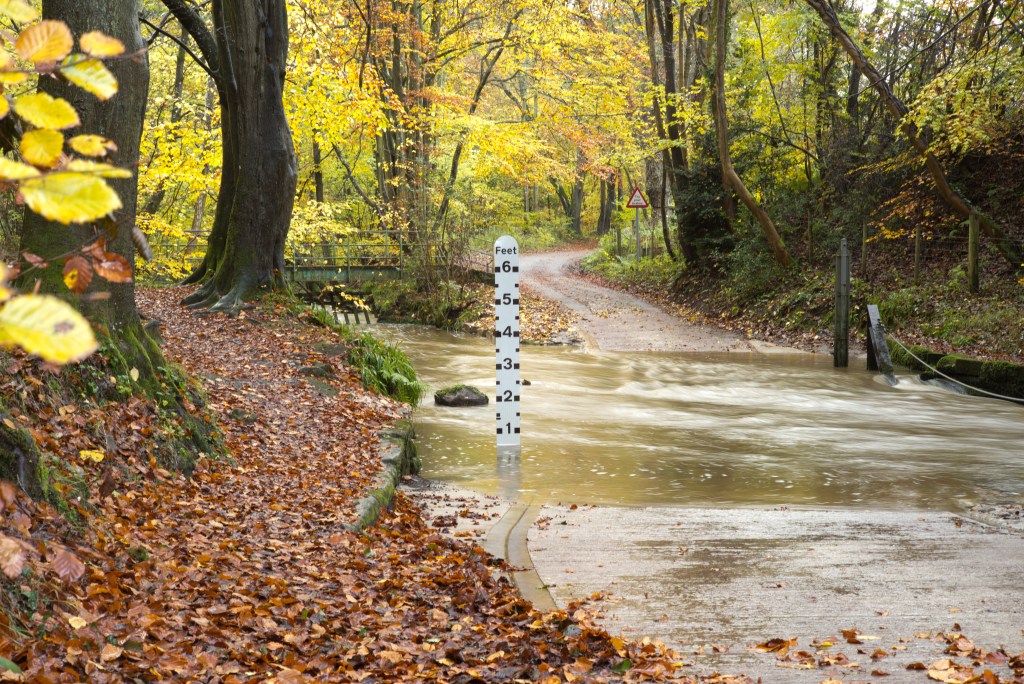
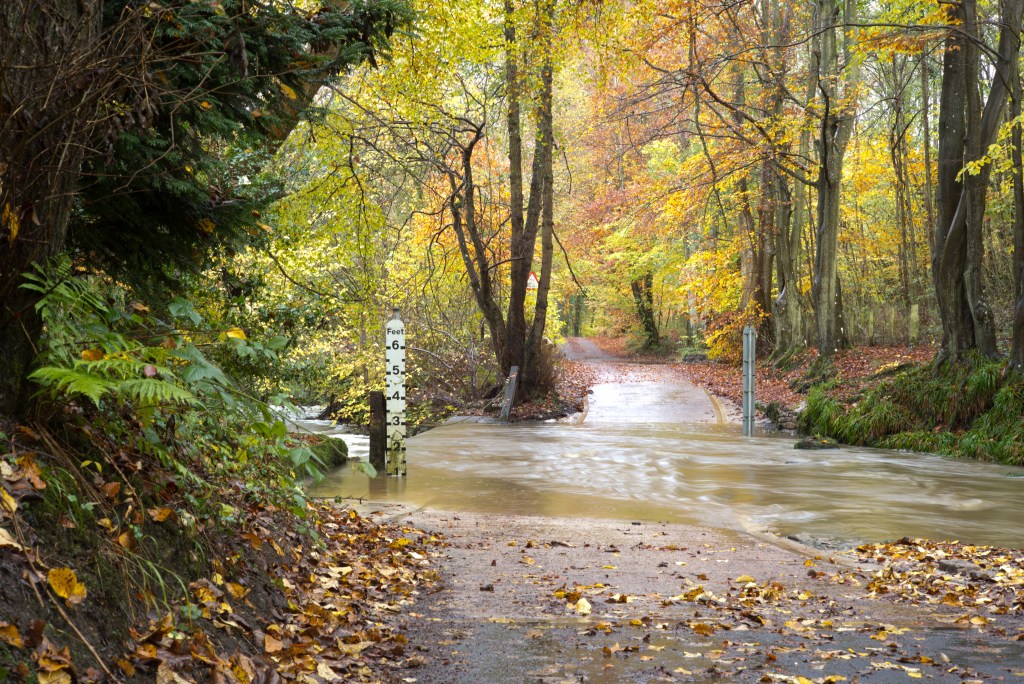
I have at last made a start shooting for this exercise. For now I have shot only the ford and will follow up with the fall back plans (on which I have had some more thought) later. I made a start now, despite the fact that the weather was quite bad today, to take advantage of the significant flow of water through the ford as a result of very heavy rain overnight. Despite the volume of rain over the last couple of weeks the water level had fallen back to just a couple of inches by yesterday. Today, on the upstream side, the water was almost two feet deep.
Having tried a few different angles I have settled on two, one looking upstream, one down. I will choose between them for the final set (assuming one of the backup plans does not take precedence) once a more substantial body of work has accumulated.
At the time these were taken it was raining (I had to shelter the camera under an umbrella as it is not weathertight!) so the light was quite poor. Exposures were as a result quite long (1.5s for the first, at f/16, ISO 400) which has made the water quite glassy and smooth. Obviously I used a tripod, which I set fairly low to keep some of the road in view in the foreground.
Fortunately, because of the depth of water I did not have to worry about cars coming through. One did approach from the downstream side but wisely turned around and went back!
Just how often I repeat these shots I have yet to decide but I expect it will probably be weekly. I can though be flexible and judge when it is worth revisiting on a daily basis as I walk the dog this way most days and so can see if there have been any noticeable changes before deciding when to come back with a camera.
14 October 2019
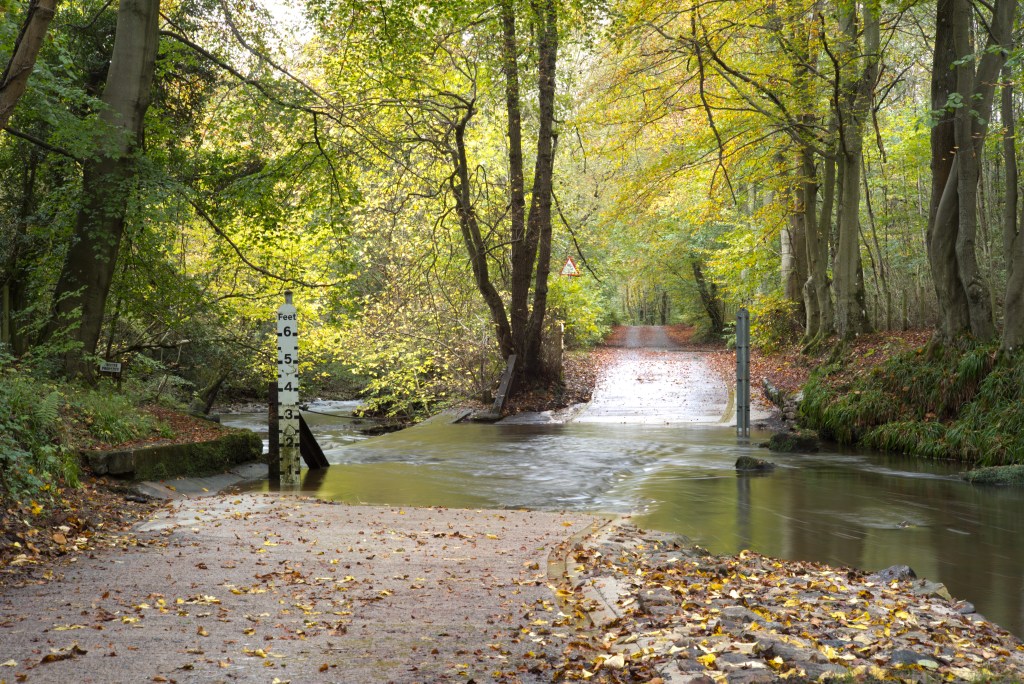
20/10/201920/10/2019
Interesting that these last two pairs of photos suggest that the default depth of water in the ford with regular but not too concentratedly heavy rain is about three inches, not something that I have noticed before.
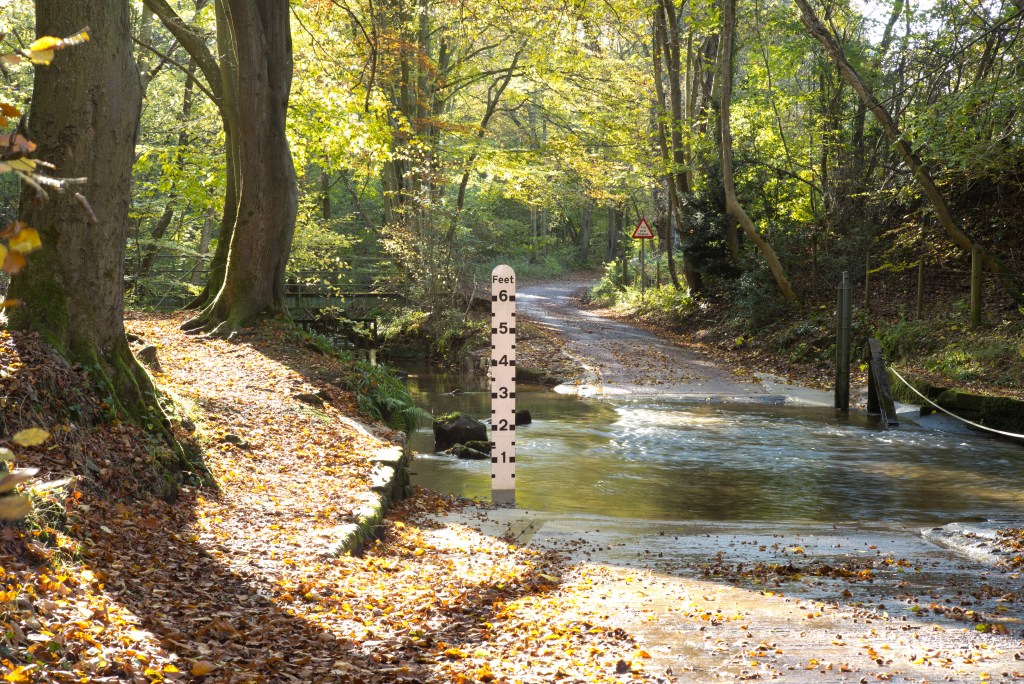
27/10/201927/10/2019
The latest instalment. As with Plan B I think now is the time to stop the regular updating of this post and simply continue to gather shots that can be properly edited later. I will though add more if, for example, we have another flood or other dramatic changes to the scene over the coming months, which is quite likely given the amount of rain we are getting at the moment.
Compared with previous modules I have got off to rather a slow start with this one, partly because its start overlapped with finishing off I&P and getting everything ready for assessment next month, partly because of some personal issues that have kept me away from working on this. I do though now feel that I am getting back into a groove, a routine, and getting more work done. What I really need to do though is get back out with an camera and make pictures again! This exercise gives me an opportunity to get going once more.
The idea of taking a series of images of the same scene over a prolonged period of time is something that I have thought about before and is something that I have already written about. Going right back to EYV and the Square Mile assignment this is an idea that I looked at then: (https://wordpress.com/post/markrobinsonocablog.wordpress.com/119). So it is good to come back to it again now. There is an obvious difference in time scale between anything that I can achieve over the next year or so and what Tom Phillips did over twenty years but nevertheless I feel this is still potentially fertile ground.
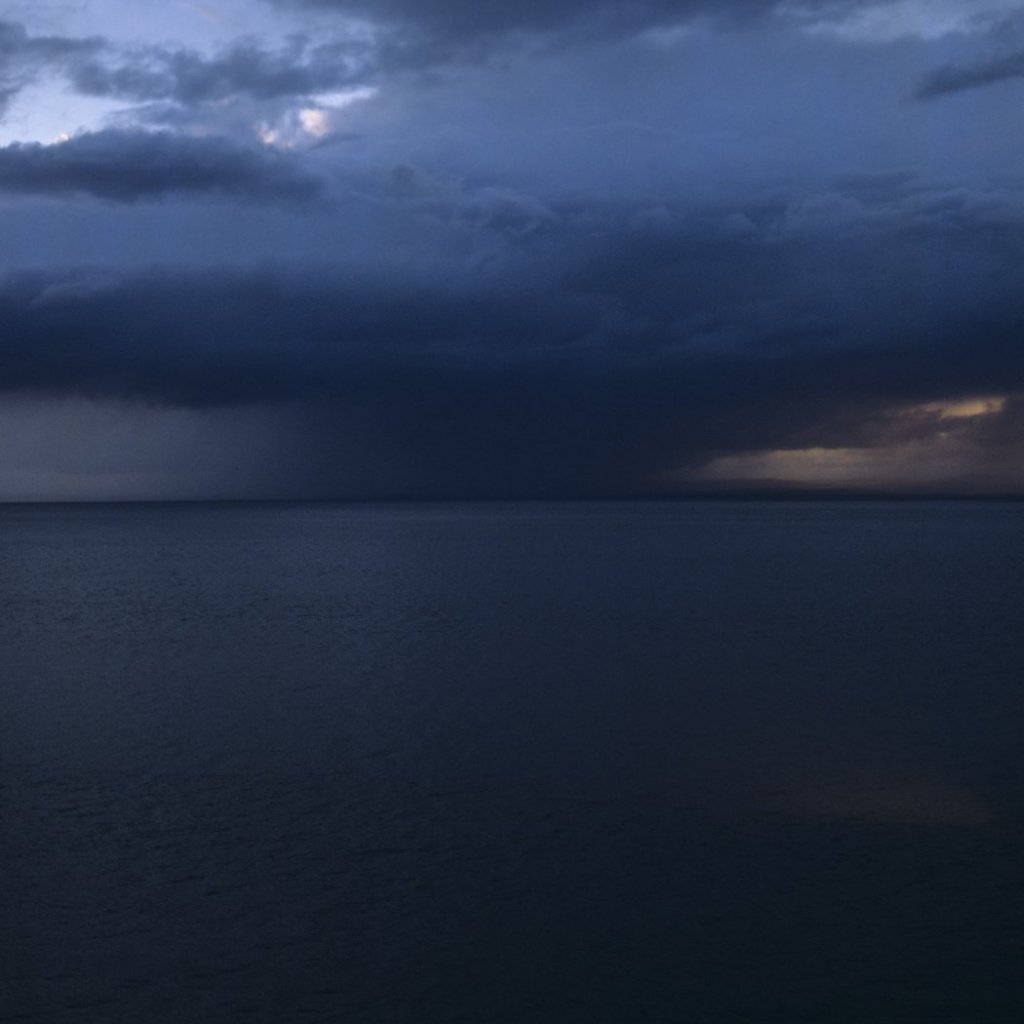
One project I would really like to pursue would be to take photos, possibly even on a daily basis at least at some times of the year, of a particular seascape, showing just sea, horizon and sky. This is partly inspired by the seascapes of Hiroshi Sugimoto (2019) that I have referred to before – though his work shows seascapes from around the world, rather than focusing on one single place. Coincidentally I have also just discovered some of the early, camera-based work of Garry Fabian Miller in the latest issue of the British Journal of Photography, particularly (at pages 52 and 53) from his Sections of England: The Sea Horizon series, of which this is an example (Number 18 Series 2 1976):
These works differ significantly from Sugimoto’s in that they are in colour whereas in his seascapes, so far as I can tell, Sugimoto worked exclusively in monochrome. They are also more overtly dramatic in so far as some feature a distinct horizon, and a focus on prevailing weather, reminiscent of the cloud sketches by Cozens and Constable, and Turner’s storm scenes. I do not know though whether he shot in a number of different locations or whether each image is of the same stretch of sea, although under differing conditions. For the purposes of a project such as this I think that Fabian Miller’s approach would be more productive.
Unfortunately however such a project is not really practical, even without bearing in mind the guidance in the brief for this exercise to concentrate on somewhere nearby. Although I am not that far from the coast, it is nevertheless the better part of a sixty mile round trip – at least – to the nearest possible location that I have in mind. It is simply not practical for me to be covering that sort of distance on a regular, let alone frequent basis. That is a shame because this is something that I would really like to try more seriously; maybe it will just have to become a personal project to be pursued over a much longer period.
My primary choice of practical subject is therefore a ford about ten minutes from home, and past which I have walked with my dog nearly every single day over the last three and a half years, where the scene is constantly changing, and which I have observed closely. I therefore already know what it is likely to look like at any given time of the year. There are obvious seasonal changes but it is also somewhere that can be subject to shorter term, sometimes quite dramatic, changes depending on weather and light conditions.
I have also been giving some thought to a plan B. I have not yet settled on a firm idea yet, and is suspect this will not crystallise until I have got down to proper work with plan A, but I have a couple of thoughts. One, proceeding from a comment in the exercise on preconceptions is that a landscape does not have to be a macro environment but can also be a micro one. With this in mind one possibility I have been thinking about is to photograph a spot (probably in one of the local woods) no more than, say, a metre across, to explore and reflect the changes that take place on a much smaller basis. Another is to focus on a location that is more man-made and is subject to more “managed” change. One possibility that I have in mind for this is a scrap-yard on a small industrial estate in Hexham, which is a site that I could realistically visit as much as weekly. Again this needs further thought but for now I think what I need to do is just get on and shoot at each location and see how they develop. I imagine there will still be time to change tack later if necessary, as long as I do not leave it too long.
Phillips, T (1992) Works and Texts. London: Royal Academy of Arts
I have been busy over the last couple of weeks with a number of other things, including getting I&P ready for assessment and prints despatched, so have not had a chance to do as much work as I would normally. Nevertheless I have at least been able to catch up with some reading, particularly on Beauty and the Sublime, which we will come to next in the course material. I have also been able to do some reading about Anselm adams, who is the focus of this particular part of the course.
When I started out on this module I identified one of the things that I would probably end up doing is re-evaluating my views on Adams and his approach to landscape photography. That I have now started to do by reading his book ‘Examples’ (1983). Subtitled “The making of 40 photographs” this is a sort of blow-by-blow account of the technical aspects of a selection of his photographs and how they were made and printed.
Of particular value to me is that this book has introduced me to a wider range of his work than I had otherwise been aware of. I am reasonably familiar with his work for the US National Park Service and have seen plenty of his other work, particularly in and around Yosemite. This book though has introduced me to some slightly more abstract work, and some striking portraits. This non-landscape work is something that I would like to see more of and will make some effort to track down. So far as the landscape work is concerned, although I still admire it and am impressed by it, it still does not really move or inspire me.
Whilst I can see the point of the position adopted by the f/64 group and their opposition to “pictorialism” and its use of photography as a sort of imitation of painting I cannot but help feel that much of the “straight” landscape work is still in essence pictorialist but with a sharper focus. The emphasis is on creating striking, impressive, beautiful, and I guess sublime, compositions – certainly very successfully – but as I have said I am left unmoved either an emotional or an intellectual level. I much prefer to look at work that carries some meaning beyond the surface appearance and with much of this sort of work I simply do not get it.
Far more interesting I find, for example, the work of Edward Weston whose landscapes tend much more towards the abstract, as illustrated by his “Dunes, Oceano” that appears in the course material. I will though keep an open mind, look at more of Adams’s work and see where it takes me.
So far as the book itself is concerned, it is interesting to follow Adams’s approach to his work and some of the little anecdotes are interesting and enlightening. However a litany of technical details repeated over forty photos eventually makes for a pretty dull read and ultimately there is a limit to how much I think I have learned so far from a technical point of view. As I have written elsewhere, particularly in the context of EYV, I am interested in, and am continuing to experiment with film, not least with my 4×5 large format camera, which I guess is not a million miles removed from some of the equipment that Adams used. I still feel that going back to basics is good discipline and it helps to reacquire some of the fundamental skills and knowledge that is perhaps otherwise at risk of getting lost with all-singing, all-dancing digital cameras. There are though limits. I do not get much from the discussion of lenses, not least because my lens (which is admittedly the only one that I currently have for this camera) although quite old is still a much more up to date piece of kit than the things Adams was using back in the 1930s and ’40s. The discussion of filters also does not help much as I do not presently have any (and indeed have no idea how I would use them with my current lens!). I do wonder what someone who has not worked with film, whose only experience is with digital equipment, would make of and get from much of this technical detail.
To be fair I think the problem stems from my own ignorance and lack of experience, rather than any underlying fault on the part of the book or adams’s writing and I guess I should use it as a spur to go out and learn more. In part I am at least going to do that once I start making prints directly from my negatives: I now have a light and timer unit that works with my camera, transforming it into an enlarger, and just need to sort out a darkroom. I suspect that once I start printing, much more of what he wrote, not least on the Zone system (on which I do not propose to say anything for now as I see that it is coming up in the course material as a topic in its own right, other than to say that it is at least now starting to make some sense to me) will have more of a practical impact and influence.
For the time being I think the most valuable thing I get from this work is the idea of visualisation. I guess it ought to be obvious but clearly it is not that it should not simply be a matter of looking through the viewfinder but of thinking from the outset about what the final image is intended to look like. I see this as particularly relevant when working with film and printing traditionally. I see no reason though why it should not also apply when working digitally and using the likes of Photoshop. I certainly feel in my own practice that I have become more thoughtful and considered about composition in camera before releasing the shutter and that as a result I am making stronger work. It also fits with my general preference not to indulge in any more post-production processing in Photoshop than I can realistically get away with. This is something for me to develop further (pardon the pun!) as I do more film based work in the darkroom.
Adams, A, (1983). Examples: The Making of 40 Photographs. Boston: Little, Brown & Co
I have long thought the question whether the photograph can be art a somewhat sterile one – shades of angels dancing on the heads of pins – and ultimately not particularly productive. It is something that has been written about at considerable length and a number of books on the subject (such as ‘Art and Photography’, ‘Art Photography Now’, ‘The Photograph as Contemporary Art’, to name just a few) grace the shelves in my study. So it is a little ironic to come across a single sentence now that in many ways I feel both encapsulates and resolves the debate, that was written as long ago as 1913.
Marius de Zayas was, I am afraid to admit, pretty much unknown to me before now, notwithstanding that I was aware of Stieglitz’s work with Gallery 291 and his championing of modern European art in New York at the beginning of the 20th Century. (I had to look him up on Wikipedia!) So being introduced to his essay “Photography and Artistic-Photography” from Stieglitz’s Camera Work in 1913 has been something of a revelation. (I have used the Journal1913 link as the other one cited in the course material comes up “Access Denied”.)
His opening sentence is the most succinct formulation on the subject I have ever come across:
“Photography is not Art, but photographs can be made to be Art.”
Photography is a process which, as de Zayas argued, seeks to find an objective view of Form. It is scientific and investigative, without preconceptions. Artistic-photography on the other hand is subjective, the artist-photographer bringing his or her preconceived ideas and notions to bear on Form: “… the [artist-photographer] uses the objectivity of Form to express a preconceived idea in order to convey an emotion.”
It is not quite as straightforward, or as simplistic, as one saying “it is art because I say it is”, but certainly in de Zayas’s view, as I read him, the intention of the person releasing the shutter is a significant element.
But – and there always seems to be a but – is his formulation wholly correct today in the light of the unprecedented number of images now being produced? For very many of the quotidian images that proliferate today I think the distinction does have validity. However, what about those images that are taken with some intention on the part of the person taking them beyond that of mere objective representation, but which fail to meet or effectively communicate those intentions? Do they cease to count as ‘art’ or are they just ‘bad art’.
And what about the works that are produced simply as a record? From the very acts of choosing what to shoot, where and when, is not the most apparently straightforwardly documentary work (in the widest possible sense) not also affected by the subjective views and intentions of the photographer and so capable of being art? I know that Don McCullin, for example, refuses to refer to himself as an artist, as anything other than “a photographer”, and that his work does not necessarily aspire to be “art”, but I cannot help but see much of it in that vein, as art, and good art at that.
Again I come back to the example of Bernd and Hilla Becher: does their ostensibly purely objective, typological approach not also amount to art?
What I am left thinking is that de Zayas’s formulation is largely correct but as ever when a dichotomy such as this is set up (and I do not like such superficially clear distinctions much at all!) it can at times turn out to be a false one, and at least to have slippery, mutable boundaries. If nothing else I guess it is for this last reason that I find the art/not-art debate so ultimately unhelpful and dissatisfying.
So what I am? Artist, photographer, neither, both? I think it varies from time depending on what I am doing and for what purpose. Mostly though I would, I think more accurately, just describe myself as a student of photography – or simply an old bloke who takes pictures.
I am going to start this brief survey of photographic analogs of conventional landscape paintings by turning it on its head and ask to what extent might the advent of photography actually have influenced painting?
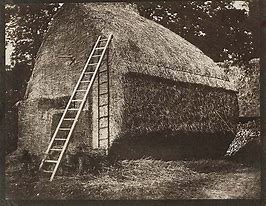
I have in mind Henry Fox-Talbot in particular. His writings on “The Pencil of Nature” and his ideas about “photogenic drawing” suggest to me he was well aware of and influenced by a number of existing conventions of painting, and not just of landscapes. What though I feel is revolutionary about some of his work, specifically the haystack photos, is the introduction of the idea of a series capable of showing related scenes at varying times. This prefigures Monet’s series paintings decades later so it is interesting to speculate about whether Monet was aware of Fox-Talbot’s work from the 1840s and saw that he could apply the same principles to landscape painting.
Leaving that aside for now, it strikes me that this could turn out to be quite an extensive exercise and that any number of examples of photographs informed by painting conventions could be cited. For now though I am going to focus on just a few examples, without, for example, trying to find an analog for each single painting in the first part of this exercise. It could though be something of a dynamic exercise and it might be worth adding and expanding as time goes on and more examples come to light. Once more the selection that I am going to put forward now is very partial and somewhat idiosyncratic, for which I make no apologies.
Also, as the brief is pretty wide, I am going to be cheeky and include a couple of my own images that might have some relevance, one taken a while ago and one that I have just made as part of the process of working on the exercise as a whole.
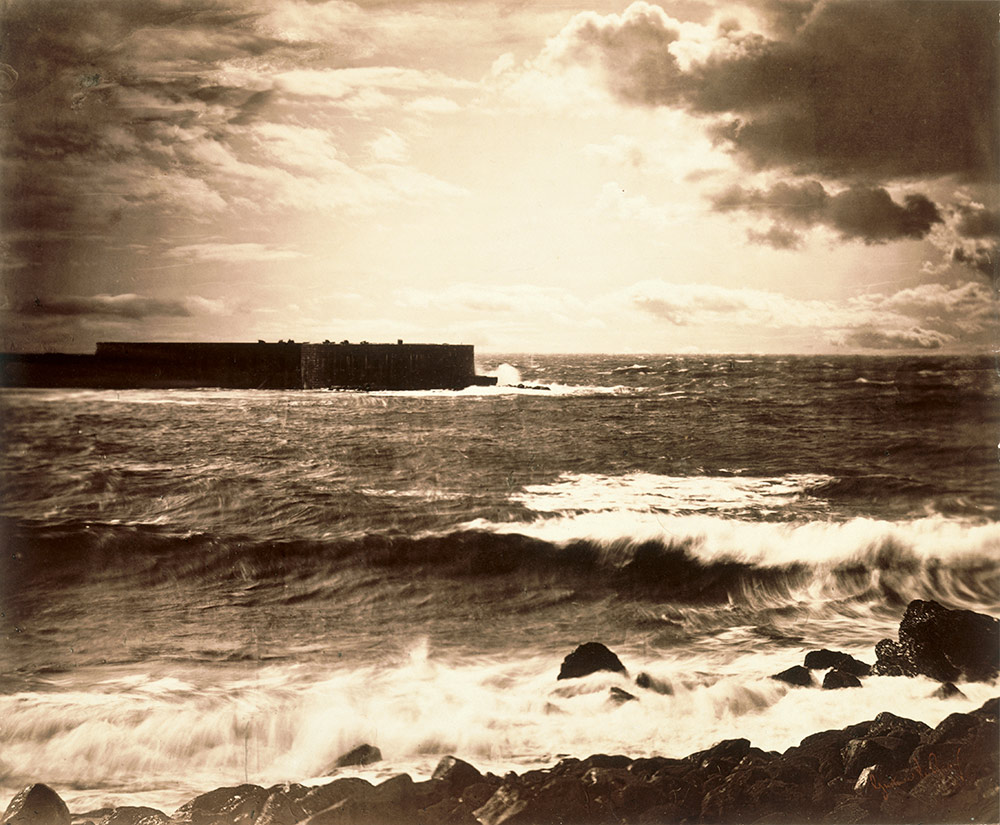
Gustave le Gray, The great wave, Sete, 1857
I did not know much about le Gray until I came across him in Warner Marien (2014) but I think he offers a useful starting point with this dramatic, indeed painterly, sea and skyscape. The light is very Claude Lorrain. It is also interesting that this image has been created in a way similar to a painting, in that it is made up of separate elements to creat on overall effect: he used separate negatives to print the sky and the sea.
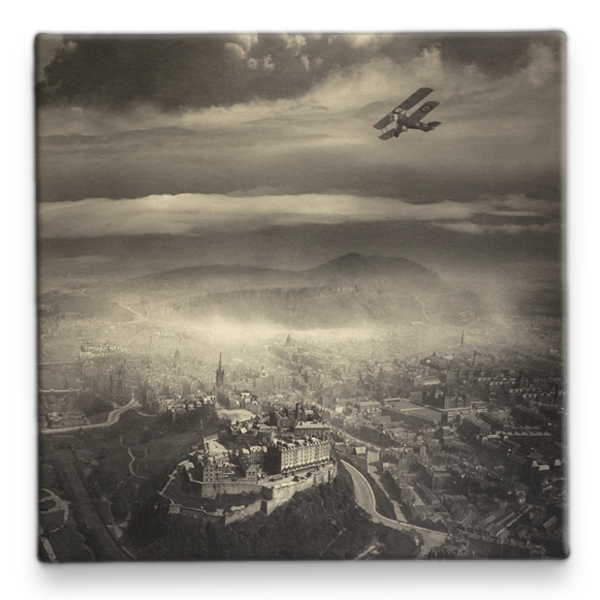
Alfred Buckham, Aerial View of Edinburgh, c. 1920
Another constructed image, taking a recognisable, actual place, and embellishing it to create something new. I first saw this at the Scottish National Portrait Gallery in Edinburgh, which has a fine photography collection, and was struck by the way multiple negatives have been used to create an idealised view of the city. I am not sure how many there were but it looks like two or more just for the sky, another for the added aeroplane (the same one crops up in some of his other pictures) and separate ones for the city and castle, and for Arthur’s Seat in the middle-ground.
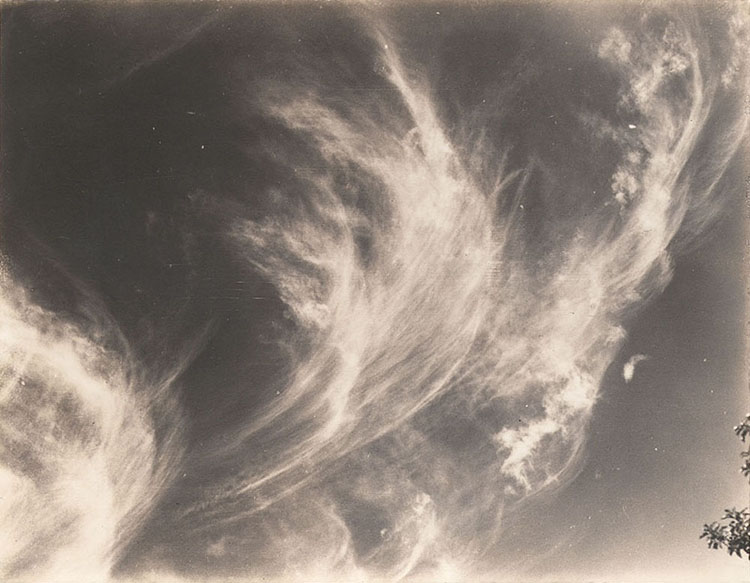
Alfred Stieglitz, Equivalent, 1930
As with Constable’s cloud sketches and Cozen’s meteorological studies, Stieglitz is here simply observing natural phenomena but is similarly, in fact even more so, presumably deliberately, producing something much more abstract.
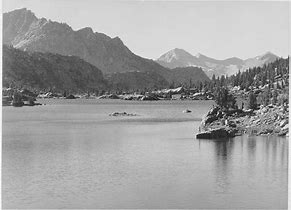
Anselm Adams, Rac Lake, Kings River Canyon, 1936
Given the nature of his work just about anything and everything that Adams produced must at one level or another have been influenced by the conventions of landscape painting. For present purposes I have chosen one of his National Park Service photos. )I could have chosen any number of other possible examples but this one seems to fit quite well with the points I want to make.) In common with, for example, Cole, Church, and Bierstadt, we have an impressive, expansive view, one that is given a sense of scale by the small figures on the spit off land towards the right side of the picture. Although it is not immediately obvious, and once again this is unfortunately not a very good example of the photo – it is probably better simply to look up any and all of the examples that I have chosen on Bing (which I tend to use) or Google Images – these tiny figures are emblematic of a new use, a new ownership, and new economic value of nature. Instead of being indigenous inhabitants living in idealised and innocent, almost prelapsarian harmony with the land, nor peasants labouring for a living, this is a new economy, that of tourism. Adams pictures for the NPS were of course, at one level, intended to publicise the natural landscapes preserved within the parks and promote tourism. There is though still a sense of a colonial enterprise at work: this landscape was once “owned”. at least inhabited by, indigenous peoples. Now it is “owned” by the US Government, under the benign stewardship of the NPS. (I do not want to mock or denigrate the work of the NPS, having benefited from their very existence and the work they do on visits to a few national parks, particularly in the US South West. Without them this is a danger many of these truly wonderful landscapes could have been exploited, desolated, and ruined. That though does not take away from the underlying colonialist enterprise of land management throughout the North American continent.)
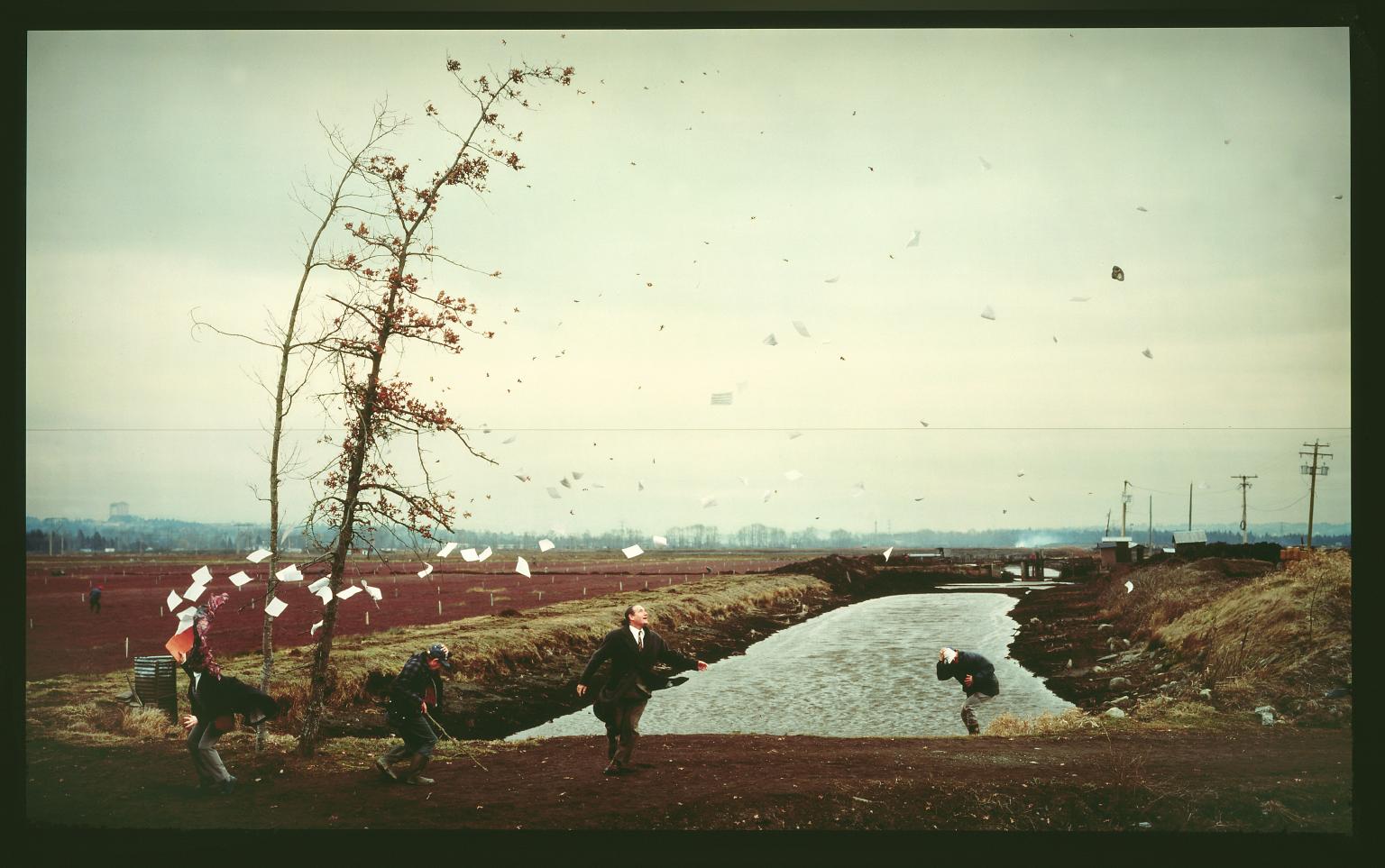
Jeff Wall, A Sudden Gust of Wind (after Hokusai), 1993
With this next one, the last for now, I realise I am pushing the envelope more than just a bit but nevertheless I think this is an interesting example of photography being influenced by the conventions of landscape painting and using them as an inspiration or jumping-off point.
I am perhaps using the breadth of the brief (which does not in all fairness restrict us to any particular artistic culture) in so far as Wall’s photo here is influenced not by any European or American artist but by the Japanese ukiyo-e painter and printmaker Katsushika Hokusai (1760-1849, so at least he falls within the time period specified by the brief!), best known for his picture of the great wave. This photo is based on one of his Thirty-six Views of Fuji-san, Travellers Caught in a Sudden Breeze at Ejiri. Although Japanese I do think the underlying image does share some things in common with Western landscape painting, not only as well as a sense of a particular place but also of a particular time, the passage of time, and recording of meteorological phenomena. Funnily enough though when I look at Wall’s picture I think more of Dutch paintings of the 17th century, such as that of Jacob van Ruisdael: there is the wide, flat landscape, the expansive sky which takes up two thirds of the composition, the sense of time and weather, and water – the channel here is reminiscent of the channels and dikes of Dutch fields, polder, reclaimed from the sea. What I suppose sets this piece apart from van Ruisdael, and links it more firmly to Hokusai, is the prominence within the landscape of the people. In contrast to the use of figures in Western landscape painting of the same time period there does not appear to be quite the same concern in Hokusai’s work of suggesting an economic, or at least amenity, value in the underlying environment being demonstrated by the presence and activities of the people.
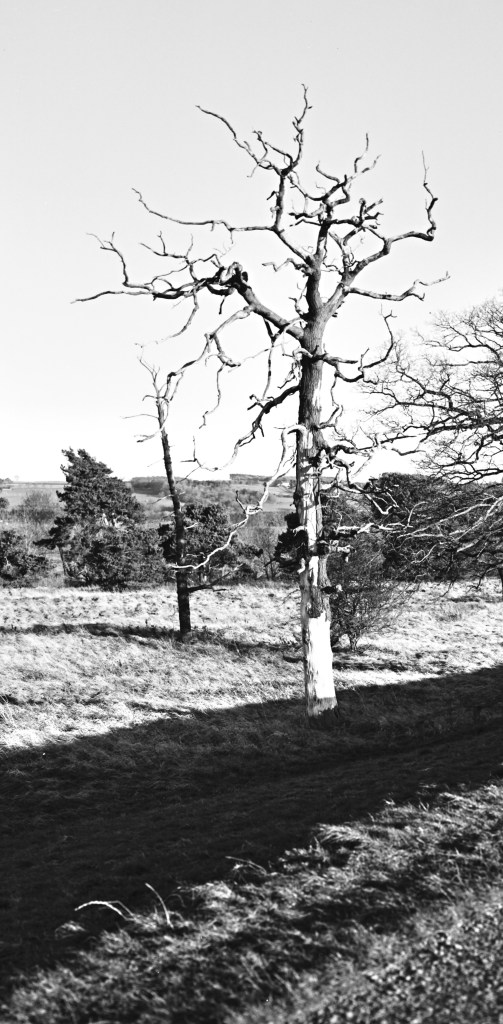
And now two examples of my own work. The first, an image of a dead tree, was an early film experiment with my 4×5 large format camera (cropped down to focus on the main element and to emphasise the verticality of the subject, as did Friedrich):
At least in retrospect there is an obvious analog with Caspar David Friedrich’s painting of a tree that I used as an example in the first part of this exercise. When I took this shot, in late December 2017, I did not consciously have Friedrich in mind. Nevertheless I do not doubt that he, and any number of other artists, were there at the back of my mind, beavering away in my unconscious, influencing my very conscious decision to seek out this particular dead tree as the subject for a photograph. I suppose it is inevitable that after a lifetime of looking at art (albeit not professionally, after all I was just a lawyer) my own artistic endeavours will have been, and continue to be, affected and influenced by the work of others.
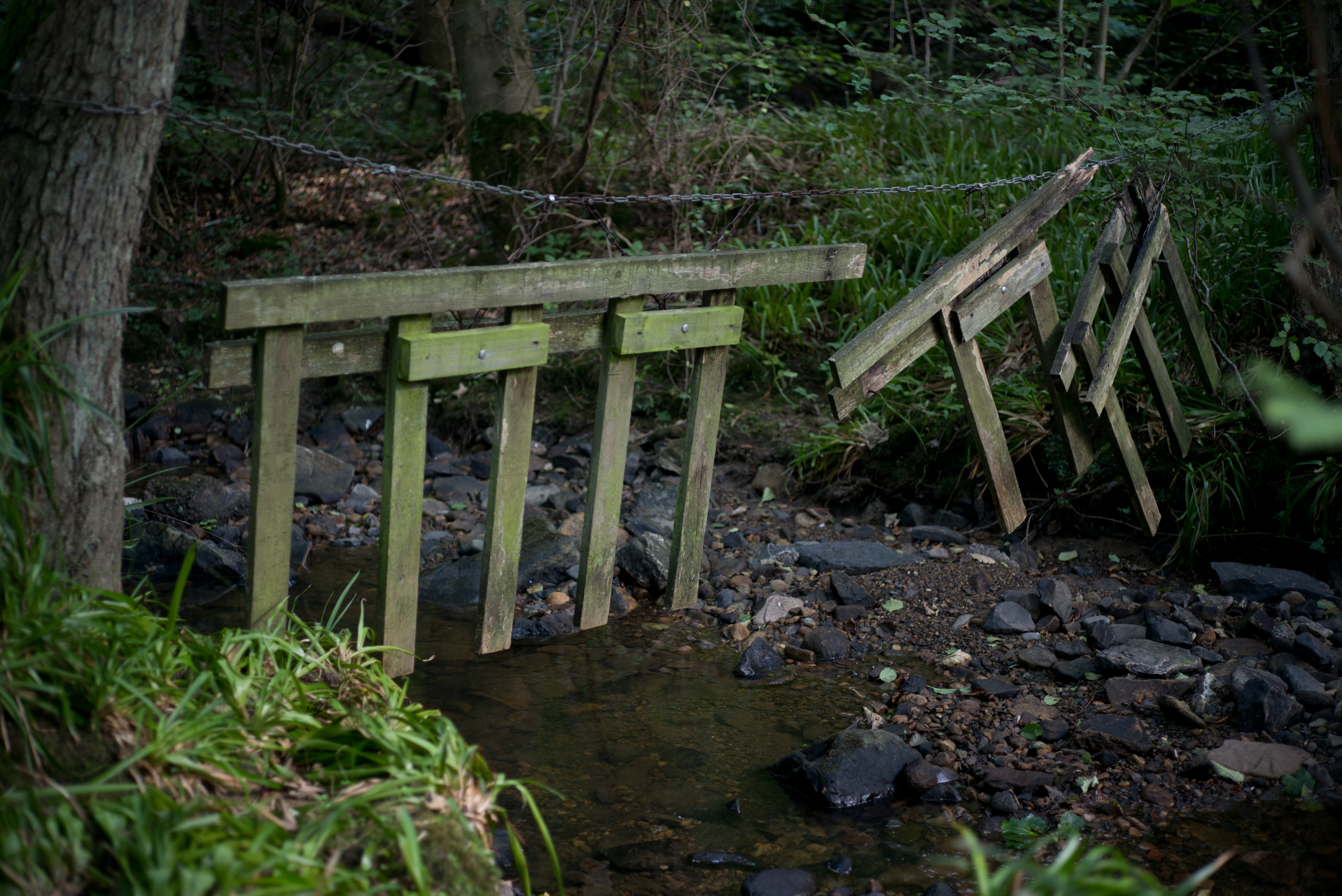
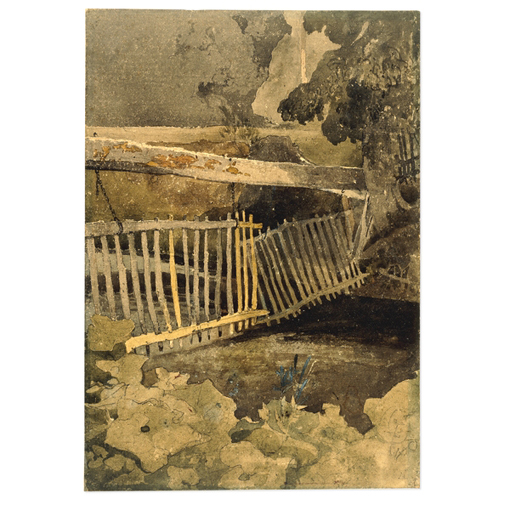
The next one though was made deliberately and with this exercise in mind. I have written elsewhere (particularly in the context of the last assignment for I&P) about the work of Fay Godwin and how, back when I was working on EYV, I made an homage, a response, to one of her works. Of course this crops up again in Exercise 1.1 in this module. For the purposes of this exercise my starting point is the Cotman in the first part. The sort of drop gate that he depicted is still quite common round here, used as a barrier and in lieu of a fence over streams and rivers. The burn along which I walk almost every day with my dog has a few of these wherever it flows into, or out of, bits of privately owned land. As will already be apparent I am not keen on this sort of boundary and it irks me all the more here because the ‘owner’ of the land does not ‘own’ the burn itself. It is a quirk of English law that a landowner does not necessarily own a watercourse that flows through the property. All this might be owned is what are known as riparian rights, which allow certain uses of the water, such as the right to extract water, or to fish within it. It is, for example, not unheard of for an owner of land along the bank of a river not to own the right to fish in the river. (It gets complicated sometimes!) So the idea of a physical barrier over something that the landowner does not necessarily actually own is not something I am particularly comfortable with! With this in mind, here is my homage to Cotman:
Quite fortuitously this drop gate echoes that in Cotman’s painting in that it is in two main parts, one of which is hanging at an angle. In contrast to the painting though I have adopted a landscape rather than portrait format. Partly this is a matter of pragmatism: it would have been physically difficult to get into a position that would have offered a similar view to Cotman’s and give a portrait view. In addition, in Cotman’s painting there is more open land in the background. Here is quite wooded at sits at the bottom of quite a steep slope in the background so there is no similar sense of openness denied. I therefore decided to focus more directly simply on the physicality of the barrier. That was in turn aided, quite by chance, by the light conditions – this bit of the burn is heavily shaded – which meant that in order to achieve a shutter speed of at least 1/60s, as I did not have a tripod with me at the time, I had to use a very shallow depth of field – f/1.7, which is close to the minimum achievable on this particular camera, a Leica M with a Summicron f/1.2 50mm lens.
Coming back to Caspar David Friedrich, one of his paintings that I considered including in the first part of this exercise was his “Monk by the Sea, 1808-10:
This has much in common with other paintings that concentrate on meteorology and natural phenomena, rather than a particular place, such as the earlier Cozens that I chose. Thinking of a modern analog someone who came to mind was the Japanese photographer Hiroshi Sugimoto and his seascape photos, of which this is just one example:
Ligurian Sea, Saviore, 1982
Whether Sugimoto was in fact influenced by earlier landscape painting I simply do not know. His website offers no clues, nor does his recently reissued book (2019) (on which I will do a separate short note). Nevertheless the parallel is there to be drawn, even if only speculatively. Apart from the obvious difference of the presence of an obvious shoreline and the figure of the Monk in the Friedrich, what they have in common is a view of sea and sky and a blurring of the horizon. Links might also be made with Turner. I suspect that Sugimoto was aware of the earlier conventions and influenced by them, even if only at an unconscious level, as with my “Friedrich” tree.
That, I think, will do for now, but as I have previously indicated it might well be worth revisiting this exercise as the course develops and add moe examples to it as I become more aware of the underlying conventions of landscape painting and their influence on photographers.
Dexter, J, (1994). Ansel Adams: The National Park Service Photographs. New York: Abbeville Press
Starting to look at this exercise has fortuitously coincided with me reading Andrews (1999) (which I have to confess I have found a bit heavy going at times; it comes across in places as a bit too earnestly academic for my taste) so I have been thinking about some of the conventions in landscape paining, in particular, and already exploring the possibility that some of the thoughts that I expressed in Exercise 1.1 (https://markrobinsonocalandscape.photo.blog/2019/08/21/exercise-1-1-preconceptions/) already might be in need of some revision or development.
As a starting point I have simply chosen (as it turns out) thirteen different artists from the 18th and 19th centuries. The choice is not entirely random, although I have not selected these artists on the basis of any preconception of what elements and conventions I might find. Rather I have simply stuck to artists with whom I already have some degree of familiarity, whose works I have seen in the flesh as well as in reproduction, and who feature in some of the books that form part of my personal library (an admittedly partial and idiosyncratic selection, which are all referenced below). Most are British, three are American (members of the Hudson River school with whose works I developed some familiarity over the years on trips to the States and visits to, in particular, the MFA in Boston, and the Metropolitan in New York – the works that I have chosen for these artists are ones that I have seen in the flesh), and one German.
At this stage I have not given too much thought (though I do have a couple of ideas already) about photographic analogs as I want to see how this part of the exercise pans out first.
The choice of actual paintings is a little more random and mostly comes down to familiarity. I have deliberately avoided the French schools, as I am not sufficiently familiar apart from some of the Post-Impressionist, such as Monet, Dufy, Cezanne, whose work I do not really want to discuss anyway. Similarly I have avoided the Dutch/Flemish schools, mostly as their heyday really dates back to the previous century and so falls outside the stated scope of this exercise.
So here is my list of artists and chosen works, that I will then have a look at and comment upon individually:
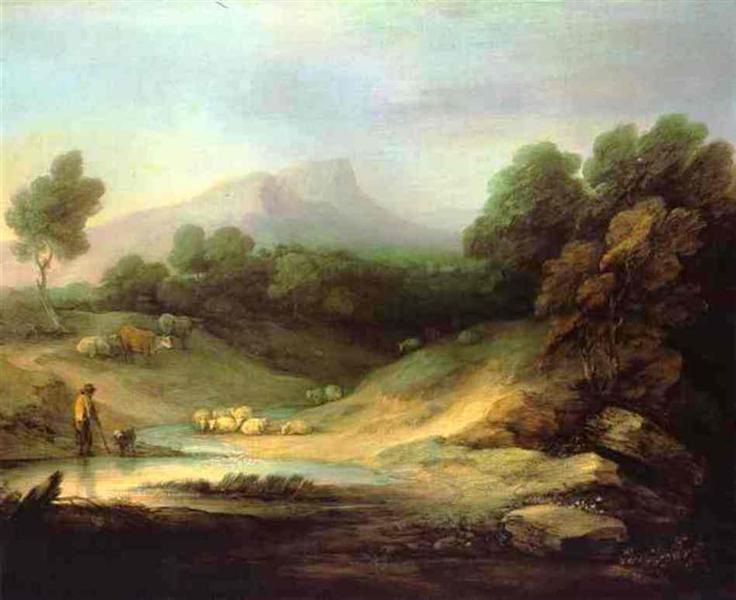
Thomas Gainsborough, 1727-88: Mountain Landscape with Shepherd, 1783.
A common theme in English landscape painting of this period in particular (though Caspar David Friedrich did something similar in some of his more bucolic, less melodramatic paintings) was nature as a realm of agriculture. Not wild country but productive land. We have it here and again in the Samuel Palmer below. I guess that it is about ownership of the land but although the owner is not identified it is clearly not the pictured peasants. It also conforms to the predominant practice of the time of being a studio piece, not painted outdoors. It is also a concoction or confection not a representation of a real place (as is also the case with the Church below). Indeed I understand it was actually painted from a model that Gainsborough constructed out of odds and ends. Why he painted it I have no idea.
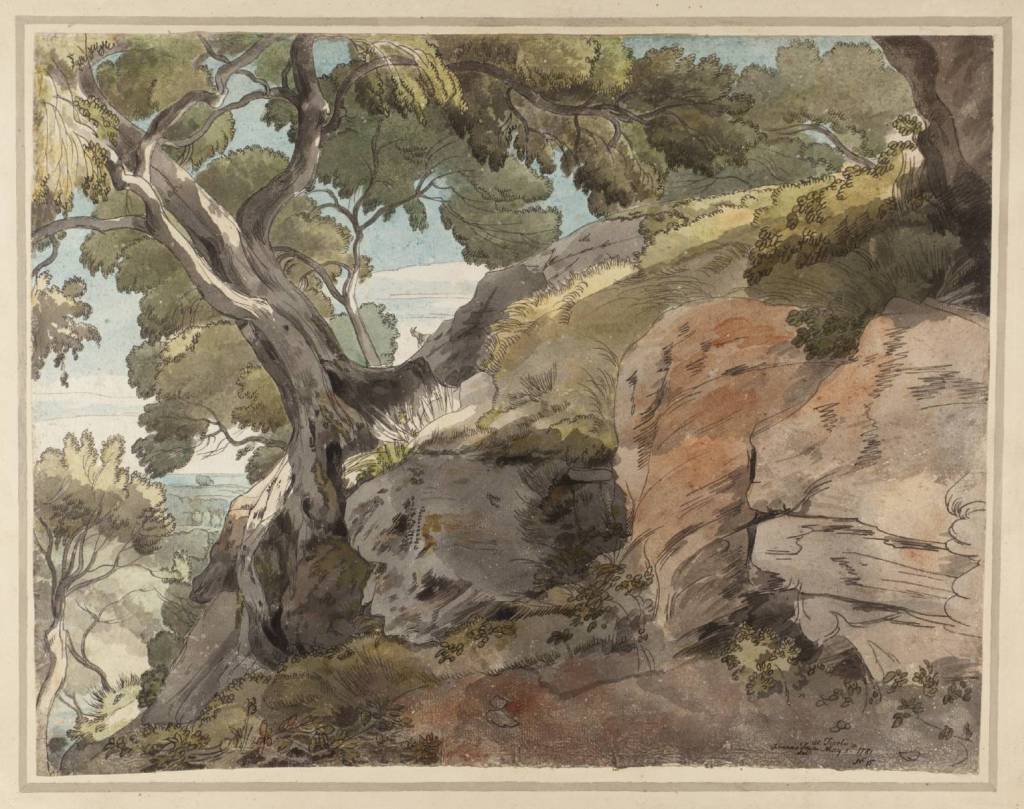
Francis Towne, 1740-1816: Rocks and Trees at Tivoli, 1781.
Painted in watercolour, in the open air, while on the Grand Tour, this was I suppose the equivalent of a modern holiday snapshot, a capturing of a picturesque scene, emphasising the wildness and ruggedness of nature even though within a broader managed and artificial environment.
John Robert Cozens, 1752-99: The Cloud, c. 1785.
Another watercolour, again evidently painted outdoors, part of what strikes me as an important strand in landscape painting, the natural and realistic portrayal of nature and natural phenomena. Turner paid close attention to meteorology, although the ends results are more often than not rather stylised, as did Constable. Paradoxically the result is sometimes rather more abstract than purely representational.
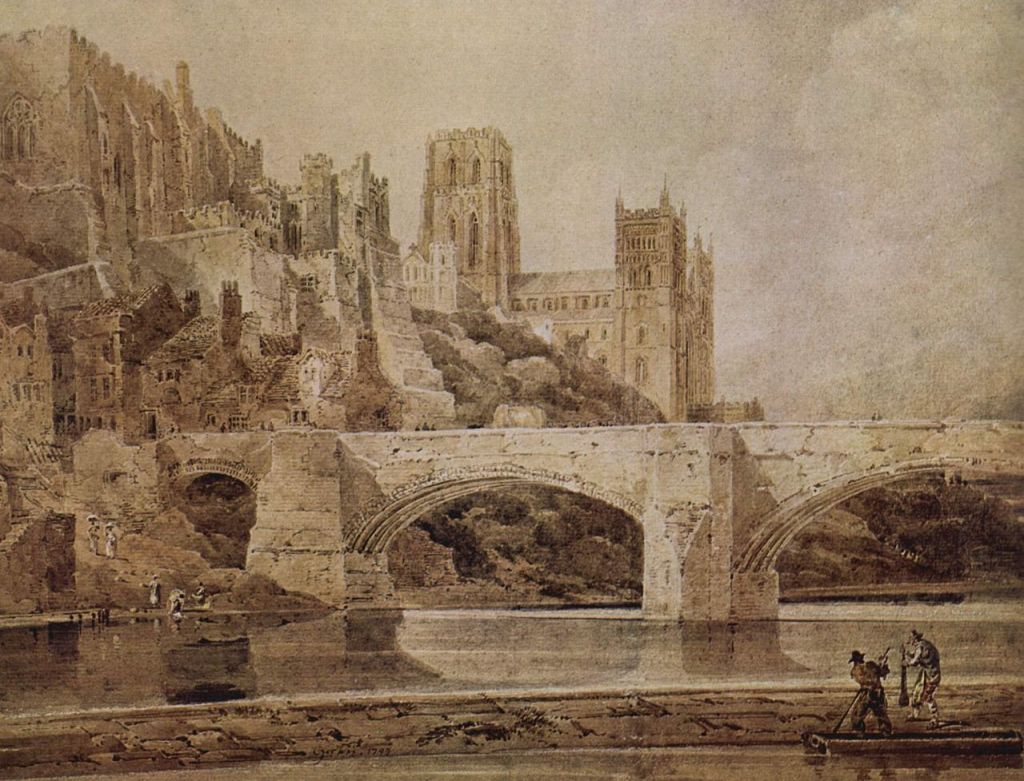
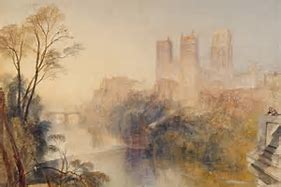
Thomas Girtin, 1775-1802: Durham Cathedral and Bridge, 1799.
Another watercolour and one in a line of what I regard as more purely topographical records. Chosen partly because I know this view very well, but also because Girtin was born locally to where I live, just a little further west along the Tyne Valley at Haydon Bridge. Rather than being an imaginative work of art this is more of a documentary record of a particular place. It also happens to be a pretty spectacular site, and sight, so is, I suppose, still conforming to ideas of the picturesque. As with many pictures from this time there are again figures in the scene. Partly they give a sense of scale. Otherwise they seem to me to emphasise a sense of separateness from the world of the cathedral and the castle and the ordinary working people. For them this is not a picturesque, tourist, place but where they live and work. (This view has not changed much at all in the last two hundred years or more!)
JMW Turner, 1775-1851: Durham, 1834-5.
Same subject but different viewpoint, again part of Turner’s record of his travels throughout the North. What sets this apart though is the emphasis more on atmosphere and grandeur rather than a purely representational portrayal of the place. As with a lot of Turner what takes precedence here is the effect of light and atmospherics, producing something more intentionally “beautiful”, in the sort of way that Claude Lorrain lit his work.
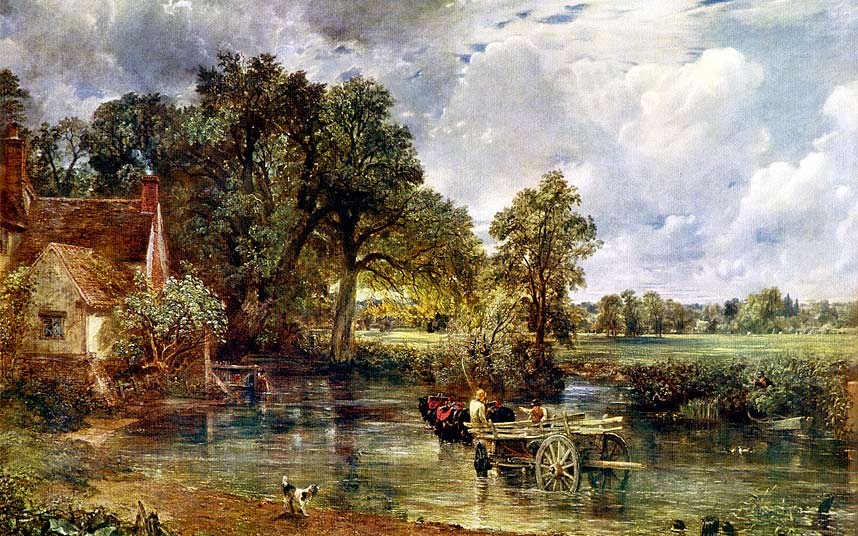
John Constable, 1776-1837: The Hay-Wain, 1821.
I guess there needs to be at least one well-known picture in this list, so this might as well be it. The significant elements for me in this are, again, observation of meteorology – I think Constable did it better in some of his cloud sketches but this nevertheless has the feel of a real sky, even though the picture was painted – constructed? – in the studio. At least though it is a view of a real place, albeit an idealised view. Once more also, there are people in the view emphasising that this is an environment that is lived in and worked; it is not raw nature but a managed, even manicured – just look at the parkland beyond the stream – landscape. But, yet again, and by no means for the last time, the lowly nature of the peasants emphasises their ties to the land without ownership of it. It is also a strangely apolitical (or perhaps not given Constable’s quite reclusive nature – “Though I am here in the midst of the world I am out of it-and am happy-and endeavour to keep myself unspoiled. I have a kingdom of my own both fertile & populous-my landscape and my children-“) and offers no hint of recognition of the dire state at the time of the English agricultural economy.
It is not really about conventions but one thing that has always puzzled me about this picture is why the wagon is moving along the stream rather than across it. Compositional impact rather than reality? Although “realistic”, in the sense of being a depiction of an actual place, this is by no means a reliable record of the actuality of rural life at the time.
John Sell Cotman, 1782-1842: Drop Gate , Duncombe Park, 1806.
I have to confess to having chosen this picture not just because I love Cotman’s work – in the days when I struggled with watercolour myself, a much more difficult medium to use properly than any other in my view, Cotman was a continual inspiration, and indictment of my own efforts – but because of the political message that it carries and how it comes with my own thinking, and work, of late. Rather than helping form conventions, in some ways this piece subverts them. Note that it is in portrait rather than landscape orientation. This I find quite interesting. A landscape format would place more emphasis on the barrier. Adopting a portrait format gives more hints (nothing more because the rest of the picture is quite sketchy) of a sense of land that is accessible – the bottom/foreground – and what is not – the top/background. Does this, perhaps counter-intuitively, give greater emphasis to the sense of barrier and exclusion?
This is not about the land but about its ownership. You do not see the surrounding land, just the physical means by which your access to it is denied. This is “landscape with keep out sign”.
This is one image that I chose from the outset with a photographic analog in mind, which I will come back to in the next post, though I have for a practical reasons as much as anything, chosen a different format and concentration on the physicality of the barrier.
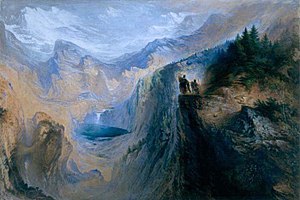
John Martin, 1789-1854: Manfred on the Jungfrau, 1837.
Another local, which is as good a reason as any for choosing Martin, though I have deliberately shied away from his more bonkers, apocalyptic, quasi-biblical extravaganzas (of which the Laing Art Gallery in Newcastle, as is fitting for a local lad, has a fine collection). This is at least a real place, though I doubt whether it is an accurate view of anywhere on the mountain and is rooted more deeply in Martin’s imagination and reading of Byron’s poem. Although not as extreme as most of the rest of his work this is, I suppose, an exercise in the Sublime, a landscape to shock and awe, that emphasises the smallness, the powerlessness and vulnerability, of humanity in the face of the enormity of the natural world.
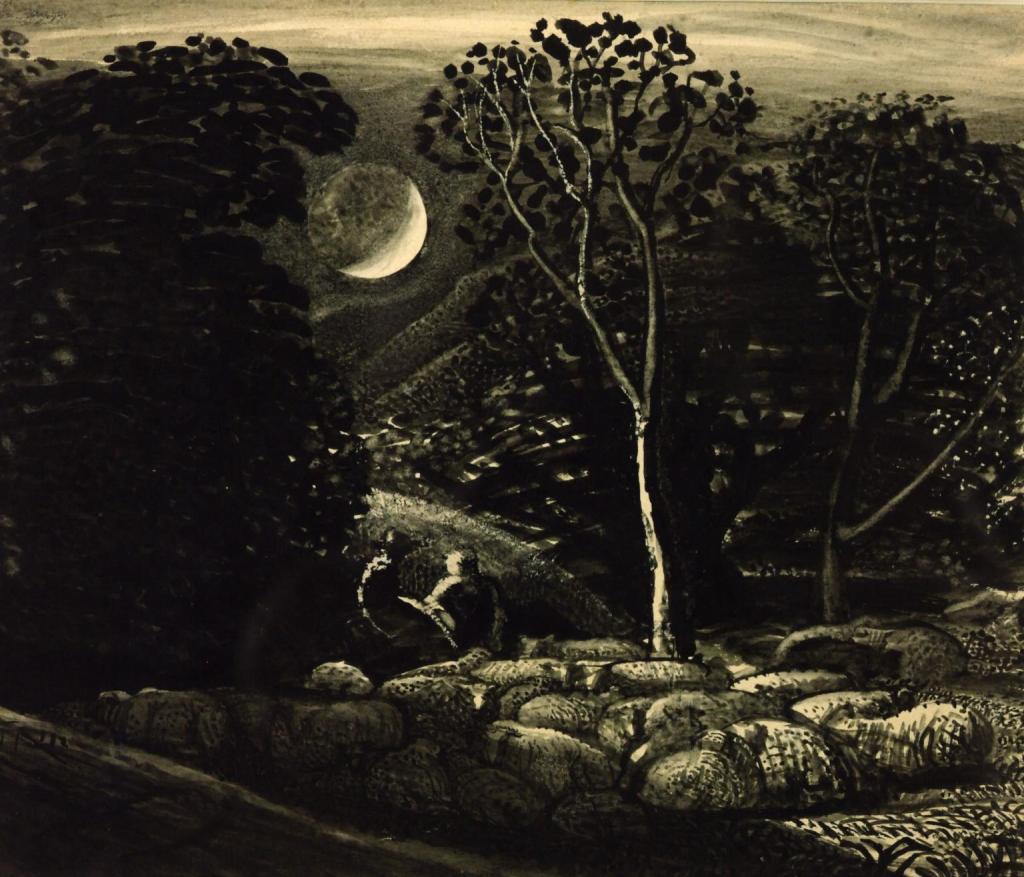
Samuel Palmer, 1805-81: Moonlight, a landscape with sheep, 1831-3.
A contrasting moment of calm and serenity, ostensibly at least, but one that carries with it other implications. In a way this is not really a landscape at all. It is not about a particular place. Indeed there is not much to be seen apart from a few trees and hints of hills in the middle distance. Rather it strikes me as more of a “nocturne”, a study of a particular time, nighttime. As with the Gainsborough at the start of this list, and various others throughout, this is more about the relationship between the countryside and the people who lived and worked upon it without owning it. Here the shepherds do not even have a shelter for the night but are sitting out in the open watching their sheep. In some ways this is, for me, quite a shocking image. The “great outdoors” is the natural environment of animals, in this case the sheep. They exist in, on, and in harmony with, the land. Humans, as we have evolved, do not. We are no longer in our element unsheltered in nature. In a way, because this is not their natural environment, the shepherds depicted here are worse off, are lower in the “natural” order of things, than the sheep.
In terms of establishing conventions I think this is a bit of an outlier. What it does do, at least, is to show that a landscape does not necessarily have to be depicted in broad daylight. I guess this is something that Monet (whom I was not otherwise going to talk about!) did with some of his “series” paintings, such as the haystacks and Rouen cathedral.
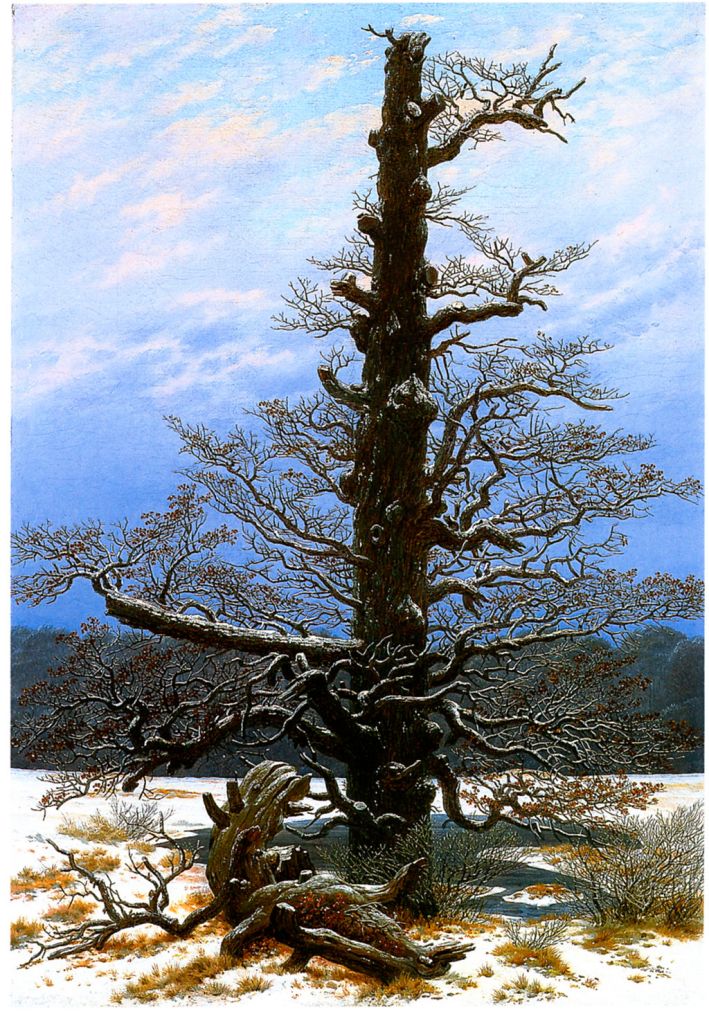
Caspar David Friedrich, 1774-1840: The Oak Tree in the Snow, 1829.
Another fairly bonkers painter (though not to the same extent as Martin) whom I guess we will look at a bit more in considering the Sublime. I have chosen this particular work because it shows how “landscape”, at least in artistic terms, can be reduced to, or more properly represented by, a single element within an environment. It is also another that I chose with a photographic analog in mind, of which more anon. Friedrich painted a number of pictures where a tree, or small group of them, are the central subject. This one though stands out as being one where the tree is the sole subject, where there is very little, if any, background. Where the tree, if it was a real tree rather than an ideal, romanticised idea of a tree, was is not important her, indeed is pretty irrelevant.
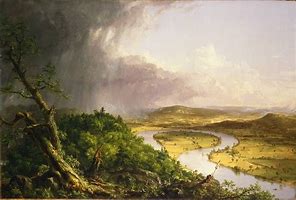
Thomas Cole, 1801-48: View from Mount Holyoke, Northampton, Massachusetts, after a Thunderstorm – The Oxbow, 1836.
These next three paintings are interesting to me because although they are of the New World, and as a result one might expect a suitably new form of representation, they are in fact quite Old World in style and composition. The Cole, with its particular sense of light, reminds me of Claude Lorrain and carries well established ideas of the picturesque, the beautiful and the sublime. There is the common trope of man taming the wilderness and making it profitable: the gentle farm land of the valley has presumably been wrested from the wilderness that still covers the hills to the left. Now though, instead of shepherds tending their sheep, we have the artist himself, towards the bottom right, taming the view. This seems to me part of the white man’s programme of colonisation of the continent.
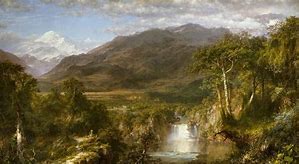
Frederic Edwin Church, 1826-1900: Heart of the Andes, 1859.
Church takes that colonisation a step further by extending it not just to the North American hinterland but to the southern continent as well. It is not very clear in this example but there is a cross and a couple of figures towards the bottom left, emphasising that this is a Christian colonisation . Again the scene itself is made up.
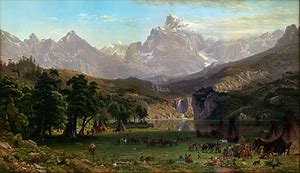
Albert Bierstadt, 1830-1902: The Rocky Mountains, Lander’s Peak, 1863.
More colonisation her, this time back in the North. Although the depiction of the native Americans in the foreground is an acknowledgement that this is their land the colonisation is already well under way as the mountain in the distance already has a white man’s name. Rather chillingly Hughes (1997) (at page 195) quotes Bierstadt as saying that one day in the foreground of this scene “a city, populated by our descendants, may rise and in its art galleries this picture may eventually find its resting place”.
These three paintings also have in common that they were commercial, money making enterprises, painted on a grand scale and toured and exhibited by the artists, another way of making the landscape productive and profitable, without the necessity of sheep.
So far as I can tell, none of the pictures in my list above were the subject of commissions. I do not doubt though, particularly in the case of the Americans, that they all had a shrewd idea of what was likely to sell (except for the Cotman and Towne perhaps, and maybe the Palmer, as these seem to me much more personal works).
Next I will have a look at some photographs that were influenced by these painterly conventions.
Andrews, M, (1999). Landscape and Western Art. Oxford: Oxford University Press
Hooker, D, (ed), (1989). Art of the Western World. London: Boxtree
Hughes, R, (1997). American Visions. London: The Harvill Press
Lyles, A, & Hamlin, R, (1997). British Watercolours from the Oppé Collection. London: Tate Gallery Publishing
A quick note on the work of Justin Partyka who is mentioned in this section, and some general thoughts on pictorials generally.
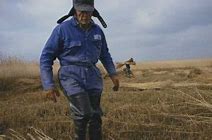
It is only when looking at Partyka’s website that I realise I have seen his work before. Rather annoyingly though I cannot remember where. It is not in any of the books in my library and I cannot see that he has appeared in the BJP recently, so where I have seen his work – a photograph of a man in blue overalls and waders working in a reed bed is especially familiar (this is unfortunately not a very good copy) – remains a mystery:
Why he is mentioned in this section on pictirialism is a bit of a puzzle as it seems to me his work is the very antithesis of pictorials, which is indeed one of the very reasons why I find his work so interesting. As I have already commented I do not find the singular-image tradition at all appealing. This work engages because it is about more than just the view. It is landscape photography, in so far as the environment and topography are important, but it is also documentary, portraiture, social comment. That is what interests me.
I did some time ago have a look at some of my local camera clubs to see if any might be worth joining. I decided not to follow up with any of them precisely because there is such an emphasis on the singular-image rather than any deeper engagement with the subject matter. I did briefly associate with a less formal local group who have weekly jaunts to local places of interest. Again though the emphasis was more on finding a picturesque view or subject and producing single images that were all too often over-processed in Photoshop or Lightroom, including over-use of the dreaded HDR. I found it all too unfocused and unstructured.
That said, one artist mentioned in this section who tends to work with single images whom I do find interesting is Jeff Wall. At one level I suppose his work can be seen as conforming to some of the norms of pictorials but I think he goes much further than that, creating much more interesting narratives and engaging with more than just a faithful reproduction of a given landscape or location.

 Mark Robinson's OCA Landscape, Place & Environment Blog