Category: Part 2

Exercise 2.6: ‘Edgelands’

It is a few years since I last reread parts of this book, having first read it when it originally came out in paperback in 2012. One of the things I had forgotten was how much of a rag-bag, a collection of scraps and tatters, shreds and threads, it is, very much like the edgelands themselves. Infinite in their variety, shifting, mutable, hard to pin down.

That is what I felt about the Wire chapter this time round. It is an entertaining and interesting read but at the end it does not really pull together into something I feel is fully coherent. That is by no means a bad thing and is perhaps a reflection of the variability of these spaces.

What I get in particular from this chapter, which is something that already interests me and is something that I have explored to a limited extent in earlier work is how a fence, an ostensible barrier, can actually be so much more complex. They are physical barriers to keep people out (or in, going back to Donovan Wylie’s Maze project) but also means of entry. I remember as child, as the chapter touches on, using the so-called barrier of the chain link perimeter fence to get inside the compound of a local factory (where I ended up working briefly as a summer job when I left school, but then I walked in through the front gate) which during the war had built armoured cars. The attraction, the irresistible pull, was a number of bunkers and air-raid shelters that were still there, scattered around the perimeter: damp and smelly but occasionally with interesting thirty year old scraps still to be found (this was in the 1970s).

It also got me thinking about a couple of more substantial barriers that I am familiar with that have multiple connotations. One is very old, Hadrian’s Wall, stretches of which are not far from where I live. This strikes me as not simply being physical barrier meant to impede movement: in some places it is nigh-on impenetrable because of the underlying topography on which it is built; in other it is not much of a physical barrier at all. Rather what this structure is about is power and control. It is a statement of ownership – everything south from here is ours! – a tangible, physical manifestation of an abstract concept. It is about control in so far as traffic passed both ways through the wall – there are various places where ancient roadways, paths and tracks, cross the line of the wall – so these became places where trade could be regulated, and more importantly, taxed.

The other, more recent and something that was contemporary with my own lifetime until it was breached in 1989, is the Berlin Wall. This was designed to keep people in, not out, though paradoxically by enclosing the small enclave of West Berlin. It also became over time a monument and memorial to those who tried, but failed and died in the attempt, to cross it – like Farley and Symmons Robert’s memorials attached to fences and barriers. Even before it was breached and even more so since 1989, it became a huge open-air gallery, much graffitied and painted on the “west” side, an extensive, not to mention potentially deadly, mural.

The Power chapter is also a bit mixed The focus on power generation stations, old fashioned ones burning coal, of which few now remain in this country following “dash for gas” – which are not actually much more ecologically friendly – says a lot about how we take so much of the infrastructure of modern life for granted, how so much of it is invisible, mysterious, banished to the exurbs where it can be seen from a distance but not encountered close up. Space, distance from the city, open ground around these sites, becomes almost as effective a barrier, physically and psychologically, as the wire fence.

The last couple of pages dealing with photography, particularly the typological work of the Bechers, and the “before and after”, post-industrial work of John Davies, are a bit of an abrupt change of pace, almost a non-sequitur if it was not for the common subject matter of industrial structures. Nevertheless, one thought that occurred to me is that this photographic work is important because it is typological, because it acts as a record, a remembrance of a recent past that is steadily being erased physically, but also mentally. It is important that these places, their functions, their societal importance and significant, be remembered.

Coincidentally, as I think I have mentioned elsewhere, I have recently been looking again at Davies’s work in his recent “Retraced” book (2019), showing industrial, rural and urban, scenes and their post-industrial appearance. Appropriately given my reference to the Berlin Wall above, he does the same out of thing in Berlin comparing and contrasting how the city looked before and after 1989.

Something else that came to mind reading this chapter was the work of Mitch Epstein and what I noticed was an interesting contrast. In this country these power stations are generally separate, if not actually remote, from places of habitation. In many of Epstein’s picture the power stations and industrial plants are cheek by jowl with and loom over suburbia.

Davies, J, (2019).  Retraced 81/19.  London:  GOST

Epstein, M, (2011).  American Power.  Göttingen: Steidl

Farley, P & Symmons Roberts, M, (2012).  Edgelands.  London:  Vintage

Psychogeography and Photography

Coming back to psychogeography, the last post was written from a mostly literary perspective. Now I want to put down some thoughts from a speficially photographic point of view, taking as a starting point the three photographers mentioned in the course material.

The first is Brassaï. Initially I thought, yes, a psychogeographic photographer. On second thoughts though I am much more skeptical that he was. Certainly he photographed Paris, geographically certainly, and arguably psychologically in so far as he spent a lot of time in pursuit of the demimonde and Parisian nightlife. To that extent he chose the home of modern psychogeography as we know it, and he does have some of the appearance of the flaneur. I do wonder though whether that is really right.

I have difficulty with the idea of him as flâneur to start with not least because his use of a large format camera and magnesium flash does not strike me as being compatible with, let alone practical for, the aimless stroller. What is more he clearly had a certain milieu in mind and went in pursuit of it. It is not as if he stumbled upon his subject matter just by strolling around. On that basis alone I would suggest that Henri Cartier-Bresson fits the bill better, though even then I am not convinced, as I will explain when I come below to the subject of street photography.

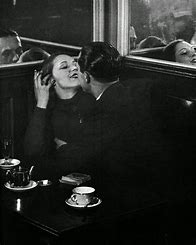
The decisive point for me though is that many of Brassaï’s photos were actually staged, carefully posed and arranged, with people standing in for the ‘types’ he was looking for. I had not realised this until I read Stuart Jeffries’s article in the Guardian cited below but it now seems almost obvious when looking again at his pictures. Here is the particular example that Jeffries singles out in his piece (unfortunately not a very good copy but easily findable through Google or Bing Images):

The posing of the figures and the composition, pivoting round the multiple reflections, now seems obviously contrived.

Before moving on I suppose it is worth considering, albeit only very briefly, another photographer of the cityscape of Paris, Eugene Atget, who admittedly is not mentioned. Again I do not think he fits the bill: no flâneury, more of a typological than psychological recording and cataloguing of parts of Paris. The only example of his work that I feel come close are the more surreal, random (?) shots of reflections in shop windows.

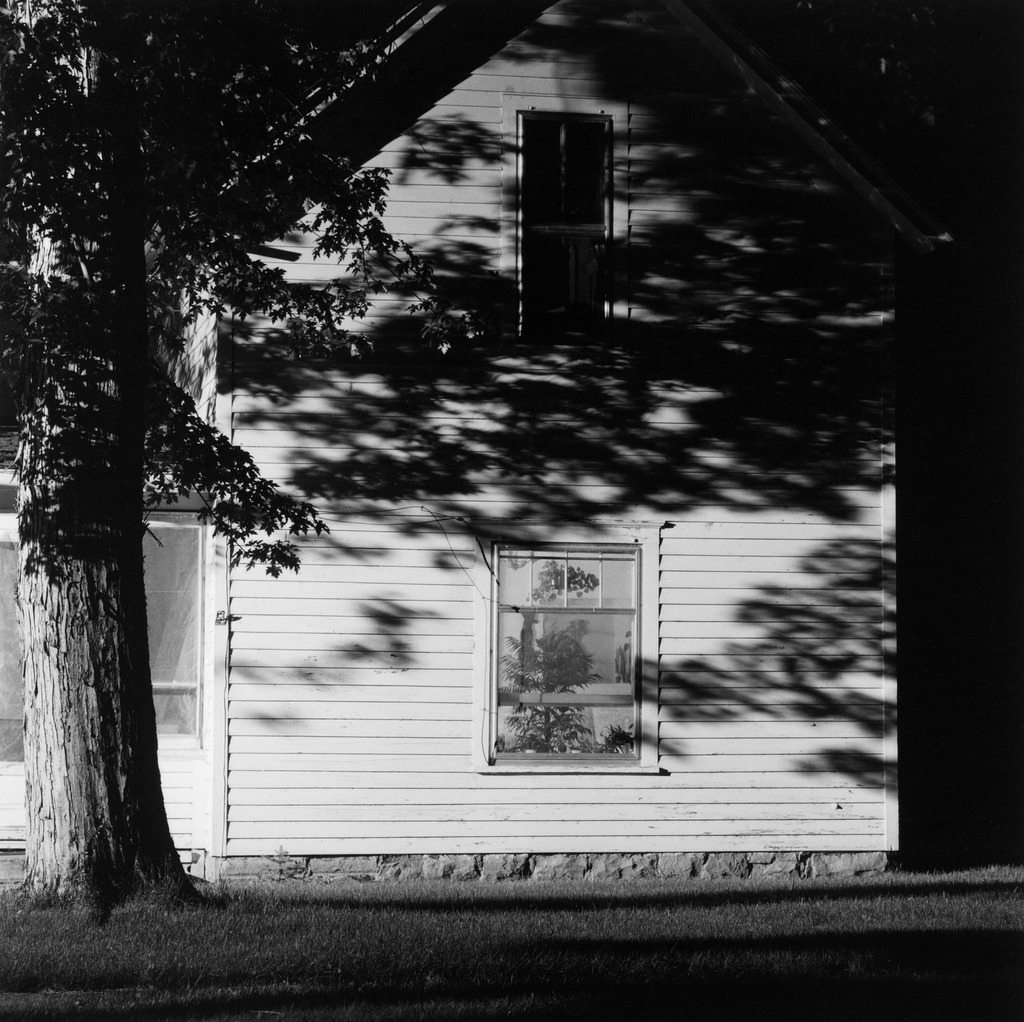
What of Robert Adams (whose writing I probably know better than I do his photographs) and his Summer Nights Walking? This I feel is more encouraging.

Although these are ostensibly just a collection of topological views taken on nocturnal walks around his home time I do feel they have much more psychological depth. They say so much more about the way of life in this town, which could probably stand as an exemplar of much of suburban America. They say much about the suburban domestic attitude towards night-time. Whereas in Brassaï’s Paris people came out at night to play, here they retreat behind closed doors and drawn curtains. There is almost a sense of menace in these pictures as if the camera, and we the viewers of the photos, are prowlers, looking for an opportunity to get up to no good.

At a superficial level, principally because of their nocturnal nature and the use of lighting, they call to mind some of Gregory Crewdson’s work but none of these seem to me to have the same sense of artificiality and contrivance. Crewdson’s work is often deeply psychological but rarely, to the limited extent that I am familiar with his work, in a specific, rather than generalised, way geographically rooted.

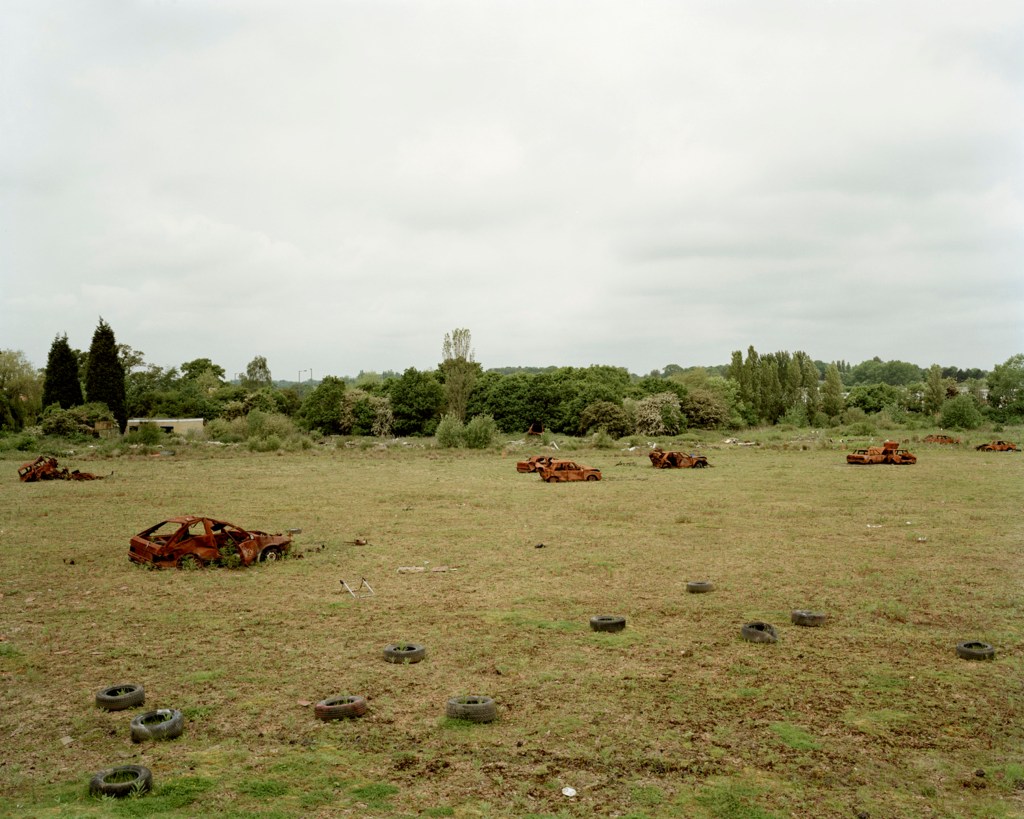
Mark Power’s work is new to me but comes across as the most psychogeographical work that I have looked at so far. There are clear echoes of the subjects written about by Farley & Symmons Roberts (2012) and the sort of places considered by Ian Sinclair. What I get first and foremost is a sense that these are not necessarily psychologically easy place to live. There is a strange almost post-apocalyptic absence of people and some of the places look more like the aftermath of a war-zone.

Rarely has an otherwise ordinary suburbia, or perhaps more appropriately exurbia, looked quite as menacing and unsettling.

This has set me thinking in more general terms about psychogeography in photographic terms. For example, where does the broad church of street photography stand in relation to the concept? My immediate reaction is that mostly it does not. So much street photography seems to be more concerned with human activity, and particularly the catching of people unawares, than addressing how they relate to the environment within which they are captured on camera. Coming back to HCB, he seems to be more concerned with capturing that elusive moment (I am not a devotee of the idea of the decisive moment, as I have written more than once elsewhere!), the sudden confluence of events and elements that makes an interesting picture, rather than how that is affected, caused, or influenced by the environment, notwithstanding that some of his work is set in quite specific geographical locations, such as India and China.

Casting my eyes over the bookshelves in my study two artists leap out at me as fitting more closely the idea of psychogeography. One is Guido Guidi. I am not sure about his work in Sardinia and around his home town of Cesena but I do think there is an element of the concept in his work in the Veneto (2019) in so far as he is not just picturing marginal and marginalised areas but how those places, policies of development and land use practices, have affected life there.

The other, more specifically, is Daido Moriyama, with his repeated, obsessive strolling around the Shinjuku area of Tokyo – a Japanese flâneur – compact camera in hand observing anything and everything going on, recording the environment, warts and all, the people, and the way the place affects their lives. There will no doubt be others who also fit the bill but Moriyama is for me the one who stands out most clearly as being the nearest photographic equivalent to one of Debord’s situationists.

Guidi, G, (2019).  In Veneto, 1984-89.  London:  MACK

Moriyama, D, (2017).  Daido Moriyama: Record.  London:  Thames & Hudson

Moriyama, D, (2016).  Daido Tokyo.  Paris:  FondationCartier pour l’art contemporain

https://www.markpower.co.uk/projects/26-DIFFERENT-ENDINGS

https://www.theguardian.com/culture/2001/feb/06/artsfeatures

Psychogeography

Before getting to the next exercise, some initial thoughts about and observations upon the concept of psychogeography on the basis of my reading to date.

The first is more of a question: why London and Paris? These two cities are at the roots of and dominate much of the writing (at least that I have read) on psychogeography. Debord and the Situationists were of course based in Paris. It is from Paris, thanks to Baudelaire, that we have the figure of the flâneur, particularly as subsequently developed by Walter Benjamin, and although Debord’s formulation of psychogeography does not specifically refer to the flaneur he (or she, the flâneuse), the stroller is implicit within the concept of the dérive as the means of carrying out psychogeographic research.

In London we have, historically, Defoe, Blake, De Quincey, Stephenson, and Machin, among others although in writing about London I doubt that they would necessarily have recognised themselves as psychogeographers. Latterly of course we have Ackroyd and Sinclair. I have to confess I have not read much by Ackroyd as I actually find his almost monomaniacal focus on the city to be overwhelming, to the extent of almost being a parody of itself. Sinclair I have read more though I do find his writing style sometimes a little overwrought and mannered for a comfortable read.

And of course there is also JG Ballard, but I sometimes wonder if his work is more psycho than geography.

Where are the other cities? I see from his book (2007) Will Self has sought to extend the scope of investigation to other places, notably New York, but so far I have only had a chance to skim through it and not yet read it closely. (Another confession: I am not a great fan of Self’s writing so although I have a copy of his book I am not quite straining at the leash to spend time on it.) Rebecca Solnit has written extensively about San Francisco in a way that I suppose counts as psychogeographical, and walking generally. She is also just about the only woman that I can currently think of who has addressed the subject, particularly the role of walking, in any concentrated way, which begs another question: where are the women psychogeographers? (Pace Rachel Lichtenstein mentioned below.) I am rereading her chapter on Paris (2002, at pages 196ff) at the moment and might come back to her again in a later post.

The opening question remains unanswered. Or is it just that because of the roots in London and Paris similar explorations of other cities have not made their presence felt here?

My next question is why the prevalence of writing on and about cities? Is it as much as anything a practical issue, that it is difficult to be a flâneur, to wander aimlessly in the countryside? At most, particularly with Farley & Symmons Roberts (2012), and of course Ian Sinclair’s orbital walk around the M25 (which I have not read), it seems to me exploration has pushed only as far as the edge lands.

I do not really feel comfortable with appending the label of psychogeography to much contemporary nature and topographical writing, which simply does not seem to be concerned with quite the same things, though I accept that there is an argument to be made in connection with the psychological effects on us of exposure to nature, wildlife and place. Nevertheless I still feel somewhat resistant. Partly I think the issue is of the inappropriateness of the idea of the flaneur in the country. Merlin Coverley makes something of a case for this in the preface to the latest edition of his book (2018) but, as I read him, decides that ultimately the label that is attached to any given work is not what really matters.

Incidentally, he identifies more women wandering into the otherwise solidly masculine realms of psychogeography but unfortunately I cannot comment on them as I am not familiar with their work, with the exception of Rachel Lichtenstein whose book (1999) I read years ago, which was, surprise surprise, co-authored with Ian Sinclair!

I wonder though if a stronger case might be made for earlier works, such as William Cobbett’s Rural Rides, given the influence of his Radical politics? Does that give him something more in common with Sinclair and Debord? Unfortunately these are questions that I cannot answer or explore further for now as I have never before read his book properly (not since I was introduced to bits of it at school more than forty years ago) and do not currently have a copy.

I would venture that perhaps Sinclair’s Black Apples of Gower (2015) fits the bill, notwithstanding that it is as much about Ceri Richards as anyone or anything else. Partly this is a matter of his style and the way he writes about the subject but it does strike that it is significant that he engaged in an exploration of childhood memories specifically through the medium of walking. Something similar might also be claimed for Robert Macfarlane’s first book (2003) though I hesitate somewhat that mountains are not really places where one can indulge in aimless wandering. Of his more recent work I do think his chapter on Invisible Cities (2019) (at pages 127 ff) does fall into the category but then we are back in, or underneath, Paris again.

A few more points to close with to avoid this post becoming too long. Unfortunately I have not been able to listen to Philip Pullman’s discussion of the Manet painting. The Guardian site requires the latest version of Flash Player which for some reason will not instal on my computer (a ten year old iMac, possibly because it cannot run the latest version of Mac OS) and is similarly not supported by my iPad. This is frustrating as Pullman is a writer I admire and picking apart this deeply enigmatic painting is always interesting – I had not thought of the gent, through whose eyes we, the viewers of the painting, rather alarmingly regard the young woman, as a flaneur but given the strong undertones of sexual exploitation it makes sense to me.

Brassai, Adams, and Power I have not yet looked at properly but as a trio of photographers they are probably worth addressing separately.

Lastly, I am struck by the fact that apart from Coverley and Self all of the books cited below are ones that I have already read some years ago, or where more recently, independently of this course.

Coverley, M, (2018).  Psychogeography.  Harpenden:  Oldcastle Books

Farley, P & Symmons Roberts, M, (2012).  Edgelands.  London:  Vintage

Lichtenstein, R, & Sinclair, I, (1999).  Rodinksy’s Room.  London:  Granta

Macfarlane, R, (2003).  Mountains of the Mind.  London:  Granta

Macfarlane, R, (2019).  Underland.  London:  Hamish Hamilton

Self, W, (2007).  Psychogeography.  London:  Bloomsbury

Sinclair, I, (2015).  Black Apples of Gower.  Taller Fratrum:  Little Toller Books

Solnit, R, (2002).  Wanderlust: A History of Walking.  London:  Verso

Solnit R, (2006).  A Field Guide to Getting Lost.  Edinburgh:  Cannongate

Land Art

I had not thought about it before but I suppose there is indeed a distinction between the works of the likes of Robert Smithson (which I have not seen in the flesh) and that of Richard Long, Hamish Fulton, and others. The polar differences are defined by the permanence or ephemerality of the work: Spiral Jetty still exists, although from time to time either swallowed up by the lake water, or left high and dry as the water recedes: much of Long’s work, such as A Line Made by Walking and his mud paintings (which I last saw about twelve years ago in Edinburgh) now exist only as photographs.

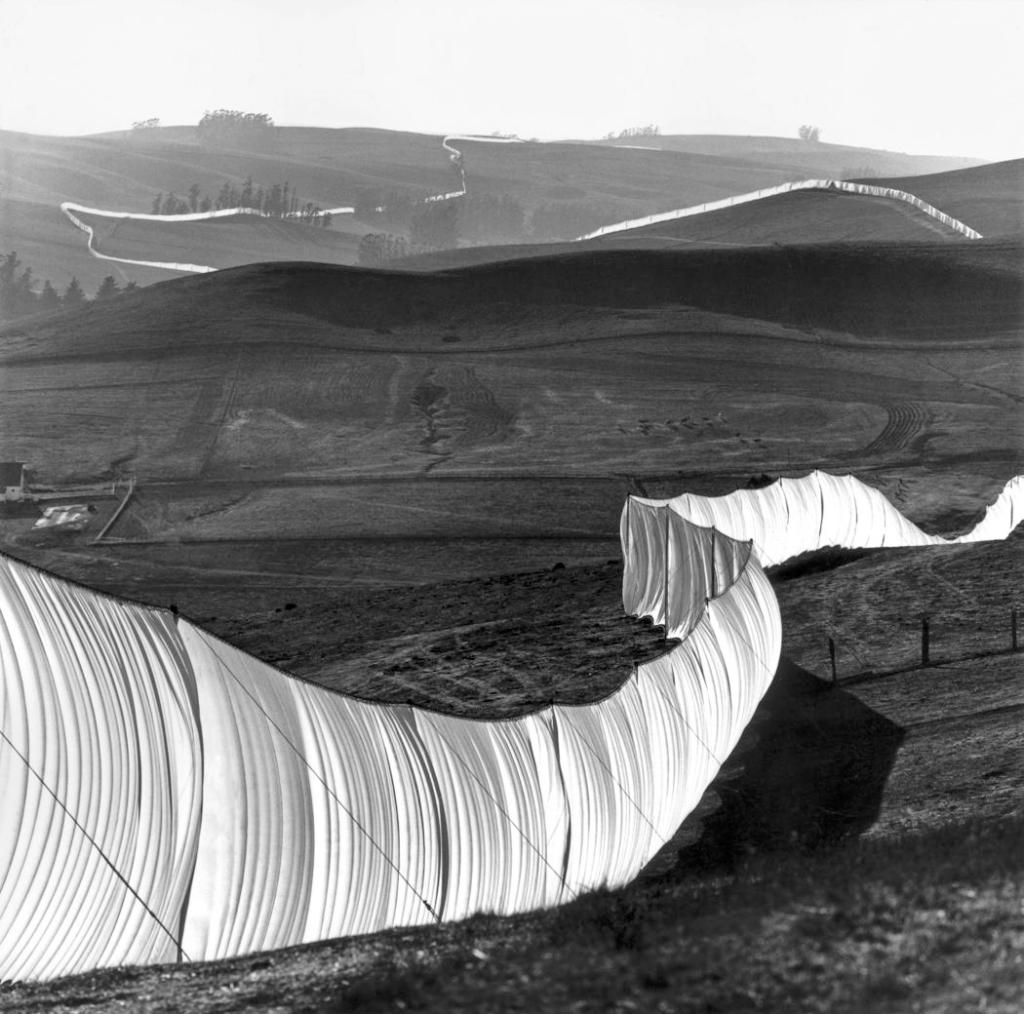
Christo and Jean-Claude are also mentioned in the part of the course material but I would place their work somewhere in between. Certainly it is “capitalist” art, to use Long’s phrase, in so far as these projects are expensive to implement. However their lasting impact on the ground is limited, they sit on more than in or as part of the landscape, and are ephemeral in their installed form – Running Fence, for example, took four years or so to plan and install but was then in place only for a brief time in 1976.

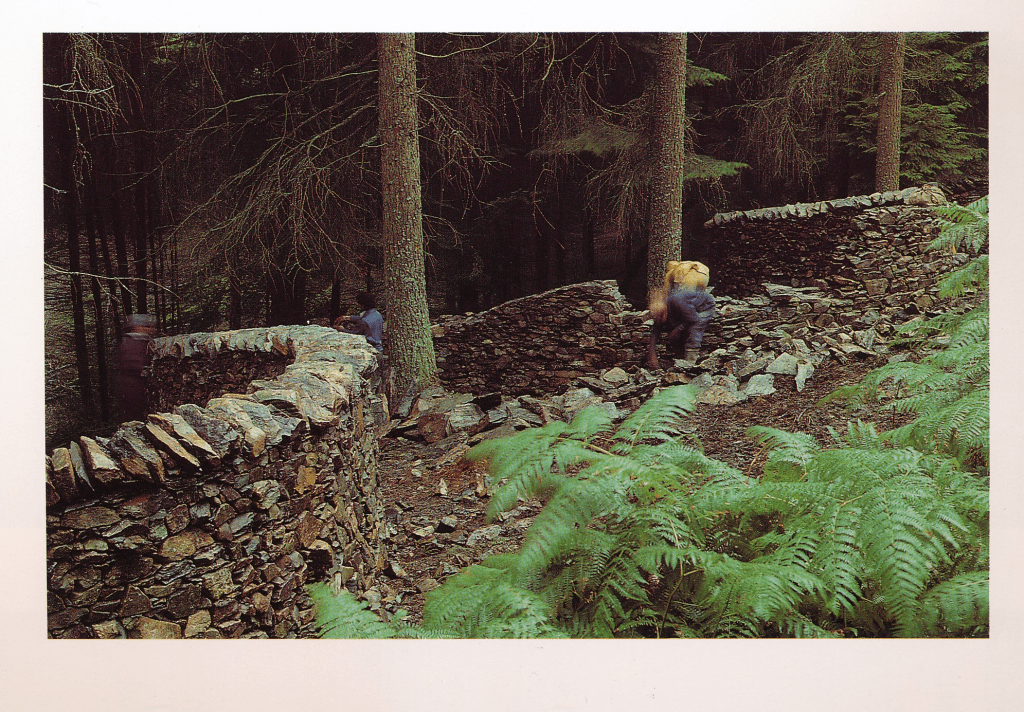
Another artist who comes to mind, much more environmentally minded and drive than Christo, is Andy Goldsworthy. Some of his works remain, such as “Wall that went for a walk” in Grizedale, but many, such as the ice or leaf sculptures, were naturally short-lived and remain now only as photographs.

What I think sets Long’s work apart is the mixture of approaches: physical artefacts both long-lived (gallery installations, painted sculptures) and temporary, some accessible, many not; photography; text; and the conceptual, the otherwise unrecordable activity simply of walking. (One other artist who occasionally mixes the physical with the conceptual that comes to mind here is David Nash. In particular I think of his Wooden Boulder which was both a physical artefact, a large carved wooden boulder, and the conceptual in the form of its journey down stream from Ffestiniog to the sea and its ultimate disappearance.)

It is this conceptual element, the idea that simple activity can itself be art is one of the aspects of Long’s work that I find particularly interesting and it is this part of his approach that has heavily influenced my efforts in the text in art exercise. (https://markrobinsonocalandscape.photo.blog/2019/12/27/exercise-2-5-text-in-art/). It is though also an influence on my thinking for Assignment 2 and the idea that it is the act of performing the journey, rather than for example simply recording the landscape through which it passes, that is important. I am similarly attracted by his use of chance in his work. As he says in the Guardian interview: “I guess I’m an opportunist, really. I go out into the world with an open mind, and I rely to a degree on intuition and chance.” Thesis one of the thoughts that has driven my first experiments with the camera simply pointed through the train window and images taken automatically with the interval timer.

Goldsworthy, A, (1994). Stone. London: Viking

Long, R, (2007).  Walking and Marking.  Edinburgh:  National Galleries of Scotland

Nash, D, (2007). David Nash. London: Thames & Hudson

http://www.richardlong.org

https://www.theguardian.com/artanddesign/2009/may/10/art-richard-long

Exercise 2.5: Text in art

As will be evident from some of my other work, particularly for C&N, I am a bit wary about combining photographs and text for fear that the latter can restrict the meaning of the image, or subvert and distort it. The idea of using text to make a piece of art is though a different matter.

I have had a look at the websites for Ed Ruscha, Barbara Kruger and Mark Titchner as recommended by the brief for this exercise but do not actually find any inspiration here. Whilst I admire Ruscha’s gas station paintings, for example, I find his text works do nothing for me: I struggle to see the point of an apparently random statement superimposed over a painting of a mountain. Kruger’s work is interesting but still does not affect me. Titchner’s work comes across to me as little more than empty sloganeering. Maybe I am being a little unfair to them all, but this is simply art that I do not like and from which I find I extract very little meaning.

Much more interesting and influential I find the text works made by Richard Long (on whom I am writing a separate post), Hamish Fulton, and some of the work of Autumn Richardson and Richard Skelton, to which I will return below.

For the purposes of this exercise I have started by making two lists rather than one as I have in mind different means of presentation for each. These are the product not just of one journey but a few over the last week or so. All stem from my daily dog-walking routine.

In the first I have made a list of all of the types of trees and shrubs that I can see (and can identify!) around here. Not all are necessarily native but at least they are all wild. I have deliberately excluded various of ‘plantation’ trees, ones that would not otherwise occur naturally in this area, such as the Pines and Spruces. Here is the list:

Apple, Ash, Beech, Birch, Blackthorn, Bramble, Broom, Buckthorn, Cherry, Chestnut, Dog Rose, Gorse, Hawthorn, Hazel, Holly, Hornbeam, Ivy, Larch, Oak, Rowan, Yew.

The second is of birds that I have seen on these same walks. There are a lot more varieties of birds about that I see on a regular basis at this time of year but I am excluding them because I have not seen any recently, such as Dipper, Goldfinch, Heron, Kingfisher, Red Kite, Mallard, (and obviously not including birds that are not here during the winter):

Blackbird, Bullfinch, Buzzard, Chaffinch, Crow, Dunnock, Jackdaw, Jay, Kestrel, Magpie, Nuthatch, Tawney Owl, Pheasant, Wood Pigeon, Redwing, Robin, Rook, Sparrowhawk, Starling, Mistel Thrush, Song Thrush, Blue Tit, Coal Tit, Great Tit, Grey Wagtail, Wren.

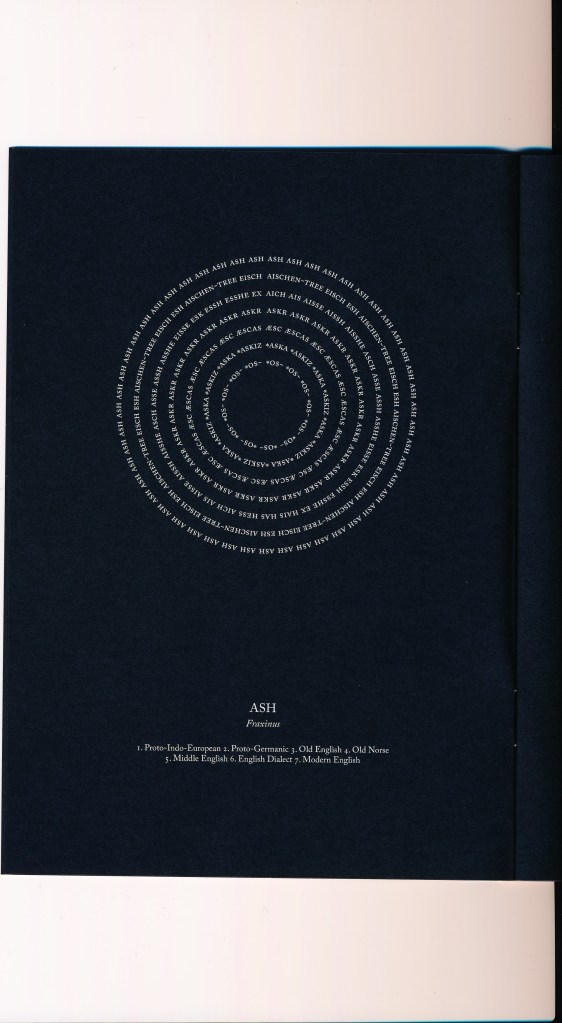
For the first list I take inspiration from Richardson and Skelton who have produced some text based works relating to trees, particularly those collected in Relics (2013). For each of a selection of trees they have created circular works made up of rings formed by various names for each tree, modern, ancient, dialect, and so on. The effect is of a cross section through the rings of thee tree. There is a form of dendrochronological effect in the finished work in so far as there is a temporal progression from the oldest form of the word in the centre to the modern on the outer ring. For example, Ash:

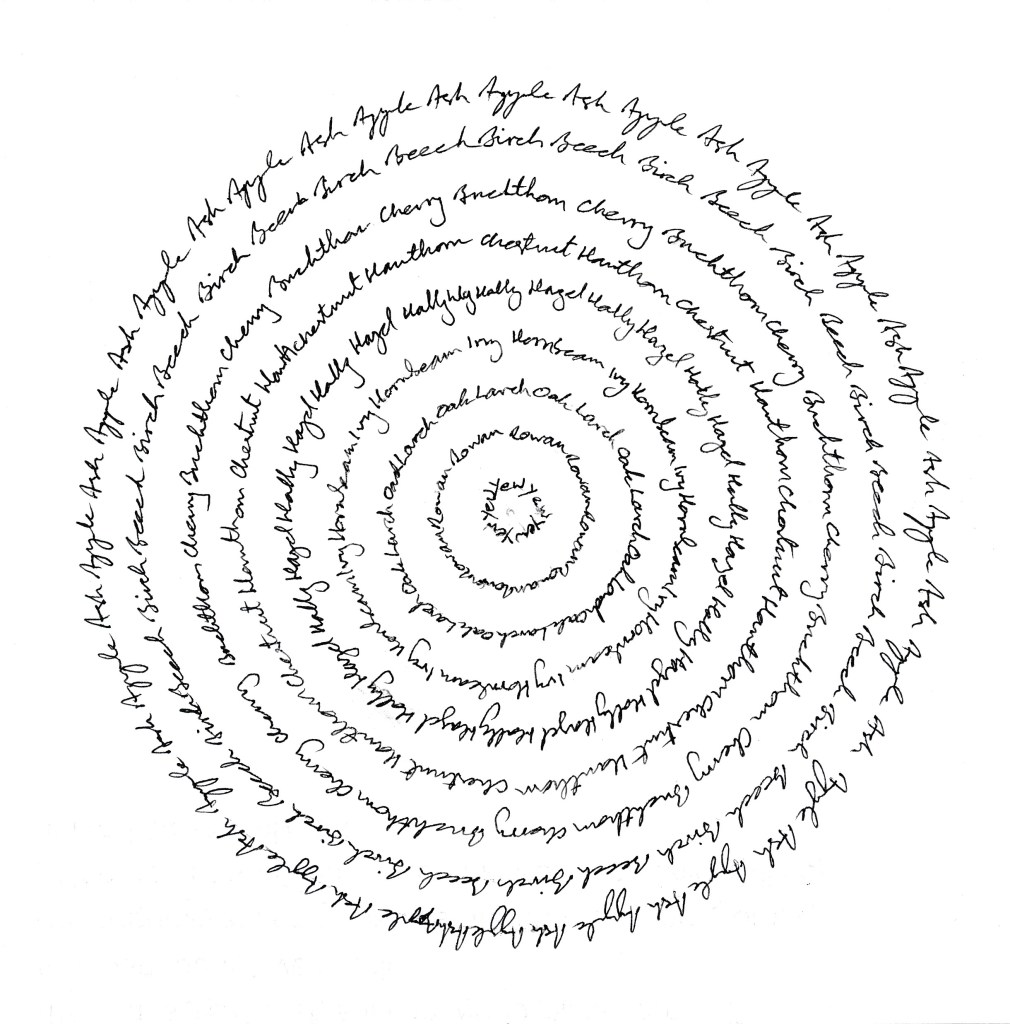
Taking this example as a starting point I have created my own version using a selection of the trees recorded on my walks, with Yew and Rowan alone on the inner two rings and pairs of trees, arranged nothing more than alphabetically, on the others:


This is a bit rough-and-ready, nothing more than an initial sketch. I do not have any programs on my computer which would enable me to make anything like this so I have simply roughed it out by hand on a sheet of paper. Although in need of further work and refinement it nevertheless serves for present purposes and gives an indication of what might be achieved. As a first attempt I do not think it has come out too badly!

For the bird list I have two ideas. For the first I unfortunately cannot remember where the idea comes from (I thought it was either Richard Long or Hamish Fulton but cannot find any examples of their work that fit the bill). I know though that I have seem similar work before. The idea is to take a map, at fairly large scale, of the immediate area where I live and walk my dog, and put a ring on it, with a half mile radius circle centred upon my house, made up of the names of the birds on the list. (I have not yet had a chance to try a mock up to see how it might work in practice.)

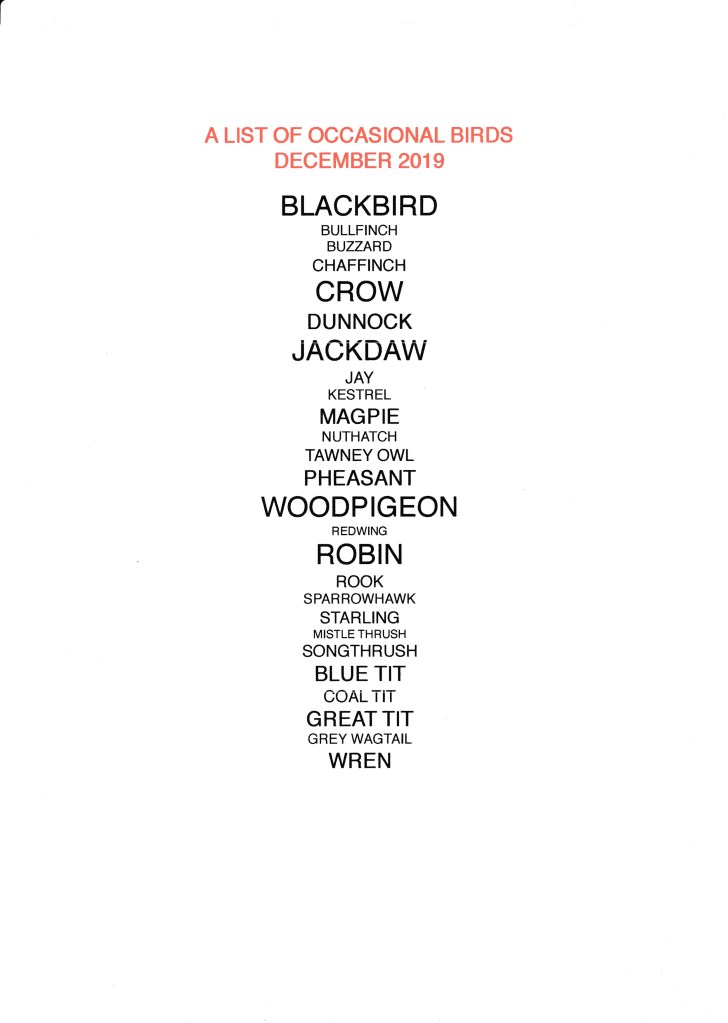
The other is based on Richard Long’s text works: a simple list of the birds but the size of the text varying depending on the frequency of sitings, from abundant as the largest to rare as the smallest. The text sizes are not strictly to scale but simply give an indication of the relative numbers of each species, and of course do not reflect their relative physical sizes. Again this could be refined and worked on further but here is what the first attempt looks like:

Richardson, A, & Skelton, R, (2013).  Relics.  Newcastleton:  Corbel Stone Press

http://www.barbarakruger.com

https://www.corbelstonepress.com

http://www.edruscha.com

https://hamish-fulton.com

http://marktitchner.com/work/

Exercise 2.4: Is appropriation appropriate?

The course material calls for about 300 words on this question, particularly in the light of the use by artists and “photographers” – I use the word cautiously here – of such internet vehicles as Google Earth and, more particularly, Street View. I do not honestly believe this is achievable in any way that does justice to the subject. This is a big topic, perhaps as old as visual art in all its forms itself, and there are lots of issues at stake. Not least there are ethical and legal issues, which I have been struck by their repeated absence, or at best only cursory address, in what I have read so far. I am therefore not even going to try to keep to that word count, but nor am I going to address this in as much detail or with the forensic rigour that it deserves. Rather I will simply make a number of observations in general and upon the practices of specific artists.

One immediate issue I have with much of what I have seen and read is that the word “appropriation” is used rather loosely. On the one hand there are those who, for example, are taking material produced by others and simply by presenting it in a particular way are effectively claiming that work for their own. On the other, are those who take someone else’s work and then use it to produce something new (in which category I do not include those simply making a different edit or juxtaposition).

Throughout art history artists have borrowed, stolen, from each other but despite that what has been produced is something that is the work of the ultimate author. Copying the work of earlier masters has long been a means of training new artists. There is nothing wrong with that, nor in my opinion, taking ideas or elements from earlier existing work to produce something new.

In the field of photography two works spring to mind, simply because they are in my library. The first is Bertolt Brecht’s War Primer (2017). There is no sense of Brecht claiming the photos for his own work but by arranging them as he did and applying his own text he produced something that is very much his own. In a similar way so too have Adam Broomberg and Oliver Chanarin with their updating of that earlier work in War Primer 2 (2011). There is no sense of them seeking to appropriate Brecht’s work as their own, nor the contemporary photos that they have overlaid upon those used by Brecht. Indeed they specifically give credit to the original sources of all of the images that they have used. I do not therefore regard this as a work of “appropriation” either.

This leads me on to the first article cited below on the OCA site. I struggle with the idea of Marc Quinn’s tapestry being in any way an act of appropriation. Certainly he has used a photograph as his starting point and has apparently rendered it faithfully (I have not actually seen it) but what he has done is produce something new, in a different medium, that is not the same as the photograph, and he has not sought to claim the photograph itself. Indeed as the article explicitly points out Quinn obtained the rights to make his new work.

In contrast there is the work of Jon Rafman and Mishka Henner, the former addressed in Geoff Dyer’s article and Henner in the course material. I have serious problems with the work of both. In Rafman’s case I confess I do not really understand what he is doing. He is presenting work by others, albeit a huge corporation, as his own, without, as I note looking at some of the images on his website, even bothering to remove or cover the statement of Google’s copyright (why they have not sued the pants off him is beyond me) and without any sense of him having intervened with the original material to produce something new. All he seems to do is juxtapose them in an apparently random manner. This is why I say I do not understand what he is trying to do, what his themes are, what message he is trying to put across. I regard the comment quoted by Dyer, “By reintroducing the human gaze, I reassert the importance, the uniqueness of the individual”, as little more than self-serving BS. He is taking ideas that come from photography and then seeking to apply them to his random, and apparently rambling, assortment of choices. And it seems to me that to assert that, as Dyer again quotes him, that these are “photographs that no one took and memories that no one has” is similarly self-serving and simply wrong. I struggle to see the relevance of memory here! (I would have expected a bit more of a robust response to this from Dyer, but there we go.) These might not be images that were actively and consciously taken by an individual but they were taken at the instigation and under the control of a company. They did not materialise out of thin air. Someone made this happen. These are not random snapshots of unidentified provenance that just happen to be picked up while walking along the street. To claim them as his own strikes me as naive at best, dishonest at worst.

I similarly have a problem with Henner’s work. I do not feel comfortable with the art-critical view expressed in the course material about his work (specifically the Street View shots of prostitutes waiting for business) operating as a critique about the invasive nature of such photographic technology. Yes, I can see that to an extent it certainly does this. But I do not consider that this is sufficient to take away the charge of voyeurism. The Google cameras are presumably indiscriminate in what they photograph, they simply capture whatever, or whoever, happens to be there at the time. Henner on the other hand has specifically and consciously chosen this particular set of subject matter. His point about invasive technology could have been made with any number of other subjects but this is the one that he chose, very much a male centred gaze of woman who find that in order to make a living they need to be sexually subservient to male desires.

I felt rather more comfortable with his satellite image work, discussed for example in Robert Shore (2014) (pages 14 to 21) but I still have difficulties with the question of whether he has done enough to make a new work rather than just apply his own name to something that already exists. I remain to be convinced that it is enough simply that the images he has used are apparently really quite difficult to find in the first place.

Michael Wolf is an interesting case. What sets him apart from the likes of Rafman and Henner is that he is actually a photographer, and an interesting, innovative, thought-provoking one at that. Again I thought Dyer could have been a bit more questioning rather than simply accepting the Unfortunate Events series as a continuity with his earlier work, something I have difficulty seeing clearly. Shore (pages 226 to 233), unfortunately I felt did not add much. I am therefore left a little ambivalent about his use of Street View. It is not to say that mining the images these commercial enterprises produce is not in itself a valid exercise but I have difficulty with he idea that it is sufficient simply to rely on artistic historical traditions of appropriation. I also still question whether the crop or the edit are themselves sufficient. (I think here that Dyers reference to Blow Up is not quite on point as of course the David Hemmings character was blowing up his own photograph, not taking someone else’s work as his starting point.) I am not hostile to Wolf’s work, as I would have to admit I am to Rafman and Henner, but I remain to be convinced.

One of the tricky questions which I do not see being addressed much, which I have touched upon above in my reference to War Primer, is how much intervention, rather than just finding, editing , and re-presenting obscure material, is enough to make the product new or original. This is though touched upon in the second OCA article in so far as it refers to the work of Richard Prince and the action brought against him by photographer Patrick Cariou. I understand the case originally went against Prince, was later overturned on appeal, but subsequently settled out of court. We are therefore unfortunately left without much guidance (from the courts in New York at least) from this particular case. (My knowledge of intellectual property law, despite having been a lawyer, is unfortunately minimal as this was a subject I never studies or practiced so I cannot offer any thoughts on where we might stand from an English point of view.)

In this regard it is interesting to see the work of Doug Rickard, also mentioned by Dyer. Evidently the source images have been processed and treated in a number of ways, though how is not immediately clear. This does seem to me to make a difference. I also have to admit though that the nature of the subject matter and the social concern that his collection and treatment of these images illustrate – many of these are people on the fringes of society, at least more affluent society and are viewed with a degree of sympathy and not, unlike Henner, in a way that comes across as voyeuristic – and that alone (the element of intention) makes me more accepting of his work.

In doing a bit of research into the Prince case I came upon a 2016 article in the Guardian, cited below, in which I note that Prince had been up to his old tricks again and was once more being sued. I know nothing more of the details of the case or its rights and wrongs. I was though nevertheless struck, most unfavourably, by something he is quoted as having said during the earlier case: “Copyright has never interested me. For most of my life I owned half a stereo, so there was no point in suing me, but that’s changed now and it’s interesting … So, sometimes it’s better not to be successful and well-known and you can get away with much more. I knew that I was stealing 30 years ago but it didn’t matter because no one cared, no one was paying any attention.”

After exceeding the suggested word-count very considerably, do I think appropriation is appropriate? I think the answer is far from straightforward and variable depending on the circumstances. I think much depends, or at least should, on the manner of the appropriation, the intentions behind it, the nature and extent of any intervention or manipulation, including, though not alone, selection, editing, presentation, cropping, and so on. I also think a very important element should come down simply to respect, whether the source work is that of an individual, whether an artist or not, or of a giant corporation (much though I have to confess I do not like Google the product of Street View is their property), and acknowledgment of the prior work and its ownership.

And no, this is not a method of working that I have any particular desire to explore, even if only experimentally. I am happy to take ideas from other people’s work to help make something of my own but not simply to try to take their work into my own oeuvre.

Brecht, B, (2017). War Primer. London: Verso

Bloomberg, A, & Chanarin. O, (2011). War Primer 2. London: MACK

Shore. R, (2014). Post-Photography: The Artist with a Camera. London; Lawrence King

https://9-eyes.com

https://dougrickard.com

https://mishkahenner.com

http://photomichaelwolf.com/#

https://www.theguardian.com/artanddesign/2012/jul/14/google-street-view-new-photography

https://www.theguardian.com/artanddesign/2016/jan/04/richard-prince-sued-copyright-infringement-rastafarian-instagram

https://www.oca.ac.uk/weareoca/fine-art/photography-meets-textiles/

https://www.oca.ac.uk/weareoca/fine-art/whos-afraid-of-appropriation/
Mapping and other technologies

As the next exercise directly addresses the issue of appropriation and the use of internet utilities such as Google Street View, I will leave my responses to the work of the like of Rafman and Henna until then. For now I will just make some observations – nothing too profound! – on the work of Liz Nicol and Ian Brown.

I have to confess I am not entirely sure why Liz Nicol’s work is featured at this point in the curse material. Whilst I understand how the Rubber Band Project came about I struggle to see it as a map of the walks in question and cannot but help feel that the mapping element is a little overstated. I do not expect it to be a literal map but looking at the work in isolation I do not get any sense of a progression, of a journey. Perhaps I am just missing something.

I do not have a problem with the use of cyanotypes as such but by their very nature, particularly when dealing with anything other than flat objects (I think the process was particularly well suited to Anna Atkins’s botanical work) they can be a bit difficult to decipher. As a result I sometimes find them to be a bit unengaging. It has to be said though that it is a fun medium and one that can be used very flexibly. I helped with a cyanotype workshop, run by the local rural arts charity that I volunteer for, at a small rural first school and the kids had lots of fun. I have also worked with another artist in residence at VARC, Lucy May Schofield, who has made some interesting pieces – including a mattress! – using the process. Nevertheless, of the various non-camera media I think I find photograms, such as the work of Man Ray and Laszlo Moholy-Nagy, more interesting.

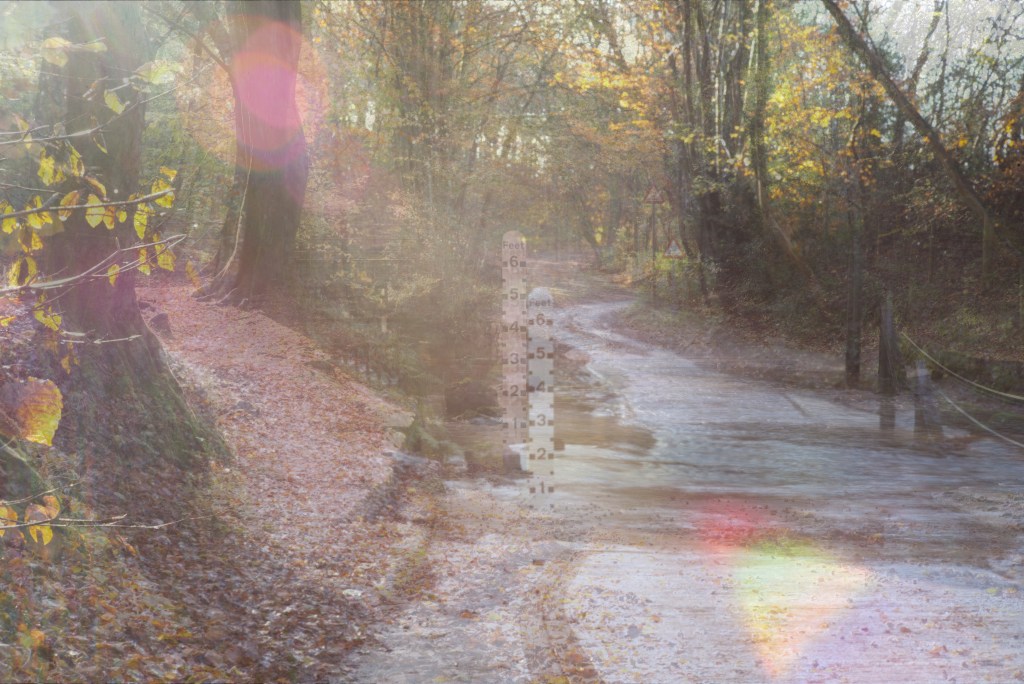
Ian Brown’s work I have found more immediately engaging and thought-provoking. It has in particular got me to think differently about the work that I am continuing to do for Assignment 6. The idea of layering multiple images made over time of the same scene is intriguing and is perhaps another way of recording and representing a series of transitions. Just out of interest I have made an experiment in Photoshop with just half a dozen of the pictures I have taken so far, layering them one over another, and playing around with the opacity of each layer so that all are at least partially visible, to see how this might work in practice:

It is still very early days but already it is possible to start to see how the image is already starting to become blurred and indistinct, with the varying light and weather conditions and the small differences in the position of the camera from shot to shot over the weeks. Over time I can see how this view would become increasingly impressionistic. When I have some time I think some more extensive experiments would be in order.

http://www.beardsmoregallery.com/exhibitions/walking-the-land/

https://www.liznicol.co.uk

http://www.lucymayschofield.com/work

Exercise 2.3: Typologies

Having read O’Hagan’s Guardian article I have decided to focus on the work of Stephen Shore in Uncommon Places for the simple reason is that this is the work mentioned that I have in my library. It has actually been sitting in the pile of books in my study waiting to be looked at that never seems to get any smaller! This exercise gives me the perfect excuse – encouragement – to look at it in more detail.

The first thing that strikes me about it, and which I immediately find appealing, it that although there is an over-arching typology to the collected work – views of ordinary but as a result overlooked, hence “uncommon” places – there are a number of sub-categories within it, for example: motels, inside and out; street intersections; shops and shop windows; downtown, business areas; automobiles everywhere; portraits. This gives the work an openness and a freedom to the viewer to construct and collect their own sets from within the whole. Much as, for example, I admire the work of the Bechers, I find it can get a little overwhelming sometimes looking at examples of the same type of structure over and over again. In Shore’s work there is more relief, more fluidity, and as a result a greater richness through variety. It is also interesting to note, and make fresh, juxtapositions between different sub-sets of subjects and yet still see how they fit into the overarching typology.

The Lewis Baltz interview I also found interesting as it chimes with some of the thoughts I have already had for myself about typological approaches. A few things he says particularly caught my attention. He concentrates on looking at and recording the “overlooked”, very much what Shore has done. In my response to Exercise 2.2 exploring a road I settled on precisely this sort of approach, concentrating mostly on the overlooked road hardware, overlooked often for the simple reason we are standing on it! (https://markrobinsonocalandscape.photo.blog/2019/11/28/exercise-2-2-explore-a-road-2-photos/)

Interest in the pictures comes from something in the work with which to engage. I think it is precisely the depiction of, the drawing attention to, the overlooked that does this. There is so much in our environments that we take for granted and do not notice, that is in fact worth some attention. The very fact this stuff is ubiquitous but unseen is itself interesting enough to make the exercise of making and looking at typologies worth it.

Waltz’s concern is not beauty and art is interesting to think about rather than look at. This is I suppose just a different way of saying the point above. A picture of one water-tower is not in itself that interesting, but a collection of numerous of them is definitely something that gets you thinking, and looking more attentively. I would though not necessarily rule out entirely the role of, or simply room for, beauty within a typology. Some of Shore’s work, for example, has a beauty of its own that stands scrutiny when looked at alone and outside the context of the book as a whole. Though I dare say it myself, some of the individuals in my road exercise are not without some aesthetic attraction.

Looking back over some of my own work for this degree course, right from the early days of EYV, I am surprised to see how often some sort of typological approach has made an appearance.

Now I come to think about the issue it seems to me typologies are everywhere and infinitely flexible but themselves easy to overlook unless presented in the sort of rigorous, almost scientific way the Bechers used. Is this in a sense the result of the primacy of the photo-book? Putting together a themed collection and assemblage of work is I think almost inevitably going to result in the generation of some typologies, even if they are more or less loose. Just looking across the bookshelves in my study there are a significant number that indulge to an extent in creating typologies, some more than others. A few examples, in no particular order: Mitch Epstein, Guidi Guidi, Ute and Werner Mahler, Alys Thomlinson, Hiroshi Sugimoto, Ragnar Axelsson, Sirkka-Liisa Konttinen, Martin Parr, Vanessa Winship. If nothing else this suggests that the typological approaches offer rich veins of material for exploration and experimentation.

Lastly, as if to confirm my last point, while working on this I came across the work of Antoine D’Agatas on the Magnum website, and which coincidentally links back to Donovan Wylie’s work at the Maze. Thesis an interesting example of how a number of typologies, working together, can help to bring out in greater detail and richness a portrait of a place, in this case Belfast, that is not simply geographical or topological, but also social and historical.

Axelsson,R, (2019).  Faces of the North.  Reykjavik:  Qerndu

Guidi, G, (2019).  In Sardegna: 1974, 2011.  London:  MACK

Guidi, G, (2019). In Veneto, 1984-89. London: MACK

Guidi, G, (2018).  Per Strada.  London:  MACK

Konttinen, S-L, (1989). Step by Step. Newcastle upon Tyne: Bloodaxe Books

Parr, M, (2013). The Non-Conformists. New York: Aperture

Mahler, U, & Mahler, W, 2018.  Kleinstadt.  Stuttgart:  Hartmann Books

Shore, S, (2014).  Uncommon Places.  London:  Thames & Hudson

Sugimoto, H, (2019).  Seascapes.  Bologna:  Damiani Editore

Tomlinson, A, (2019).  Ex-Voto.  London:  GOST Books

Winship, V, (2018). And Time Folds. London: MACK

https://www.tate.org.uk/art/artists/lewis-baltz-5373/lewis-baltz-industrial-suburban-landscape

https://www.theguardian.com/artanddesign/2010/feb/08/new-topographics-photographs-american-landscapes

Typologies and New Topographies – Donovan Wylie – 2 : The Maze – Book

Further to my last post on this subject I now have a copy of the book – and what a book; how did I miss this when it first came out? And how did I miss this site when driving past it given its sheer size?

Now I can see the typological elements properly. Although all of the images are from the same site I can now see that they are arranged in a way that is clearly typological: “inertias” and “steriles” (‘dead-zones’ but at least without the machine gun towers that might otherwise be associated with concentration camps); roads; yards; cells with beds and neat piles of bedding, all taken from exactly the same position.

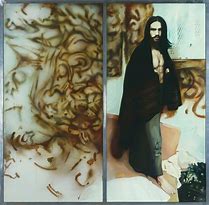
The book is actually a bit of a jolt. I had got used, when growing up, to seeing the Maze through the prism of the dirty protests, to the inmates dressed in nothing more than a blanket (here I think of Richard Hamilton’s iconic, Christ-like painting), the walls daubed with shit, the emaciated and dying Bobby Sands, so it is a bit of a shock to the system to see the surprisingly domestic nature of, of all things, the curtains in the cells. Everything else though reminds us that this was not a holiday camp but a place of imprisonment, of oppression, of disorientation, and of violence (both inmates and guards died here).

A scary thought, looking at all of those walls and lengths of razor wire: it is so reminiscent of that great British invention, the concentration camp. We invented these god-forsaken places back during the Boer Wars. Then it was men, women and children. Here it was only men but that does not make it feel any less uncomfortable. At least we did not go the whole hog and turn them into death camps. This place is though nevertheless burdened with an uneasy ethical legacy in so far as many of the inmates were “interned”, an administrative euphemism for locked up without trial. Without question there were people incarcerated here who were, without wanting to be too coy about it, not the nicest. Nevertheless this place remains for me an indelible stain on “the rule of law”. I am glad that is is gone, but it is nevertheless important that it be remembered.

Wylie, D, (2004). The Maze. London: Granta

Typologies and New Topographies – Donovan Wylie

I have unfortunately found the experience of looking for Wylie’s work a bit frustrating: none of the links given in the course material, including those in the erratum, appear to work; the Belfast Exposed website (a project that I did not know about before now but one that is clearly of significant importance) contains very little on The Maze project, only a few images, and no examples of or extracts from the essays in the book. At least there is some more information on Wylie’s own website and there are the short videos on YouTube. These latter are at least more informative about the Watchtowers and Outposts projects.

I am trying to get hold of a cheap second-hand example of the Maze book as probably the only way of seeing this project in detail. Until I have done so I can only defer making any comments or observations on it apart from a couple of preliminary points.

The first is that this does not strike me as falling comfortably within the category of typological in so far as all of the pictures were taken within the confines of the one camp. I am not convinced that the repetition of similar views (as I understand the project includes) necessarily makes this a typological study. To that extent I feel the point is being stretched a bit to far in this section of the course material. I see this more as straight documentary and a topological survey. Ultimately though I do not think that the label that is attached to this work really matters.

As an aside, it is only now that I realise that I have driven past the site of the camp without realising it, going from Magheralin to Lisburn along the Moira road, which runs very close to the site, and visiting Hillsborough which is just to the south. This is a beautiful, verdant, and quite well off part of County Down, so it is a bit shocking to realise that the most notorious prison camp in the North was right at the heart of it.

The Watchtowers and Outposts series are clearly more straightforwardly typological. There are similarities in location and construction for each OP, in the North and Afghanistan respectively, but it is only when they are seen en masse that the similarities, and more to the point the differences, become evident and important. It seems to me that this accumulation and juxtaposition of the images is what serves to focus the work on the themes of power and control, something that is also shared by the Maze project. However I am also led to think that the power and control that these structures represent was perhaps more illusory than real.

In the case of the Maze there was certainly an exercise of power, in so far as people were held subject to a prison system, denied their freedom. Inherent in this is also an exercise of control. However it seems to me that it would be too easy to overstate the extent to which that power and control were exercised. Prisoners organised themselves within their respective parts of the camp. There were times and places within it when it was difficult for the authorities to exercise power: just think of the dirty protests and the periodic mass breakouts.

This contradiction is even more apparent with the OPs. (Again I remember seeing some of these on my first lists to the North in the 1980s, particularly in Armagh and in and around Derry.) The problem as I see it with these sort of structures is that they do not very effectively exercise power or control. Certainly they are important for intelligence gathering that can then be used in a wider context but as individual sites they neither exercise power or control over the immediate area. Rather what they do is isolate soldiers in a small, exposed, isolated, and vulnerable position and do not prevent enemy movements around or past them, whether that was IRA or Taliban. In am nay ways I therefore see these places, and these images, as monuments to military hubris. Perhaps this is a more important theme in Wylie’s work.

Moving on, I see that Sontag crops up again here and I have to confess that I do not fully understand why. Wylie’s work, in so far as it is about power and control, is not about the power or control, supposed or real, of the photographer and the photograph. What Sontag was writing about was the way that photography itself is a form of acquisition, a symbolic act of possession. These two positions are far from being the same thing.

Putting aside my general dislike of Sontag’s book I have to admit that I do find some common ground with her on this point, even if I do still think her case is somewhat overstated. It is though interesting that although Campany was thinking about the photographer as a collector he does not go into the same sort of territory of possession and control and concentrates, more appropriately in my view, on the way that process of collection, the acquisitiveness of the photographer, has an impact and effect upon the meaning and significance of the images so collected.

Incidentally, so fas as I can see the page references for Sontag given in the course material are wrong. The section on possession that I can find is in the essay The Image-World, from page 153. Pages 12 to 16 are more about the camera as weapon and means of sexual fantasy. I am not going to analyse her arguments now but simply point out what strikes me as a glaring contradiction between the two sections. The later essay explicitly argues that photography is a form of possession, albeit symbolic or surrogate. At page 13 though she says “The camera doesn’t rape or even possess, though it may presume, intrude, trespass, distort, exploit..”. Is this just another change of mind along the lines of that in Regarding the Pain of Others on documentary photography and compassion fatigue? Nothing wrong with that.

Sontag, S, (1979).  On Photography.  London:  Penguin

Sontag, S, (2004). Regarding the Pain of Others. London: Penguin

https://www.belfastexposed.org/exhibitions/the-maze/

http://donovanwyliestudio.com/index.php?page=about

https://www.youtube.com/watch?v=VQekhfX73zE