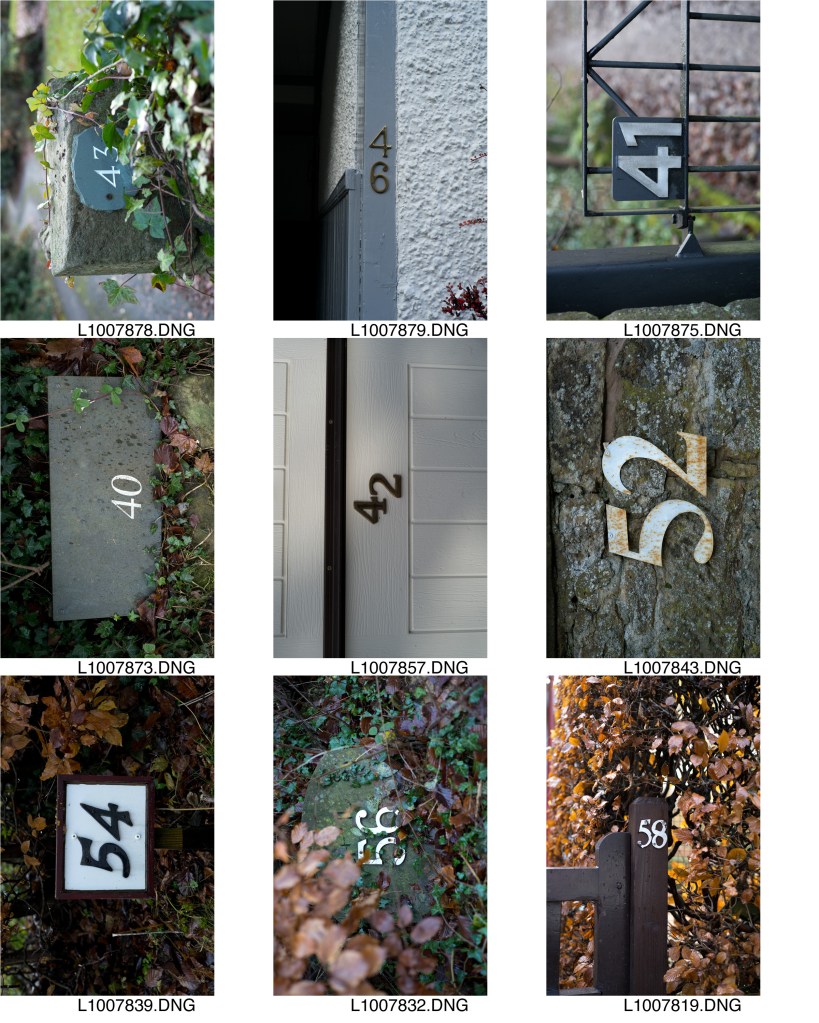
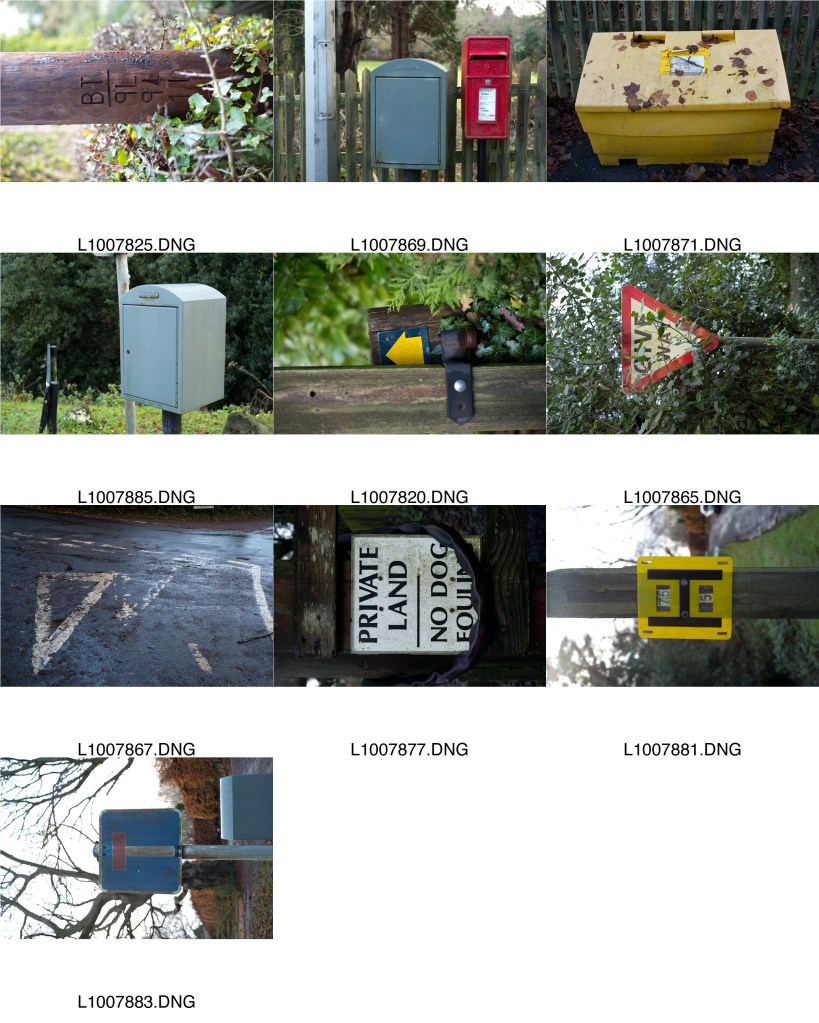
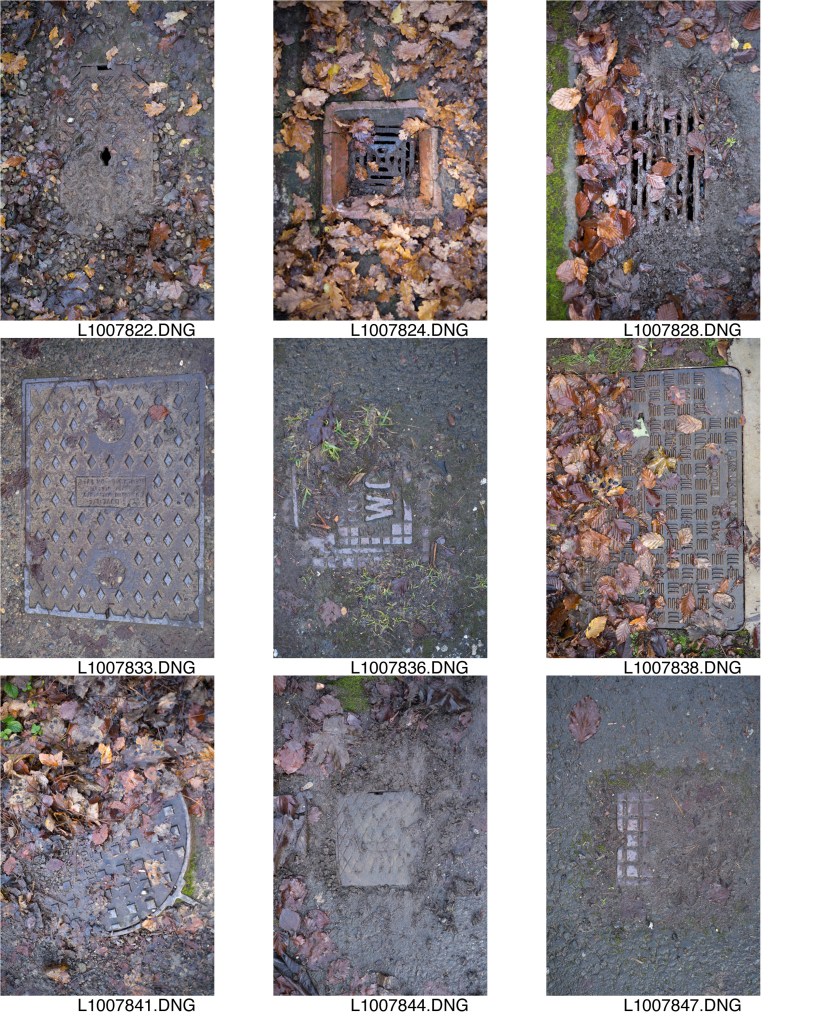
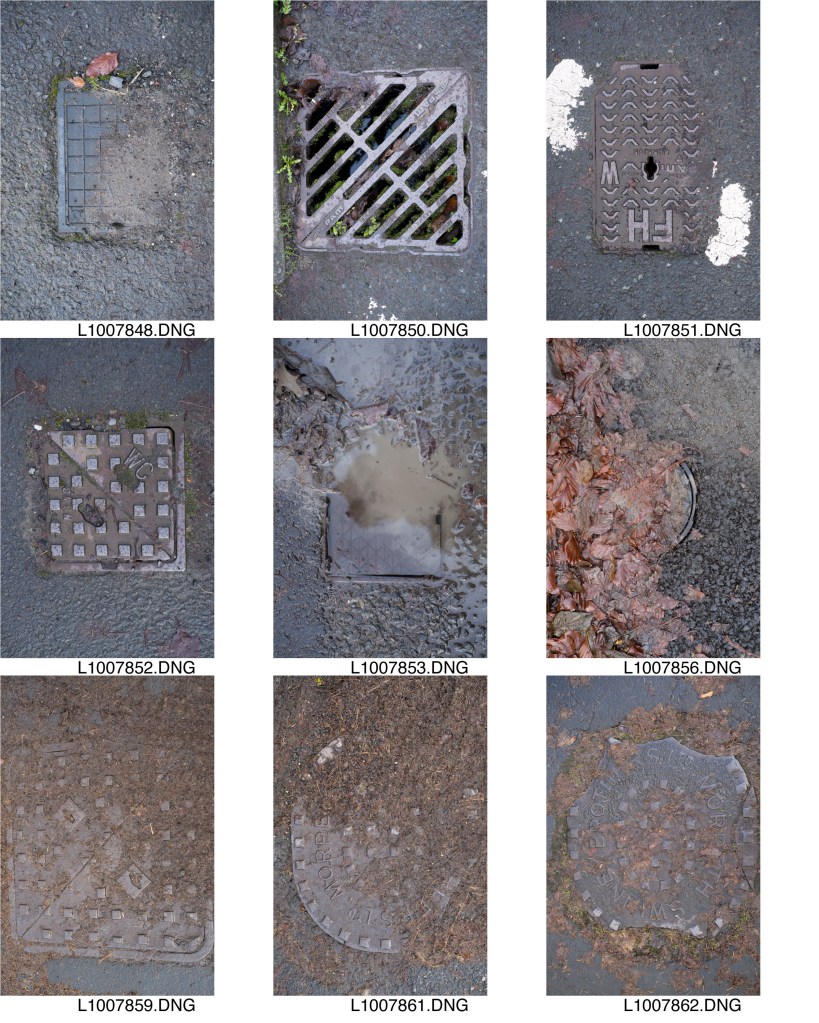
I had not read ahead to this next part of the course material while working on the last exercise and taking a typological approach to photographing my road so did not realise that this is what we would be getting into next. A happy coincidence though as increasingly I find my thoughts on landscape photography focusing more and more on collections of images, typologies, and the accumulation of meaning over time. Because I have already been thinking in these terms some of the material discussed here is already, to an extent, familiar.
Farley & Symmons Roberts (2012) is a book that I read when it first came out. I was not at the time, and to an extent I am still deficient in this regard, well acquainted with their poetry, though I am sure I had come across the odd piece, and was not really sure about the subject matter, though I had previously read some of Iain Sinclair’s in a similar, psychogeographic vein. I found though that I enjoyed it greatly, particularly the way they bring their poets’ eyes to these marginal, liminal, landscapes. I particularly remember the reference to the Bechers: as I did not know their work at the time I went in search of it to learn more, and in the process realised that I had in fact seen some of their collected images in galleries without properly registering it, or them, or appreciating its importance. The poets’ observations very much echo my own thoughts: the single image does not necessarily communicate its meaning adequately. Juxtaposing a series of images though sets up dialogues, reflections, clashes, synchronies, that bring out much more meaning and significance. This is why I still prefer, as I have written elsewhere, collections of related images to the idea of the singular image, the salon photograph.
There is an interesting parallel on the previous page (page 193) extolling the virtues of not just the individual wind turbine but serried ranks of them: “How majestic it would be, on our way into or out of our cities, to drive past strips of giant white daffodils blowing in the breeze.”
An interesting coincidence is that after the Bechers they mention the work of John Davies. One of the things that attracts me to his work is the use of the repeated view, particularly when separated over time, as exemplified by his latest book, Retraced 81/19, a copy of which I have just bought, with its pairs of pictures of the same place but separated by decades.
I have not been able to track down a copy of Cruel and Tender but David Company’s essay is at least available on his own website. Though he makes a number of points, it seems to me that the most important one is about the way photographs have come over time to be seen more in book form than in exhibitions and that the enables them to communicate their meanings more fully and effectively. As he puts it, showing series of images collectively gives them “the chance to articulate each other. In this way photography doesn’t simply show but ‘shows itself showing what it it showing’. The straight image is made self-conscious and reflexive …”
“The isolated picture/artefact is given a depth of meaning through the structure and orchestration of the group. Art is largely effaced from the image but returns in the act of assembly.”
The other important point for present purposes is his observation about the ‘snapshot model’ which “has had its own tendency towards accumulation that is very different from the archival straight image. Essentially chancy and speculative it works by taking many images then editing the large haul for revelations and epiphanies.” Here we have the photographer as collector and one of the underlying strengths of the typological approach.
“Veracity and voracity became almost indistinguishable.”
Here is another of those coincidences: while reading and thinking about this issue I have been looking again at some of the work of Rinko Kawauchi and reading about her working practices in Sasha Wolf’s new book (2019).
Whilst her approach is not invariably the same, particularly when working on a specific project such as Ametsuchi or The River Embraced Me, where the work is produced with a single subject inn mind, I understand she often collects and juxtaposes individual images that are sometimes made years apart. As she puts it in her interview in Wolf’s book (at pages 108 and 109):
“An individual photograph is like a single cell, or a single voice; I think that a body of work comes into being when those individual elements constellate and resonate with one another. “
“… In a way different from viewing a single photograph on its own, another world comes into view when lining up photographs of varying subjects. The overall ‘countenance’ of a work can be expressed in a variety of ways depending on how one arranges these components; as such the editing process is crucial. It is also an entertaining one, as elements I had not been conscious of while shooting often come into view when editing.”
The last mentioned work in this part of the course material, Donovan Wylie’s typological work, raises some interesting issue about power and control, and the role of photography in those regards, is, I think, worthy of looking at separately so I will deal with that in another post. I will also include a brief reference to Sontag who I see crops up again in the context of collection and possession.
Davies, J, (2019). Retraced 81/19. London: GOST
Farley, P & Symmons Roberts, M, (2012). Edgelands. London: Vintage
Sontag, S, (1979). On Photography. London: Penguin
Wolf, S, (ed), (2019). PhotoWork: Forty Photographers on Process and Practice. New York: Aperture
https://davidcampany.com/almost-the-same-thing-some-thoughts-on-the-photographer-as-collector/
 Mark Robinson's OCA Landscape, Place & Environment Blog