I find this a somewhat odd section of the course material as a significant part of it is not really about landscape or specific places but more about the general function of photographs as mechanisms for recording and promoting particular memories (personal or collective, and not necessarily in full accordance with our own memories) and putting forward a particular view of historical events, with a nod to the tradition of history painting that continues, or at least forms the roots of, some photographic practice.
Barthes’s discussion of the photograph of his mother (which of course we never see, leaving some doubt in my mind whether it actually existed, or whether what he is discussing is based on a memory of a photograph so that the “photograph” de describes is actually a product of his own memory) is to do with the role of photographs as representations for and triggers of memory, repositories of them, in general. He does not not tie this function to operating in any particular place, though the actual, physical photograph, in so far as it was taken in a particular place of some significance (to his mother or her parents, for example) would actually be a repository of some memory associated with that place, even if in the absence of evident context it might be difficult, in particular at a generational remove, to extract that memory. Otherwise he deals with the unreliability of the photograph as a mnemonic device.
Peter Kane’s work I found interesting but as I have written elsewhere (in I&P) this sort of exercise would be difficult for me in the absence of any archive of my own family photographs. I did of course experiment with something of this sort, using historical rather than personal photographs, when working on the last assignment for I&P, but without much success. Something of this sort would be possible with my wife’s family albums, but not really feasible in so far as it could conceivably involve visiting two other countries, which I am not about to do! What I do get from this work though is the idea of a space taking on a significance, and becoming a place, even if only for an individual or small group of people, by virtue of a personal memory being associated with it. This is very much the direction that I am moving in with my continuing work for Assignment 3.
Shimon Aktie was completely unknown to me before reaching this section of the course but this strikes me as one of the most interesting examples locating memory in a particular place through the medium of photography. I like the multiple layers of palimpsest: the historical photograph, itself an object of memory/place, projected onto the surfing place itself, and then photographed again. The memory of the original place, as it was in the past, and of the people who were there, becomes re-embedded in the place as it is now, and that in turn, the installation itself, is further memorialised by the photographs that were taken of it. At a superficial level it reminded me of the work of Roman Vishniac in 1930s Poland, which are of considerable historical importance. I find though the experience of looking at this modern work richer and more engaging, not least because of the link to the contemporary environment.
Perhaps I have run up against a blind-spot but I am not completely sure why Jeff Wall’s Dead Troops Talk is included here. Generally I admire his work, but I am afraid that this is not one that appeals much. Because it is so theatrical, so clearly staged, I wonder what purpose it really serves as an instrument of memory, and memory related to a particular place, notwithstanding that the work’s long title provides the geographical, and historical, context. At best I surmise it is working within the tradition of history painting and, in the same way as many public historical monuments (as Bate discusses in the context of Fox-Talbot’s photographs of Trafalgar Square and Nelson’s Column) it is “creating” a new public memory, an idealised memory, for those who have no actual, visual, memory of their own of the events in question. Given the context of Afghanistan and the litany of imperialist/colonial wars fought there (which is in essence what the Soviet invasion was) I think of William Barnes Wollen’s 1898 painting of the disastrous British retreat from Kabul in 1842:
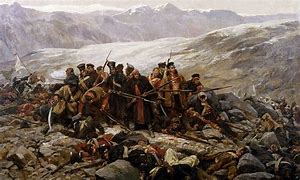
I have similar questions about the work of Luc Delahaye, though his is something I take much more seriously as a particularly fine example of late-photography. Although he also has an eye on the conventions of history painting, it does not seem to me that he is offering, let alone promoting, any given collective memory. His work strikes me as much more dead-pan than that, simply recording places, events, and people as he encountered them and leaving to to the viewers to form their own responses. How his work might help or influence what I am doing for this course remains to be seen.
http://www.shimonattie.net/portfolio/the-writing-on-the-wall/
https://www.theguardian.com/artanddesign/2011/aug/09/luc-delahaye-war-photography-art
https://www.theguardian.com/artanddesign/2012/oct/09/luc-delahaye-wins-2012-prix-pictet-award

 Mark Robinson's OCA Landscape, Place & Environment Blog