The subject of late photography is one that loomed fairly large in C&N and as such is something that I spent some time looking at then. I have gone back to that earlier work and again looked at Paul Seawright and Sarah Pickering, and read John Stathatos’s article. I find that having done so I do not really have much, if anything, to add for the time being. I think the important points are the ones to be made in response to Exercise 3.3. I do not propose therefore to write anything fresh here but simply refer back to a couple of my C&N posts, on which my views have not changed significantly in the interim.
Otherwise, I would mention that the link to the Library of Congress website appears to be bad and as no indication is given of what the content the subject of that link was supposed to be it is not really possible to find whatever the intended material is from within the website itself.
I have of course already looked at Campany’s essay “Safety in Numbness” while working on C&N. (https://markrobinsonocablog2cn.wordpress.com/2018/01/05/safety-in-numbness/). The focus then though was on the issue of compassion fatigue that Sontag had addressed in her earlier book (1979) but on which she later changed her mind in her last book (2004). This time round we are coming to the article from a different angle. This time the relevant point is more about the role of “late photography”.
Rereading the essay this time round there are two particular points that come across strongly to me, which are of course related: that in a world of instant news feeds and live video broadcasts, the photograph, particularly in the mode of late-photography, offers a slower, more considered view of and approach to events; at the same time the late-photograph has increasingly become an aesthetic object rather than simply (was it ever a case of “simply?) a piece of photojournalism.
Today images of unfolding or recent events are more likely to be in the form of video, often taken at the very time on bystanders’ smart phones. As such they have an immediacy, though not necessarily reliability or objectivity. If we see a still image of an event it is just as likely to be a screen grab from a video sequence. Thinking back on the other hand to, for example, the Vietnam war (I am of an age to remember the nightly news bulletins) the images that were taken in the thick of the action were taken not on film or TV cameras, which were too bulky, but on 35mm film cameras: just look at the work of the likes of Don McCullin and Tim Page, to name but two. Now the photographer goes in with a camera after the event, to record what Campany calls the traces of traces, the aftermath, the consequences of action that has gone before. (Ivor Prickett’s work in Syria and Iraq immediately jumps to mind here having seen it at the Side Gallery and having written about it recently. There are a few images where something has just happened – a bomb blast or an airstrike – but mostly they are separated and divorced from the immediate action.)
Late photography offers an opportunity away from the sound/image-bite and increasingly short news cycles for a more considered, sober, assessment of events. It offers an opportunity to memorialise events. One consequence though is the aestheticisation, or at least the risk of turning reportage into art, of the work. This is not work for immediate consumption and is more likely to be seen, not by way of news outlets, but on the walls of galleries, as is the case with Prickett’s work, and Meyerowitz’s World Trade Centre photos. That is not necessarily a bad thing but is something that I think needs to be borne in mind when viewing and interpreting such work.
The pictures that Joel Meyerowitz took at the site of the twin towers is in some ways a perfect example.
As a first step, rather than looking at them again on-line, I have deliberately chosen to look at them only in hard copy, going back to the second chapter of his recent book (2018). These are pictures that deserve to be looked at more slowly, lingered over, and appreciated in a physical, tactile form, rather than as pixels on a bright screen. The scenes that he captured were intensely physical and to get something of that back I think it is worth slowing down and appreciating the physical feel of printed images in a hefty book.
How they differ from what we saw at the time on television is obvious. We saw repeated (indeed too often distastefully so) images of planes flying into the buildings and exploding, the spreading fires, people falling to their deaths, the steady collapse of the buildings. What we did not see, and for obvious reasons could not, is what was happening on the ground. Meyerowitz obviously cannot show this either but what he does show is the aftermath, what was left after, literally, the dust settled. What he shows is what, by the time he was able to photograph there, was no longer a prime concern of the news outlets.
And its value? In part it is I think precisely that, this filling in of the less “newsworthy” details. In some ways I see it as a truer, at the very least less sensationalist and therefore more reliable, portrayal of what happened here. Rather than sensationalist it is much more considered. As such I feel it serves as a more fitting memorial to events, the people who died (though they are of course strikingly absent from much of this work, other than in an more indirect way, as in photos such as “Five more found, New York City, 2001” – (2018) at pages 34 and 35.) It also serves as a tribute to those who worked to clean up the site afterwards, an unpleasant, dirty, traumatic, and dangerous process in its own right, who might otherwise be overlooked.
Meyerowitz, J, (2018). Where I find myself. London: Lawrence King
Sontag, S, (1979). On Photography. London: Penguin
Sontag, S, (2004). Regarding the Pain of Others. London: Penguin
A few reflections on this part of the course, prompted perhaps more by the two exercises that follow this section of the course material and by some of the reading I did in connection with the Picturesque. Nothing very profound, and indeed slightly random, but nevertheless pertinent to the way my thinking about landscape photography is developing.
Just by way of a preface, it is unfortunate that the video interview with Martin Parr that appeared in the Guardian and that is cited in the course material is no longer available. Though I am not much of a fan of Parr’s work, it would nevertheless have been interesting to hear his take on collecting in general, and postcards in particular. I never did see the Parrworld exhibition when it showed at the Baltic in Gateshead (more than ten years ago now!) and I have not looked at any of his Boring Postcards books so feel that, for all my generally critical stance, I have perhaps missed out on something here.
With that out of the way, I thought I would start with Susan Sontag (1979) and the closing comments in her essay “In Plato’s Cave” (page 24). Whilst I still bridle at the hyperbolic absolutism of her judgment I do find myself broadly in agreement. No, not “everyone is now addicted” to “an aesthetic consumerism”. Perhaps I and people I know are ‘unusual’ in this regard but I do not know anyone who really falls into this catch-all. For many years I did not take a camera with me when travelling. I had got tired of seeing the world through the viewfinder of a cheap camera (starting with a Kodak Instamatic as a child and working up to an Olympus OM-10 as a young adult) and taking pictures that did not really do reality any justice (a bit like the postcards in my last post). What I was missing was the experience of really looking at what was before me. That led me to replace the camera with a sketchbook, which made me look much harder and, although sometimes quite frustrating, was much more rewarding.
One of the things that brought home to me the banality of a lot of tourist photography, and here I am with Sontag wholeheartedly, was a [particular experience I still recall from nearly thirty years ago. On a road-trip through Europe with friends back in the 1980s we visited the BMW museum in Munich (a couple of those friends were real petrol-heads). At the same time we visited a group of Japanese tourists were also there. (I am most definitely not singling out the Japanese here. They could have been any nationality. They were just more noticeable as at that time I had not encountered many people from East Asia. What was most striking was that a number of them took pictures in front of almost every car on display. The pictures though were not of the cars but of the rest of their little group standing in front of, and in all likelihood almost completely obscuring the exhibits. Although again I do feel that Sontag somewhat overstates her case, I nevertheless do think this was an interesting example one of her comments:
“Ultimately, having an experience becomes identical with taking a photograph of it, and participating in a public event comes more and more to be the equivalent of looking at in photographed form.”
For these tourists the experience was not of looking at some old cars but of having their photographs taken while standing in front of them.
I guess this phenomenon continues today in up-dated form, but essentially the same thing, with the ubiquity of the smart phone and the compulsion (which, at the risk of indulging some Sontag-like hyperbole, seems almost pathological) to take the wretched “selfie” in front of whatever the tourist is ostensibly there to look at and experience.
I think I have since got over my former aversion to travelling with a camera (not that I do much travelling now) but am certainly a lot more considered about when I press the shutter as a tourist (as opposed to someone pursuing a particular photographic project). And yes, I do still sketch a little as well, though not as much as I used to.
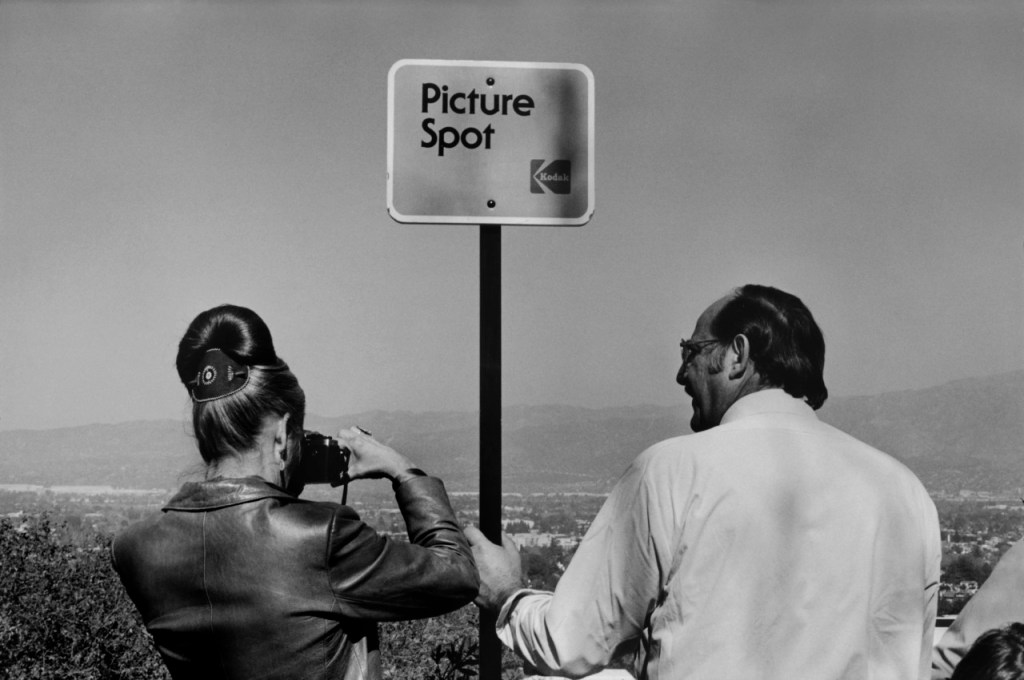
Gilpin’s ‘pioneering’ work (1789) as a guide for tourists came back to mind when I read a little of Wells (2011) (around page 90) prompted by the course material. The tourist photographer is effectively being shepherded into particular places for the specific purpose of taking photographs. The tour bus stops at the local “beauty-spots”. Ordinance Survey maps still include a symbol identifying places from which to view picturesque scenes. I was reminded of a photo by Magnum photographer Raymond Depardon:
USA. California. Los Angeles. 1982.
Perhaps not surprisingly the photographic industry, in this case film and consumer camera manufacturers Kodak (as I have said above my first camera was a Kodak), got on the bandwagon and erected their own signs. Says it all really about the consumerist commodification attacked by Sontag.
Going back to Wells and to Snyder in Mitchell (2002) and their narratives of the development of commercially available photographic images and a consumer market for them, struck a chord when I embarked on the postcards exercise. As I indicated then, I rarely if ever receive postcards now and if I do they tend to be of works of art rather than places. Given the proliferation of smartphones and cheap digital camera I had therefore expected that it would not necessarily be easy to find any decent contemporary postcards that would serve for the exercise. In that respect I was not surprised that I only found one shop in Hexham selling any (though that has to be caveated by the fact that there were a number of possible outlets that I did not get round to visiting). What did surprise me though was to be told by the ladies working in the shop in question that they actually sell a lot of cards. Not just a few but, in their words, “lots”! Apparently there is still a market for these things and my little corner of the world does attract quite a lot of visitors (Not too many: Northumberland is known as “The Hidden Kingdom” and we would like it to stay that way; but enough to support the local tourist economy.) Indeed, the first question I was asked was whether I was there on holiday! These factors then led me to speculate whether the relative health of this particular market for postcards might actually be a demographic issue. Again not at all a scientific analysis, but my guess is that a majority of the visitors we get, particularly in the local towns, as opposed to the wilder reaches of the county (Hadrian’s Wall, bits of the Pennine Way, the Cheviots) tend to be more ‘mature’ (which does not necessarily mean old!) Are they, I wonder, of a generation that is less likely to spend all their time pointing their phones at the sights and not into selfies?
Whatever the explanation might be, it would appear that there is still, possibly against the odds, a market and a life for the picture postcard.
Gilpin, W, (1789). Observations on the River Wye, and Several Parts of South Wales. London: Blamire (Gale ECCO facsimile reprint)
Mitchell, W.J.T, (ed) (2002). Landscape and Power. Chicago: The University of Chicago Press
Sontag, S, (1979). On Photography. London: Penguin
Wells. L, (2011) Land Matters: Landscape Photography, Culture and Identity. London: IB Tauris
Coming back to the first part of this exercise, in some ways I find it a bit of an odd one. These days I have very few postcards. Those that I do I have either bought myself or have been sent to me by others and are invariably of works of art rather than places. I do not recall ever having been sent many postcards of places that I actually know, rather than places I have not otherwise visited – is that not part of the rationale of the postcard?
I do know at least one person with an extensive collection of cards but these are, so far as I know, nearly all historical views, or at least not contemporary, which rather defeats the object of this exercise.
I have therefore had to go out and buy some that show places I know particularly well in Newcastle and the Tyne Valley area where I live. Not quite as easy a task as I first anticipated as very few places locally – I only had time today to go to Hexham – now sell the things. (I will write a little more about buying postcards in general when I get round to reflecting on “The tourist perspective” that prefaces this exercise – yes, I know, I am doing this section in reverse order! That is just the way it has worked out.)
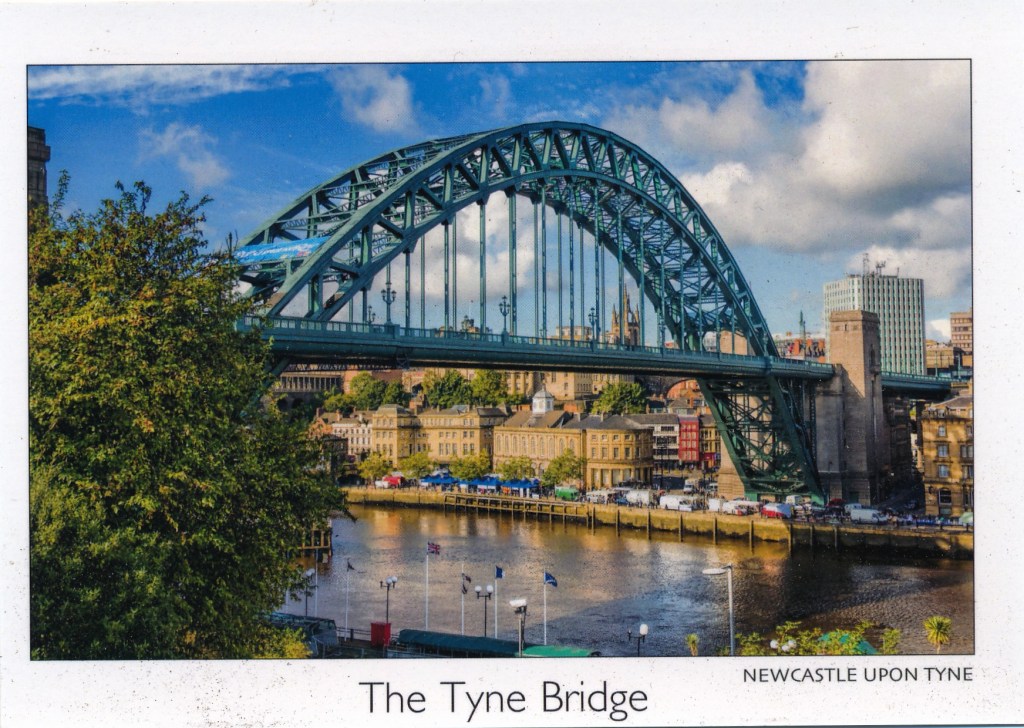
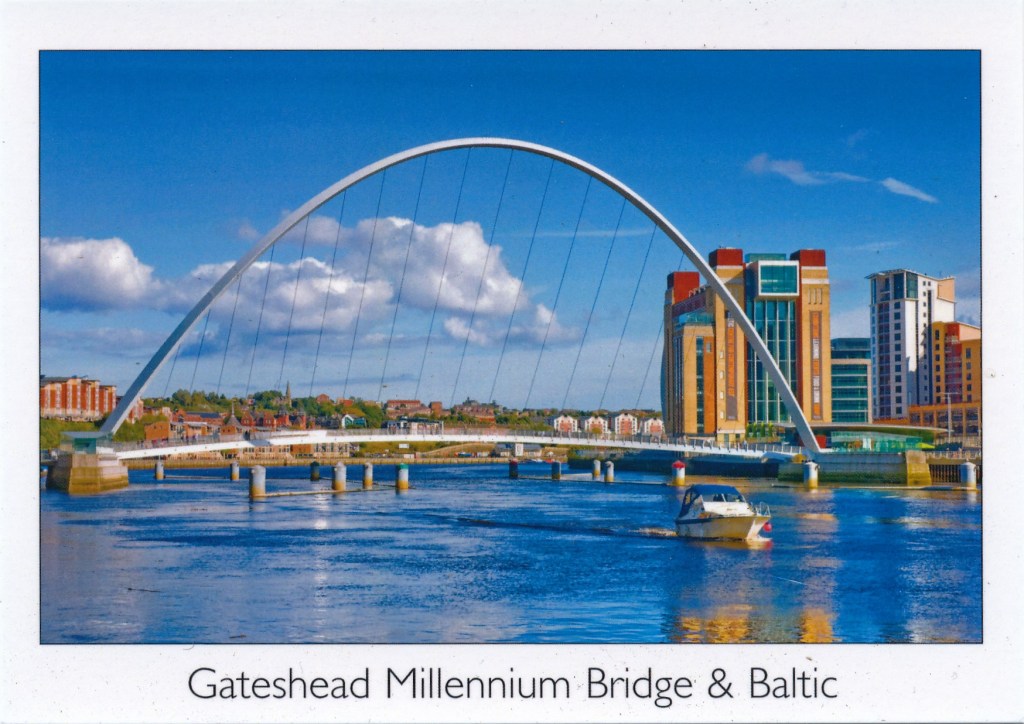
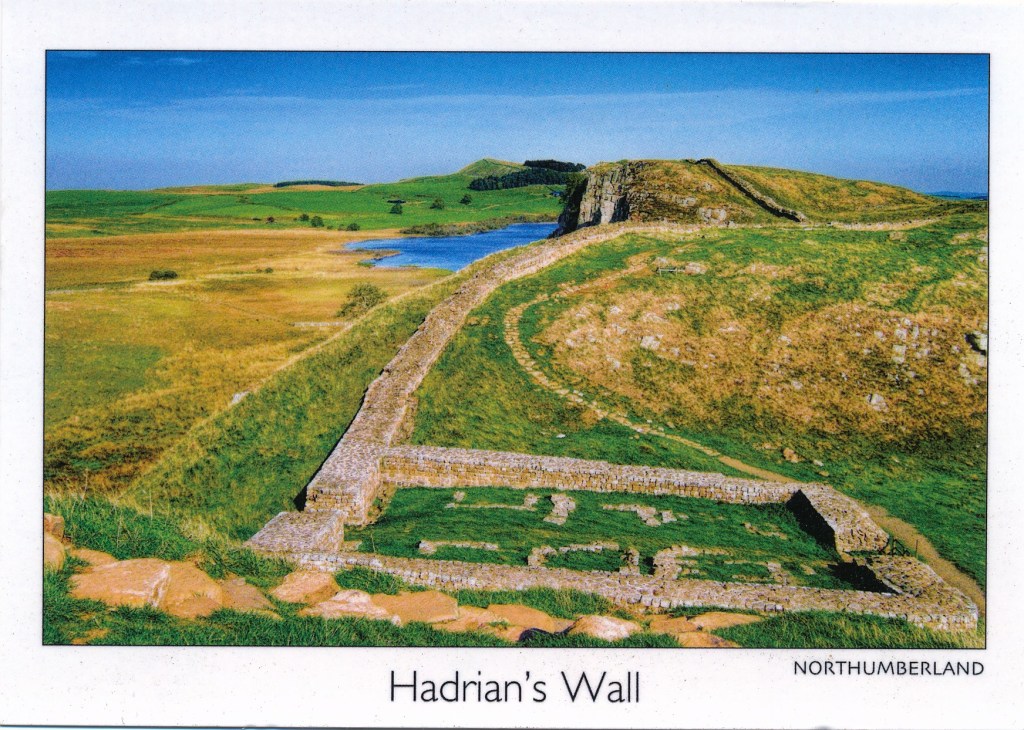
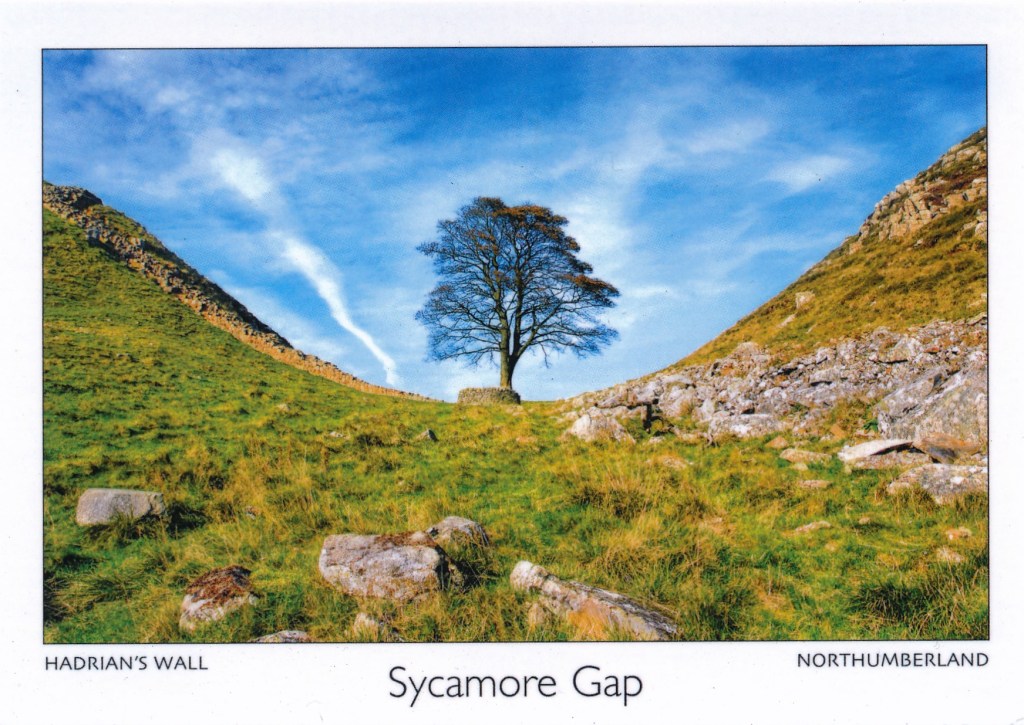
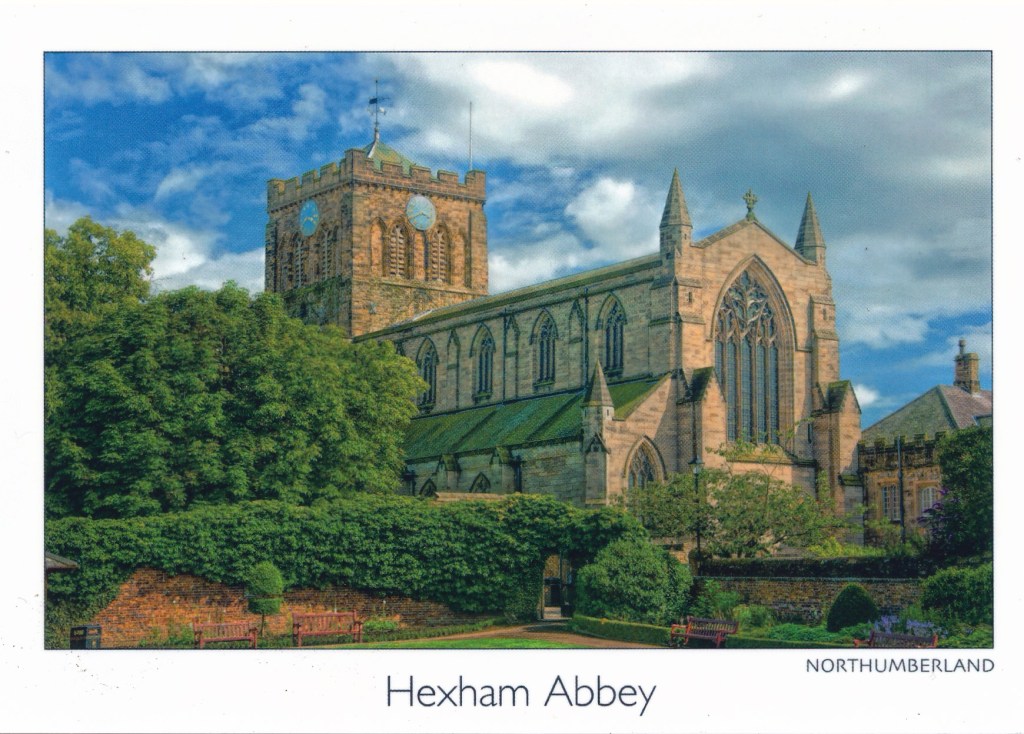
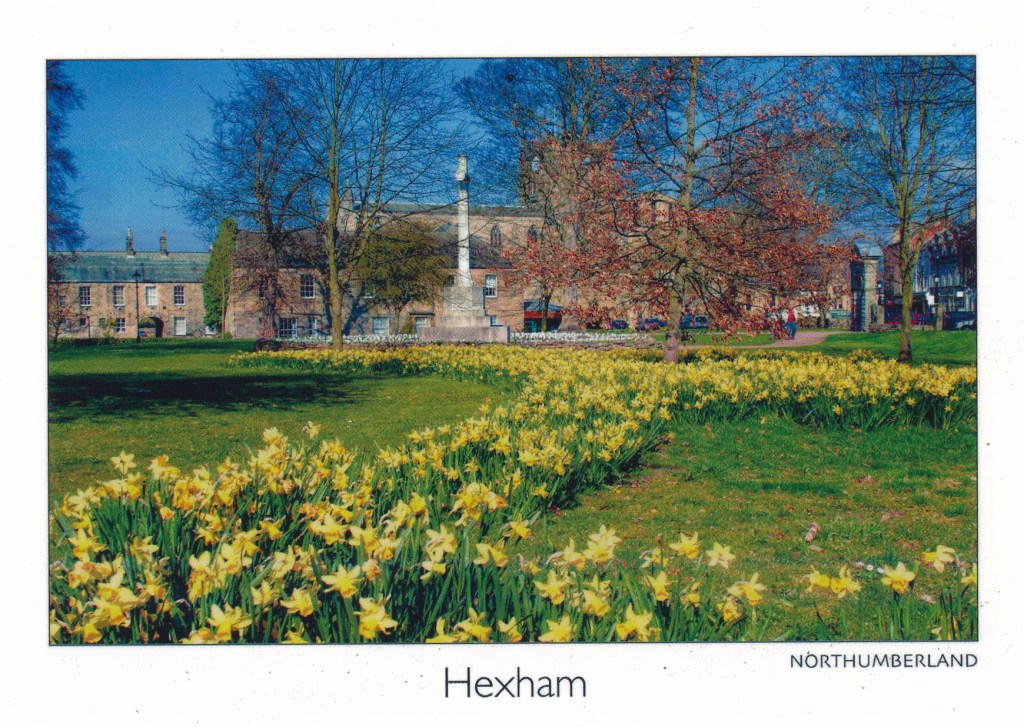
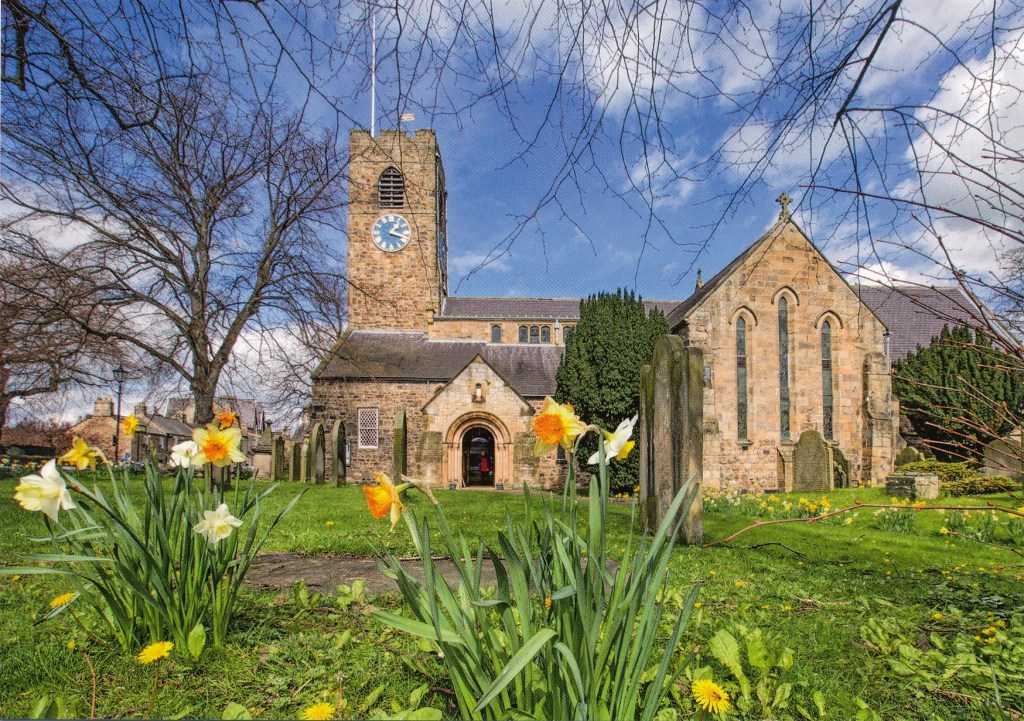
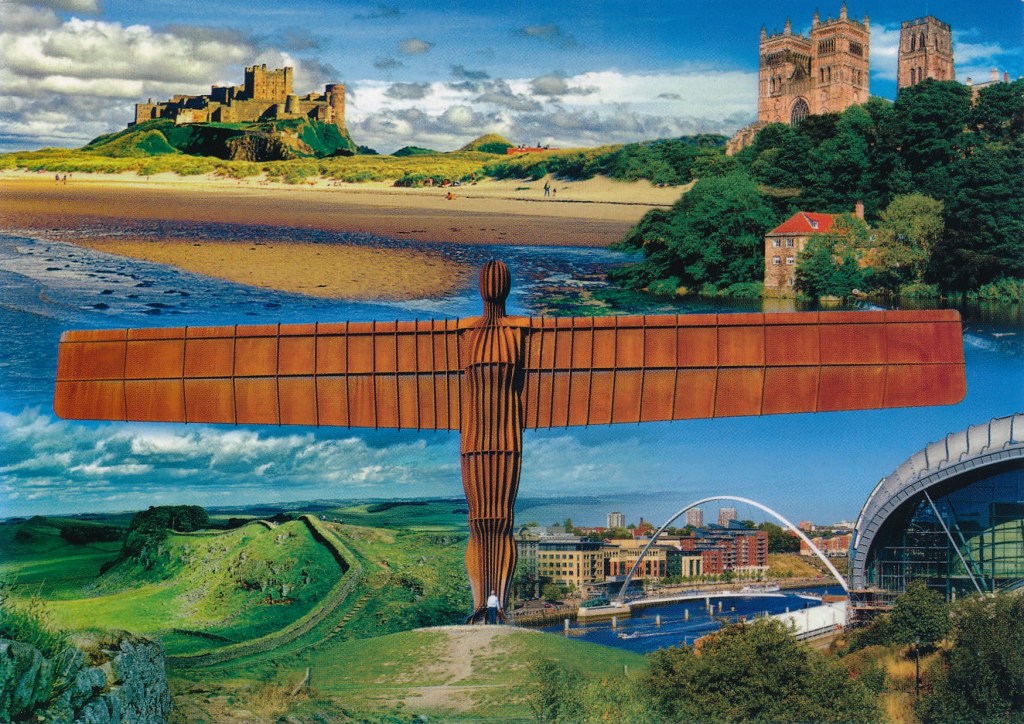
Here are my chosen views, eight in number which was about the limit of those available and usable for this exercise, all local icons:
Mile Castle 39 and Crag Lough, looking East towards HousesteadsView across the Sele towards the AbbeySt. Andrews, Corbridge“The North East” Bamburg Castle, Durham Cathedral, The Angel of the North, Hadrian’s Wall, Gateshead Millennium Bridge and Sage Music Centre
The first thing that strikes me about all of them is the exaggerated colours; the blues are too blue and the greens too green. Yes, we do get blue skies up here but these do not feel at all natural. I cannot remember in thirty or so years of seeing the Tyne quite as blue as it appears in the second picture. (Indeed, in that one, all of the colours are too vivid.)
The next thing I get is a remarkable sense of flatness. It is not just that it looks as if they have deep depths of field but something about the reproduction has flattened everything out. The effect is quite unreal and two-dimensional. Are both of these effects simply the result of the processes of mechanical reproduction rather than choices made by the photographer, I wonder?
Three of them have what I would regard as odd viewpoints: Hexham, Hexham Abbey, and St. Andrews. The first is simply a bit of an odd view. I can think of plenty of other potentially more ‘picturesque’ views that this one, which is not one that I would expect the average visitor to Hexham to encounter or recognise. Given that the most striking physical presence in Hexham is the Abbey it is odd that in this view it is barely visible through the trees.
The second does at least focus on the Abbey, an impressive structure dating back in its current form (though much rebuilt in the 19th century) to the 11th century. (The original foundation goes back to 674.) The viewpoint is though not the most obvious or most impressive. The view that most visitors get is of the east facade from the market square, which it tends to dominate. This view is from the west, from the abbey gardens which are attractive enough in their own right, and at least it does show off the fine structure of the nave, but it is not one that your average visitor is likely to see without a bit of effort or help.
The view of St Andrews, which again is Saxon in origin and is a very fine parish church in its own right, home to a first rate annual chamber music festival, is again odd because of its viewpoint. The photographer must have been lying on the ground to get this. As a result the foreground daffodils are. for my taste, too dominant. This angle has also resulted in a dramatic foreshortening of the building so that its proportions have become strangely distorted: the south transept looks much bigger than it really is and the tower looks further away, and shorter, than again it is in reality. For me a much more satisfying, ‘picturesque’ even, view would have been from ordinary eye level and a few metres to the left which would give a much more natural impression of the church.
Not much more to say about the Hadrian’s Wall picture, which is not bad I think in compositional terms and does give some sense of the nature of the topography and countryside along this stretch of the wall (it is not like this for all of its length!).
Similarly not a lot to say about the Sycamore Gap picture. Yes, this is the view that I keep on disparaging – nevertheless with apologies to all and sundry who like this sort of thing. What I really do not like about this view in general, not just limited to this postcard, is the way this tree has very much been taken out of context: it is a tree in a dip. That gives no real hint though about the narrowness of the ridge, what, despite the dip in the crest at this point, is quite an impressive natural physical barrier, and why the Wall is built along it I do not even think it is the most ‘dramatic’ view of it, which I think you get from much further back on the road. Again, as an aside, I am struck by the relatively low camera angle, which does at least give more of a sense of the sky, and the openness of the landscape than would, for example, be apparent from a ‘square-on’ view from the road, which is not at quite the same elevation but not much below.
The last one, the collage with the Angel, I have chosen simply because this is not the angle from which I would normally see it. More usually (which is not in fact that often) my view is from below and from the left, either from an East Coast line train heading into Newcastle, or from a car on the A1 which passes just below it. One thing I do like about this view is that there is a person just visible at the Angel’s feet, making this the only card that gives a reliable sense of scale, a reminder of just how big the Angel really is!
None of these cards fully align with my own experience and perception of these places. Nevertheless that does not by any means lead me to conclude that they are good examples of the genre, and they do all contrive to portray this region in a positive and attractive light. It is a beautiful part of the world but not always (often?) quite as brightly coloured as this!
I am a bit out of sequence with this exercise, starting with the second part first, before even I have reflected more generally on “The tourist perspective”.
To put the quotation from Clarke (1997) into perspective I have re-read the whole chapter on Landscape in Photography (pages 55 to 73). This is in my view a well written and thoughtful historical summary of the development of landscape photographing, clearly identifying the different trends as they developed in, specifically, English and American practice. Indeed, it is one of the best that I have read. I was though a bit surprised that the penultimate paragraph that is quoted in the brief resorts to such broad generalisations. Why do some theorists do this, make sleeping assertions that are ill-supported by actual evidence (I am thinking here in particular of Sontag)? I think Clarke’s assertion does hold good from an historical perspective. Photographers were largely literally in a privileged position, in so far as they could afford the cost of the equipment which was beyond the reach of most until the advent of mass market cameras such as the Box Brownie. Or they had, as for example, Timothy O’Sullivan, some official status or backing. They were also frequently tourists or outsiders and the camera was often used for the purposes of appropriation, colonisation and imperialism, for commercial gain. However, can it truly be said that the “photographer of landscapes is always the tourist, and invariably the outsider” (my emphasis)?
I would argue this broad generalisation is not supportable. “Always” and “invariably” are simply not true today for all landscape photographers. What if the photographer is showing his or her own ‘territory’, is depicting places that are known, indeed inhabited by the photographer? Does the act of getting behind the camera automatically make the photographer an outsider? No, I do not agree that this is the case. Let us consider some examples of photographers who have focused on their own patch (all examples who appear in my own library), working from the point of view of insiders with particular knowledge of and familiarity with the places they have photographed: Daido Moriyama in his home parish of Shinjuku in Tokyo; Guido Guidi on his home turf around Cesena; William Eggleston in Memphis; Michael Schmidt in Kreuzberg, Berlin. What about the people of Ashington in the Ashington District Star project photographing their home town, surely the epitome of the insider?
Most of my own landscape work, for this course and also personal projects, is made in and around the village where I live. I very much regard myself as an insider here. The things and places that I photograph have been chosen because I know them, many are places I see almost every day. I have come to know much of the local landscape intimately, watching it in all weathers and through all the seasons. This is after all what I am doing for Assignment 6. This is not something that I would have been able to do if I was an outsider. I simply would not know what to look for or the significance of what I am looking at, the places deeper histories and meanings. In that sense my landscape photography does not insist “on the land as spectacle” or “involve an element of pleasure”. I accept that much landscape photography, which I tend to deride to some extent or to dismiss, does indeed do both. But neither necessarily follow from the simple act of placing a camera between your eye and the landscape before you.
Clarke, G, (1997). The Photograph. Oxford: Oxford University Press
I have never really given much serious thought to the idea of the Picturesque before and now that I have done so what I have read and looked at goes some way towards why I have not bothered before.
What I get now reading a number of sources is how ill-defined a concept it is. Whilst Gilpin came up with a number of principles that define the Picturesque I find they are actually rather nebulous, changeable, hard to pin down. Indeed, the impression I have is that Gilpin speculated, and sometimes pontificated upon, what amounted to the Picturesque and then found that much of the natural landscape that he looked at did not fit his ideals. As Anna Pavord quotes him in her book (page 29) the Picturesque “is that particular kind of beauty, which is agreeable in a picture”. Not exactly a formula that could be used reliably to predict whether or not a view fits the bill.
The other thing, more importantly, is a sense of its unreality, perhaps in part driven by its fluid definitions. The most striking example of this (no pun intended) that I have come across in Gilpin’s book (1789 at page 47) is his suggestion that Tintern Abbey could be made more picturesque by taking a hammer to some the stonework in order to improve the view: “A mallet judiciously used (but who durst use it?) might be of service in fracturing some of them, particularly those of the cross isles, which are not only disagreeable in themselves, but confound the perspective.” I find this particularly egregious. In line with the rather loose definitions of the Picturesque he gives no real indication of exactly what manner or degree of amateur stone-masonry is required, and how dare the actual physical remains not comply with his conceptions of what is acceptable!
This sense of unreality is also highlighted by Andrews (1999) who quotes Uvedale Price (page 171) in his Essay on the Picturesque (I have discovered that his book is available on the Google Books project and have included a link below though I have not read very much at all of it myself) which is all about the artificial creation of a landscape (true “landscaping”) in order to create something that is Picturesque.
One useful thing that Andrews highlights at various points throughout his book is the important role of the farming of the view in order to make Picturesque, a view worthy of being looked at, which is also there in Gilpin with his talk of ‘screens’. In so many paintings that would be regarded as Picturesque the scene is carefully framed on each side, by trees, rocks, what have you, and the view within is carefully separated into fore-, middle-, and back-grounds. This artificiality is something that you also get in real places, where the picturesque viewing point has been careful chosen, and the viewer’s attention directed in such a way as to bring out the beauty of the view. One particular place that comes to mind in this regard is Queen Victoria’s View near Pitlochry (https://www.visitscotland.com/info/towns-villages/queens-view-p402191) which fits the bill almost perfectly and continues to this day to offer a highly idealised, and stage managed, view of what is admittedly very beautiful and dramatic countryside, but int the process tames and commodifies it.
How has the idea of the Picturesque influenced my own ideas about landscape art? It has not, other than in a negative way. I have expressed the view before that the salon approach to landscape photography, the single beautiful image, holds no interest for me. Coming back to one of my bug-bears, the endless shots of the tree at Sycamore Gap leave me entirely unmoved. These are, I suppose, classic Picturesque views: there are Gilpin’s side screens an idea that calls to mind little more than scenery for a stage play) in the form of the sides of the cleft and the remains of wall; a foreground in the form of the gently sloping land leading up to the tree; and a dramatic, wide-open sky in the background. But they do not say anything, mean anything. I have long been much more interested in landscapes that say something.
Here I am very much in the same camp as Fay Godwin, whose work has been something that I have cited and referred back to at various points throughout this degree course, going right back to the early days of EYV. I did not see the South Bank Show programme about her when it was first shown (I do not recall actually having a television in 1986) so I was glad to be able to find a copy of it on YouTube, though, perhaps a little oddly, a recording of a retransmission on Italian television, complete with Italian subtitles. I was impressed by her disdain, which she was not shy to express, about the banality of so many “picturesque” postcard views of countryside. What interested her more, and what appeals to me in her work and my own approach to landscape in art, is the political, the historical, the human, more broadly environmental, elements that go to help make up the landscape and have been influenced and created by it. I was intrigued by the discussion in the programme about Godwin’s work being seen as Romantic and how she never saw her work in quite that light, although nevertheless took it as something of a compliment. As the critic Ian Jeffery puts it in the programme her romanticism is always offset by something practical, analytical, commonplace. It is never just a pretty view.
Godwin’s work I suppose comes closest to what I would regard as a good landscape photograph.
Andrews, M, (1999). Landscape and Western Art. Oxford: Oxford University Press
Gilpin, W, (1789). Observations on the River Wye, and Several Parts of South Wales. London: Blamire (Gale ECCO facsimile reprint)
Pavord, A, (2016). Landskipping – Painters, Ploughmen, and Places. London: Bloomsbury
 Mark Robinson's OCA Landscape, Place & Environment Blog