Category: Part 4

Exercise 4.6: Proposal for the self-directed project

My present intention is to develop some of the ideas explored in Assignment 3 about how spaces that are in themselves non-descript, not picturesque, are transformed into places of significance through human agency.  In addition I want to explore how an additional layer of significance can be added to them by the simple act of photographing them.  Specifically I have in mind various sites around the village, such as the petrol station, the cricket club, pharmacy, communal recycling bins, etc.

Background influences are very much the same as for Assignment 3, with perhaps particular emphasis on the work of Ed Ruscha and Toshio Shibata, Eiji Ohashi, and, in terms of presentation, Ingrid Pollard, as explained below.

The precise number of images is not yet clear.  One consideration is that most of the sites I have in mind so far are along the main road that runs through the village.  I need to assess each one first to ensure that I can photograph them safely without having to stand in the road!  Subject to that, I currently have in mind eight to ten sites.

So far as presentation is concerned I have in mind two contrasting approaches that will both nevertheless make the same point.  One, inspired by some of Ingrid Pollard’s work, is to produce a series of postcards, in similar style to those I bought for Exercise 3, using a digital camera and processing in Photoshop, with saturated colours and emblazoned with “Greetings from Stocksfield”; a somewhat ironic, tongue-in-cheek approach.  The other is to take a more fine-art based approach, in the style of Anselm Adams and use black and white film (4×5) and a large format camera.  Again, an ironic approach, raising the mundane to the level of art, possibly inviting a “gallery” exhibition to display them.  Technically, this latter approach will involve some expense but as I already have film, paper for printing and darkroom equipment, that expense will be negligible.  The “postcards” will need to be printed professionally (I cannot presently print in colour to a high enough standard) but as the prints will be fairly small I do not anticipate great expense.

One important practical consideration that needs to be borne in mind, and will have an effect on when this project might be carried out and how long it will take, is the effect of the current Covid-19 lock-down.  So long as that remains in place there may well be physical constraints that hamper its execution.  It will in any event have to approached sensitively to avoid too much unwelcome attention being drawn to it.  With that in mind, I anticipate that the first stage will be to take a series of test shots to establish the best viewpoints and camera angles to keep setting-up time for the large format camera to a minimum.  A further assessment of this will need to be made in due course.

Exercise 4.5: Signifier – Signified

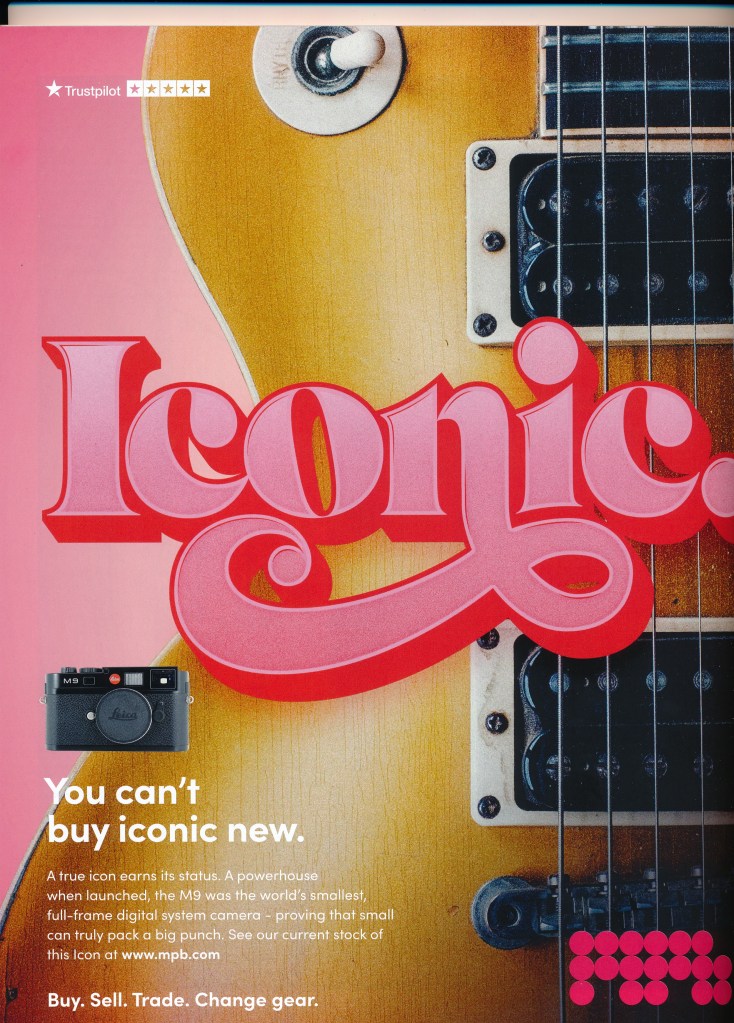
I thought for this exercise that I would have a look at an advert in a photography magazine and see where it goes.  I have chosen an ad from the company MPB who specialise in the buying and selling of quality used equipment (I have had various bits of kit from them over the last few years, including a Leica – M type 240 – which is relevant to this particular advert)  that appeared in the British Journal of Photography a couple of issues ago.  As an aside, it is interesting how little advertising the BJP carries, which is something of which I approve!  Another reason for choosing this ad is that it works with both text and image.

As I read this I see four primary Signifiers:  the camera, the guitar, the two bits of text – “Iconic” and “You can’t buy iconic new”. From these I get a number of Signifieds: these are things that you cannot simply go out and buy, they are no longer made; they are design classics; they are likely to be expensive, and so all the more desirable; you are clearly a person of discernment and taste, not to mention means, for being interested in such items; you are an “artist”, or at least take artistic activity and endeavours seriously; you are possibly quite good at what you do – photography and/or music, but really any artistic practice – for you to consider such an item; although expensive these are quality products designed and built to last a life-time, and if anything improve with age – note the cracking of the varnish on the guitar, signs of wear and dirt, a patina of use and age that shouts “quality” – and so are actually good value, an investment; by buying and using such a camera or guitar you can be up there with your heroes, “standing on the shoulders of giants”.

Another point that is significant here from the point of view of Signifier and Signified is that the image of the camera is really quite small, taking up only a tiny portion of the page and dwarfed by the guitar, and the text emphasises the compactness of the camera.   The message I get here is that with this camera you can be discrete, tasteful even, not having to flaunt your taste or means.

There are no doubt more SIgnifieds that could be read from this image but that is probably enough for now.

What I particularly like about this advert is the way it also works with and depends on Barthes’s idea of myth.  To get a full meaning out of the image you need to take account of existing contextual knowledge.  You need to know, for example, what the guitar is, a Gibson Les Paul – there is nothing explicit in the image to tell the viewer this – (I am not enough of a guitar geek to know which specific model this is, but that is not to say that I would not quite like to have one), and that this is a classic and desirable instrument.  You also need to know the significance of the camera.  It is interesting that “Leica” is not referred to by name in the ad, appearing only on the body of the camera in the classic red dot, and on the lens cover. 

At a literal level there is of course a ‘myth’ that Leicas are in themselves superior cameras, with a rich historical background and pedigree.  I have to confess that this myth is a very strong and attractive one. I know because to an extent this myth, and all the Signifieds identified above, led me for quite some time to aspire to owning a Leica.  I now have two:  the digital M; and an almost 60 year old M3 (35mm film).  (And no, they were not very expensive, both bought second-hand and no more expensive than any of the current crop of good new digital cameras.) They are great to use and their optical qualities are first rate but I have to accept that they are not to everyone’s taste and there are plenty of other cameras that perform as well and do some things better (I still use my old Canon dslr for a lot of work).  And no, they cannot in themselves make you a better photographer!  They certainly do not make me a better photographer.  I just like using them.

Landscape in advertising

I have to confess I am not really interested in advertising, indeed am deeply sceptical of it and pay it very little attention.  I cannot therefore say that I enjoyed looking at much of the images suggested by the course material.  (Not helped by the fact the Tim Simmons link appears to be bad and I could not find anything about the billboards on his website.  The ads-ngo reference was also a bit of a mystery as I could not find any examples of parody ads:  has the site moved on and changed since the course material was written, I wonder?)

What I did find interesting is Richard Prince’s work (which I have come across before) and revisiting Roland Barthes.  In the case of the latter there is for me an interesting example of the unreliability of memory, relating to his Mythologies book (1972).  I have a very clear mental image of owning a copy of this book.  I remember the colour of the spine and the lettering on it; I can picture it sitting on a shelf next to his Image Music Text and The Pleasure of the Text; I remember reading it nearly thirty years ago. But where is it?  I cannot find it anywhere in my library and it does not appear in my catalogue of the library.  Did I actually own a copy?  Did I but has it gone West somewhere along the line?  Or have I just imagined it?  Whether real or imagined I now have a pdf copy on my computer!

Having now (re)read Myth Today section (pp 109 ff) I was wondering what to say about this aspect of semiology, which he also writes about in the later book (1977, Change the Object Itself:  Mythology Today, pp 165 ff), the concept having moved on in the intervening years, and how to express it.  It then occurred to me that Prince’s work with the Marlboro adverts is actually quite a good example of what Barthes was talking about, and it fact made it easier for me to understand  Barthes’s argument, which although very lucidly written, is still a bit dense to take in fully with just one reading.  The course material itself even uses the word “myth” in discussing his work.

As the course material succinctly puts it, myth “takes into account the viewer’s existing contextual knowledge that informs a reading of the image.  This, it seems to me, is what is at work in Prince’s work.  Having removed the explicit context from the original adverts, having taken out the text and brand logo, the viewer is left to read the images in the light of their own knowledge and experience.  In Western, European, culture, that knowledge is possibly fairly universal and consistent.  Anyone who has ever seen a cowboy movie will bring a similar set of experiences, beliefs, memories, ideas, to a reading of the image and so imbue it with that second level of meaning that goes beyond mere signification.

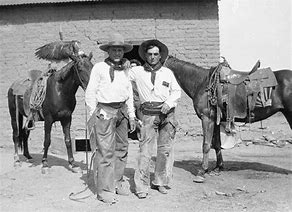
Barthes was of course writing about myth as a system of communication, a message.   In its English dictionary definition though it has also taken on connotations of widely held but false belief or ideas.  The myth of the cowboy, that the cigarette company and Prince were playing with, exploiting, fits nicely within that form of meaning, adding an extra layer of richness to a Barthesian use of the word.  The idea of the cowboy that most of us carry with us is of course made up, largely by Hollywood and the movie industry.  The very ‘look’ of the cowboy is made up, a relatively modern construct.  If you look at contemporary photographs from the end of the 19thcentury, early 20th, such as the work of Erwin E Smith (easily findable on-line with a Google search) their ‘look’ is quite different, much more dated and ‘old-fashioned’. 

With those thoughts in mind, what now occurs to me is that all these glossy car adverts that the course material talks about, are using “myth” in both these senses.  But what appears to me to be particularly significant is that to an extent they are actually helping to form the viewers’ contextual knowledge, rather than relying on or exploiting what is already there, and it is this that perhaps I find particularly pernicious about advertising in general.

Barthes, R, (1977). Image Music Text.  London:  Fontana Press

Barthes, R, (1972). Mythologies.  London:  Jonathan Cape

Landscape and Gender & Exercise 4.4: ‘Of Mother Nature and Marlboro Men’

Usually I find that my writing is fairly fluent and I do not have to labour to produce a piece, subject to a bit of judicious editing. For some reason though that eludes me at the moment I have found this piece a bit of a struggle. Maybe it is just a sign of the times. Anyway, rather than continuing to wrestle with this, here it is, imperfect and unsatisfactory though it might be, though at least I think it gets across the principle points I want to make.

I have this growing feeling that Part 4 of the course is a bit of a rag-bag, trying to cover a diverse range of issues but not in any great depth.  As a result, not all of the material that is presented in the course book always seems to sit well, and coherently, together.  The section on ‘landscape and gender’ is another case in point.  The underlying point, that from within the conventions of landscape painting into contemporary photographic practice, there is still a very male-centric point of view, seems to me entirely apt.  The female and the natural world have for millennia been raped, actually and metaphorically (visually – at this point, Berger junkie that I unashamedly am, I would rather reread his Ways of Seeing and its discussion of the “male gaze”), by the male of the species, and continue to be.  This is something that it seems to me Jo Spence’s work was particularly engaged with – it still makes me feel somewhat uncomfortable, which is presumable what she intended, though I am attracted by her exploration of, and attacks upon, the ideas of exclusionary land-ownership.  But I struggle to see how Helen Sear’s work, good and interesting in its own, perhaps slightly surreal light, right, clearly it is, let alone that of Joan Fontcuberta, add much, if anything, to the gender debate.

Bright’s essay, coming to the exercise, is, I think, much more interesting, coherent, and pertinent. On a first reading it struck me, admittedly a little superficially, as just a bit of a feminist rant (not that I have any problems in principle with that).  Going through it again though it seems to me there are some discrete, and important, themes running through her piece that raise it above the level of simple polemic.  That said, I do not see it as a particularly gender-based analysis.  Certainly, she does, and quite rightly in my view, castigate certain critics, curators, and others for ignoring or excluding from exhibitions, overviews, or assessments of photographic works photographers who happen to have been women, in the past and also today.  Nevertheless, I do not read her critique as a particularly feminist one. Rather, not wishing to in any way denigrate the important feminist issues, I read it as an attack on attempts to subvert and appropriate photography and its more “political”,  in the widest sense, intentions and effects: to divert work into the higher, purer, and therefore un-political world of “fine art”.

I am intrigued, in a way, to find that John Szarkowski becomes something of the villain in the piece. He was undeniably a major figure in gaining recognition for photography within the wider art world it has troubled me before that he seems to have sought to put photography on some art-pedestal but in doing so cut photographs off from their historical and cultural contexts, leading to Jenkins’s spurious and unsustainable assertion that photographs are “aesthetic arrangements resisting interpretation”.  Much though I otherwise admire some of Robert Adams’s writing I do very much agree with her argument that there is no such thing as “Form” that exists naturally, outside human agency.

I similarly share her concerns about the commodification of the medium.  Certainly, photographers should be able to make a proper living from their work but it seems to me the “market” is heavily skewed and distorted, in part at least as a result curatorial decisions.  It seems the big names, the ones that get the big shows in the big galleries, make the big bucks whereas the lesser names, who let us face it must make up the majority, can struggle to gain recognition and reward, notwithstanding that their work is, for example, more socially committed.  It has long troubled me that, for example, Salgado prints sell for tens of thousands of dollars because they have appeared on big gallery walls, because they are “Art”, notwithstanding that some of his work can be seen as morally questionable, in particular with its “essentialism – dwelling on the notion of a fixed or unchanging world” as argued by Franklin (2016, at page 46).

More than just a rant, Bright’s article is a call to action, to collective social action, and that landscape photography should be more than just a canvas on which the artist sets out their own personal aesthetic.  Her final paragraph, responding to Lewis Baltz’s comment that landscape is simply “a location where things and events might transpire rather than a given thing or event in itself” is particularly apt and expresses a view with which I very much agree:

“But landscapes needn’t serve such meagre ends.  If we are to redeem landscape photography from such a narrow, self-reflexive project, why not use it to question the assumptions about nature and culture it has traditionally served?  Landscape is not the ideologically neutral subject many imagine it to be.  Rather, it is an historical artefact that can be viewed as record of the material facts of our social reality and what we have chosen to make of them.”

Give me any day of the week a gritty Fay Godwin photo of a “keep out” sign rather than a picturesque image of a sycamore tree on Hadrian’s Wall.

Franklin, S, (2016).  The Documentary Impulse.  London:  Phaidon
Exercise 4.3: A subjective voice

This strikes me as one of those exercises that could generate a different answer on a different day. I suspect that my personal response to landscape is variable and multifaceted so that it is difficult to pin down just one answer, with so few words.  Nevertheless there are two points that are currently of particular concern to me.

One is something that I have touched on a number of times in the past and that is the closing off of the countryside.  Here I am very much moved by Fay Godwin’s work.  This is a far from straightforward issue in so far as property rights have to be respected but my main concern is that too much of the country is closed off by such property rights that are not appropriate  (that are themselves the result of “appropriation” in the past. The mass trespass on Kinder Scout in 1932 made a major difference but in England, unlike in Scotland, there is no “right to roam”.

Paradoxical as it might seem, one of my other current concerns is the over-use and commodification of parts of the landscape.  People must have access but that access carries with it disadvantages:  traffic, yet more car parks, litter, overcrowding, environmental degradation.  Bits of, for example, the Pennine Way and Lake District hills have suffered badly from erosion cause by the tramping of so many boots.  Bits of Hadrian’s Wall (in my back yard, so to speak) have been badly damaged by too much foot traffic and have had to be closed, even if only temporarily.  Ben Nevis can feel like a busy high street in good weather as so many people disgorge from their busses and cars (particularly at times when the Three Peaks Challenge is in full swing).  That is why I no longer go to these places (apart from the Wall if we have interested visitors staying) and prefer instead to frequent to quieter, the local, the otherwise unvisited, the hidden places so if nothing else I can try to avoid being a part of a wider problem.

This thinking is there as part of how I view the concept of landscape and its unavoidable connections with people.  It is that relationship which is already affecting the landscape work that I do and is, I am sure, going to have a significant impact on what work I decide to explore in the future.

Personal identities and multiculturalism

This feels a slightly odd mixture of materials to consider and as a result I suspect my comments and thoughts below are similarly going to be a bit of a mixed bag.

Ingrid Pollard’s work is interesting – I do not think I have come across it before – but I have to confess that as an ageing white male it does not really speak to me.  I simply do not share her experiences so I can only imagine (which is by no means the same thing as understanding, let alone experiencing) how she might have felt in the countryside.  I can see that there is a popular perception that the Black experience is an urban one and in all of my years of tramping about I have to say that I have not been conscious of seeing many people of colour.  Particularly in areas of the countryside close to urban areas where there are significant Asian ethnic minority populations, as Simon Roberts goes on to point out in his blog post, it has not been uncommon in my limited experience to see people out and about and apparently at ease in the countryside.  I am intrigued by this apparent different between different communities and wonder why it is there.  Roberts unfortunately does not really address this, so perhaps it is a bit of a puzzle for him.

My own experience of this is perhaps a bit distorted by where I live.  It is some years since I regularly went walking in some of our more famous bits of countryside:  the Peaks, Yorkshire Dales, the Lake District, and so on.  I now live in a largely rural county (not the largest by any means but quite big and with the lowest population density in England) and just by stepping out of my village I am in the country.  Not grand nor dramatic but countryside nevertheless, and quiet.  The BAME population locally is very small. The nearest significant population, mostly of people originally from South Asia, is in Newcastle and by most standards is still quite small.  Rarely do I see them out and about.  Perhaps that is because it is such a small, rural population around here and they do not feel comfortable?  I do not know but it is striking.  To put things in a bit more perspective though if you go to our own “big hills”, the Cheviots which are in many ways equivalent to the Lake District hills, in some places it is possible to go all day and not see a soul, of any ethnicity!

On a different point, I did listen to the Tate audio programme.  I have to say that audio is not really a very successful medium alone for discussing visual arts.  Without being able to see the works under discussion I found it difficult properly to take on board the points being made and so did not find that I got much out of this.  I also have to say that I found the quality of the sound a bit patchy so that it was sometimes hard to follow properly what was being said; and no, that was not just because I am a bit deaf in one ear!

The other audio piece, which I thought did work rather better, possibly because I am more familiar with her work, the episode of Desert Island Discs featuring Fay Godwin, was entertaining but I did not really think I got much if anything new about her work. I think I got much more from the material that we looked at earlier in this module, not least the old Melvin Bragg documentary.  Not particularly revelatory but at least mildly diverting.  My serious point here though is that I did not feel the move from Pollard’s work, with its ethnic social implications, to Godwin’s more political work, was entirely comfortable.

The same might be said about the foot and mouth disease work of John Darwell and Clive Landon.  This is certainly political work with much in common with Godwin but I am far from sure how it fits with the issues of personal identity.  So far as this work is concerned, unfortunately I could not find much of Landon’s work online so drawing comparisons with Darwell’s is difficult.  The sense I get though is that Landon’s is much more visceral, disturbing.  Darwell’s actually reminds me of some of how it felt at the time living within rural communities that were affected by the disease:  a strange sense of unreality and physical distance – large parts of the county were closed off and people were distanced from places affected.  I remember road blocks and barriers, road diversions, disinfection points where the car was sprayed with chemicals, ominous clouds of smoke in the distance.  Where I live is only a few miles from a farm that was at least the epicentre of the outbreak of disease locally and one of the earliest nationally that was affected.  Local folk-lore still has it that DEFRA (or whether the government department was called back then, it is constantly changing) were buying up timber (you could not get the likes of old railway sleepers for garden landscaping for love nor money) for weeks before the outbreak eventually went public for the ubiquitous pyres once the slaughter started.  It is strange but as I write this – it was a very bad time for the local agricultural community and I have not though about it for years – I can recall the smell of disinfectant and bonfire, a not very pleasant note on which to stop for now.

http://www.bbc.co.uk/programmes/p00947zh

http://johndarwell.com/index.php?r=image/default/category&alias=dark-days

http://www.tate.org.uk/context-comment/audio/conversation-pieces-ingrid-pollard-on-landscape

http://we-english.co.uk/blog/2009/01/16/contested-countryside/

Exercise 4.2: The British landscape during World War II

This article concentrates on thinking about, and the use of ideas of, landscape as used during the Second World War but I think the points actually go deeper, are much older, and are fundamental to enduring ideas of “Britishness”.

One irony that the article touches on is that these ideas of landscape are very much rooted in England, and Englishness, but have come to stand for Britain and Britishness as a whole, at least in some circles.  Our idealised landscapes are nearly all English, particularly southern English. At best some of the ideal images will come from, for example, the Lake District, but most of the rest of the nation does not get much of a look-in.  There might be the odd view from the South-west, particularly if related to that great “British” myth of King Arthur, or a suitably picturesque, but rugged and wild – sublime even? – view from the Scottish Highlands, but little from anywhere else.  It is ironic that this is essentially a bucolic, rural myth, whereas the majority of the population live in cities, a disjunction all the more striking in the south given the huge proportion of the population that lives in London alone.

The key theme, particularly in relation to the war years, is how viewing the landscape has been, and still is, very much rooted in the past.  Sometimes an imagined, even mythical past (King Arthur again), but nevertheless an idea of the past as something different from, and better than, the present but that helps to define the present.  What is more, and this is an idea that from my admittedly jaundiced and sceptical 21stcentury view I struggle with personally, the landscape was seen to go as far as defining, or at least helping to define, a quintessentially English way of life.

One idea I find particularly interesting in the article is the way, during the war, the landscape was closed off, not only to outsiders (the hiding of place names, road signs, and so on), but also to the inhabitants of these islands behind barbed wire fences and other physical defences, so that in a way the landscape was put away for safe-keeping for the duration.  The image that came to my mind while reading this piece was of the works of art that were taken from public galleries and stored in quarries and mines in remote areas out of harms way.  It is as if the landscape had been packed up and hidden in a cave.

The article makes much of the way the presentation of the landscape as something that had to be preserved, that was worth fighting for, almost indeed why the war was being fought (which I think is a rather reductive view but I can see why that message might have been put across at the time), served to unite the different classes and groups within society who had, notably during the inter-war years, but in fact going back far, far longer, been at odds over land use and ownership.  I am not sure that these conflicts have in fact yet been resolved, or indeed ever will be, and with the war past are as alive today as ever before.

The other major point that the article brings out is the sense of the nation as a fortress.  This was of course nothing new and probably goes back as far what one might regard as the birth of a distinct, single, united nation of England (deliberately leaving out for now Scotland, Wales, pre Act of Union, and Ireland) after the last successful European invasion in 1066.  The idea of the “fortress” island promoted during the war at the very least leads me to think of John of Gaunt’s  “scepter’d isle’’ speech in Shakespeare’s King Richard II (Act II, Sc. i, lines 43 – 49):

“This fortress built by Nature for herself

Against infection and the hand of war;

This happy breed of men, this little world,

This precious stone set in the silver sea, 

Which serves it in the office of a wall, or as a moat defensive to a house, 

Against the envy of less happier lands;”

A bit ironic today in light of the coronavirus!  Whilst this myth of “England” has been alive and well of late in the context of Brexit it is not much help, let alone protection, in the face of Covid-19, which shows up the myth for what it is.

Exercise 4.1: Critical review proposal

Having given this quite a lot of thought, and having done some reading already, the subject that holds the most interest for me at the moment is the idea that landscape photography does not necessarily have to focus on the physical landscape or environment, natural or built, in order to convey something about it.  Rather this can be done by concentrating on the people who inhabit the particular landscape.  This comes from the idea that “a place and its people are inextricably linked”, as the course material puts it, and from thinking about the work of Lixenberg and Sobol. However, rather than looking again at their work, what I am thinking of is looking at the genre of street photography, and in particular a few artists who concentrated on photographing people in New York City, specifically.  

Looking at some of this work again I am struck by how much some of it speaks of the nature of the city, built by, lived in, and used by people, and how the city in turn affects and shapes the lives of those people.  I am not interested here in the street photography that simply seeks out “characters”, chance events or juxtapositions, nor indeed what has been described as the “social landscape” (though that would in itself be an interesting subject, albeit not one I am sure would fit entirely comfortable within this part of the course), but that which says something about the city as a place.

Exactly what the argument will be is still developing but it is beginning to take shape as the jottings accumulate in my notebook.

As indicated in a recent post, part of the reason for choosing such a subject is to step out of my comfort zone, literally out of my natural environment in so far as I do not live in a city, and have not lived in a big one for many years (not since a brief sojourn in London 36 years ago).  Another reason is a desire to question and challenge the idea of distinct genres within photography. I also want to indulge in a bit of original thought, and it is interesting that in my research so far I have found nothing that is directly on the point, though enough that is more germane when given a wider view. I nevertheless hope that I can draw from this something that will be relevant to some of the work that I would like to attempt over time in my current more rural environment.

Part 4: Landscape and Identities

It is not often that I find the mere introduction to a section of the course material as significant or useful but on this occasion the opening paragraphs do just that. They chime with my thinking about Assignment 4 and coincidentally validate the approach I am planning. One sentence in particular strikes a chord: “A place and its people are inextricably linked.” This is exactly the point that I want to explore in the assignment and address the apparent paradox that photographs of people, rather than a physical location, can actually represent the landscape.

Although it does not fit with my current intentions, Dana Lixenberg’s book (2008), referred to in the same paragraph, and on which I have written previously (https://markrobinsonocalandscape.photo.blog/2020/02/19/landscape-as-a-call-to-action-2-dana-lixenberg-the-last-days-of-shishmaref-book/) is one that I have been looking at again and has informed some of my thinking in this regard. The further reference to Jacob Are Sobol’s book is similarly interesting in so far as it deals with similar subject matter. What I find particularly striking about his work though is the way it is much more personal, not least in the sense that he became a protagonist in his own story, an insider’s view. Lixenberg on the other hand, although clearly closely engaged with the community she was documenting, was nevertheless an outsider.

One thing that is particularly important to me, and my ideas about landscape, is that both these bodies of work illustrate that the relationship between people and landscape is two-way. This is particularly evident here in the case of these two groups of Inuit people (although they are thousands of miles apart, and speak different languages, their cultures are quite similar) although I guess the same might also be said of virtually everyone. Their landscapes are influenced and affected by the people themselves: they have built upon and changed the physical landscape in many ways, both in microcosm, in their immediate vicinity, but also in macrocosm in so fas as, even if only in a small way, their use of the trappings of modern life makes some contribution to global warming, which is in turn degrading their environment. But also their way of life and culture, the way they live on, in and on the land and its resources, is affected and shaped by the environment, as it has been for millennia.

Incidentally, the link to Sobol’s work cited in the course material appears no longer to exist and I found samples of his photographs on a newer site, to which there is a link below.

I would dearly love to have a physical copy of his book “Sabine”. It is set in a country that fascinates me, and which I have visited, albeit only briefly. It also has a visual aesthetic that I particularly like (though have so far not tried seriously to emulate) that I am more used to seeing in the work of Japanese photographers (such as, to name a few who appear in my library, the Provoke group, Daido Moriyama, Hajime Kimura, Masahisa Fukase – think Ravens in particular, Yasuhiro Ogawa, and Valentino Barachini – not Japanese I know, Italian, but has spent time and worked in Japan and has applied a similar aesthetic). I am not sure though that I can justify the cost: something in excess of €500!

Lixenberg, D, (2008).  The Last Days of Shishmaref.  Edam/Rotterdam:  Paradox/episode

https://www.jacobauesobol.com