Category: Part 5

Exercise 5.3: Print on demand – Printed!

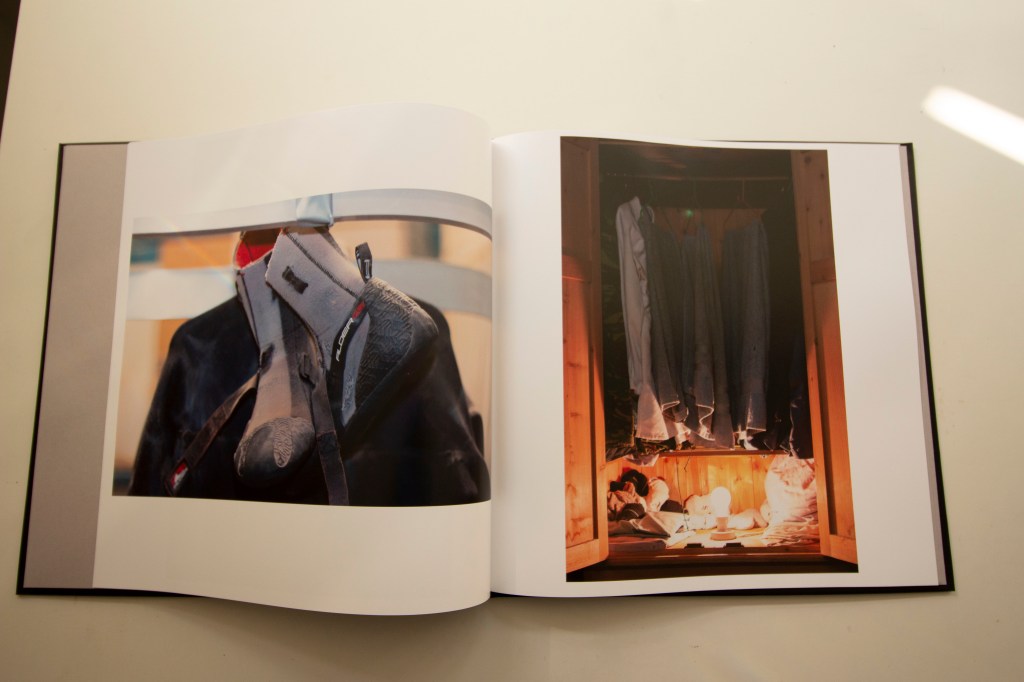
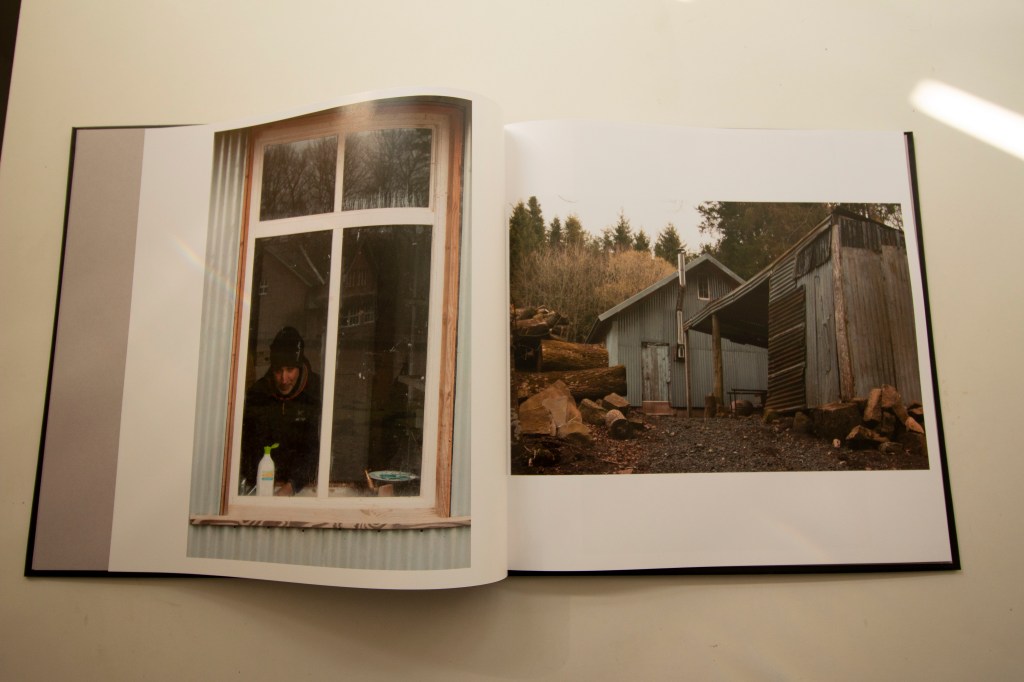
Although this exercise did not call for anything more than making a mock-up and producing a pdf, I nevertheless went ahead and had a couple of books printed up to see how they would look.  Blurb have been falling over themselves to offer substantial discounts so I thought I might as well go ahead.  One book is the one of which I made the mock-up for the exercise, a development of the work for Assignment 3.  The other is a development and expansion of a project that I did for one of the Assignments for I&P.

Both are fairly slight, using no more than the standard layout of twenty pages.  For Assignment 3 I have kept the layout of images only on the right-hand page.  For the other, I effectively doubled the number of images that formed the final set for the earlier project and put one on each facing page.  In both cases I went for image wrapped hardcovers, rather than dust jackets, and premium matte paper.  The end results look and feel reassuringly professional, if a little spartan.  If I have any issue with them it is the colour balance on a few pictures from the old project is a little off, compared with the original prints. That said, unless you were to compare them with those prints I doubt you realise that they are slightly different.  They certainly do not look “wrong” in their own right.  I guess some slight differences like this are probably inevitable.

And here is a short video showing the printed version of Assignment 3:

Exercise 5.7: Prepare your artist’s statement

For this exercise I have taken a very unscientific approach and have not drawn on a very wide assortment of artists.  Nevertheless, there are a couple of things that have been particularly striking.

The first is how few of the artists I have looked at – all are ones whose work I like and a number of them are represented on my book-shelves – have any form of statement at all.  To take just a few examples, Rinko Kawauchi, Matthew Genitempo, Hiroshi Sugimoto, Nick Waplington, do not say anything.  I would also have included Alec Soth but he is already mentioned in the course material:  his rather laconic description of himself does not really come across to me as a “statement” at all, beyond, I am a photographer and what I do is make photographs.  In many ways that is actually the sort of statement to which I would aspire.

Elina Brotherus does not have what I would necessarily call an artist’s statement but her biography, on her website, I suppose serves the purpose in so far as it identifies the shifting strands within her work as it has developed over time.  Rinko Kawauchi does, it seems to me, despite the strictures of the course material, let her work speak for itself, and has in effect left it to others to write her statement for her.  As Charlotte Cotton put it in Aperture, “She shapes subtle, elegiac narratives without the aid of interpretive or endorsing text, leaving the reader nonetheless fully nourished by the extent of exquisite and intriguing sights to be found on this earth”.  An elegant argument against the need for an artist’s statement at all!

A few statements that I did find all seem to me to add to the argument against the need for a statement in so far as they are simply not very well written.  It is horrible to single out anyone but a couple stand out.  Shane Taylor is a street photographer whose work I find subtle and intriguing.  His statement includes the following:  “His street photography explores classic, humanistic themes, drawing inspiration from classic street photography of the 1950s and 60’s.”  My problems with this include the repetition of the word “classic”, the wooliness of “humanistic themes” – just what is that supposed to mean? –  the misuse of the apostrophe at the end of the sentence and the inconsistent ways of referring to the two decades.  A lot of people do not seem to know how to use an apostrophe properly, indeed do not know what it is really for and what its purpose is, and this is a classic – to reuse an already over-used word – example. 

Another, and this came as something of a surprise given that he is also an academic, is Donovan Wylie, again for the repetition of a key word:  “Utilizing a combination of conceptual and typological approaches, Wylie’s work integrates the conceptual architecture of power, containment and war”.

In neither case is my appreciation or understanding of their work enhanced by such language.

The one statement that I do really like, not least because it addresses one of the problems of language, appeared in the first issue of Provoke:  “We now live in a world in which words have lost their material foundations, have become detached from reality and wander in space.  Faced with this, what we photographers can do, indeed, must do, is capture with our own eyes those fragments of reality which are utterly impossible to capture with existing words, and actively keep creating materials to confront those words and thought.  This was the instigation behind PROVOKE, and the reason we chose, admittedly a little self-consciously, the sub-title “Provocative Materials for Thought”.”  Another anti-manifesto argument.  Why should we tie a visual medium, one that is as airy as light itself, down with leaden words of clay?

Taking a slightly different tack, it was illuminating to go back to Sasha Wolf’s book.  Rather than speaking in terms of any sense of manifesto or statement, each of the artists that she interviewed simply talks about how they approach their work rather than trying to categorise and anatomise it.  This is an approach I find much more enlightening.

My inclination, it should by now be clear, is to steer clear of artist’s statements and their potentially limiting, or just plain embarrassing, nature.  Nevertheless, for the purposes of this exercise if nothing else, I am going to make an attempt.  The link referred to in the course material appears to be bad and as there is no indication of what the article referred to is, I have done a bit of hunting in the UCA on-line library and found a couple of articles that are helpful.  I have not gone through the exercises outlined in Goodwin’s article but have at least thought about this sort of approach.  Conor Risch’s piece is perhaps more immediately helpful and practical.  What I get from these, if nothing else, is that I should keep things simple, so here goes:

“My current work is concerned with the role landscape can play as a place that contains and records memory. I am also interested in how human relationships with the landscape affect that memorial function and can give places particular meanings and significance beyond being merely a geographical location.”

I think I still do not like it!

Cotton, C, (2004).  Rinko Kawauchi Utatane.  Aperture No. 177

Goodwin, A, (1999).  Writing an Artist’s Statement.  Ceramics Monthly, May 1999, Vol. 45, Issue 5.

Nakahira, T, Okada, T, Takahashi, Y, Taki, K, (1968). Provoke No. 1. Tokyo: Nitesha

Risch, C, (2017).  Conquering the dreaded artist statement:  expert advice for writing about your photography.  Photo District News, Vol. 37, Issue 8.

Wolf, S, (ed), (2019).  PhotoWork:  Forty Photographers on Process and Practice.  New York:  Aperture

http://www.donovanwyliestudio.com

www.shanetaylor.net
Exercise 5.6: Context and meaning

My ideal venue for displaying a set of photographs from Assignment 5 would be the Side Gallery in Newcastle (dream on!).  I very much doubt that there would be enough prints to properly fill the space in one of the two upper galleries but there is a small space on the ground floor that would work.  It is though fairly small and so the prints themselves would similarly have to be kept on the small scale, probably no bigger than 8×10 inches.  Exactly how they would be hung is difficult to estimate, or sketch, at the moment as I do not have any clear details of the scale of this space, which is little more than a large alcove with two and a bit usable walls. Depending on the final number of images though I would expect them to hang in a single row at eye level.

The next most suitable space locally would be the gallery at the Queen’s Hall in Hexham.  Again, it is difficult to judge scale but I would expect that a dozen or so prints could easily be accommodated in the main ground floor space of a size up to A3, which is the biggest that I can currently print.  Again, one row of images at eye level on the two main walls of the space, with perhaps a couple between the windows on the western elevation that overlook Beaumont Street.

As the subject matter is going to be locations in Stocksfield it would of course be nice to be able to display them here in the village.  Unfortunately though, I cannot think of a suitable location.  The village hall is not set up to act as a gallery.  The Quaker Meeting House would be a nice venue but is too small and again not really suitable as a gallery space.  The same goes for the cricket club.  The local school (I am still not sure it is going to feature) might be a possibility but then there are issues with access.   The local church hall is similarly not geared up to act as gallery.

This is a shame as having read John Walker’s essay (which I got from academia.edu rather than Scribd), it is clear that a local exhibition of local views would have an extra resonance for people local to the village.  Such a display context would have greater meaning for people who live here in the village, and who might not otherwise necessarily see the pictures if they were hung in Hexham, albeit only about ten miles away.  Equally, Hexham based viewers would not necessarily ascribe the same meaning and importance to such local images.

This is, I suppose, the central point to Walker’s piece, that where and how images are displayed inevitably has an impact on their meaning, just as, for example, does the juxtaposing of images, and the use of text either as caption or accompaniment.  How and where images are displayed carries with them implications for the value, cultural or monetary, that might be ascribed to them.  This is of course something that has been touched on before in the context of considering what amounts to a “photograph”:  something that appears on a gallery wall is naturally going to be regarded as more “valuable” than something that is printed in a newspaper.  McLuahan again and the medium as message.

The other main point I take away from his writing is the question of individualism in responses to images.  I had not really thought about this before but it now seems to me to be obvious that there will not necessarily be as many different reactions to a picture as there are viewers.  Yes, each individual might bring something particular to themselves to their engagement with and response to a photo but there will also be a great deal in common within groups of viewers.  Certain experiences, values, understanding, beliefs, will be shared in common within any given group and that should mean that there will be a certain commonality in the way the images are read. 

I have had some limited experience of this in the past when exhibiting some of my etchings and prints.  In one group show that I participated in all the works were of the same dimensions and hung in the same way.  There was a resulting sense of equality, no one’s work being favoured in any way over that of the others.  In another group show (in a commercial gallery) there was a much more hierarchical approach, some prints being framed and hung, others simply mounted and put in browsing racks.  The different contexts immediately drew different responses to the works from the buying public:  the framed and hung pictures were much more likely to be bought than the others.  Needless to say my work was only in the browsers and none of it sold!  I did also have a small one-man show that coincided with the Tall Ships race calling at Newcastle some years ago.  The pictures were of a nautical theme and the show took place on board one of the sailing ships that was taking part (a former colleague arranged things for me with the captain).  Because of the context, the nautical theme, the display on board the ship, the prints actually sold quite well!

https://www.academia.edu/11911020/Context_as_a_determinant_of_photographic_meaning

Exercise 5.3: Print-on-demand mock-up

Working in a rather roundabout fashion I have now got back to this exercise.  I have been rather more concerned with producing a physical book (not something I can do through the likes of Blurb given my chosen format) which has been taking up an inordinate amount of time.  Turning to this exercise has been something of a light relief!

As I am now using Lightroom I thought I would start with the Book Module contained within it.  Although it would appear to be a fairly simple matter if the book is to contain only photos it seems to be of another order of difficulty to incorporate and combine with text.  There is no doubt a way of doing it but I have not found it yet.  I have therefore fallen back on Blurb’s own Bookwright program and this has proved to be remarkably easy to use and I have come up with something, albeit not yet very refined, after just a few hours work.

As I have barely got off the ground with Assignment 5, for which I do intend to make a book, I have, for sake of ease, gone back to an earlier project and used the images produced for Assignment 3.  For these I have adopted Blurb’s standard landscape format, one image per double page spread, on the righthand page alone, with the map reference captions.  Simply for the purposes of experimenting I have also added a single page of text at the end which is a lightly edited version of the text that accompanied the final set in my blog post for the assignment.  The only other addition is a title page:  somewhat mockingly I have decided to call this book version “Sedes Memorabiles”, Latin for memorable seats, which of course ironically, not all of them are and even some of those with a memorial function are not easily readable by a general public.

I have no training in or prior experience of book design but I am well aware it is not a simple matter of putting some images and text on a page.  What I see though from looking at photobooks in my own library is that for most keeping things simple is what works best.  There are of course exceptions:  William Klein’s New York book works precisely because it is busy and slightly disorienting:  some of my favoured Japanese photographers’ works are also more successful because of their sometimes unorthodox presentation.  I also just like the idea of one image per spread, or no more than one per page, with minimal text.  I do not think my effort is anything that someone else would want to go out and buy but as an exercise, an experiment, and first dipping of the toes into the waters of making books, I think it is not bad.  No doubt it could be refined further but I am otherwise reasonably pleased with it as a first attempt.  Not to mention surprised at how relatively easy it was to put together.

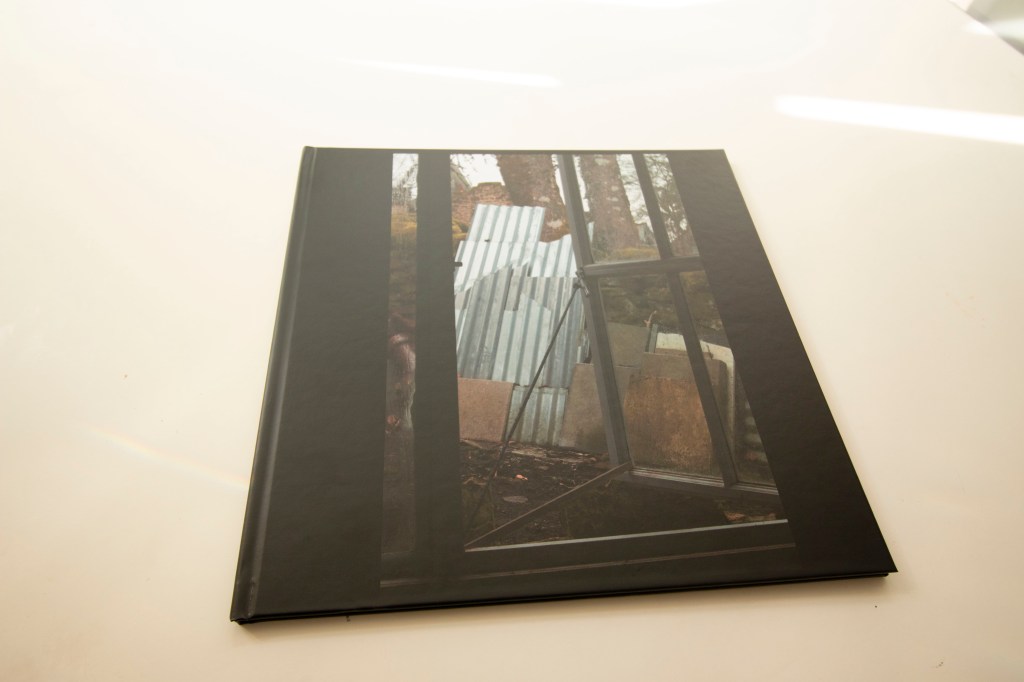
Proof copies of the cover and main body are accessible below:

Exercise 5.5: Create a slideshow – 2

Last night while cooking dinner, and listening to Mozart sonatas for piano and violin, (not so irrelevant perhaps, as it meant that I was not actively thinking about this coursework) I had some more thoughts about the book project for Assignment 2 and the slideshow experiment for this exercise.  In particular there came to mind two books that I had not thought out before in connection with any of this work but that are in fact helpful to what I am doing now, Molitor (2015) and Stenger (2014).  

Neither of these involve photography but they do have linked visual and audio elements.  Claudia Molitor’s work, which can still be experienced on her website cited below, is an audio representation of a journey by train from London to Margate, the sounds, songs, music, and words, representing places along the way, accompanying a schematic, hand-drawn map of the journey.  Susan Stenger’s work was an installation based around a geological cross-sectional map of the coast of Northumberland, from the mouth of the Tyne to the Tweed at Berwick, made in 1839 by Nicholas Wood, some 12.5 metres long.  The map was accompanied by a soundtrack, mostly made up of fragments of folk tunes associated with places along the route, lasting about an hour.  The idea was that you walked along the map, listening to the fragments at the relevant points along the way.

These two works set off an idea for developing the work I did for Assignment 2 as a possible alternative to the book.  When I originally did that work, I did not think that a slideshow would work well, particularly with the limited set that will form the book.  I also did not have a good grasp on creating a slideshow.  Now that I have done a couple of experiments for this exercise, and having played around a bit more with Lightroom, which has proved easier than I thought, notwithstanding a couple of false starts, I think that something could be done.  To work properly though it needs to be much more substantial and include many more of the shots that I took along the route.  Indeed, I have for now settled on about 108, making a slideshow that lasts almost 12 minutes.  In an ideal world I think it would be interesting to make the slideshow last as long as the journey itself, about 25 minutes, to make a much more immersive experience.  I have posted this initial trial set on Vimeo.

Bearing in mind the work of Molitor and Stenger, what the slideshow needs is a soundtrack to accompany it.  Realistically I do not think this is easily achievable now, for the purposes of this exercise, and would be quite a major project in its own right, not least if the whole piece was to last the equivalent time of the train trip.  There are also issues with regard to licensing, and presumably royalties, for some of the music that would be useful in a project such as this.  Nevertheless, here are some ideas for music and sounds that might work:

The start of Richard Rodney Bennett’s theme music for “Murder on the Orient Express”

Extracts from Arthur Honegger’s “Pacific 231”

The sound of migrating geese for the ponds at Merryshield

“Rocket Man” for Wylam where George Stephenson’s cottage is (an unforgivable but irresistible pun)

The sound of golfers for Ryton golf course

“Blaydon Races” (for Blaydon, obviously!)

The sound of cash registers from Pink Floyd’s “Money” (Dark Side of the Moon) for the Metro Centre

Iron foundry/heavy industrial noises for the Armstrong works at Scotswood

Pons Aelius “Fire under the Bridge”

Lindisfarne “Fog on the Tyne”

I am sure there are plenty of other sounds and tunes that could also be incorporated, particularly folk tunes that have specific local connections, but it is going to take quite a lot more work to identify them and bring them together.  For now, just let this be a mental exercise.

Molitor, C, (2015).  Sonorama.  Listening to the view from the train.  Axminster:  Uniformbooks

Stenger, S, (2014).  Sound Strata of Coastal Northumberland.  Newcastle:  AV Festival

http://www.claudiamolitor.org/sonorama-1/

Exercise 5.4: Online exhibitions

Just a brief note on this.  Whilst I understand that Sharon Boothroyd really liked this online exhibition, I am afraid I just do not get it.  I agree there are plenty of fine, striking individual images, but I find it hard to see, at least on a first viewing, what is driving the structure and sequencing, what made it so good as a slideshow.  

I think Boothroyd sums things up nicely when in comparison she praises the Sally Mann shows.  The ability to stop, go back, linger, establish connections between individual works, makes all the difference.   When viewing a physical exhibition I usually have a fairly quick go round first to get a sense of the structure of the show and what is to be seen, then go back and forth, across the grain and flow of the show, the better to appreciate what is there and make my own sense of what the artist or curator has chosen to show.  I do not reject the idea that a particular flow has been purposefully set up to display the work in a particular light, and to a particular end or purpose, but I like to make my own connections, form my own views and conclusions as well.  Needless to say, this also enables me to filter out stuff that does not interest or engage me, or that I simply do not like.

The slideshow based online exhibition simply does not give that sort of opportunity.  It has something of the feel of one of those blockbuster art exhibitions where you effectively join a long queue that snakes around the gallery, everyone seeing the same things in the same order and without the opportunity to spend time with any individual work.  That is something that I hate and is one of the reasons I rarely go to such exhibitions anymore.  I had a similar sort of experience on a brief visit to Auschwitz a few years ago and simply could not stand the sense of being shepherded, herded indeed, around the museum exhibits without any choice of what was to be seen and in what order.  Needless to say, I pretty quickly broke ranks!

https://vimeo.com/49855891

https://www.oca.ac.uk/weareoca/photography/online-exhibitions/

Exercise 5.5 : Create a slideshow

I am a little out of sequence again, but I have jumped ahead to this exercise as it fits with some work that I have been playing around with recently in connection with Assignment 1.  When I completed that assignment my primary mode of presentation was simply a sequence of still images.  I did though speculate about the possibility of transforming then into a slideshow, not realising at the time that this is something that we would be coming to later.  At the time I was not at all sure how I would be able to achieve this, but I have subsequently worked out how to do it, without special software.  I do now have the latest version of Lightroom, and I see that there is a slideshow function within it.  I have yet to master it so for the time being I have used the very simple function within iPhoto on my Mac, converting the resulting files into .m4v and .mov to enable them to play on any platform.

As I speculated when working on Assignment 1, in order for a slideshow of this sequence to work well, with a good transition from image to image, I have had to do a bit more editing of the final set I put together at the time.  I have had to flip a couple of the images to make sure that there is greater consistency in the direction in which the clouds eventually clear.  I have also added a couple of extra images, that did not form part of the original set, to make the dissolve smoother.  Ideally, I would have liked to add a couple more but unfortunately there are not enough suitable images amongst the experimental shots to make this possible.

Initially I was not sure about using an audio track, not least because there is not much choice within iPhoto.  I have though now had a look at the Free Music Archive website and found a track that is suitable – a manipulated field recording of temple bells and singing bowls, which are appropriate to the Buddhist ideas that underpin the work I made.  For the sake of comparison, I have uploaded to my new Vimeo account (apart from this exercise I am not sure how much I am going to use this!) two versions, one with, and one without, sound. My feeling at this stage though is that the version with sound works better.  Visually I am also quite pleased with this:  the sense of transition that I was looking for in this work is much stronger with the slideshow than a simple sequence of still images.

Apart from the work on the soundtrack, I had essentially finished the editing of the slideshow before I read any of this part of the course material.  To that extent I have not been influenced by any of the suggested examples, nor indeed much helped by them.  Most of the cited links appear to be bad so I could not access the recommended materials in any event.  Some I could not look at properly as I have a problem with running Flashplayer on my computer (why, is a mystery, as it is brand new and running the latest version of Mac OS, but Flashplayer will simply not load and run).  A couple of the photo-stories in Foto8 were interesting but not particularly helpful:  they are dealing with the use of slideshows in a documentary setting, without a particular narrative, whereas my work for Assignment 1 was predicated on specific start and end points, with a progression between them.  In any event I have my doubts about the suitability of slideshows for such documentary work.  I think it works with Chris Leslie’s piece where the still images stand in for video.  The soundtrack also gives it a sense of structure and progression.  For some of the work on Foto8 though it felt more like a mechanical means of moving from one image to the next, doing away with the need to press the “next” button that did not really add a sense of storytelling, at least in a linear sense.  I would much rather have moved through the images at my own pace, lingering, going back where necessary.

At the moment I do not envisage that any form of slideshow would be suitable for the work that I have in mind for Assignment 5.

http://foto8.com/new/online/photo-stories

http://freemusicarchive.org

Without soundtrack.
With soundtrack.

The photobook

This section of the course material has got me thinking in wider terms about how I look at photographs and to reflect on photobooks as physical items, artefacts in their own right.  This not only ties in, to an extent, with the essay that I have written for Assignment 4, but is also relevant to what I am thinking about for the physical presentation of the sequence of images I made for Assignment 2, and also how I might approach Assignment 5.

How do I look at photographs?  Inevitably most have to be viewed on-line.  The sheer range of material that needs to be looked at for the purposes of the course work means that this is the only practical approach available, in the absence of an accessible, local, public or institutional library with a significant holding of photographic work.  The Side gallery in Newcastle has an impressive archive but is of course presently closed and in any event is not somewhere that I would be able to go on a sufficiently regular basis.

Physical exhibitions are similarly limited.  Whilst I have been over the last few years to as many local shows as I could, mostly at the Side, they have been few in number, and are now non-existent.

Then there is my own library.   This is fairly substantial as a whole (though not comparable with that owned by one of my favourite writers about reading and the ownership of books, Alberto Manguel, whose library is made up of 35,000 or so volumes!) with a photography section that is growing steadily.  Obviously, there are plenty of books that have been acquired on the basis of the OCA reading lists.  Many though are photobooks – monographs and exhibition catalogues – that have been bought purely out of personal interests and tastes.  It is these that I find the most satisfying to use:  being something of a Luddite I still prefer the physical feel, the heft, the weight, the smell, of physical books.  I find I engage with them more deeply, not least because I get to know them over a longer period and at a more leisurely pace than the internet encourages.  It is these books, few of which appear on any of the reading lists, though some of which are from time to time referred to within the course material, that tend to influence and inform my own work more profoundly, even when not necessarily obviously directly relevant to a particular assignment or exercise.  There are limits imposed by cost (I shudder to think how much I have paid over time for this modest collection; quite a lot of photobooks today are pretty expensive) and space.  This though is the medium that gives me the greatest satisfaction.

Letting my eyes roam across the shelves in my study, which is where all of the photography books in the house live, I am struck by the range of publishers.  There are a few under the imprint of some of the big guns in the art publishing world, such as Prestel, Thames & Hudson, Phaidon, but the majority are by much smaller, independent, specialist publishers.  Judging from the number of new photobooks coming out on a regular basis this is an area of publishing that seems to be, if not necessarily thriving, at least surviving.  I am also struck by the number of books that are self-published or put out by tiny presses, most of which are really nice physical artefacts in their own right, and really interesting photographic work.

The next thing that strikes me is the range of bindings and physical presentation.  Most, although varying considerably in size, proportions, and layout, are in conventional book form, either hardback, or soft.  Those that really stand out are mostly, at least in my collection, East Asian, specifically Japanese, books – either by Japanese, Chinese or Korean, artists, or published by Japanese companies.  There are pamphlets that are little more than folder paper, elaborately stitched bindings, boxes (some elaborate in their own right) containing multiple elements, loose sheets, concertina folds, you name it.  Perhaps the most impressive “book” that I have seen was produced by Goliga in Tokyo in very limited numbers of work by Rinko Kawauchi that takes the form of a traditional Japanese scroll in a bespoke wooden box:  absolutely beautiful but also, as a result, rather expensive and with very few copies still available.  How I wish … dream on!

The relevance of these musings to work for this course is that, as I have written in connection with Assignment 2, I have been thinking of submitting that sequence of images in book form, as a concertina, rather than a conventional book.  This is something that I have been working on of late, now that I have a decent printer of my own, enabling me to experiment with different possible prints that might work in the form of such a book.  What in particular this process has prompted is a rethink of the outcome of the assignment itself.  Specifically, because of the physical constraints imposed by such a book format, I have had to rethink how I approach the map element that is to go on the reverse of the photographs.  This is turning into an interesting case of the format to an extent dictating content.  I will write more on this in due course.

Coming back to the course material, the William Klein interview I found very interesting because of my focus on his work in the essay for Assignment 4.  (The link in the material is no longer working but it was not too difficult to find it on the current Tate website and a new link is cited below.)  Unfortunately, the section in which Klein’s assistant talks about an early maquette of his New York book is frustratingly short and does not actually say anything about how and why the book is arranged and laid out as it is.  This is a shame because in my opinion the layout is one of the things that helps make this book so successful, as a photobook in its own right but also as an unorthodox “landscape” of New York, as I argue in the essay.  I would dearly have liked to hear more about the process that the book went through to reach its final state.  This book is an interesting example of the argument made by Marshall McLuhan that “the medium is the message”.

For Assignment 5 I have already been thinking about producing a set of postcards.  For the “fine art” alternative a book might well be appropriate, or at least trying as an experiment if nothing more.  I already have some thoughts on this and it is encouraging to see that the OCA video about photobooks confirms some of those ideas.  The nature of Klein’s project meant that a “busy” layout was appropriate and adds much to the outcome.  For what I have in mind, something much more straightforward, minimal even, would be much more appropriate and effective.  I am nowhere near ready with that project yet so in the interim, for the purposes of exercise 5.3, I am going to have to use an existing set of images.  

As an aside with regard to Blurb, although I have not used them before I do have a book produced by them.  It was made by one of the artists who had a residency with VARC and is a visual diary of her year in the wilds of Northumberland.  The quality is pretty good and I do not recall it being particularly expensive when I bought it.

http://oca-student.com/node/66693

https://www.tate.org.uk/art/artists/william-klein-11498/william-klein-pictures

Exercise 5.1: Origins of the White Cube

So far, although I now have a copy of O’Doherty’s essay, I have only read McEvilley’s introduction for the purposes of this exercise.  When I have a moment I will read the full article but for now I have sufficient thoughts to be able to write something in response to this exercise.

The key point is that the modernist White Cube art gallery takes the work of art displayed within it out of time and space, cuts it off from the outside everyday world.  This in turn takes the work of art away from “ordinary” people, sets it apart, and makes it available only to a particular, “special”, self-selecting group, namely the art lovers who visit this sort of gallery.  The gallery, rooted in Platonic ideas of True Form, becomes a ritual place in its own right, itself a performance, a work of art.  As O’Doherty argues, this is nothing new and indeed goes back to the very earliest human art, Palaeolithic cave paintings.  (This does of course assume that the not uncommon pre-historical archaeological assumption that these ritual spaces accessible only to a chosen few is correct.  Certainly, in so far as it is possible to extrapolate, the example of the Pharaonic tombs suggests that this is at least plausible.)  This got me thinking a bit about why there has been this move towards the “exclusive” gallery space (I imagine their modernism might be off-putting for some, or might at least get in the way of some peoples’ connection with, and appreciation of, the art on display.  It has also sent me back to a point made by Benjamin (2008) whom I have just been rereading in connection with Exercise 5.2.

Right up until the industrial age – I know I am generalising more than just a bit here – art was displayed either in ritual spaces, such as churches, that were outside time and place, and the art itself was very much tied to the rituals and religious observance and belief, or in private spaces (domestic or ‘official’) accessible only by the wealthy and powerful, not the general populace.  Only in the industrial age is there much in the way of the public display of art, particularly of secular art not tied to religion.  Even then there was a sense of ritual not far removed from the idea of the White Cube.  Grand imposing buildings, with classical porticos, often referred to as “Temples to Art”, were the norm (just think of the National Gallery in London) cut off from the outside world: no windows looking onto the outside from the display galleries, lit from above.  Just visiting one of these spaces was a form of ritual:  one in honour of an almost religious belief in the power or Art.  Not perhaps as theatrical as entering a hushed, subtly lit, colourless box, but nevertheless still something of a performance.

This is where Benjamin comes in and his observations on the reproducibility of works of art.  Benjamin argued that works of art were never completely separated from a ritual function.  Mechanical reproduction changed that: (at pages 11-12)

“… being reproducible by technological means frees the work of art, for the time in history, from its existence as a parasite on ritual.”

I wonder, is the advent of the modernist white space an attempt to turn back the clock, to reconnect art with ritual and restore its value (cultural and monetary), and take control back into the hands of an elite?  (I am not going to attempt to answer that question for now, nor comment on whether I think it is a good or a bad thing.  Those are for another time and place.  For now it is merely an observation.)

Leaving that for now, a couple of observations on the course material itself on this section.  So far as commercial galleries are concerned, I rarely visit them these days, simply because apart from the odd trip to Edinburgh I no longer often go to wherever they might be found, and I can see that for some people they might be quite intimidating, that they might not feel they are the sort of place they can properly go.  Some of the cultivate an air of mystique, of exclusivity, of separateness from the general public.  Visiting one can therefore itself become a sort of ritual, an act and performance, in a way taking us back to Benjamin’s pre-reproducible age.

On the fashion for building modern galleries in old industrial structures, is this to a large extent a matter of these places being the only ones that are really big enough to function as a gallery (particularly a major one, such as Tate Modern), the lack of land otherwise to build on and the expense involved?  One observation in the course material in this regard that I would quibble with a bit is the suggestion that the industrial heritage is hard for them to entirely shake off.  Is this really the case?  Thinking again of Tate Modern, about the only part of it that really shows its heritage seems to me to be the Turbine Hall, although that has been comprehensively gutted, and its exterior.  Otherwise the rest of the gallery is a series of boxes slotted into the shell of the building that betray hardly anything of its past.  The same can be said of the Baltic.  The two long external walls are all that remain of the original structure.  Everything else was ripped out and again the inside offers no hints of the building’s past.  I actually think this is regrettable.  The problem with so many contemporary gallery spaces is that they do not show any quirks or idiosyncracies so that they all become almost homogenous, difficult to distinguish from each other, and frankly dull and bland.  Much more interesting for me are those that do still show some of their past, such as the Arnolfini, and the Side in Newcastle.  This latter, quite a small space and conforming to the norm of white box display areas, nevertheless bears signs of its past (I confess I do not know exactly what it was, store, workshop, or something else):  substantial exposed wooden ceiling beams, cast iron pillars, a slightly wonky and creaky bare wooden floor.  Much is of course to do with the work that is displayed in these disparate spaces but I certainly prefer the atmosphere in the smaller, more characterful spaces, and feel more comfortable there, and probably appreciate the works on display more, than in the bigger identikit modernist galleries.  (I am actually a fan of Modernism but I do fear it has become debased as a style and aesthetic through overuse, some of it unthinking, unoriginal, derivative.)  In this regard I very much agree with what the course material says about the nature of the space affecting the way the work on display is received and read.

Benjamin, W, (2008).  The Work of Art in the Age of Mechanical Reproduction.  London:  Penguin

O’Doherty, B, (1999) Inside the white cube: the ideology of the gallery space. Berkeley: University of California Press

Exercise 5.2: Print Quotes

I am taking this exercise slightly out of order, before reading about the White Cube, simply because I have been experimenting with printing of late, having just bought a new, professional standard Canon inkjet printer. For some time I have struggled with a fairly basic all-rounder Epson printer but it simply does not produce good quality prints. Colour balance can be problematic and ink delivery can sometimes be a bit streaky. Given what I have paid over the last couple of years to have prints made professionally for assessment purposes I reckon that although the new printer was expensive it will actually pay for itself in fairly short order, particularly as I am now likely to print more of my work routinely.

This exercise is also a bit odd in its timing as I have been through the process of preparing images for professional printing on various occasions before now, not least for the assessment of the last three modules. Nevertheless, I have gone through the motions of file preparation again as I have just added Lightroom to my computer and this is a useful opportunity to get to know how that program works.

  1. Quotes

Much of the work that I have had printed has been in the region of A4 so for the purposes of this exercise I have checked the prices for 12×8 inches. The type of paper used does not seem to make a great deal of difference to the price, so I have chosen a lustre finish for C-types. For Inkjet comparison I have checked out prices for giclée and where there has been a choice I have opted for a fairly basic Fuji or equivalent paper, rather than a more fine art, and therefore more expensive, paper such as those produced by Hahnemühle (which I have used in the past for printing etchings).

The company that used to print for me, Lumejet, unfortunately stopped trading a while ago which is a real shame as I was very impressed with their quality. They were somewhat on the pricey side but I felt it was worth it as their product (a new form of silver halide print that they had developed) was excellent. In their stead for the last lot of printing that I needed I used Loxley, who also seem to be pretty good, so I have turned to them first. In rough terms their prices start at about £2.24 for C-type, and £7.29 for giclée.

Next I have checked DS Colour. Although I have not used them before I understand they have a good reputation. Their prices seem to start as low as £0.65 for a C-type (I have to say this does not seem to me to be quite right and maybe I have just got it wrong or misunderstood) and £6.99 for inkjet.

A company that I use for my film supplies, but which I have not used before for printing, is AG Photographic. C-types are about £3.86. They have also started offering inkjet prints but unfortunately the prices do not yet appear on their website.

Out of curiosity I have also looked at a local, Newcastle-based, printer, Max Spielman. C-types are about £2.50. They do not seem to do inkjet printing other than in poster form, which unfortunately they do seem to do as small as 12×8. Their smallest size, 16×12, comes in at about £11, which sounds about right compared with the other giclée costs mentioned above.

In practice, now that I have a good printer, I am more likely to make my own inkjet prints for the foreseeable future, unless I need something a bit more special. Costs per unit should be significantly less this way, mostly just being the cost of the paper. The inks are pretty expensive but depending on the number of prints that can be made before running out I do not expect the proportionate unit cost per print to be significant.

For my black and white film work I can now do all my own printing in the new darkroom in the traditional way.

2. File preparation

This is now fortunately pretty easy and straightforward. By way of example I have included a link below to Loxley’s file preparation guide, which is simplicity itself. This is greatly helped by the company handling colour management for you.

Nevertheless, as indicated above, notwithstanding that I have been through the process before I have gone through the exercise again to try to get the hang of Lightroom. Unfortunately though so far it has defeated me – I clearly need to spend more time learning how to use it (and to properly understand the difference between Lightroom Classic and the cloud-based Lightroom CC!). I have therefore for now simply redone it in the latest version of Photoshop, which is much more familiar having used older versions of it in the past.


This was originally a .dng file, now converted to .jpg, 300 dpi resolution, compression level 10, Adobe RGB colour profile.

3. Inkjet/photograph?

This is in a way a particularly significant question given that I have just bought a printer.

At the same time though I wonder whether it is still really relevant in today’s digital world.  I can certainly see the argument that only a traditional print (whether produced in a darkroom from a negative or digitally) on light sensitive paper is a “photograph”.  It is certainly supported by the dictionary definition of a photographic print.  I do though feel that this is an old-fashioned and unhelpful distinction today.  Not the least part of the problem that I have with the distinction is actually a point by Walter Benjamin back in 1936 (2008, at page 12):

“The reproduced work of art is to an ever-increasing extent the reproduction of a work of art designed for reproducibility.  From a photographic plate, for instance, many prints can be made; the question of the genuine print has no meaning.”

More than whether or not something is properly a “photograph”, it strikes me the issue is more one of the value to be placed on the physical artefact.  A print made by the photographer in person in the darkroom will have a certain value, that is, what someone is prepared to pay to acquire it.  The more prints the photographer makes, the less will be their value.  It seems to me that a photograph printed in a newspaper is still a photograph but it will be effectively worthless.  I see no reason why an inkjet print should be regarded in any different way.  If a photographer works digitally and uses a printer instead of light-sensitive paper why should that not also amount to a “photograph”?  Why should it, indeed, have any less value as an artefact?

The way I look at this is that so many photographs now do not actually have any tangible, physical existence.  They are little more than bits of information in an electronic realm.  They only become “photographs” when given physical form, by printing, for example.  That is not so different from an analog image.  It exists in the form of a negative but it is not until light is shone through that negative onto photo-paper that a physical “photograph” comes into being.  The photograph is something that is created by exposing a light-sensitive chemical or electrical cell to light.  How the physical photograph is then produced seems to me to be more a matter of process and that process should not in itself determine whether or not something can properly be called a “photograph”. 

Benjamin, W, (2008).  The Work of Art in the Age of Mechanical Reproduction.  London:  Penguin

https://www.loxleycolour.com/help/Preparation