The latest exhibitions at the Side Gallery are a welcome antidote to some of the rather harrowing work that has been shown of late (particularly the last show of Ivor Prickett’s work: https://markrobinsonocalandscape.photo.blog/2019/10/17/ivor-prickett-end-of-the-caliphate-seeking-shelter-exhibition/). Working in different parts of the world Rena Effendi and Tessa Bunney have both focused on people leading traditional, rural lives that are increasingly under threat from modernity and development. These are no bucolic paradises, for many of these people life is clearly hard and challenging but these are nevertheless very positive portrayals, tapping into the fundamental dignity and decency of these people and their ways of life. The pictures of traditional haymaking particularly struck a chord with me as I done this work myself, cutting hay by hand with a scythe and raking it up into ricks. Very satisfying but really hard work!
It might sound a bit of a weak reaction but these are “nice” pictures, a pleasure to see, full of life (even though death is something that keeps intruding), wit and empathy. This is a show I positively want to go back to see again.
There is a also a third small show documenting a community project in Pennywell in Sunderland, one of the most deprived areas in the country. Members of the community were given cameras which they used to record aspects of their lives. Again what comes across strongly is a sense of humanity and dignity in the way these people, despite their challenges, help and support each other and have a strong sense of community.
I only found out about this exhibition quite by chance a week ago and managed to see it today. This is an exhibition at Locomotion at Shildon (which is about an hour’s drive away for me), an outpost of the National Railway Museum in York, which is the site of one of the very earliest locomotive building workshops. Despite its relative closeness I had no idea it even existed, which is a shame because it is an absolute gem. I am not really a railway buff but have visited the main site in York in the past and I enjoyed this visit even more because of the rather less overwhelming scale of the museum and its exhibits, which are still pretty impressive.
What I particularly wanted to see was this small but nicely staged exhibition of the work of Chinese photographer Wang Fuchun, of whom I had not heard before. Apparently over a period of forty years or so – the earliest images in this show date back to the 1970s, when China was very clearly a remarkably different country from what it is now – he travelled on every train in China and took hundreds of thousands of photos of people on those trains. Out of that massive haul of images this show contains just 45 but they seem to be very well chosen to give a true flavour of his work, and the way China has developed throughout the recent decades.
Nearly all of the photos are black and white: there are just a couple in colour and they stand apart as being shots of trains rather than in them and strike me as being rather too stylised. Nevertheless, still interesting enough in their own right as they depict some of the last steam trains (although, as I say, not a railway buff, I do have a soft-spot for steam trains – don’t we all, or at least those of us old enough to remember when they were not just curiosities or tourist attractions?).
The bulk of the work is simply of people on trains, each particular train route being identified in the caption with details such as the time the journey takes. Captions apart they are not really pictures about particular journeys, rather about the way people relate to those journeys. It is particularly striking that as the images become more contemporary so the passengers become more isolated from the country through which the trains travel as the trains become more ‘sealed’ and air-conditioned (more like aeroplanes in a way; indeed some of the seats look more like what you might expect on a plane) but also from each other as they become more engrossed in their mobile phones and tablets. There is hardly anyone in the more recent pictures who is depicted as doing anything as mundane as looking out of the window! (This is, I am sure, not just a Chinese thing and you would in all likelihood see the same things on any train today anywhere.)
Wang’s approach to his subjects is particularly interesting. Whilst photographs are proliferating at an unprecedented rate, and ‘every man and his dog’ is taking pictures on their phones, he has found that openly photographing people leads to too much hostility. People are happy to take pictures but not necessarily be photographed by others. He therefore does so subtly, if not surreptitiously. There is some interesting footage of him at work in a brief video interview that accompanies the stills: instead of a big camera he uses a compact automatic (in fact a Sony RX100) which he can point at his subjects without them necessarily being aware of what he is doing, or at least without him being blatantly obvious. The results are still technically good but benefit in particular from being candid and unstaged. In fact some people are evidently so engrossed in their phones that they were probably oblivious to his presence.
This style has parallels with the work of, for example, Daido Moriyama, who similarly uses a small compact camera and is practiced at catching people unawares. The main difference between the two though is that I guess Wang is pursuing a fairly refined aesthetic whereas Moriyama, in common with a number of other Japanese photographers that come to mind – the Provoke group, Masahisa Fukase, Hajime Kimura, for example – have much less refined, often positively ‘dirty’, anti-aesthetic approach.
So far as this course is concerned, this has been quite a timely discovery as I am already starting to think about how I might approach the journey theme in the next assignment. Bearing in mind also the pictures taken by Kazuma Obara on the Chernobyl train I have been thinking about making a sequence on my old train commute line into Newcastle. At the moment though I am leaning more to the idea of taking shots of the landscapes through which the train passes rather than of the people on board. I will return to this again and in more detail later.
Strange as it might sound I had forgotten that I saw this exhibition at the Birmingham Museum and Art Gallery back in September. It was only when going through one of the pocket notebooks that I am in the habit of carrying with me, which is now nearly full, to see if there is anything in it that I need to deal with, that I came across a reference to this show.
Although it has nothing to do with the present module I nevertheless try to get to any exhibition that looks interesting if I am in its vicinity. I happened to be in Birmingham for a concert, saw that this show was on, and popped along.
It was only quite small, and dominated by a sculpture installation by Anna Pacheco, but there were some really interesting pieces in it by some major artists, including Picasso, Frank Auerbach, Keith Vaughan, Craigie Aitchison, John Bellany, just to name those I am more familiar with.
The only example of photographic work was that of John Stezaker, consisting of a series of his Hollywood portrait collages. I have previously thought much about, or indeed of, his work but this particular set (unfortunately I have not been able so far to find an example from it on-line) impressed with its subversive wit, playing around with and blending male and female characters, different perspectives and points of view of the same scene, and chopping up the geometry. In an odd, but quite serious way, his perspectival games offer multiple views from a single standpoint as if it was possible to look round corners, is the best way that I can put it.
Nice little show and well worth seeing, were it not for the fact that it has just finished. Too late now, alas!
Just a very brief note on an exhibition at the Baltic Gateshead of work by the American artist Judy Chicago that I visited this week. I have to say that much of her work is not really to my taste (though I do find her perhaps most famous work, The Dinner Party, really quite impressive) so this is not a show that I would normally go out of my way to see. There were though enough works that I do like to make a visit worthwhile.
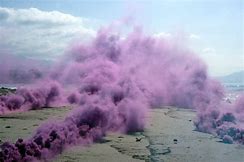
What I particularly wanted to see was the small handful of photographic works based on clouds of smoke. These, specifically Desert Atmosphere, Smoke Bodies, and Purple Atmosphere, have some connection with the thinking that went into Assignment 1 and have some similarities to another artist at whose work I have looked subsequently, Berndnaut Smilde, about whom I will write a bit more when I deal with some further research prompted by my tutor’s feedback.
Purple Atmosphere #4 / Fireworks, 1969
Big prints on metal sheet these make quite an impact and are so much more interesting for being seen in the flesh rather than in reproduction. It was also good that the gallery was not very busy so it was easy to linger in front of them, move in and out, and not have to dodge people in the way!
This is the latest show at the Side Gallery in Newcastle and is easily the most harrowing one they have shown for some time. Also it has surprising relevance to certain aspects of this module on landscape.
There has been quite a lot of publicity about this work recently as it has been nominated for a number of awards and has featured in a recent issue of the BJP.
This work is about the end of the ISIS caliphate in Syria (Raqqa specifically) and Iraq (Mosul) and focuses primarily on how the conflict affected and impacted directly upon the ordinary people caught up in the conflict. It goes on to explore the experiences of people from these areas, and elsewhere affected by conflict, such as Afghanistan, in their efforts to find safety and sanctuary in Europe (and I defy anyone to come away from these images without a sense of outrage that these poor people have been received in so many places in the west with hostility and disdain, as if they were criminals rather than people literally fleeing for their lives, and in too many cases losing them in the process). It is all very powerful and deeply moving work and how Pickett has apparently not been traumatised by what he has seen and experienced is beyond my comprehension, though I have the deepest admiration for it.
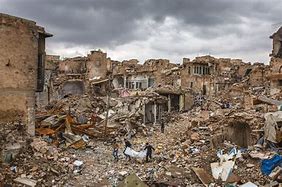
For the purposes of this module though I would rather, albeit most reluctantly, concentrate more on the landscape elements in his work. As well as showing the people he shows how their cities and homes have been devastated by the war and how their landscapes have been changed, possibly irrevocably. Take for example this picture of volunteers recovering bodies in Raqqa:
This is unfortunately not at all a good copy so I suggest getting a better view on the Panos site referred to below, or looking at a physical copy of the BJP (the double page spread at 72 & 73).
This is a big print and the shattered landscape of the city is the main subject. The people who appear in the frame are tiny in comparison and dwarfed by the devastation. In common with much of Prickets work in this show the amount of detail he has matured, the sharpness and depth of field are breathtaking. What they, and this picture in particular, bring to mind are some of the big works of Ansel Adams, which have a similarly almost hallucinatory effect: masses of detail, huge depth of field, a strange flattening of perspective. Also come to mind some of the paintings that I discussed in connection with the establishment of conventions within landscape painting. Particularly those of Bierstadt where people are included in the scene in order to emphasise the scale of the landscape around them.
I do not know whether he was consciously affected by these earlier works but certainly it seems to me the parallels are there to be drawn.
Another parallel that strikes me is with the work of Jeff Wall (thinking particularly of things like his picture of dead Russian soldiers in Afghanistan). This work is all real but some of it almost becomes hyper-real, there is so much detail, so that it has some of the air constructed images. I suppose in a way what is happening here is that Prickett has managed to convey more of the reality, the detail, the grit and dirt, the death and destruction as he saw it than we are perhaps used to seeing in press photos (which is not a phrase that to my mind really does this work full justice) so that my observation is far from pejorative but is rather, I hope, an accolade for its quality.
I had lots of other reactions to this work as I lingered in the gallery. So many though were so personal and emotional – I do not remember when I was last moved in quite this way by photographs – that I think it is better for now to keep them to myself and content with these few technical observations.
British Journal of Photography, Issue 7887, September 2019
I continue to try to get to as many photography exhibitions as possible that come within easy reach, regardless of their relevance to the current module that I am working on, and this is the latest, a Hayward Touring exhibition that has come to our local arts centre in Hexham.
I had not heard of Blossfeld before this exhibition and I have not so far found any reference to him in any of the books relating to photography in my personal library though he does at least merit a brief mention in a footnote in Gamwell (2002) on the connections between art and science (at page 312). (This is itself an absolutely fascinating book in its own right that even though not immediately relevant to the current module is nevertheless worth reading to offer a different way of looking at ‘things’ which is of course what we are supposed to do as photographers.)
In many ways I find this quite remarkable given the striking nature of his work – early macro shots of plant forms made during the early years of the twentieth century, probably before anyone had even heard of macro photography – and the regard that he was evidently held in at the time. Walter Benjamin, for example, rated him alongside Moholy-Nagy (about whom I shall write something soon), August Sander and Eugene Atget – stellar company in those early days. Perhaps not surprisingly given the almost abstract, other-worldly, alien appearance of some of his images, he proved to be something of a darling, as was Atget, of the French Surrealists, particularly Malraux.
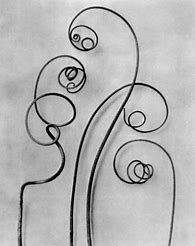
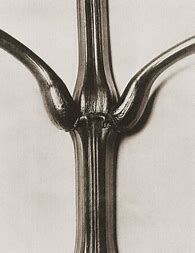
Here are just a couple of examples from this particular set:
White Briony, looking like an abstract wire sculpture.
Himalayan Balsam, looking like carved furniture.
There are others that look like carved wooden panels by the likes of Grindling-Gibbons, and in some he arranged multiple examples of his chosen specimens to create repeating patterns reminiscent of fabric or wallpaper.
Amazing stuff, years ahead of its time technically and artistically.
Gamwell, L, (2002). Exploring the Invisible: Art, Science, and the Spiritual. Princeton: Princeton University Press
 Mark Robinson's OCA Landscape, Place & Environment Blog