Category: Home

One Billion Journeys – Exhibition

I only found out about this exhibition quite by chance a week ago and managed to see it today. This is an exhibition at Locomotion at Shildon (which is about an hour’s drive away for me), an outpost of the National Railway Museum in York, which is the site of one of the very earliest locomotive building workshops. Despite its relative closeness I had no idea it even existed, which is a shame because it is an absolute gem. I am not really a railway buff but have visited the main site in York in the past and I enjoyed this visit even more because of the rather less overwhelming scale of the museum and its exhibits, which are still pretty impressive.

What I particularly wanted to see was this small but nicely staged exhibition of the work of Chinese photographer Wang Fuchun, of whom I had not heard before. Apparently over a period of forty years or so – the earliest images in this show date back to the 1970s, when China was very clearly a remarkably different country from what it is now – he travelled on every train in China and took hundreds of thousands of photos of people on those trains. Out of that massive haul of images this show contains just 45 but they seem to be very well chosen to give a true flavour of his work, and the way China has developed throughout the recent decades.

Nearly all of the photos are black and white: there are just a couple in colour and they stand apart as being shots of trains rather than in them and strike me as being rather too stylised. Nevertheless, still interesting enough in their own right as they depict some of the last steam trains (although, as I say, not a railway buff, I do have a soft-spot for steam trains – don’t we all, or at least those of us old enough to remember when they were not just curiosities or tourist attractions?).

The bulk of the work is simply of people on trains, each particular train route being identified in the caption with details such as the time the journey takes. Captions apart they are not really pictures about particular journeys, rather about the way people relate to those journeys. It is particularly striking that as the images become more contemporary so the passengers become more isolated from the country through which the trains travel as the trains become more ‘sealed’ and air-conditioned (more like aeroplanes in a way; indeed some of the seats look more like what you might expect on a plane) but also from each other as they become more engrossed in their mobile phones and tablets. There is hardly anyone in the more recent pictures who is depicted as doing anything as mundane as looking out of the window! (This is, I am sure, not just a Chinese thing and you would in all likelihood see the same things on any train today anywhere.)

Wang’s approach to his subjects is particularly interesting. Whilst photographs are proliferating at an unprecedented rate, and ‘every man and his dog’ is taking pictures on their phones, he has found that openly photographing people leads to too much hostility. People are happy to take pictures but not necessarily be photographed by others. He therefore does so subtly, if not surreptitiously. There is some interesting footage of him at work in a brief video interview that accompanies the stills: instead of a big camera he uses a compact automatic (in fact a Sony RX100) which he can point at his subjects without them necessarily being aware of what he is doing, or at least without him being blatantly obvious. The results are still technically good but benefit in particular from being candid and unstaged. In fact some people are evidently so engrossed in their phones that they were probably oblivious to his presence.

This style has parallels with the work of, for example, Daido Moriyama, who similarly uses a small compact camera and is practiced at catching people unawares. The main difference between the two though is that I guess Wang is pursuing a fairly refined aesthetic whereas Moriyama, in common with a number of other Japanese photographers that come to mind – the Provoke group, Masahisa Fukase, Hajime Kimura, for example – have much less refined, often positively ‘dirty’, anti-aesthetic approach.

So far as this course is concerned, this has been quite a timely discovery as I am already starting to think about how I might approach the journey theme in the next assignment. Bearing in mind also the pictures taken by Kazuma Obara on the Chernobyl train I have been thinking about making a sequence on my old train commute line into Newcastle. At the moment though I am leaning more to the idea of taking shots of the landscapes through which the train passes rather than of the people on board. I will return to this again and in more detail later.

https://www.locomotion.org.uk/whats-on/one-billion-journeys

Exercise 1.5: Visualising Assignment Six Transitions – A Random Thought

As I continue to take my weekly shots at the ford for this project I am becoming increasingly aware of, and attuned to, the subtle changes in the scene as time passes There are the occasional substantial changes, such as when the water level increases dramatically after prolonged rain, or as was the case this last weekend when the temperature plummeted, down to around minus 7º C first thing and not rising above freezing all day leaving everywhere iced up. Otherwise the major changes are only going to be visible over a much longer period.

This strikes me as being relevant to project in part 2, typologies and new topographies that I am just starting to explore and think about. As I am going to write elsewhere it is not the single image that is important but the greater mass and the juxtapositions that mass can create.

The true random thought here though for now is a musical analogy. I have been listening recently to a new set of recordings of piano music by Morton Feldman and what I see is a commonality of approach: Feldman’s work often evolves slowly, positively glacially (for example the second string quartet lasts for more than three hours and sometimes it is difficult to properly register the changes and development of the music from moment to moment – I have never yet managed to listen to the whole work in one sitting!) and it is only by taking a long view that it makes proper sense. That sort of process is at work here in this project and I expect that it will only be once it is complete that it will make proper sense.

Assignment 1 – Further research

The two Dutch artists recommended by my tutor, Berdnaut Smide and Jan Dibbetts, are both new to me. In the context of the work that I have done for this first assignment I think the former is more interesting and relevant.

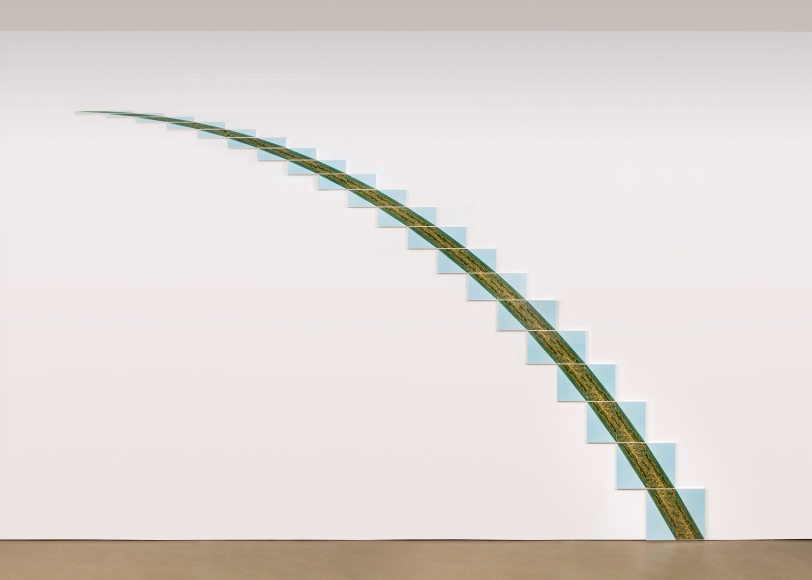
Dibbets’s geometrical collage approach is certainly striking and I can see some contexts in which I might want to experiment with this sort of form.

Comet Land 3º – 60º Sky Land Sky

For the present cloud/skyscape series though I struggle to see how it might be applied constructively.

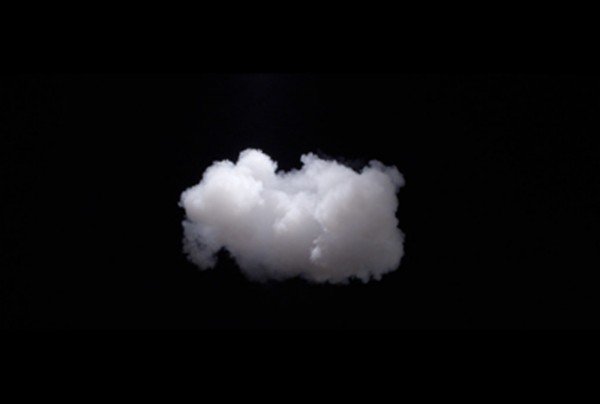
Smide’s work, which at least in its static forms has some similarities with Judy Chicago’s smoke photos that I have written about briefly separately, but what I find more intriguing is his dynamic, video based work.

Nimbus Atlas

This was one of the influences for exploring the possibility of some sort of slideshow presentation, as discussed in my last post. I have no idea how he achieves this effect but clearly as it is video based it is potentially more successful as it avoids any sense of discontinuity which I fear is always going to be an inherent problem with any progression of still images.

I have kept what I hoped would be the best tip last, the interview with Hiroshi Sugimoto. I have to say though that I am a bit disappointed. I find this interview rather shallow, no doubt as a result of limited space and enforced brevity, and rather disjointed, so that it does not really do justice to any of the varied strands of his work. The references to spirituality in general and Buddhism in particular are unfortunately too superficial to add much that is useful to my understanding of Sugimoto’s work from this point of view.

What I did find interesting though is his observation on black and white photography, that it is the best medium to show “the tonality of darkness to light”, which is a view I share, and which perhaps goes to explain why so much of the work in my library of photobooks and the prints that I have collected are in black and white.

https://baltic.art/whats-on/judy-chicago

http://www.berndnaut.nl/

https://www.huffpost.com/entry/interview-with-hiroshi-su_b_8924692

https://www.peterfreemaninc.com/exhibitions/jan-dibbets2?view=slider#6

Assignment 1 – Tutor feedback

First feedback from a new tutor is always for me a bit of a nerve-wracking prospect. Whilst the first assignment is an opportunity for the tutor to get to know something of me and my work, this is also an important opportunity to get more of a feel for the tutor. Fortunately all has gone well this time and the feedback has been very positive and supportive. Needless to say I am pleased. For the sake of ease I have cut and pasted the main text below:

Overall Comments

This is an impressive submission, well-conceived and developed through rigorous and focused research evidenced in both the assignment notes and the exercises for Part 1.

All work uploaded to the online log.  

Feedback on assignment 

Aligning the idea of the ‘sublime’ with Buddhist ideas and principles such as Sunyata, a meditative state, works well as an approach for this assignment.  Your reference to Morley’s article about contemporary interpretations dealing with transformative and transcendent states really does bring a contemporary feel to the concept and a framework for the images you produced.  As does your note in Exercise (1.6),  ‘The Buddhist view is that phenomena are impermanent, interconnected, and in continuous flux. …’, 

The images as presented in the Blog don’t, perhaps, do justice to the concept and as you observe later, would better be displayed in an immersive situation (similar to Rothko’s works in the Tate or a dedicated space such as the chapel in Houston).

Alternatively, thinking about Turrell’s installation work – both the site specific and the gallery works – another option would be to use an audio-visual installation to produce a similar effect.  

But it’s the idea here that is important, and certainly gazing into space, the shifting patterns of cloud, light and colour, can certainly induce a meditative state.

You quote Mark Godfrey’s take on Richter to qualify your own ideas:  

 “these are not just paintings of skies – they are paintings that show Richter’s attraction to the ‘unknowable and unrepresentable’…” This fits exactly with the interpretation that I have sought to place upon the Sublime. 

Your set of images, from overcast to ranges of cloud textures, to an almost clear sky, do, in terms of a sequence, offer what might be moments from a single experience and viewpoint.  A range of colours – temporal and meteorological – would be interesting for their variation, but wouldn’t offer the same sense of continuity.  

In his seascapes, Sugimoto, I recall, was looking for vistas that had remained unchanged for millennia, the same our ancestors would have seen, producing a sense of continuity – certainly the sublime: his aesthetic serves to enhance this. Interesting what he says in the introduction to the series on his website, ‘Every time I view the sea, I feel a calming sense of security, as if visiting my ancestral home; I embark on a voyage of seeing.’

Your note:

‘How paradoxical though that Burke was of the view that art was not really capable of communicating a sense of the Sublime and that this was better done through poetry. ‘

Is this about imagination, where visualisation is a more personal first-hand experience through literature, rather than gazing at the work (interpretation) of an artist?  But then one role of an artist has always been to visualize and to provide a (communal) representation of the unknown. 

I thought the work of Gary Miller was very interesting; a man of many ideas with a truly prolific output, some of it reminiscent of Turrell.

I agree with your Postscript about the images from the Blue Skies Project (terrifying indeed). The lack of a frame for your images does reduce the context and emphasizes perhaps, that this is more of a representation of the idea, ‘a bit like thoughts drifting across one’s consciousness while meditating.’  An additional challenge might be to find a way of converting this into an alternative and immersive experience for the viewer.

Coursework

Demonstration of technical and Visual Skills, Demonstration of Creativity 

Excellent work here.  A detailed response to 1.9 ‘Social Contrasts’ with a range of examples and lucid commentary.  Strong practical application in 1.8 The Zone System.

Highly focused research and observations providing a framework for the assignment (Contemporary Abyss and Beauty and the Sublime) – a short literary review that I would be pleased to see from my Masters students at an institution elsewhere.

Research

Context, reflective thinking, critical thinking, analysis  

Mentioned elsewhere, the critical thinking around this assignment is of the highest quality, supported by a broad range of research from historians, theorists and practitioners.

Learning Log

Context, reflective thinking, critical thinking, analysis  

Strong concept, initial notes and images for Assignment 6. It will be interesting to see how your take on this idea progresses.  Would you consider any interaction from people/traffic/ animals – also weather conditions as well as the shifting seasons?”

The final comment about interaction from people and traffic is something that I have already addressed in my updated post on Exercise 1.5 (https://markrobinsonocalandscape.photo.blog/2019/11/26/exercise-1-5-visualising-assignment-six-transitions-update/).

The question of how best to present this work is something I have also been thinking about. Although as matters presently stand it is not practical or feasible for me to do so I still very much like the idea of an immerse space containing just big prints of the photos. I have though also played around a bit with the idea of some sort of slideshow. My present resources for creating one area fairly limited. There is a facility to do so with the Apple propriety Photos programme on my iMac. This is fairly basic and, again for present purposes, I do not have the possibility of making and running a proper slideshow in a public space. Nevertheless it has provided a vehicle with which to experiment and see how a dynamic presentation might look. What I have achieved is a slow resolve of each image into the next, starting from the fully occluded sky to the almost clear one. Even in this family basic form the result is still quite immersive, and meditative. There are though a couple of points that I get from it. One is that the sequence would probably need to be expanded with a few more “intermediate” images to make the progression a bit smoother. The other is that the direction of the resolve means that a couple of images would need to be reversed so that the clearer patches of sky are all on, and so emerge from, the right hand side. As it is, with some clearer patches on the left, a couple of the transitions are a bit abrupt. With a bit more work, and a more sophisticated program or app I am sure this could turn out quite well.

My tutor has helpfully suggested some further research and I will write about this separately.

Exercise 2.2: Explore a Road – 2 – Photos

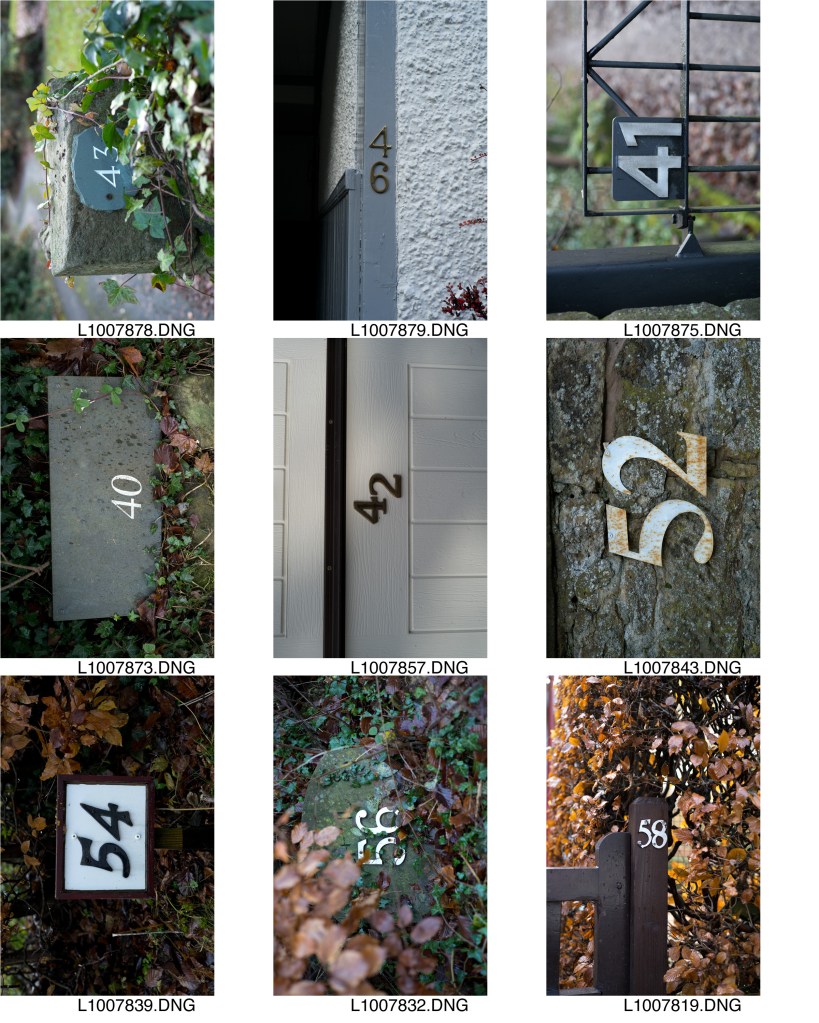
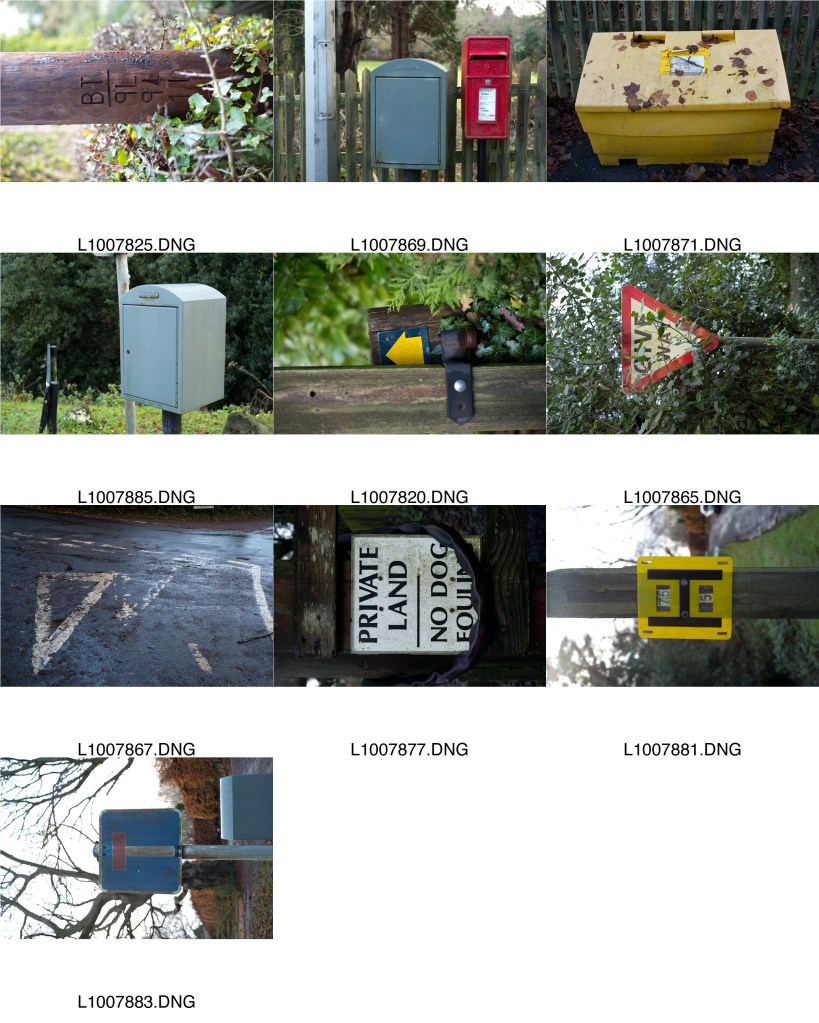
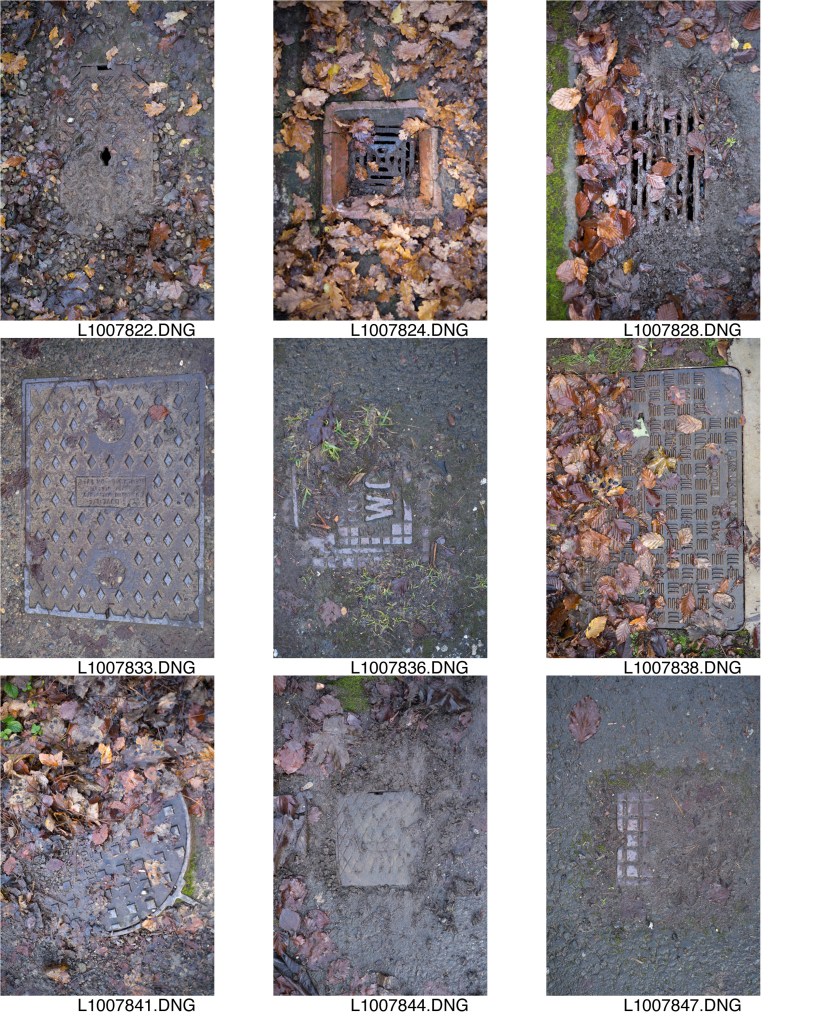
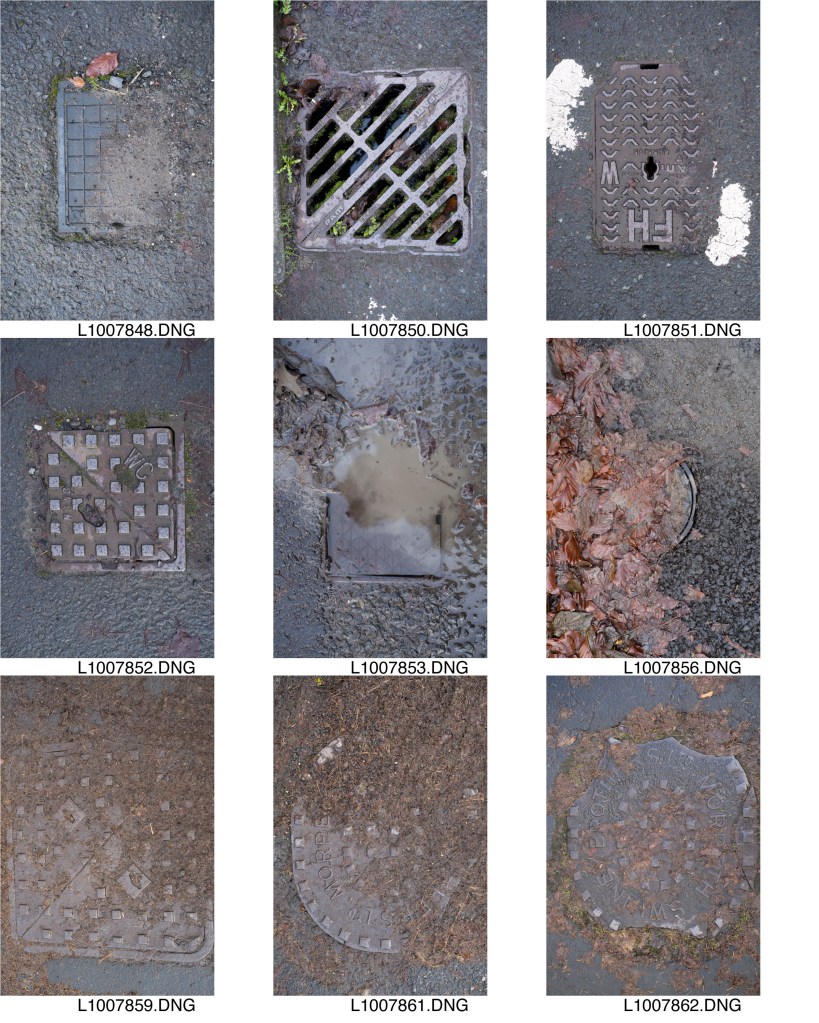
What I have chosen to do for this part of the exercise is simply to walk from one end of my chosen stretch of road to the other and along the way photographs elements that would mostly normally pass unnoticed: house numbers and other signage; street furniture; drain grids, man-hole covers, water stopcocks, fire hydrants – road hardware. This last group are largely invisible (apart from a couple of the larger covers) unless you pay attention and indeed I could not find one of them (I know it is there, it is the stopcock cover for my house) as it is buried under leafmold, gravel, mud, and other natural detritus!

The house numbers are not complete (and I do not know why, having arranged them carefully in Photoshop, they have not come out in the right order in the contact sheet) as not every house has a visible number (only nine out of fourteen), something that causes no end of trouble for visitors who do not know the area. As with Assignment 5 of I&P I have obscured house names where they would otherwise appear with the number in the interests of privacy – many houses in the village are known better by their name rather than street number.

Which do I think are the most interesting? As a typological set, in the style of the Bechers, I would choose the road hardware, the various covers and grids set into the road surface, simply because there are so many of them, and are surprisingly diverse. The numbers and street furniture do not, for me, offer enough in quantity nor in variety. For the same reason I suspect that a wider audience might similarly find the larger set more interesting, also because it is the more surprising, overlooked set of subjects.

The contact sheets are edited down from the total number of shots that I took (seventy-odd) and do not include alternate takes, other trial shots that did not, for whatever reason, work out quite so well.

Finally, as our little stretch of road is a cul de sac and very quiet, I did not encounter anyone while shooting. Except when I was photographing the stopcock cover outside one of the cottages. To do so I was bent right over to frame the shot. My neighbour suddenly came out to see if I was alright: he and his wife had seen me through their window and were concerned I was unwell. He was also surprised to see me without my dog. Small village life is like that, people expect certain regular behaviours from their neighbours and any deviation from the norm is more likely to draw attention. Many of the people that I see on anything like a regular basis are out because they are walking their dogs and I am walking mine. It is though encouraging that neighbours, even if we do not know each other very well (another characteristic of life in this village, as again my work on Assignment 5 for I&P demonstrated, is that many people tend to be very private, and some positively withdrawn), are ready to come to another’s aid in case of need!

House numbers
Signage and street furniture
Road hardware

Thoughts on Portraiture – Exhibition

Strange as it might sound I had forgotten that I saw this exhibition at the Birmingham Museum and Art Gallery back in September. It was only when going through one of the pocket notebooks that I am in the habit of carrying with me, which is now nearly full, to see if there is anything in it that I need to deal with, that I came across a reference to this show.

Although it has nothing to do with the present module I nevertheless try to get to any exhibition that looks interesting if I am in its vicinity. I happened to be in Birmingham for a concert, saw that this show was on, and popped along.

It was only quite small, and dominated by a sculpture installation by Anna Pacheco, but there were some really interesting pieces in it by some major artists, including Picasso, Frank Auerbach, Keith Vaughan, Craigie Aitchison, John Bellany, just to name those I am more familiar with.

The only example of photographic work was that of John Stezaker, consisting of a series of his Hollywood portrait collages. I have previously thought much about, or indeed of, his work but this particular set (unfortunately I have not been able so far to find an example from it on-line) impressed with its subversive wit, playing around with and blending male and female characters, different perspectives and points of view of the same scene, and chopping up the geometry. In an odd, but quite serious way, his perspectival games offer multiple views from a single standpoint as if it was possible to look round corners, is the best way that I can put it.

Nice little show and well worth seeing, were it not for the fact that it has just finished. Too late now, alas!

https://www.birminghammuseums.org.uk/bmag/whats-on/thoughts-on-portraiture

Exercise 1.5: Visualising Assignment Six Transitions – Update

A brief update on how this project is progressing.

Firstly, I have decided to abandon my plan B as it is increasingly clear that there is insufficient prospect of enough change over a prolonged period of time to make the scrapyard a viable subject. Similarly I think that the microcosmic approach of plan C is similarly too limited. I am though going to persevere with the views of the local ford.

I will deal separately with my tutor’s feedback on Assignment 1 but will mention now a couple of points that he has raised in connection with this project.

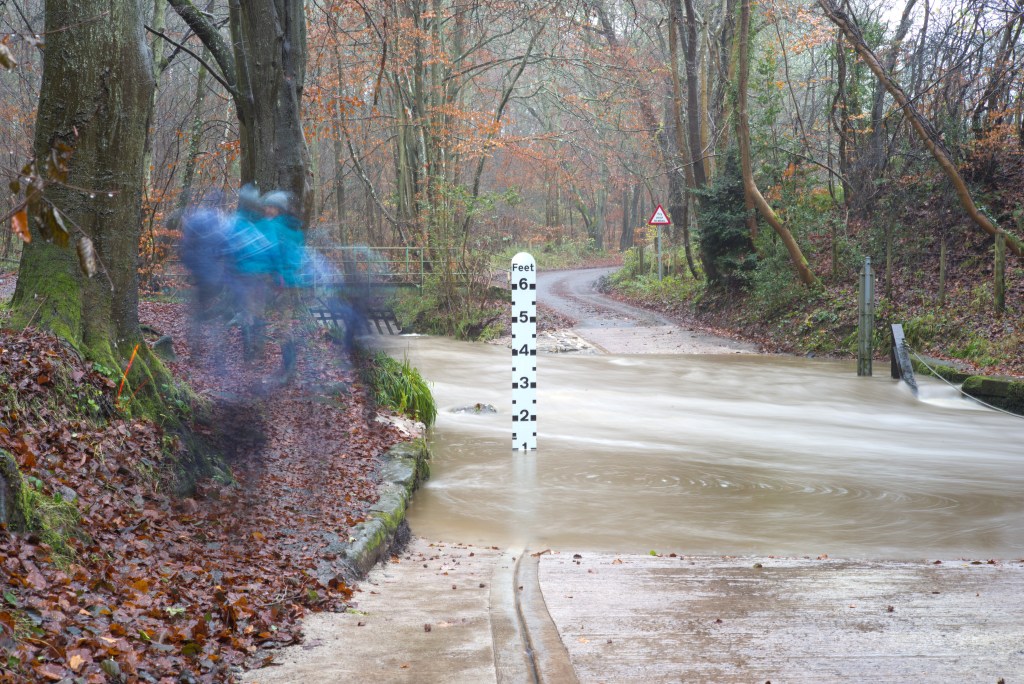
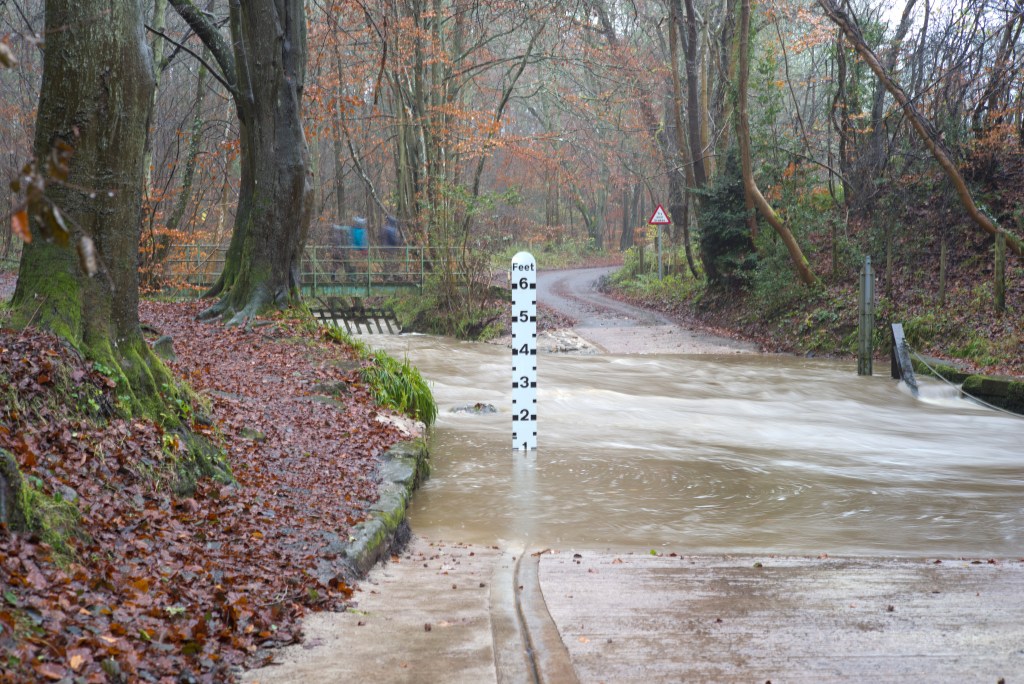
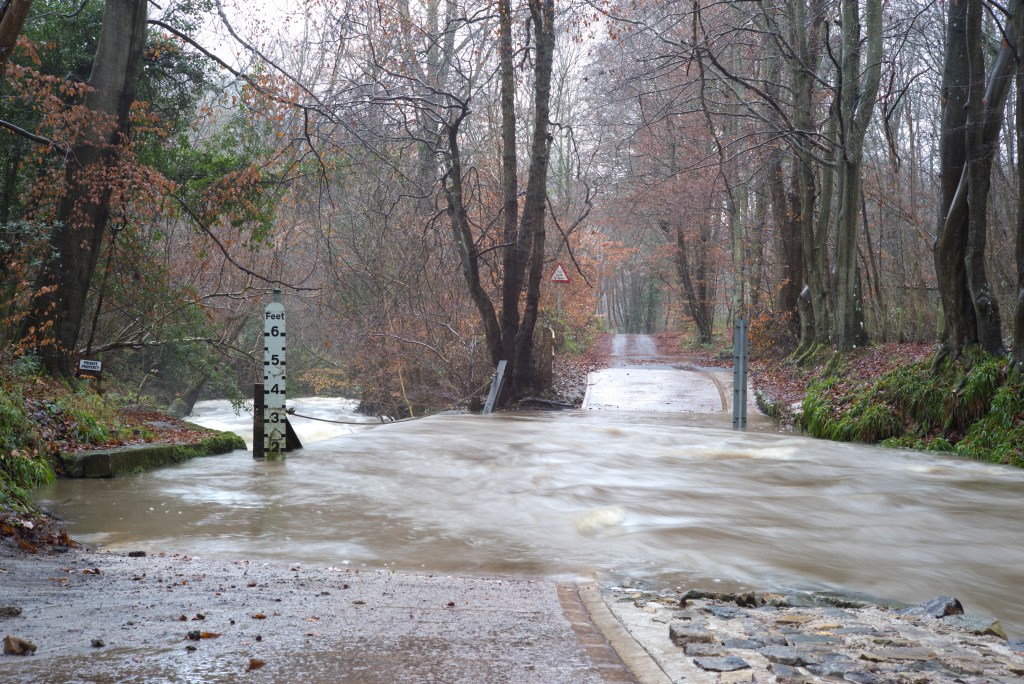
One is that I should consider shooting in different weather conditions rather than just relying on seasonal changes. In fact I am already doing this. The very first shots that I took were made during a rain storm and I had to shelter the camera under an umbrella, as it is not weathertight. The fact that it was raining quite hard is though not readily apparent from the pictures that I have already posted as the exposure times were quite long because the light was so poor so the rain is hard to see. The same happened with my last foray, this past weekend:

24/11/2019

The exposure here was about 1.7s (hence the blurred figures, to whom I shall return below) which has smoothed out the water again.

24/11/2019

I reduced the aperture here to f/8 to increase shutter speed though it did not make a significant difference and it is still hard to see that it was raining.

24/11/2019

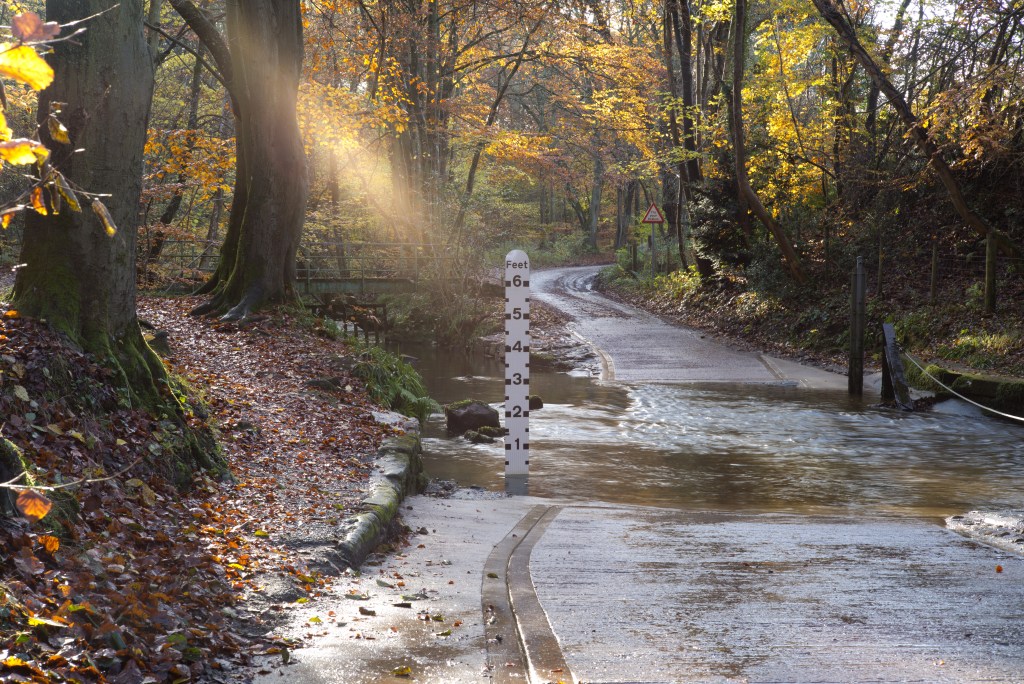
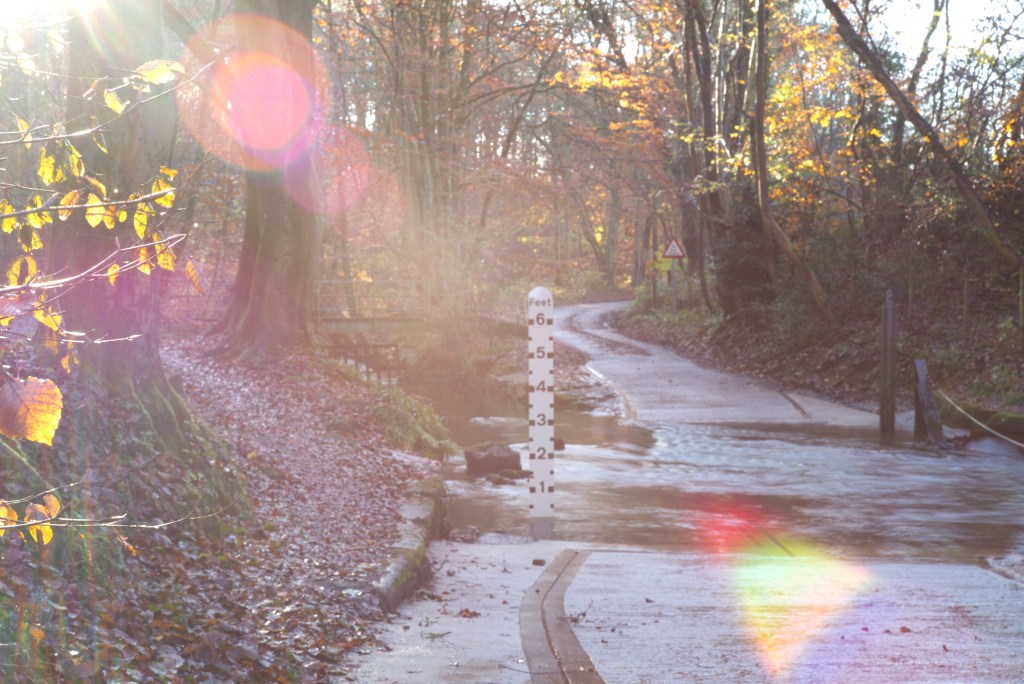
The weather has been pretty monolithically and monotonously bad of late so there has simply been little variation in conditions. Nevertheless there have been a couple of times when there has been a bit of sun:

10/11/219
18/11/2019

This view of the ford looks west so by early afternoon the sun is already quite low and it is almost a case of shooting contre jour, creating some interesting lens flare for variety.

The other question is whether I intend to include any people or vehicles. This is not really a matter of active choice and simply depends on if anyone is around when I am there shooting. This is not a busy stretch of road at the best of times, even less so during the current wet weather. By chance when I took the first two pictures above a family, who are actually near neighbours and whom I see fairly regularly when out with my dog, were braving the weather with their black lab and just happened to fall within shot. As indicated above, because of the slow shutter speeds they have appeared blurred. I do though think this introduces a new sense of dynamism in the scene.

Cars are another matter. This road does not attract a lot of traffic. I have to be careful of what little does come through because at this point the road is little more than one car wide and to avoid becoming a hazard I need to step aside with the camera on its tripod. The poor weather has also limited the number of vehicles coming through. Although it does not look too bad, the depth of water on the upstream side of the ford this last weekend was two feet. The flow rate was also very fast. That is more than enough to cause a problem for, and consequently deter, the average car. Indeed, while setting up for the first shot a car was coming from the west but beat a hasty retreat when the driver saw how much water there was. I am just going to have to play this by ear and see what happens whenever I am there.

As an aside, these recent conditions have been by no means particularly bad for this ford. During winter it is not uncommon for the depth to exceed three feet, as for example it did last March after a heavy snowfall melted, enough to put my vantage point at risk. There have been occasions when it has been even deeper!

I will for now simply continue to turn up regularly once a week and see what ever there is to be seen.

Exercise 2.2 – Stalker

The “road movie” that I have chosen for this part of the exercise is Andrei Tarkovsky’s 1979 film Stalker. None of Tarkovsky’s films are what might be called ‘easy’ but that for me is one of the attractions of his work. Although the initial critical reception of this film was poor it has subsequently grown in stature and I have even come across it being cited as the Tarkovsky film for people who do not like Tarkovsky. I am not sure I entirely agree with that – I would suggest The Sacrifice instead – but certainly regard it as one of his best, most immediately engaging, films.

One of the things I find most intriguing about it is how it predated the Chernobyl disaster of 1986. The Zone, a sealed off area affected by some cataclysmic disaster, prefigures the exclusion zone around Chernobyl in an uncanny way. There is obviously no real connection but the parallels are remarkable.

That Chernobyl connection brings back to mind Kazuma Obara’s book (2018) that I have previously written about for I&P. I suspect that this is something that I am going to come back to when thinking about a subject for Assignment 2 as many of the images deal with the train journey between Chernobyl and Slavutych.

So, to the film itself. Looking at it again I am struck by the parallels that can be drawn with, in particular, The Divine Comedy and Pilgrim’s Progress. as in both of those books, the journey undertaken by the protagonists, in this case Stalker, the guide through the Zone (a Virgil to Dante), the Writer and the Professor, is a metaphorical one in which the latter two seek to reach The Room which will grant their desires. The Room is a bit like Paradise/the Celestial City but more ambiguous in that it does not necessarily bring about consequences that are positive. Indeed, as happened to another stalker, Porcupine, who does not appear but whose story is retold, the Room can be fatal for those who seek it for negative reasons. The Room is therefore capable of providing redemption, or perdition. (In this regard the coincidence of Chernobyl is almost overwhelming; the exclusion zone around the nuclear plant has proved to be a sanctuary for wildlife, a redemption; the radio-active contamination on the other hand is still killing people and leading to birth defects and illnesses more than 30 years after the event – perdition.)

The fact of and the nature of the journey are central to the film. Again following the established conventions, it is important that the journey is hazardous, that there are trials and obstacles to be overcome: there are guards at the perimeter of the Zone to be avoided, there are perils and hazards, not visible to or discernible by anyone other than the Stalker, along the way; the route is tortuous and circuitous, discovered by Stalker throwing ahead metal bolts tied with strips of cloth to find the safe way.

The process of the journey also importantly provides a literary/cinematic opportunity for the characters to explore their motives for coming to the Zone – the Stalker, apparently altruistically, to help people fulfil their desires (and presumably more mundanely to make a living for himself and his family), the Writer to recover his inspiration, the Professor to win a Nobel prize for scientific investigation of the Room – and reassess their validity. The process of the journey, by bringing the protagonists into such close proximity, and conflict, by challenging their motives and beliefs, brings out the true nature of the Professor’s intention, which is to destroy the Room with a nuclear bomb. (There is a supreme irony here that the zone around Chernobyl, which in so many ways resembles the Zone, was caused by a nuclear accident.) The journey is itself the redemptive process and force. The Stalker comes to doubt the value and purpose of what he does in so far it is no longer clear to him that the Room can provide true happiness; the Writer, who first realises the negative potential of the Room depending on an individual’s desires and intentions (in passing, quite a Karmic notion) loses some of his own arrogance and self-centredness; the Professor gives up his plan and dismantles his bomb.

I could go on, but am mindful of the suggested word limit for this exercise. I will therefore simply add a recommendation of Dyer (2013) which is a scene by scene description of, and commentary on the film. I have written elsewhere that I like Dyer’s writing on photography despite a tendency towards hyperbole and over interpretation. In this case though my view is that he spot on. His book is itself a sort of road movie in its own terms. As one reviewer quoted on the back cover (Sukhdev Sandhu of the Guardian) puts it, Dyer has the ability “… to make pilgrims of his readers and lead them on a journey in search of truths about love and about the nature of happiness…”. How apt!

Dyer, G, (2013).  Zona.  Edinburgh:  Canongate

Obara, K, (2018).  Exposure / Everlasting.  Cordoba:  Editorial RM / RM Verlag

Tarkovsky, A, (1979). Stalker.

Judy Chicago – Exhibition

Just a very brief note on an exhibition at the Baltic Gateshead of work by the American artist Judy Chicago that I visited this week. I have to say that much of her work is not really to my taste (though I do find her perhaps most famous work, The Dinner Party, really quite impressive) so this is not a show that I would normally go out of my way to see. There were though enough works that I do like to make a visit worthwhile.

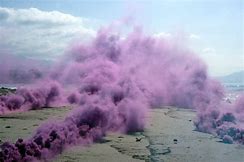
What I particularly wanted to see was the small handful of photographic works based on clouds of smoke. These, specifically Desert Atmosphere, Smoke Bodies, and Purple Atmosphere, have some connection with the thinking that went into Assignment 1 and have some similarities to another artist at whose work I have looked subsequently, Berndnaut Smilde, about whom I will write a bit more when I deal with some further research prompted by my tutor’s feedback.

Purple Atmosphere #4 / Fireworks, 1969

Big prints on metal sheet these make quite an impact and are so much more interesting for being seen in the flesh rather than in reproduction. It was also good that the gallery was not very busy so it was easy to linger in front of them, move in and out, and not have to dodge people in the way!

https://baltic.art/whats-on/judy-chicago

Road Movies

Before getting on to Exercise 2.2, in particular the critique of a ‘road movie’, I thought it would be worthwhile first thinking about what amounts to a road movie, its roots in literature, and some common or key themes that I feel I have detected. I will then settle on just one film (I think I have already chosen the one) for further comment as part of the exercise proper later.

A car chase does not a road movie make! I rule out many films in which there might be a lot of action on the road (for example, Bullitt, in my view the greatest car chase ever, The French Connection, the second best, or any of the Mad Max movies, even the most recent, Thunder Road, which has some elements of what might otherwise amount to a road movie). Similarly I rule out movies where travel is merely incidental to the plot but not essential to it: for example two Agatha Christie thrillers, Murder on the Orient Express and Death on the Nile. In both cases there is a journey but the nature of those journeys are not essential to the underlying murder mystery, whodunnit, plots. They could just as easily have been static, set in a hotel or stately house.

Rather it seems to me the key factor is that the journey, whether physical or metaphorical, is integral to the plot and is part of its development and forward motion. The journey is not necessarily the whole point of the plot but is an inherent part of it. Here I think of the likes of, to make a fairly random selection, Thelma and Louise (which I have to say I have seen just the once and disliked intensely), Easy Rider, 2001: A Space Odyssey, Priscilla Queen of the Desert. Even Bergman’s The Seventh Seal I would count in here as the journey of the knight is of central importance: it is the journey of the crusaders back to Europe from the Holy Land that helps to spread the plague that carries off most of the characters at the end. Similarly The Blues Brothers. It is not just an extended car chase, though certainly up there with the greats, but the whole film is about a journey, both a physical one while the band is put back together and the concert receipts are run from the ballroom to Chicago, and a psychological/allegorical one as Jake and Elwood effectively grow up and take responsibility for their actions and for the benefit of others. (It has to be included in any event just because it is so funny!)

On a somewhat more serious note I would mention Almost Sunrise in which two US Army veterans return from service in Iraq with all sorts of traumatic psychological problems (PTSD) and seek relief by walking across America. This was a recent choice of the film club run by Tricycle Magazine, a Buddhist review, though not a specifically Buddhist film, and the link below is intended for subscribers to the magazine. It does at least show a brief trailer. The film is also available on DVD, and I guess might be accessible through some of the TV streaming services but I have not investigated. Even if not easily available I nevertheless mention it as it is a fine example of one of the key themes (which I have already touched on in passing in connection with The Blues Brothers and to which I shall return).

I see that The Road is mentioned in the course material. I have not seen the film but I have at least read the book. I confess it is not the sort of book that I would ordinarily read; someone lent it to my wife, it was lying around and I picked it up more or less idly. While I cannot say that I was wholly engaged, let alone convinced, by it I found it interesting enough and I guess I just gave it the benefit of the doubt on the basis it won a Pulitzer Prize. However, looking back I can see there is an important link back to much earlier literature that is worth noting and to which I will return below.

I pass over for now Kerouac’s On the Road, simply because I have never succeeded in wading my way through it.

Now turning to earlier literature there are a number of really important works that are built around and upon the idea of a journey and what that means for, and affects, the central characters. These are really the precursors of all modern road movies and set the abiding themes. Whilst I will look briefly at these chronologically I do not suggest that they represent a continuous or congruous tradition. They just happen to touch on the same issues and use similar forms.

Perhaps the very first example of a ‘road movie’ is the Babylonian Epic of Gilgamesh (second millennium BCE). It is really only the last three of the tablets that record the life and exploits of Gilgamesh in his wanderings and quest for immortality so it is really only this latter third or so of the whole epic that might be regarded as fitting the bill here. The key points though are there and in some ways established for subsequent works: the journey in search of a particular goal which either is, or is not, found. (I will come back to this point anon.)

Next Homer’s The Odyssey (eighth century BCE?), the story of the tortured and tortuous journey of Ulysses after the end of the Trojan war to his home in Ithaca. This is much more ‘modern’ in its form and much easier, and more accessible, for a modern reader, not to mention much longer, with a greater number of adventures and encounters on the way.

The Old Testament books of Exodus, Leviticus, Numbers, and Deuteronomy (sixth century BCE) telling of the journey of the Hebrews from captivity in Egypt to the Promised Land, led by Moses. (Does this mean that Cecil B. DeMille’s 1956 film The Ten Commandments, with Charlton Heston as an over the top Moses, counts as a road movie?)

Dante Alighieri, The Divine Comedy (1320). A metaphorical journey by Dante down through the circles of Hell, through Purgatory, and finally to Paradise where he not only witnesses the Almighty but is reunited with his beloved Beatrice.

Geoffrey Chaucer, The Canterbury Tales (late 14th century). A precursor of all the road movies and books that seek to present a picture of the contemporary country in which they are set. As On the Road is “the great American novel”, so the Tales are a portrait of 14th century England.

John Bunyan (1677-84). As with Dante, an allegorical journey to salvation in the Celestial City. (Oddly, although I have read it, probably more than just a couple of times since I was first introduced to Bunyan while at grammar school. I do not actually seem to have a copy of the book and so have not included it in the citations below.)

From these in many ways disparate sources there are a couple of particular themes that emerge. Each epic involves the main protagonist going through a series of encounters and tests which determine the outcome of the journey, resulting in either redemption or perdition. Gilgamesh fails in his search for immortality as a result a result of failing the test of not sleeping for a week. Ulysses reaches some form of redemption as he eventually makes it back home and regains his wife, Penelope, having largely remained true to his quest, despite his questionable dalliance with Circe. Moses does not cross over to the Promised Land because he failed a test set for him by God on the journey: he did not trust God’s word and struck the rock again in anger when water did not appear the first time. He was not redeemed. Dante on the other hand remains true and comes into the presence of the Divine. The Canterbury pilgrims reach the shrine of Thomas à Becket, despite all their ribaldry and naughtiness. Pilgrim is likewise redeemed by completing his journey despite the distractions, temptations and obstacles along the way.

These themes play out in the modern stories. Thelma and Louise plunge to their deaths at the end of a journey that becomes more and more criminal. The hippies in Easy Rider discover in their search for “America” that it is a place of ignorance, bigotry, isolationism, and hated, paying the ultimate price. The knight and lost of the other characters joint death’s dance at the end of the Seventh Seal, carried off by the plague. The travelling player, his wife and baby though are spared, arguably because of their simplicity and inherent goodness, so we have both perdition and redemption in one story. As I have already indicated Jake and Ellwood Blues both achieve a measure of redemption. In Priscilla Bernadette finds a man who loves and respects her, Mitzi is reconciled with his wife, at last bonds with his son, and finds contentment with Felicia.

The two Iraq veterans eventually find their peace of mind despite challenges and set-backs along the way.

In The Road the outcome strikes me as oddly Biblical, in a way echoing Moses: having guided his son across the country to safety he does not reach their goal, finally succumbing to some unidentified illness. This one stands apart to an extent though in that it is not immediately what his failure, that warrants perdition, actually amounts to. 2001 is also perhaps a little ambiguous. I tend though to favour the view, that I gather was Kubrick’s own, that although Dave Bowman dies, suggesting perdition, he is nevertheless reborn as the Star Child, elevated to a higher level of being, creating “a new heaven”, and so is redeemed.

So, next is my brief crit of my choice of road movie, and without giving away right now which film it is, I will say I have chosen one with a redemptive ending!

Alighieri, D, (Milano, P, ed) (1977). The Portable Dante. London: Penguin

Bates, E S, (ed), (1937). The Bible: Designed to be read as living literature, the old and the new testaments in the King James version. New York: Simon and Schuster

Chaucer, G, (Coghill, N, trans), (1979). The Canterbury Tales. London: Penguin

George, A, (trans.), (1999). The Epic of Gilgamesh. London: Allan Lane

Homer (Pope, A, trans) (1942). The Odyssey. New York: Heritage Press

McCarthy, C, (2007). The Road. London: Picador

http://tricycle.org/filmclub/almost-sunrise

Collins, M, (2016). Almost Sunrise