I have to confess that until I saw the brief obituary in the Guardian this morning I did not realise that Robert Frank was, until now, still alive. Nevertheless, very sad now to learn of his passing.
For my money, along with Walker Evans, he was one of the greatest American photographers of the 20th century. Indeed, one of the greatest photographers, full stop. “The Americans” (despite its rather mannered, acid fuelled?, introduction by Jack Kerouac which I find a sad and embarrassing self-parody of what he achieved in “On The Road” – even though I never actually managed to finish it!) is one of the truly great photo-books of all time. He brought a new aesthetic to photography and, for my taste, is more interesting and compelling in his immediacy, naturalism, and honesty, than, for example, the work of HCB, which unfortunately has had to carry the burden of what I still regard as a somewhat preposterous concept, the Decisive Moment. That concept was not something that dogged Frank.
One thing I find quite remarkable, and which had not really been brought home to me before now, is how relatively little major photographic work he seems to have produced throughout his long career. The Americans is about all that immediately springs to mind. Much of his later work was concentrated on movies, very little of which I am afraid I have seen. Nevertheless that book alone is a major legacy and testament to his achievement.
I cannot say that within my own work I am conscious of any direct influence. I nevertheless regard Frank’s early work as one of the foundations of my own understanding of the practice of and appreciation of photography. I guess it is almost inevitable that when I am out play-acting as street photographer with my film Leica, the work that Frank did is somewhere in the back of my mind.
Starting to look at this exercise has fortuitously coincided with me reading Andrews (1999) (which I have to confess I have found a bit heavy going at times; it comes across in places as a bit too earnestly academic for my taste) so I have been thinking about some of the conventions in landscape paining, in particular, and already exploring the possibility that some of the thoughts that I expressed in Exercise 1.1 (https://markrobinsonocalandscape.photo.blog/2019/08/21/exercise-1-1-preconceptions/) already might be in need of some revision or development.
As a starting point I have simply chosen (as it turns out) thirteen different artists from the 18th and 19th centuries. The choice is not entirely random, although I have not selected these artists on the basis of any preconception of what elements and conventions I might find. Rather I have simply stuck to artists with whom I already have some degree of familiarity, whose works I have seen in the flesh as well as in reproduction, and who feature in some of the books that form part of my personal library (an admittedly partial and idiosyncratic selection, which are all referenced below). Most are British, three are American (members of the Hudson River school with whose works I developed some familiarity over the years on trips to the States and visits to, in particular, the MFA in Boston, and the Metropolitan in New York – the works that I have chosen for these artists are ones that I have seen in the flesh), and one German.
At this stage I have not given too much thought (though I do have a couple of ideas already) about photographic analogs as I want to see how this part of the exercise pans out first.
The choice of actual paintings is a little more random and mostly comes down to familiarity. I have deliberately avoided the French schools, as I am not sufficiently familiar apart from some of the Post-Impressionist, such as Monet, Dufy, Cezanne, whose work I do not really want to discuss anyway. Similarly I have avoided the Dutch/Flemish schools, mostly as their heyday really dates back to the previous century and so falls outside the stated scope of this exercise.
So here is my list of artists and chosen works, that I will then have a look at and comment upon individually:
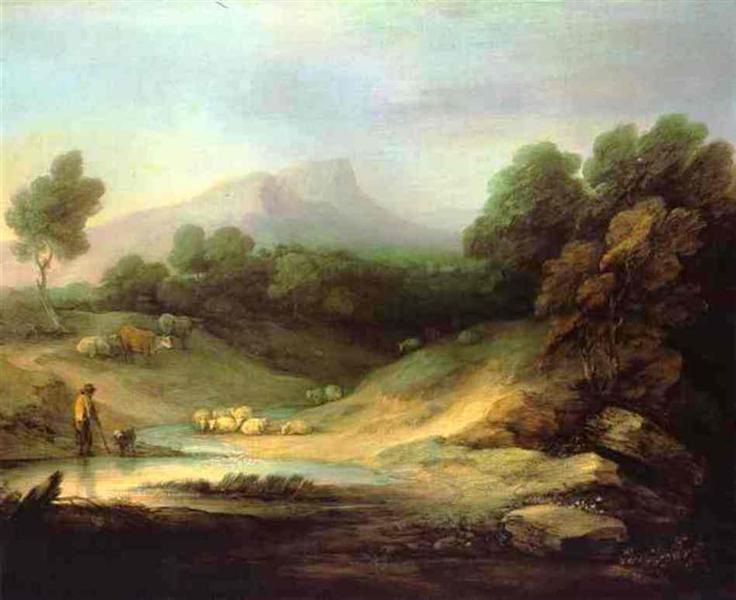
Thomas Gainsborough, 1727-88: Mountain Landscape with Shepherd, 1783.
A common theme in English landscape painting of this period in particular (though Caspar David Friedrich did something similar in some of his more bucolic, less melodramatic paintings) was nature as a realm of agriculture. Not wild country but productive land. We have it here and again in the Samuel Palmer below. I guess that it is about ownership of the land but although the owner is not identified it is clearly not the pictured peasants. It also conforms to the predominant practice of the time of being a studio piece, not painted outdoors. It is also a concoction or confection not a representation of a real place (as is also the case with the Church below). Indeed I understand it was actually painted from a model that Gainsborough constructed out of odds and ends. Why he painted it I have no idea.
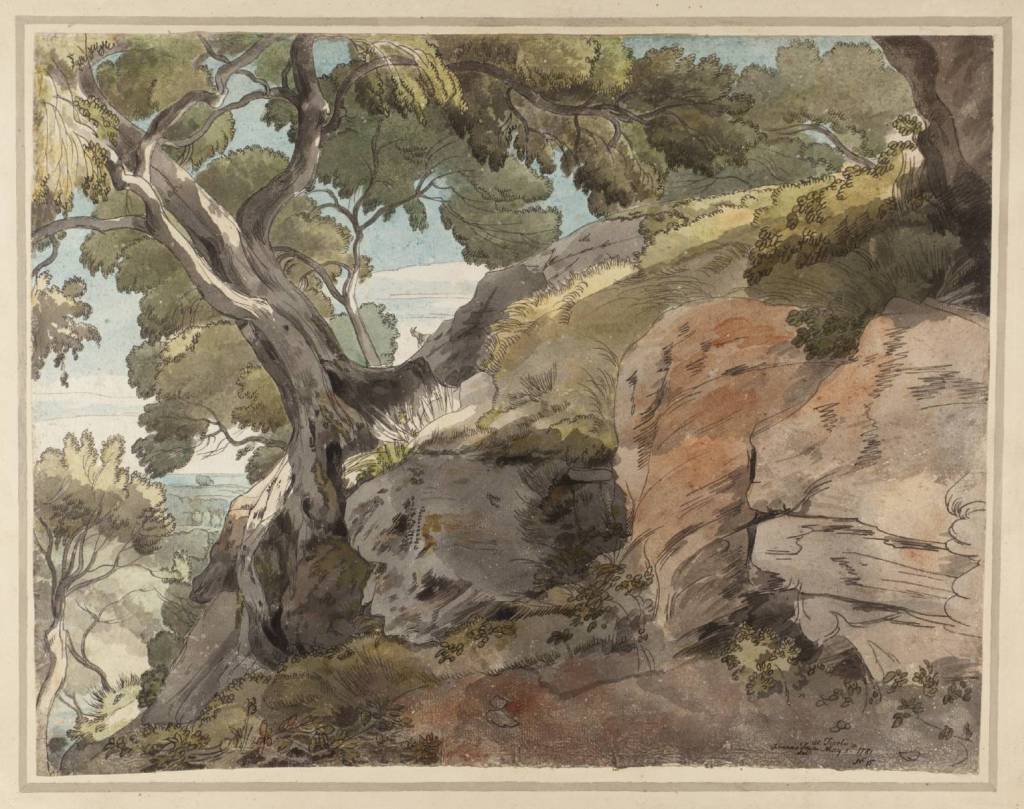
Francis Towne, 1740-1816: Rocks and Trees at Tivoli, 1781.
Painted in watercolour, in the open air, while on the Grand Tour, this was I suppose the equivalent of a modern holiday snapshot, a capturing of a picturesque scene, emphasising the wildness and ruggedness of nature even though within a broader managed and artificial environment.
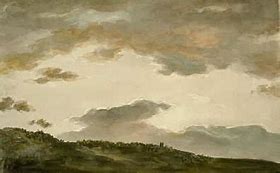
John Robert Cozens, 1752-99: The Cloud, c. 1785.
Another watercolour, again evidently painted outdoors, part of what strikes me as an important strand in landscape painting, the natural and realistic portrayal of nature and natural phenomena. Turner paid close attention to meteorology, although the ends results are more often than not rather stylised, as did Constable. Paradoxically the result is sometimes rather more abstract than purely representational.
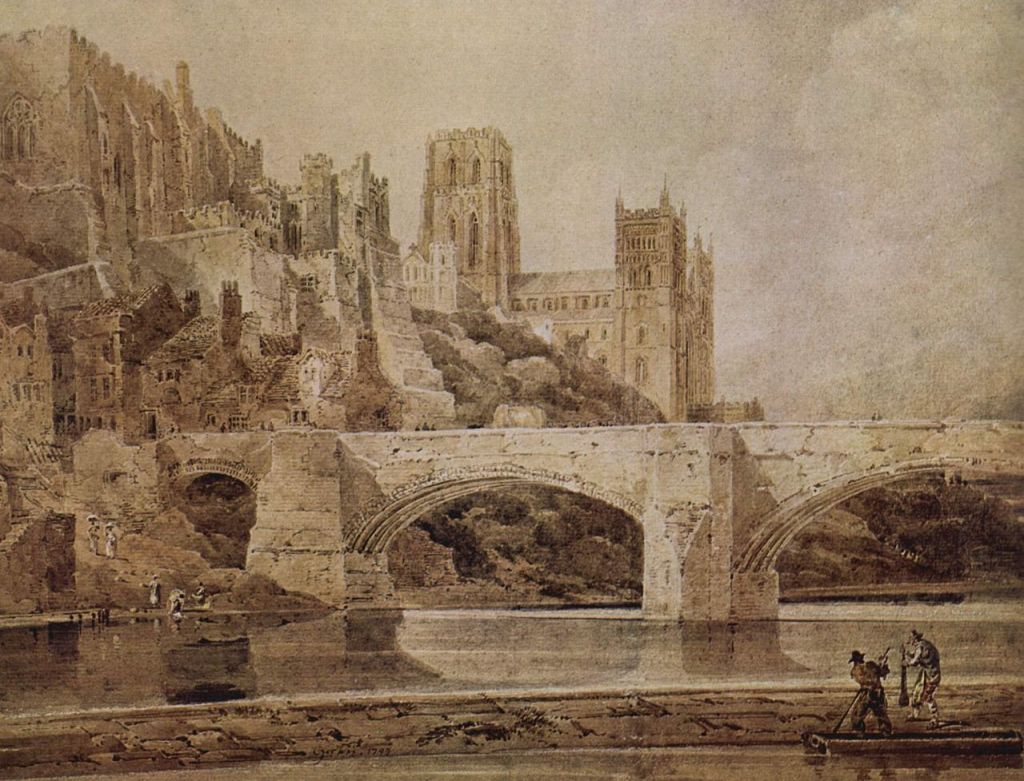
Thomas Girtin, 1775-1802: Durham Cathedral and Bridge, 1799.
Another watercolour and one in a line of what I regard as more purely topographical records. Chosen partly because I know this view very well, but also because Girtin was born locally to where I live, just a little further west along the Tyne Valley at Haydon Bridge. Rather than being an imaginative work of art this is more of a documentary record of a particular place. It also happens to be a pretty spectacular site, and sight, so is, I suppose, still conforming to ideas of the picturesque. As with many pictures from this time there are again figures in the scene. Partly they give a sense of scale. Otherwise they seem to me to emphasise a sense of separateness from the world of the cathedral and the castle and the ordinary working people. For them this is not a picturesque, tourist, place but where they live and work. (This view has not changed much at all in the last two hundred years or more!)
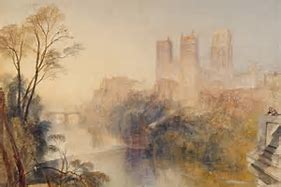
JMW Turner, 1775-1851: Durham, 1834-5.
Same subject but different viewpoint, again part of Turner’s record of his travels throughout the North. What sets this apart though is the emphasis more on atmosphere and grandeur rather than a purely representational portrayal of the place. As with a lot of Turner what takes precedence here is the effect of light and atmospherics, producing something more intentionally “beautiful”, in the sort of way that Claude Lorrain lit his work.
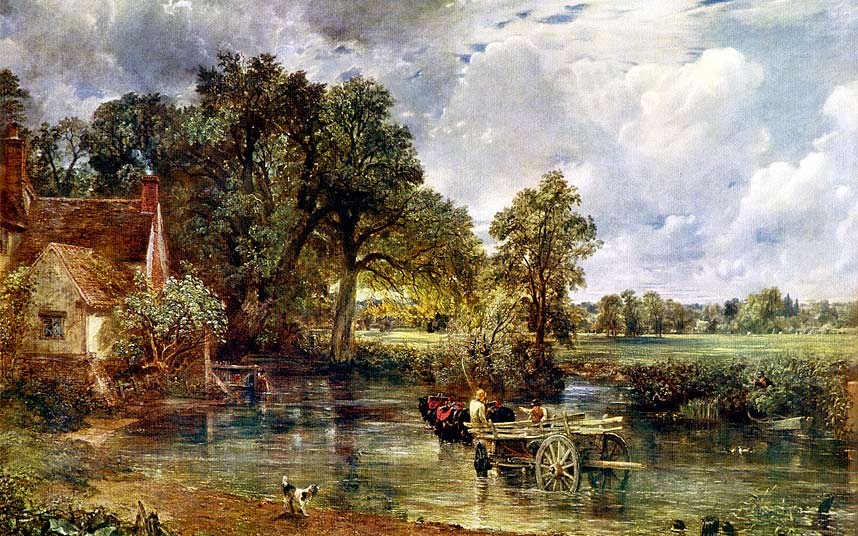
John Constable, 1776-1837: The Hay-Wain, 1821.
I guess there needs to be at least one well-known picture in this list, so this might as well be it. The significant elements for me in this are, again, observation of meteorology – I think Constable did it better in some of his cloud sketches but this nevertheless has the feel of a real sky, even though the picture was painted – constructed? – in the studio. At least though it is a view of a real place, albeit an idealised view. Once more also, there are people in the view emphasising that this is an environment that is lived in and worked; it is not raw nature but a managed, even manicured – just look at the parkland beyond the stream – landscape. But, yet again, and by no means for the last time, the lowly nature of the peasants emphasises their ties to the land without ownership of it. It is also a strangely apolitical (or perhaps not given Constable’s quite reclusive nature – “Though I am here in the midst of the world I am out of it-and am happy-and endeavour to keep myself unspoiled. I have a kingdom of my own both fertile & populous-my landscape and my children-“) and offers no hint of recognition of the dire state at the time of the English agricultural economy.
It is not really about conventions but one thing that has always puzzled me about this picture is why the wagon is moving along the stream rather than across it. Compositional impact rather than reality? Although “realistic”, in the sense of being a depiction of an actual place, this is by no means a reliable record of the actuality of rural life at the time.
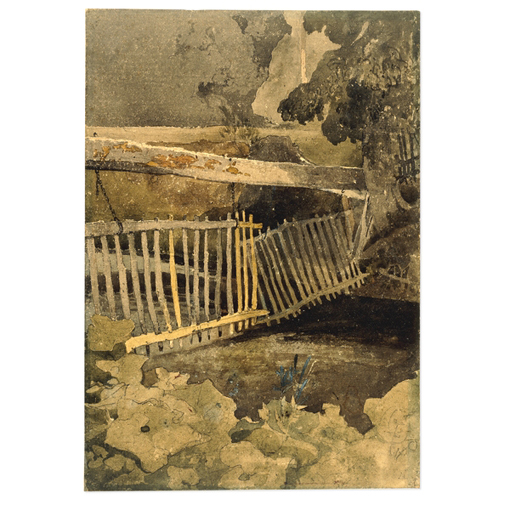
John Sell Cotman, 1782-1842: Drop Gate , Duncombe Park, 1806.
I have to confess to having chosen this picture not just because I love Cotman’s work – in the days when I struggled with watercolour myself, a much more difficult medium to use properly than any other in my view, Cotman was a continual inspiration, and indictment of my own efforts – but because of the political message that it carries and how it comes with my own thinking, and work, of late. Rather than helping form conventions, in some ways this piece subverts them. Note that it is in portrait rather than landscape orientation. This I find quite interesting. A landscape format would place more emphasis on the barrier. Adopting a portrait format gives more hints (nothing more because the rest of the picture is quite sketchy) of a sense of land that is accessible – the bottom/foreground – and what is not – the top/background. Does this, perhaps counter-intuitively, give greater emphasis to the sense of barrier and exclusion?
This is not about the land but about its ownership. You do not see the surrounding land, just the physical means by which your access to it is denied. This is “landscape with keep out sign”.
This is one image that I chose from the outset with a photographic analog in mind, which I will come back to in the next post, though I have for a practical reasons as much as anything, chosen a different format and concentration on the physicality of the barrier.
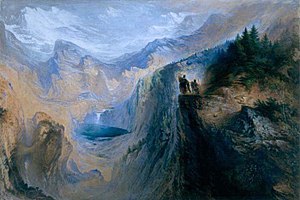
John Martin, 1789-1854: Manfred on the Jungfrau, 1837.
Another local, which is as good a reason as any for choosing Martin, though I have deliberately shied away from his more bonkers, apocalyptic, quasi-biblical extravaganzas (of which the Laing Art Gallery in Newcastle, as is fitting for a local lad, has a fine collection). This is at least a real place, though I doubt whether it is an accurate view of anywhere on the mountain and is rooted more deeply in Martin’s imagination and reading of Byron’s poem. Although not as extreme as most of the rest of his work this is, I suppose, an exercise in the Sublime, a landscape to shock and awe, that emphasises the smallness, the powerlessness and vulnerability, of humanity in the face of the enormity of the natural world.
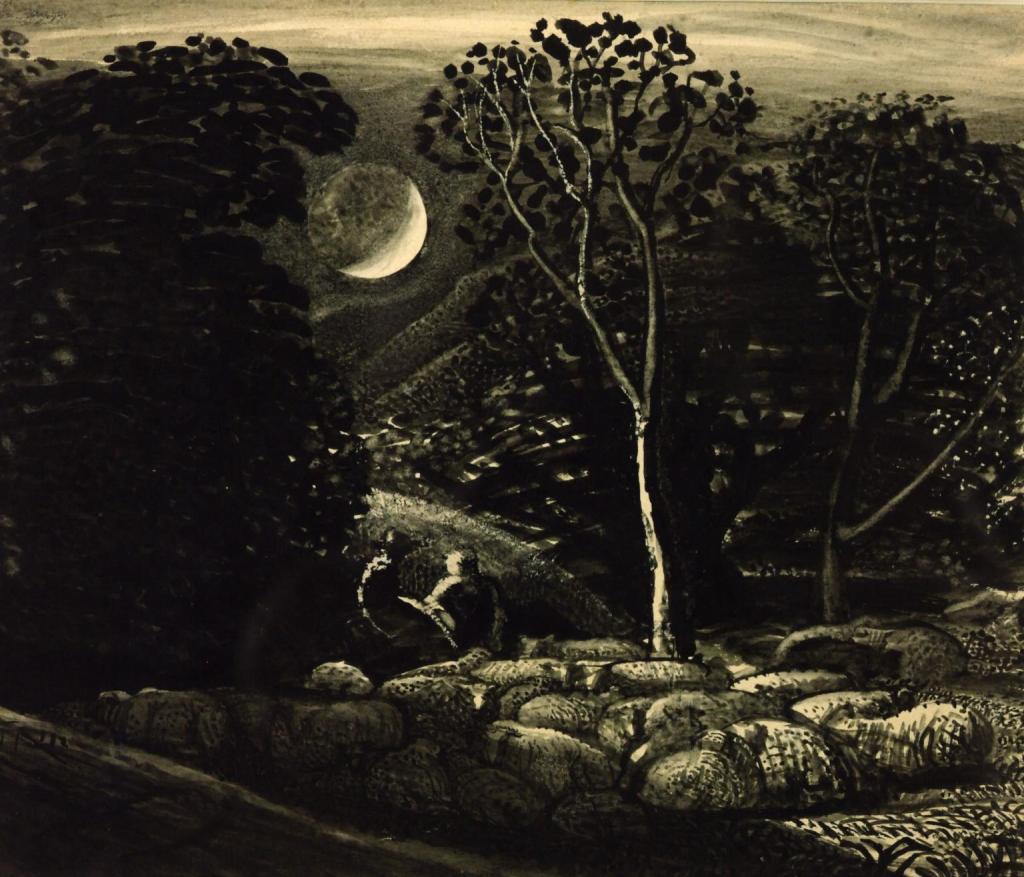
Samuel Palmer, 1805-81: Moonlight, a landscape with sheep, 1831-3.
A contrasting moment of calm and serenity, ostensibly at least, but one that carries with it other implications. In a way this is not really a landscape at all. It is not about a particular place. Indeed there is not much to be seen apart from a few trees and hints of hills in the middle distance. Rather it strikes me as more of a “nocturne”, a study of a particular time, nighttime. As with the Gainsborough at the start of this list, and various others throughout, this is more about the relationship between the countryside and the people who lived and worked upon it without owning it. Here the shepherds do not even have a shelter for the night but are sitting out in the open watching their sheep. In some ways this is, for me, quite a shocking image. The “great outdoors” is the natural environment of animals, in this case the sheep. They exist in, on, and in harmony with, the land. Humans, as we have evolved, do not. We are no longer in our element unsheltered in nature. In a way, because this is not their natural environment, the shepherds depicted here are worse off, are lower in the “natural” order of things, than the sheep.
In terms of establishing conventions I think this is a bit of an outlier. What it does do, at least, is to show that a landscape does not necessarily have to be depicted in broad daylight. I guess this is something that Monet (whom I was not otherwise going to talk about!) did with some of his “series” paintings, such as the haystacks and Rouen cathedral.
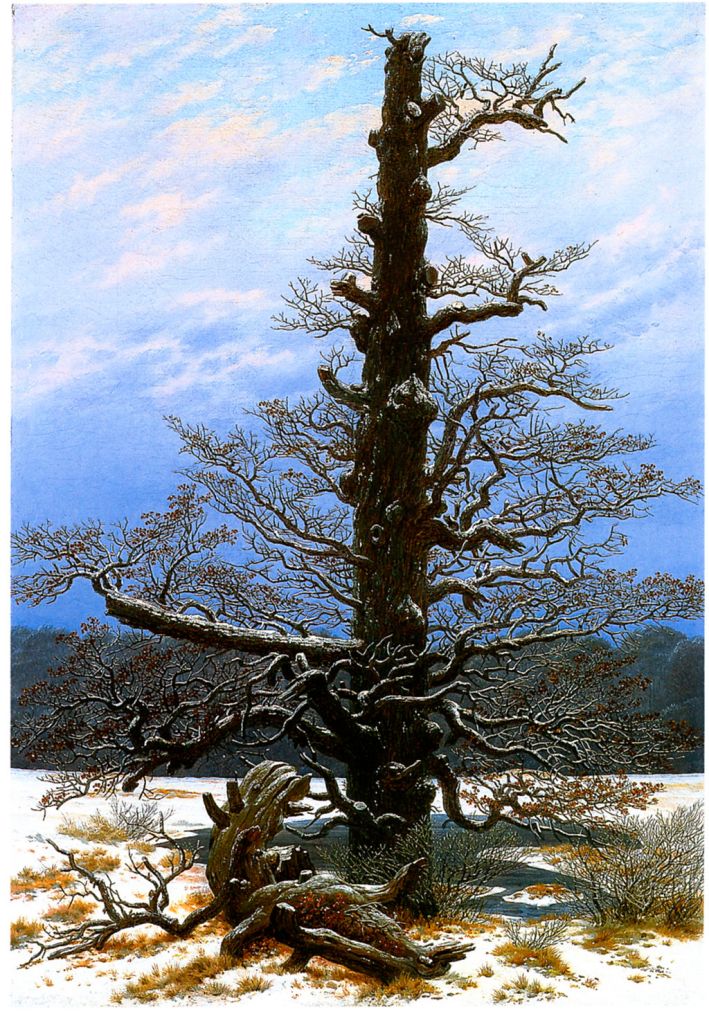
Caspar David Friedrich, 1774-1840: The Oak Tree in the Snow, 1829.
Another fairly bonkers painter (though not to the same extent as Martin) whom I guess we will look at a bit more in considering the Sublime. I have chosen this particular work because it shows how “landscape”, at least in artistic terms, can be reduced to, or more properly represented by, a single element within an environment. It is also another that I chose with a photographic analog in mind, of which more anon. Friedrich painted a number of pictures where a tree, or small group of them, are the central subject. This one though stands out as being one where the tree is the sole subject, where there is very little, if any, background. Where the tree, if it was a real tree rather than an ideal, romanticised idea of a tree, was is not important her, indeed is pretty irrelevant.
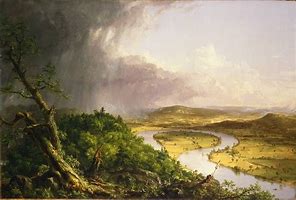
Thomas Cole, 1801-48: View from Mount Holyoke, Northampton, Massachusetts, after a Thunderstorm – The Oxbow, 1836.
These next three paintings are interesting to me because although they are of the New World, and as a result one might expect a suitably new form of representation, they are in fact quite Old World in style and composition. The Cole, with its particular sense of light, reminds me of Claude Lorrain and carries well established ideas of the picturesque, the beautiful and the sublime. There is the common trope of man taming the wilderness and making it profitable: the gentle farm land of the valley has presumably been wrested from the wilderness that still covers the hills to the left. Now though, instead of shepherds tending their sheep, we have the artist himself, towards the bottom right, taming the view. This seems to me part of the white man’s programme of colonisation of the continent.
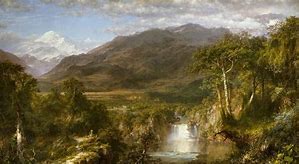
Frederic Edwin Church, 1826-1900: Heart of the Andes, 1859.
Church takes that colonisation a step further by extending it not just to the North American hinterland but to the southern continent as well. It is not very clear in this example but there is a cross and a couple of figures towards the bottom left, emphasising that this is a Christian colonisation . Again the scene itself is made up.
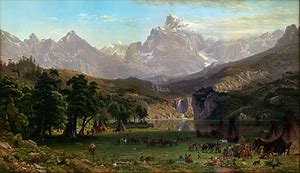
Albert Bierstadt, 1830-1902: The Rocky Mountains, Lander’s Peak, 1863.
More colonisation her, this time back in the North. Although the depiction of the native Americans in the foreground is an acknowledgement that this is their land the colonisation is already well under way as the mountain in the distance already has a white man’s name. Rather chillingly Hughes (1997) (at page 195) quotes Bierstadt as saying that one day in the foreground of this scene “a city, populated by our descendants, may rise and in its art galleries this picture may eventually find its resting place”.
These three paintings also have in common that they were commercial, money making enterprises, painted on a grand scale and toured and exhibited by the artists, another way of making the landscape productive and profitable, without the necessity of sheep.
So far as I can tell, none of the pictures in my list above were the subject of commissions. I do not doubt though, particularly in the case of the Americans, that they all had a shrewd idea of what was likely to sell (except for the Cotman and Towne perhaps, and maybe the Palmer, as these seem to me much more personal works).
Next I will have a look at some photographs that were influenced by these painterly conventions.
Andrews, M, (1999). Landscape and Western Art. Oxford: Oxford University Press
Hooker, D, (ed), (1989). Art of the Western World. London: Boxtree
Hughes, R, (1997). American Visions. London: The Harvill Press
Lyles, A, & Hamlin, R, (1997). British Watercolours from the Oppé Collection. London: Tate Gallery Publishing
A quick note on the work of Justin Partyka who is mentioned in this section, and some general thoughts on pictorials generally.
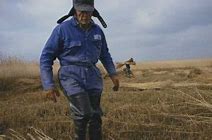
It is only when looking at Partyka’s website that I realise I have seen his work before. Rather annoyingly though I cannot remember where. It is not in any of the books in my library and I cannot see that he has appeared in the BJP recently, so where I have seen his work – a photograph of a man in blue overalls and waders working in a reed bed is especially familiar (this is unfortunately not a very good copy) – remains a mystery:
Why he is mentioned in this section on pictirialism is a bit of a puzzle as it seems to me his work is the very antithesis of pictorials, which is indeed one of the very reasons why I find his work so interesting. As I have already commented I do not find the singular-image tradition at all appealing. This work engages because it is about more than just the view. It is landscape photography, in so far as the environment and topography are important, but it is also documentary, portraiture, social comment. That is what interests me.
I did some time ago have a look at some of my local camera clubs to see if any might be worth joining. I decided not to follow up with any of them precisely because there is such an emphasis on the singular-image rather than any deeper engagement with the subject matter. I did briefly associate with a less formal local group who have weekly jaunts to local places of interest. Again though the emphasis was more on finding a picturesque view or subject and producing single images that were all too often over-processed in Photoshop or Lightroom, including over-use of the dreaded HDR. I found it all too unfocused and unstructured.
That said, one artist mentioned in this section who tends to work with single images whom I do find interesting is Jeff Wall. At one level I suppose his work can be seen as conforming to some of the norms of pictorials but I think he goes much further than that, creating much more interesting narratives and engaging with more than just a faithful reproduction of a given landscape or location.
During an introductory chat with my new tutor, in response to my first post on this exercise, he mentioned an article that appeared in the Daily Telegraph (no, not my favourite newspaper either!) on some interesting symbolism within Gainsborough’s portrait/landscape. See the link below.
I have never seen this painting in the flesh, nor a sufficiently high quality version in a book or on the internet to be able adequately to pick out these details. I have until now been unaware that the animals in the background are donkeys – I had assumed they were horses. Nor could I see properly what is in Mrs Andrews’s lap.
With this new insight I feel all the more comfortable with my views on what pictorial depictions of landscapes can mean and amount to. To the various other categories or genres that I have already mentioned I would now add satire and straightforward insult, a slap in the face with a piece of metaphorical wet fish. I love the idea of a grand gesture in the form of a painting also being a more intimate and personal gesture of the two-fingered variety. As a result the painting appeals to my personal and political sentiments and leanings on questions of property and land ownership even more! It certainly made this crusty old Leveller and Digger laugh out loud.
Some quotations/paraphases to identify her argument as it is developed, and some additional observations and comments of my own.
Of the two versions of O’Sullivan’s image, they belong to two separate domains of culture. The lithograph belongs to the discourse of empirical science – presumably the museum of the title. The photograph operates within the aesthetic discourse – the space of exhibition.
The space of exhibition was constituted in part by the continuous surface of wall. The gallery wall became the signifier of inclusion. Ipso facto if a photograph was hung on a gallery wall it became art?
The gallery wall can be seen as constituting in itself a representation of “exhibitionality”. Horrible argument based on a made up word! This smacks too much for me of sterile theory and, frankly, art-bollocks. I certainly do not feel it usefully adds to or advances the argument. In any event, even assuming that there is some validity in the argument (on which I have no more to say for the time being), I struggle to see how it can properly apply today. The dominant mode of displaying and viewing photographs is not now the exhibition. Rather it seems to me it is the internet: Instagram, Flickr, individual photographer’s websites, and so on; and books and zines. Increasingly photographs are not viewed in a public space but, as with the stereographs, in a private domain, albeit not one entirely free from distractions. An argument that suggests a photograph is art because it is displayed in a gallery setting does not really work when the photo is not so displayed and, what is more, when in the domain of the internet it does not for the viewer, and might not anywhere, have any physical existence (if for example the photographer has not printed it). Whilst the argument might have had some validity in 1982 I certainly do not see that it works today, is outdated and simply too narrow.
Landscape (in the sense of landscape painting?) transformed into a flattened and compressed experience of space, voiding perspective, a single painting becoming a representation of the very space of exhibition. serial landscapes mimed the horizontal extension of the wall or expanded to become the absolute size of the wall, synonymy of landscape (the painting) and wall. This constitution of the work of art as a representation of its own space of exhibition is what we know as the history of modernism.
Within what discursive space does the original O’Sullivan function? The aesthetic discourse and it is itself a representation of the plane of exhibition. Is this a retrospective construction designed to secure it as art? For my part I find it hard to escape that conclusion. The modernist argument (if Krauss’s formulation is correct, something I cannot comment on at the moment) makes the work of art something of a solipsism, arguably not itself a work of art. I really struggle with that.
Referring to Galassi: “The object here is to show that photography was not a bastard left by science on the doorstep of art, but a legitimate child of the Western pictorial tradition.” The perspective so prominent in 19th century outdoor photography (“analytic”) was fully developed within the discipline of painting. Therefore, photography is not simply the child of technical rather than aesthetic traditions. Viewing the evidence on the gallery wall we have no doubt Art (capital A!) was intended and represented in the painterly analytic perspective.
Doubt is then cast on this by a discussion of stereoscopy and the difference between landscape and view, the latter term most often being used by photographers; questions of “authorship” and copyright – mostly vested in the publisher rather than the photographer; and modes of viewing – private and cut off from other visual stimuli as opposed to pictures hung in a gallery – and modes of storage – cabinets rather than open walls. More consistent with the museum than the gallery.
This argument is developed by a consideration of the work of Atget, with a discussion of what constitutes an artist and, particularly, that artist’s oeuvre, concluding in Atet’s case that his work amounts not to an oeuvre but to a catalogue. HIs work is not art belonging in the gallery, but a number of typologies that are more at home in the museum.
There is a passing mention of the selective roles that are played by archives. A more interesting an informative, possibly simply because it is the primary subject of the article, I think is Theopisti Stylianou-Lambert’s “Photographic Ecosystems and Archives” which shows how different meanings, values, can be assigned to material within an archive depending upon how it is arranged, presented, chosen, by whom, and for what purpose.
Ultimately the thrust of Krauss’s argument is that early landscape photography belongs in the archive, in the museum, rather than the gallery, and that there is a continuing effort to dismantle the archive and to reconstitute the work as art, on a par with landscape painting.
A general observation: I find this sort of debate about whether or not photography – in its broadest sense, not just in the limited context of portrayals of landscape – is art or not pretty sterile and largely unhelpful, at least so far as developing my own work and voice is concerned. It is interesting, I suppose, from an historical point of view but I do not find it practically helpful now. Take for example the work of the Bechers: at one level it can be seen as purely typological, a catalogue of examples of particular subjects, but at the same time it is art because of the intentions of the makers, the way the work is organised and presented, and so on. It is both, though not necessarily at the same time, in the same place, or for the same people or purposes. It also serves to maintain my general mistrust of and impatience with “theory”, particularly that of modernist theorist who write ad nauseam about the medium while in the process holding it in low regard and often attacking it in sometimes strangely intemperate terms. I have commented on theory before and am not going to repeat myself here!
One last point. The course book refers to a “rebuff” – presumably a rebuttal or a riposte rather than a brushing off – of Krauss’s argument by Tod Papageorge. Whilst his book of essays is mentioned the particular one (or more?) that deals with this is not cited. Unfortunately it appears that this book is currently out of print. It is available second-hand but only at prices that are very significantly in excess of the original cover price – not everyone can afford to be laying out substantial amounts of money in this way to address what might actually be quite a peripheral point. It does not appear in the UCA on-line library. For the time bing therefore I am going to have to pass on this source.
Do I have any preconceptions about what “landscape” means in terms of art? Probably, possibly even inevitably, up to a point. However after a lifetime of looking at art, in the broadest sense, in galleries, books, magazines, and doing a bit of practising on the side for my own part, generally I try to see categories as being fairly malleable, flexible, and not prescriptive.
Any given image is potentially capable of being “filed” under a number of different categories: landscape, documentary, socially engaged, post-photography, narrative/historical, allegorical, even portraiture. In this latter regard I think in particular of some of Elina Brotherus’s work were she is the subject of a self-portrait, often with her back to the camera, but posed within a landscape. The painting that I have chosen as the starting point for my sketch, of which more below, is similarly both a landscape and a portrait.
The genre is not just about pretty pictures and impressive views. I admire and can see the greatness in the work of classical painters such as Claude Lorrain, John Constable, JMW Turner (who regarded Lorrain as a genius), but luminous sunsets, bucolic scenes, dramatic light and storms, are not enough for me if the picture is not saying something more profound.
Nor do I think it is limited by scale. A patch of pavement can just as easily be a landscape, albeit perhaps at a micro level, just as much as a mountain range or an ocean at the macro.
Funnily enough I was going to include in that very short, highly exclusive, and it must be admitted wholly partisan, list, a few American painters of monumental landscapes (both the land itself but also the sheer scale of some of the paintings themselves), particular Albert Bierstadt, Thomas Moran, and Thomas Cole, whose works I first got to know on visits to New York and Boston in particular. However, I have gone back to look again at some of their pictures and am stuck by how much there are other narratives at play in their work – the role and place of mankind in the environment, and most vexedly questions of ownership and belonging. Even when the ostensible subject is just the monumental view, there are often figures introduced who help not simply to define the scale of the scene but also raise questions about the relationships between man and land. (Are we going to look at more of this sort of thing when we get to Martha Sandweiss’s book, dealing as it does specifically with the American West?)
Generally speaking what I might term pure landscape work (whether painting or photography) that does not have some deeper significance beyond simply recording the view, leaves me cold. What is allegedly the most photographed tree in Britain is not far from where I live, at Sycamore Gap (guess what species of tree it is) on Hadrian’s Wall. Yes it is pretty, and the physical setting is quite striking, but it does not say much and there are so many banal images of it out there that it has become little more than a cliche, Instagram fodder. That is not the sort of representation of any landscape that interests or inspires me.
Looking at my own modest, but growing, collection of photographic prints I have few “pure” landscape pictures, mostly by the Canadian artist Mark Brennan who has been documenting the coastline of Nova Scotia in his Almost an Island series. What appeals to me about this work, notwithstanding that it does not ostensibly do anything more than record the “view” is that it does at a deeper level carry other messages: about the physical nature of the environment, its vulnerability, the effects of climate change, for example.
I have otherwise been sent back to think about the work of other artists, particularly those whose books I have bought of late and who have had, in varying degrees, influence on some of the work that I have done for I&P. The landscape, the place, the environment has been a major feature in much of it, but not simply as a view. Rather questions of identity, belonging, the effect of man on the environment, and vice versa, ideas of home and ownership have all been there. Indeed it has to an extent only been now that I have started to think about them as landscape work, rather than for example simply documentary or socially engaged, or indeed portaiture. Some examples: Maja Daniels in Elf Dalia, the Wagners in Kleinstadt, Rinko Kawauchi and her landscape pictures inspired by peoples’ stories and recollections in ‘The river embraced me’, Eiji Ohashi and his vending machines, Matthew Genitempo, Alec Soth on the Mississippi, Toshiya Murakoshi in Tohoku, Fay Godwin, Guido Guidi on his home turf and in Sardegna, Ekaterina Vasilyeva’s St. Petersburg, Stephen Shore’s Uncommon Places.
Hiroshi Sugimoto’s Seascapes perhaps stand apart from this crowd as they are just that, seascapes. I cannot help loving this work as it is so striking and impressive, impressive, particularly when seen in the flesh as some of the original prints are quite big.
What surprised me a bit, as I have written in my I&P blog, is how certain political ideas have found their way into the landscape work that I did their, exemplified particularly by the series I shot for the fifth assignment on the idea of home as somewhere exclusive and exclusionary.
Which, I suppose, brings me to the question why I decided to choose this course next. Partly it is because of that growing awareness and a desire to explore and develop some of those ideas further. It also seems to me to offer an opportunity to do much more than take pictures of views, to introduce and explore other “genres”, not least documentary and portraiture. Already I have started to off-piste from the recommended reading list and, predictably, have gone back to John Berger. There is an apt quotation from his book A Fortunate Man in Landscapes (2016) (at page xiii):
“Sometimes a landscape seems to be less a setting for the life of its inhabitants than a curtain behind which their struggles, achievements and accidents take place. For those who, with the inhabitants, are behind the curtain, landmarks are no longer only geographical but also biographical and personal.”
It might not appear very important at the moment but one thing that I can see this course is going to do is make me reassess my view of Ansel Adams, whom I see we will be looking at more systematically anon. At one level his work, which I certainly admire, might be seen to do little more than record the view (and mess with the mind a bit with the almost hallucinatory effects he sometimes achieved with his long exposures and extreme depth of field which does funny things to a sense of physical scale). It will be interesting though to think a bit more deeply about what else is going on in his work, and indeed whether a purely pictorial approach is actually ok after all.
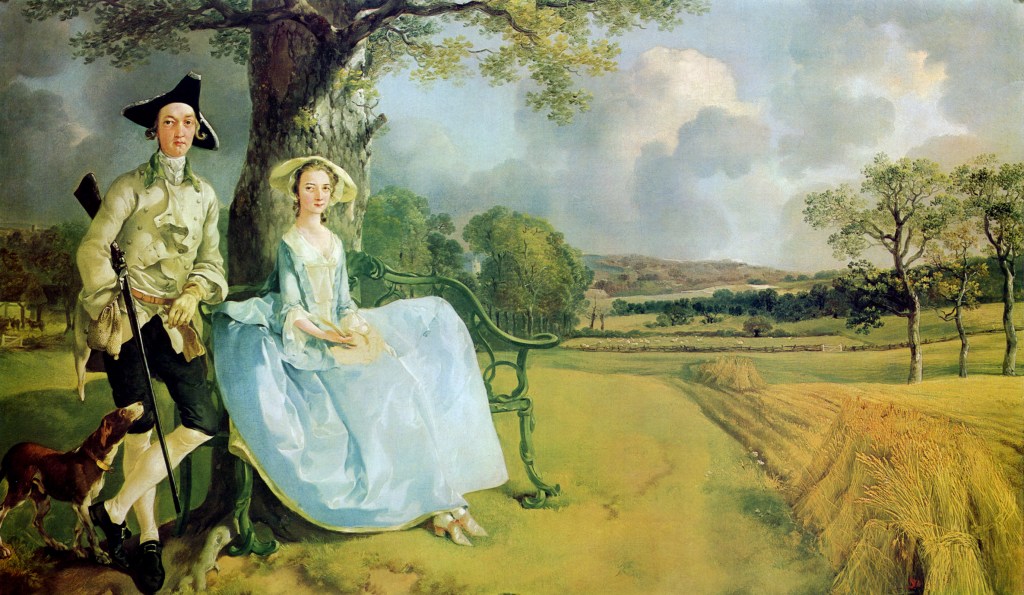
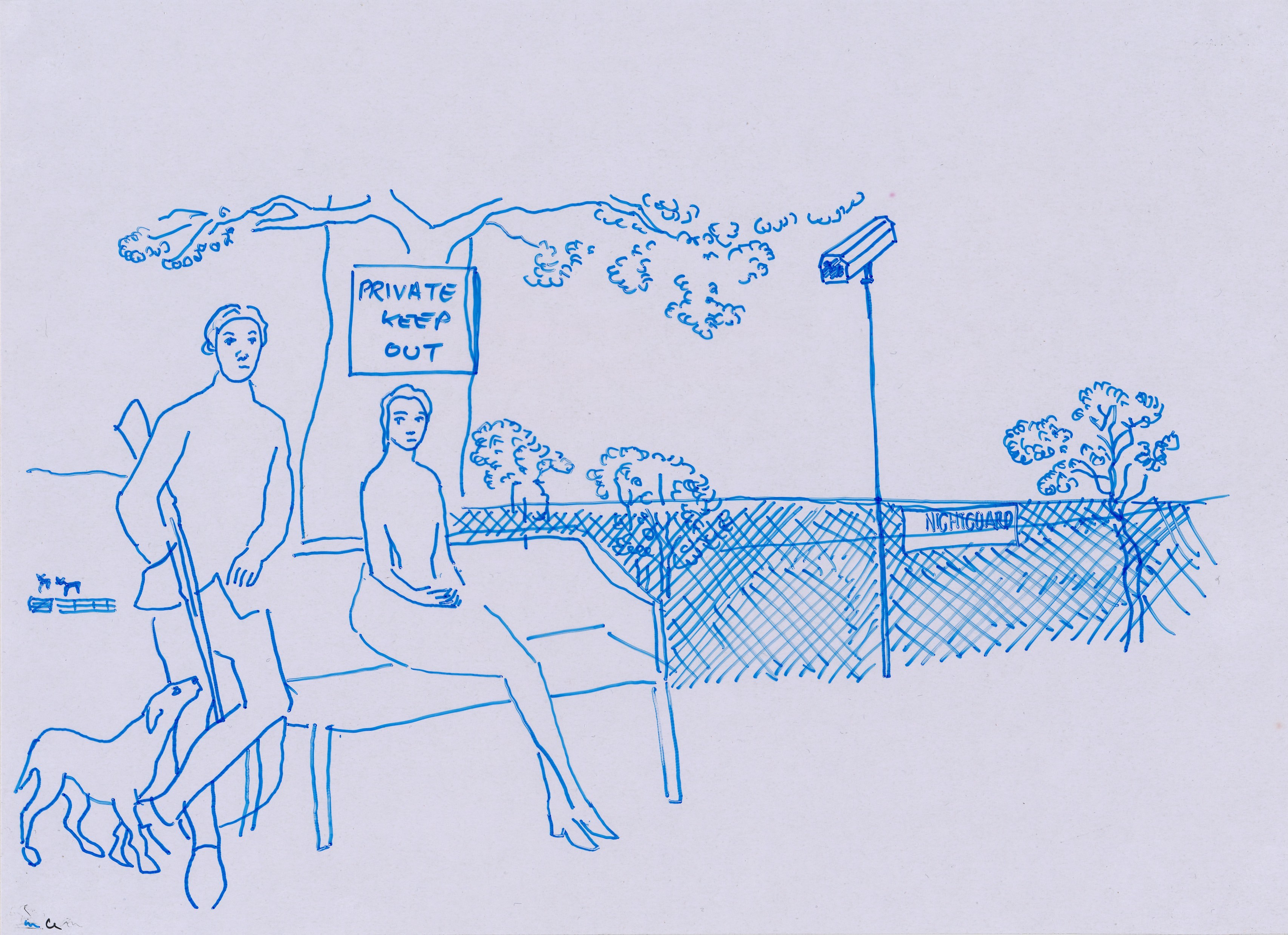
So to my “sketch”. I have taken for this as my starting point Gainsborough’s Mr & Mrs Andrews.
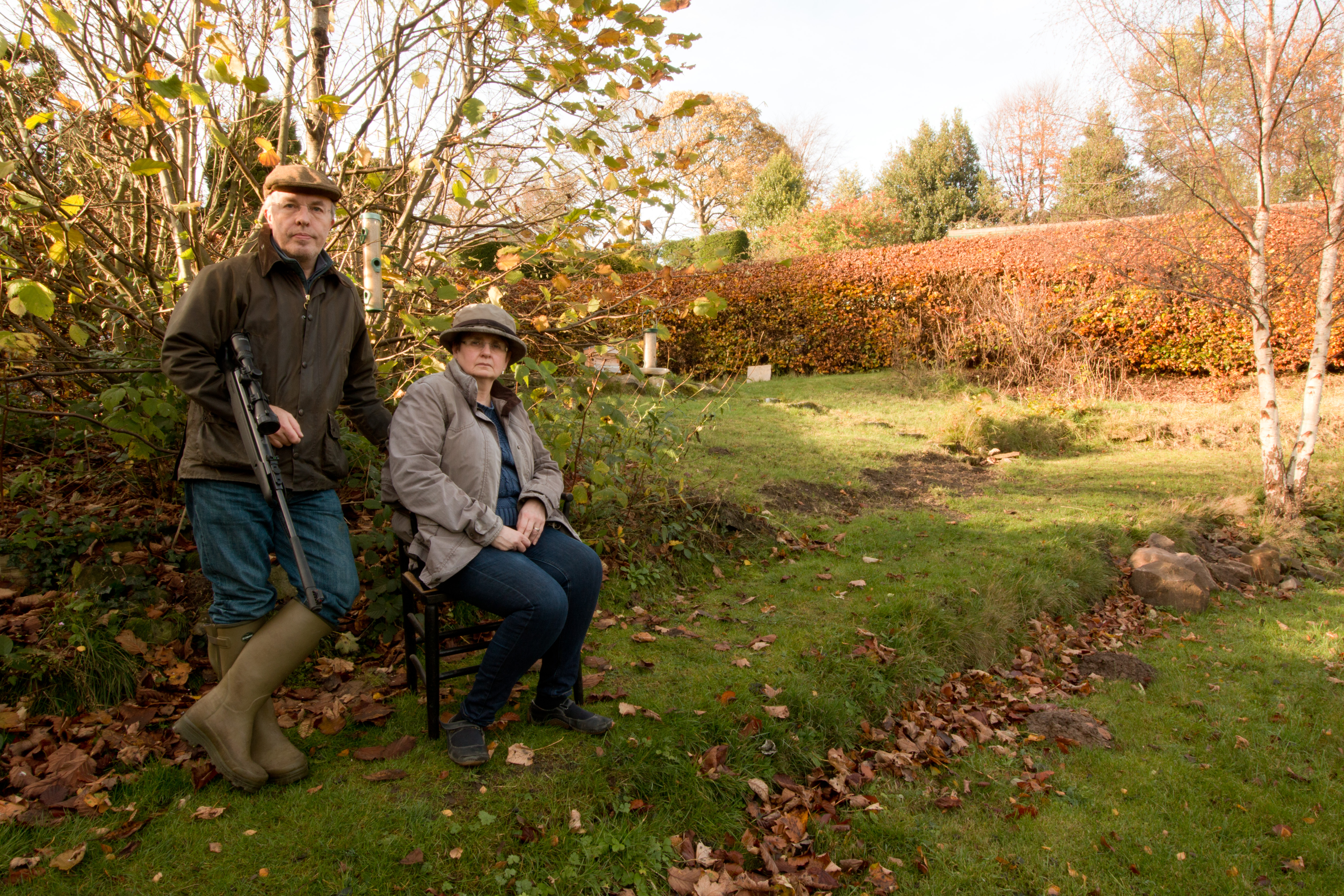
I actually first looked more closely at this painting when working on a previous (pre-OCA) course and played around with an homage to it, creating an updated version of it, a first exploration of the theme of ownership of property. (This was taken shortly before we got our current dog, otherwise he would have been in the picture as well, sitting at my feet!)
I was already thinking about this painting as an inspiration before I started to read Berger again and was then reminded that he explored it in Ways of Seeing (1972). Again it is worth quoting him as he speaks so well to my own developing thoughts (at page 108):
“Of course it is very possible that Mr and Mrs Andrews were engaged in the philosophic enjoyment of unperverted Nature. But this in no way precluded them from being at the same time proud landowners. In most cases the possession of private land was the precondition for such philosophic enjoyment – which was not uncommon among the landed gentry. Their enjoyment of ‘uncorrupted and unperverted nature’ did not, however, usually include the nature of other men. The sentence of poaching at that time was deportation. If a man stole a potato he risked a public whipping ordered by the magistrate who would be a landowner. There were very strict property limits to what was considered natural.”
By the way, I do not accept the idea that they were enjoying “uncorrupted and unperverted nature” as Professor Gowing maintained in his argument with Berger. This is a carefully managed and controlled landscape, one that was no doubt fashioned and sculpted to some extent to “improve the view” and create an artificial, and artful, impression of “nature”. At the very least it has been altered, and managed, by agriculture.
Another bit of coincidence is that I was already thinking of incorporating an element of “Private – Keep Out” before I read that when the original television version of Ways of Seeing was broadcast the producer put just such a sign on the tree in the painting.
For this I have also drawn on one of Fay Godwin’s pictures (“Nightguard, Stonehenge, 1988”) and added some other elements of my own.
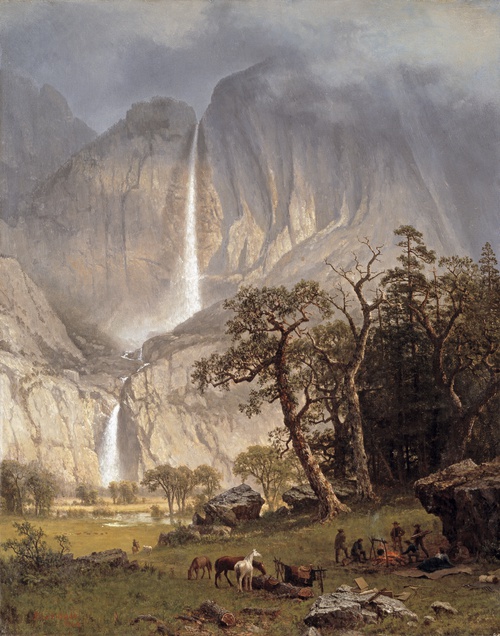
Shape? Naturally, landscape format. I say “naturally”, almost tongue in cheek but really I do not think the image would work in quite the way I intend (nor indeed as Gainsborough no doubt intended) had a portrait format been used. That though does not mean to say that a different aspect ratio, a portrait format, might also suit a landscape picture. Here I think of one of Bierstadt’s paintings that has a distinct portrait alignment because it suits his subject, the physical height of a waterfall (Cho-looke in Yosemite). Here verticality is the important point rather than, for Gainsborough the emphasis on the extensive nature of the Andrews’s property, and in my sketch, the sense of barrier and exclusion. (Note the inclusion of people to at the very least give a sense of scale.)
Terrain? Rural. No buildings (significantly as I suggest below), hints of countryside and farm animals in the distance on the left edge.
What is in it? Landowners, their dog, a gun, a fence with indications of security, an unmistakable sign, a surveillance camera.
How are the subjects arranged? Most importantly for me the composition is spread across the picture plane so that it by itself acts as a barrier. We cannot see what lies behind, apart from hints of trees and animals in the distance. Significantly, at least in light of the work I did for Assignment 5 of I&P, it is not possible to see the house. (https://wordpress.com/post/markrobinsonocablog3ip.wordpress.com/1033)
Mood? Menacing, defensive, unwelcoming. There is though a sense of comfort, ease, even nonchalance about the figures, which I had not realised was there in the original Gainsborough painting until I looked at it again, indeed even smugness. Without necessarily having deliberately composed the sketch in this way with this in mind, the landowners are outside their barrier, acting as if guards. They seem at ease, almost daring the viewer to try to cross the threshold of the picture into their private domain, knowing that they have back-up (Nightguard Security) and main-force in the form of a gun and a dog. I find that all strangely and unexpectedly disturbing.
Berger, J, (2016). Landscapes: John Berger on Art. London: Verso
Berger, J, (1972). Ways of Seeing. London: Penguin
Daniels, M, (2019). Elf Dalia. London: MACK
Genitempo, M. (2018). Jasper. Santa Fe: Twin Palms Publishers
Godwin, F, (2001). Landmarks. Stockport: Dewi Lewis Publishing
Guidi, G, (2019). In Sardegna: 1974, 2011. London: MACK
Guidi, G, (2018). Per Strada. London: MACK
Kawauchi, R, (2016). The river embraced me. Tokyo: torch press
Mahler, U, & Mahler, W, 2018. Kleinstadt. Stuttgart: Hartmann Books
Murakoshi, T, (2018). An Eventual Saturation. Tokyo: Case Publishing
Ohashi, E, (2017). Being There. Tokyo: Case Publishing
Ohashi, E, (2017). Roadside Lights. Tokyo: Zen Foto Gallery
 Mark Robinson's OCA Landscape, Place & Environment Blog