The brief for this exercise says that it is not necessary to make any preparations but it is inevitable that I have at least been thinking about what I am going to do, and why. What I have decided to do follows on from a couple of ideas that I explored in I&P, thinking about the Georges Perec exercise, typologies (the Bechers), and Assignment 5.
With that background what I have firstly decided to do is focus only on a relatively short stretch of the road on which I live, about 200 metres out of a total length of roughly a kilometre, from the dead end at the top of the little cliff above the burn, to the first crossroad. Because this is where I live this is the stretch that I know best, not least because of the number of times I walk it with my dog. It also defines something of a distinctive enclave within the village as a whole comprising, as it does, three of the four oldest buildings in the village (350 plus years old, of which mine is one – there are few houses in most of the village that are much more than 120 years old), and includes a locally well known, and quite picturesque, but unusual, terrace of five former farm workers’ cottages.
Before I get down to actually taking pictures I first want to start with a little exercise in the style of Perec simply listing some of this small area’s characteristics, some of which have turned out to be a bit of a surprise:
Length of road: 200 metres.
Number of houses: 14 (of which one is unoccupied). Oldest, pre-1670. Newest, 2005.
Number of residents: 26 adults, 3 children.
12 retired people (comprising 2 former lawyers, 1 psychiatrist, 1 architect, 2 engineers, 1 cancer nurse, 5 unknown). 2 teachers. 1 lawyer. 2 care workers. 2 airline employees. 1 decorator. 1 dog walker/trainer. 1 full-time mother. 1 supermarket manager. 3 unknown.
There is so much material packed into this little corner of the course that there is almost too much to respond to adequately so, having concentrated for now just on Alec Soth, I will pay a little attention, just a few brief notes, to the works of Nadav Kander and Paul Graham that are also referred to. I find these two particularly interesting because of the very different ways they approach the photographing of a particular geographical line through both time and space.
Until now I have tended to think of Kander more as a portrait artist so it has been interesting to look at this more topographical work along the Yangtze River, not least just because of the sheer scale of the project.
This is in many ways quite a literal depiction of the river. It is there, or not far off, in most of the images. The series leaves you in no doubt that it is about following a specific route. Soth’s work on the other hand is I think rather more impressionistic and discursive (which is part of its charm for me). We see little of the river. It is not always evident that there is a river nearby in many of the shots. Were it not for the captions we would not know. More attention if focused on people, and places peripheral to the river itself, although no doubt in many ways shaped, informed, and affected by it. What they both do though is show the impact of human intervention on the landscapes defined by these river-sources. Soth does this, I might say, more benignly and less judgmentally than Kander who does not spare us the naked truth of the appalling environmental impact of people. If nothing else Kander has just put China even more firmly on my list of countries that I do NOT want to visit!
Graham’s work is similarly impressionistic in so far as the road itself does not appear directly a great deal. Again he is more concerned with the people encountered along it and places either side of it. The environmental issues are still there but they are not as ‘in your face’. What I find most striking though is what comes across to me as his sympathy for the people he encountered. He does not come across as judgmental and is much more respectful than, for example, I would expect someone like Martin Parr to be if he photographed a similar project. In a way it is quite a gentle work.
It is also interesting from the point of view of how the road has changed over the years. More of it has become multilane since the 1980s, much elevated to motorway status, and is of course very much busier. Not long after Graham made this work, just two years later, I used the A1 a lot once I had moved from London to the North East and I still remember how quiet (apart from a few notorious bottle-necks) certain stretches could be. Odd as it might sound – we are dealing here with a busy and far from attractive road that is really quite boring to drive along – this work evokes in me a strange sense of nostalgia.
Perhaps I will reflect a bit more on other work, or indeed the same stuff, as I start to work on the next exercise, once I have formed some idea of how I actually want to approach it.
A bit of a ramble, not so much a defined journey from A to B, with some observations along the way…
The idea of a landscape as a number of linked (though not necessarily physically or geographically) locations or places has been with me for a long time and indeed formed the very first assignment I did for this course, EYV’s Square Mile – a series of images showing a walk I do, with variations, almost every day with my dog.
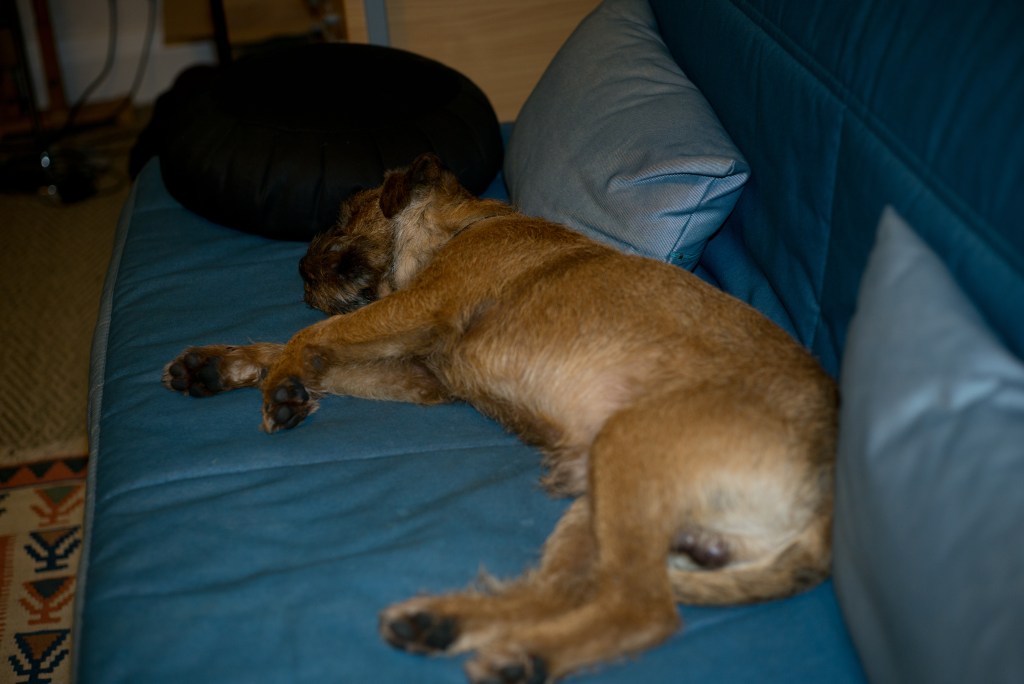
(As an aside, here he is fast asleep on the sofa-bed in my study as I write this, tired out from a walk on that very route.
Admittedly a bit of an indulgence but not entirely inappropriate given the title of Soth’s book, though for us it would be more a case of “Sleeping by the Stocksfield Burn”. It does not have quite the same sense of scale and grandeur, does it? Anyway, I just felt like including it! It is about time the wee man makes an appearance. There is though nevertheless a serious point embedded in the use of this picture about how we interact with and are affected by landscape, the environment in which we I’ve and through which we move. In this case the landscape has simply tired out my dog!)
Alec Soth’s book is also one of my favourites. Oddly though I have not looked at it critically for a while, despite having referred to it a number of times while working on I&P (I think at the time I was probably more engaged by the more recent work of Matthew Genitempo). So it has been quite refreshing to come back to Soth and look at his work more closely again in the light of the article refered to in the course material.
So far as the book itself is concerned, one of the first things that strikes me, again, is the sharpness, the detail, the depth of field, that he achieves. This is no doubt a result of the use of a large format film camera (I understand he uses a 8×10), something that I have experienced myself with my 4×5. I am not quite sure why but it seems to me that this sort of effect is not so easily achieved with a digital camera, but it is one of the reasons why I keep coming back to film; 35mm, medium 120, and 4×5 large format. The other thing that I get this time round (no doubt the next time I go through it again it will be something different) is the sequencing of the images. Although the book is ostensibly record of a journey (or series of journeys) along the river it is not entirely sequential. There are diversions and on occasions it doubles-back on itself: just like the river itself. This question of sequencing, which I feel is what sets apart the best photo-books, is something that Soth addresses in the interview.
Turning to the interview in the link below (doesn’t the interviewer talk too much and ask over-elaborate questions!) there are a few points that I would like to reflect upon, not necessarily all related specifically to landscape photography. Almost random but all nevertheless personally important to me.
“The lesson I learned is that great pictures are all about luck, and anyone can take a great picture. But very, very few people can put together a great collection of pictures … the art, for me, is in the collection and interplay of images.”
This resonates very strongly with me. I am not, as will be apparent from other blog posts, a fan of the ‘salon’ approach to photography, the individual image, no matter how arresting or striking. Much more interesting for me is the sequence that builds and carries meaning and significance, that contains or creates some sort of narrative of its own. That does not though necessarily mean that there needs to be a clear narrative thread, that the sequence of images needs to have been created specifically with that in mind. I think here in particular of the work of Rinko Kawauchi whose genius, it seems to me, rests in her ability to bring together otherwise unrelated images, sometimes made over not inconsiderable periods of time, and find resonances, connections, coincidences, and combined meanings and significances within them when they are brought together.
Speaking of his project to record a version of the river: “… but I was shaping my own river. This is what photographers usually do, right? They create their own vision. I’d love to see how other photographers would approach the river. I’m quite certain that each approach would be entirely unique.”
Something else that speaks clearly to me and one of the reasons I get so annoyed, or more to the point, simply bored by the repeated, hackneyed images of the same things, the same places – whatever is fashionable or trending on Instagram or Flickr – the same view, from the same viewpoint, that says nothing about the photographer and what this place actually means to them (not much in most cases, I suspect). I would rather take a picture that is not that good so long as it actually means something to me, and possibly to some other hapless soul who happens to come across it and find something in it of interest.
Referring to Joel Sternfeld, whose work I am afraid I am by no means familiar with enough, yet: “He showed me that this life of serious looking was possible.” That is surely what photography is really about; not taking pictures alone but observing the world, attentively, critically, mindfully, and then choosing to record some element of that. Although not by any means a fan of the idea of the Decisive Moment I am very much in agreement with HCB’s view that this business is, at root, all about looking.
“… I really didn’t need all of the theory, critiques and assignments. I did’t begin to find my eyes until I was away from all of that. … I’m much more comfortable with the idea of apprenticeship than I am with the classroom.”
This is something of an existential question that I continue to ask myself as I work through this course. What really is the purpose or value of this degree? Why, indeed, am I doing it? What ultimately do I hope to get out of it? Is it actually going to make me a better or more thoughtful photographer (not necessarily the same things)? Not all of these, and any number of other, questions can necessarily be answered at any given time or consistently over time. I am not going to try to address any of them now. They are nevertheless always there, constant companions, always worth at least being aware of. Always worth bearing in mind, but not in themselves reasons, in so far as any of the answers might be negative, when not otherwise simply equivocal, not to continue with what at root I regard as a journey, an exploration of myself and the world around me.
“I don’t want to have to photograph water towers or Weimaraners year after year.” (Whoever put this interview together clearly cannot spell the dog breed’s name properly, and presumably has no idea what it actually means! I have used the proper spelling, curmudgeonly old pedant that I am.) I think this is a bit unfair on the Bechers whose typological work, though not something that I would want to do all the time myself, is serious and important. I do though agree about the dogs. I find Wegman’s work twee, pointless, self-indulgent, and utterly meaningless, not to say demeaning so far as the poor dogs are concerned.
Finally, “Words can easily ruin pictures.” I have banged on any number of times about my mistrust of combining pictures and words because of precisely this point. Not so much that words can “spoil” a picture, mar in it some aesthetic way, but that they can if used improperly subvert, manipulate and distort what the picture is really about. I would very much rather let an image speak for itself, even if that means that the message that the picture transmits is unclear, ambiguous, or open to different interpretations. Unravelling an image is something I would rather leave to the viewer than seek to trammel it with a written commentary.
Soth, A, (2017). Sleeping by the Mississippi. London: MACK
Rather than just read Joel Snyder’s essay “Territorial Photography” in isolation using the example on the student website, I have gone back to Mitchell (2002) itself, particularly the introduction and Mitchell’s own opening essay “Imperial Landscape”, as I think this helps to put Snyder’s thoughts into context. That context is one that I have already looked at in the earlier modules of this course, not least in the final assignment for I&P, as one of the things that interests me about the idea of landscape, whether as a noun or, as Mitchell seeks to reclaim it, as a verb, is its social and political implications: ownership and exclusion in particular. As Mitchell puts it (at page 2):
“What we have done and are doing to our environment, what the environment does to us, how we naturalise what we do to each other, and how these “doings” are enacted in the media of representation we call ‘landscape’ are the real subjects of Landscape and Power.”
This resonates strongly with the views that I expressed on what landscape is in the first exercise on preconceptions. Ownership and exclusion are also elements of that thinking and these are perhaps, for me at least, the two most important points that I get from Snyder’s essay.
Snyder’s first main point, as I read it, might at first glance appear to be on a slightly different tack, discussing the way that landscape photography in the middle of the nineteenth century moved away from a pictorialist, artistic, approach towards on that was much more scientific and manufactured, thus establishing a sense of the truth and reliability of the photograph as a record. Linked with this he discusses the processes by which a mass audience and market for photographs was developed, quite different from the means by which “art” was distributed and seen by the wider public. It nevertheless strikes me that this is an important precursor to the two there main issues that Snyder discusses with his consideration of the work of Carleton Watkins and Timothy O’Sullivan respectively. As Mitchell writes at the start of his essay, the first of his “Theses on Landscape”: Landscape is not a genre of art but a medium.
The first main point that I take from Snyder, with his discussion of Watkins, is that landscape photography, at least in the US at that time, was effectively an imperial exercise. It was a way of saying that the great American landscape was that it was already “owned” by the (implicitly) white, western population of the continent. It was a relatively benign, though often imposing – awe inspiring, sublime – landscape that “belonged” to the modern Americans, that was already familiar and known. As with earlier landscape painting, such as the work of Bierstadt and Moran, both of whom I have looked at earlier, many of the places they painted had already been named by the new, non-indigenous, Americans.
What is more, as a concomitant of the ownership, Watkins depicted the landscape as something that should be exploited for its commercial and economic value. Not only did he take ‘picturesque’ images but, for example, he took pictures of railroads that blended into the landscape, and other industrial developments as if they belonged naturally in the environment. Ownership.
In the case of O’Sullivan, as Snyder presents his work, we also get a sense of ownership but this time of a more exclusionary nature. Watkins was employed by the mining companies, by the railroads, to promote their interests. O’Sullivan on the other hand was employed not to carry out precise, surveying and recording photographs (a task left to specialist surveyors and draftsmen) but simply to take pictures that could be used on an interim basis by his employers, the scientific (as opposed to the military who had hitherto carried out such exploratory work) explorers of previously unexamined territory.
This is the point at which the earlier discussion of a market for landscape photographs comes back into play. Watkins was producing work that was intended for wider dissemination, as part of the promotion of the ideas that the landscape was “your land” (at least that of the industrialists, mining, and railroad companies, something with which of course Woody Guthry disagreed with vehemently in his song “This land is your land”) that it was right and proper should be exploited. O’Sullivan’s work on the other hand was intended only for a much narrower audience, the scientific community that employed him, who were effectively saying that at least the knowledge to be derived from and about the landscape, if not the land itself, and the rights and means of its publication or distribution, was theirs alone. Exclusion.
Another point that Snyder draws out is that much of O’Sullivan’s work is the antithesis of that made by Watkins as its hows not a familiar, inviting, landscape, but one that is unknown and hostile. This is a sort of “keep out” sign, again part of the scientific attempt to retain ownership of knowledge. More exclusion.
Not touched upon by Snyder, at least not explicitly, but something that caught my eye was another element of this approach. In part it is perhaps explicable by the fact that there had been little previous non-indigenous exploration of some of these places, but it seems to me that fewer places have names applied to them that refer to modern Americans. For example, see Snyder’s quotation of O’Sullivan about Shoshone Falls (at pages 198 – 199), comparing it unfavourably with Yosemite. Many of the well known sites in Yosemite were then not named after indigenous peoples but American luminaries (such as Washington) and explorers, or Spanish imperialists. “Yosemite is a grace.” The falls on the other hand are named for indigenous people and are reached across “a waste”, are a “chaotic brink”, “a frightful glimpse of the unknown Inferno”. Yet more exclusion, and naked imperialism.
For the two further examples of photographs that the exercise calls for I have turned to Sandweiss (2002) as her book covers the photographing of the American West in more detail. From this I have chosen one work from each of Watkins and O’Sullivan as again their work was being used in different ways, consistent with the distinctions identified by Mitchell.
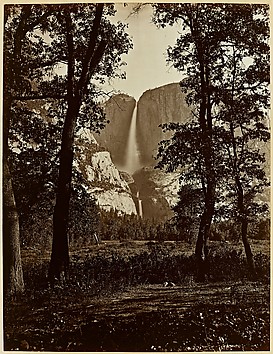
Staring with Watkins, here is a determinedly pictures view of the Yosemite Falls, a vista artfully framed by a stand of trees.
Carleton Watkins, The Yosemite Falls, 1866
This picture falls clearly into the category of works that were demonstrating the ownership of the landscape by modern Americans and the propriety of using and exploiting it. This photo was included in a book published by Josiah Dwight Whitney following an eight-year survey of California and as Sandweiss puts it (page 276) it “exemplified the twinned spirits of scientific inquiry and unabashed boosterism”. The book was explicitly authorised and supported by the state legislature to act as a guidebook for travellers, a sort of illustrated Baedecker. Put to this use, whatever Watkins’s original intentions in making this photograph might have been, in the context of Whitney’s guide book, published in 1868, it becomes an invitation not only to visit the National Park (which had been created, or at least given protected status just a few years earlier in 1864) but to stand in the same spot and admire this particularly picturesque view of the falls. The visitor can “own” the view, and by extension the Yosemite park area, by standing on the same spot or simply by owning the book (of which only something in the order of 250 where produced with original photographic prints which effectively made that “ownership” more select and exclusive.)
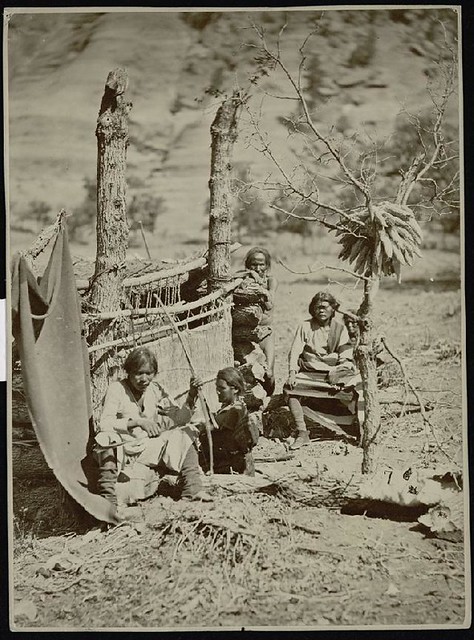
For a further example of O’Sullivan’s work I have chosen not a straightforward landscape picture but more of a portrait, a group portrait, of Native Americans in their environment.
Timothy O’Sullivan, Life Among the Navajoe Indians, 1873
This was taken while O’Sullivan accompanied an Army run expedition, headed by Lieutenant George Wheeler that explored the area west of the hundredth parallel. This work is again exclusionary in that it was intended for the US Geological Survey and not for a wider, popular, audience, at least initially. It does though also have an ownership function in a similar way to Watkins’s work. What I find particularly interesting about it though is the uses to which it was put, how it was recontextualised by the texts that accompanied it in the survey reports and how its meaning was changed by those texts.
The composition of the image itself is fairly simple but still laden with significance. The central feature is a loom. It is still possible to see people working with looms like this today making the famed Navajo blankets and models of this sort of thing are offered for sale to visitors wherever you go in Navajo reservation towns. (I have travelled round the Four Corners area and saw, and was pressed to buy, any number of these things, temptations that I have to say I resisted.) The native Americans are in this way depicted as crafts-people. It also shows cobs of corn being dried, showing they are a rooted (forgive the pun), agricultural society. The figure to the front left though holds a bow and arrow, a nod to their martial past (the Navajo had been “pacified”, for which read defeated militarily, divested of their ancestral lands and confined to reservations, since the end of the 1860s).
When the album in which this image was included was first published in 1874 the accompanying text, as quoted by Sandweiss (page 191) described the Navajo as “an intelligent and fierce people by nature…[who have made]…good progress towards civilization”, all of which can be clearly read in the picture. It also supported the idea of modern American ownership of the West (Manifest Destiny) by reassuring settlers that this area was safe, while conflict continued on the Norther Plains and far Southwest. This ownership function was developed still further when the report was reissued, and presumably made more widely available in 1889, with the Navajo now portrayed as “quaint figures, dependent on government rations, whose glorious past had long since disappeared. And words that had once depicted them as industrious farmers now portrayed them as exotic anachronisms”. (Page 193.)
Paradoxically I cannot escape the feeling that in a way the sellers of the model looms on the reservations are perpetuating that same imperialist view of themselves.
Mitchell, W.J.T, (ed) (2002). Landscape and Power. Chicago: The University of Chicago Press
Sandweiss, M, (2002). Print the Legend: Photography and the American West. New Haven: Yale University Press
Almost inevitably, having posted on this assignment yesterday something else has come up today that is worthy of comment.
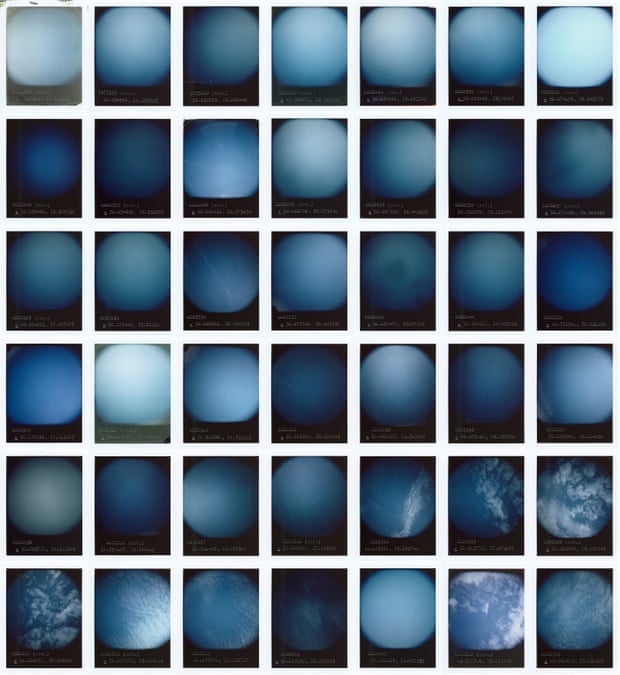
In the Guardian this morning there was a piece on the latest Deutsche Börse photography prize and what caught my eye was the Anton Kuster Blue Skies Project. This is a series of ‘Polaroid’ photographs taken of the skies above the known, ‘official’, 1078 Nazi concentration camps. This has obviously not been an influence on me at all in the choice of subject for my assignment submission as I did not know about it until today. I am nevertheless very much struck by it and clearly this is an example of the Sublime, in the sense of provoking awe and even terror. A lot more serious than my little project!
One thing that is worthy of note, and which I have not covered in any of the previous posts on my own work, is the vignetting. I do not know how Kusters has achieved this with his work. I did think about doing something like this, most likely by adding a mask in post-production, but ultimately rejected the idea because I felt it would make the resulting images much too derivative of Turrell’s work, in which the sky is seen within a frame created by an aperture in the roof of the structure. A sense of framing is also important in, for example, Hiroshi Sugimoto’s movie theatre work. For good or ill though I decided I did not want an artificial frame within the confines of the image itself. I preferred to let the limits of the photographic images themselves serve that purpose. In a way this again links back to some of the Buddhist ideas that have informed my project. The final images are a bit like thoughts drifting across one’s consciousness while meditating. They are insubstantial and fleeting, to be neither welcomed nor rejected or resisted, but merely to be noticed as they pass and let go on their way. Introducing some sense of frame would, I fear, give these “thoughts” too great a sense of solidity that would not fit within the particular conception of the Sublime that I have chosen to explore.
And how do I react to this work? That is a bit difficult as I have not seen it in the flesh. My first thoughts though are that it must be overwhelming simply because of the scale of the project, the number of individual images involved, small as they appear to be individually. Nothing can ever really convey or encompass the sheer scale and horror of the camps (even my own visit to Auschwitz a few years ago did not really convey a sense of the full scale of the evil at work though the experience of being there was itself shocking, deeply disturbing, and chilled me in a way that nothing has ever done before, and haunts me still) but the number of pictures does perhaps at least give some sense of it. If nothing else the affectless, almost abstract nature of the photos, lacking any inner context other than that provided by the stamped captions, gives some idea of the way that for the Nazis the death camps became paradoxically mundane, even banal, the killing merely a mechanical, bureaucratic process: which I find quite difficult to say and which serves only to emphasise how utterly horrific this enterprise was.
I do not honestly think this is the sort of project I could ever undertake and to that extent it does not lead me to think that there is anything I would necessarily do fundamentally differently if I was to address my own project again.
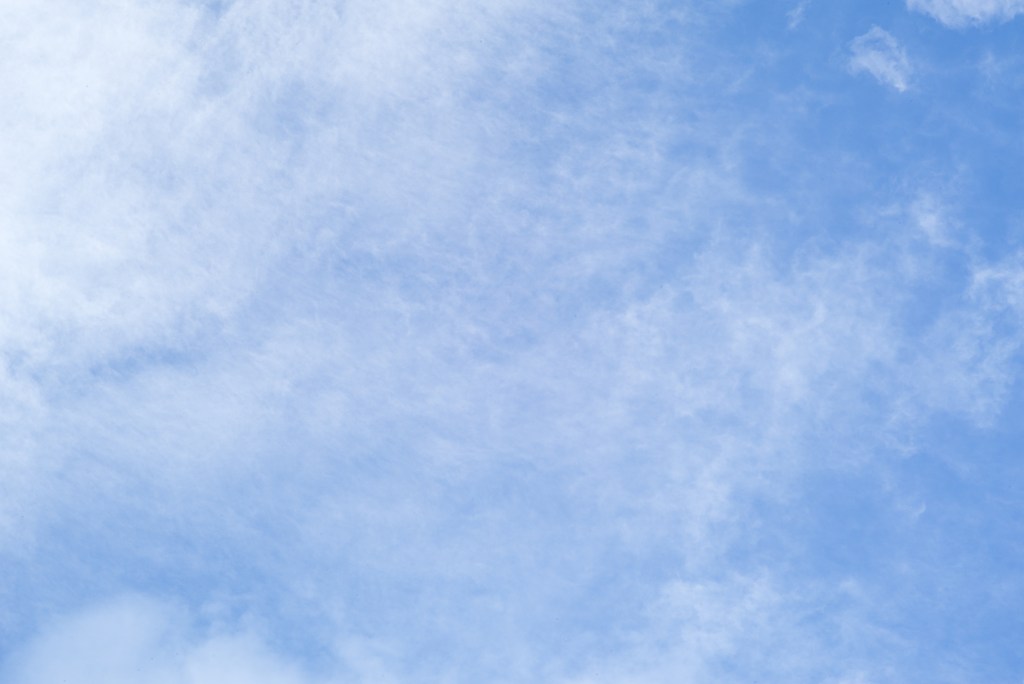
I have already discussed at some length the thinking behind my approach to this assignment in the preparation done as Exercise 1.7 (https://markrobinsonocalandscape.photo.blog/2019/10/15/exercise-1-7-assignment-preparation/). To recap briefly, I have taken the idea of the Sublime as my subject and have interpreted that notion as the representation of the unrepresentable, of nothingness in a specifically Buddhist sense, of the void. In this regard I have been most consciously influenced by the work of Hiroshi Sugimoto, particularly his movie theatre and seascape pictures, though I have stopped short of directly emulating any of that work by concentrating instead on clouds rather than the sea and sky or the passage of time. There are nevertheless, almost inevitably, elements of passing time and trying to capture something intangible, ineffable, transient, in choosing clouds as my raw material.
The choice of clouds was also influenced by the skyscape works of James Turrell, and, as it turns out on a more unconscious level, the cloud paintings of Gerhard Richter. Alfred Stieglitz, who blazed a trail by taking some of the earliest cloud photos, was explicitly not a direct influence although I was of course already aware of his Equivalents; if anything he has been something of a negative influence, as I suggest below.
One of the things that I had not fully considered while working on the preparation for this assignment, as recorded in Exercise 1.7, was how the final set would be chosen and how it would be sequenced. That is something that has been resolved only now that I have come to finalise the set and in a way the solution was obvious and embedded within the basic idea.
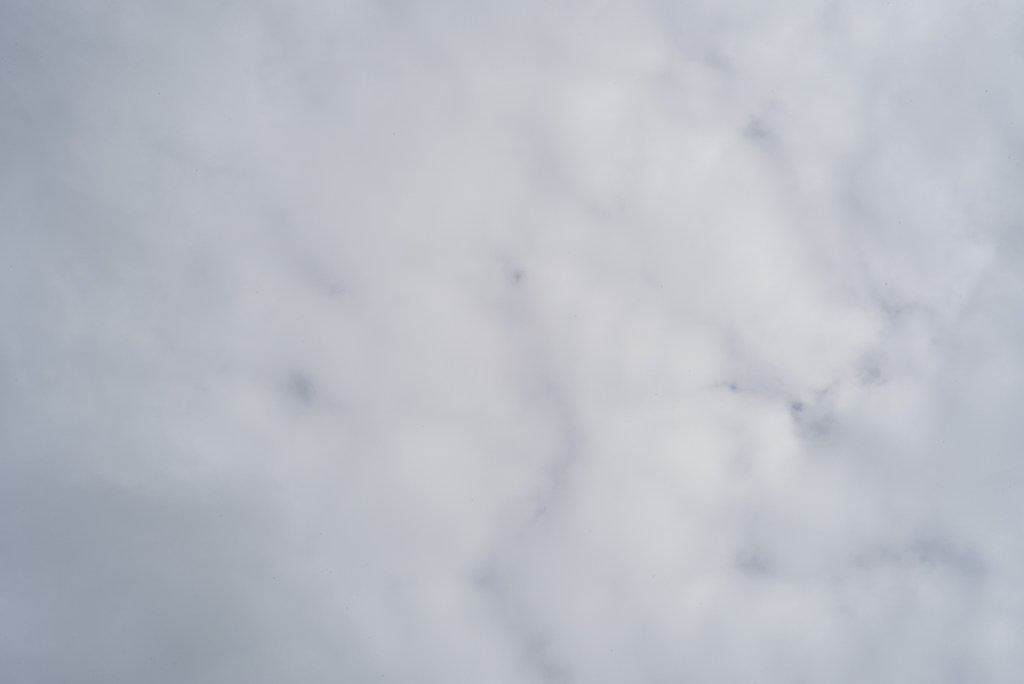
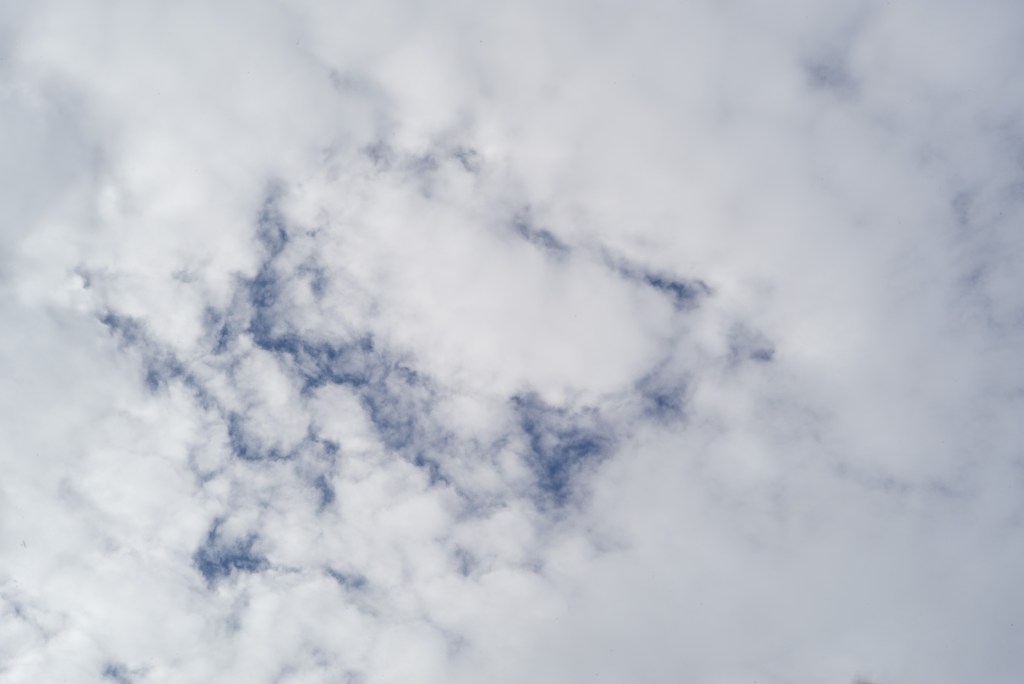
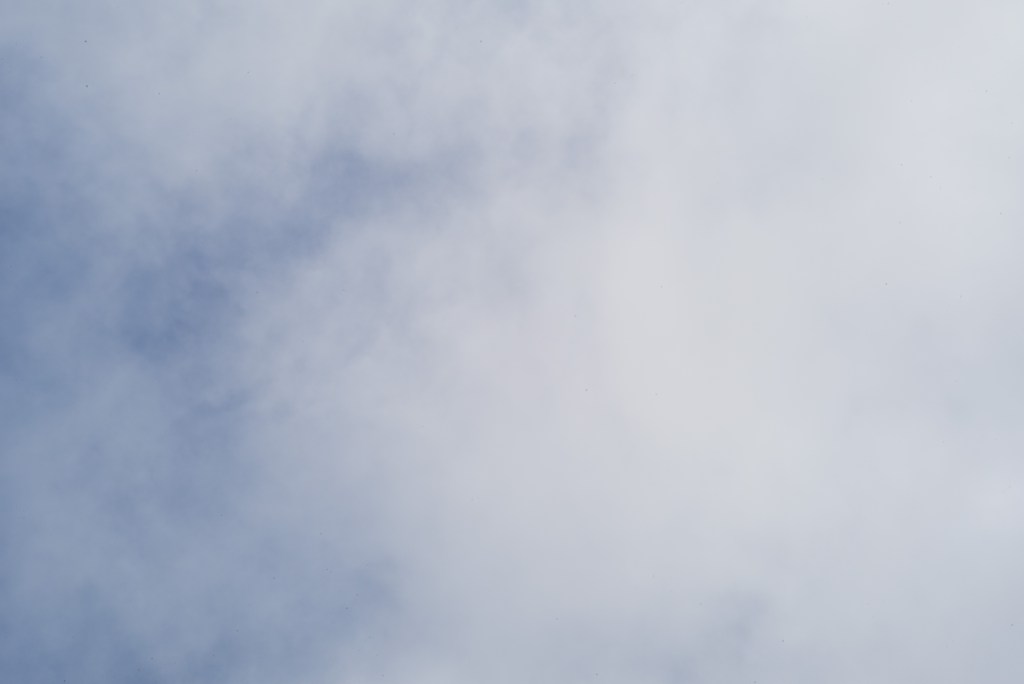
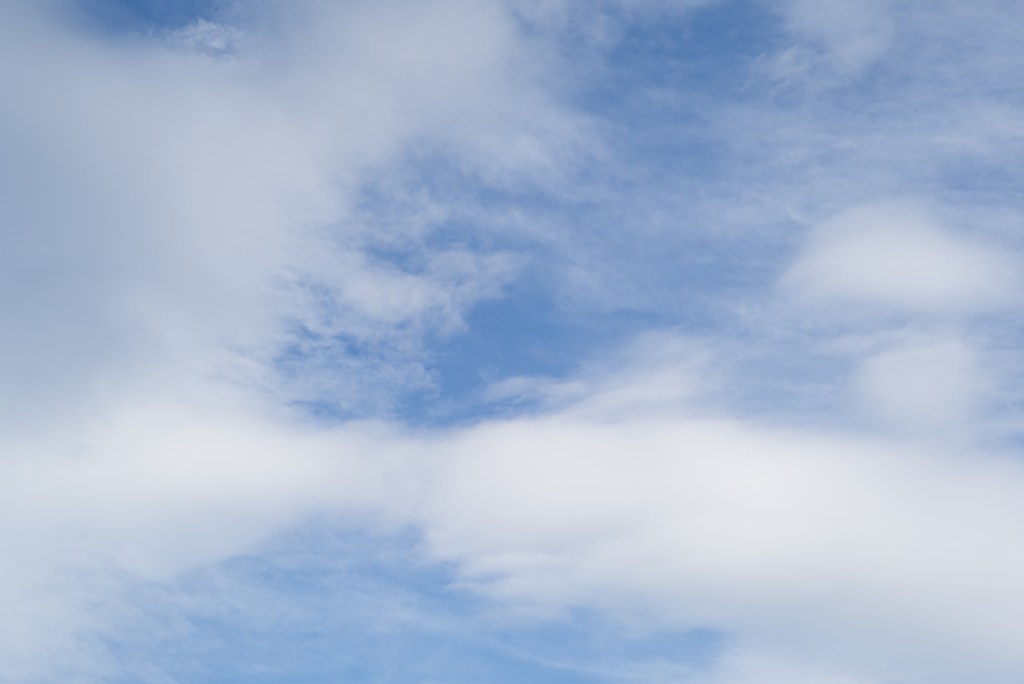
As the idea that I want the the images to portray is itself quite abstract I decided not to use any pictures that are too clearly and easily identifiable as photos of clouds. I have in this sense deliberately shied away from the pictorialist approach of Stieglitz. The final set are therefore some of the more purely abstract images that I made, though in a couple of cases this has been achieved more in post-production by judicious cropping rather than in the original composition of the shots. To a limited extent that desire for abstraction has also been influenced by the paintings of Mark Rothko.
So far as sequencing is concerned, to the extent that the final images have no apparent intrinsic meaning in themselves, any random order might have sufficed. However as there is an explicit Buddhist element of thinking behind my approach to the assignment a natural sequence presents itself. Not quite a series of reincarnations towards enlightenment but nevertheless a progression from doubt and obscurity, in the form of the blank, even, grey sky of the first image, through slowly breaking cloud cover, to clarity and enlightenment in the final clear blue sky. It is though significant that there remains some small vestige of cloud in that final image – doubt and lack of absolute clarity will always be with us and it is important to acknowledge that.
Although not really part of the brief for this assignment I have in addition given some thought to how, in an ideal world, this sequence might be displayed or exhibited to best effect. Thinking of the all encompassing and enveloping experience of viewing Rothko’s paintings where they fill a space dedicated to them alone, as for example in their special room at Tate Modern, I feel this set would work as big prints filling a room so that the viewer is immersed in them and left with no other points of reference. That would at least make them a bit more awe-inspiring, to come back to one of Burke’s definition of the Sublime, than the small images above.
Although Czech, locally at least, Markéta Luskačová is best known for her work on the coast, mostly at Whitley Bay in the 1970s. Indeed, I am afraid that I know nothing else of her work since that time, somethings that clearly I need to remedy. A number of her pictures were included in the Women by Women exhibition at the Baltic Gallery in Newcastle last summer about which I wrote a short piece (https://markrobinsonocablog2cn.wordpress.com/2018/06/28/women-by-women-exhibition/), which was the first time that I encountered her work.
At last the work that she did then has been published and naturally I had to buy the book. Rather than discussing the book itself though what I want to focus on for now is an interesting question that it raises in connection with this module on landscape photography: to what extent can a photograph be about, and tell us anything of, a particular place if it is not possible, or at least difficult without extrinsic knowledge, to identify that place?
In the absence of the list of photographs at the back of the book listing the places and dates of their making, and in the absence of any other knowledge about the making of this work, is it possible to identify a particular place? In a sense, is this work about, a representation of, the North East? Is this landscape or social documentary?
Clearly it is the latter in so far as it shows people at play in the late 1970s though while some of the hairstyles and fashions can be confidently placed in that particular time many of the images of older people would be much harder to date. If I did not know better I would have said that some of them could be from the 1950s or 1960s. But what about a sense of place? This is much harder. In a few of the pictures there are some clues, but resolving them does require some local knowledge. Some of the places I recognise as they have barely changed over the last forty years or so. Without that local knowledge though I would expect any viewer relying purely on the internal context of these pictures alone to identify where they were made.
There is the tricky question. If you cannot, or cannot easily, identify the place in question, can it be said that the pictures are “about” that particular place? Do they simply become emblematic of a time or type of place rather than a specific location? Does the actual location stand in for and represent any or all similar types of place? Does it actually matter?
I know this work is about the North East; I could confidently take you to a few of the specific places depicted. To that extent I very much see this as, amongst other things, a work of landscape photography. Without that local knowledge though I am not sure that I would. I suppose where this leads me is to the point that has been made any number of times before that without context photography is not reliable, that it does not necessarily tell a particular truth.
And does it matter if you can or cannot place this work? No, it stands on its own merits!
Luskačová, M, (2019). By the Sea. Bristol: RRB Photobooks
I am not entirely sure why the course material now requires me to record correspondence with my tutor about my chosen subject for Assignment One. It is not something that any of the other modules have asked for. Nevertheless, suitably redacted to concentrate on the principal subject, here is my email and my tutor’s reply:
“Whilst the idea of the Beautiful has not really engaged me I feel more drawn to the ideas of the Sublime and that is the path I want to go down. If you have a look at my recent blog-post, particularly on 1.6 The contemporary Abyss and preparatory work in 1.7 you will get an idea of where my thinking is heading at the moment. The ideas that appeal most to me are the Sublime as representing the unrepresentable, the void, and Buddhist notions of emptiness/nothingness. The two particular artists who are influencing me most at the moment are Hiroshi Sugimoto and James Turrell. What I have been concentrating on is a series of sky-scapes, cloud-scapes, with a view to producing images that are in a way devoid of any meaning or significance in and of themselves – other than at a most basic level, meteorological records – almost abstract, hinting at something ineffable and transcendent (without wishing to sound too much likes Pseuds’ Corner!).
If you have a moment please take a look and yours thoughts would be most welcome. All going well I would hope to have this assignment finalised within the next few weeks, at which point I would propose simply to produce a further blog post covering the points required by the brief and a final set of images. I will probably also include contact sheets to give some idea of the preparatory work and final selection process.”
Reply:
“The direction you’re taking A1 looks fine, with some solid points of research – Turrell, Sugimoto and Richter: they all have a solid conceptual framework for their work. Also, very detailed exercises uploaded to your LL.”
The pile of photobooks in my study just seems to get bigger and bigger but not yet quite to the point where it starts to totter and represent a physical threat. (The impact on my bank account is of course another matter and still perilous enough!) Fortunately they do not grumble too much if I take a while to getting around to writing anything about them.
Step up Sadie Catt’s impressive book about the Canadian town of Woodstock (in Ontario and not to be confused with its more infamous name-sake in New York state the other side of the border) and its inhabitants. I came across her work for the first time in the May issue of BJP this year and was immediately struck by it. Why mention it now? Because it very much fits with my thesis about the nature of landscape photography, that is it not just about pretty, picturesque views but also about the people that inhabit it, help to form, and are formed by it. Sometimes it is a matter of a book needing to settle into my consciousness (or unconscious?) for a while before I feel ready to write anything about it. For some reason that time has just arrived, not least because I realise, as I look over the pile of volumes waiting for my attention, and thinking about a lot of the books already in my library, that one of the things that really interests and engages me in photographic terms is work that deals with people in their local environment. Documentary, humanistic, socially engaged, topographical, environmental, and portrait, photography all collide, meet, mingle, and coalesce without boundaries and without categories being needed, helpful, nor particularly informative.
So this is a collection of portraits, some of them quite intimate, of inhabitants, many, if not all, of whom have tales to tell (though we are not taken into their confidence), mixed with various views of the town. Together they show a more nuanced and complex picture of the place than a merely topological approach might have made possible. This sort of approach I find so much more appealing and engaging, intriguing and challenging, than any straightforward depiction of a physical place.
It has to be said it is also just a rather beautiful physical piece of work. I am a bit of a sucker for nicely produced, artisanal, books, whatever the subject matter, as works of art in their own right. (There are any number of artists and small presses out there that I am more than happy to allow to help hoover up my savings, and fill my bookshelves.) The fact that this is a such a well considered, compassionate and empathetically engaged set of images also helps to ensure this volume’s place in my study.
Catt, S, (2019). Woodstock. From: The Lost Light Recordings
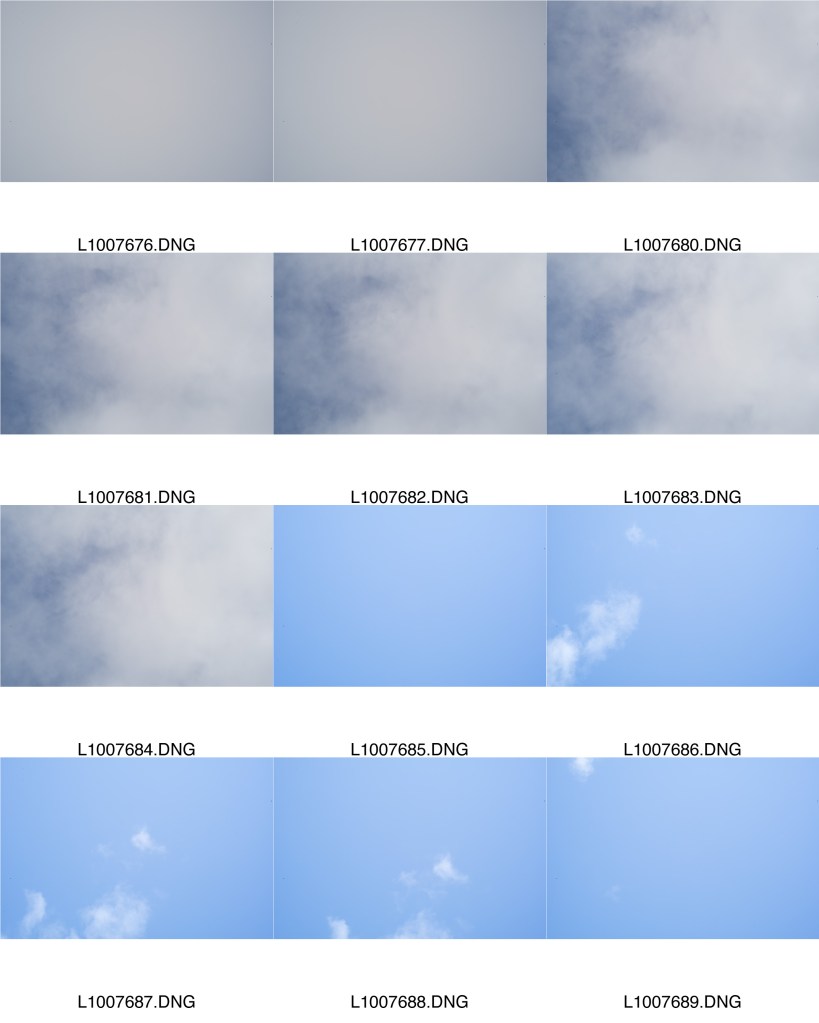
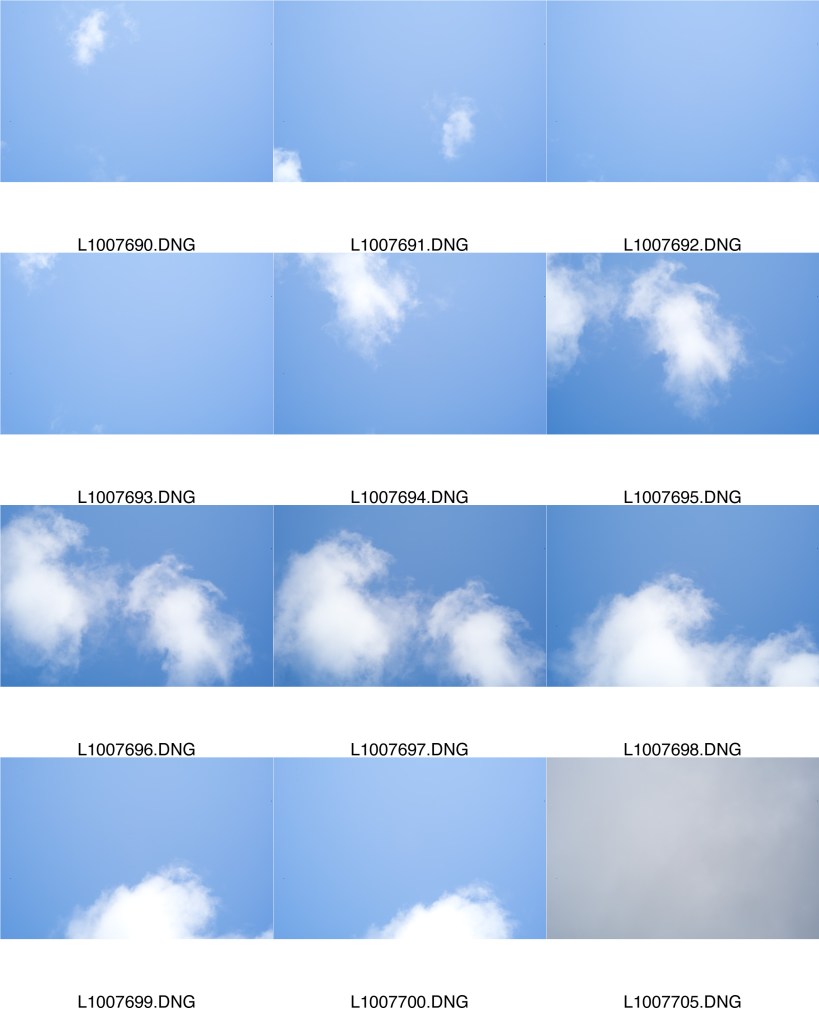
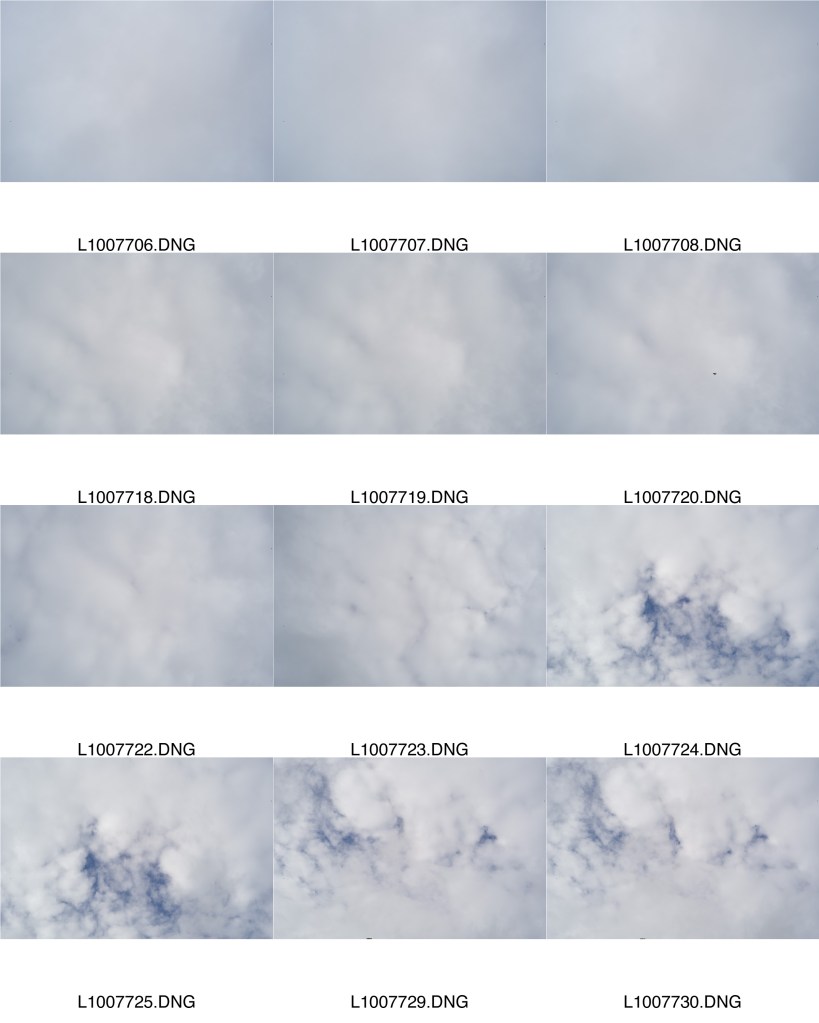
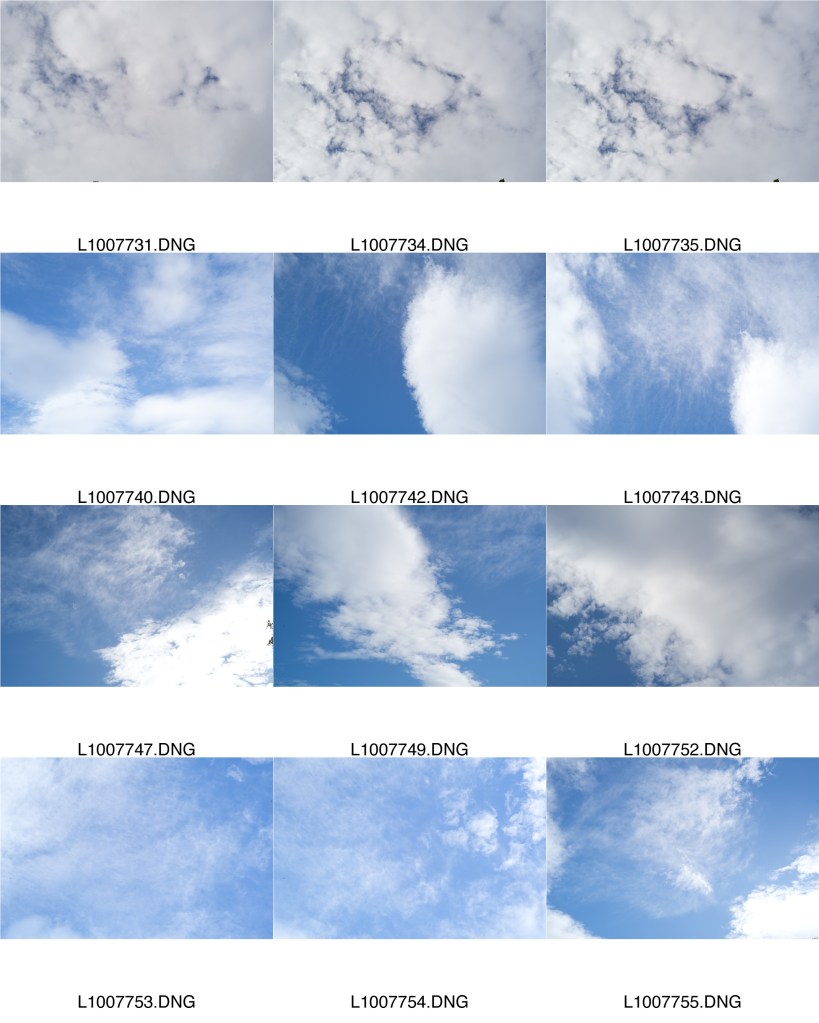
Although I have posted only a few, representative, sky shots in the evolving post for Exercise 1.7 I have actually now taken about 60 pictures and so it is time to start editing them and narrowing down to a final set for submission.
Reviewing the body of images that has developed there are a number that a are unusable because tree branches have got in the way. On one of the last days that I worked on this it was quite windy and it was only when I came to look at what I had taken that it became evident that the tops of a couple of trees in my garden – a pair of birches in particular which are quite tall – had whipped about in the wind and got into the frame. I have simply excluded these. Those that remain are the ones that can potentially be used, albeit a few might need some cropping and a bit of other tidying up – there is a passing bird in one that would need removing (if anything it is amazing that there is just the one!) – and some dust spots. Somewhat annoyingly there are some dust specks on the lens I used for this project that clearly need a bit of vigorous cleaning and once I have made the final choice I will have to do some spot healing in Photoshop.
Here are the remaining potentials. Next job is to edit and sequence them.



 Mark Robinson's OCA Landscape, Place & Environment Blog